More than 1,000 people spent more than eight hours waiting in emergency departments over the festive break.


More than 1,000 people spent more than eight hours waiting in emergency departments over the festive break.
Do you still cling to the idea that booze may lower your risk of heart disease?
But new research has found that this mostly applies to the wealthy.
Alcohol’s effect on heart health, good or ill, may rely in part on the drinker’s income, a new study suggests.
A large study
For example, a study of more than 200 000 Norwegian adults found that having a few drinks per week was linked to lowered odds of dying from heart disease over the 30 years of the study.
But that trend was most pronounced in wealthier people.
On the other hand, drinking more than that – four to seven drinks per week – was linked to higher rates of heart-linked death, but only for people in the “lowest socioeconomic position”, according to a team led by Eirik Degerud, of the Norwegian Institute of Public Health in Oslo.
Drinking habits linked to income
The findings couldn’t prove cause-and-effect. However, the researchers believe that any health recommendation that centres on alcohol should keep income levels in mind, since the effects of drinking seem to change depending on a person’s pay cheque.
One type of consumption – regular binge drinking – appeared to be bad news regardless of financial background, however.
Folks who routinely get drunk on a weekly basis saw their odds for fatal heart events rise regardless of their financial status, the study found.
The findings are based on an analysis of health and wealth data concerning nearly 208 000 Norwegian adults. All had been born in 1960 or earlier, and all had participated in three decades’ worth of compulsory censuses conducted in Norway between 1960 and 1990.
Booze does not affect everyone the same
Two cardiologists agreed that drinking’s effects on the heart may not be a “one size fits all” proposition.
As regards the potential benefits of two to three drinks per week, Dr Michael Goyfman said that the rich may appear to benefit more, but the reasons behind that trend remain unclear.
Perhaps it may simply be that the poor are damaged more by even a little drinking, said Goyfman, who directs clinical cardiology at Northwell Health’s Long Island Jewish Forest Hills, in Queens, New York.
Or wealthier people who have a few drinks per week might also be more apt to engage in heathier eating and exercise, explaining the supposed benefit.
Drink moderately
Whatever the reasons, Goyfman believes that the study, “should not be interpreted as an endorsement by researchers to encourage alcohol consumption, since alcohol can have an adverse effect in those with different medical conditions.”
Dr Rachel Bond helps direct Women’s Heart Health at Lenox Hill Hospital in New York City. She agreed that, “in my practice, I advise my patients to drink in moderation. The detrimental effects from other organ systems outweigh any potential cardiac benefit.”
“While my patients certainly do not have to abstain from alcohol, I educate them about the risks of excessive alcohol intake,” she added, “both from a cardiovascular standpoint and for their overall health and well-being, regardless of socioeconomic status.”
The Norwegian findings were published in the journal PLOS Medicine.
The conclusion
Several studies have debated alcohol’s effect on longevity in the past. One should keep in mind that moderation is key and that, besides long-term effects on your health, alcohol can also have an adverse effect on your weight.
So whether you decide to kick the tipple to the curb this January or not, practise drinking in moderation and always ask your doctor’s advice when not sure.
Image credit: iStock

NEXT ON HEALTH24X

Getting into shape or losing a few kilograms is a worthy New Year’s resolution, but one that comes with a warning: Take it slow.
Jumping whole-hog into an exercise regime is a good way to get yourself hurt if you haven’t worked out for a while, experts say.
“People get into trouble when they want to do too much too soon,” said Dr Gerardo Miranda-Comas, an assistant professor of rehabilitation at the Icahn School of Medicine at Mount Sinai in New York City. “You need to increase your level of activity gradually.”
“Consider it more like a marathon than a sprint,” he said.
Don’t pick up where you left off
Keep in mind that you’ve likely lost a good amount of fitness if you haven’t worked out in a while, warns the American Council on Exercise (ACE).
People who stop regular resistance training tend to lose their strength at about half the rate it was gained, and cardio fitness declines even faster than that, according to council.
So before you start, understand that you won’t be able to perform at previous levels. Also consider that you might have developed a medical condition that could affect your exercise.
The council recommends that you answer a few questions:
Answering “yes” to any of those questions should prompt you to talk with your doctor or a sports medicine specialist before you hit the gym, Miranda-Comas said.
Call on the professionals
“We can evaluate and assess for any possible medical issue that might come up, and help create an exercise programme that’s right for you,” he said.
Once you start, ease yourself back into your exercise programme, suggested Neal Pire, executive director of the American College of Sports Medicine’s Greater New York Regional Chapter.
“Keep in mind that, regardless of how low and slow you go when you start a new exercise plan, some is better than none,” Pire said. “Starting slowly – even if only with a 20-minute moderately paced walk – is key. Gradually and steadily increasing the amount, intensity and duration of your exercise is how you get fit over time.”
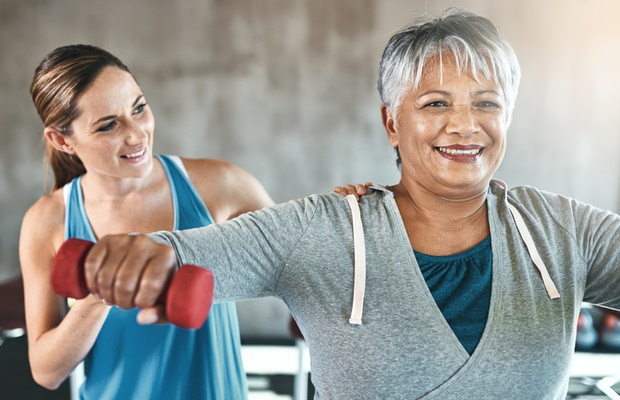
How should you exercise?
ACE recommends that people start with 20 or 30 minutes of low-intensity aerobic activity two or three times a week. Once you’re comfortable, gradually increase the duration, intensity or frequency of your workouts.
Same goes for weight training. Pick a weight you can lift at least 12 times in a row but not more than 15 – and keep in mind it might be 50 to 90% less that what you could lift four months ago, according to the council.
Also, be sure to warm up before working out to further reduce your chances of injury, said Dr Russell Camhi, a primary care and sports medicine physician at Northwell Health in Great Neck, New York.
“People just walk right into the gym, jump onto the first machine they see and start doing three sets of 10,” Camhi said. “It’s proper to do a proper warm-up to get the body loose and warm and get the heart rate up.”
Walking on a treadmill for vife to 10 minutes will warm you up, but if you want to get into your workout more quickly, try a “dynamic warm-up”, Camhi said. A few lunges, squats or other body-weight exercises can prepare you for more strenuous activity.
Don’t forget stretching
People also should weave stretching into their workout routine, along with aerobics and strength training, Camhi added. This could be stretching for 10 minutes before and after working out or taking part in a yoga class.
“Muscles have a range of motion they have to move through, and we underestimate the importance of flexibility to our body’s ability to move,” Camhi said.
Once you’ve started working out, don’t be surprised or discouraged if you have a few sore muscles, the experts say.
Be mindful of DOMS
People are sometimes surprised to find that sore muscles arise a couple days after their workout, but it’s a common phenomenon called delayed onset muscle soreness (DOMS), he said.
“If you work out on Monday, expect to be sore the day after the day after (Wednesday),” Camhi said.
However, if your muscle soreness lingers past a few days, it’s a sign you’re probably overdoing it, Camhi and Miranda-Comas said. Reduce the amount of aerobic exercise you’re performing or drop some pounds off your weights.
Keep an eye out for fatigue, chest pain or dizziness as you’re working out – these could be signs that you’re working too hard, Miranda-Comas said. Trouble sleeping or being in a perpetual bad mood could be signs of overtraining as well. Consider taking a step back or consulting your doctor.
Be realistic
To maintain a long-term exercise plan, set a realistic goal for yourself and a realistic plan for getting there, said Sharon Zarabi, director of the bariatric programme at Lenox Hill Hospital in New York City.
“Start off with an attainable yet realistic goal of doing some sort of purposeful activity three times a week,” Zarabi said. “Be specific with what days of the week and arrange times within the day so you are more inclined to actually stick with it.” She suggests not committing to something like an hour a day, five days a week at first, “because the likelihood of that continuing through the long term will probably fade”.
And don’t expect miracle results. The pounds should not drop off or your fitness improve within a couple weeks. If that happens, it’s a sign that you’ve undertaken an exercise regime or diet that will not be sustainable in the long run.
“Appropriate weight loss is 500g to 1kg per week,” Camhi said. “You should have realistic expectations. It does not happen overnight – and the slower things change, the more likely it is that they will stay that way. If you lose 5kg in the first two weeks, it’s very unlikely that’s going to stay off.
Images credit: iStock

The month of January is traditionally a time for lofty goals and new commitments. But in the midst of all the self-promises and good intentions, have you taken a moment to consider your anti-resolutions? Here, a few suggestions for things you can stop giving a crap about in 2016, because YOLO.
Sometimes making a healthy weight loss goal is what's needed to kick you into gear. But if this is the umpteenth year in a row you've pledged to shed those final 5 pounds, and you're already moving plenty and eating your veggies, maybe it's time to just… let those 5 pounds be?
Give yourself a break from the endless pressure to be just a little bit thinner. That's what Jenna Bush Hager decided to do after she found a New Year's diary entry by her fourth-grade self. Scrawled in cursive across the pink page, number one on her resolution list reads: "Loes [sic] 4 pounds. That broke my heart," the journalist and mom of two girls said on the Today show earlier this week. "That's probably been on my list in some form or another for 25 years."
RELATED: 12 Worst Habits For Your Mental Health
Instead of obsessing over some arbitrary number on the scale, focus on how you feel in 2016. Exercise because moving gives you energy, and boosts your mood. Eat cleaner because you want to think clearly, and sleep soundly. You might still end up slimmer by December, but for all the right reasons, which means you'll be happier and healthier above all.
Repeat after Elsa: Let it go, let it goooo! Seriously, those pangs of guilt you feel when you turn down a request (from a friend, your car pool mate, a third cousin) mean you're on the right track. Every time you say no to someone else because you don't have time to do whatever is they're asking, or your heart simply isn't in it, you are saying yes to yourself. And self-care isn't selfish. It is essential.
Does just the thought of uttering "no" trigger a guilt trip? If so, Gail Saltz, MD, Health's contributing psychology editor, recommends practicing this bulletproof response: "Thanks for thinking of me. I appreciate the vote of confidence, but I've got a lot on my plate, and I can't fit this in right now." End of story. Move on.
RELATED: Foods to Boost Your Mood
Between the nip-tucked pics of models on Instagram (take Chrissy Tiegen's word for it: "I've seen these women in person, they are not like that") and the carefully curated and filtered snaps of "friends" in your Facebook feed, it's easy to fall into the Why-don't-I-look-that-hot/happy? trap. (Is it any surprise that research has linked Facebook to depressive symptoms?) But in the year ahead, vow to give fewer craps about other people's selfies. Forget making comparisons between you and them. For the next 12 months, you just do you, and see how refreshing it feels.
While you're at it, you might want to start caring less about your own selfies, too. When your get preoccupied with creating the perfect image of your brunch/vacation/girl squad, your lose out on some of the joy in that moment, explains Dr. Saltz.
One worthy exception: the healthie, in which you photo-brag about, say, your yoga headstand, or your spiralized cucumber noodles. "Occasionally patting yourself on the back for health achievements on social media can propel you to keep them up," Dr. Saltz says, "especially if you get reinforcement from friends like 'Go you!'"
RELATED: Happiness Really Is Contagious, Study Finds
You know the thoughts: I should be more present with my family / putting in extra hours at work / having frequent fantastic sex. It seems like everyone else is accomplishing so much (thanks again, Facebook!). The fear of falling short becomes habitual, Dr. Saltz explains, and can even turn into shame: We end up feeling that we're crappy mothers, employees, partners and friends, when just the opposite is true, she says. You are doing the best you can, and that is plenty good enough. Here's an assignment for that bossy inner-critic of yours: quit using the word "should."
Consciously, you know you're not perfect, of course, and that nobody is. But like most of us, you're probably still haunted by your flaws, right? "There is no such thing as perfection and yet so many people exhaust themselves and erode their confidence in the pursuit of it," writes happiness expert Dominique Bertolucci in her book The Kindess Pact ($12; amazon.com), published last year. She urges us to shed that burden, and accept our imperfections once and for all. Only then, she says, will you be free to employ your positive qualities to their fullest. In other words, acknowledging your weaknesses will actually make you stronger.
If you make no other changes in 2016, at least take Bertolucci's advice, and adopt her mantra as your own: "I am perfectly imperfect." Just the way you are.
Human beings can spot a sick person on a photo, a mere two hours after he or she was infected by a germ, researchers said.
Such an ability to detect infection early, and from the subtlest of facial clues, has never been demonstrated before, but is presumed to be part of a crucial survival skill called “disease avoidance”, they wrote.
“An ability to detect sick people would allow people to avoid being close to sick people, and hence minimise the risk of becoming sick if the person is a carrier of contagious disease,” study co-author John Axelsson of Stockholm University told AFP.
How did they do the study?
The research team experimented with 16 healthy volunteers, all Caucasian.
Each was given a shot of lipopolysaccharides (LPS), the molecules taken from bacteria.
The LPS molecules are sterile, meaning that no live bacteria are injected. But they cause a strong immune response and flu-like symptoms that lasts a few hours, mimicking someone who is “acutely sick” and fighting off infection.
It is a method commonly used to cause infections in humans and people for experimentation purposes.
On a second occasion, each participant received a placebo or “dummy” injection.
The volunteers had their photo taken about two hours after each shot – thus once in a healthy state after receiving the placebo, and once “sick”.
After the LPS shot, some of the participants “felt very sick and others did not feel much sick at all” when their photo was taken, Axelsson explained.
Both pictures, healthy and sick, of all participants were then showed to a different group of people, which had to rate whether the person was sick or healthy.
“The raters could correctly discriminate 13 out of 16 individuals (81%) as being sick,” said the study published in the journal Proceedings of the Royal Society B.
This was at a rate higher than predicted by pure chance alone.
Previous research had used photos of “obviously sick people” to induce disgust, anxiety and even an immune response in people, but the participants in the latest study were photographed with neutral expressions and very shortly after infection.
There was thus no sneezing, coughing or other overt symptoms of sickness on display.
What does a ‘sick’ face actually look like?
The results suggested that “humans have the ability to detect signs of illness in an early phase after exposure to infectious stimuli,” the study authors concluded.
Sick individuals were rated by observers as having paler lips and skin, a more swollen face, droopier mouth corners and eyelids, redder eyes, and duller, patchier skin.
Valuable diagnostic
The finding could “help medical doctors and computer software to better detect sick people,” said Axelsson – a potentially valuable diagnostic tool in a disease outbreak.
Further study is needed to determine whether levels of infection detection are similar across diseases and ethnic groups.
Image credit: iStock


Mothers in group singing sessions with babies have faster improvement in symptoms, a study suggests.
[unable to retrieve full-text content]

[unable to retrieve full-text content]

[unable to retrieve full-text content]

A mother describes the harrowing moment her 17-year-old daughter died suddenly of sepsis.
