Health24.com | This healthy food might actually be causing your acne

Here at Women’s Health, we know all about the benefits of protein powder.

It can help you lose weight and build muscle, while also being a great way to add protein to nearly every meal (even dessert!).

But US WH beauty director Maura Lynch recently learnt a surprising downside of the stuff from dermatologist Dr Mona Gohara.

Here’s the scoop:

Read more: 6 superfood powders that’ll give your body a boost

“Dr Gohara and her colleagues are anecdotally seeing an uptick in acne among women who drink shakes and smoothies spiked with whey protein.

“There is some research to back it up; one study followed 30 participants on a daily whey regimen for two months and found that female subjects were most susceptible to breakouts. The thinking is that whey upregulates our androgenic hormones, such as testosterone, more than men’s, spurring excess sebum production.

“It also causes an increase in the amount of insulin growth factor our bodies produce, triggering more oil production.

“So what’s the solution? Easy. Switch to a pea protein powder in your drink, like Health Connection Pea Protien Isolate [R148, wellnesswarehouse.com], and you’ll pack the same punch, minus the inflammatory reaction.”

This article was originally featured on www.womenshealth.co.za

Image credit: iStock

Share Button

Health24.com | 2017 Comrades champ smashes a world record

She had tried twice before in 2017, but Camille Herron still hadn’t finished a 100-mile (161km) race until Saturday.

She not only placed first at the Tunnel Hill 100, but also set a world record in the process.

Finishing in 12:42:39, averaging 4:45 per kilometre, Herron, 35, crossed the finish line before any of her male competitors at the Vienna, Illinois, race.

She also set the fastest known time for men and women on the USA Track & Field-certified course. The previous 100-mile women’s world record belonged to Gina Slaby and was set at the 2016 Desert Solstice track race in 13:45:49.

As for fuelling, Herron dutifully ingested two gels per hour and sipped on her sports drink throughout the race. But after so many hours of sugar, she decided to get creative during the last 32km.

“I drank a beer and a half and it helped settle my gut,” she said. “I think you gotta treat yourself at some point.”

It was less than two weeks ago that Herron decided to run Tunnel Hill.

Finding a certified course in the trail-racing world is rare, and the opportunity seemed too good to pass up. But in order for her record to be ratified, Herron also needed to have a US Anti-Doping Agency official there for drug testing, several additional timing mats set out on the course and additional official hand timers present.

The rest was up to Herron and her strategy.

“I do a lot of progression runs with a heart rate monitor in training, so I decided to focus on my easy long-run effort, which is about 75% of my max heart rate,” Herron said. “That usually is about the right pace.”

Herron, who lives in Oklahoma City and works part-time as a research assistant in osteoimmunology at the University of Oklahoma, won the 2017 Comrades Marathon in June.

She originally set a goal to also win the Western States Endurance Run just days after Comrades to become the first woman to claim the double victory since ultrarunning legend Ann Trason did so in 1997. Unfortunately, Herron was forced to drop out.

“There was a lot of snow in the first 24km of Western States this year… I slid down an embankment into a tree and had a concussion,” Herron said. “I kept falling, then started having pain and paralysis in my hands, pain in my head and neck. It was not a good state to be in just 8km into the race – it was pretty traumatic.”

She went for another 100-mile finish at the Leadville Trail 100 later in the summer but suffered a hip injury about 64km into the race. The Tunnel Hill event was her last-ditch effort to conquer the distance before the year was up.

“I’ve really wanted to get redemption pretty much all year,” Herron said. “There have been so many accidents and injuries.”

What’s next for the ultrarunner, who also holds the Guinness World Record for the fastest marathon dressed as a superhero (2:48:51 as Spider Man at the 2012 Route 66 Marathon)?

More record attempts at the ultra distances – and a dedication to having a good time while doing so.

“I think I have to give credit to my teammates [over the years] for showing me what is possible,” she said. “We’ve all been bitten by that running bug – we all like to run a lot and just do crazy things. For me, it’s fun. It’s just fun.”

This article was originally featured on www.runnersworld.co.za


Image credit: iStock

NEXT ON HEALTH24X

Share Button

Sussex Health Care: Men’s legs broken in Beech Lodge care home

The men’s relatives say the cases are not part of the investigation into nine Sussex care homes.

Share Button

Tampon tax: How much have you spent?

The amount it has cost you depends on how old you are and when you started your first period.

Share Button

Health24.com | 5 things your chiropractor wishes you’d stop doing

Sometimes you want to go where everybody knows your pain.

The chiropractor isn’t just a place to get your back popped or worked on anymore.

Sports chiropractors are sprinters, marathoners and runners just like you, specialising in all types of athletic endeavors.

Most importantly, they know how to help diagnose a problem and get you back on the road.

To figure out what these professionals don’t want you to do before making an appointment, Runner’s World asked two chiropractors who specialise in running about what common training flaws are leading to patients ending up in their offices over and over again.

1. Don’t buy shoes for looks

While studies go back and forth on whether or not specific types of running shoes actually lead to injury, it’s still a good idea to opt for a proper fit over a pair of kicks that look cool or you got for cheap.

Ian Nurse, DC, founder of Wellness in Motion Boston and a sub-2:30 marathoner, believes that a lot of running injuries can start from not having the right shoes on your feet.

Read more: How to buy the right running shoes

Nurse recommends going to a run specialty store and having someone watch your gait outside or on the treadmill. This will give someone at the store the ability to find a range of shoes that might work best for your specific running/walking mechanics.

Person tying their running shoelace

From there, you can go by what feels the best when you’re running.

Nurse said he also asks his patients if there has been a change in running shoes from one style to another.

For example, switching to a zero-drop shoe from a normal shoe, without easing into them, may increase your risk of injury.

Like a fitter at a running store, a sports chiropractor like Nurse may even look at your running gait in the office to diagnose imbalances in your foot’s motion mechanics.

“The whole biomechanics starts in your foot,” Nurse said. “We all have different foot strikes. If it hits the ground in a certain way, the shoe has to support that. If you are a forefoot striker, rearfoot striker, overpronator or underpronator, all of those different types of foot strikes can lend itself to different running injuries.”

2. Don’t do static stretching before a run

Holding a static stretch for longer than 10 seconds can take away from your explosive muscular power before a run, according to Derek Vinge, DC at Fit Chiropractic & Sports Therapy in Courtenay, British Columbia.

One study even showed that stretching cold muscles before a tough 3K left individuals starting their runs slower and at a greater perceived effort. And when your muscles aren’t signalling properly, it can lead to small injuries turning into larger problems over time.

Read more: 5 stretches you should never do

You are better off with a series of dynamic stretches – like lunges and squats – to get the blood flowing in the body. (This two-minute warmup should do the trick.)

The benefits will be noticeable if you add just five to 10 minutes of dynamic stretching before you hit the roads or trails.

“I forget to do a dynamic stretch as well, and I think maybe it is a time thing where you tell yourself ‘I’ll do this later. I’ll deal with it later,’” Vinge said. “If you do some activation and some dynamic warmups, you are going to be a stronger, faster runner.”

3. Don’t overdo it on foam rollers

Foam rolling and other ways to work out a knot or refresh your legs can be a good thing – in moderation. But less sometimes is actually more, according to Nurse.

“I see a lot of people who tend to go overboard on that,” Nurse said. “They do so much foam rolling on their IT band and/or their quads, and then they are in even more pain. It’s more of like a finesse, where you are trying to get blood flow into the area, but you aren’t trying to beat up the area so badly that you are causing more damage.”

Woman using a foam roller

Read more: Foam rolling? Do it right by avoiding these 10 mistakes

If you’re working out on a foam roller and something continues to hurt or gets worse, stop. Overdoing a problem spot may inflame it more.

If you’re feeling relatively good, Nurse suggests doing some light work on the foam roller after a run to hit any problem areas for one to two minutes.

4. Don’t clam up when you get into the office

You shouldn’t arrive to an office visit with pages and pages of notes from the internet. But you shouldn’t be silent and just think a sports chiropractor has all the answers just by looking at you.

Going into an appointment, think about what has been consistently driving you crazy on a run – a stiff neck, a cranky left ankle – as that will allow a doc to focus on what’s really bothering you.

“Runners know their bodies a lot better than a lot of people,” Nurse said. “As we run we are constantly kind of checking in on different body parts, and people really are able to recognise what is wrong and they can tell if their gait is altered and what is hanging them up. The information I get from my patients helps me a lot.”

5. Don’t forget to see someone if you need it

With training goals and kays to complete, runners often don’t admit when there is something wrong. It’s almost a badge of honour to stay off the table for long periods of time.

But Vinge thinks there’s more to what he does than fixing injuries. Once an underlying issue is taken care of, you can teach your body to perform at a higher level than you thought was possible.

“After they start to get better, then we can work on other issues to get some more performance out of them,” said Vinge. “If you’ve never been looked at, then you have no idea what’s going wrong.”

This article was originally featured on www.runnersworld.co.za

Image credit: iStock

NEXT ON HEALTH24X

Share Button

Health24.com | Strength train this way for maximum watts

As a cyclist, you’d never saddle up and spin 25km/h around the same 50km loop three times a week expecting to make measurable fitness gains.

Yet many riders do just that in the gym: We go in and lift things up and put them down 10 times, rest, repeat, and wonder why we don’t seem to be getting any stronger.

Just as you need to vary your intensity on the bike with intervals, endurance and threshold rides to improve your fitness, you need to challenge your muscles on a variety of levels to build more strength, power and stamina.

You can start shaking it up – and boosting your results – right now by using a training method called daily undulating periodisation (DUP for short).

DUP training mixes high- and low-intensity exercise as well as volume into the same week, surprising your cycling muscles every workout with different sets, reps and weights.

In a study published in the Journal of Strength and Conditioning Research, exercisers who followed this type of undulating plan for 12 weeks increased leg-press strength twice as much as exercisers who followed a more traditional strength training plan without weekly variation (56% versus 26%), though both groups performed identical training volume over the course of the study.

“By constantly challenging your muscles in different ways, they continue to adapt, so you’re less likely to hit a plateau,” says study author Wayne Phillips, PhD.

You’re also less likely to get bored. Here’s how it’s done.

Schedule your training days

The best training plan incorporates three degrees of strength workouts. On light-weight days, perform two sets of 10 to 12 repetitions. On medium-weight days, perform three sets of 8 to 10 reps. On heavy-weight days, complete four sets of 4 to 6 reps.

Simply rotate through leaving at least 24 hours between strength training sessions.

Do the moves

You can apply DUP programming to your current strength-training regimen. Or try the quick-hit, cycling-specific workout below to put more power in your pedals, pronto.

Squat

If you want to ride longer, harder, try the squat: the king of cycling moves. One study found that cyclists who added squats to their regular training routine improved their cycling time-to-exhaustion at maximum aerobic power by 17.2% after just eight weeks.

Woman doing a squat in the gym

Do it:

1. Stand with your feet hip- to shoulder-width apart, with your toes pointed slightly out. Hold weights at your shoulders or down at your sides.

2. Push your butt and hips back as if you were sitting in a chair and lower down as far as possible while keeping your weight on your heels.

3. Return to the starting position and repeat.

Deadlift

This often-overlooked move targets the glutes – notoriously weak muscles in cyclists – making you more stable and powerful in the saddle.

Man doing a deadlift with weights.

Do it:

1. Hold a barbell in front of your thighs, arms extended, palms facing in.

2. Keeping your back flat, hinge at the hips and lower the weight toward the floor; allow your knees to bend slightly.

3. Keep the weight close to your body and lower it until your upper body is almost parallel to the floor.

4. Contract your glutes and push your hips forward to return to the starting position.

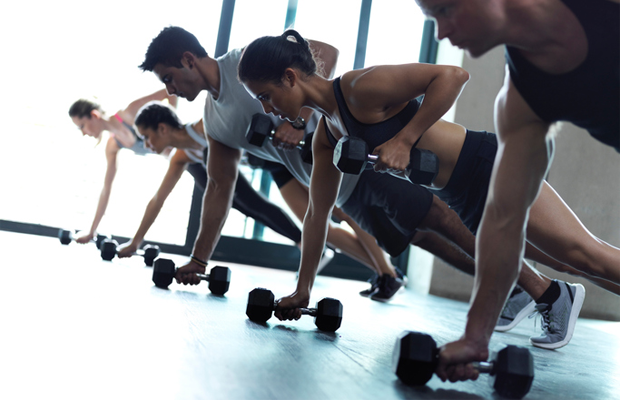
Plank row

The plank row is a must-do move for endurance cyclists. It develops core strength, upper-back strength and the stamina needed to support your torso during long days in the saddle.

People doing plank rows

Do it:

1. Assume a push-up position with your hands holding the handles of two dumbbells so the weights run parallel to your body. Position your feet hip- to shoulder-distance apart; the further apart they are, the easier the move.

2. Keeping your back straight, pull the right dumbbell to your right side, while pressing the left dumbbell into the floor for balance.

3. Return to the starting position and repeat to the other side. Alternate for a full set.

This article was originally featured on www.bicycling.co.za

Image credits: iStock

NEXT ON HEALTH24X

Share Button

Health24.com | SEE: The 6 best types of dogs for runners

The information on Health24 is for educational purposes only, and is not intended as medical advice, diagnosis or treatment. If you are experiencing symptoms or need health advice, please consult a healthcare professional. See additional information.

Share Button

Health24.com | SEE: 9 cycling things you cannot do in real life

We know, we know… cycling is your life.

We love it just as much.

But it doesn’t mean we can incorporate our cycling behaviour to our regular daytime activities. 

There are certain things that are reserved for the bike and the bike only!

Want proof of this?

Just check out the video and see how silly you’d look trying to draft behind someone in an office corridor.

<br _moz_dirty=”” />

This article was originally featured on www.bicycling.co.za

NEXT ON HEALTH24X

Share Button

Health24.com | This is why women are more prone to yeast infections in summer

Summer – a time for sun, swimming… and uncomfortable yeast infections. You may wonder why you’re more prone to yeast infections during the warmer months.

A vaginal yeast infection can cause the following symptoms:

  • Vaginal itching and/or soreness
  • A thick, white discharge which may resemble cottage cheese and smell like baking bread
  • Burning discomfort around the vaginal opening, especially when urinating
  • Pain or discomfort during sexual intercourse
  • Redness and swelling of the vulva

Here are four reasons why women are more prone to yeast infections during the warmer months – and what you can do to avoid the problem.

1. Wet swimwear 

If you make a habit if lounging around in your wet swimming costume straight after getting out of the pool or ocean, stop doing it. While water from pools and seawater won’t cause a yeast infection, the prolonged wearing of wet swimming costumes will increase your risk of yeast overgrowth.

Avoid this: Always take a dry set of clothes when you go swimming. If you plan to lounge around the pool, a dry swimming costume might be a good idea. Rinse yourself and change into dry clothes straight after swimming if you are prone to yeast infections.

woman in swimming costume

 2. Synthetic materials and tight clothing 

You may be tempted to wear lace underwear, or may live in your bikini bottoms all summer long. But synthetic materials like lycra can trap heat, which can cause you to sweat more, creating the ideal environment for yeast to grow.

Avoid this: Stick to cotton underwear. It’s more breathable and less likely to cause a yeast overgrowth or irritation.

underwear drawer

 3. An unhealthy diet

We are all guilty of overindulging during the summer months – more sugary treats, more cocktails. Unfortunately, refined sugar causes blood sugar spikes, which can increase your risk for yeast overgrowth, leading to a yeast infection. On top of that, excessive sugar compromises the immune system, making it harder for your body to fight yeast infections.

Avoid this: You don’t have to skip the treats completely, but maintain a balanced diet by getting plenty of nutrients from fruits and vegetables. You can also take a daily probiotic to optimise your gut bacteria. You can also swap the ice-cream for yogurt as this contains probiotics to fight yeast infections. 

girls drinking cocktails

 4. Stress

The summer months mark the end of the year in the Southern Hemisphere, adding additional pressure to our lives. Trying to meet deadlines, end-of-year exams, getting ready for the festive season all cause stress, challenging your immune system and making you more susceptible to yeast infections.

Avoid this: Make time for relaxation in your day, even if it’s just a couple of minutes to meditate or de-stress. Get regular exercise and take a probiotic.

woman stressed at work

Image credits: iStock

Share Button

Social care: MPs seek cross-party group to ‘sustain’ NHS

Ninety MPs write to the PM, saying patients are being “failed” by strained NHS social care services.

Share Button