[unable to retrieve full-text content]



[unable to retrieve full-text content]
Heather Zar, a physician and scientist, has been declared one of the 2018 L’Oreal-UNESCO Women in Science Laureates.
Zar has been recognised for the work on child health in Africa and triumphed above several other opponents from the Middle East and Africa.
Saving children’s lives
The prestigious aware is awarded annually and contestants are chosen from Africa and the Middle East, Europe, Asia-Pacific, North America, Latin America and the Caribbean – one contender per region.
This is in recognition of her wide-ranging contributions to child health, which have improved – and saved – children’s lives across the globe, as well as helping to shape international policy.
Zar is the Head of Paediatrics and Child Health, the Director of Paediatric Pulmonology and the Director of the South African Medical Research Council Unit on Child and Adolescent Health at Red Cross War Memorial Children’s Hospital at the University of Cape Town. She has conducted extensive research in child lung health, ranging from pneumonia and asthma to TB and HIV-associated lung diseases.
In a statement issued by UCT, Zar said it is humbling to be counted among such amazing women scientists, and a wonderful acknowledgement of the work they have been doing in child health over many years.
“The aware reflects the extraordinary teams and people I am fortunate to work with and the strong collaborations that we have built,” said Zar.
Respiratory illnesses are a few of the major causes of mortality and are incredibly debilitating illnesses affecting children worldwide. These illnesses are also considered serious complications in HIV-infected children. Zar has made invaluable contributions in epidemiology, diagnosis, prevention and management of respiratory illnesses, which has resulted in reductions in childhood mortality around the world.
Joins past laureates
Zar won the American Thoracic Society’s World Lung Health Award in 2014 and is also known for her innovation in the development of a low-cost alternative for asthma spacers – using a simple 500ml plastic cold drink bottle.
Possibly her most important work has been establishing the Drakenstein child health study. This unique birth cohort study is among the first in Africa to investigate comprehensively the early life determinants of child health and the link between early life illness and development of chronic disease. The information obtained from studies like this provides new knowledge to inform strategies for improved prevention and treatment of childhood illnesses.
This body of work has had a big impact on child health, improving management and prevention of childhood illnesses, and changing policy and international practice guidelines, including those produced by the World Health Organization (WHO).
Zar now joins the likes of past laureates Valerie Mizrahi, Jennifer Thomson, Tebello Nyokong, Jill Farrant, and Quarraisha Abdool Karim – the only other South African women in science who have won the prestigious award.
Image credit: iStock

NEXT ON HEALTH24X

If you’re looking for an effective cough remedy, you might be out of luck.
Nothing has been proven to work that well, according to a new report from the American College of Chest Physicians (ACCP).
OTC cough medicine not recommended
After reviewing clinical trials testing everything from cough syrups to zinc, an ACCP panel came to some less-than-positive conclusions: Over-the-counter medicines – including cold and cough products and anti-inflammatory painkillers – cannot be recommended.
Nor is there evidence supporting most home remedies – though, the group says, honey is worth a shot for kids.
However, not everyone agrees, and a previous Health24 article has the following advice for treating coughs:
People want relief
Every season, most people probably battle at least one cold-induced cough, said report author Dr Mark Malesker.
The recommendations were published in the journal Chest.
And they apparently want relief. In 2015, Americans spent more than $9.5 billion (±R135 billion) on over-the-counter cold/cough/allergy remedies, according to the report.
In South Africa the situation is similar, and in 2016, South Africans spent around half a billion rand on cough syrups alone.
“But if you look at the evidence, it really doesn’t support using those products,” said Malesker, a professor at Creighton University in Omaha.
A hacking cough
Malesker’s team looked at trials of cold products that combine decongestants and antihistamines, or decongestants and painkillers. They found no consistent evidence that any quash a cough.
The same was true when they analysed studies of nonsteroidal anti-inflammatory drugs, which include naproxen (Aleve) and ibuprofen (Advil, Motrin).
So what do you do when a hacking cough keeps you up all night?
A couple of studies have found that honey may bring some relief to children age one and up. (Honey should not, however, be given to babies younger than one year, the physicians’ group says.)
There was also “weak evidence” that zinc lozenges might help ease adults’ coughing – but it wasn’t enough to recommend them, according to the report. Plus, it says, zinc can have side effects, including a bad taste in the mouth, stomach cramps and vomiting.
What about home remedies?
What about storied home remedies, like Grandma’s chicken soup or neti pots for nasal irrigation? There’s no strong evidence for them, either, the review found.
On the other hand, Malesker said, if your favourite tea or soup makes you feel better, use it.
“It’s very frustrating that we haven’t found a good way to address this,” said Dr David Beuther.
Beuther is a pulmonologist at National Jewish Health, a Denver hospital that specialises in respiratory diseases.
A simple cold-related cough is generally something healthy people can wait out – but it can be miserable, Beuther pointed out.
“It can affect your sleep and quality of life,” he said. “So people are looking for ways to make it more bearable.”
Varying ingredients
And while a quick fix might be tempting, simply slowing down could help, Beuther said.
“Sometimes you just need to take a day off and let yourself rest,” he noted.
Beuther also recommended that people drink enough water to stay hydrated – which may help break up any thick mucus that is causing the cough.
As for healthy adults, Beuther said that if they have found an over-the-counter product to be useful in the past, he wouldn’t discourage them from trying it again.
There are many products, with varying active ingredients, he said. So a doctor or pharmacist may be able to steer you toward the most appropriate one.
Image credit: iStock


The World Health Organization (WHO) estimates that there are currently about 235 million people worldwide who suffer from asthma, and that in 2016 there were 383 000 deaths due to this disease.
Controlling asthma
An asthma attack occurs when the lining of the bronchial tubes swell. This causes the airways to narrow, which reduces the airflow in and out of the lungs.
According to the WHO the strongest risk factors for asthma are a combination of genetic predisposition with environmental exposure to inhaled substances and particles.
Asthma can be controlled with the help of medication and by avoiding triggers that irritate and inflame the airways.
How severe is your asthma?
The treatment of your asthma is based on your severity level. This means that your doctor will assess and classify the severity according to the latest guidelines for the management of asthma in either adults and adolescents or children.
Asthma treatment involves a two-pronged approach: targeting chronic airway inflammation and relieving acute bronchial spasms.
Determining the severity
The following tables will help you (and your doctor) determine the severity of your or your child’s asthma symptoms:
Table 1: Classification of severity of asthma in adults and adolescents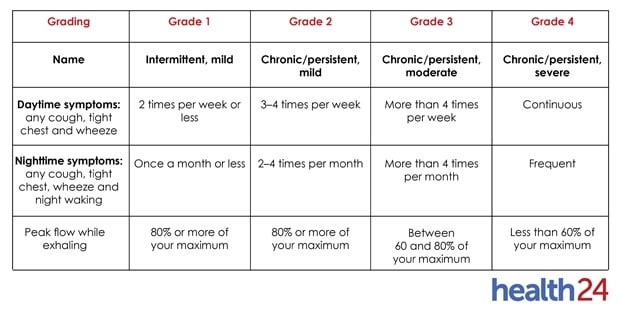
Table 2: Classification of severity of asthma in children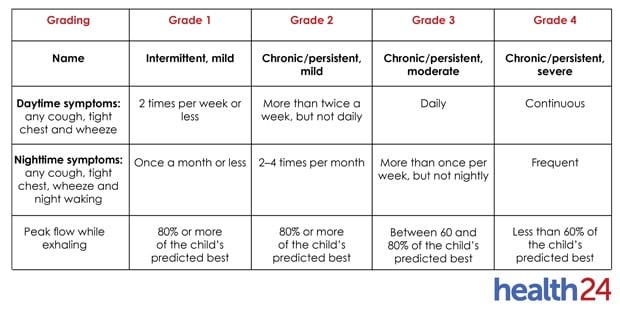
Image credit: iStock


Stirling University scientists call for more studies looking into dementia links following an Alan Shearer documentary.
Sudden cardiac arrest is linked to sexual activity far more often in men than women, a study finds.
The Scottish government hopes the proposed contract will also make it easier to run practices.
A few months back, former Vuelta a España winner Luis “Lucho” Herrera revealed that he’d been dealing with skin cancer on his arms, hands and face for the past six years.
The 56-year-old famed Colombian climber shouldered some of the responsibility.
“We didn’t take precautions to apply sunblock because there was no time and sometimes we were sweating a lot,” Herrera said.
Most of us can relate, as we haphazardly swipe a few blobs of sunscreen on our face and arms, toss a leg over our saddles and roll out for a few hours, where said sunscreen will likely sweat off before it does us much good.
But we can – and should – do better, especially if we hope to avoid the same fate down the road, says longtime cyclist Allen Richburg, MD, of the San Diego Sports Medicine and Family Health Center.
“The risk is cumulative, so the damage you’re incurring today can show up as cancer decades down the road,” he says. “Like riding itself, you can’t eliminate all your risk, but you can take measures to minimise it.”
Here’s what Dr Richburg and other sun safety experts recommend.
1. Apply early and often
For sunscreen to do its job you need to apply it early and give it time to soak into your skin. The recommendation for most products is that you apply at least 15 minutes beforehand.
“Thirty minutes is even better,” says Dr Richburg, noting that cyclists are prone to applying sunscreen as the last thing they do before clipping in and rolling off, usually when they’re already out in the sun.
“Rework your pre-ride ritual so you apply it before you kit up. Then get your stuff together, have a bite to eat, fill your bottles and so forth. By the time you roll out, the sunscreen will have had time to sink in.”
Read more: All you need to know about sunscreen
2. Know your numbers
The main number you’re looking for when choosing sunscreen is the SPF rating. People often mistakenly think these numbers indicate the length of time you can stay in the sun without burning (so if you’d typically burn in 10 minutes with bare skin, you can stay out 15 times longer with SPF 15 on).
That’s not really the case. The SPF number refers to the percentage of UVB rays the product filters out. Sunscreens with SPF 15 filter out 93% of UVB radiation; SPF 30 filters out 97%; SPF 50 blocks out 9%, and so forth. For a sun-exposed cyclist, higher is probably better, says Dr Richburg.
“It hasn’t been proven that higher numbers will protect against skin cancer better, but if one to two percent could protect you from even a bit more damage, it’s worth it,” he says.
3. Spray it on
Anyone who’s ever come back from a long ride with streaks of ruby red where they “missed a spot” in their sunscreen application knows it’s not easy to cover yourself completely with lotions.
Sprays eliminate the problem by shrouding your skin with a protective mist. Just don’t blast it straight into your face. Apply it to your hands and rub it on, instead.
4. Slip a spare in your pocket
Regardless of the SPF, there is no sunscreen that can last for hours against sweat, says Northwestern Medicine dermatologist Sheryl Hoyer, MD, of Grayslake, Illinois.
“A sunscreen can no longer say ‘waterproof’. It can say ‘water resistant’ if it has passed appropriate FDA testing,” she says.
And that resistance doesn’t last terribly long: 80 minutes is about the limit. That means you must reapply if you’re out for several hours.
5. Shift your ride time
You can’t control the times you race or ride organised events, but you can often control the hours you train, which can help minimise your exposure to the peak sun intensity hours when UV light is strongest, says Dr Richburg.
“Plan most of your training hours for the early morning and evening hours when possible,” he says.
6. Cover what you can
You wear arm warmers when it’s cold, consider also wearing them during hot, sunny months, says Dr Richburg.
These summertime sleeves, like arm coolers, not only have an SPF rating of 50, but also are made with special cooling fabric that incorporates xylitol (the compound found in breath-freshening chewing gum) that reacts with your body heat to turn your sweat into a coolant.
“Sunglasses and a visor are good additional weapons against the sun,” says Dr Hoyer.
Many mountain bike helmets have a visor attached. On the road, consider a cycling cap with a fuller brim.
Read more: 30 years of crazy, cool helmets of the tour
This article was originally featured on www.bicycling.co.za
Image credit: iStock

NEXT ON HEALTH24X

Mpolokeng Mudau (pictured) visited her gynaecologist for a routine checkup two months before she was to deliver her son, only to return home disappointed that she had been diagnosed with type 1 diabetes.
Although this happened in 2009, she remembers the incident vividly, saying she had complained to her doctor about an insatiable thirst during the consultation.
“No matter how much water I drank, I could not feel quenched,” recalls Mudau.
“I also experienced blurred vision. When the doctor ran some tests, he realised my sugar level was high,” she said, adding that when her blood sample was examined, she was found to have type 1 diabetes.
Mudau is one of more than 199 million women worldwide living with diabetes. Some of them will mark World Diabetes Day on Tuesday.
The day is meant to promote diabetes care, prevention and a cure worldwide.
This year’s theme is Women and Diabetes – our right to a healthy future.
Globally, there are 366 million people living with diabetes, and the International Diabetes Federation has predicted that this number could rise to 552 million by 2030.
Mudau (31) tells City Press that what frightens her most about diabetes is the thought of losing her eyesight.
“The minute the sugar levels in my body go up, my eyes become blurry,” she says, adding that the fear of losing her eyesight has kept her motivated to take her medication religiously.
She has familiarised herself with facts about the disease to such an extent that she now runs an empowerment community programme where, once a week, she holds regular talks with young girls about the illness to dispel the falsehoods surrounding the disease.
In some communities, for example, she says there is a prevailing belief that if no one in a family is diabetic, it is not possible for a person to be diagnosed with it.
Other myths include the belief that if a person is not fat, they cannot become diabetic – or if a person does not consume too much sugar, they cannot be diabetic.
Mudau says she often encourages young people to lead a healthy lifestyle to avoid all kinds of illnesses. She also teaches youngsters about hygiene and distributes sanitary towels.
Mudau believes that her diabetes had led her to her calling.
“It is as if my life was waiting for me to become diabetic in order to move forward,” she says.
However, her supportive husband often “watches me like a hawk” at meal times to ensure she makes the right choices.
“I was very lazy around the seventh month of my pregnancy. I was fairly big, lazy and tired,” she recalls.
“To be honest, I sometimes still have rough days when I want to let loose and eat whatever I want, and it’s hard. But I just snap out of it when I think about my children.”

Dr Larry Distiller, executive chairman of the Centre of Diabetes and Endocrinology, says South Africa has the biggest number of people diagnosed with diabetes on the continent, with Nigeria in second place.
He makes the distinction between diabetes type 1 and 2, saying type 1 occurs as a result of the destruction of insulin-producing cells in the pancreas, and it sometimes affects young people.
“Patients become insulin depleted and deficient, and they need to have insulin injections to survive. Type 1 diabetes is not preventable because it is a genetic condition,” he explains.
Type 2 diabetes is more of a lifestyle condition, says Distiller. It affects mainly older people – and sometimes young people.
Type 2 diabetes is associated with being overweight. However, Distiller is quick to point out that the effects of this type can be reduced “by leading a healthy lifestyle and keeping fit and active”.
Type 2 diabetes also occurs when a person’s insulin-producing cells are not entirely healthy, and are fragile and damaged.
“The cells can normally make enough insulin if you’re thin, but when you become overweight and inactive, you become resistant to insulin and so the cells cannot cope,” explains Distiller.
He recommends that people over the age of 40, and those who are overweight and inactive, should get tested every year by means of undergoing a simple blood test.
“Diabetes is not a death sentence; it is a life sentence.
“Once you are diagnosed with diabetes you need to be treated properly, monitored, followed up and managed for the rest of your life.
“If you do the right thing by following the rules, looking after yourself as a diabetic and keeping your blood pressure and cholesterol under control, you can live a long life with diabetes.”
There are three types of diabetes:
– TYPE 1 DIABETES – a condition where the body stops producing insulin, an essential hormone produced by the pancreas to convert glucose into energy;
– TYPE 2 DIABETES – a condition that develops over time where the body is unable to use insulin properly; and
– GESTATIONAL DIABETES – a form of diabetes that occurs during pregnancy because of hormonal changes, genetics and lifestyle factors.
Most South Africans with diabetes have type 2 diabetes.
The highest prevalence of diabetes among South Africans is in the Indian population (11% to 13%) as this group has a strong genetic predisposition for diabetes.
This is followed by 8% to 10% of people in the coloured community, 5% to 8% among blacks and 4% among whites.
TALK TO US
Do you think the myths about diabetes can be dispelled?
SMS us on 35697 using the keyword DIABETES and tell us what you think. Please include your name and province. SMSes cost R1.50

NEXT ON HEALTH24X

Children with life-limiting illnesses are being denied out of hours care, according to a new report.
