Health24.com | ‘I beat cancer, now what?’

One in four South Africans will be affected by cancer in their lifetime through diagnosis of a family member, friend, colleague or themselves. Look around you and count the people sitting in your office – one in four is a high statistic. 

Receiving a cancer diagnosis is terrifying and comes with a multitude of questions – Why me? What did I do wrong? Will treatment work? Where to next?

The treatment will be exhausting – mentally, physically and financially – and incredibly challenging. Then, you hear those words: “You are in remission.”

It’s been a long, tumultuous journey and you’re finally at the end of it – or so you thought. Unfortunately, you may still have a long road ahead of you. 

Remission does not mean the end

“Most cancer survivors are looking forward to leaving the cancer behind and regaining a sense of normality in their lives,” Dr Jill Harris, an oncologist at Cancercare, said at the Cancer Survivors’ Summit held in September 2016.

“But making the transition into the period after treatment can bring new, unexpected challenges, including long-term side effects and ongoing medical costs.”

Guest speaker at the event, Professor Melvyn Freeman, Chief Director: non-communicable Diseases at the Department of Health said, “Surviving cancer is a process of psychological graduation involving personal growth.”

Financial burden

Research shows that about three in every 10 people who recover from cancer will face financial difficulties. Many cancer survivors avoid or delay medical care, miss their follow-up appointments and stop taking medications because they are anxious about costs.

Dr Harris says oncologists should consider offering more economical options with similar outcomes to patients. As a patient, you need to be involved in the decision-making process, especially when it comes to the treatment costs involved. Melvyn Freeman, quote

Fear of recurrence

It’s perfectly normal for cancer survivors to feel anxious or scared about the cancer returning, especially in their first year following treatment. 

Dr Harris suggests that survivors do a genetic test to determine their susceptibility to relapse – if they qualify. 

“I never asked to do this journey, but a journey it became. And it didn’t finish after treatment either,” testicular cancer survivor David Scott told Health24.

“When you have a shadowy ‘death date’, no matter what the prognosis, you still believe you could be the percentile that doesn’t make it. Or that your body does not respond to chemo.”

Chronic fatigue

Persistent fatigue is a long-term effect experienced by 30% to 40% of patients cured of cancer and can continue for years following treatment, says the National Cancer Institute in the US.

Exercise is one of the more successful treatment options to help address cancer-related fatigue. Dr Harris says the combination of exercise, cognitive therapy and coping skills training are a good way to combat cancer-related fatigue.

“It’s also important to remember that everybody’s treatment and recovery are different, so you shouldn’t compare yourself with other patients or you may end up feeling hopeless,” breast cancer survivor Wilma van der Bijl previously told Health24.

“I never thought I’d bounce back but, although it takes time, you come through the experience and regain your energy and lust for life.”

Life after cancer 

Cancercare believes cancer survivors should be celebrated and will host its annual Cancer Survivors Day in September 2017. Cancer survivors need ongoing support. 

“The goal is to give us the opportunity as a practice to acknowledge the people who are treated with us and to recognise the journey they have undertaken with cancer,” says Linda Greeff, oncology social worker, Cancercare Rondebosch.

“It is also a chance for us to raise awareness around the fact that this illness can be treated and that people can live long and productive lives with cancer.”

The day is designed to break the stigma that cancer is a life-threatening illness, while sharing inspirational cancer survivors’ stories. “Being around other cancer survivors inspires and motivates people,” says Greeff. 

Two women hugging

“The feedback we have received every year has been overwhelmingly positive. People feel that they are not alone in their experiences and they use this as a chance to learn from one another. It is also a special experience for our treatment teams as they get to connect with their patients and see how they are getting on with their lives.”

Greeff concludes, “From the moment you receive your diagnosis, you are a survivor, and this day is for you.”

For more information or if you’d like to attend the Cancer Survivors Day, you can email Joleen Retief.

All images provided by iStock.

Share Button

Health24.com | 7 foods that may help relieve erectile dysfunction

There are many men who need help with erectile dysfunction (ED). Some only struggle to achieve or maintain an erection on the odd occasion while others have a more permanent problem.  

There are a number of radical treatments available, but if you only experience occasional erectile dysfunction and want to treat it without any medical intervention, you could do it at home – with food.

Healthy diet

“A healthy diet and an avoidance of highly processed unhealthy food will go a long way towards relieving symptoms of erectile dysfunction,” said Dr Zakariyya Patel of Pelonomi Hospital Complex in Bloemfontein.

Although certain foods may assist with ED, cases are not well documented and evidence is only anecdotal – based on individual accounts, said Dr Patel. These foods can be labelled as aphrodisiacs, and although some people may swear by their effects, there is no medical evidence that any one specific food can cure ED.

“The reason for this is that ED is a complex condition that may have complicated aetiology (causes). So, certain foods may increase sexual desire to a certain extent but it does not mean that it will change the ED if the underlying cause is not addressed,” added Dr Patel.

Foods that may increase your sexual desire:

  • Berries (as well as citrus fruits) contain chemicals that are associated with a decreased risk of ED.
  • Dark chocolate increases levels of dopamine, the “pleasure” hormone, in the body.
  • Oysters contain more zinc than other foods and assists with sperm mobility.
  • Cayenne pepper raises the heart rate and releases endorphins.
  • Red wine relaxes the arteries and increases blood flow to the genitals. (Red wine contains the same biochemicals found in berries and citrus fruits.)
  • Pistachios contain the protein arginine, which relaxes the blood vessels, increasing blood flow throughout the body.
  • Coffee. A study suggests that caffeine relaxes certain muscles and arteries in the penis, increasing blood flow and helping to maintain an erection.

Your lifestyle has an impact

Owing to the fact that physiological factors like blood flow and hormone levels may affect erectile dysfunction, a good diet with the right vitamins and minerals will optimise the patient’s sexual health, according to Dr Patel.

It does, however, not mean that there is a “silver bullet” that will “magically” solve the problem. 

And as the world population struggles with obesity and cardiovascular disease, there is a significant increase in diseases such as hypertension and diabetes, which have a direct impact on blood flow – consequently increasing the severity of ED, Dr Patel added.

Exercise may help

Studies have shown that men who exercise more have better sexual and erectile function. Better sexual function was reported by men in the study who engaged in either two hours of strenuous exercise, 3.5 hours of moderate exercise, or six hours of light exercise a week.

And although there is no specific exercise men need to do in order to achieve better sexual health, any form of exercise is better than none at all. 

Share Button

Sea bug attack: Why was a wading teenager left covered in blood?

An incident that left an Australian boy covered in blood has been described as “very unusual”.

Share Button

Health24.com | Is stem cell injection the cure-all miracle?

Stem cell therapy has been claimed to cure cancer, improve chronic conditions such as headaches, and even make your skin look younger. How can that not be a good thing?

You’ve probably heard about stem cell research before, but what exactly are stem cells, and how can stem cells injected into the body treat various diseases and conditions?

There has been enormous progress in this field over the last few decades, so let’s take a look at how stem cell injections work.

What exactly are stem cells?

Stem cells are the body’s building blocks – the reserve cells that the body is made up of. These cells are able to produce multiple different cells, each performing a specific function. Stem cells can be divided into two main categories:

  • Embryonic stem cells (ES cells) – derived from the inner cell mass of a blastocyst (an embryo in the earliest stage of conception)
  • Induced pluripotent stem cells (IPS cells) – derived from human bone, cartilage, fat and blood after embryonic formation

What is stem cell therapy?

Stem cell therapy can be categorised as regenerative medicine. Stem cells used in medical treatments are currently harvested from three sources: umbilical cord blood, bone marrow and blood. These are treatments that restore damaged tissue and regenerate new cells in the case of illness or injury.  

While there are other forms of stem cell therapy, these are still in the early stages and regarded as research. 

How is stem cell therapy performed?

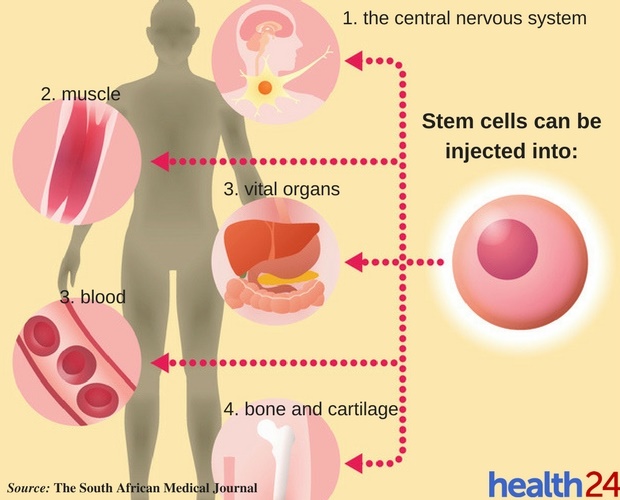
Adult stem cells are derived from a blood sample and injected back into the patient’s blood. The surrounding cells are then activated, stimulating rejuvenation in the area. 

infographic of stem cell treatment

Why the controversy?

In 2004 South Africa became the first African nation to open a stem cell bank. This involved embryonic stem cells for cloning research and not the “adult” stem cells used in treatment. 

Embryonic stem cells are often viewed as problematic, as they are derived from very young foetuses. It is thus viewed as a form of “abortion” to use embryonic stem cells for treatment. But in most cases of stem cell therapy adult stem cells are used, which causes few ethical problems. Stem cells derived from the umbilical cord are not the same as from the embryo.

What does science say?

Prof Jacqui Greenberg from the University of Cape Town stated that although stem cells can potentially treat various diseases, they should be treated with extreme care.

She has no doubt that in time (in medical science particularly, progress is slow and measured in blocks of 10 years), stem cells will be the solution for many things. “But right now we have to strike a balance of not creating too much hype and raising hope too soon. Stem cells are the future, but the future is not now,” Greenberg states. 

The reason for this is that stem cells derived from an adult are too volatile at times. Researchers are not clear on how many of these stem cells will actually “survive” and “activate” to treat the condition at hand. Therefore it can’t be predicted how many cells will survive and become functional.

There is as yet little proof that stem cells can actually fight disease when injected back into the host. Despite the success of IPS cell technology up to date, there are still challenges with regard to the purity of stem cells before their use in therapy. 

Availability and cost in South Africa

Stem cell therapy is available at various treatment centres in South Africa. One of the most prominent is the South African Stem Cell Institute in the Free State. Here, various treatments, such as regenerative skin treatments and prolotherapy (regeneration of the joints), are offered.

Therapy starts with an initial consultation. During the second consultation vitals are checked, followed by either the fat harvest procedure under tumescent anaesthesia or bone marrow aspiration under local anaesthesia. 

The stem cells are then cryopreserved and injected into the patient as needed. Prices of the treatment vary from R500 (for a once-off treatment in a small area, such as the hand) to R22 500 (a comprehensive process), depending on the condition being treated and length of treatment needed. This excludes the initial consultation fee and after-care. 

There are also stem cell banks in South Africa, such as Cryo-Save, where stem cells can be stored at an annual fee (excluding initial consultation, testing and harvesting) and used for treatment.

Do your own research

If you do want to go the stem cell route, make sure that the medical programme being offered is legitimate and that the projected outcome is based on real evidence.

There are a number of private institutions banking on the promise of curing any number of diseases with stem cells from a patient’s own blood. The truth, however, is that there is no conclusive proof that the majority of these diseases can be cured with the person’s own stem cells – annihilating the claim that stem cell therapy is the solution to all diseases.

Share Button

New CubeSat propulsion system uses water as propellant

[unable to retrieve full-text content]

Share Button

DNA from Viking cod bones suggests 1,000-year history of European fish trade

[unable to retrieve full-text content]

Share Button

Scientists improve forecast of increasing hazard on Ecuadorian volcano

[unable to retrieve full-text content]

Share Button

Contaminated egg scandal widens to UK and France

UK health officials say the numbers in circulation are “very small” and the risk to the public is “very low”.

Share Button

Judge approves suicidal girl care plan

The senior family court judge previously said society should be “ashamed” for not protecting the teenager.

Share Button

NHS access to IVF being cut in England

A charity is calling for eligible women to be offered three full treatment cycles, as recommended in guidelines.

Share Button