Health24.com | Why chopping onions makes you cry

Ever wonder why your eyes fill with tears when you chop an onion?

One eye doctor pinpoints the culprit.

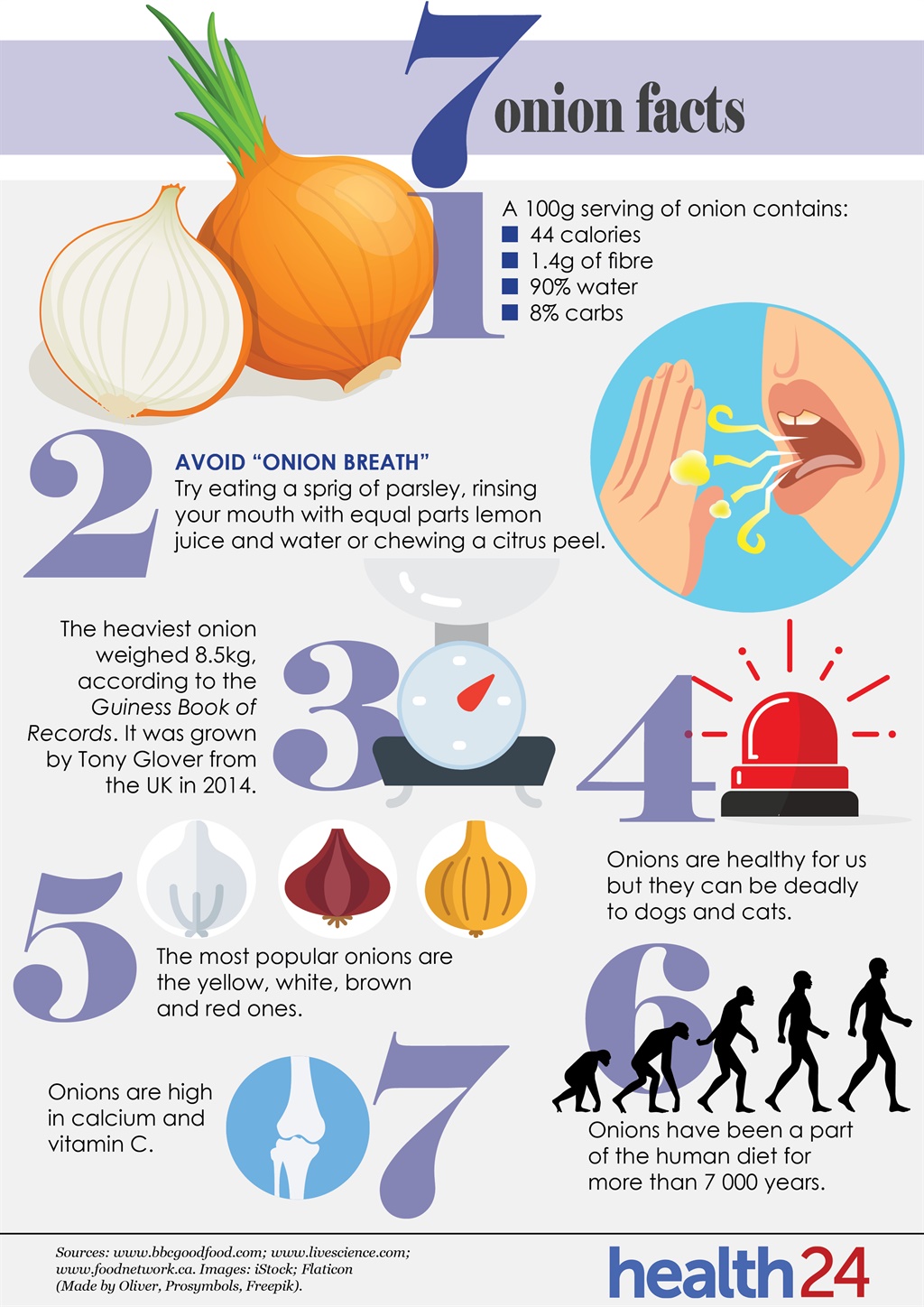
Onions use sulphur in the soil to create amino acid sulfoxides, which are sulphur compounds that readily turn into a gas. When an onion is cut, it releases the sulfoxides and enzymes, which react and create a gas called syn-propanethial-S-oxide.

Because onions grow underground, this gas helps deter critters that want to feed on them.

So why do we cry?

But the gas is also what causes your eyes to water when chopping onions, said Dr Robert Rosa Jr., an ophthalmologist at the Texas A&M College of Medicine.

“It really is a complicated chemical process that creates the gas,” said Rosa. “They all act as precursors that create the lachrymatory processor – or what makes you tear up.”

“Your eyes have a set of nerves that detect anything that’s potentially harmful to your eyes. Your eyes react to the gas that is formed, and your eyes try to flush it out with tears,” Rosa explained in a school news release.

However, onions pose no serious threat to your visual health.

“Chopping onions can cause some burning and irritation and tears. Other than that, it’s pretty safe on your eyes. It’s a temporary sensation with no known long-term effects, nor will it worsen any other conditions, like pink eye,” Rosa said.

Goggles can prevent the gas from reaching your eyes while cutting onions, but they aren’t really necessary, he added.

“Some people may cut the onions in a bowl of water,” Rosa said. “I’d personally recommend using eye drops, like comfort drops, to help lubricate or rinse the eyes and dilute the gas exposure to the eyes.”

onions, health, facts, infographic


Read more:

Curry, onion guards against cancer

Eye doctors debunk 5 fireworks myths

Green, leafy vegetables may keep glaucoma at bay

Share Button

Health24.com | SEE: How long should you stay home when you are sick?

You know the scenario: You’ve been booked off with flu, and after a day or two your symptoms start easing up.

You picture your email inbox exploding and your work piling up – and the next morning you brave the elements back to work. Hey, you’ll be fine, and you’re already feeling better, right?

Before you know it, your legs feel wobbly and that achy, feverish feeling starts creeping up on you again. Maybe you should have taken another few days off…

Flu, a sore throat, stomach bugs, the list goes on. Germs abound in winter, especially in confined air-conditioned office spaces. Taking enough time off to heal can be hard, especially when work is piling up and your symptoms are starting to abate.

We look at some of the reasons why you absolutely shouldn’t return to work if you are sick, and how to know when your body is strong enough to get back to the office. 

When you should wait before going back to work:

1. Your illness is contagious

You will risk making your colleagues sick. Diseases like influenza (flu) or the norovirus (stomach bug) spread easily through airborne droplets, human contact and shared surfaces.

According to the Centers for Disease Control and Prevention, the incubation period for common illnesses starts before symptoms appear, which means you can be contagious even before you know you’re sick.

Contagious diseases can quickly spread in public spaces, especially open-plan offices with shared kitchen and bathroom facilities. According to a previous Health24 article, it is recommended that you only go back to the office 24 hours after your fever breaks or after symptoms clear up to be entirely sure you are no longer contagious. 

2. Your symptoms and medication disrupt your work 

While you might think you are able to cope, you could be costing the company more than you realise by making silly mistakes because you feel lousy. Some medications taken for common illnesses such as cold or flu can impair your cognitive skills and make you feel drowsy.

If your job allows no room for mistakes, stay home until you are fully healed. Your office may also not be equipped for you to heal comfortably – there might be limited bathroom access or no suitable storage for your medication.

3. Even if your symptoms are clearing up, your body still needs rest  

We often mistake lack of symptoms for normal health and don’t give our bodies a proper break. If you rush back into your work routine too quickly, you may have a relapse and get sick all over again. 

Why your body needs rest even after your symptoms are gone

While you may no longer be contagious after your symptoms have cleared up, you should remember that your body took strain. Your immune system is still in fighting mode and has not entirely recovered.

The odds are that you might get infected again if you don’t protect yourself. Dr Will Sorey from the University of Mississippi Medical Centre says that proper care during common illnesses, as well as the steps you take afterwards, are important to build up your immune system He suggests the following:

  • Proper hydration and nutrition
  • Not rushing back into exercise or physical activity
  • Paying attention to worsening symptoms immediately
  • Taking extra precaution not to get reinfected when you are back at work
  • Getting extra sleep at night to replenish your body 
how long to recover

Read more:

11 sick leave FAQs

Sick leave: the facts

Anxiety and depression increase risk of sick leave

Share Button

Health24.com | More and more people smoking in kids’ movies

Movie makers just can’t seem to resist the temptation of depicting people puffing at cigarettes. A recent example is the 2015 movie Carol, which shows endless images of Cate Blanchett taking sultry drags. 

As if smoking in movies aimed at an adult audience isn’t bad enough, progress to keep tobacco use out of kid-friendly movies is apparently also going up in smoke.

The number of youth-focused films that showed smoking rose sharply between 2010 and 2016, a new study reveals.

A public health concern

During that time, 46% of movies with smoking were youth-rated. That’s 210 of the 459 top-grossing films. And the number of smoking scenes in movies rated PG-13 – suitable for teens – surged, from 564 in 2010 to 809 in 2016.

That’s a public health concern that must be addressed, the study’s senior author said, because it could encourage young people to light up.

South Africa has made significant progress in reducing smoking and according to the latest national statistics, 16.4% of South Africans were smokers in 2012. This is a significant drop from 32% in 1993, which has been largely attributed to stricter smoking legislation, advertising limitations and steeper tobacco prices.

“Modernising Hollywood’s rating system to reflect the audience by awarding movies with smoking an R rating would save a million kids’ lives,” said Stanton Glantz. He directs the Center for Tobacco Control Research and Education at the University of California, San Francisco.

“That is the best way that the six big media companies that control the Motion Picture Association of America could ensure that movies marketed to kids are not also selling cigarettes,” Glantz said in a university news release.

The study was published in the US Centers for Disease Control and Prevention’s Morbidity and Mortality Weekly Report.

No progress since 2010

A 2012 US Surgeon General’s report said youth with extensive exposure to smoking in movies are two to three times more likely to smoke than those with little exposure.

Glantz – founder of Smokefree Movies, which targets public policy and film industry practice – said no progress has been made to reduce tobacco images in youth-rated movies since 2010.

“All the major media companies have had years where all their youth-rated movies are smoke-free. There is an enormous need to implement an industrywide standard by requiring that all movies rated for kids are smoke-free,” he said.

Between 2010 and 2016, the study found tobacco incidents rose:

  • 72% in top-grossing movies (from 1 824 to 3 145)
  • 43% in PG-13 movies
  • 90% in R-rated movies (those for which children under 17 must be with an adult)

Only in movies rated G or PG – for general audiences or where parental guidance is suggested – did tobacco use fall, from 30 incidents to 4.

Risk of lifetime addiction

Researchers defined incidents as the use – or implied use – of a tobacco product, including cigarettes, cigars, pipes, hookah, smokeless tobacco and electronic cigarettes.

Nancy Brown, head of the American Heart Association (AHA), called the findings a “troublesome plot twist”.

“As this study points out, there are fewer movies made these days, but you can watch them anywhere on demand, on your tablet and on your smartphone. Easier access, coupled with a growing number of tobacco images in film, means more and more young people will be put at risk of a lifetime addiction, disease and possibly an early death,” she said in an AHA news release.

Brown said scenes that “glamorise” smoking should be eliminated or flagged with a R rating so that they are not marketed to children.

The report suggested state and local health departments take steps to block public subsidies to movie makers that depict tobacco use. It noted that during the study period, movies with tobacco scenes received $3.5 billion in public subsidies.

Read more:

James Bond quits smoking, but co-stars don’t

Vaping leads to ‘real’ smoking by teens

WHO: smoking shock tactics

NEXT ON HEALTH24X

Share Button

David Frost cardiac genetic testing service opens

The service at Belfast City Hospital aims to identify and support those at risk of heart problems.

Share Button

Oral sex spreading unstoppable bacteria

If you get gonorrhoea, you might not be able to get rid of it, world health experts warn.

Share Button

Contraception fails in quarter of abortions, say experts

More than 14,000 women attending clinics in 2016 had become pregnant despite using contraception.

Share Button

Mental health care ‘risks being over-run’

Survey of mental health leaders suggests rising demand and staff shortages are major problems.

Share Button

Use of WhatsApp in NHS ‘widespread’, say doctors

Internet-based messaging apps are a key way for doctors to send patient information, the BBC has learned.

Share Button

Health24.com | 7 ways to cut 50 calories every day

South Africans are increasingly becoming obese, with two-thirds of women and a third of men being overweight, according to a previous Health24 article.

Did you know that eating an extra 50 calories a day can sneak on more than two kilograms a year? But trimming the same number calories will put the trend in reverse.

Cutting out 50 (or more) calories a day isn’t as hard as you think, says registered dietitian Rachel Begun.

Here are seven ways you can cut down on your calorie-intake throughout the day:

1. Start with your daily coffee. Skip the sugar, and flavour your java with vanilla extract or cinnamon instead.

calories,weight loss,health

                                                                                              iStock

2. Replace that pat of butter on your morning toast with a teaspoon of jam.

calories,weight loss,health

                                                                                             iStock

3. At lunch, make tuna or salmon salad with low-fat vinaigrette instead of full-fat mayo.

calories,weight loss,health

                                                                                              iStock

4. When ordering a salad, ask for a non-creamy dressing on the side, but resist the temptation to use it all – about half is all you really need.

calories,weight loss,health

                                                                                             iStock

5. Downsize that glass of wine before dinner from 150ml to 100ml. Add a splash of seltzer to extend it.

calories,weight loss,health

                                                                                             iStock

6. Cooking with olive or sesame oil is healthy, but go easy – every tablespoon has 120 calories. Measure out a half-tablespoon instead so that you won’t use too much of a good thing. Save even more by switching to an oil spritzer instead of pouring from the bottle, Begun says.

calories,weight loss,health

                                                                                              iStock

7. At 30 calories a tablespoon, barbecue sauce adds unwanted calories to meat. Instead, grill or roast meats with fresh herbs and spices for flavour. Use fat-free (and low-salt) broth when you need to baste.

calories,weight loss,health

                                                                                            iStock

Tip: And don’t forget to drink plenty of water. Water keeps you feeling full and your metabolism running in tip-top shape.

Read more:

5 ways to ensure you stick to your healthy eating plan

5 things your dietitian wants you to stop doing

40 tips for cheap and healthy eating

NEXT ON HEALTH24X

Share Button

Health24.com | Shingles boosts risk of heart attack and stroke

Most of us have chicken pox as children and assume that’s the end of it. But many years later the disease can become reactivated as herpes zoster or shingles, caused by the varicella zoster virus (VZV).   

Shingles is also called herpes “zoster”, meaning “girdle” or “belt”, which describes the appearance of the rash. Small blisters, resembling chickenpox, appear on the “girdle line”. Eventually they fill with clear fluid, break and crust, before finally disappearing.

South Korean researchers recently found that besides the uncomfortable rash on the girdle line, those affected had an increased risk of cardiovascular problems such as heart attack and stroke.

Health24 previously reported that when VZV first enters the body, as it does in the case of 90% of all children, it leads to chickenpox. But the body is never totally rid of VZV, which belongs to a family of viruses known as the “herpes viruses” that become latent in their host after causing the first infection.

Ballooning risk for heart problems

Their study found that people with shingles saw an overall 41% higher risk of cardiovascular events, such as heart attack or stroke, when compared to an age-matched control group that did not develop shingles.

The risk of stroke was 35% higher and heart attack 59% higher, said the report published in the Journal of the American College of Cardiology.

The riskiest period was the first year after infection, and the dangers appeared to decline after that.

Researchers also found the risk for stroke was highest in those under 40 years old.

The study was based on a medical database of 519 880 patients whose records were tracked from 2003–2013.

Link still unclear

Researchers are unclear why shingles would boost the risk of cardiovascular problems, and said more study is needed.

“While these findings require further study into the mechanism that causes shingles patients to have an increased risk of heart attack and stroke, it is important that physicians treating these patients make them aware of their increased risk,” said study author Sung-Han Kim, a physician in the department of infectious diseases at Asan Medical Center in Seoul.

Prevalence of shingles

Nearly one in three people in the United States will develop shingles in their lifetime, according to the US Centers for Disease Control and Prevention.

The infection, which may cause blisters, rash and shooting pain, can affect anyone who has had chickenpox.

Shingles can be spread through direct contact with the rash, but not by air.

A vaccine against shingles is available and is recommended for people 60 and older.

Read more:

Approximately 90% of adults are at risk for shingles

Shingles vaccine is safe

People with shingles have a higher stroke risk

Share Button