Payments need to be made fairer and faster, the chair of the public inquiry into the disaster says.


Payments need to be made fairer and faster, the chair of the public inquiry into the disaster says.
The medics say the walkout can still be avoided if the government enters pay negotiations.

A Los Alamos collaboration has replicated an important but largely forgotten physics experiment: the first deuterium-tritium (DT) fusion observation. As described in Physical Review C, the reworking of the previously unheralded experiment confirmed the role of University of Michigan physicist Arthur Ruhlig, whose 1938 experiment and observation of deuterium-tritium fusion likely planted the seed for a physics process that informs national security work and nuclear energy research to this day.
“As we’ve uncovered, Ruhlig’s contribution was to hypothesize that DT fusion happens with very high probability when deuterium and tritium are brought sufficiently close together,” said Mark Chadwick, associate Laboratory director for Science, Computation and Theory at Los Alamos. “Replicating his experiment helped us interpret his work and better understand his role, and what proved to be his essentially correct conclusions. The course of nuclear fuel physics has borne out the profound consequences of Arthur Ruhlig’s clever insight.”
The DT fusion reaction is central to enabling fusion technologies, whether as part of the nation’s nuclear deterrence capabilities or in ongoing efforts to develop fusion for civilian energy. For instance, the deuterium-tritium reaction is at the center of efforts at the National Ignition Facility to harness fusion. Los Alamos physicists developed a theory about where the idea came from — Ruhlig — and then built an experiment that would confirm the import and accuracy of Ruhlig’s suggestion.
Tracking down the origin of DT fusion
In 2023, Chadwick was working with colleagues, including theoretical physicist Mark Paris, on a compendium of the early history of the development of fusion. A reasonably well-known part of that history is the suggestion — at a meeting at future Manhattan Project-director J. Robert Oppenheimer’s July 1942 Berkeley physics conference — by physicist Emil Konopinski that DT fusion, among numerous possible fusion reactions, would be particularly advantageous as a component of a fission-reaction weapon.
But Chadwick and his Los Alamos colleagues wondered: How did Konopinski arrive at this insight about DT fusion? Seizing on the most viable fusion process among several options this early in the program — the Manhattan Project had started in earnest only months before — certainly proved a fortuitous decision.
Searching the National Security Research Center archive one night, Chadwick came across a 1986 audio recording of Konopinski recounting the decision making around deuterium-tritium reactions. (The team made the Konopinski recording available on YouTube.) His voice coming out of the past, reflecting on an even further past, Konopinski several times attributed his motivation to explore deuterium-tritium research to his knowledge of “pre-war” research.
Tritium was discovered in 1934 by experimental physicist Ernest Rutherford’s team. Rutherford was a titan of early physics, having advanced the model of the atom with Neils Bohr, and also having overseen work by James Chadwick to discover the neutron. Starting with 1934, Paris scoured the published physics literature, eventually coming across Ruhlig’s single-author, 1938 letter to the editor published in Physical Review about a gamma-ray experiment.
Ruhlig was working with deuterium-on-deuterium interactions: blasting deuterium with a beam of deuterons and studying gamma-ray effects. (A deuteron is the nucleus — one neutron and one proton — of a deuterium atom.) In what is nearly an aside in the final paragraph of the letter, Ruhlig described observing protons with extremely high energies, inferring that they were generated by secondary reactions: tritium-on-deuterium fusion neutrons scattering protons out of a thin cellophane foil placed inside a cloud chamber. He cited a private conversation with Hans Bethe in unpacking what he’d seen. The DT reaction “must be an exceedingly probable one,” he concluded, offering a quantitative estimate of one in 1,000 energetic protons against lower-energy protons.
And there the matter dropped; Ruhlig’s paper was infrequently cited, with the few citations bearing mostly on the gamma-ray issues. But Konopinski appears to have remembered the work.
Paris and Chadwick put together the pieces: As it happens, Ruhlig and Konopinski were both University of Michigan students, overlapping in their doctoral studies in the 1930s. Ruhlig’s thesis adviser, Richard Crane, was a colleague of Bethe, and Konopinski served on a research fellowship overseen by Bethe. They also shared a mentor in University of Michigan physicist George Uhlenbeck, co-discoverer of electron spin. And though Ruhlig’s paper was not often cited, that does not necessarily mean it was unknown — the journal would have been part of many physicists’ regular reading.
“The evidence for Konopinski interpreting and taking up Ruhlig’s suggestion of the probability of DT fusion is circumstantial, but nonetheless strong,” Paris said. “We’re left to ask, what did Ruhlig actually observe? Are his conclusions consistent with what we would arrive at with a computational approach and an understanding of modern cross sections? Ultimately, the way to answer those remaining questions is to replicate the experiment.”
Chadwick mentioned the Ruhlig paper, and their theories about the 1938 experiment’s role in the development of DT fusion, to Lab Director Thom Mason, who insisted on the team conducting an experiment — not just a simulation — to validate their conclusions.
Replicating the experiment
The team collaborated with experimental physicists from Duke University, based at the Triangle Universities Nuclear Laboratory in North Carolina, to replicate Ruhlig’s work with a modern, rigorously executed duplication of the original experiment. The reproduction would be accompanied by theoretical and computational analysis.
The team used the laboratory’s Tandem accelerator at its lowest operating power, producing a 3.5-mm deuteron beam. They paired that beam with a thin, cobalt-alloy foil between the accelerator vacuum and target that effectively duplicated as best as possible Ruhlig’s 500 keV beam. As in 1938, the beam was directed at a target of deuterated phosphoric acid, with a liquid scintillator neutron detector tracking the neutrons of interest to gauge the secondary reactions.
“In contrast to fusion experiments such as in the inertial confinement fusion efforts at the National Ignition Facility, we were able to perform, for the first time at a low-energy nuclear physics facility, a DT fusion experiment as a secondary reaction following the initial deuterium-deuterium interaction which provides the tritium,” said Werner Tornow, Duke University physicist for the Triangle Universities Nuclear Laboratory. “This work helps answer some intriguing questions about physics history, but it’s also impactful in extending our ability to work with DT fusion in a considerably more challenging environment.”
Confirming Ruhlig’s essential observations
In analyzing their results, the modern experiment did observe secondary DT reactions, although it also suggests that Ruhlig overestimated the ratio at which he was seeing excess neutron production, the products of fusion; the researchers detected a much smaller ratio. As Ruhlig’s 1938 letter describing the experiment provides only sparse details as to how he arrived at his determination, though, it is ultimately difficult to decisively gauge the Michigan physicist’s accuracy against the modern results. The team’s calculated value using modern methods did agree with the measure value gleaned from the replicated experiment.
Importantly, the measurements derived from the experimental techniques employed by Ruhlig and re-tested by the Los Alamos and Triangle Universities Nuclear Laboratory researchers can be applied to active fusion efforts such as at NIF.
“Regardless of the inconsistency of Ruhlig’s rate of fusion against our modern understanding, our replication leaves no doubt that he was at least qualitatively correct when he said that DT fusion was ‘exceedingly probable,'” Chadwick said. “Ruhlig’s accidental observation of DT fusion, together with subsequent Manhattan Project cross section measurements, contributed to the peaceful application of DT fusion in tokamaks focused on energy projects and in inertial confinement fusion experiments like NIF. I think we’re all proud to lift Arthur Ruhlig up again out of history as an important contributor to ongoing, vital research.”
Notably, the team published its results in Physical Review — the same journal that published Ruhlig’s first observation of DT fusion in 1938.
Arthur J. Ruhlig: A Physics Life
While Arthur (Art) Ruhlig never received wide acclaim for his initial observation of deuterium-tritium fusion, he was an important contributor to essential physics for many years. Born June 13, 1912, in Michigan, he graduated from high school in Fort Wayne, Indiana, before setting off for the University of Michigan. Studying under H. Richard Crane, Ruhlig was awarded a doctorate in physics in January 1938 for his thesis, “The Passage of Fast Electrons and Positrons Through Lead.” Ruhlig’s critical publication in Physical Review, “Search for Gamma-Rays from the Deuteron-Deuteron Reaction,” with its observation of DT fusion, followed in August of that year.
Ruhlig’s career spanned government and private industry research across a few disciplines. He joined the Naval Research Laboratory in 1940 as an electrical engineer, and he was with the Laboratory for more than 15 years. In 1946, he was with the Rocket Sonde Research Branch, an arm of the Naval Research Laboratory charged with developing rocketry that uses instruments to study the atmosphere. He went on to become the branch head first of the radiation division and then the electron tubes group. Much of his work from this time was and remains classified, though he occasionally published in open literature.
In a serendipitous turn, Ruhlig was a member of a Naval Research Laboratory team that supported Los Alamos’ 1951 Operation Greenhouse in the Pacific. Ruhlig led a diagnostic group responsible for amplifiers and transmission lines. Having been the first to observe DT fusion in 1938, he was thus among the first to observe ignited burning fusion plasma as deployed in the series of thermonuclear tests. Ruhlig developed a formula, widely used for decades, to infer the temperature of a burning plasma from the observed neutron spectrum.
In 1956, Ruhlig joined the engineering and research company Aeronutronic (later purchased by Ford and merged with Philco), managing a radar and electronics laboratory. In 1960, Ruhlig was named manager of physics and computing for what was now the Aeronutronic division of Ford Motor Company in Newport Beach, California, and then in 1961 was named a senior staff scientist. The company noted Ruhlig’s “wide-ranging competence” on display during his tenure there in the 1960s, including his valuable role in developing a laser system proposal for the U.S. Air Force. He could fluently read in German, French and Russian and was praised as a “brilliant scientist,” whose “company loyalty and (…) personal and professional integrity are of the highest order.”
A family-oriented man, Ruhlig married his wife, Emily, in 1934, and they were married for nearly 67 years before her death in 2001. Arthur Ruhlig died in 2003 in Santa Ana, California. The Los Alamos-Duke University research team replicating the experiment connected with Ruhlig’s daughter Vivian Lamb, living in North Carolina. She had been searching family history to share with her granddaughter, and, seeing the team’s request for information about Ruhlig online, reached out to the research team and graciously shared her time and memories. She also passed along a picture of her hardworking father, likely from sometime following his 1938 work — a portrait of, in Vivian’s words, the “consummate scientist,” one who paired a “lifelong curiosity about problems in physics” with abiding “respect for careful scientific experiments.”
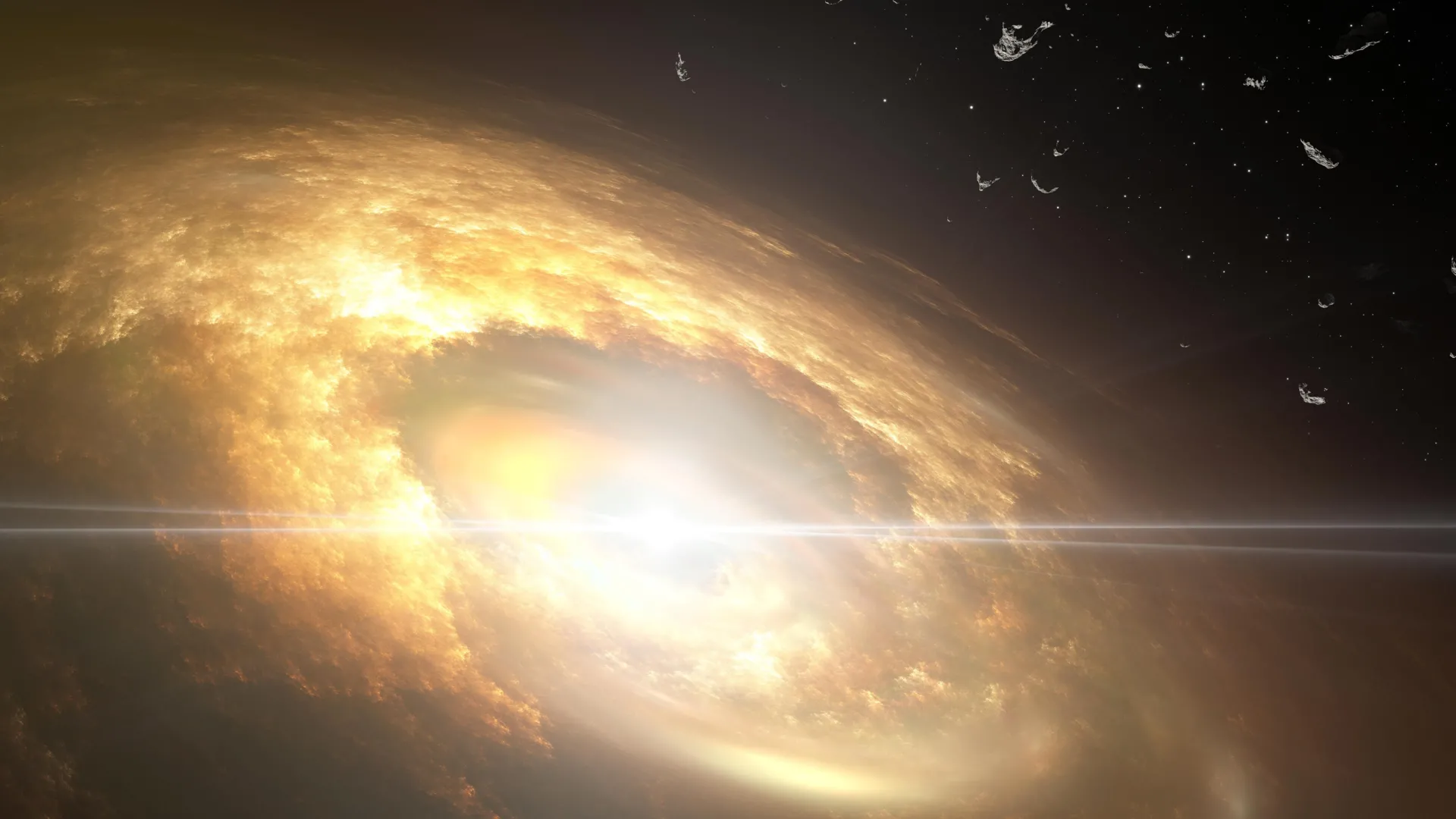
A fascinating glimpse into how a solar system like our own is born has been revealed with the detection of planet-forming ‘pebbles’ around two young stars.
These seeds to make new worlds are thought to gradually clump together over time, in much the same way Jupiter was first created 4.5 billion years ago, followed by Saturn, Uranus, Neptune, Mercury, Venus, Earth and Mars.
The planet-forming discs, known as protoplanetary discs, were spotted out to at least Neptune-like orbits around the young stars DG Tau and HL Tau, both around 450 light-years from Earth.
The new observations, revealed at the Royal Astronomical Society’s National Astronomy Meeting 2025 in Durham, are helping to fill in a missing piece of the planet formation puzzle.
“These observations show that discs like DG Tau and HL Tau already contain large reservoirs of planet-forming pebbles out to at least Neptune-like orbits,” said researcher Dr Katie Hesterly, of the SKA Observatory.
“This is potentially enough to build planetary systems larger than our own solar system.”
The latest research is part of the PEBBLeS project (Planet Earth Building-Blocks — a Legacy eMERLIN Survey), led by Professor Jane Greaves, of Cardiff University.
By imaging the rocky belts of many stars, the team are looking for clues to how often planets form, and where, around stars that will evolve into future suns like our own.
The survey uses e-MERLIN, an interferometer array of seven radio telescopes spanning 217 km (135 miles) across the UK and connected by a superfast optical fibre network to its headquarters at Jodrell Bank Observatory in Cheshire.
It is currently the only radio telescope able to study protoplanetary discs — the cosmic nurseries where planets are formed — at the required resolution and sensitivity for this science.
“Through these observations, we’re now able to investigate where solid material gathers in these discs, providing insight into one of the earliest stages of planet formation,” said Professor Greaves.
Since the 1990s, astronomers have found both disks of gas and dust, and nearly 2,000 fully-formed planets, but the intermediate stages of formation are harder to detect.
“Decades ago, young stars were found to be surrounded by orbiting discs of gas and tiny grains like dust or sand,” said Dr Anita Richards, of the Jodrell Bank Centre for Astrophysics at the University of Manchester, who has also been involved in the research.
“Enough grains to make Jupiter could be spread over roughly the same area as the entire orbit of Jupiter, making this easy to detect with optical and infra-red telescopes, or the ALMA submillimeter radio interferometer.
“But as the grains clump together to make planets, the surface area of a given mass gets smaller and harder to see.”
For that reason, because centimetre-sized pebbles emit best at wavelengths similar to their size, the UK interferometer e-MERLIN is ideal to look for these because it can observe at around 4 cm wavelength.
In one new e-MERLIN image of DG Tau’s disc, it reveals that centimetre-sized pebbles have already formed out to Neptune-like orbits, while a similar collection of planetary seeds has also been detected encircling HL Tau.
These discoveries offer an early glimpse of what the Square Kilometre Array (SKA) telescope in South Africa and Australia will uncover in the coming decade with its improved sensitivity and scale, paving the way to study protoplanetary discs across the galaxy in unprecedented detail.
“e-MERLIN is showing what’s possible, and SKA telescope will take it further,” said Dr Hesterly.
“When science verification with the SKA-Mid telescope begins in 2031, we’ll be ready to study hundreds of planetary systems to help understand how planets are formed.”
The company is getting the funding to collect local stories of experiences of menopause.
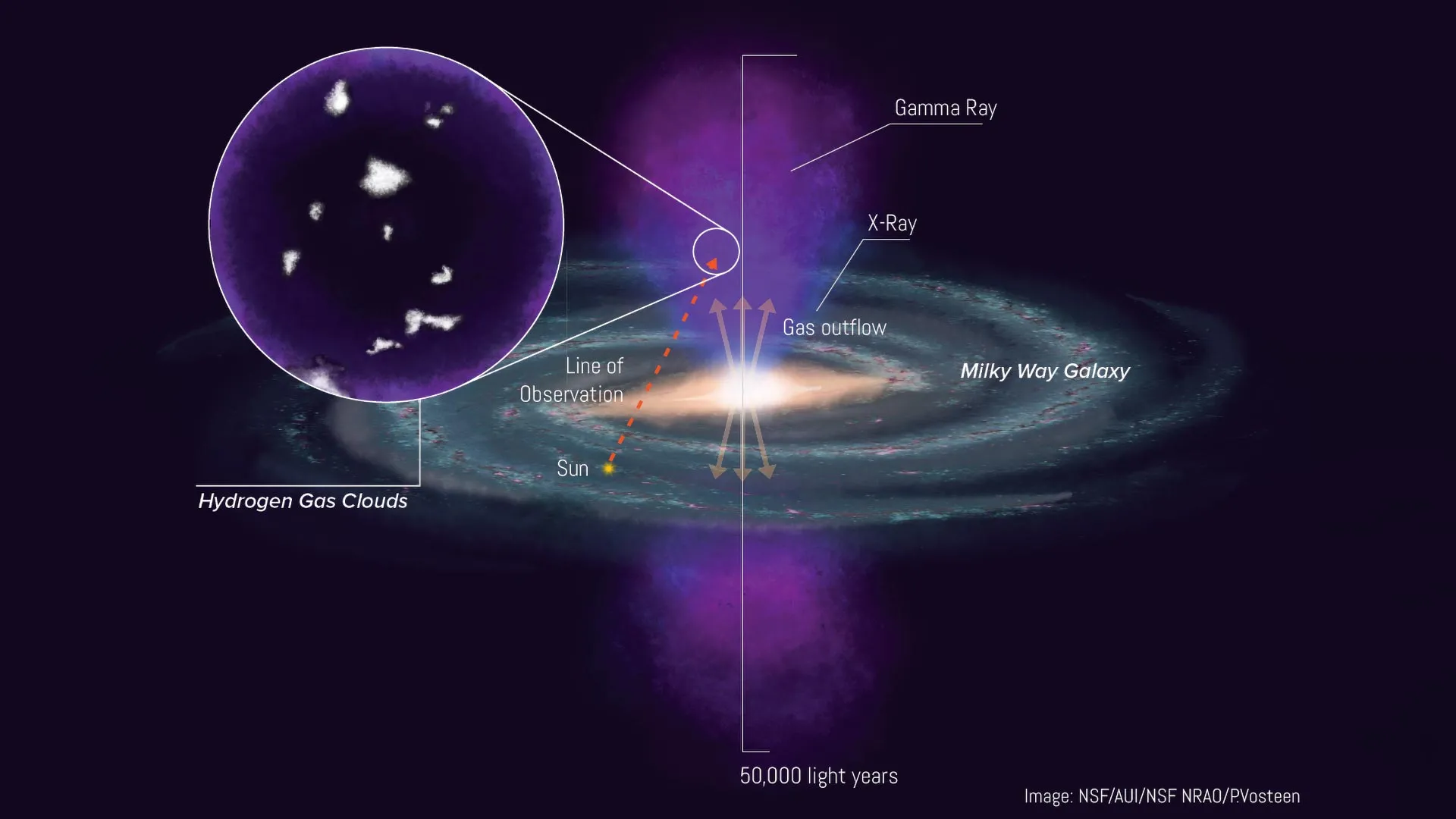
Researchers have found clouds of cold gas embedded deep within larger, superheated gas clouds — or Fermi bubbles — at the Milky Way’s center. The finding challenges current models of Fermi bubble formation and reveals that the bubbles are much younger than previously estimated.
“The Fermi bubbles are enormous structures of hot gas that extend above and below the disk of the Milky Way, reaching about 25,000 light years in each direction from the galaxy’s center — spanning a total height of 50,000 light years,” says Rongmon Bordoloi, associate professor of physics at North Carolina State University and corresponding author of the research.
“Fermi bubbles are a relatively recent discovery — they were first identified by telescopes that ‘see’ gamma rays in 2010 — there are different theories about how it happened, but we do know that it was an extremely sudden and violent event, like a volcanic eruption but on a massive scale.”
Bordoloi and the research team used the U.S. National Science Foundation Green Bank Telescope (NSF GBT) to observe the Fermi bubbles and get high resolution data about the composition of the gas within and the speed at which it is moving. These measurements were twice as sensitive as previous radio telescope surveys of the Fermi bubbles and allowed them to observe finer detail within the bubbles.
Most of the gas inside the Fermi bubbles is around 1 million degrees Kelvin. However, the research team also found something surprising: dense clouds of neutral hydrogen gas, each one measuring several thousand solar masses, dotted within the bubbles 12,000 light years above the center of the Milky Way.
“These clouds of neutral hydrogen are cold, relative to the rest of the Fermi bubble,” says Andrew Fox, ESA-AURA Astronomer at the Space Telescope Science Institute and coauthor of the paper.
“They’re around 10,000 degrees Kelvin, so cooler than their surroundings by at least a factor of 100. Finding those clouds within the Fermi bubble is like finding ice cubes in a volcano.”
Their existence is surprising because the hot (over 1 million degrees Kelvin), high-velocity environment of the nuclear outflow should have rapidly destroyed any cooler gas.
“Computer models of cool gas interacting with hot outflowing gas in extreme environments like the Fermi bubbles show that cool clouds should be rapidly destroyed, usually within a few million years, a timescale that aligns with independent estimates of the Fermi bubbles’ age,” Bordoloi says. “It wouldn’t be possible for the clouds to be present at all if the Fermi bubbles were 10 million years old or older.
“What makes this discovery even more remarkable is its synergy with ultraviolet observations from the Hubble Space Telescope (HST),” Bordoloi says. “The clouds lie along a sightline previously observed with HST, which detected highly ionized multiphase gas, ranging in temperatures from a million to 100,000 Kelvin — which is what you’d expect to see if a cold gas is getting evaporated.”
The team was also able to calculate the speed at which the gases are moving, which further confirmed the age.
“These gases are moving around a million miles per hour, which also marks the Fermi bubbles as a recent development,” Bordoloi says. “These clouds weren’t here when dinosaurs roamed Earth. In cosmic time scales, a million years is the blink of an eye.”
“We believe that these cold clouds were swept up from the Milky Way’s center and carried aloft by the very hot wind that formed the Fermi bubbles,” says Jay Lockman, an astronomer at the Green Bank Observatory and coauthor of the paper. “Just as you can’t see the motion of the wind on Earth unless there are clouds to track it, we can’t see the hot wind from the Milky Way but can detect radio emission from the cold clouds it carries along.”
This discovery challenges current understanding of how cold clouds can survive the extreme energetic environment of the Galactic Center, placing strong empirical constraints on how outflows interact with their surroundings. The findings provide a crucial benchmark for simulations of galactic feedback and evolution, reshaping our view of how energy and matter cycle through galaxies.
The work appears in Astrophysical Journal Letters and is supported by the National Science Foundation under grant number AST-2206853.
The weather alert service warns the public when high or low temperatures could damage their health.
The star illegally advertised prescription-only weight loss drugs, the advertising watchdog found.
Do you need to spend more to get the best for your chapped lips?
The group hopes to help women with newborn care, maternal health, and mental wellbeing.
