
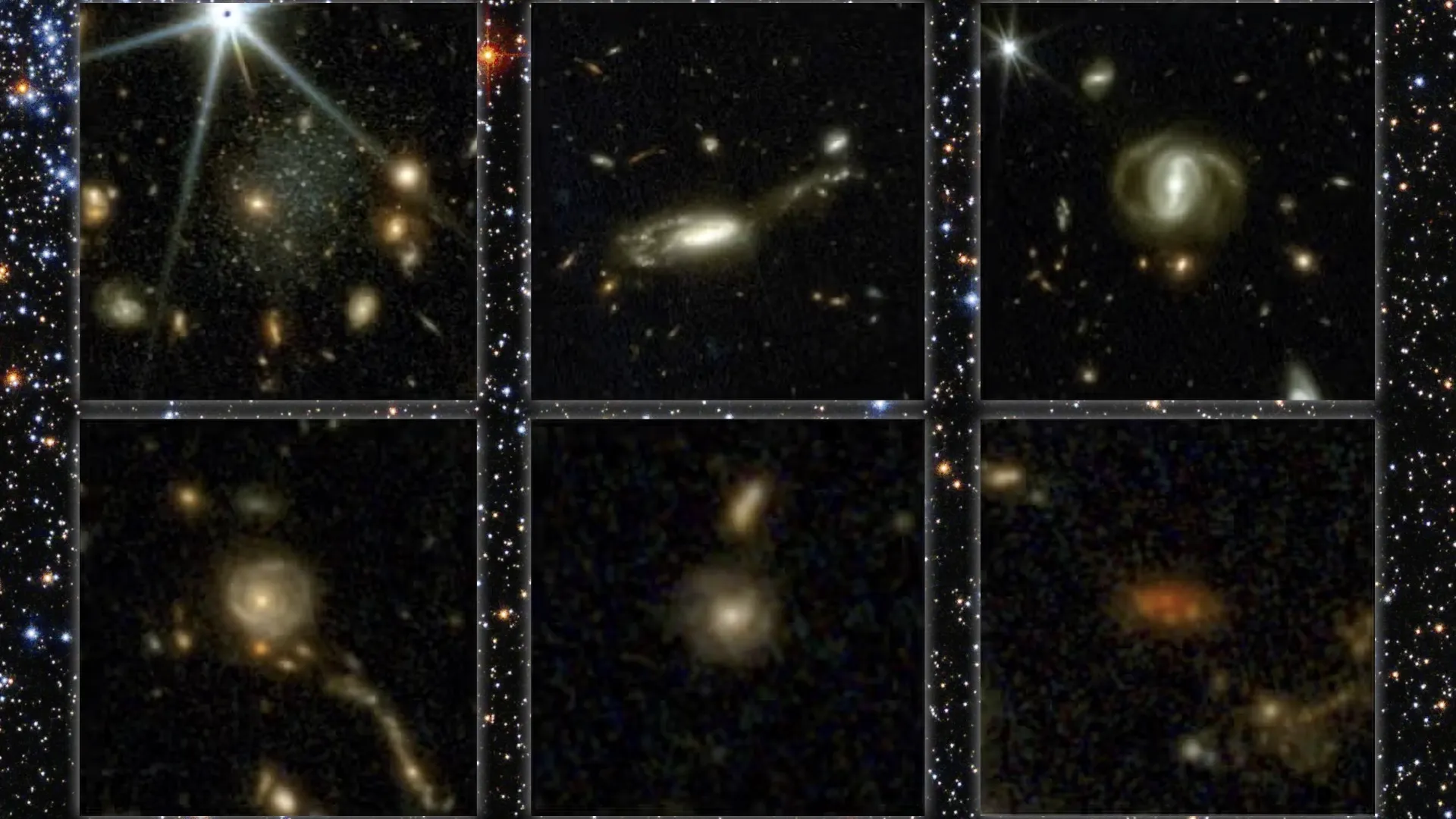
Largest-ever map of the universe reveals 10x more early galaxies than expected

In the name of open science, the multinational scientific collaboration COSMOS on Thursday released the data behind the largest map of the universe. Called the COSMOS-Web field, the project, built with data collected by the James Webb Space Telescope (JWST), consists of all the imaging and a catalog of nearly 800,000 galaxies spanning nearly all of cosmic time. And it’s been challenging existing notions of the infant universe.

“Our goal was to construct this deep field of space on a physical scale that far exceeded anything that had been done before,” said UC Santa Barbara physics professor Caitlin Casey, who co-leads the COSMOS-Web collaboration alongside Jeyhan Kartaltepe of the Rochester Institute of Technology. “If you had a printout of the Hubble Ultra Deep Field on a standard piece of paper,” she said, referring to the iconic view of nearly 10,000 galaxies released by NASA in 2004, “our image would be slightly larger than a 13-foot by 13-foot-wide mural, at the same depth. So it’s really strikingly large.”

The COSMOS-Web composite image reaches back about 13.5 billion years; according to NASA, the universe is about 13.8 billion years old, give or take one hundred million years. That covers about 98% of all cosmic time. The objective for the researchers was not just to see some of the most interesting galaxies at the beginning of time but also to see the wider view of cosmic environments that existed during the early universe, during the formation of the first stars, galaxies and black holes.

“The cosmos is organized in dense regions and voids,” Casey explained. “And we wanted to go beyond finding the most distant galaxies; we wanted to get that broader context of where they lived.”

A ‘big surprise’

And what a cosmic neighborhood it turned out to be. Before JWST turned on, Casey said, she and fellow astronomers made their best predictions about how many more galaxies the space telescope would be able to see, given its 6.5 meter (21 foot) diameter light-collecting primary mirror, about six times larger than Hubble’s 2.4 meter (7 foot, 10 in) diameter mirror. The best measurements from Hubble suggested that galaxies within the first 500 million years would be incredibly rare, she said.

“It makes sense — the Big Bang happens and things take time to gravitationally collapse and form, and for stars to turn on. There’s a timescale associated with that,” Casey explained. “And the big surprise is that with JWST, we see roughly 10 times more galaxies than expected at these incredible distances. We’re also seeing supermassive black holes that are not even visible with Hubble.” And they’re not just seeing more, they’re seeing different types of galaxies and black holes, she added.

‘Lots of unanswered questions’

While the COSMOS-Web images and catalog answer many questions astronomers have had about the early universe, they also spark more questions.

“Since the telescope turned on we’ve been wondering ‘Are these JWST datasets breaking the cosmological model? Because the universe was producing too much light too early; it had only about 400 million years to form something like a billion solar masses of stars. We just do not know how to make that happen,” Casey said. “So, lots of details to unpack, and lots of unanswered questions.”

In releasing the data to the public, the hope is that other astronomers from all over the world will use it to, among other things, further refine our understanding of how the early universe was populated and how everything evolved to the present day. The dataset may also provide clues to other outstanding mysteries of the cosmos, such as dark matter and physics of the early universe that may be different from what we know today.

“A big part of this project is the democratization of science and making tools and data from the best telescopes accessible to the broader community,” Casey said. The data was made public almost immediately after it was gathered, but only in its raw form, useful only to those with the specialized technical knowledge and the supercomputer access to process and interpret it. The COSMOS collaboration has worked tirelessly for the past two years to convert raw data into broadly usable images and catalogs. In creating these products and releasing them, the researchers hope that even undergraduate astronomers could dig into the material and learn something new.

“Because the best science is really done when everyone thinks about the same data set differently,” Casey said. “It’s not just for one group of people to figure out the mysteries.”

For the COSMOS collaboration, the exploration continues. They’ve headed back to the deep field to further map and study it.

“We have more data collection coming up,” she said. “We think we have identified the earliest galaxies in the image, but we need to verify that.” To do so, they’ll be using spectroscopy, which breaks up light from galaxies into a prism, to confirm the distance of these sources (more distant = older). “As a byproduct,” Casey added, “we’ll get to understand the interstellar chemistry in these systems through tracing nitrogen, carbon and oxygen. There’s a lot left to learn and we’re just beginning to scratch the surface.”

The COSMOS-Web image is available to browse interactively; the accompanying scientific papers have been submitted to the Astrophysical Journal and Astronomy & Astrophysics.


Share Button

We always joked dad looked nothing like his parents – then we found out why

Matthew’s father died late last year – before learning the truth about his family history.

Share Button

‘I’m going to outlive our child, there are no words’

Jack is one of only 16 children in the world with a genetic condition so rare it doesn’t have a name.

Share Button

Measles holiday warning as cases rise in Europe

As the summer holiday season gets going, families are being warned of measles outbreaks in many popular European destinations, with vaccination rates in the UK still far below what experts advise.

Share Button

Growing number of MPs changing their mind on assisted dying

At least a dozen MPs who backed the bill or abstained now say they are likely to vote against it.

Share Button

Why food firms are scrambling to cut down on ingredients

Food firms are marketing ranges with fewer ingredients, but are they healthier?

Share Button

Handwritten notes reveal Churchill’s penicillin concern ahead of D-Day

Handwritten notes show the wartime prime minister’s frustration over slow penicillin production.

Share Button

Scientists freeze quantum motion using ultrafast laser trick

Quantum materials exhibit remarkable emergent properties when they are excited by external sources. However, these excited states decay rapidly once the excitation is removed, limiting their practical applications. A team of researchers from Harvard University and the Paul Scherrer Institute PSI have now demonstrated an approach to stabilize these fleeting states and probe their quantum behaviour using bright X-ray flashes from the X-ray free electron laser SwissFEL at PSI. The findings are published in the journal Nature Materials.

Some materials exhibit fascinating quantum properties that can lead to transformative technologies, from lossless electronics to high-capacity batteries. However, when these materials are in their natural state, these properties remain hidden, and scientists need to gently ask for them to pop up. One way they can do this is by using ultrashort pulses of light to alter the microscopic structure and electronic interactions in these materials so that these functional properties emerge. But good things do not last forever – these light-induced states are transient, typically persisting only a few picoseconds, making them difficult to harness in practical applications. In rare cases, light-induced states become long-lived. Yet our understanding of these phenomena remains limited, and no general framework exists for designing excited states that last.

A team of scientists from Harvard University together with PSI colleagues overcame this challenge by manipulating the symmetry of electronic states in a copper oxide compound. Using the X-ray free electron laser SwissFEL at PSI, they demonstrated that tailored optical excitation can induce a ‘metastable’ non-equilibrium electronic state persisting for several nanoseconds – about a thousand times longer than they usually last for.

Steering electrons with light

The compound under study, Sr14Cu24O41 — a so-called cuprate ladder — is nearly one-dimensional. It is composed of two distinct structural units, the so-called ladders and chains, representing the shape in which copper and oxygen atoms organize. This one-dimensional structure offers a simplified platform to understand complex physical phenomena that also show up in higher-dimensional systems. “This material is like our fruit fly. It is the idealized platform that we can use to study general quantum phenomena,” comments experimental condensed matter physicist Matteo Mitrano from Harvard University, who lead the study.

One way to achieve a long-lived (‘metastable’) non-equilibrium state is to trap it in an energy well from which it does not have enough energy to escape. However, this technique risks inducing structural phase transitions that change the material’s molecular arrangement, and that is something Mitrano and his team wanted to avoid. “We wanted to figure out whether there was another way to lock the material in a non-equilibrium state through purely electronic methods,” explains Mitrano. For that reason, an alternative approach was proposed.

In this compound, the chain units hold a high density of electronic charge, while the ladders are relatively empty. At equilibrium, the symmetry of the electronic states prevents any movement of charges between the two units. A precisely engineered laser pulse breaks this symmetry, allowing charges to quantum tunnel from the chains to the ladders. “It’s like switching on and off a valve,” explains Mitrano. Once the laser excitation is turned off, the tunnel connecting ladders and chains shuts down, cutting off the communication between these two units and trapping the system in a new long-lived state for some time that allows scientists to measure its properties.

Cutting-edge fast X-ray probes

The ultra-bright femtosecond X-ray pulses generated at the SwissFEL allowed the ultrafast electronic processes governing the formation and subsequent stabilization of the metastable state to be caught in action. Using a technique known as time-resolved Resonant Inelastic X-ray scattering (tr-RIXS) at the SwissFEL Furka endstation, researchers can gain unique insight into magnetic, electric, and orbital excitations – and their evolution over time – revealing properties that often remain hidden to other probes.

“We can specifically target those atoms that determine the physical properties of the system,” comments Elia Razzoli, group leader of the Furka endstation and responsible for the experimental setup.

This capability was key to dissecting the light-induced electronic motion that gave rise to the metastable state. “With this technique, we could observe how the electrons moved at their intrinsic ultrafast timescale and hence reveal electronic metastability,” adds Hari Padma, postdoctoral scholar at Harvard and lead author of the paper.

The first of many more to come

tr-RIXS gives unique insight into energy and momentum dynamics of excited materials, opening new scientific opportunities for users of SwissFEL in studying quantum materials; indeed, these results come from the first experiment conducted by a user group at the new Furka endstation. It was the interest in the development of tr-RIXS at Furka that motivated the Harvard team to collaborate with scientists at PSI. “It’s a rare opportunity to get time on a machine where you can do these sorts of experiments,” comments Mitrano.

Since this initial pilot experiment, the Furka endstation has undergone upgrades to improve the RIXS energy resolution, and it is ready to study new types of individual and collective excitations, such as lattice excitations. “This experiment was very important to showcase the kind of experiments that we can carry out. The endstation and its instrumentation are already much better now, and we will keep improving it,” concludes Razzoli.

This work represents a major step forward in controlling quantum materials far from equilibrium, with broad implications for future technologies. By stabilising light-induced non-equilibrium states, the study opens new possibilities for designing materials with tuneable functionalities. This could enable ultrafast optoelectronic devices, including transducers that convert electrical signals to light and vice versa — key components for quantum communication and photonic computing. It also offers a pathway toward non-volatile information storage, where data is encoded in quantum states created and controlled by light.

Share Button

Watch: Are weight-loss jabs worth the side effects?

Rebecca ordered the jab online, but now says she is considering not using it after losing some of her hair.

Share Button

Women warned weight-loss jabs may affect the pill

Women should use the most effective contraception to avoid pregnancy while taking ‘skinny jabs’, the drugs regulator says.

Share Button