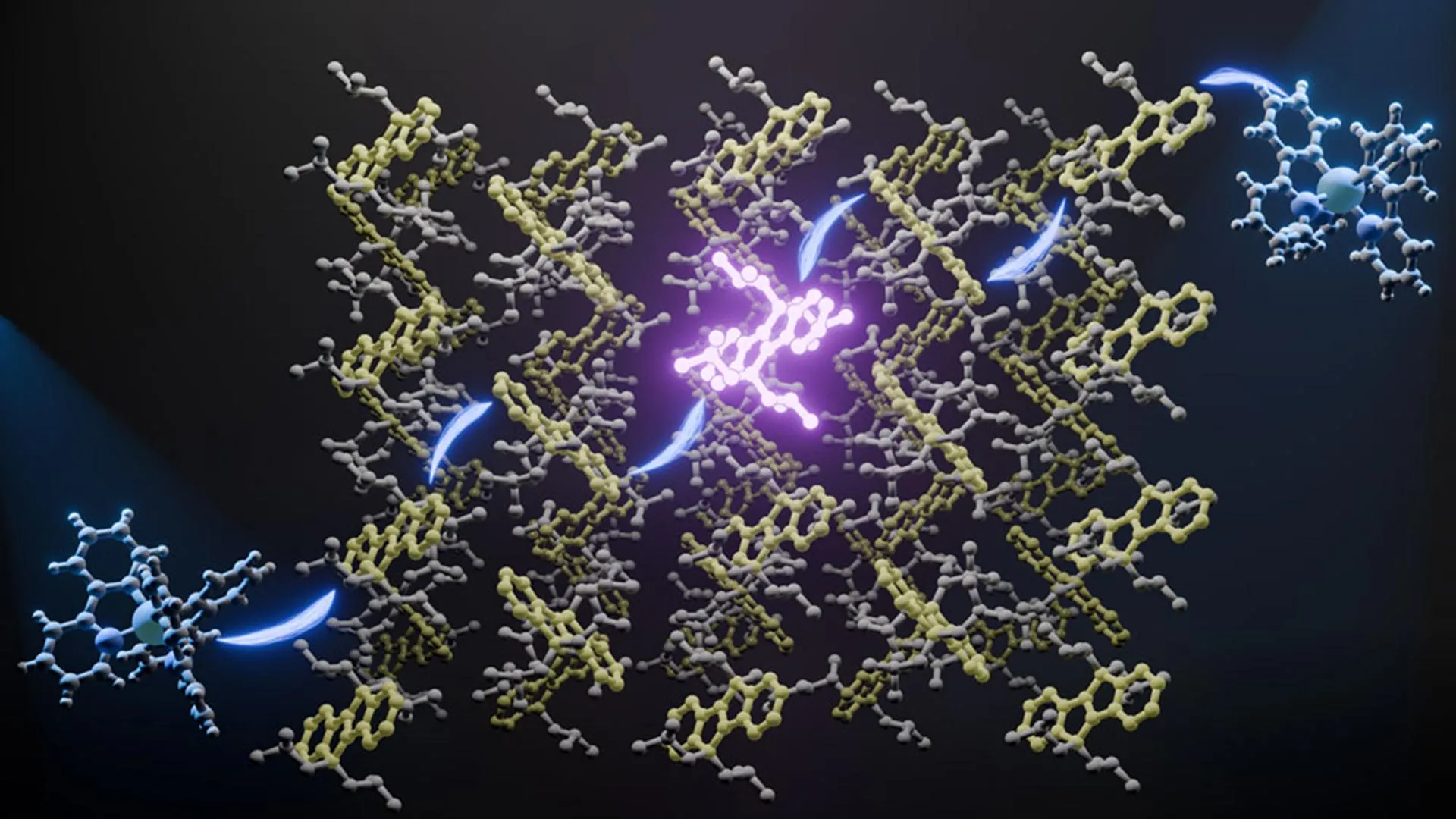
New solid-state material converts sunlight into higher-energy UV light

Imagine pouring together two cups of warm water and somehow ending up with a cup of boiling water. That cannot happen in everyday life, but at the quantum level, something similar is possible. Multiple low-energy particles of light can combine their energy to create a single particle with much higher energy.

Researchers at Kyushu University have now created a solid-state molecular material capable of converting visible sunlight into ultraviolet (UV) light under normal outdoor conditions. The new material achieves a photo upconversion efficiency of 1.9%, according to a study published June 23 in Nature Communications.

Why UV Light Matters

Although many people associate UV light with sunburns and skin damage, it plays an important role in numerous technologies. UV light is used for air purification, curing resins in 3D printing, hardening gels in dental fillings, and even applications such as nail treatments.

Despite its usefulness, UV light represents only about 6% of the sunlight that reaches Earth’s surface. Even then, only part of that UV radiation is practical for technological applications.

“What we do here is ‘add together’ the energy from two visible light photons to make one ultraviolet photon. It’s a fascinating process called photo upconversion,” explains Yoichi Sasaki, Associate Professor at Kyushu University’s Faculty of Engineering and the study’s corresponding author.

Turning Visible Light Into UV Light

The process relies on a phenomenon known as triplet-triplet annihilation (TTA). In this approach, a molecule known as a donor absorbs visible light and enters a high-energy triplet state. That energy is then transferred to a nearby acceptor molecule.

When two triplet states encounter one another, they combine and release their energy as a single UV photon.

Scientists have long known that TTA works effectively in liquids because molecules can move freely and interact easily. However, liquid systems often require toxic solvents and may evaporate over time, limiting their practicality. As a result, researchers have spent years searching for a reliable solid-state alternative.

“In solids, molecules are packed tightly, and the π electron clouds — regions of high electron density hovering above and below each molecular plane — can overlap,” says Sasaki. “When that happens, triplets easily fizzle out before they ever meet. Molecules must be close enough for energy to transfer but separated enough to prevent quenching of excitons.”

A New Solid-State Solution

The team’s breakthrough came from an organic semiconductor called dihydroindenoindenedene (DHI).

The researchers modified DHI by attaching alkyl chains to its sp³ carbon atoms — which have four bonds pointing in fixed 3D directions. This design created carefully controlled spacing between neighboring molecules. The molecules remained close enough to transfer energy efficiently while avoiding the strong electronic interactions that can suppress performance.

The resulting material exhibited strong luminescence, long-lived excited states, and highly effective energy transfer. It achieved a solid-state fluorescence quantum yield greater than 60%.

When paired with a donor molecule, the system reached an upconversion efficiency of 1.9%.

“This means roughly two UV photons are produced for every hundred visible-light photons absorbed,” Sasaki adds. “It may sound low, but it runs on natural sunlight alone. Most solid-state materials cannot realize this even at much higher light intensity.”

Potential Applications for Solar-Powered UV Light

The researchers have filed a patent application for the material.

In addition to its performance, the material offers practical advantages. It can be synthesized relatively easily and is made from inexpensive starting materials. The team believes it could eventually be used in solar-powered photocatalysis, indoor air purification systems, and low-intensity 3D printing technologies.

A 14-Year Scientific Journey

For the researchers involved, the achievement represents more than a technical advance.

In 2012, Nobuo Kimizuka, now Professor Emeritus at Kyushu University’s Research Center for Negative Emissions Technologies, began exploring photon upconversion through triplet energy migration in self-assembled molecular systems. His goal was to establish a form of molecular systems chemistry in which self-assembly could perform useful functions.

Over the following years, his group made steady progress using solution-based and gel-based systems. Efficient solid-state upconversion, however, remained difficult to achieve.

A major breakthrough finally arrived in May 2024, less than a year before Kimizuka’s retirement.

The months that followed became an intense push to bring the project to completion. Graduate students Naoyuki Harada, Hayato Shoyama, and Nutnicha Boonmong worked alongside Sasaki and then-Assistant Professor Kiichi Mizukami of Kyushu University’s Faculty of Engineering to consolidate years of research into a final publication.

“We handed the draft to Professor Kimizuka just 11 days before he left the lab, which for us felt like a heartfelt retirement gift,” Sasaki notes.

“This discovery is the culmination of over 14 years of our research and marks a major milestone in photon-upconversion and molecular self-assembly research,” concludes Kimizuka.


Share Button

Researchers discover why fructose doesn’t satisfy hunger like glucose

Fructose and glucose are two common sugars found in many foods and drinks. Although they contain the same number of calories, new research suggests the brain responds to them in very different ways.

Scientists at the Monell Chemical Senses Center discovered that fructose and glucose communicate with the brain through separate gut-brain pathways. Their findings indicate that these differences may influence food and beverage preferences and could help explain why certain sweetened products are especially appealing.

The study, published June 10 in the journal Neuron, identified a specific signaling route that allows fructose to communicate with the brain. In experiments involving mice, researchers found that this pathway was far less effective than the one used by glucose when it came to reducing activity in neurons associated with hunger.

“This work adds to our growing understanding of how modern diets, especially those high in fructose or high-fructose corn syrup, interact with the neural systems involved in appetite,” said senior author and Monell Member Amber Alhadeff, PhD.

How Fructose and Glucose Affect Hunger Neurons

To investigate how the sugars influence the brain, researchers recorded neural activity in mice after exposure to fructose and glucose.

The team found that fructose increased levels of the gut hormone PYY. That hormone then signaled through the vagus nerve, leading to a modest reduction in the activity of agouti-related protein (AgRP) neurons, which play a major role in driving hunger. When researchers disrupted this pathway, fructose could no longer affect those neurons.

Glucose produced a very different response. According to the researchers, it did not rely on the same PYY-Y2 vagus nerve pathway. Instead, glucose strongly suppressed AgRP neuron activity, resulting in a much larger effect on hunger-related brain signaling.

Sugar Type Influenced Food Preferences

Although fructose and glucose produced similar short-term effects on food intake, the mice eventually developed preferences that corresponded to the degree of AgRP neuron inhibition triggered by each sugar.

The researchers also examined high-fructose corn syrup (HFCS), a widely used sweetener made from a combination of fructose and glucose. The mice showed a preference for HFCS, and the sweetener suppressed AgRP neuron activity more strongly than fructose alone.

According to the researchers, this stronger effect on hunger-related neurons may help explain why foods and beverages containing HFCS can be particularly appealing.

Challenging Assumptions About Calories and Hunger

The results call into question a long-held assumption that AgRP neurons primarily track calorie intake regardless of where those calories come from.

Instead, the findings suggest that these hunger-related neurons can distinguish between different sugars and respond through separate biological pathways. Even though fructose and glucose provide the same amount of energy, the mice’s brains processed them differently.

The study highlights the complexity of nutrient sensing in the body and suggests that even simple sugars can have distinct effects on the gut, the brain, and behavior.

This research was supported by grants R01DK131558, DP2AT011965, R01DK116004, F31DK13558, and S10OD030354 from the National Institutes of Health; the American Heart Association; the New York Stem Cell Foundation; the Klingenstein Fund; the Simons Foundation, the Pew Charitable Trusts, the Penn Institute for Diabetes, Obesity, and Metabolism; the Hearst Fellowship, and the Monell Chemical Senses Center.

Share Button

Even young and fit urged to skip runs and too many beers in heatwave

Cardiac arrests have gone up during very hot weather, and it’s not just among the elderly and frail, experts are warning.

Share Button

Is laughter really the best medicine?

Researchers launch a “Laughter Lab” to explore how laughing can improve wellbeing and health.

Share Button

Earth may have been seeding Venus with life for billions of years

The theory of panspermia proposes that life, or the ingredients needed for it, can spread throughout the cosmos aboard asteroids, comets, and other rocky objects. When life develops on a planet, powerful impacts can blast material from its surface into space, potentially carrying microscopic organisms or organic compounds to other worlds. Scientists have long debated whether this kind of transfer may have occurred between Earth and Mars (in both directions). More recently, renewed interest in the possibility of microbial life within Venus’ thick cloud layers has expanded that discussion to include Earth, Venus, and Mars.

A recent study presented at the 2026 Lunar and Planetary Science Conference (LPSC) takes a closer look at that possibility. Researchers from The Johns Hopkins University Applied Physics Laboratory (JHUAPL) and Sandia National Laboratories used the “Venus Life Equation” (VLE), a framework developed by Noam Izenberg et al. in 2021, to estimate how material from Earth could introduce life into Venus’ atmosphere. Their modeling suggests that life delivered from Earth could potentially survive in Venus’ clouds for at least a few days per century.

The Venus Life Equation

Like the famous Drake Equation, the VLE estimates the probability of life by combining several contributing factors. Each factor is multiplied together to produce an overall estimate of the likelihood that life exists.

*### L = O x R x C*

In this equation, L represents the likelihood of Extant Life (0 to 1, where 0 is no chance and 1 is certainty). O stands for origination (the chance life began and became established on Venus), R represents Robustness (the ability of a biosphere to survive and adapt to changing conditions), and C refers to Continuity (The chance that habitable conditions persisted until today). Before applying this framework, the researchers first examined whether organic material could survive the journey from one planet to another, regardless of where it originally formed.

Surviving the Journey to Venus

Material blasted into space by an impact must endure enormous challenges. In addition to the violent shock of ejection, it is exposed to intense heat, the vacuum of space, radiation, and extreme temperature swings. Previous computer simulations and analyses of meteorites found on Earth have shown that organic material can survive both ejection from a planet and the trip through interplanetary space. Once it reaches Venus, however, that material would also need to remain suspended within or above the planet’s cloud layers in order to survive.

To investigate this, the team modeled how fireball meteorites (bolides) behave as they enter Venus’ atmosphere, including their ablation, explosion, and breakup into smaller fragments capable of remaining in the clouds. They relied on the “pancake model,” a widely used semi-analytic approach that describes how a bolide fragments while passing through an atmosphere. After the bolide explodes in the atmosphere (an “airburst”), aerodynamic drag spreads the fragments outward into a flattened “pancake” of material that the researchers describe as “cells.”

Billions of Potential Transfers

Using the pancake model together with values derived from earlier studies, the researchers estimated how many bolides from Earth or Mars could have reached Venus’ clouds. Their calculations suggest that hundreds of billions of cells may have been delivered from Earth to Venus, with hundreds of billions potentially remaining viable. Their preferred estimate indicates that about 100 cells become dispersed throughout Venus’ clouds each Earth year. Over the past 1 billion years, roughly 20 billion cells may have been transferred from Earth.

The researchers emphasize that their model does not capture every aspect of how bolides interact with Venus’ atmosphere. They also note that every parameter in the VLE carries significant uncertainty, much like the Drake Equation. Even so, their findings support the possibility that panspermia between Earth and Venus could occur. If a future astrobiology mission discovers life in Venus’ clouds, one possible explanation is that it originally came from Earth.

Share Button

Einstein Probe may have caught a black hole tearing apart a white dwarf for the first time

An extraordinary high-energy event detected deep in space is giving astronomers a rare opportunity to study some of the Universe’s most extreme phenomena.

On July 2, 2025, the China-led Einstein Probe (EP) space telescope spotted an exceptionally bright X-ray source during a routine survey of the sky. The object’s brightness changed rapidly, making it immediately stand out from typical cosmic X-ray sources. The unusual detection prompted observatories around the world to begin follow-up observations.

The research was coordinated by the EP Science Center at the National Astronomical Observatories, Chinese Academy of Sciences (NAOC), with scientists from research institutions in China and several other countries contributing to the effort. Researchers from the Department of Physics at The University of Hong Kong (HKU), who are key members of the Einstein Probe scientific collaboration, helped interpret the observations. Their analysis suggests the event may represent an intermediate-mass black hole tearing apart and consuming a white dwarf star. If confirmed, it would provide the first direct observational evidence of this type of black hole feeding event. The results were published as the cover article in Science Bulletin.

Einstein Probe Detects an Unusual Cosmic Explosion

The discovery relied on the Einstein Probe’s two complementary X-ray instruments.

During its routine survey on July 2, 2025, the mission’s Wide-field X-ray Telescope (WXT), which combines advanced lobster-eye micro-pore optics with a very wide field of view and high sensitivity, detected a rapidly changing X-ray source that was later designated EP250702a (also known as GRB 250702B). At nearly the same time, NASA’s Fermi Gamma-ray Space Telescope detected several gamma-ray bursts coming from the same region of the sky.

Scientists realized the event was far more unusual after reviewing earlier WXT observations. The telescope had already detected steady X-ray emission from the same location roughly a day before the gamma-ray bursts appeared, a sequence rarely associated with powerful cosmic explosions. Around 15 hours after the initial detection, the source erupted into a series of intense X-ray flares. At its brightest, it reached a luminosity of approximately 3 × 1049 erg s-1, making it one of the brightest instantaneous outbursts ever recorded in the Universe.

“This early X-ray signal is crucial,” said Dr. Dongyue Li, first author of the paper from the National Astronomical Observatories of China. “It tells us this was not an ordinary gamma-ray burst.”

Rare X-Ray Signal Points to a Black Hole Feeding Event

Using the precise location measured by WXT, astronomers quickly directed major telescopes around the world toward the source. Observations across multiple wavelengths confirmed that the object was located on the outskirts of a distant galaxy. The Einstein Probe’s second instrument, the Follow-up X-ray Telescope (FXT), then monitored the event as it evolved.

Over roughly 20 days, the object’s brightness faded by more than a factor of 100,000. During that time, its X-ray emission also shifted from higher-energy (“hard”) X-rays to lower-energy (“soft”) X-rays.

After combining Einstein Probe observations with data collected across the electromagnetic spectrum, researchers found that EP250702a displayed several characteristics that existing models struggled to explain. Its X-ray emission began before the gamma-ray burst, it reached extraordinary brightness, evolved unusually quickly, and occurred in the outer region of its host galaxy instead of near the galaxy’s center, a combination that is rarely seen in known high-energy cosmic events. After evaluating multiple possible explanations, one scenario emerged as the strongest candidate: an intermediate-mass black hole tearing apart and consuming a white dwarf star.

Share Button

How to treat heat exhaustion

BBC Medical Editor Fergus Walsh speaks to St John’s ambulance service about treating heat exhaustion.

Share Button

Consultants and specialist doctors take strike action over pay

Full emergency cover remained in place and patients were told to attend all scheduled appointments unless advised otherwise.

Share Button

This common vitamin deficiency can mimic normal aging

Two micrograms is an almost unimaginably small amount. It weighs less than a tiny fragment of a grain of table salt. Yet adults need only around this amount of vitamin B12 each day, depending on the guideline used, to support red blood cells, nerves and DNA production.

In 2026, it is 100 years since George Minot and William Murphy reported that a liver-rich diet could treat pernicious anemia, then a frequently fatal disease. Their work transformed medicine and eventually led scientists to identify vitamin B12 as the substance in liver that treated the disease.

But the route to that breakthrough began with an unexpected clue from animal experiments. The American physician and pathologist George Whipple had shown that liver helped dogs recover from anemia caused by blood loss. Blood-loss anemia happens when the body loses red blood cells through bleeding. Pernicious anemia is different: the problem is not bleeding, but poor absorption of vitamin B12. Even so, Whipple’s experiments pointed researchers towards liver as a source of a powerful blood-forming factor.

Patients with pernicious anemia who had been close to death often improved dramatically within weeks of eating liver-rich diets. The success of liver treatment eventually led scientists to isolate the deep red compound now known as vitamin B12, or cobalamin.

Often mistaken

Despite decades of research, vitamin B12 deficiency remains common, particularly among older adults, vegans, vegetarians and people with conditions that affect absorption. Some people do not consume enough B12 because it is naturally found mainly in foods from animals, including meat, fish, eggs and dairy products. Others struggle to absorb it properly.

This becomes more common with age. Some older people produce less stomach acid, which is needed to release B12 from food. Others develop autoimmune gastritis, in which the immune system damages stomach cells involved in producing acid and intrinsic factor, the protein needed for vitamin B12 absorption. Weight-loss surgery and some medicines used for diabetes or acid reflux can also reduce absorption.

The symptoms of deficiency can develop slowly and are often mistaken for normal ageing. People may feel exhausted, weak or short of breath. Some develop numbness or tingling in their hands and feet, poor balance, memory problems or what many describe as “brain fog”. These symptoms are not specific to B12 deficiency, so persistent tiredness, tingling or balance problems should be checked rather than assumed to be a simple vitamin problem.

People at higher risk, including vegans, vegetarians, older adults and those taking medicines that affect stomach acid or diabetes treatment, may need testing or supplementation advice from a health professional.

Doctors have traditionally linked tiredness in B12 deficiency to anemia. Without enough vitamin B12, the bone marrow cannot produce healthy red blood cells. Instead, it releases unusually large and immature cells that carry oxygen less effectively around the body.

But anemia may not be the only reason people with low B12 feel exhausted.

Low energy

In humans, vitamin B12 is directly needed by only two enzymes, the proteins that help chemical reactions happen in the body. One helps the body make DNA, which cells need when they divide. The other helps mitochondria process certain fats and protein building blocks. Mitochondria are the tiny structures inside cells that help turn food into usable energy.

This mitochondrial role has attracted growing interest from researchers studying ageing, muscle function and vitamin B12 status. A 2026 study explored what happens when cells do not have enough B12. Researchers found that low B12 could interfere with the DNA inside mitochondria and reduce energy production in laboratory models of skeletal muscle (muscle cells studied outside the human body).

A related study in aged female mice found that B12 supplementation improved several signs of mitochondrial health in muscle, including the number and structure of mitochondria. Together, this work points to one possible reason why some people with low B12 report fatigue before obvious anemia is detected.

These findings do not mean vitamin B12 supplements can reverse ageing or act as an energy booster for people whose B12 levels are already normal.

Scientists have suspected a link between B12 and mitochondrial function for many years, because one of the two B12-dependent enzymes works inside mitochondria. Earlier research has also suggested that low B12 status may be linked with poorer muscle function in older adults, although much of this work is observational and cannot prove cause and effect.

So if you’re feeling persistently tired, is it worth paying for vitamin B12 injections at a wellness clinic or medispa? For most people, no. B12 injections are an established treatment for diagnosed deficiency, particularly when absorption is impaired, and the NHS uses hydroxocobalamin injections for vitamin B12 deficiency anemia.

But there is little evidence that B12 shots boost energy, weight loss or performance in people whose B12 levels are already normal. The more useful first step is to find out what is causing the tiredness.

The story of vitamin B12 is unusual because the body needs so little of it, yet the consequences of deficiency can be profound. Long before scientists understood its chemistry, doctors recognized that something in liver could restore strength, appetite and vitality to desperately ill patients.

A century later, researchers are still finding that this tiny cobalt-containing molecule does more than prevent anemia. It may also help explain how cells maintain energy and function as the body ages.The Conversation

Share Button

They knew the pill was fake but their memory still improved

A placebo, or fake supplement, may offer real benefits for older adults, according to new research from psychologists at the Università Cattolica in Milan. After taking placebo pills for three weeks, participants showed improvements in both physical performance and cognitive function. Surprisingly, the benefits were seen even when participants knew the pills contained no active ingredients.

The study, published in the International Journal of Clinical and Health Psychology, was led by Diletta Barbiani, Alessandro Antonietti, and Francesco Pagnini. It was supported by PNRR grants through the Age-IT project.

“The study is part of an established line of research in which we analyze the role of the mind in aging processes, which is very important,” says Pagnini, Full Professor of Clinical Psychology at the Faculty of Psychology of the Università Cattolica.

Testing the Placebo Effect in Healthy Aging

Until now, no research had investigated whether a traditional placebo could influence abilities that naturally decline with age.

“Our goal,” Professor Pagnini explains, “was to clarify whether an open-label placebo therapy (i.e., where the recipient is aware it is a placebo) or a fake supplement (people don’t know it’s a placebo) could influence psychological, cognitive, and physical functions in older adults living in the community.”

To explore that question, the researchers recruited 90 healthy older adults and randomly assigned them to one of three groups. One group received no treatment at all. A second group received placebo pills but was told the pills contained active ingredients designed to improve well-being and physical function. The third group received the same inactive pills but was openly informed that the pills were placebos that could still trigger beneficial mind-body responses.

Before and after the three-week study, participants completed questionnaires (providing information on levels of perceived stress, psychological well-being, sleepiness, fatigue, optimism, self-efficacy, and stereotypes about aging). They also took objective tests measuring short-term memory, selective attention, and physical performance.

Memory, Stress, and Physical Performance Improved

After three weeks, the participants who knowingly took placebo pills experienced lower stress levels than both the deceptive placebo group and the control group. They also showed significant improvements in short-term memory compared with those who received no intervention.

Overall, both placebo groups experienced gains in cognitive and physical performance, although the strongest improvements were generally seen among participants who knew they were taking a placebo.

Physical performance increased by 7% in the deceptive placebo group and by 9.2% in the open-label placebo group. Cognitive performance also improved. Depending on the specific test, scores increased by between 12.6% and 14.6% among participants who believed they were taking a real supplement, while those who knowingly took a placebo improved by between 6.9% and 21.5%.

“These are significant effects,” the psychologist emphasizes, “comparable to those seen in some experimental studies on physical activity regarding physical performance and cognitive training, especially with regard to memory.”

Researchers also observed reductions in drowsiness. Stress levels improved most noticeably among participants who were aware they were taking a placebo.

A New Approach to Healthy Aging?

The findings suggest that placebo treatments can improve several aspects of functioning in older adults, with open-label placebos performing as well as, or in some cases better than, deceptive placebos.

According to the researchers, this makes open-label placebos a promising and ethically acceptable strategy for supporting healthy aging.

Professor Pagnini says the results add to growing scientific evidence that the mind plays an important role in the aging process. Thoughts, emotions, and self-perception may influence not only psychological well-being but also physical abilities and cognitive function, highlighting the powerful connection between the mind and the body.

Share Button