Walkout by Royal College of Nursing members in more than half of services expected by end of year.


Walkout by Royal College of Nursing members in more than half of services expected by end of year.
As I’ve been playing around with AI art tools, I decided to update the associated images for our courses. I wanted to come up with a more unique and personal expression than using the old stock images as we’ve been doing for the past few years.
This was a relatively small project, and it gave me a nice reason to delve into some interesting AI tools to better assess their capabilities. I definitely learned a lot and very much enjoyed the experience.
With most of the images I iterated dozens of times, feeding incremental images back to the AI tools and prompting them to keep evolving those images in directions of my choosing.
I also did some classic image editing to get the images the way I wanted them to look. Often I’d do some edits along the way to nudge the AI to explore in a different direction.
I began by feeding the AI different words that I associated with a given course, including the name of the course, my name, and lots of topical keywords that relate to the course. Then I set the AI to generate at least 100 images to begin with, sometimes a few hundred, so I could see a nice divergent set of conceptual ideas. From there I could pick my favorites and evolve some of them further.
I went through many rounds of diverging to generate more ideas and then converging by creating more subtle variations of concepts I like. Finally I did some fine-tuning.
The experience was like having a team of artists to keep creating more art, and I could keep guiding them and giving them feedback till they created something that satisfied me.
I don’t expect or need other people to like my creations. My goal was to replace the stock photo images with creations that are meaningful to me, full of symbolism and imagery that genuinely connects with each course. I wanted to raise my standard for authentic and personal expression. I’m not seeking to impress anyone, and I’m sure some people will not like the images. I’m totally okay with that. I really like how these turned out though.
I smile now when I look at the Courses page since I have a personal connection to each image. I no longer think, “I should really replace that stock image with something more expressive.”
The first one I made was the Submersion image.

Submersion is about exploring Subjective Reality, which can be like stepping through a portal, so I like that this looks portal-like. SR is also a lens that can be used, so the lens-like look works nicely too.
With this image I did very little editing and largely used what the AI created, although I did generate many hundreds of other images before finding this one. I like how it conveys so many aspects of the Submersion experience in a compact visual form, especially how you can’t really grasp the world of SR until you finally dive in and explore it. It looks like some kind of deep aquatic world inside, but you’ll never know what it’s like to be in that reality till you go inside and experience it for yourself. I love how this image invites us to explore what’s in there.
I especially like the intricate look of the border around the portal. I deliberately prompted the AI to create something intricate and detailed.
Rachelle also noted that this image reminds her of an old diver’s helmet, which is another good association to the course.
I find this image very beautiful too. I love the rich complexity of it.
The next image I created was for the Octo Intensive workshop that we did online in October 2021.

This was a one-time workshop, so I’m only using this image for the recorded version that Conscious Growth Club members can access as part of their membership.
The Octo Intensive was about 8 principles of motivation, hence the Octo theme. At first the AI was generating a lot of weird octopus images that were too literal, so I had to tone down the octopus prompting and nudge it to do more with the other concepts. Eventually we started converging in an interesting direction.
I like how to ribbon represents a prize, award, or gift, and there are embedded diamonds as well, representing the many rewards of maintaining strong motivation. The octopus owns its place in the midst of those rewards, like of course that’s where it belongs. Its eyes look a bit like gemstones too – a reminder to practice intentionality by focusing on our desires.
For Deep Abundance Integration, I started with a tree in a circle and then evolved it a lot from there, eventually coming up with this.

I put a lot of thought into the symbolism that I included in this one. There’s a tree and leaves for growth. The leaves are textured for nuance and subtleties in the growth journey. The tree has branches for the many form of abundance. There are leaves below (inner journey) and leaves above (external rewards).
The heart jewel is to remind people to follow their path with a heart and for a symbol of wealth and luxury. The water has ripples for the many ripples that we can create with an abundance mindset. Sunrise is happening in the background (sunny days ahead).
The copper color was Rachelle’s idea. I like it as a symbol of groundedness and depth since it’s mined from the earth. She also came up with the heart idea.
The sky represents unlimited expansion (i.e. the sky’s the limit).
I like images that look like they could be real physical objects instead of just making flat 2D images. I like it when images convey depth and texture, like I could reach out and touch them. This reminds me that the growth ideas in these courses are accessible. They aren’t merely ideas – we can integrate them into our lives and make them real.
This new Stature image took took the longest, but I love how it turned out.
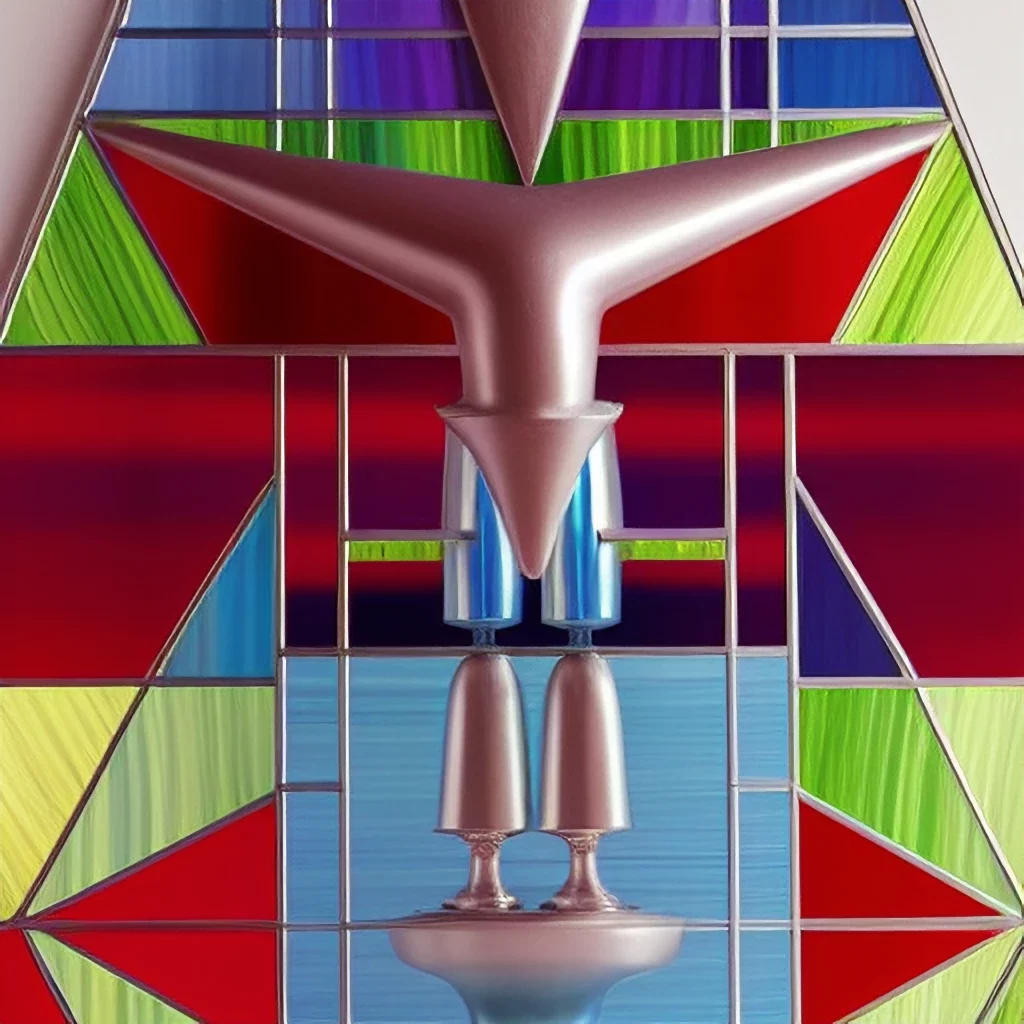
There’s a bronze person with outstretched arms, and there’s an animal-like face in the glass behind. The eyes of the face also function as a Superman-like cape for the figure.
There’s more symbolism embedded in this… such as putting metal (strong) in front of glass (fragile).
Stature is a course on character sculpting, which is like transforming the wild, beast-like parts of ourselves into the strong selves that we wish to become. Yet we don’t abandon the beast side because it supports us in our human journey.
The Amplify image merges a microphone, speaker, and light bulb all in one. I love the simple elegance of this one.
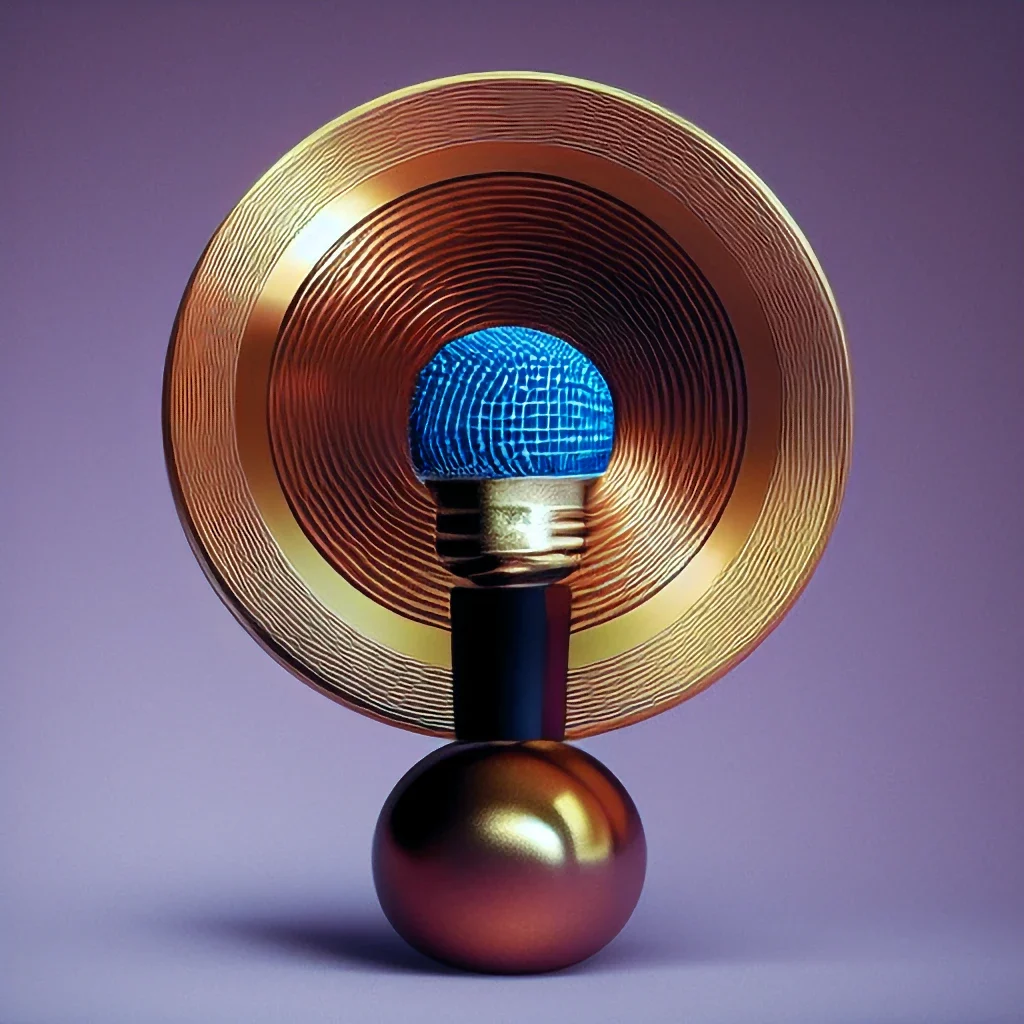
This was the fastest and easiest course image to create, and I felt like I was really in the flow of working with the AI to develop it. It still took many iterations, but we made interesting progress at each step and converged pretty quickly.
Amplify is a course on creative flow and creative productivity. The mic represents finding our voice. The light bulb is for creative ideas, and since the light bulb is the same object as the mic, it’s a reminder to act on inspired ideas immediately. The speaker in the background is there to amplify the message, and it also looks a bit rippled to represent the ripples we can create.
This image also has a structure similar to a trophy, representing the fulfillment side of creative achievement.
And the image is compact and simple, reminding us that we can just create without overcomplicating the experience.
Tech-wise though, that configuration would send a ton of audio feedback from the speaker right into the mic, so that’s symbolic of hearing the call of one’s audience so loudly you can no longer ignore it. It’s like the speaker is advertising that it’s time to step up to the mic and start expressing yourself.
Guild is a course on social alignment, so I wanted to convey many different aspects of a good social circle in a single image.
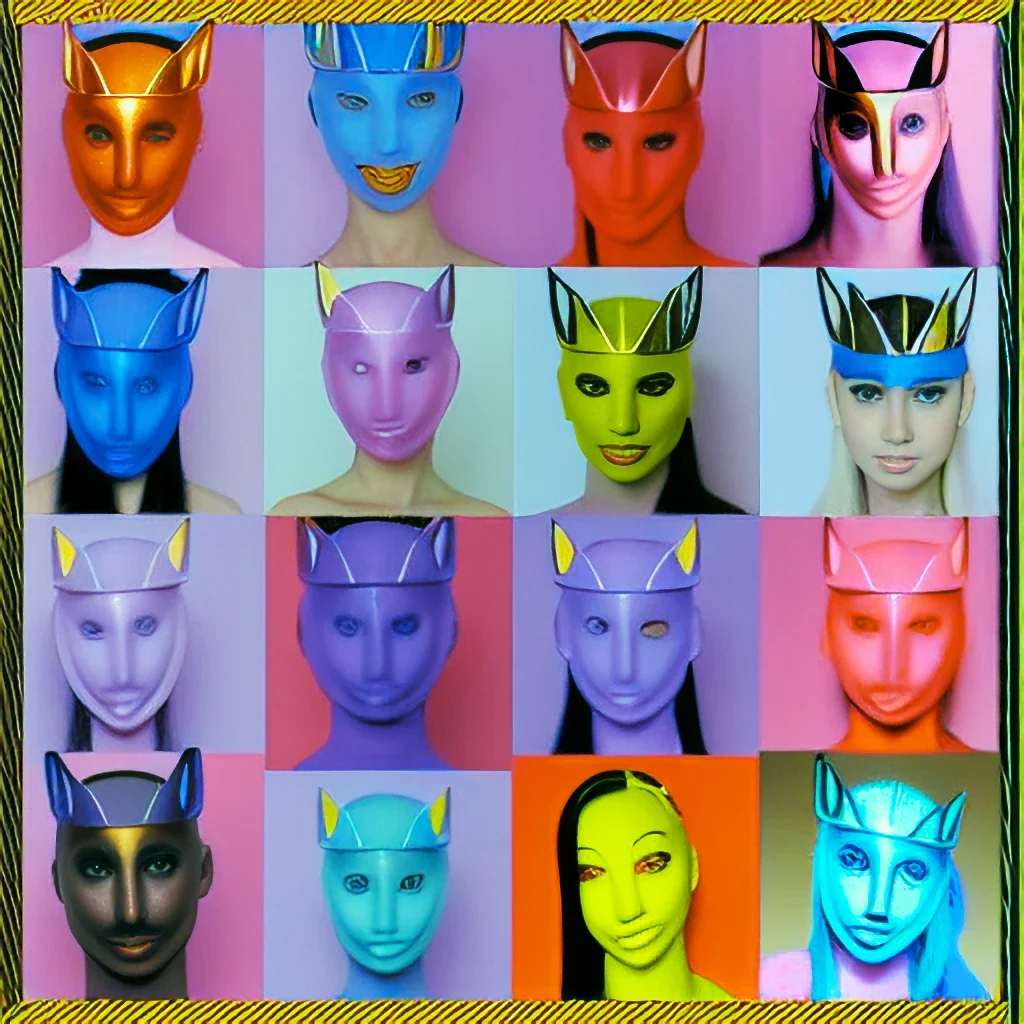
In the different faces, you’ll see diversity and playfulness. But there’s also a lot of uniformity, which represents creating alignment in your social circle.
The characters are in sync, but the pieces aren’t all perfectly square since we’ll surely invest more in some people than in others. There’s a gold cord around the outside since good friends are like gold.
We all wear masks at times, so the challenge of intimacy is to look beyond the surface and get to know the characters behind the masks. Not everyone is masked to the same degree.
There’s a mix of warm and cool colors since people can be warm or cold too – and sometimes both.
Does working with AI tools circumvent the creative process, such that the AI does all the heavy lifting?
I don’t see it that way at all. Using such rich tools allows me to focus more attention at a different level. Instead of thinking about brush strokes and colors, I can focus on meaning and symbolism and the overall structure of an image. I can pay attention to lower level details too, but I don’t have to get bogged down in creative skills that don’t interest me, like learning to draw, paint, or sculpt.
That might bother some people who invested years in some of their creative skills, which I can understand as a former game developer. I could just as easily say that to be a true artist, you should make your own canvases, paints, pencils, brushes, etc. I could say that it’s cheating if you play a musical instrument that someone else built and that a real artist would build their own. But of course that’s rubbish. We all lean on the work of the past, and to me this experience is no different in that regard. There’s just more past to lean on now.
I will say that I didn’t try to copy or emulate any known artist’s style with these images, living or dead. I never fed in the name of an artist or person (other than myself) for any of the prompts I used. That wouldn’t have felt good to me, and it would have run contrary to my purpose for this exploration.
These images may violate people’s expectations. Right now I don’t know of any friends in this field making these kinds of images to associate with their products. I’m sure some people would discourage me from going this route as well, just as people tried to discourage me from getting into blogging back in 2004.
To me these images are all meaningful. They represent much of what I put into the courses. I actually prefer images that make people do a double-take. If people see these as odd or unusual, I consider that a good thing.
Even though people often invite me to converge on their expectations, Reality has been rewarding me for divergent behavior for decades, and I trust my instincts. Presently my instincts tell me that this is a fascinating toolset to continue to exploring with.
I don’t have negative associations to co-creating with AI. I leveraged AI ideation tools for the Octo Intensive and for the Guild course, and I felt this added value to those experiences. Other participants appreciated the AI’s contributions as well, which helped us to explore some interesting directions.
Moreover, I’ve gained some useful personal growth insights from co-creating with AI tools. As I worked with prompting images to evolve in a certain direction, it reminded me of the importance of iterative upgrades in my life as well. In the short term, progress may appear to be minimal, but the compounding effects can be profound in the end.
I’m reminded of a time that my first wife Erin and I put up a sign in our living room that said, “$5000 per month,” back when we were struggling financially. That simple sign did the trick, and we soon got to that income level and well beyond. It was like prompting ourselves to create what we wanted, causing our mindsets to shift a bit more each day. Those micro-shifts can really add up over time.
I was also reminded of the importance of combining intentionality with flexibility. When I tried to over-control the AI, I would often hit a plateau because I wasn’t playing to the AI’s strengths. In those situations it was better to give the AI more creative flexibility, so it could evolve images even in violation of my prompting. But it wasn’t wise to let the AI be too divergently creative for too long since we could get lost in the vastness of the possibility space and never converge on an idea. I found other ways to leverage the AI to refine a messy or flawed concept into a more refined one.
At its best this was a transcendent experience. I love the synergy of combining my strengths with the AI’s strengths and working in the zone where we can each contribute our best creativity for interesting results. Sometimes I would see a new image and smile, marveling at the AI’s cleverness or brilliance. Its ideas often inspired me to go down different paths than I’d previously had in mind. Where we ended up with each image was usually very different from where we started.
This is good reminder to bring a similar mindset to our goals. Be intentional but also flexible because you’re not 100% in control. You’re co-creating this journey with Reality, and you need to play to its strengths to invite the best flow of cooperation.
I remain very optimistic about the future of co-creating with AI. It seems like such a rewarding path to keep exploring. It elevates the creative experience away from the mundane and towards the divine. I love how such tools are extending the range of what I can create and express and with whom.

For centuries, Indigenous communities in the American Southwest imported colorful parrots from Mexico. But according to a study led by The University of Texas at Austin, some parrots may have been captured locally and not brought from afar.
The research challenges the assumption that all parrot remains found in American Southwest archaeological sites have their origins in Mexico. It also presents an important reminder: The ecology of the past can be very different from what we see today.
“When we deal with natural history, we can constrain ourselves by relying on the present too much,” said the study’s author, John Moretti, a doctoral candidate at the UT Jackson School of Geosciences. “These bones can give us kind of a baseline view of the animal life of the ecosystems that surrounded us before huge fundamental changes that continue today began.”
The study was published in print in the September issue of The Wilson Journal of Ornithology.
Parrots are not an uncommon find in southwestern archaeological sites dating as far back as the 7th or 8th centuries. Their remains have been found in elaborate graves and buried in trash heaps. But no matter the condition, when archaeologists have discovered parrot bones, they usually assumed the animals were imports, said Moretti.
There’s good reason for that. Scarlet macaws — the parrot most commonly found in the archaeological sites — live in rainforest and savannahs, which are not part of the local landscape. And researchers have discovered the remains of ancient parrot breeding facilities in Mexico that point to a thriving parrot trade.
But there is more to parrots than macaws. In 2018, Moretti found a lone ankle bone belonging to a species known as the thick-billed parrot. It was part of an unsorted bone collection recovered during an archaeological dig in the 1950s in New Mexico.
“There was a lot of deer and rabbit, and then this kind of anomalous parrot bone,” said Moretti, a student in the Jackson School’s Department of Geological Sciences. “Once I realized that nobody had already described this, I really thought there was a story there.”
Thick-billed parrots are an endangered species and do not live in the United States today due to habitat loss and hunting. But that was not the case even a relatively short time ago. As recently as the 1930s, their range stretched from Arizona and New Mexico to northern Mexico, where they live today. The boisterous, lime-green birds are also very particular about their habitat. They dwell only in mountainous old-growth pine forests, where they nest in tree hollows and dine almost exclusively on pine cones.
With that in mind, Moretti decided to investigate the connection between pine forests in New Mexico and Arizona and the remains of thick-billed parrots found at archaeological sites. He found that of the 10 total archaeological sites with positively identified thick-billed parrot remains, all contained buildings made of pine timber, with one settlement requiring an estimated 50,000 trees. And for half the sites, suitable pine forests were within 7 miles of the settlement.
Moretti said that with people entering parrot habitat, it’s plausible to think they captured parrots when gathering timber and brought them home.
“This paper makes the hypothesis that these [parrots] were not trade items,” Moretti said. “They were animals living in this region that were caught and captured and brought home just like squirrels and other animals that lived in these mountains.”
Moretti relied on thick-billed parrot bones from the United States and Mexico permanently archived in collections at The University of Kansas Biodiversity Institute and the Smithsonian Institution to conclusively identify the lone bone that sparked the research. Mark Robbins, an evolutionary biologist and the collection manager of the ornithological collections at The University of Kansas, said this study shows the value of natural history collections and the innumerable ways they assist with research.
“The scientists who originally collected those specimens, they had no idea they would be used in this fashion,” Robbins said. “You can revisit old questions or formulate new questions based on these specimens.”
The research was funded by the Museum of Texas Tech University, where Moretti earned a master’s degree.
Staff who’ve been in the NHS for a short time say they have seen enough to know change is needed.

20 years ago, Danish chemist Morten Meldal discovered a new method for assembling molecules.
Assembling molecules has always been and still is a large part of chemists’ work — whether they are hired to develop new sewage treatment plants, sunscreens, batteries or dishwashing liquid; no new product is created until the molecules are put together correctly.
Meldal’s discovery was called click chemistry, and this year it won him the Nobel Prize in Chemistry (along with Barry Sharpless and Carolyn Bertozzi).
“Click chemistry is a huge discovery, and the Nobel Prize is fully deserved,” says Changzhu Wu, who is a chemist and an associate professor at the Department of Chemistry, Physics and Pharmacy, where he studies sustainable enzymes.
But, as he adds:
“The chemistry of the future needs be more sustainable, and this also applies to click chemistry.”
Together with colleagues, Changzhu Wu has published a scientific article in which the team describes a new type of sustainable click chemistry.
Traditional click chemistry requires a catalyst to get the desired chemical reaction started (in click chemistry, you want to get some molecules to “click” together), and that catalyst is copper ions.
“Copper ions are effective as a catalyst, but toxic to living organisms. So, we wanted to find an alternative to copper in click chemistry,” explains Changzhu Wu.
So did the chemist Carolyn Bertozzi, who further developed Morten Meldal’s discovery and found a way to avoid the toxic copper ions.
She came up with the idea of changing the shape of the click molecules to the octagon shape, which made them more reactive and able to click together without copper ions. This technique led to her being co-recipient of the Nobel Prize 2022.
“In our proposal for a new kind of click chemistry, we are still working with copper — but in a different way. We incorporate the copper ions into proteins and thus create a metalloenzyme that is already present in our organism. Copper in proteins poses no danger to nature or living organisms,” explains Changzhu Wu.
For the task, the research team used cheap and biodegradable proteins, namely bovine serum albumin (BSA), which originates from cows and is a common standard protein in laboratories.
It gets a polymer attached to it, and now copper ions can be embedded in the protein/polymer structure and act as a catalyst to start the click chemistry and allow chemist to put molecules together.
“In short, we use cheap, biodegradable proteins to convert toxic copper ions into non-toxic, biological catalysts,” said Changzhu Wu.
Sustainable chemistry at SDU:
Sustainable chemistry is essential for the development of new technologies for a greener future. At SDU, our goals are:
Story Source:
Materials provided by University of Southern Denmark. Original written by Birgitte Svennevig. Note: Content may be edited for style and length.

Our current chip technology is largely based on silicon. Only in very special components a small amount of germanium is added. But there are good reasons to use higher germanium contents in the future: The compound semiconductor silicon-germanium has decisive advantages over today’s silicon technology in terms of energy efficiency and achievable clock frequencies.
The main problem here is to establish contacts between metal and semiconductor on a nanoscale in a reliable way. This is much more difficult with a high proportion of germanium than with silicon. The team at TU Wien, however, together with research teams from Linz and Thun (Switzerland), has now shown that this problem can be solved — with contacts made of crystalline aluminium of extremely high quality and a sophisticated silicon germanium layer system. This enables different interesting contact properties — especially for optoelectronic and quantum components.
The problem with oxygen
“Every semiconductor layer is automatically contaminated in conventional processes; this simply cannot be prevented at the atomic level,” says Masiar Sistani from the Institute for Solid State Electronics at TU Wien. First and foremost, it is oxygen atoms that accumulate very quickly on the surface of the materials — an oxide layer is formed.
With silicon, however, this is not a problem: silicon always forms exactly the same kind of oxide. “With germanium, however, things are much more complicated,” explains Masiar Sistani. “In this case, there is a whole range of different oxides that can form. But that means that different nanoelectronic devices can have very different surface compositions and therefore different electronic properties.”
If you now want to connect a metallic contact to these components, you have a problem: Even if you try very hard to produce all these components in exactly the same way, there are still inevitably massive differences — and that makes the material complex to handle for use in the semiconductor industry.
“Reproducibility is a big problem,” says Prof. Walter Weber, the head of the Institute for Solid State Electronics, TU Wien. “If you use germanium-rich silicon germanium, you can’t be sure that the electronic component, after you’ve put contacts on it, will really have the characteristics you need.” As a result, this material is only used to a limited extent in chip production.
That is a pity, because silicon germanium would have decisive advantages: “The charge carrier concentration is higher, especially positive charge carriers, the so-called “holes,” can move much more efficiently in this material than in silicon. The material would therefore allow much higher clock frequencies with increased energy efficiency than our current silicon chips,” says Lukas Wind, a doctoral student in Walter Weber’s research group.
The “perfect” interface
Now, however, the research team has been able to show how the problem can be solved: They found a method to create perfect interfaces between aluminium contacts and silicon germanium components on an atomic scale. In a first step, a layer system is produced with a thin silicon layer and the actual material from which the electronic components are to be made — the silicon-germanium.
By heating the structure in a controlled manner, a contact can now be created between the aluminium and the silicon: At around 500 degrees Celsius, distinctive diffusion occurs, the atoms can leave their place and start to migrate. Silicon and germanium atoms move into the aluminium contact relatively quickly, and aluminium fills the vacated space.
“The diffusion dynamics in the layer system used thus create an interface between aluminium and the silicon germanium with an extremely thin silicon layer in between,” explains Masiar Sistani. Through this manufacturing process, oxygen atoms never have the opportunity to get to this atomically sharp and highly pure interface.
“Our experiments show that these contact points can be produced in a reliable and easily reproducible way,” says Walter Weber. “The technological systems you need to do this are already being used in the chip industry today. So, this is not just a laboratory experiment, but a process that could be used relatively quickly in the chip industry.
The decisive advantage of the presented manufacturing process is that high-quality contacts can be produced regardless of the silicon-germanium composition. “We are convinced that the presented abrupt, robust and reliable metal-semiconductor contacts are highly interesting for a variety of new nanoelectronic, optoelectronic and quantum devices,” says Walter Weber.
Pembrolizumab will be offered to more women in England, to fight aggressive triple-negative tumours.

A new model that accounts for the interplay of forces acting on newborn planets can explain two puzzling observations that have cropped up repeatedly among the more than 3,800 planetary systems cataloged to date.
One puzzle known as the “radius valley” refers to the rarity of exoplanets with a radius about 1.8 times that of Earth. NASA’s Kepler spacecraft observed planets of this size about 2-3 times less frequently than it observed super-Earths with radii about 1.4 times that of Earth and mini-Neptunes with radii about 2.5 times Earth’s. The second mystery, known as “peas in a pod,” refers to neighboring planets of similar size that have been found in hundreds of planetary systems. Those include TRAPPIST-1 and Kepler-223, which also feature planetary orbits of near-musical harmony.
“I believe we are the first to explain the radius valley using a model of planet formation and dynamical evolution that self-consistently accounts for multiple constraints of observations,” said Rice University’s André Izidoro, corresponding author of a study published this week in Astrophysical Journal Letters. “We’re also able to show that a planet-formation model incorporating giant impacts is consistent with the peas-in-a-pod feature of exoplanets.”
Izidoro, a Welch Postdoctoral Fellow at Rice’s NASA-fundedCLEVER Planets project, and co-authors used a supercomputer to simulate the first 50 million years of the development of planetary systems using a planetary migration model. In the model, protoplanetary disks of gas and dust that give rise to young planets also interact with them, pulling them closer to their parent stars and locking them in resonant orbital chains. The chains are broken within a few million years, when the disappearance of the protoplanetary disk causes orbital instabilities that lead two or more planets to slam into one another.
Planetary migration models have been used to study planetary systems that have retained their resonant orbital chains. For example, Izidoro and CLEVER Planets colleagues used a migration model in 2021 to calculate the maximum amount of disruption TRAPPIST-1’s seven-planet system could have withstood during bombardment and still retained its harmonious orbital structure.
In the new study, Izidoro partnered with CLEVER Planets’ investigators Rajdeep Dasgupta and Andrea Isella, both of Rice, Hilke Schlichting of the University of California, Los Angeles, and Christian Zimmermann and Bertram Bitsch of the Max Planck Institute for Astronomy in Heidelberg, Germany.
“The migration of young planets towards their host stars creates overcrowding and frequently results in cataclysmic collisions that strip planets of their hydrogen-rich atmospheres,” Izidoro said. “That means giant impacts, like the one that formed our moon, are probably a generic outcome of planet formation.”
The research suggests planets come in two “flavors,” super-Earths that are dry, rocky and 50% larger than Earth, and mini-Neptunes that are rich in water ice and about 2.5 times larger than Earth. Izidoro said new observations seem to support the results, which conflict with the traditional view that both super-Earths and mini-Neptunes are exclusively dry and rocky worlds.
Based on their findings, the researchers made predictions that can be tested by NASA’s James Webb Space Telescope. They suggest, for instance, that a fraction of planets about twice Earth’s size will both retain their primordial hydrogen-rich atmosphere and be rich in water.
The research was funded by NASA (80NSSC18K0828), the Welch Foundation (C-2035-20200401) and the European Research Council (757448-PAMDORA).
Story Source:
Materials provided by Rice University. Original written by Jade Boyd. Note: Content may be edited for style and length.

COVID-19 patients placed on ventilators can take a long time to regain consciousness. New research from Weill Cornell Medicine, NewYork-Presbyterian, MIT, and Massachusetts General Hospital is now illustrating that these delays may serve a purpose: protecting the brain from oxygen deprivation.
The existence of such a brain-preserving state could explain why some patients wake up days or even weeks after they stop receiving ventilation, and it suggests that physicians should take these lengthy recovery times into account when determining a patient’s prognosis.
In a study published Nov. 7 in the Proceedings of the National Academy of Sciences, the investigators connect the pattern seen among those who have survived severe COVID-19 with similar delays known to occur in a small fraction of cardiac arrest patients.
“The delayed recoveries in COVID-19 patients are very much like the rare cases we’ve documented in previous research. In this new paper, we describe a mechanism to explain what we’re seeing in both types of patients,” said study co-senior author Dr. Nicholas D. Schiff, the Jerold B. Katz Professor of Neurology and Neuroscience in the Feil Family Brain and Mind Research Institute and co-director of the Consortium for the Advanced Study of Brain Injury (CASBI) at Weill Cornell Medicine.
He found evidence for this explanation — that patients’ brains are protecting themselves — in animals, most notably painted turtles, that can tolerate extended periods without oxygen.
More than a decade ago, Dr. Schiff and his colleagues first observed these delays among comatose cardiac arrest patients who received cooling therapy to reduce brain damage caused by a loss of blood flow. In one such case, a 71-year-old patient took 37 days to awaken, before ultimately making a near-complete recovery.
During the pandemic, Dr. Schiff, who is also a neurologist at NewYork-Presbyterian/Weill Cornell Medical Center, performed neurology consultations for COVID-19 patients, and he soon began seeing similar, delayed awakenings occurring when patients were taken off ventilators and stopped receiving the sedatives given to them to reduce their movement.
In a separate analysis of a large cohort of Covid-19 patients from Weill Cornell Medicine and two other major U.S. medical centers, Dr. Schiff and his colleagues, including co-author of the current paper, Dr. Emery N. Brown, professor of anesthesia at Harvard Medical School, Edward Hood Taplin Professor of Medical Engineering and Computational Neuroscience in The Picower Institute for Learning and Memory at MIT and an anesthesiologist at Massachusetts General Hospital, found that a quarter of patients who survived ventilation took 10 days or longer to recover consciousness. The more oxygen deprivation they suffered while on the ventilator, the longer that delay.
In the prior study of cardiac patients, the researchers recorded a distinctive pattern in brain activity, one also seen in patients under deep anesthesia. (Recordings from COVID-19 patients are extremely limited.) Dr. Schiff read that a similar pattern had been seen in the brains of painted turtles, which can withstand up to five months without oxygen under ice in the winter. To do so, they activate the same inhibitory system within the brain targeted by anesthetics given to human cardiac and COVID-19 patients but in novel ways developed by evolutionary specializations.
Dr. Schiff and Dr. Brown propose that, by chance, the same protective response emerges in the patients.
“It is our theory that oxygen deprivation as well as practices in the ICU, including commonly used anesthetics, expose elements of strategies that animals use to survive in extreme conditions,” Dr. Schiff said.
“These observations may offer new insights into the mechanisms of how certain anesthetics produce unconsciousness and new approaches for ICU sedation and for fostering recovery from disorders of consciousness,” Dr. Brown added.
When patients fail to regain consciousness for an extended time, physicians may recommend withdrawing life-supporting care. This threshold is typically set at 14 days or less for cardiac patients, while no such guidelines exist for COVID-19.
In light of this new research, however, so long as they lack brain injuries, physicians should avoid making negative projections about these patients’ potential to recover, note the researchers.

If you hold one wire mesh on top of another one and look through it, you’ll see a larger pattern called a moiré pattern formed by the overlapping grids of the two meshes, which depends on their relative twisted angle. Scientists developing new materials are actively studying moiré patterns in overlapping atomically thin materials — they produce intriguing electronic phenomena that includes unconventional superconductivity and ferromagnetism.
Supercomputer simulations have helped scientists reveal in a bilayer moiré system a new species of an electronic phenomenon called an exciton, which is an electrically neutral quasiparticle, yet one that can carry energy and consists of an electron and electron ‘hole’ that can be created for example by light impinging certain semiconductors and other materials.
The newly discovered excitons were produced by moiré patterns from two-dimensional sheets of exotic semiconductors called transition metal dichalcogenides, with the electron bound to the hole but separated from each other by a characteristic distance in the sheet. This was named an intralayer charge-transfer exciton and was a surprise to the scientists because such excitons do not exist in the individual sheets. The research can be used in the development of new optical sensors and communication technology such as optical fibers and lasers.
Novel Exciton Discovered
“In this work we discovered a novel exciton of unforeseen intralayer charge-transfer characteristics in a moiré superlattice formed by two atomically thin layers of transition metal dichalcogenide materials,” said Steven G. Louie, a distinguished professor of physics at the University of California, Berkeley (UC Berkeley), and a senior faculty scientist at the Lawrence Berkeley National Laboratory (LBNL).
Louie is the corresponding author of research published August 2022 in the journal Nature. In it, the scientists developed computer models that go beyond the conventional parameterized models that have been used to describe moiré systems and moiré excitons. Instead, they performed ab initio calculations that only start with the identity and initial position of the 3,903 atoms of the moiré superlattice unit cell.
First Principles
“It is a powerful method to accurately predict material properties,” Louie added, “because there’s no empirical fitting involved.”
In particular, to calculate the exciton states and the optical property of the moiré systems, they used the state-of-the-art GW plus Bethe-Salpeter equation (GW-BSE) approach, considered one of the most accurate approaches to predicting the optical properties of materials.
What’s more, Louie and colleagues used their calculations to predict the different electronic and optical responses of the excitons in the system. They worked with experimental colleagues Emma C. Regan, Zuocheng Zhang and Professor Feng Wang at UC Berkeley. In a nutshell, Wang and colleagues shone light on the material and then analyzed the reflected light to see how the system responded to the impinging photons under different conditions.
Sure enough, they verified the theoretical predictions by finding distinct signatures of the intralayer charge-transfer exciton in their measurements.
Computational Challenges Overcome With TACC Support
“The GW-BSE method is very accurate, but it is also very computationally challenging,” said study co-author Mit Naik, a postdoctoral researcher working with Professor Louie at UC Berkeley and LBNL.
The challenge in simulating an exciton is that it requires solving difficult six-dimensional integrals, numerous times, and the integrals are massive in the moiré superlattice because of the large size of the moiré unit cell — composed of many unit cells of the individual layers, 25×25 for one layer and 26×26 for the other.
Typical GW-BSE calculations are performed on systems of just up to a hundred atoms in the unit cell. Here, the authors needed calculations for a whooping 3,903 atoms. “Initially, it seemed almost impossible,” Naik said.
Undaunted, the scientists hit on a new method that reduced the computational cost by a million times without loss of accuracy.
“We found a way to approximate each layer’s two thousand atom integral as a sum over many three atom integrals, which were computationally much simpler to compute,” Naik said.
The theoretical technique they developed, called the pristine unit-cell matrix projection (PUMP) method, can be generalized to study other material systems such as interlayer or hybrid moiré excitons in multi-layer moiré superlattices, shallow defects in materials, and more.
The Texas Advanced Computing Center (TACC) supported Steven Louie’s first principles study of cutting-edge materials through a large resource allocation on TACC’s Frontera supercomputer, the most powerful academic system in the U.S and funded by the National Science Foundation.
He also was awarded allocations on TACC’s Stampede2 supercomputer made through the NSF-funded Advanced Cyberinfrastructure Coordination Ecosystem: Services & Support (ACCESS), formerly the Extreme Science and Engineering Discovery Environment (XSEDE).
In their bid to push the limit of the number of atoms in their calculations, the researchers initially faced some problems with running some of the large-scale moiré calculations on Frontera.
“We received support from the research associates at TACC, who helped us resolve these problems,” Naik recalled.
For instance, they were unable to run the large-scale simulations of ground-state properties on Frontera using a standard density functional theory (DFT) package called Quantum Espresso, because of the instability created by a new version of the Intel compiler used to for the DFT package.
The TACC consulting team found a way around the problem by installing an older, more stable version of the compiler. “This allowed us to compute the electronic structure of the WSe2 moiré superlattice that went into this work,” Naik said.
“Frontera and Stampede2 hardware efficiently catered to our requirements by providing state-of-the-art internode connectivity and sufficient memory on each node,” Naik added.
SCIENCE IMPACT
“The intralayer charge-transfer exciton we discovered through this artificial stacking of two monolayers has revealed an extraordinarily strong interplay of the atomic structure and the type of exciton possible in the moiré systems,” Louie said. “This is an important step in advancing the engineering of materials for desired properties.”
That’s because, once light creates charge-transfer excitons, they can be distorted or dissociated more easily with an external field or other perturbations than the standard Wannier-type excitons.
These considerations are important in many basic phenomena and potential applications, such as novel optical sensors and electro-optic modulation nanodevices. “That’s what we’re working on with our experimental colleagues right now,” Louie said.
“Excitonic properties of materials form the basic principles behind many of the optical and optoelectronic devices and sensors that we encounter in our daily lives,” said study co-author Felipe Jornada, an Assistant Professor in the Department of Materials Science and Engineering at Stanford University and a Principal Investigator at the SLAC National Accelerator Laboratory.
He gave the example of OLED TVs and displays, which use light emission from the recombination of excitons in organic semiconductors. Also, new smartwatches use advanced optical sensors to monitor the wearer’s blood oxygen levels.
“Beyond existing devices, the transition metal dichalcogenides and heterostructures of these materials that we’re working on are considered a promising material platform for post-silicon nanoscale optoelectronic devices. Moving forward, we believe that these are going to be a promising route towards novel sensors, displays, and technologies,” Jornada said.
The majority of the funding for the study was provided by the U.S. Department of Energy’s van der Waals heterostructure program (KCWF16). The theory and algorithm development for this work was carried out at the Center for Computational Study of Excited State Phenomena in Energy Materials (C2SEPEM) at the Lawrence Berkeley National Lab. They also used the National Energy Research Science Computing Center (NERSC) at the Lawrence Berkeley National Laboratory to perform part of the calculations.
