Common food preservatives linked to higher risk of type 2 diabetes

People who consume higher amounts of food preservatives may face a greater risk of developing type 2 diabetes, according to a large new study. Preservatives are commonly added to processed foods and beverages to extend shelf life. The research was conducted by scientists from Inserm, INRAE, Sorbonne Paris Nord University, Paris Cité University and Cnam as part of the Nutritional Epidemiology Research Team (CRESS-EREN). The findings are based on health and diet data from more than 100,000 adults enrolled in the NutriNet-Santé cohort and were published in the journal Nature Communications.

Preservatives are part of the broader category of food additives and are widely used throughout the global food supply. Their presence is extensive. In 2024, the Open Food Facts World database listed around three and a half million food and beverage products. More than 700,000 of those products contained at least one preservative.

Two Major Types of Preservative Additives

In their analysis, Inserm researchers divided preservative additives into two main groups. The first group includes non-antioxidant preservatives, which slow spoilage by limiting microbial growth or slowing chemical reactions in food. The second group consists of antioxidant additives, which help preserve foods by reducing or controlling exposure to oxygen in packaging.

On ingredient labels, these additives typically appear under European codes between E200 and E299 (for preservatives in the strict sense) and between E300 and E399 (for antioxidant additives).

Why Researchers Are Investigating Preservatives

Earlier experimental research has raised concerns that some preservatives may harm cells or DNA and interfere with normal metabolic processes. However, direct evidence linking preservative intake to type 2 diabetes in large human populations has been limited until now.

To better understand this potential connection, a research team led by Mathilde Touvier, Inserm Research Director, examined long-term exposure to food preservatives and the incidence of type 2 diabetes using detailed data from the NutriNet-Santé study.

Tracking Diet and Health Over More Than a Decade

The study followed more than 100,000 French adults between 2009 and 2023. Participants regularly provided information about their medical history, socio-demographic background, physical activity, lifestyle habits, and overall health.

They also submitted detailed food records covering multiple 24-hour periods. These records included the names and brands of industrial food products they consumed. Researchers cross-referenced this information with several databases (Open Food Facts, Oqali, EFSA) and combined it with measurements of additives in foods and beverages. This allowed the team to estimate each participant’s long-term exposure to preservatives.

Measuring Preservative Consumption

Across all food records, researchers identified a total of 58 preservative-related additives. This included 33 preservatives in the strict sense and 27 antioxidant additives. From this group, 17 preservatives were analyzed individually because they were consumed by at least 10% of the study participants.

The analysis accounted for many factors that could influence diabetes risk, including age, sex, education, smoking, alcohol use, and overall diet quality (calories, sugar, salt, saturated fats, fibre, etc.).

Diabetes Cases and Risk Increases

Over the study period, 1,131 cases of type 2 diabetes were identified among the 108,723 participants.

Compared with people who consumed the lowest levels of preservatives, those with higher intake showed a markedly increased risk of developing type 2 diabetes. Overall preservative consumption was linked to a 47% higher risk. Non-antioxidant preservatives were associated with a 49% increase, while antioxidant additives were linked to a 40% higher risk.

Specific Preservatives Associated With Risk

Among the 17 preservatives examined individually, higher intake of 12 was associated with an increased risk of type 2 diabetes. These included widely used non-antioxidant preservatives (potassium sorbate (E202), potassium metabisulphite (E224), sodium nitrite (E250), acetic acid (E260), sodium acetates (E262) and calcium propionate (E282)) as well as antioxidant additives (sodium ascorbate (E301), alpha-tocopherol (E307), sodium erythorbate (E316), citric acid (E330), phosphoric acid (E338) and rosemary extracts (E392)).

What the Researchers Say

“This is the first study in the world on the links between preservative additives and the incidence of type 2 diabetes. Although the results need to be confirmed, they are consistent with experimental data suggesting the harmful effects of several of these compounds,” explains Mathilde Touvier, Inserm research director and coordinator of this work.

“More broadly, these new data add to others in favor of a reassessment of the regulations governing the general use of food additives by the food industry in order to improve consumer protection,” adds Anaïs Hasenböhler, a doctoral student at EREN who conducted these studies.

“This work once again justifies the recommendations made by the National Nutrition and Health Programme to consumers to favor fresh, minimally processed foods and to limit unnecessary additives as much as possible,” concludes Mathilde Touvier.

This work was funded by the European Research Council (ERC ADDITIVES), the National Cancer Institute, and the French Ministry of Health.


Share Button

Stanford’s AI spots hidden disease warnings that show up while you sleep

A restless night often leads to fatigue the next day, but it may also signal health problems that emerge much later. Scientists at Stanford Medicine and their collaborators have developed an artificial intelligence system that can examine body signals from a single night of sleep and estimate a person’s risk of developing more than 100 different medical conditions.

The system, called SleepFM, was trained using almost 600,000 hours of sleep recordings from 65,000 individuals. These recordings came from polysomnography, an in-depth sleep test that uses multiple sensors to track brain activity, heart function, breathing patterns, eye movement, leg motion, and other physical signals during sleep.

Sleep Studies Hold Untapped Health Data

Polysomnography is considered the gold standard for evaluating sleep and is typically performed overnight in a laboratory setting. While it is widely used to diagnose sleep disorders, researchers realized it also captures a vast amount of physiological information that has rarely been fully analyzed.

“We record an amazing number of signals when we study sleep,” said Emmanual Mignot, MD, PhD, the Craig Reynolds Professor in Sleep Medicine and co-senior author of the new study, which will publish Jan. 6 in Nature Medicine. “It’s a kind of general physiology that we study for eight hours in a subject who’s completely captive. It’s very data rich.”

In routine clinical practice, only a small portion of this information is examined. Recent advances in artificial intelligence now allow researchers to analyze these large and complex datasets more thoroughly. According to the team, this work is the first to apply AI to sleep data on such a massive scale.

“From an AI perspective, sleep is relatively understudied. There’s a lot of other AI work that’s looking at pathology or cardiology, but relatively little looking at sleep, despite sleep being such an important part of life,” said James Zou, PhD, associate professor of biomedical data science and co-senior author of the study.

Teaching AI the Patterns of Sleep

To unlock insights from the data, the researchers built a foundation model, a type of AI designed to learn broad patterns from very large datasets and then apply that knowledge to many tasks. Large language models like ChatGPT use a similar approach, though they are trained on text rather than biological signals.

SleepFM was trained on 585,000 hours of polysomnography data collected from patients evaluated at sleep clinics. Each sleep recording was divided into five-second segments, which function much like words used to train language-based AI systems.

“SleepFM is essentially learning the language of sleep,” Zou said.

The model integrates multiple streams of information, including brain signals, heart rhythms, muscle activity, pulse measurements, and airflow during breathing, and learns how these signals interact. To help the system understand these relationships, the researchers developed a training method called leave-one-out contrastive learning. This approach removes one type of signal at a time and asks the model to reconstruct it using the remaining data.

“One of the technical advances that we made in this work is to figure out how to harmonize all these different data modalities so they can come together to learn the same language,” Zou said.

Predicting Future Disease From Sleep

After training, the researchers adapted the model for specific tasks. They first tested it on standard sleep assessments, such as identifying sleep stages and evaluating sleep apnea severity. In these tests, SleepFM matched or exceeded the performance of leading models currently in use.

The team then pursued a more ambitious objective: determining whether sleep data could predict future disease. To do this, they linked polysomnography records with long-term health outcomes from the same individuals. This was possible because the researchers had access to decades of medical records from a single sleep clinic.

The Stanford Sleep Medicine Center was founded in 1970 by the late William Dement, MD, PhD, who is widely regarded as the father of sleep medicine. The largest group used to train SleepFM included about 35,000 patients between the ages of 2 and 96. Their sleep studies were recorded at the clinic between 1999 and 2024 and paired with electronic health records that followed some patients for as long as 25 years.

(The clinic’s polysomnography recordings go back even further, but only on paper, said Mignot, who directed the sleep center from 2010 to 2019.)

Using this combined dataset, SleepFM reviewed more than 1,000 disease categories and identified 130 conditions that could be predicted with reasonable accuracy using sleep data alone. The strongest results were seen for cancers, pregnancy complications, circulatory diseases, and mental health disorders, with prediction scores above a C-index of 0.8.

How Prediction Accuracy Is Measured

The C-index, or concordance index, measures how well a model can rank people by risk. It reflects how often the model correctly predicts which of two individuals will experience a health event first.

“For all possible pairs of individuals, the model gives a ranking of who’s more likely to experience an event — a heart attack, for instance — earlier. A C-index of 0.8 means that 80% of the time, the model’s prediction is concordant with what actually happened,” Zou said.

SleepFM performed especially well when predicting Parkinson’s disease (C-index 0.89), dementia (0.85), hypertensive heart disease (0.84), heart attack (0.81), prostate cancer (0.89), breast cancer (0.87), and death (0.84).

“We were pleasantly surprised that for a pretty diverse set of conditions, the model is able to make informative predictions,” Zou said.

Zou also noted that models with lower accuracy, often around a C-index of 0.7, are already used in medical practice, such as tools that help predict how patients might respond to certain cancer treatments.

Understanding What the AI Sees

The researchers are now working to improve SleepFM’s predictions and better understand how the system reaches its conclusions. Future versions may incorporate data from wearable devices to expand the range of physiological signals.

“It doesn’t explain that to us in English,” Zou said. “But we have developed different interpretation techniques to figure out what the model is looking at when it’s making a specific disease prediction.”

The team found that while heart-related signals were more influential in predicting cardiovascular disease and brain-related signals played a larger role in mental health predictions, the most accurate results came from combining all types of data.

“The most information we got for predicting disease was by contrasting the different channels,” Mignot said. Body constituents that were out of sync — a brain that looks asleep but a heart that looks awake, for example — seemed to spell trouble.

Rahul Thapa, a PhD student in biomedical data science, and Magnus Ruud Kjaer, a PhD student at Technical University of Denmark, are co-lead authors of the study.

Researchers from the Technical University of Denmark, Copenhagen University Hospital -Rigshospitalet, BioSerenity, University of Copenhagen and Harvard Medical School contributed to the work.

The study received funding from the National Institutes of Health (grant R01HL161253), Knight-Hennessy Scholars and Chan-Zuckerberg Biohub.

Share Button

Knives taken to hospitals sees amnesty bins set up

In Birmingham hospitals knives are regularly found, with one produced by a patient ready for an MRI.

Share Button

‘My endometriosis pain is excruciating but I’m still waiting for surgery’

According to the Royal College of Obstetricians and Gynaecologists, 59,733 women in NI are now on waiting lists.

Share Button

OpenAI launches ChatGPT Health to review your medical records

The firm says its chatbot sees health and wellbeing questions from 230 million people every week.

Share Button

Three NHS trusts still using fax machines, Streeting confesses

The health secretary had made it his personal mission to banish the fax machine from the NHS.

Share Button

Scientists tried to break Einstein’s speed of light rule

In 1887, a landmark experiment reshaped our understanding of the universe. American physicists Albert Michelson and Edward Morley attempted to detect Earth’s motion through space by comparing how fast light traveled along different directions. Their experiment found no difference at all. This unexpected null result became one of the most influential outcomes in scientific history. It led Albert Einstein to propose that the speed of light is constant, a cornerstone idea behind his theory of special relativity.

Special relativity rests on the principle that the laws of physics remain the same for all observers, regardless of how they are moving relative to one another. This idea is known as Lorentz invariance. Over time, Lorentz invariance became a foundational assumption in modern physics, especially within quantum theory.

Why Question a Principle That Works So Well

Quantum theory evolved with Lorentz invariance at its core. This is especially true for quantum field theory and the Standard Model of Particle Physics, which is the most thoroughly tested scientific theory ever created and has passed experimental checks with extraordinary precision. Given this track record, it may seem strange to question Lorentz invariance after more than a century of success.

The motivation comes from another of Einstein’s breakthroughs. His theory of general relativity explains gravity as a bending of spacetime itself. Like special relativity, it has been confirmed with remarkable accuracy across many environments, from weak gravitational fields to extreme cosmic conditions.

The Clash Between Quantum Theory and Gravity

Despite their individual successes, quantum theory and general relativity do not fit together smoothly. Quantum physics describes reality using probability wave functions, while general relativity describes how matter and energy shape the geometry of spacetime. These two approaches struggle to coexist when particles move through curved spacetime while also influencing that curvature.

Efforts to combine the two theories into a single framework known as quantum gravity often run into the same obstacle. Many proposed solutions require small violations of Lorentz invariance. These violations would be extremely subtle but could offer clues about new physics beyond current theories.

Testing Einstein With Light From the Cosmos

One prediction shared by several Lorentz-invariance-violating quantum gravity models is that the speed of light may depend slightly on a photon’s energy. Any such effect would have to be tiny to match existing experimental limits. However, it could become detectable at the highest photon energies, specifically in very-high-energy gamma rays.

A research team led by former UAB student Mercè Guerrero and current IEEC PhD student at the UAB Anna Campoy-Ordaz set out to test this idea using astrophysical observations. The team also included Robertus Potting from the University of Algarve and Markus Gaug, a lecturer in the Department of Physics at the UAB who is also affiliated with the IEEC.

Their approach relies on the vast distances light travels across the universe. If photons of different energies are emitted at the same time from a distant source, even minuscule differences in their speeds could build up into measurable delays by the time they reach Earth.

Sharper Limits on New Physics

Using a new statistical technique, the researchers combined existing measurements of very-high-energy gamma rays to examine several Lorentz-invariance-violating parameters favored by theorists within the Standard Model Extension (SME). The goal was ambitious. They hoped to find evidence that Einstein’s assumptions might break down under extreme conditions.

Once again, Einstein’s predictions held firm. The study did not detect any violation of Lorentz invariance. Even so, the results are significant. The new analysis improves previous limits by an order of magnitude, sharply narrowing where new physics could be hiding.

The search is far from over. Next-generation observatories such as the Cherenkov Telescope Array Observatory are being designed to detect very-high-energy gamma rays with far greater sensitivity. These instruments will allow scientists to continue testing the deepest foundations of physics and to keep pushing Einstein’s ideas to their limits.

Share Button

I stopped paying for food and heating to spend it gambling – my period made it worse

Researchers are looking to see if there is a link between hormonal fluctuations and gambling addiction.

Share Button

A quantum discovery that breaks the rules of heating

In everyday experience, applying repeated force almost always leads to heating. Rubbing your hands together warms your skin. Striking metal with a hammer makes it hot to the touch. Even without formal physics training, people quickly learn a basic rule: when you keep driving a system by stirring it, pressing it, or hitting it, its temperature rises.

Physicists expect the same behavior at much smaller scales. In quantum systems made up of many interacting particles, continuous excitation is normally assumed to cause steady energy absorption. As energy builds up, the system should heat. But a recent experiment suggests that this intuition does not always apply at the quantum level.

Researchers from Hanns Christoph Nägerl’s group at the Department of Experimental Physics at the University of Innsbruck set out to test whether a strongly driven quantum system must inevitably heat up. Their answer was unexpected.

A Quantum Gas That Stops Absorbing Energy

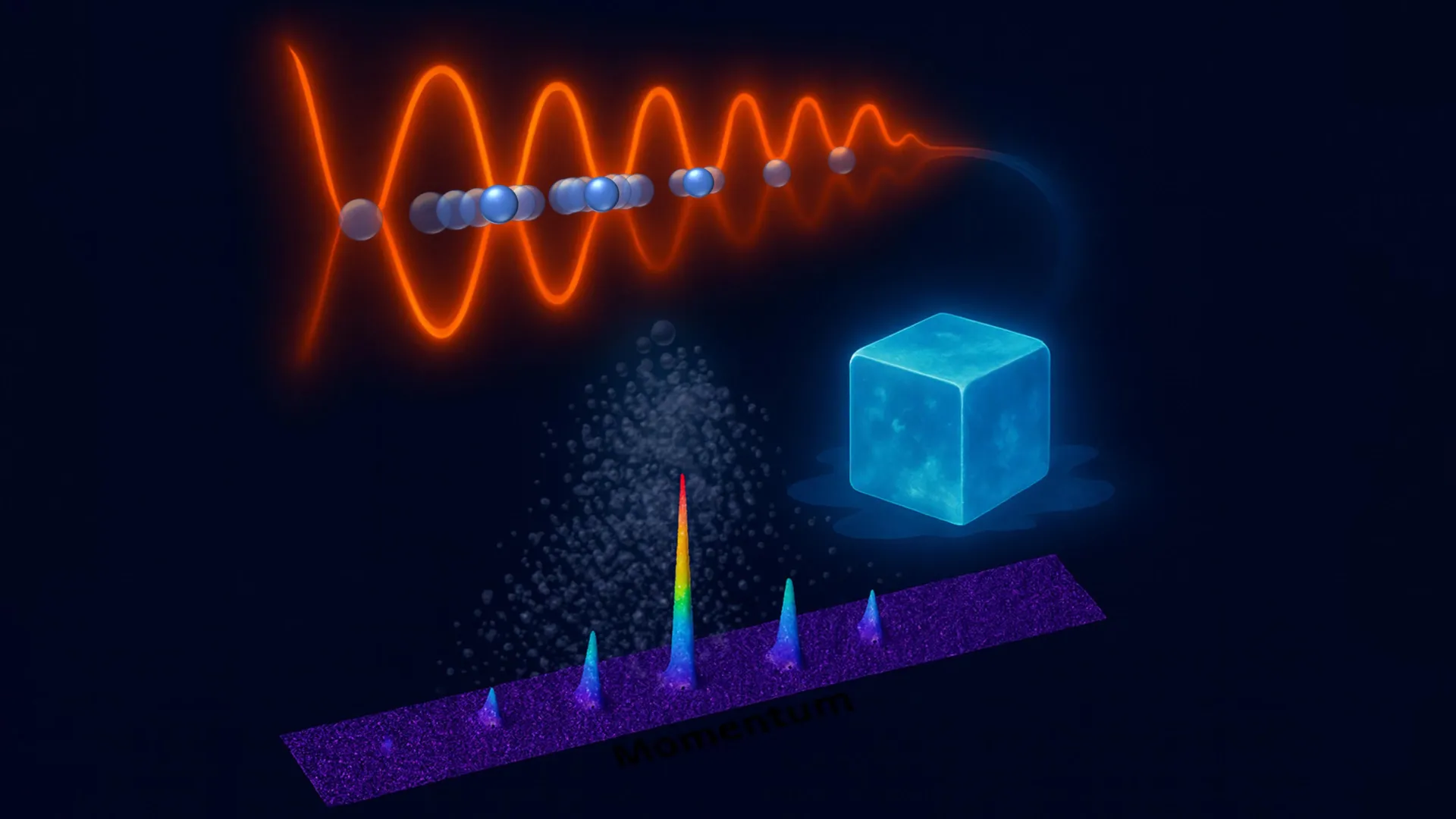
The team created a one dimensional quantum fluid made of strongly interacting atoms cooled to just a few nanokelvin above absolute zero. Using laser light, they subjected the atoms to a lattice potential that switched on and off rapidly and repeatedly. This setup created a regularly pulsed environment that effectively kicked the atoms over and over again.

Under these conditions, the atoms should have absorbed energy continuously, similar to how motion builds on a trampoline when someone keeps jumping. Instead, the researchers saw a surprising change. After a short initial period, the spread of the atoms’ momentum came to a halt. The system’s kinetic energy stopped increasing and leveled off.

Even though the atoms were still being driven and continued to interact strongly with one another, they no longer absorbed energy. The system had entered a state known as many body dynamical localization (MBDL). In this state, motion becomes locked in momentum space rather than spreading freely.

“In this state, quantum coherence and many-body entanglement prevent the system from thermalizing and from showing diffusive behavior, even under sustained external driving,” explains Hanns Christoph Nägerl. “The momentum distribution essentially freezes and retains whatever structure it has.”

An Orderly Outcome That Defied Expectations

The result surprised even the scientists involved. Lead author Yanliang Guo admitted the behavior ran counter to what they had predicted. “We had initially expected that the atoms would start flying all around. Instead, they behaved in an amazingly orderly manner.”

Lei Ying, a theory collaborator from Zhejing University in Hangzhou, China, shared that reaction. “This is not to our naïve expectation. What’s striking is the fact that in a strongly driven and strongly interacting system, many-body coherence can evidently halt energy absorption. This goes against our classical intuition and reveals a remarkable stability rooted in quantum mechanics.”

Ying also pointed out that recreating this behavior using classical computer simulations is extremely challenging. “That’s why we need experiments. They go hand in hand with our theory simulations.”

Why Quantum Coherence Matters

To see how robust this unusual state really was, the researchers altered the experiment by adding randomness to the driving sequence. The effect was immediate. Even a small amount of disorder was enough to destroy the localization.

Once coherence was disrupted, the atoms behaved more conventionally. Their momentum spread out again, kinetic energy increased rapidly, and the system resumed absorbing energy without limit. “This test highlighted that quantum coherence is crucial for preventing thermalization in such driven many-body systems,” says Nägerl.

Implications for Future Quantum Technologies

The discovery of MBDL has implications that extend well beyond basic physics. Preventing unwanted heating is one of the biggest challenges facing the development of quantum simulators and quantum computers. These devices rely on maintaining delicate quantum states that can easily be lost through energy buildup and decoherence.

“This experiment provides a precise and highly tunable way for exploring how quantum systems can resist the pull of chaos,” says Guo. By showing that heating can be halted entirely under the right conditions, the findings challenge long held assumptions about how driven quantum matter behaves.

The study opens new paths for understanding how quantum systems can remain stable even when pushed far from equilibrium.

The research has been published in Science and received financial support from the Austrian Science Fund FWF, the Austrian Research Promotion Agency FFG, and the European Union, among others.

Share Button

Flu on the rise again after Christmas mixing, says NHS

Cases up after two weeks of decline, as hospitals report rise in slips and falls because of cold snap.

Share Button