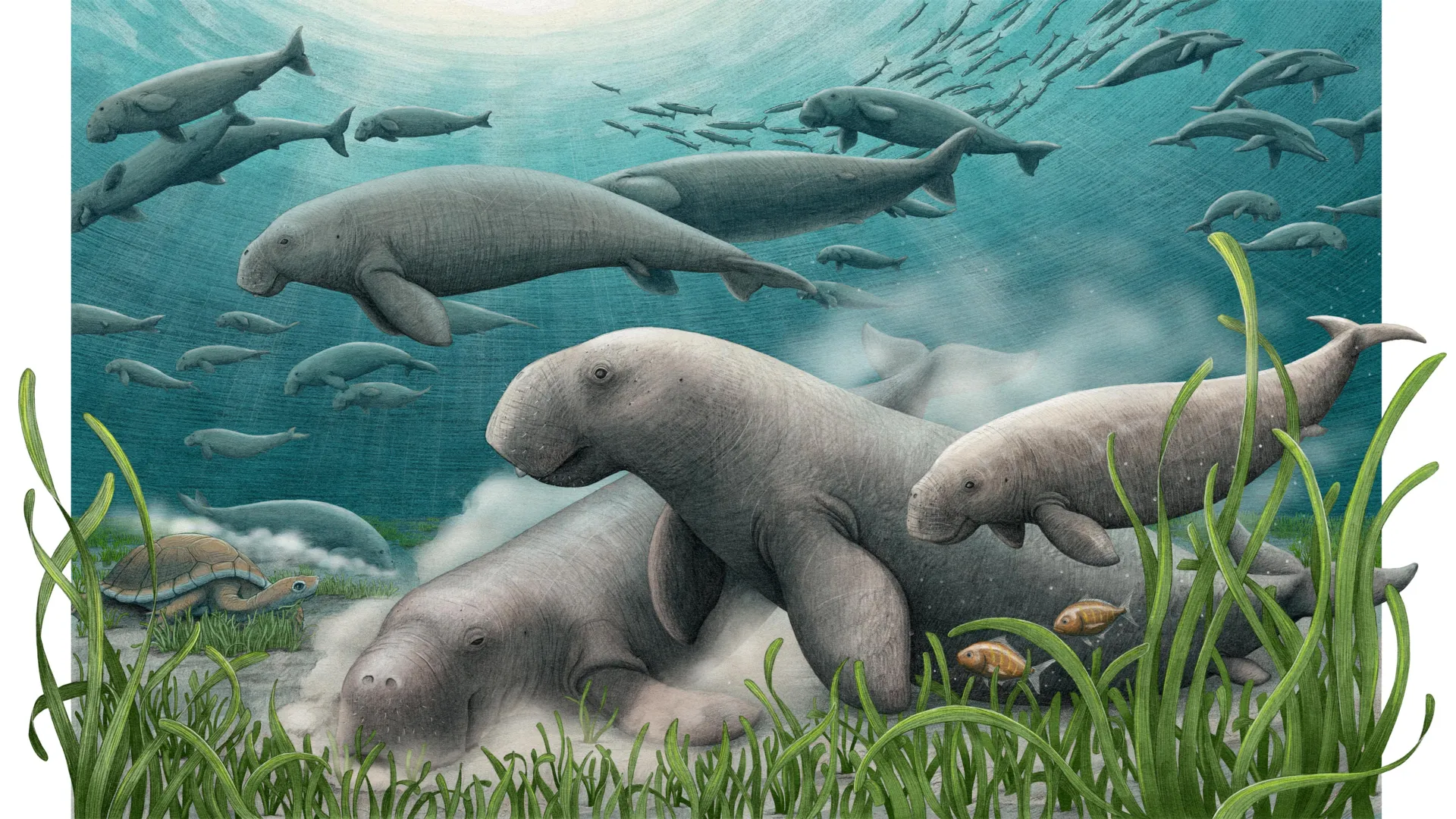
Today the Arabian Gulf supports large numbers of dugongs, marine mammals related to manatees that feed on seagrass and leave trails in the sediment as they graze. Newly examined fossils from Qatar show that sea cows living more than 20 million years ago shaped their environments in much the same way.
The findings, published December 10 in the journal PeerJ, come from a partnership between scientists at the Smithsonian’s National Museum of Natural History and Qatar Museums. The team also identified a previously unknown species of ancient sea cow that was much smaller than modern dugongs.
“We discovered a distant relative of dugongs in rocks less than 10 miles away from a bay with seagrass meadows that make up their prime habitat today,” said Nicholas Pyenson, curator of fossil marine mammals at the National Museum of Natural History and a lead author of the study. “This part of the world has been prime sea cow habitat for the past 21 million years — it’s just that the sea cow role has been occupied by different species over time.”
Modern Dugong Biology and Behavior
Dugongs (Dugong dugon) have a stout body and a downward-facing snout lined with bristles that help them sense food, giving them a broad resemblance to manatees. Their tails distinguish them from their relatives. Manatees have a rounded, paddle-shaped tail while dugongs have a dolphin-like tail with flukes (however, dugongs and manatees are more closely related to elephants than they are to dolphins, whales and porpoises).
These herbivores occupy shallow coastal habitats across a wide range that includes western Africa, the Indo-Pacific, and northern Australia. The largest single herd of dugongs occurs in the Arabian Gulf, where their constant grazing stirs up sediment and releases nutrients that benefit surrounding marine ecosystems.
A Long Fossil History and Growing Modern Threats
Fossil evidence shows that sea cow ancestors have fed on aquatic plants for roughly 50 million years. Despite this long history, dugongs in the Gulf now face significant challenges. They are sometimes caught accidentally by local fishers, and development along the coast affects the waters where they feed. Rising temperatures and increasing salinity place further pressures on the seagrass meadows that dugongs depend on.
Ferhan Sakal, head of excavation and site management at Qatar Museums and a coauthor of the study, noted that crucial information about past seagrass environments is preserved in the region’s rock record.
“If we can learn from past records how the seagrass communities survived climate stress or other major disturbances like sea-level changes and salinity shifts, we might set goals for a better future of the Arabian Gulf,” he said.
Researchers rely heavily on fossilized bones to understand these environments, since the soft blades of seagrass rarely leave impressions in the geologic record.
Exploring the Al Maszhabiya Fossil Site
One of the most significant sources of these fossils is Al Maszhabiya [AL mahz-HA-bee-yah], a site in southwestern Qatar. Geologists first encountered the site in the 1970s while conducting mining and petroleum surveys and believed they had found reptile bones. When paleontologists revisited the area in the early 2000s, they recognized the bones as belonging to ancient sea cows.
“The area was called ‘dugong cemetery’ among the members of our authority,” Sakal said. “But at the time, we had no idea just how rich and vast the bonebed actually was.”
After obtaining the required permits in 2023, Pyenson, Sakal, and their team surveyed the site. Surrounding rock layers suggest that the fossils date to the Early Miocene, approximately 21 million years ago. The area was once a shallow sea inhabited by sharks, barracuda-like fish, prehistoric dolphins, and sea turtles.
The World’s Densest Sea Cow Bonebed
The team documented sea cow remains at more than 170 separate locations across the site. Pyenson described Al Maszhabiya as the richest fossil sea cow assemblage known. He compared it to Cerro Ballena in Chile’s Atacama Desert, where he and other researchers had uncovered a large collection of whale fossils.
Although the bones share similarities with those of modern dugongs, they also show differences. The ancient animals still had hind limb bones, which living dugongs and manatees lost during their evolution. The prehistoric species also had a straighter snout and smaller tusks.
Naming a New Species: Salwasiren qatarensis
The team formally designated the Al Maszhabiya sea cows as a new species, Salwasiren qatarensis. The genus name refers to the Bay of Salwa, a nearby section of the Gulf where dugongs live today. Although the Bay of Salwa touches the waters of several countries, the species name “qatarensis” honors Qatar, where the fossils were discovered.
“It seemed only fitting to use the country’s name for the species as it clearly points to where the fossils were discovered,” Sakal said.
Based on their estimates, the researchers believe Salwasiren weighed around 250 pounds, similar to the weight of an adult panda or a heavyweight boxer. Even at that size, it was relatively small compared with some dugongs living today, which can weigh nearly eight times more.
Ancient Seagrass Meadows and the Role of Sea Cows
The fossils provide evidence that abundant seagrass beds existed in the region more than 20 million years ago, during a period when the Gulf supported high marine biodiversity. Sea cows would have helped maintain these underwater meadows by feeding and disturbing the sediment.
“The density of the Al Maszhabiya bonebed gives us a big clue that Salwasiren played the role of a seagrass ecosystem engineer in the Early Miocene the way that dugongs do today,” Pyenson said. “There’s been a full replacement of the evolutionary actors but not their ecological roles.”
Pyenson also noted that sea cow fossils often appear in mixed species groups, making it likely that further research at the site could uncover additional dugong relatives.
Preserving Qatar’s Fossil Heritage
Sakal hopes continued collaboration between Qatar Museums and the Smithsonian will lead to further discoveries at Al Maszhabiya and other nearby locations. Protecting the site is a top priority, and the team plans to nominate it for recognition as a UNESCO World Heritage site.
“The most important part of our collaboration is ensuring that we provide the best possible protection and management for these sites, so we can preserve them for future generations,” Sakal said.
“Dugongs are an integral part of our heritage, not only as a living presence in our waters today, but also in the archaeological record that connects us to generations past,” said Faisal Al Naimi, coauthor and director of the Archaeology Department at Qatar Museums. “The findings at Al Maszhabiya remind us that this heritage is not confined to memory or tradition alone, but extends deep into geologic time, reinforcing the timeless relationship between our people and the natural world. In preserving and studying these remarkable creatures, we are also safeguarding a narrative that speaks to our nation’s identity, resilience and enduring connection to the sea.”
Digital Access and Continued Research
To make their data widely available, Pyenson and Sakal worked with the Smithsonian’s Digitization Program Office to create digital scans of several fossil sites and of the fossil skull, vertebrae, tooth, and other skeletal parts of the newly described species. These 3D models can be explored through the open-source Smithsonian Voyager platform, which includes interactive educational materials and a virtual tour of the excavation.
The study’s authors also include researchers from the Smithsonian’s Digitization Program Office, the Stone Ridge School of the Sacred Heart, Texas A&M University at Galveston, Texas A&M University College Station, and the Natural History Museum of Los Angeles County.
This work was supported by a collaborative agreement between the Smithsonian Institution and Qatar Museums and received additional funding from the National Museum of Natural History and the Qatar National Research Fund.