ChatGPT wrote a woman a suicide note and another AI chatbot role-played sexual acts with children, BBC finds.


ChatGPT wrote a woman a suicide note and another AI chatbot role-played sexual acts with children, BBC finds.
Nicola Hutton was sentenced to five months in prison after being convicted of a false communication offence.
Vulnerable urged to come forward for flu jab quickly as virus has come early this year.
The universe may not be speeding up after all. According to a new study, its expansion could actually be slowing down, challenging one of modern cosmology’s most fundamental ideas.
The findings, published November 6 in Monthly Notices of the Royal Astronomical Society, question the long-accepted belief that a mysterious force known as “dark energy” is pushing galaxies apart at an ever-increasing rate. Instead, researchers found no convincing evidence that the universe is still accelerating.
If confirmed, the results could reshape scientists’ understanding of dark energy, help resolve the long-standing “Hubble tension,” and transform theories about the universe’s past and future.
Evidence for a Cosmic Slowdown
Lead researcher Professor Young-Wook Lee of Yonsei University in South Korea said, “Our study shows that the universe has already entered a phase of decelerated expansion at the present epoch and that dark energy evolves with time much more rapidly than previously thought.
“If these results are confirmed, it would mark a major paradigm shift in cosmology since the discovery of dark energy 27 years ago.”
For nearly three decades, astronomers have believed that the universe’s expansion was accelerating due to dark energy, a mysterious force acting as a kind of “anti-gravity.” This conclusion was originally based on measurements of distant type Ia supernovae, a discovery that earned the 2011 Nobel Prize in Physics.
Rethinking the Universe’s “Standard Candles”
The new research from Yonsei University challenges that foundation. Type Ia supernovae, long considered reliable “standard candles” for measuring cosmic distances, appear to be influenced by the age of the stars that create them.
Even after standardizing their brightness, the team found that supernovae originating from younger stars tend to look fainter, while those from older stars appear brighter. Analyzing data from 300 host galaxies, the researchers confirmed this age effect with an extraordinary level of confidence (99.999%).
This means that part of the dimming once attributed to cosmic acceleration could actually result from stellar population differences rather than universal expansion.
A New Model Emerges
When the team corrected for this age-related bias, the supernova data no longer fit the standard ΛCDM model, which assumes a constant form of dark energy. Instead, it matched more closely with a newer model supported by the Dark Energy Spectroscopic Instrument (DESI) project.
This alternative model draws on baryonic acoustic oscillations (BAO) — essentially ancient sound waves from the Big Bang — and data from the cosmic microwave background (CMB). Both sources suggest that dark energy is not constant but instead weakens and changes over time.
When researchers combined the corrected supernova data with BAO and CMB results, the evidence became overwhelming: the universe does not appear to be accelerating anymore, but has entered a phase of decelerated expansion.
A Universe Already Slowing
Professor Lee explained, “In the DESI project, the key results were obtained by combining uncorrected supernova data with baryonic acoustic oscillations measurements, leading to the conclusion that while the universe will decelerate in the future, it is still accelerating at present.
“By contrast, our analysis — which applies the age-bias correction — shows that the universe has already entered a decelerating phase today. Remarkably, this agrees with what is independently predicted from BAO-only or BAO+CMB analyses, though this fact has received little attention so far.”
Testing the Findings
To strengthen their conclusions, the Yonsei team is performing what they call an “evolution-free test.” This approach examines only supernovae from young, coeval galaxies — those with stars of similar ages — across the entire redshift range. Early results already support the main finding.
“Within the next five years, with the Vera C. Rubin Observatory discovering more than 20,000 new supernova host galaxies, precise age measurements will allow for a far more robust and definitive test of supernova cosmology,” said research professor Chul Chung, a co-lead author of the study, along with PhD candidate Junhyuk Son.
The Vera C. Rubin Observatory and the Future of Cosmology
Located high in the Chilean Andes, the Vera C. Rubin Observatory houses the world’s most powerful digital camera. Having begun scientific operations this year, it is expected to revolutionize our understanding of both the solar system and the broader universe.
After the Big Bang, roughly 13.8 billion years ago, the universe expanded rapidly before gravity slowed it down. Then, around nine billion years after its birth, scientists discovered that expansion had begun speeding up again. This was attributed to dark energy, which is believed to make up about 70 percent of the universe.
Dark Energy’s Mystery Deepens
Despite decades of study, dark energy remains one of science’s most puzzling enigmas. Last year, data from DESI in Tucson, Arizona hinted that the influence of dark energy might have changed over time, an idea now gaining traction with the Yonsei team’s new results.
With advanced instruments like DESI and the Vera C. Rubin Observatory, astronomers hope to finally uncover what dark energy really is — and how it shapes the fate of the universe.
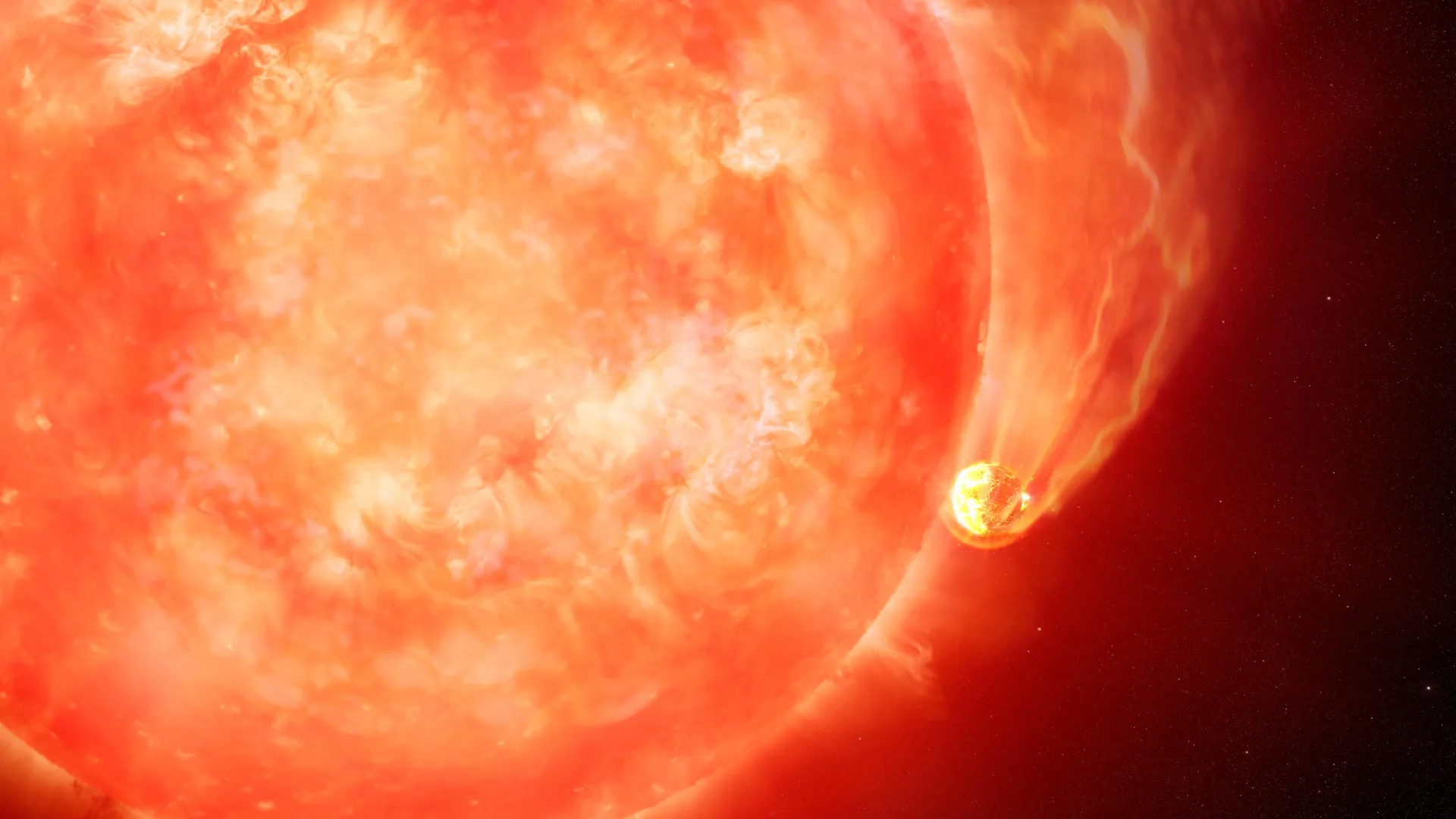
A new study from astronomers at UCL (University College London) and the University of Warwick suggests that aging stars may be destroying the giant planets orbiting closest to them.
When stars like the Sun exhaust their hydrogen fuel, they begin to cool and expand, transforming into red giants. For our Sun, this dramatic phase is expected to occur in roughly five billion years.
The research, published in the Monthly Notices of the Royal Astronomical Society, analyzed nearly half a million stars that had recently entered this “post-main sequence” stage of evolution.
Searching for Planets Around Evolving Stars
The team identified 130 planets and potential planet candidates (i.e., that still need to be confirmed) orbiting closely around these aging stars, including 33 new candidates never detected before.
They found that such planets were far less common around stars that had expanded and cooled enough to qualify as red giants (i.e., those further along in their post-main sequence evolution). This pattern suggests that many of these planets may already have been destroyed.
Evidence of Planetary Destruction
Lead author Dr. Edward Bryant (Mullard Space Science Laboratory at UCL and the University of Warwick) explained: “This is strong evidence that as stars evolve off their main sequence they can quickly cause planets to spiral into them and be destroyed. This has been the subject of debate and theory for some time but now we can see the impact of this directly and measure it at the level of a large population of stars.
“We expected to see this effect but we were still surprised by just how efficient these stars seem to be at engulfing their close planets.”
According to Dr. Bryant, the destruction occurs through a powerful gravitational struggle known as tidal interaction. As a star grows and expands, these forces intensify. “Just like the Moon pulls on Earth’s oceans to create tides, the planet pulls on the star,” he said. “These interactions slow the planet down and cause its orbit to shrink, making it spiral inwards until it either breaks apart or falls into the star.”
What It Means for the Solar System
Co-author Dr. Vincent Van Eylen (Mullard Space Science Laboratory at UCL) added perspective: “In a few billion years, our own Sun will enlarge and become a red giant. When this happens, will the solar system planets survive? We are finding that in some cases planets do not.
“Earth is certainly safer than the giant planets in our study, which are much closer to their star. But we only looked at the earliest part of the post-main sequence phase, the first one or two million years of it — the stars have a lot more evolution to go.
“Unlike the missing giant planets in our study, Earth itself might survive the Sun’s red giant phase. But life on Earth probably would not.”
To carry out their research, the team used data from NASA’s Transiting Exoplanet Survey Satellite (TESS). They employed an algorithm to identify small, repeated dips in starlight caused by planets passing in front of their stars. Their focus was on giant planets with short orbits (i.e., taking no more than 12 days to circle their star).
Starting with more than 15,000 possible signals, the researchers used rigorous checks to eliminate false positives, ultimately narrowing the list to 130 confirmed or candidate planets. Of these, 48 were already known, 49 were known candidates awaiting confirmation, and 33 were completely new discoveries.
Fewer Planets Around Older Stars
The researchers found that stars further along in their evolution were significantly less likely to host nearby giant planets. The overall occurrence rate was just 0.28%, with younger post-main sequence stars showing a higher rate (0.35%) comparable to main sequence stars. The most evolved stars — those classified as red giants — showed a sharp drop to 0.11%. (For this analysis, the smallest 12 of the 130 identified planets were excluded.)
Using TESS data, astronomers can estimate a planet’s size (radius). To confirm whether these objects are true planets or low-mass stars or brown dwarfs (“failed stars” that never ignited nuclear fusion), their mass must be determined.
This is done by measuring the tiny shifts in the motion of the host star caused by a planet’s gravitational pull. These “stellar wobbles” allow scientists to infer the planet’s mass.
Dr. Bryant added: “Once we have these planets’ masses, that will help us understand exactly what is causing these planets to spiral in and be destroyed.”
The research was supported by the UK Science and Technology Facilities Council (STFC).

Scientists at Weill Cornell Medicine have identified a surprising culprit that may contribute to dementia: free radicals generated in a particular region of brain support cells known as astrocytes. The study, published Nov. 4 in Nature Metabolism, found that blocking this specific site reduced inflammation and protected neurons. The results point toward a promising new strategy for treating neurodegenerative diseases such as frontotemporal dementia and Alzheimer’s disease.
“I’m really excited about the translational potential of this work,” said Dr. Anna Orr, the Nan and Stephen Swid Associate Professor of Frontotemporal Dementia Research in the Feil Family Brain and Mind Research Institute and member of the Appel Alzheimer’s Disease Research Institute at Weill Cornell, who co-led the study. “We can now target specific mechanisms and go after the exact sites that are relevant for disease.”
How Mitochondria and Free Radicals Affect the Brain
The research focused on mitochondria, the cell’s energy-producing structures that convert food into usable energy. In the process, mitochondria release reactive oxygen species (ROS) — molecules commonly known as free radicals. At normal levels, ROS help regulate essential cell functions, but excessive or poorly timed production can damage cells.
“Decades of research implicate mitochondrial ROS in neurodegenerative diseases,” said Dr. Adam Orr, an assistant professor of research in neuroscience in the Feil Family Brain and Mind Research Institute at Weill Cornell, who co-led the work.
Because of this connection, scientists have long tested antioxidants as a potential way to neutralize ROS and slow neurodegeneration. However, these clinical trials have largely failed. “That lack of success might be related to the inability of antioxidants to block ROS at their source and do so selectively without altering cell metabolism,” Dr. Adam Orr explained.
A New Way to Stop Harmful Free Radicals
As a postdoctoral researcher, Dr. Orr developed a drug discovery platform designed to find molecules that specifically suppress ROS at individual mitochondrial sites while leaving normal functions intact. Through this approach, the team identified a group of compounds called S3QELs (“sequels”), which showed potential to block harmful ROS activity.
The researchers focused on Complex III, a mitochondrial site known for producing ROS that can leak into the rest of the cell, potentially causing damage. To their surprise, the excess ROS did not originate from neurons, but from astrocytes — non-neuronal cells that provide structural and metabolic support to neurons.
“When we added S3QELs, we found significant neuronal protection but only in the presence of astrocytes,” said Daniel Barnett, a graduate student in the Orr lab and the study’s lead author. “This suggested that ROS coming from Complex III caused at least some of the neuronal pathology.”
Further experiments showed that when astrocytes were exposed to disease-related factors such as inflammatory molecules or proteins linked to dementia (including amyloid-beta), their mitochondrial ROS production increased dramatically. Treatment with S3QELs suppressed much of this rise, while blocking other ROS sources did not have the same effect.
Barnett discovered that ROS oxidized certain immune and metabolic proteins involved in neurological disease, altering the activity of thousands of genes tied to inflammation and dementia.
“The precision of these mechanisms had not been previously appreciated, especially not in brain cells,” said Dr. Anna Orr. “This suggests a very nuanced process in which specific triggers induce ROS from specific mitochondrial sites to affect specific targets.”
Promising Results in Animal Models
When the team administered the S3QEL compound to mice engineered to model frontotemporal dementia, they observed reduced astrocyte activation, lower levels of inflammatory gene expression, and a decrease in a tau modification linked to dementia. Remarkably, these effects appeared even when treatment began after symptoms had already started.
Extended treatment improved lifespan, was well tolerated, and produced no significant side effects. Dr. Anna Orr attributes this to the compound’s highly targeted action.
The team plans to continue developing the S3QEL compounds in collaboration with medicinal chemist Dr. Subhash Sinha, professor of research in neuroscience in the Brain and Mind Research Institute and member of the Appel Alzheimer’s Disease Research Institute at Weill Cornell.
They also intend to investigate how disease-associated genes influence ROS production and whether certain genetic variants that raise or lower dementia risk might do so by altering mitochondrial ROS activity.
Changing How Scientists Think About Free Radicals
“The study has really changed our thinking about free radicals and opened up many new avenues of investigation,” said Dr. Adam Orr. The potential of these findings to open new research approaches to inflammation and neurodegeneration is highlighted in the journal.
If you’re getting a pattern of milder, recurring headaches here are four things you can do to help manage it.
The palliative care nurse was convicted of the murder of 10 patients, and the attempted murder of 27 others.
A BBC investigation finds that a host of areas in England are closing waiting lists and others are rationing care.
An offer was made to avert the resident doctors’ strike but the union said it did not go far enough.
