A telescope larger than Earth just revealed the hidden heart of a mysterious galaxy

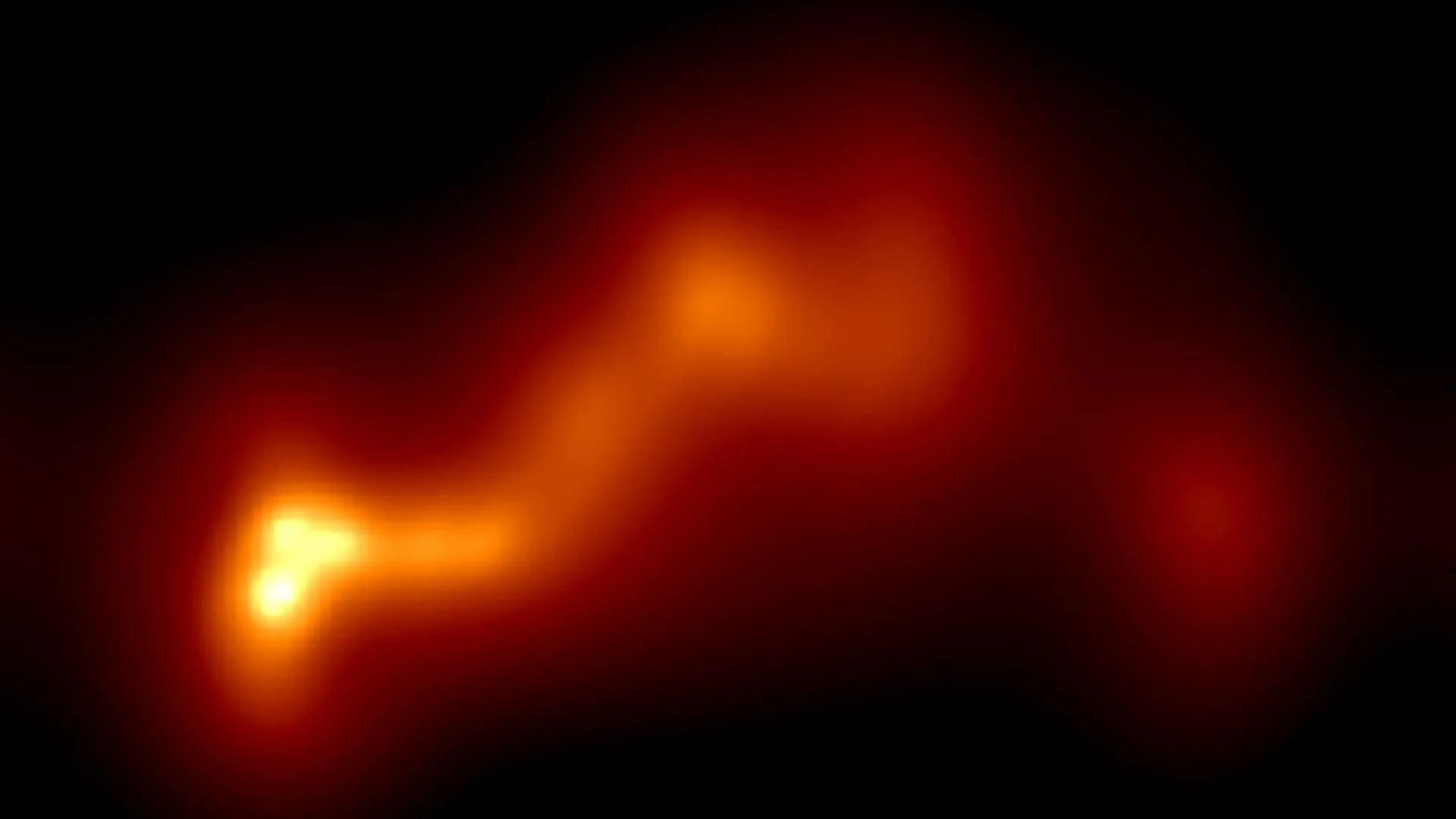
For more than a century and a half, astronomers have been captivated by the distant galaxy OJ 287, located about five billion light years from Earth. Its puzzling variations in brightness have long hinted that two enormous black holes may be orbiting and merging at its center. Now, an international team led by Dr. Efthalia Traianou of Heidelberg University has captured a highly detailed image of the galaxy’s core, revealing features never seen before. Using a space-based radio telescope, the researchers produced an image that uncovers a sharply curved section of a plasma jet streaming from the galaxy’s center, offering fresh insight into the extreme environments surrounding supermassive black holes.

OJ 287 is classified as a blazar, a type of active galaxy known for its intense energy and brightness. At its heart lies a supermassive black hole that draws in matter from nearby space and propels some of it outward in colossal plasma jets filled with radiation, heat, magnetic fields, and heavy particles. “We have never before observed a structure in the OJ 287 galaxy at the level of detail seen in the new image,” said Dr. Traianou, a postdoctoral researcher working with Dr. Roman Gold at Heidelberg University’s Interdisciplinary Center for Scientific Computing.

The image penetrates deeply into the galaxy’s center, revealing a sharply bent, ribbon-like jet structure and providing clues about the plasma’s composition and motion. Some areas reach temperatures of around ten trillion degrees Kelvin, showing just how much energy is being released near the black hole. The scientists also detected a new shock wave forming and colliding along the jet, which they linked to trillion-electron-volt energy levels observed in an unusual gamma-ray signal detected in 2017.

To obtain this remarkable view, the researchers used a ground-space radio interferometer that combined a radio telescope in Earth’s orbit (the ten-meter antenna of the RadioAstron mission aboard the Spektr-R satellite) with 27 ground-based observatories around the world. By linking signals from these observatories, they effectively created a virtual telescope five times wider than Earth’s diameter. The extraordinary resolution of the resulting image comes from measuring how light waves overlap, taking full advantage of the wave properties of light itself.

The interferometric image underpins the assumption that a binary supermassive black hole is located inside galaxy OJ 287. It also provides important information on how the movements of such black holes influence the form and orientation of the plasma jets emitted. “Its special properties make the galaxy an ideal candidate for further research into merging black holes and the associated gravitational waves,” states Efthalia Traianou.

Institutions from Germany, Italy, Russia, Spain, South Korea, and the US all contributed to the research. It was supported by various research and funding institutions. The research results were published in the journal Astronomy & Astrophysics.

Share Button

Targeted prostate cancer screening could save countless lives, says Sunak

The former PM is among those in favour of targeted screening for men most at risk, but some medical experts are sceptical.

Share Button

JWST may have found the Universe’s first stars powered by dark matter

In the early universe, a few hundred million years after the Big Bang, the first stars emerged from vast, untouched clouds of hydrogen and helium. Recent observations from the James Webb Space Telescope (JWST) suggest that some of these early stars may have been unlike the familiar (nuclear fusion-powered) stars that astronomers have studied for centuries. A new study led by Cosmin Ilie of Colgate University, together with Shafaat Mahmud (Colgate ’26), Jillian Paulin (Colgate ’23) at the University of Pennsylvania, and Katherine Freese at The University of Texas at Austin, has identified four extremely distant objects whose appearance and spectral signatures match what scientists expect from supermassive dark stars.

“Supermassive dark stars are extremely bright, giant, yet puffy clouds made primarily out of hydrogen and helium, which are supported against gravitational collapse by the minute amounts of self-annihilating dark matter inside them,” Ilie said. Supermassive dark stars and their black hole remnants could be key to solving two recent astronomical puzzles: i. the larger than expected extremely bright, yet compact, very distant galaxies observed with JWST, and ii. the origin of the supermassive black holes powering the most distant quasars observed.

Katherine Freese first proposed the idea of dark stars with Doug Spolyar and Paolo Gondolo, publishing their initial peer-reviewed paper on the concept in Physical Review Letters in 2008. That study outlined how dark stars might grow and eventually collapse into supermassive black holes in the early universe. In 2010, Freese, Ilie, Spolyar, and their collaborators expanded on the theory in The Astrophysical Journal, describing two possible processes that could allow dark stars to reach immense sizes and predicting that they could seed the black holes found in the earliest quasars known to exist.

Dark matter is thought to make up roughly a quarter of the universe, yet its nature remains one of science’s greatest mysteries. Researchers believe it is composed of a still-undetected type of elementary particle. Decades of experiments have searched for these particles, but so far without success. One leading possibility involves Weakly Interacting Massive Particles (WIMPs). When two WIMPs collide, they are expected to annihilate each other, releasing energy that could heat collapsing hydrogen clouds and cause them to shine as brilliant dark stars.

Conditions a few hundred million years after the Big Bang, within dense regions called dark matter halos, appear to have been ideal for forming such stars. These regions are also where the first generation of normal stars was expected to appear.

“For the first time we have identified spectroscopic supermassive dark star candidates in JWST, including the earliest objects at redshift 14, only 300 Myr after the Big Bang,” said Freese, the Jeff and Gail Kodosky Endowed Chair in Physics and director of the Weinberg Institute and Texas Center for Cosmology and Astroparticle Physics at UT Austin. “Weighing a million times as much as the Sun, such early dark stars are important not only in teaching us about dark matter but also as precursors to the early supermassive black holes seen in JWST that are otherwise so difficult to explain.”

In a 2023 PNAS study by Ilie, Paulin, and Freese, the first supermassive dark star candidates (JADES-GS-z13-0, JADES-GS-z12-0, and JADES-GS-z11-0) were identified using photometric data from JWST’s NIRCam instrument. Since then, spectra from JWST’s NIRSpec instrument became available for those, and a few other extremely distant objects. The team, which now also includes Shafaat Mahmud analyzed the spectra and morphology of four of the most distant objects ever observed (including two candidates from the 2023 study): JADES-GS-z14-0, JADES-GS-z14-1, JADES-GS-13-0, and JADES-GS-z11-0 and found that each of them is consistent with a supermassive dark star interpretation.

JADES-GS-z14-1 is not resolved, meaning it is consistent with a point source, such as a very distant supermassive star would be. The other three are extremely compact, and can be modeled by supermassive dark stars powering a nebula (i.e. ionized H and He gas surrounding the star). Each of the four objects analyzed in this study is also consistent with a galaxy interpretation, as shown in the literature. Dark stars have a smoking gun signature, an absorption feature at 1640 Angstrom, due to the large amounts of singly ionized helium in their atmospheres. And in fact, one of the four objects analyzed shows signs of this feature.

“One of the most exciting moments during this research was when we found the 1640 Angstrom absorption dip in the spectrum of JADES-GS-z14-0. While the signal to noise ratio of this feature is relatively low (S/N~2), it is for the first time we found a potential smoking gun signature of a dark star. Which, in itself, is remarkable,” Ilie said.

Astronomers using the Atacama Large Millimeter/submillimeter Array (ALMA) measured the spectrum of the same object, revealing the presence of oxygen, via a nebular emission line. Researchers said that if both spectral features are confirmed, the object cannot be an isolated dark star, but rather may be a dark star embedded in a metal rich environment. This could be the outcome of a merger, where a dark matter halo hosting a dark star merges with a galaxy. Alternatively, dark stars and regular stars could have formed in the same host halo, as the researchers now realized it is possible.

The identification of supermassive dark stars would open up the possibility of learning about the dark matter particle based on the observed properties of those objects, and would establish a new field of astronomy: the study of dark matter-powered stars. This published PNAS research is a key step in this direction.

Funding Acknowledgments: This research was made possible by generous funding from the following agencies: Colgate University Research Council, The Picker Interdisciplinary Sciences Institute, the U.S. Department of Energy’s Office of High Energy Physics program, Swedish Research Council, LSST Discovery Alliance, the Brinson Foundation, the WoodNext Foundation, and the Research Corporation for Science Advancement Foundation.

Share Button

Could I have saved my parents if I’d been taught CPR?

Cameron McGerr lost both his parents and is campaigning to have life-saving first aid taught in schools.

Share Button

A single protein could stop sudden death after heart attacks

Nina Kumowski, MD, of the Department of Radiology and Center for Systems Biology at Massachusetts General Hospital, is the lead author and Matthias Nahrendorf, MD, PhD of the Department of Radiology and Center for Systems Biology at MGH, is the senior author of a paper published in Science, “Resistin-like molecule γ attacks cardiomyocyte membranes and promotes ventricular tachycardia.”

Q: How would you summarize your study for a lay audience?

In short: We found that the defense protein “Resistin like molecule gamma” (Relmy), produced by neutrophils, punches holes into heart cells after a heart attack. This promotes dangerous, fast, and irregular heart rhythm and cell death in the heart.

The longer version: The most lethal complications of coronary artery disease are myocardial infarction (MI) and sudden cardiac death.

In MI, the blockage of a heart artery leads to insufficient oxygen supply to heart muscle cells (cardiomyocytes). This compromises their ability to maintain a stable rhythm and can give rise to a dangerous, unstable heart rhythms (arrhythmia) called ventricular tachycardia (VT) and ventricular fibrillation (VF).

VT and VF are both serious arrhythmias that can lead to sudden cardiac arrest and death within minutes. In VT, the heart beats very rapidly, but in a coordinated rhythm. In VF, the rhythm is chaotic and uncoordinated.

Most arrhythmias occur within 48 hours after MI and coincide with massive immune cell infiltration into the heart tissue. We were interested in how these immune cells may promote arrhythmia.

We found neutrophils that get recruited into the infarct (the area of dead tissue resulting from the cutoff of oxygen supply) in large numbers upregulate the gene “Retnlg,” coding the protein resistin like molecule gamma (RELMy). We also found a comparable gene, “RETN,” in human infarcted heart tissue. When we removed this protein from neutrophils in mice, the arrhythmia burden after MI was reduced 12-fold.

Q: What question were you investigating?

We were investigating the question of how neutrophils, a specific kind of immune cell, promote ventricular arrhythmia (a dangerous fast irregular heartbeat) after heart attacks. Cardiomyocytes as the main actors in arrhythmia are very well studied, but if and how immune cells can promote arrythmia is less clear. This work is important because ventricular arrhythmia is the most lethal complication after myocardial infarction. We need to understand better what promotes arrythmia to help us develop new antiarrhythmic drugs.

Q: What methods or approach did you use?

We used a plethora of methods to figure this out. For an initial understanding about which proteins in neutrophils might be important, we used deposited data on gene expression generated by single cell and spatial RNA-sequencing from mice that underwent myocardial infarction. But we also used data from human studies to find similarities in human tissue.

We also relied on confocal and super-high resolution microscopy in isolated mouse heart muscle cells that were treated with the labeled protein. Further, we deployed in vitro assays such as a liposome model and cell culture techniques to investigate the mouse and the human version of the protein to find out if they work similar.

Q: What did you find?

We found that after MI in mouse models, neutrophils upregulatethe expression of “Retnlg,” the gene coding for RELMy. We also found that the human biological homolog “RETN,” the genecoding for Resistin, was higher expressed in human infarcted myocardial tissue compared to non-infarcted tissue, similar to mice.

We saw that deleting the gene from bone marrow derived cells (such as neutrophils) and deleting the gene from neutrophils specifically significantly reduced incidents of ventricular arrhythmia in the mouse models.

Q: What are the implications?

The implications are that immune cells play a crucial role in sudden death and arrhythmia.

We should think about treating both the myocardial infarction both by quick recanalization of the vessel to restore oxygenated blood supply and also by targeting immune cells to mitigate the arrhythmic effects of the injury.

When we understand the underlying mechanisms better, we can pursue therapeutic targets that go beyond the broad immune suppression that is used today.

If we can treat targets more specifically, we can reduce unwanted side effects and unravel the full potential of immune modulation in cardiovascular disease.

Q: What are the next steps?

The next steps are to find a way to neutralize the harmful protein and test if this can reduce VT burden and infarct size. First in the mouse models, but, we hope, eventually also in humans.

We should gather more evidence about the significance of this protein in human disease. It is also interesting to see these findings have implications for other diseases with neutrophil recruitment and activation.

Authorship: In addition to Nina Kumowski and Matthias Nahrendorf, Mass General Brigham authors include Steffen Pabel, Jana Grune, Noor Momin, Kyle I. Mentkowski, Yoshiko Iwamoto, Yi Zheng, I-Hsiu Lee, Fadi E. Pulous, Hana Seung, Alexandre Paccalet, Charlotte G. Muse, Kenneth K. Y. Ting, Paul Delgado, Andrew J. M. Lewis, Vaishali Kaushal, Antonia Kreso, Dennis Brown, Kamila Naxerova, Michael A. Moskowitz, and Maarten Hulsmans.

Funding: This work was supported by grants from the Leducq Foundation, the National Institutes of Health (NIH grants HL155097, HL149647, HL142494, HL176359, NS136068, DP2AR075321); the Deutsche Forschungsgemeinschaft (DFG) Walter Benjamin Programm (491497342 and 530157297); the British Heart Foundation (FS/ICRF/24/26111 and RE/18/3/342140), and the NIHR Oxford Biomedical Research Centre.

Disclosures: Nahrendorf has received funds or material research support from Alnylam, Biotronik, CSL Behring, GlycoMimetics, GSK, Medtronic, Novartis, and Pfizer, and has received consulting fees from Biogen, Gimv, IFM Therapeutics, Molecular Imaging, Sigilon, Verseau Therapeutics and Bitterroot. Matthias and Wirth are employees of the company Abberior Instruments America, which commercializes the MINFLUX technology. Lewis is on the advisory board of Abbott, AstraZeneca, and Novartis. Pabel is employed by the Novartis Institute of Biomedical Research. Hayat is a cofounder and shareholder of Sequantrix GmbH and has received research funding from Novo Nordisk and AskBio. The remaining authors declare no competing interests.

Share Button

Popular hair-loss pill linked to depression and suicide

A new analysis by a public health expert at the Hebrew University of Jerusalem has found that finasteride, a widely used treatment for hair loss, has been associated with depression and suicide for more than twenty years. Despite these long-standing concerns, neither regulators nor the drug’s manufacturer took meaningful action. Drawing on adverse event reports and health records from several countries, the review identifies a consistent pattern of psychiatric side effects linked to the drug. Even with growing evidence, both Merck and the FDA failed to launch necessary safety investigations. The author is now urging major reforms to the way medications are approved and monitored for long-term risks.

For more than two decades, finasteride has been prescribed to millions of men seeking to slow or reverse hair loss. Behind its cosmetic appeal, however, evidence has continued to emerge suggesting serious mental health consequences, including depression, anxiety, and in some cases, suicide.

Prof. Mayer Brezis of the Hebrew University of Jerusalem argues that both the medical community and regulators have repeatedly failed to protect the public by overlooking signs of psychiatric harm associated with the drug.

His review analyzed data from eight large studies published between 2017 and 2023. The findings show a clear trend: people who used finasteride were far more likely to experience mood disorders and suicidal thoughts than those who did not. This pattern appeared consistently across various national databases, including the FDA’s adverse event system and healthcare records from Sweden, Canada, and Israel.

“The evidence is no longer anecdotal,” said Prof. Brezis, a professor emeritus of medicine and public health. “We now see consistent patterns across diverse populations. And the consequences may have been tragic.”

The report estimates that hundreds of thousands of users may have suffered from finasteride-related depression, and that hundreds — possibly more — may have died by suicide. Originally approved by the FDA in 1997 for male pattern baldness, the drug has remained popular for its perceived safety and effectiveness, particularly among younger men. Critics say, however, that its risks were downplayed or ignored.

A Delayed Response, With a High Cost

Although the FDA recognized depression as a possible side effect in 2011 and added suicidal thoughts to the label in 2022, researchers had been warning of potential dangers as early as 2002. Internal FDA files from 2010, cited in Brezis’ review, contained entire sections redacted as “confidential,” including estimates of how many people might have been affected.

By 2011, only 18 suicides linked to finasteride had been reported to the FDA. Based on worldwide usage, Brezis concluded the actual number should have been in the thousands. “It wasn’t just underreporting,” Dr. Brezis wrote. “It was a systemic failure of pharmacovigilance.”

Unlike drugs used to treat obesity or psychiatric disorders, which are often closely monitored after approval, finasteride’s classification as a cosmetic treatment may have shielded it from deeper scrutiny. None of the data-mining studies referenced in the review were initiated by Merck, the company that developed the drug, nor were they commissioned by regulatory authorities.

A Cosmetic Drug With Life-Altering Risks

Brezis argues the drug’s classification as a non-essential, appearance-enhancing medication changes the risk calculus. “This wasn’t about life or death medical necessity,” he said. “This was about hair.”

The biological rationale is clear. Finasteride works by blocking the conversion of testosterone into dihydrotestosterone (DHT), but in doing so, it may also disrupt neurosteroids like allopregnanolone — linked to mood regulation in the brain. Animal studies have shown long-term effects on neuroinflammation and even changes in hippocampal structure.

For some patients, the consequences don’t end when the pills do. Reports of lingering symptoms — dubbed “post-finasteride syndrome” — include insomnia, panic attacks, cognitive dysfunction, and suicidal thoughts that persist months or even years after stopping treatment.

Regulatory Gaps, Corporate Silence

The report is especially scathing toward the FDA and Merck. Despite having access to millions of patient records and robust pharmacovigilance tools, neither party acted in time, Brezis argues. The industry’s silence was strategic, he suggests, driven by market pressures and legal liability — echoing past controversies like Merck’s handling of Vioxx.

“Nothing is more important to Organon than the safety of our medicines,” the company recently claimed in a public statement. Yet none of the safety studies cited were initiated by the manufacturer.

The FDA, meanwhile, took five years to respond to a citizen petition calling for a black-box warning. Its final decision? To add suicidal ideation to the label — but not as a formal warning.

What Now?

Brezis is calling for immediate changes in how drugs like finasteride are approved, monitored, and prescribed. His recommendations include suspending marketing of the drug for cosmetic purposes until safety is re-established, mandatory post-approval studies with strict enforcement, and systematic recording of drug histories in suicide investigations.

“For many, those changes come too late. The paper is dedicated to one such individual — a previously healthy man who took finasteride “just” to improve his hair. Within days, he spiraled into severe psychiatric distress. He never recovered. Months later, he took his own life.”

Share Button

Eat kiwi fruit to relieve constipation, says guidance

New guidance for doctors says focusing on fruit in our diets can help with a really common complaint.

Share Button

Decades-old photosynthesis mystery finally solved

Scientists from the Indian Institute of Science (IISc) and the California Institute of Technology (Caltech) have finally solved a long-standing puzzle about the earliest moments of photosynthesis — the vital process through which plants, algae, and certain bacteria capture sunlight to generate oxygen and energy-rich compounds.

Their research reveals why the first movements of electrons, which are crucial for transferring energy, occur through only one side of a key protein-pigment structure. The findings were published in the Proceedings of the National Academy of Sciences.

Photosynthesis is a sequence of reactions in which electrons pass between multiple pigment molecules. Although it has been examined for decades, the process remains difficult to fully explain because it involves numerous intricate components, operates at extremely fast timescales, and varies slightly across different species. Gaining a deeper understanding of these steps could help scientists develop efficient artificial systems, such as synthetic leaves and solar-based fuel technologies, that replicate nature’s design.

In most life forms that use photosynthesis, the process begins with a protein-pigment complex known as Photosystem II (PSII). This complex captures sunlight and splits water molecules, releasing oxygen and sending electrons onward to other molecules in the chain of energy transfer.

PSII contains two nearly identical branches, known as D1 and D2, surrounded by four chlorophyll molecules and two related pigments called pheophytins. These are symmetrically arranged and connected to electron carriers known as plastoquinones. In theory, electrons should move from chlorophyll to pheophytin and then to plastoquinone along both branches.

However, experiments have consistently shown that electrons move only through the D1 branch — a finding that has baffled scientists for years. “Despite the structural symmetry between the D1 and D2 protein branches in PSII, only the D1 branch is functionally active,” explains Aditya Kumar Mandal, the study’s first author and a PhD student in the Department of Physics at IISc.

To investigate this imbalance, the team combined molecular dynamics simulations, quantum mechanical analyses, and Marcus theory (a Nobel Prize-winning model that describes how electrons are transferred) to chart the energy patterns in both pathways. “We assessed the electron transfer efficiency step-by-step through both D1 and D2 branches,” says Shubham Basera, PhD student in the Department of Physics and one of the authors.

The team found that the D2 branch has a much higher energy barrier, which makes electron transport energetically unfavourable. Specifically, the transfer of electrons from pheophytin to plastoquinone in D2 requires twice as much activation energy as D1 — a barrier that electrons seem unable to overcome, preventing energy from flowing forward.

The researchers also simulated the current-voltage characteristics of both branches and found that the resistance against electron movement in D2 was two orders of magnitude higher than that in D1.

The asymmetry in electron flow may also be influenced by subtle differences in the protein environment around the PSII and how the pigments are embedded in it, the researchers suggest. For example, the chlorophyll pigment in D1 has an excitation state at a lower energy than its D2 counterpart, suggesting that the D1 pigment has a better chance of attracting and transferring electrons.

The researchers also suggest that tweaking some of these components can boost or rewire electron flow across PSII. For example, swapping chlorophyll and pheophytin in D2 could overcome the electron block, because chlorophyll needs lower activation energy than pheophytin.

“Our research presents a significant step forward in understanding natural photosynthesis,” says Prabal K Maiti, Professor at the Department of Physics and one of the corresponding authors of the study. “These findings may help design efficient artificial photosynthetic systems capable of converting solar energy into chemical fuels, contributing to innovative and sustainable renewable energy solutions.”

This is a beautiful combination of theory at various levels to address a long-standing problem culminating in a new level of understanding, but still leaving mysteries to be challenged, says Bill Goddard, Professor at Caltech and one of the corresponding authors.

Share Button

Watchdog vows Botox crackdown after BBC exposé

BBC researchers caught pharmacists trying to sell Botox without assessing patients first.

Share Button

Scientists found a smarter Mediterranean diet that cuts diabetes risk by 31%

Eating a Mediterranean-style diet with fewer calories, adding moderate physical activity, and receiving professional guidance for weight management can lower the risk of developing type 2 diabetes by 31%. That is the key finding of PREDIMED-Plus, a large clinical trial led in Spain by the University of Navarra together with more than 200 researchers from 22 universities, hospitals, and research institutes. The project was carried out in over 100 primary care centers within Spain’s National Health System.

Launched in 2013 after the University of Navarra received an Advanced Grant of over €2 million from the European Research Council (ERC), PREDIMED-Plus is the largest nutrition trial ever conducted in Europe. Between 2014 and 2016, additional institutions joined the effort, bringing total funding above 15 million euros. Most of the support came from the Carlos III Health Institute (ISCIII) and the Center for Biomedical Research Network (CIBER), through its divisions on Physiopathology of Obesity and Nutrition (CIBEROBN), Epidemiology and Public Health (CIBERESP), and Diabetes and Associated Metabolic Diseases (CIBERDEM).

The study, published in Annals of Internal Medicine, followed 4,746 adults between the ages of 55 and 75 who were overweight or obese and had metabolic syndrome but no prior history of cardiovascular disease or diabetes. Over six years, researchers compared two groups. One group adopted a calorie-reduced Mediterranean diet (about 600 fewer kilocalories per day), engaged in moderate exercise such as brisk walking and strength and balance training, and received professional counseling. The other group continued a traditional Mediterranean diet without calorie limits or exercise advice.

The results revealed that the participants who followed the calorie-reduced diet and exercise plan not only reduced their diabetes risk but also lost more weight and trimmed more from their waistlines. On average, they lost 3.3 kg and 3.6 cm from their waist, compared to 0.6 kg and 0.3 cm in the control group. This translated to preventing about three new cases of type 2 diabetes for every 100 participants — a meaningful benefit for public health.

“Diabetes is the first solid clinical outcome for which we have shown — using the strongest available evidence — that the Mediterranean diet with calorie reduction, physical activity and weight loss is a highly effective preventive tool,” said Miguel Ángel Martínez-González, Professor of Preventive Medicine and Public Health at the University of Navarra, Adjunct Professor of Nutrition at Harvard University, and one of the principal investigators of the project. “Applied at scale in at-risk populations, these modest and sustained lifestyle changes could prevent thousands of new diagnoses every year. We hope soon to show similar evidence for other major public health challenges.”

Type 2 Diabetes: A Preventable Global Epidemic

According to the International Diabetes Federation, type 2 diabetes now affects over 530 million people around the world. Its rise is fueled by urbanization (unhealthy diets, sedentary lifestyles, reduced physical activity), an aging population, and increasing rates of overweight and obesity. In Spain, an estimated 4.7 million adults live with diabetes — mostly type 2 — giving the country one of the highest rates in Europe, where total cases exceed 65 million. In the United States, roughly 38.5 million people have diabetes, and the disease carries some of the highest per-patient healthcare costs worldwide. Experts emphasize that prevention is crucial to slow this escalating crisis, which greatly increases the risk of heart, kidney, and metabolic complications.

“The Mediterranean diet acts synergistically to improve insulin sensitivity and reduce inflammation. With PREDIMED-Plus, we demonstrate that combining calorie control and physical activity enhances these benefits,” explained Miguel Ruiz-Canela, Professor and Chair of Preventive Medicine and Public Health Department at the University of Navarra’s School of Medicine and first author of the study. “It is a tasty, sustainable and culturally accepted approach that offers a practical and effective way to prevent type 2 diabetes — a global disease that is, to a large extent, avoidable.”

International Relevance and Support for a Realistic and Scalable Strategy

Annals of Internal Medicine accompanied the publication with an editorial by Sharon J. Herring and Gina L. Tripicchio, nutrition and public health experts at Temple University (Philadelphia, USA). They praised the intervention’s clinical relevance and its potential as a preventive model for type 2 diabetes. Furthermore, they warn that replicating similar strategies outside the Mediterranean context — such as in the U.S. — requires overcoming structural barriers, including unequal access to healthy foods, the limitations of the urban environment, and the lack of professional guidance. In this scenario, they advocate strengthening public policies that promote more nutritious and more equitable environments. At a time when new drugs against obesity and diabetes are grabbing headlines, PREDIMED-Plus demonstrates that modest, sustained lifestyle changes can still deliver powerful health benefits.

The PREDIMED-Plus project (2013-2024), which involves different patients, is a continuation of the PREDIMED study (2003-2010). This study demonstrated that following a Mediterranean diet enriched with extra-virgin olive oil or nuts reduces the risk of cardiovascular disease by 30%. Researchers emphasize that primary care providers can integrate the new intervention as a sustainable, cost-efficient strategy to prevent type 2 diabetes on a large scale.

Participating Institutions

The PREDIMED-Plus trial has assembled a broad network of investigators from across Spain. In order of the number of participants, the study included researchers from the following institutions: the University of Navarra and the Navarra Health Service (2 centers), Hospital Clínic de Barcelona (2 centers), University of Valencia, Rovira i Virgili University (Reus), IMIM-Hospital del Mar, Miguel Hernández University (Alicante), Son Espases Hospital (Palma de Mallorca), University of Malaga, Reina Sofía Hospital (Córdoba) and University of Granada. In addition, Bioaraba and the UPV/EHU (Vitoria), the University of the Balearic Islands, the Hospital Virgen de la Victoria (Malaga), the University of Las Palmas de Gran Canaria, the University of Leon, the Primary Health Care District of Seville, the Fundación Jiménez Díaz (Madrid), the Hospital de Bellvitge, the Hospital Clínico San Carlos (Madrid), the University of Jaen, and the IMDEA Food Institute (Madrid) have also participated.

The project also benefited from international collaboration with the Harvard T.H. Chan School of Public Health (USA). Most of the participating researchers are affiliated with the CIBEROBN, CIBERESP, or CIBERDEM research networks.

Share Button