With bags packed and boarding passes at the ready, what can you do to keep your body clock on track?


With bags packed and boarding passes at the ready, what can you do to keep your body clock on track?
Scientists have kept vaccines stable at room temperature for a year, which could transform global vaccination.
Government plans network of nearly 200 specialist services to help those facing mental health crises.
Scientists have discovered an enormous body of magma deep beneath Tuscany, even though the region shows few of the surface clues typically associated with such systems. Using a seismic imaging method called ambient noise tomography, researchers detected approximately 6,000 km3 of volcanic fluids buried 8 to 15 km below the surface. (6,000 km3 equals the volume of 2.4 billion standard Olympic swimming pools.)
The international team included scientists from the University of Geneva (UNIGE), the Institute of Geosciences and Earth Resources (CNR-IGG), and the National Institute of Geophysics and Volcanology (INGV). Their findings, published in Communications Earth & Environment, could also help researchers locate geothermal reservoirs, lithium deposits, and rare earth elements connected to deep magmatic activity.
A Vast Magma System With No Obvious Warning Signs
Some of the world’s best-known volcanic regions, including Yellowstone National Park in the United States, Lake Toba in Indonesia, and Lake Taupo in New Zealand, sit above magma reservoirs containing thousands of cubic kilometers of molten material.
Scientists usually identify these systems through visible or measurable evidence at the surface. Such clues can include ancient eruption deposits, volcanic craters, rising or sinking ground, and escaping gases. When those signs are absent, however, even enormous quantities of magma can remain undetected within Earth’s crust.
That appears to have happened in Tuscany. Researchers from UNIGE, working with specialists from the Institute of Geosciences and Earth Resources (IGG-CNR) and the National Institute of Geophysics and Volcanology (INGV), mapped approximately 6,000 km3 of volcanic fluids within the continental crust.
The newly identified material extends across Tuscany at depths ranging from 8 to 15 km.
No Current Volcanic Threat
Over geological timescales, a magma body of this size could theoretically play a role in the development of a supervolcano. Researchers emphasize, however, that the system does not currently represent a threat.
“We knew that this region, which extends from north to south across Tuscany, is geothermally active, but we did not realize it contained such a large volume of magma, comparable to that of supervolcanic systems such as Yellowstone,” explains Matteo Lupi, associate professor in the Department of Earth Sciences at UNIGE’s Faculty of Science, who led the study.
Using Earth’s Background Noise as an Underground X-ray
The team located the magma through ambient noise tomography, a technique commonly used by seismologists to examine structures hidden below the surface. The method functions like an “X-ray” of Earth’s crust by analyzing subtle vibrations continuously produced by ocean waves, wind, and human activity.
As these vibrations move through the ground, seismic instruments at the surface record how quickly the waves travel. The researchers deployed around 60 high-resolution sensors for the study.
Seismic waves generally slow down when they pass through unusually hot or partially molten material. By identifying areas where the waves moved at lower velocities, the researchers were able to pinpoint the likely location of magma.
They then combined the measurements to create a three-dimensional reconstruction of the underground structures across the study area.
New Tool for Geothermal Energy and Critical Minerals
The discovery has implications beyond understanding Tuscany’s geology. Because ambient noise tomography can survey large underground regions relatively quickly and inexpensively, it may provide a useful way to search for geothermal energy and mineral resources.
Deep magmatic systems are often associated with deposits of lithium and rare earth elements. These materials are increasingly important for technologies such as electric vehicle batteries and other components needed for the energy transition.
“These results are important both for fundamental research and for practical applications, such as locating geothermal reservoirs or deposits rich in lithium and rare earth elements, which are used, for example, in electric vehicle batteries. In addition to their great scientific interest, these studies show that tomography, by exploring the subsoil quickly and at low cost, can be a useful tool for the energy transition,” concludes Matteo Lupi.
Wildfires occur across Europe each summer, but the fires that swept through Spain and France in July 2026 ranked among the most destructive either country had experienced in decades. Some of the worst outbreaks developed in southwestern France’s Gironde Department and in Spain’s Ávila and Madrid provinces during the middle of the month. The fires forced hundreds of thousands of people to evacuate and destroyed hundreds of homes.
Spanish officials reported that the fire in Ávila burned about 50,000 hectares (124,000 acres), making it the largest wildfire ever recorded in the country. It surpassed the 2025 fire that affected Larouco, Quiroga, and Oencia.
NASA satellites first detected signs of the Ávila blaze near Burgohondo on July 22 and July 23. By July 24, the fire had joined with blazes burning in nearby provinces. Together, they had scorched 77,000 hectares, an area roughly equal in size to New York City.
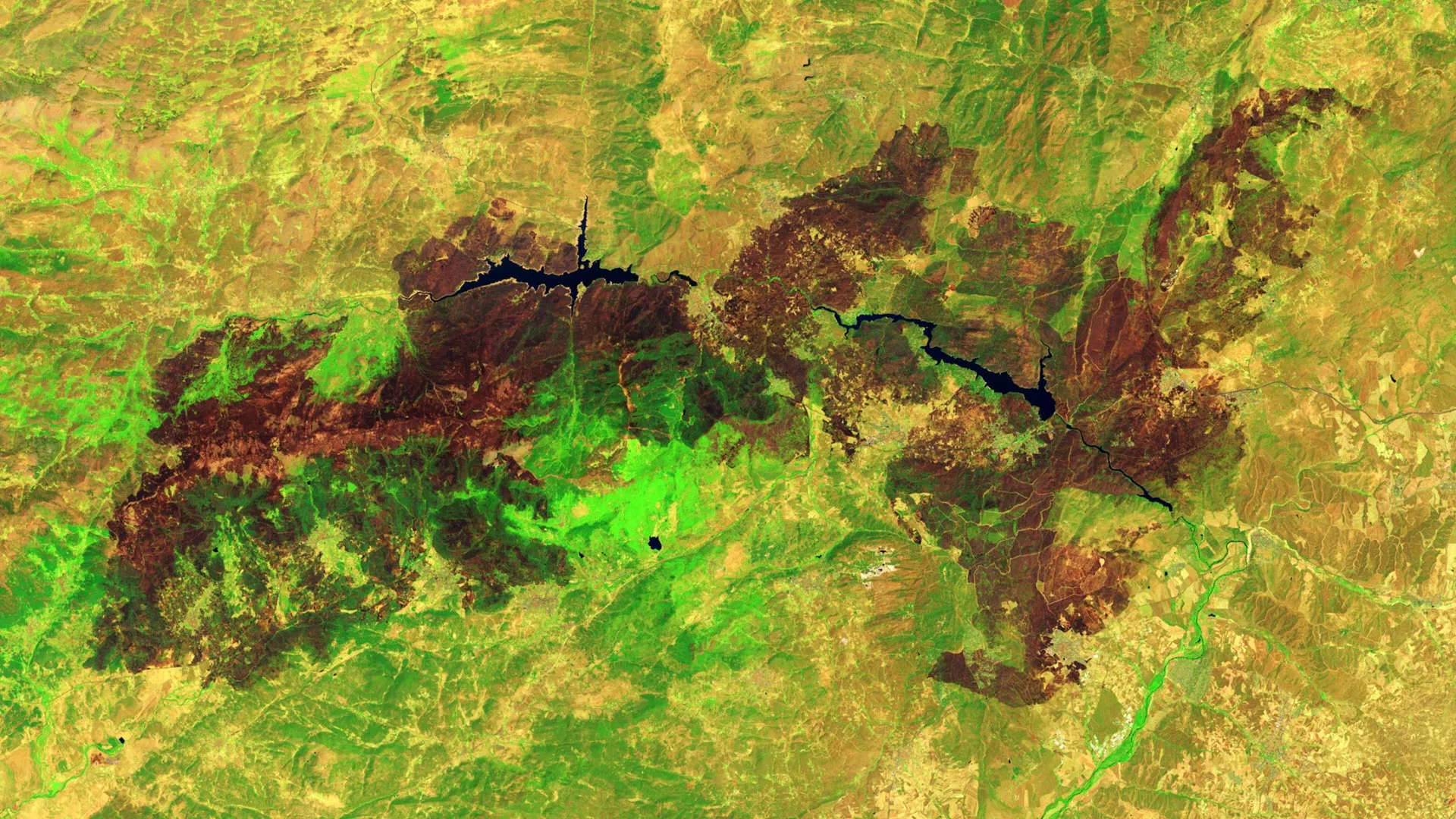
A Landsat 9 image taken on July 29, 2026, shows the extensive damage around Burgohondo. In the false-color view, healthy vegetation appears light green, while burned terrain appears brown. The two reservoirs near the center of the image were among the areas hit hardest.
According to news reports, flames destroyed homes, restaurants, campgrounds, marinas, and other facilities around the reservoirs.
Major Fires Sweep Southwestern France
A similarly severe emergency developed west of Bordeaux in southwestern France. One of the country’s largest fires of the decade burned more than 42,000 hectares, forced widespread evacuations, and devastated the village of Le Porge.
By late July, wildfires had burned more than 90,000 hectares across France. Data from the European Forest Fire Information System showed that this was the greatest area lost to fire in the country in decades.
Weather Created a Dangerous Fire Setup
Conditions that developed months before the fires began left parts of Spain and France especially vulnerable, according to an analysis by researchers with The State of Wildfires Project.
An unusually wet winter encouraged dense plant growth across grasslands, shrublands, and forest understories. Later, repeated heat waves and a period of drought dried out that vegetation, turning it into abundant fuel.
Researchers found that several days of strong winds completed the dangerous sequence. At times, wind speeds reached 65 kilometers (40 miles) per hour, helping the flames spread rapidly across the landscape.
France Reports a Rare Fire Cloud
On July 25, the fires in southwestern France became intense enough for firefighters to report the formation of a pyrocumulonimbus — a towering type of “fire cloud” that draws convective energy from the heat of the fires.
An international team of atmospheric scientists and wildfire specialists monitors these unusual clouds. The group has recorded occasional pyrocumulonimbus events in Spain and Portugal during recent decades, but its members said this marked the first reported case of a wildfire producing one in France.
Firefighters Battle the Blazes
Thousands of firefighters and military personnel were deployed across both countries. Aircraft dropped water and flame retardant from above, while ground crews built firebreaks with equipment ranging from bulldozers to hand tools.
By late July, firefighters had gained enough control for authorities to begin lifting some evacuation orders. Even so, forecasters warned that the danger remained high because hot and dry conditions were expected to continue.
Satellites Track Wildfires in Real Time
Government satellite observations contribute to a global monitoring system used to follow fire activity and study long-term wildfire trends.
NASA provides several tools for tracking active fires, including FIRMS (Fire Information for Resource Management System) and the Worldview browser.
Former agricultural land is turned into a public park in Plymouth, the National Trust says.
Southampton woman Lauren has health anxiety that gets worse during the hot weather.
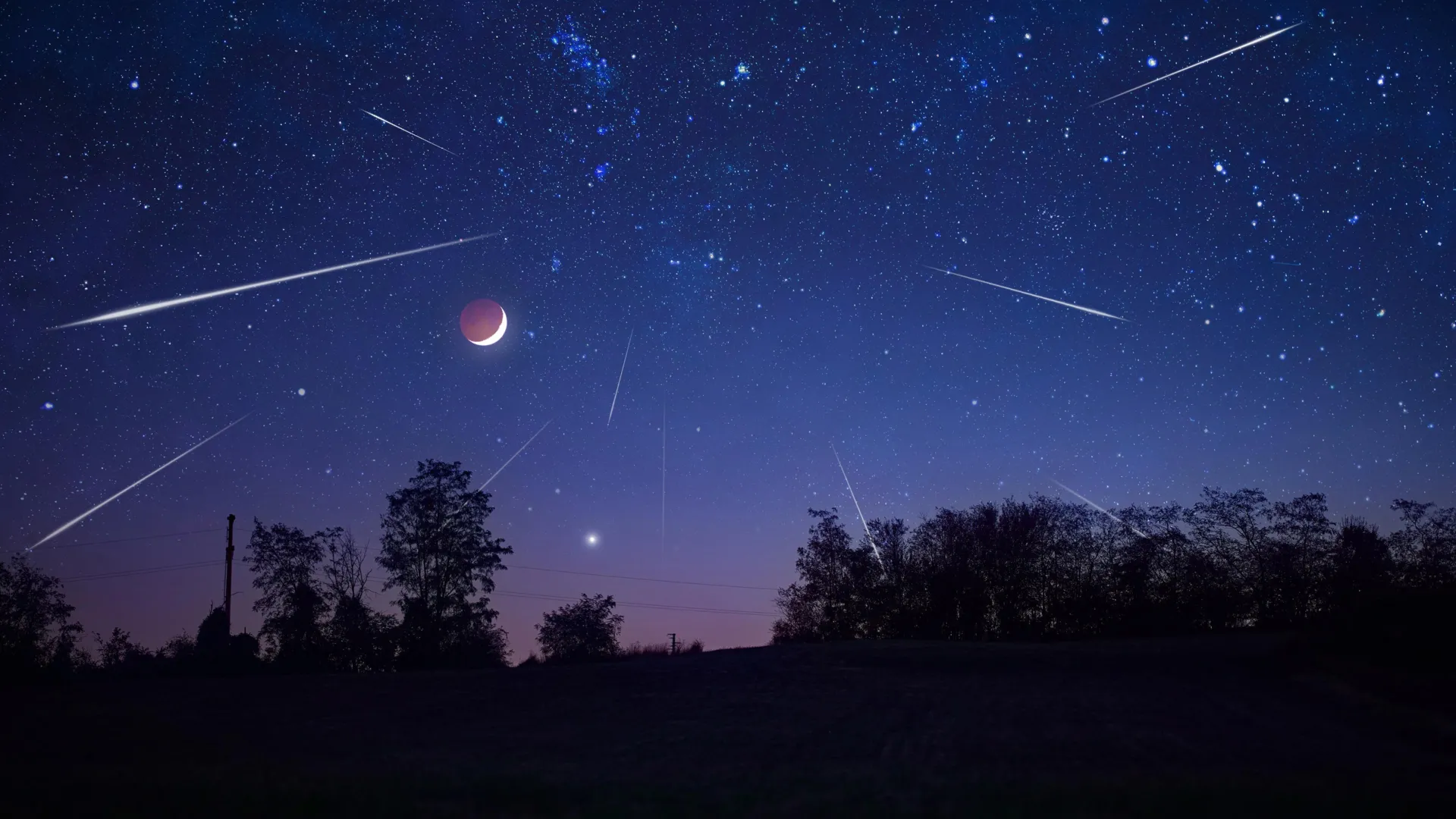
A solar eclipse, the Perseid meteor shower, brilliant Venus, and a deep partial lunar eclipse will make August an unusually eventful month for skywatchers.
August Skywatching Highlights
Aug. 5: Last Quarter Moon
Aug. 12: A total solar eclipse crosses northern Russia, Greenland, Iceland, northern Spain, and part of Portugal. A partial eclipse will be visible from parts of the United States. The New Moon also occurs on this date.
Aug. 12 and 13: The Perseid meteor shower reaches its peak under exceptionally dark skies.
Aug. 14 through 16: Venus reaches its greatest eastern elongation and glows low in the western sky after sunset.
Aug. 27 and 28: A partial lunar eclipse will be visible across much of North and South America, along with parts of Europe and Africa.
[See Video Link After Article.]
A Solar Eclipse Crosses the Northern Hemisphere
A solar eclipse, one of the year’s most popular meteor showers, a dazzling evening appearance by Venus, and a lunar eclipse will fill August with memorable celestial events.
That’s “What’s Up” for August.
On Aug. 12, the path of a total solar eclipse will sweep across northern Russia, Greenland, Iceland, and northern Spain. A small section of Portugal will also fall within the path of totality.
Observers in parts of the United States, stretching from Alaska to North Carolina, will see a partial eclipse instead. From these locations, the Moon will cover only a small portion of the Sun, with the amount of coverage depending on where the observer is located.
How to Watch the Solar Eclipse Safely
Proper eye protection is essential whenever any part of the Sun remains visible. Viewers should use certified eclipse glasses or another approved solar viewing device. Ordinary sunglasses do not provide enough protection.
Never look at the Sun through binoculars, a telescope, or a camera unless a solar filter designed for the front of the instrument is securely attached.
Dark Skies for the Perseid Meteor Shower
Later on Aug. 12, the Perseid meteor shower will begin its peak, continuing into the early morning of Aug. 13. Because the New Moon also arrives on Aug. 12, moonlight will not interfere, creating ideal dark conditions for spotting meteors.
The Perseids return each year as Earth travels through a trail of debris released by Comet Swift-Tuttle. Tiny particles of comet material enter the atmosphere at tremendous speed, heat up, and produce bright streaks across the sky.
Once darkness falls, look toward the northeast and wait for the constellation Perseus to rise above the horizon. The meteors appear to come from this part of the sky, but they can streak across almost any direction, so viewers should scan a wide area overhead.
For the clearest view, choose a dark location with an open horizon, remain outside as the night progresses, and allow about 30 minutes for your eyes to adjust to the darkness.
Venus Shines Brightly After Sunset
From Aug. 14 through 16, Venus reaches its greatest eastern elongation. This marks the planet’s widest visible separation from the Sun during its current appearance in the evening sky.
Shortly after sunset, Venus will be easy to find low in the west. It will appear brighter than every nearby star. Through a telescope, the planet will look almost half illuminated, resembling a miniature lunar phase.
A Deep Partial Lunar Eclipse
On the night of Aug. 27, extending into Aug. 28 in some time zones, the Full Moon will pass through Earth’s shadow and create a partial lunar eclipse. The event will be visible from much of North and South America, as well as portions of Europe and Africa.
At the eclipse’s maximum point, about 93% of the Moon’s diameter will lie within Earth’s dark central shadow, known as the umbra. The Moon will not become completely covered, but most of its surface may appear dramatically dimmed. The shadowed portion could also develop a rusty or copper colored tint.
Unlike a solar eclipse, a lunar eclipse can be viewed safely without eye protection. Binoculars or a small telescope can provide a closer look as the curved edge of Earth’s shadow moves across the lunar surface.
Here are the phases of the Moon for August.
They may keep your feet cool but some styles could be doing more harm than good.
Inmates say it is “rewarding” to create artwork and sell it online with the help of a charity.
