Astronauts just gave the International Space Station a powerful upgrade

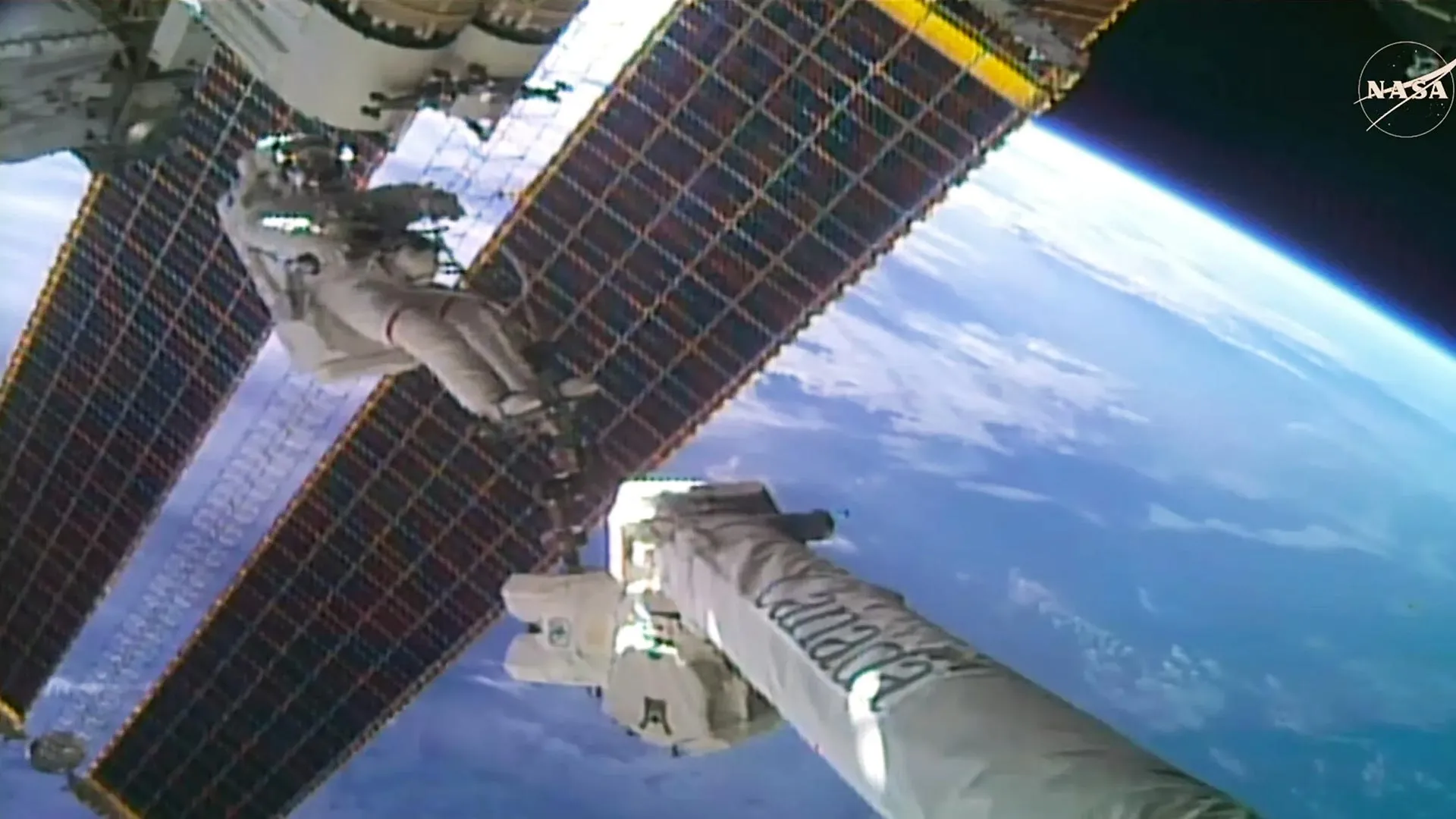
NASA astronaut Anil Menon and CSA (Canadian Space Agency) astronaut Joshua Kutryk have completed a 7-hour, 11-minute spacewalk outside the International Space Station, marking another important step in a major upgrade to the orbiting laboratory’s power system. The astronauts finished their work at 3:08 p.m. EDT.

During the spacewalk, Menon and Kutryk installed and deployed a new International Space Station Roll-Out Solar Array (IROSA) on the station’s 2A electrical power channel. This is the seventh such array added to the station, providing additional electricity for essential operations, including the station’s eventual safe and controlled deorbit.

Final Spacewalk Will Complete Solar Array Upgrade

The astronauts also performed several preliminary tasks to prepare for another spacewalk scheduled for Thursday, Nov. 5. During that mission, astronauts will install the eighth and final solar array on the station’s 3B power channel. NASA plans to begin live coverage at 6:45 a.m., with information on how to watch available through the agency.

Once the final array is installed, the International Space Station’s solar power expansion will be complete. Together, the eight new arrays will increase the station’s available power by as much as 30%, raising its electricity generation capacity from 160 kilowatts to approximately 215 kilowatts.

A Milestone for Space Station Operations

The completed mission, designated U.S. spacewalk 100, marked Menon’s fourth spacewalk and Kutryk’s first. It was also the 285th spacewalk conducted to support the assembly, maintenance, and improvement of the International Space Station.

Share Button

Heart attack patient, 83, had to drive four hours for hospital appointment

Charles Swift faced a 140-mile round trip to get to a hospital, but had to drive himself.

Share Button

Biggest fibre boost could be scraps in your bin, experts say

Chomping on vegtable skins, seeds and stalks could give us vital fibre, say food scientists.

Share Button

I didn’t know I was lacking in vitamin D until I collapsed at work

Doctors are finding vitamin D deficiency is increasingly widespread in the UK, especially in young people. But the symptoms are difficult to spot and can be missed.

Share Button

Hundreds of GP practices lose online services after collapse of tech firm

It will cause huge disruption in some parts of England and Wales, say GP leaders.

Share Button

Six popular sugar substitutes linked to faster brain aging

Sugar substitutes are often promoted as a healthier way to enjoy sweet foods and drinks without consuming as much sugar. However, new research suggests that some of these widely used sweeteners may have an unexpected downside for long-term brain health.

A study published in Neurology, the medical journal of the American Academy of Neurology, found that people who consumed the most low- and no-calorie sweeteners experienced significantly faster declines in memory and thinking skills than those who consumed the least. The association was particularly pronounced among people with diabetes.

Researchers examined seven sweeteners commonly used in foods and beverages: aspartame, saccharin, acesulfame-K, erythritol, xylitol, sorbitol and tagatose. These ingredients frequently appear in ultra-processed products, including diet sodas, flavored waters, energy drinks, yogurt and low-calorie desserts. Some are also sold separately for sweetening foods and beverages.

“Low- and no-calorie sweeteners are often seen as a healthy alternative to sugar; however, our findings suggest certain sweeteners may have negative effects on brain health over time,” said study author Claudia Kimie Suemoto, MD, PhD, of the University of São Paulo in Brazil.

Importantly, the findings show an association rather than a proven cause-and-effect relationship. Researchers cannot conclude from this study that consuming these sweeteners directly damages the brain or causes memory loss.

Study Tracks Nearly 13,000 Adults for Eight Years

To investigate whether sugar substitutes might be connected to cognitive health, researchers analyzed data from 12,772 adults across Brazil. Participants were 52 years old on average when the study began and were followed for approximately eight years.

At the beginning of the study, participants completed detailed dietary questionnaires describing the foods and drinks they had consumed during the previous year. Researchers used these responses to estimate each person’s daily intake of the seven sweeteners.

Participants were then separated into three groups according to how much of the sweeteners they consumed. Those in the lowest consumption group averaged 20 milligrams per day (mg/day), while those in the highest group averaged 191 mg/day. For comparison, 191 milligrams of aspartame is roughly the amount found in one can of diet soda.

Of the seven sweeteners examined, sorbitol had the highest average intake, at 64 mg/day. Sorbitol belongs to a category of sweeteners called sugar alcohols, which provide sweetness and are commonly used as sugar substitutes.

Throughout the study, participants completed cognitive assessments at three points: the beginning, middle, and end. These tests measured several abilities essential for everyday mental functioning, including memory, language, and the speed at which the brain processes information.

Researchers evaluated verbal fluency, or the ability to quickly retrieve and produce words, along with working memory, which allows people to temporarily hold and use information. They also tested word recall and processing speed to determine how these abilities changed over time.

High Sweetener Consumption Linked to 62% Faster Cognitive Decline

The results revealed a striking difference between people who consumed the most sweeteners and those who consumed the least.

After accounting for factors that could influence cognitive health, including age, sex, high blood pressure, and cardiovascular disease, researchers found that participants in the highest consumption group experienced a 62% faster decline in overall thinking and memory abilities compared with those in the lowest group.

That difference was equivalent to approximately 1.6 additional years of cognitive aging over the study period.

Even moderate consumption was associated with measurable differences. Participants in the middle group experienced a 35% faster decline than those consuming the least, equivalent to roughly 1.3 additional years of cognitive aging.

These estimates describe changes in cognitive test performance rather than a direct measurement of biological brain aging. They also do not mean that everyone who consumes artificial sweeteners will experience memory problems.

Stronger Links Found in Adults Under 60 and People With Diabetes

When researchers examined different age groups, they discovered that the association was not consistent across all participants.

Among adults younger than 60, higher sweetener consumption was linked to faster declines in verbal fluency and overall cognitive performance. However, researchers did not find a similar association among participants older than 60.

The relationship was also stronger in people with diabetes than in those without the condition. This finding is especially relevant because people with diabetes frequently turn to sugar substitutes to help manage their sugar intake.

Examining the sweeteners individually revealed another important distinction. Six of the seven substances were associated with faster declines in overall cognitive performance, particularly memory.

Those six were aspartame, saccharin, acesulfame-K, erythritol, sorbitol and xylitol.

Tagatose was the exception. Researchers found no association between its consumption and cognitive decline in this study. However, that finding does not establish that tagatose protects the brain or is necessarily safer than other sweeteners.

Should People Rethink Artificial Sweeteners?

The findings raise important questions about whether replacing sugar with low-calorie alternatives always delivers the health benefits consumers expect, particularly when it comes to the brain.

“While we found links to cognitive decline for middle-aged people both with and without diabetes, people with diabetes are more likely to use artificial sweeteners as sugar substitutes,” Suemoto said. “More research is needed to confirm our findings and to investigate if other refined sugar alternatives, such as applesauce, honey, maple syrup or coconut sugar, may be effective alternatives.”

Researchers also acknowledged several limitations. The analysis did not cover every artificial sweetener available on the market, so the findings cannot necessarily be applied to all sugar substitutes.

In addition, dietary information came from participants’ own recollections of what they had eaten and drunk. Because people may forget foods, underestimate portions, or inaccurately report their habits, these estimates may not perfectly reflect actual sweetener consumption.

The observational design also means that other factors could help explain the relationship between sweetener intake and cognitive decline, despite researchers’ efforts to account for several important health differences.

Further studies will be needed to determine whether the sweeteners themselves contribute to changes in brain function, why certain groups appear more strongly affected, and whether different sugar alternatives produce different long-term outcomes.

The research was supported by the Brazilian Ministry of Health, the Ministry of Science, Technology, and Innovation, and the National Council for Scientific and Technological Development.

Share Button

NASA discovers Jupiter’s invisible shield is more complex than Earth’s

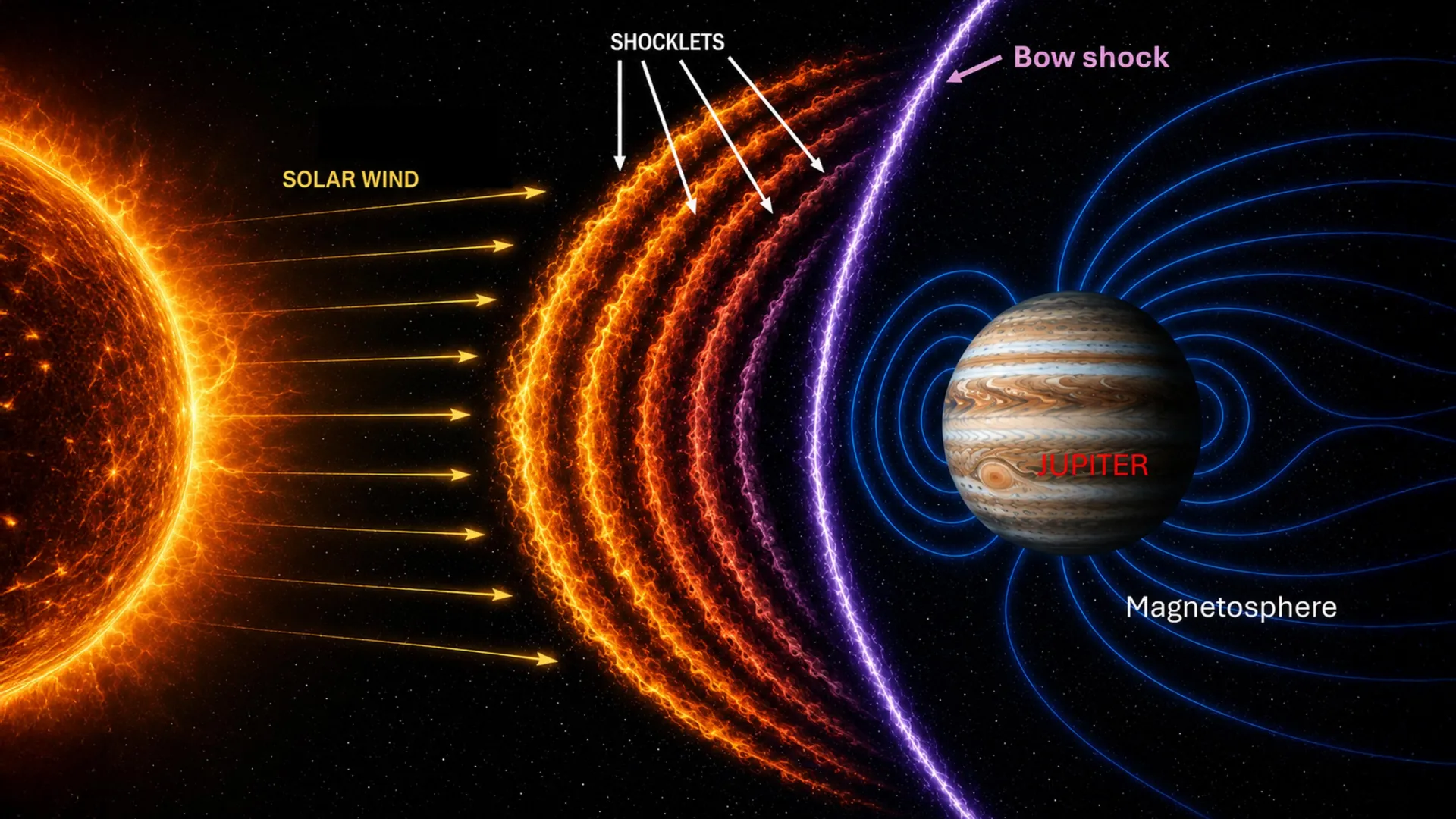
NASA’s Juno spacecraft has uncovered remarkable new details about how Jupiter withstands the constant stream of high-energy particles flowing from the Sun. The findings reveal that the solar system’s largest planet relies on a much more complex system of plasma waves and shock regions than Earth does.

Led by scientists at the University of Iowa, the research provides the most detailed observations yet of Jupiter’s bow shock, an invisible boundary where particles from the Sun encounter the planet’s magnetic environment. The discovery reveals important differences in how Jupiter and Earth respond to these incoming particles.

Beyond Jupiter, the results could also help scientists understand some of the most powerful events in the universe, including the extreme shock waves associated with exploding stars.

How Jupiter Protects Itself From the Solar Wind

The Sun continuously releases a stream of electrically charged particles called the solar wind. These particles travel through space at tremendous speeds, often faster than the speed at which sound waves move through the surrounding plasma. When the solar wind approaches a planet with a magnetic field, it encounters a boundary known as the bow shock.

At Earth, this boundary plays an important protective role. It slows and heats the incoming particles, helping redirect much of the solar wind around the planet. Without this process, more harmful particles could reach Earth’s atmosphere, potentially making conditions less favorable for life.

Jupiter also has a bow shock, but its enormous size, powerful magnetic field, and gaseous composition make it a particularly interesting place to study how these boundaries behave. Scientists have long wanted to understand whether Jupiter handles the solar wind differently from Earth and what those differences might reveal about other objects throughout the universe.

Scientists Discover a More Complex Defense System

Using measurements from Juno, researchers discovered that Jupiter relies on plasma waves with multiple frequencies to slow and heat incoming solar particles. These different frequencies, known as “harmonics,” create a more elaborate wave pattern than the one typically observed at Earth.

The process can be compared to music. Just as several notes played together produce a richer sound than a single note, plasma waves containing multiple frequencies can interact with incoming particles in more complex ways. This allows Jupiter’s bow shock to transfer energy to more particles, heating them and reducing their speed.

Earth’s bow shock, by comparison, primarily uses plasma waves concentrated around a single frequency. That simpler arrangement is generally sufficient for the conditions encountered near our planet.

“Jupiter has found its own way to deal with the solar wind, through plasma waves that are stronger and exhibit richer harmonic structures,” says Jayasri Joseph, a postdoctoral researcher in the Department of Physics and Astronomy at Iowa and the study’s corresponding author. “That’s important because if you have multiple frequencies, you can heat more particles in the solar wind and slow them down.”

Jupiter Has an Extra Line of Defense

The researchers identified another striking difference in how the two planets interact with the solar wind.

Before incoming particles reach Jupiter’s main bow shock, they can encounter smaller shock structures called shocklets. These additional regions help slow the solar wind before it arrives at the primary shock boundary.

Earth’s bow shock, in contrast, generally serves as the main region where the incoming solar wind is slowed and redirected. Jupiter’s additional shock structures reveal a more complicated process for managing the energy carried by solar particles.

“Earth does not need to take these extra steps to handle the solar wind because the impact isn’t as powerful,” says Bill Kurth, a research scientist in Iowa’s Department of Physics and Astronomy and a coauthor of the study.

Kurth has participated in NASA’s Juno mission since the spacecraft launched in 2011.

What Jupiter Can Teach Us About Exploding Stars

Although these observations focus on Jupiter, their significance could extend far beyond our solar system.

Shock waves occur throughout the universe, particularly in environments where enormous amounts of energy are released. Some of the most extreme examples are found in supernova remnants, the expanding clouds of material left behind when certain dying stars explode.

These cosmic shock waves are vastly more powerful than those encountered near Jupiter. However, the physical processes that control how energy moves through plasma share important similarities. By examining Jupiter’s bow shock in unprecedented detail, scientists can investigate mechanisms that would be much harder to measure directly around distant stars.

“Because even more powerful shocks occur around astrophysical objects such as supernova remnants, Jupiter’s bow shock offers a nearby natural laboratory for exploring and for understanding how nature converts enormous amounts of flow energy into heat and energetic particles,” Joseph says.

Understanding these processes could improve scientific models of how shock waves transfer energy, heat particles, and shape environments across the universe.

NASA’s Juno Makes Unprecedented Measurements

The breakthrough was made possible by observations Juno collected in December 2024. The NASA spacecraft has been orbiting Jupiter since July 2016, providing researchers with an extraordinary opportunity to investigate the giant planet and its surrounding environment.

A key part of the discovery came from the Juno Waves instrument, which was designed and built by physicists at the University of Iowa. The instrument measures electric and magnetic wave activity, allowing scientists to study the behavior of plasma around Jupiter.

Earlier spacecraft had detected the presence of bow shocks at outer planets, but they lacked the measurements needed to reveal the detailed structure of the plasma waves involved. Juno’s observations have now provided a much clearer picture of how these waves behave at Jupiter.

The findings were published online on July 31 in Nature Communications in a study titled “Plasma wave observations from Juno spacecraft at the Jovian bow shock.”

Research Team and NASA Support

Additional contributors from the University of Iowa included Allison Jaynes, an associate professor in the Department of Physics and Astronomy, along with Jeremy Faden and Chris Piker, who provide research support in the same department.

The international research team also included Lynn Wilson III of NASA Goddard Space Flight Center; John Connerney of NASA Goddard Space Flight Center and the Space Research Corporation; Frederic Allegrini of the Southwest Research Institute and the University of Texas-San Antonio; Rob Wilson of the University of Colorado-Boulder; Ali Sulaiman of the University of Minnesota; Scott Boltion and Robert Ebert of the Southwest Research Institute; and Barry Mauk of the Johns Hopkins University Applied Physics Laboratory.

NASA provided funding for the research.

Share Button

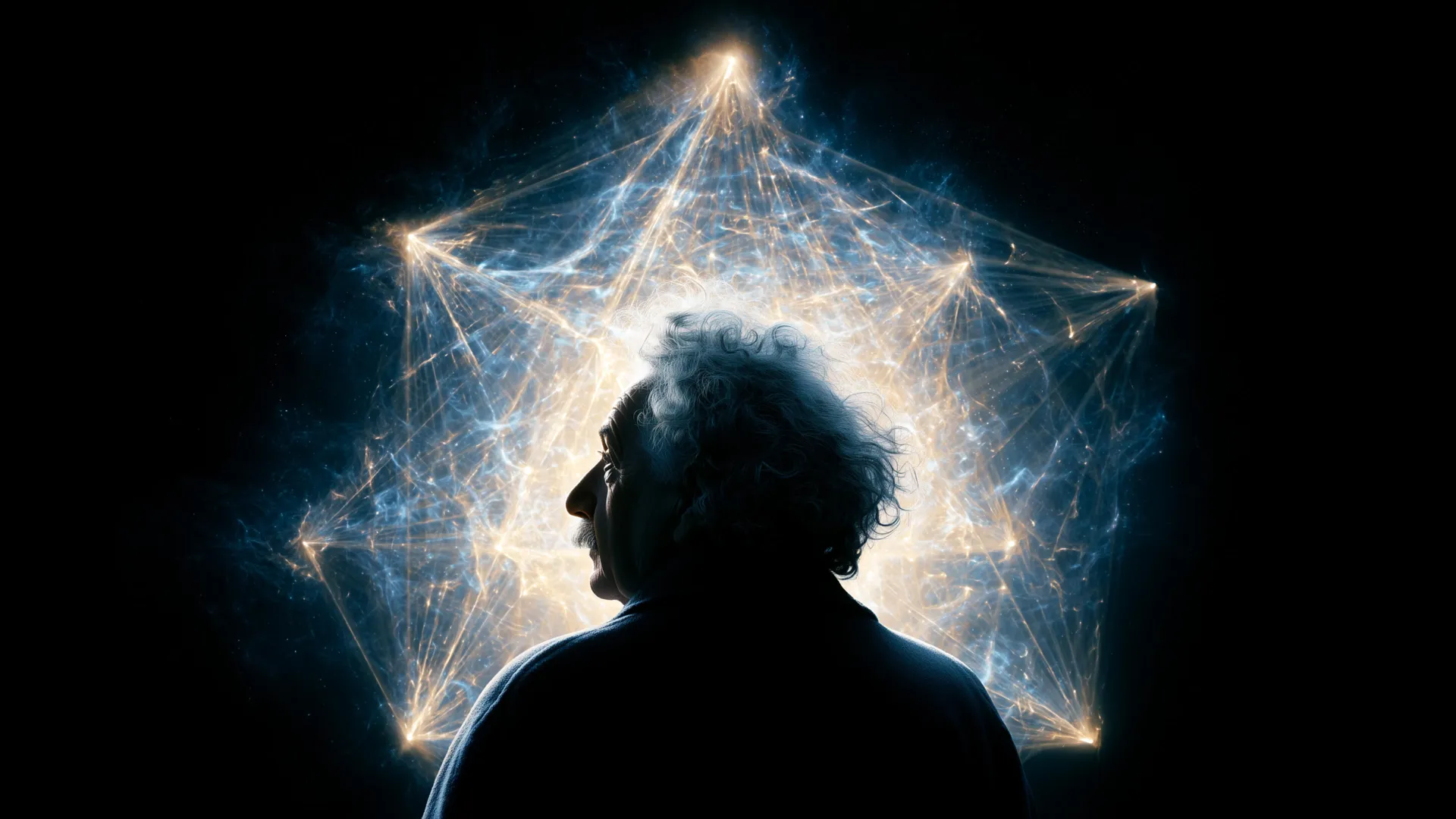
Einstein’s equations may explain the universe without dark energy

Mathematicians are raising a major challenge to one of modern cosmology’s most widely accepted explanations: the idea that dark energy is driving the accelerating expansion of the universe.

A study published in Proceedings of the Royal Society A presents mathematical findings that researchers at the University of California, Davis, say reveal a fundamental instability in the standard model of the expanding universe. Their calculations suggest that cosmic acceleration could emerge naturally from Einstein’s equations, potentially eliminating the need to invoke mysterious dark energy.

The work challenges the Lambda-cold dark matter model, the leading framework scientists use to describe the universe’s evolution since the Big Bang. The researchers reached their conclusions by studying the Einstein-Euler equations, which combine Einstein’s theory of general relativity with equations describing how fluids behave. Together, these mathematical tools help scientists investigate everything from galaxies and black holes to the expansion of the cosmos.

A Hidden Instability in Our Model of the Universe

To explain the problem, Blake Temple, the study’s corresponding author and a distinguished professor emeritus of mathematics at UC Davis, offered a simple comparison: a pencil balanced vertically on its tip.

“All the forces are in balance when a pencil is standing on end, so it is a ‘solution of the equations,'” he said. “But it’s unstable. Any breath of air and it falls away.”

According to Temple, the team’s mathematical analysis shows that Friedmann spacetimes, which form the foundation of conventional models of cosmic expansion, are unstable at both small and large scales in the context of the Big Bang. He described the standard solution as exceptionally unstable.

“Unstable solutions in physics and science are considered not physical,” Temple said. “You’ll never observe them in nature.”

This instability could have far-reaching consequences. If the universe naturally evolves away from the behavior predicted by these conventional models, its accelerating expansion might not require a separate form of energy to explain it. Instead, Temple argues, the answer could already be contained within Einstein’s original theory of gravity.

“The instability of all Friedmann spacetimes to accelerated expansion suggests a simpler, more natural explanation for the acceleration of the universe than dark energy,” he said.

Why Scientists Believe Dark Energy Is Expanding the Universe

For nearly three decades, dark energy has been the leading explanation for one of astronomy’s most puzzling discoveries: the universe is not simply expanding, but its expansion is accelerating.

The concept has roots in Einstein’s groundbreaking 1915 theory of general relativity, which describes gravity as the curvature of space and time. Einstein originally believed the universe was static, neither expanding nor contracting. To make his equations compatible with that assumption, he introduced a mathematical term that counteracted gravity, calling it the “cosmological constant.”

That assumption changed after Edwin Hubble discovered evidence in 1929 that the universe was expanding. Einstein famously referred to his introduction of the cosmological constant as his “biggest blunder,” since his original equations without the additional term could have predicted an expanding universe.

The cosmological constant returned to prominence in the 1990s, when astronomers discovered that cosmic expansion was speeding up. It became closely associated with dark energy, the name given to the unknown component thought to be responsible for this acceleration.

Today’s standard cosmological framework builds on the Friedmann universe, a mathematical description in which space expands while matter remains evenly distributed across the cosmos at any given moment. This assumption of large-scale uniformity plays a central role in how scientists reconstruct the universe’s history.

But Temple and his collaborators began questioning whether the underlying mathematics could remain stable, prompting them to investigate other possible explanations for the observed acceleration.

Could Einstein’s Equations Explain Cosmic Acceleration?

The researchers initially considered whether a massive shockwave might help explain the universe’s expansion and the unexpected acceleration associated with it.

“Our first idea was that maybe the universe was expanding because there was a shockwave, and the anomalous acceleration was the expanding wave behind that shockwave,” Temple said. “Then we realized there’s a family of self-similar solutions during the radiation epoch of the Big Bang, which might model that expanding wave.”

In mathematics and physics, self-similar solutions describe patterns that retain their underlying structure when viewed at different scales. A familiar example is a fractal, in which similar shapes can appear at increasingly larger or smaller sizes.

The researchers identified a family of these solutions associated with the radiation-dominated period of the early universe, when radiation played a major role in determining how the cosmos evolved.

Building on their earlier work, they used a self-similar form of Einstein’s equations to represent the standard cosmological model as a rest point, a mathematical state in which the system’s defining variables remain unchanged. This approach allowed them to examine whether small departures from that state would disappear or grow over time.

Their analysis provided a mathematical framework for evaluating the stability of the standard model and, more broadly, Friedmann spacetimes during the matter-dominated era of the early universe, when matter became more influential than radiation.

A Mathematical Challenge to the Standard Big Bang Model

The results suggest that the conventional mathematical descriptions of the expanding universe are vulnerable to disturbances that grow rather than fade.

“We prove that, like Einstein’s static model, the Friedmann spacetimes are all unstable to radial perturbation at large length scales,” Temple said. “This appears to rule out the Lambda-cold dark matter model as a viable stable solution of the Einstein equations of general relativity, with or without dark energy.”

Radial perturbations are disturbances that change with distance from a central point. In the researchers’ mathematical framework, such changes can cause the behavior of an expanding universe to depart from the predictions of the standard Friedmann model.

“This means,” he added, “that the Big Bang should generically look exactly like a Friedmann spacetime near the center of symmetry, but generically one should observe accelerations away from Friedmann far from the center.”

In other words, the universe could behave much like the standard model predicts near a central region while exhibiting different expansion behavior farther away.

The researchers argue that this instability may offer a natural route to accelerated cosmic expansion without adding a cosmological constant or invoking dark energy. Their calculations indicate that the acceleration can emerge directly from the Einstein-Euler equations themselves.

The findings represent a theoretical challenge to standard cosmology rather than observational proof that dark energy is unnecessary. Establishing whether this alternative can describe the actual universe would require determining how well its predictions match astronomical observations.

Does the Universe Have a Special Location?

Beyond the dark energy question, the study also raises a more fundamental issue involving the Copernican principle.

Named after astronomer Nicolaus Copernicus, who helped overturn the belief that Earth sits at the center of the solar system, the principle holds that our location in the universe is not fundamentally special or privileged.

This assumption has become an important part of modern cosmology, supporting the view that the universe looks broadly similar when observed from different locations on sufficiently large scales.

The researchers’ alternative mathematical framework introduces a center of spherical symmetry, raising questions about where an observer would need to be located for the model to agree with observations.

Temple argues that the Copernican principle must be applied consistently when evaluating competing explanations of the universe.

“Both the Lambda-cold dark matter model and a spherically symmetric spacetime produce a special place where we must lie for the model to be physically plausible,” Temple said. “If this principle rules out one, it has to rule out the other.”

The work opens another avenue for investigating why the universe’s expansion is accelerating. Although dark energy remains a central component of the prevailing cosmological model, the researchers contend that the mathematics of general relativity may offer a different explanation for the same phenomenon.

If further theoretical and observational work supports their interpretation, it could lead to a significant reassessment of how scientists understand cosmic expansion and the mathematical foundations of the Big Bang.

The research received funding from the United Kingdom’s Engineering and Physical Sciences Research Council and the American Institute of Mathematics SQuaREs Program.

Share Button

Vulnerable at risk as ‘life-saving’ drug needle site closes

Belfast charity workers warn people who use the “life-saving” service will be left without support.

Share Button

Concern over cut to young people’s mental health crisis scheme

The Card Before You Leave scheme ensures young people experiencing a mental health crisis who present at a hospital’s emergency department are given a written appointment with specialists before leaving.

Share Button