Is Sajid Javid The Ministerial Interchange Boris Johnson Needed?

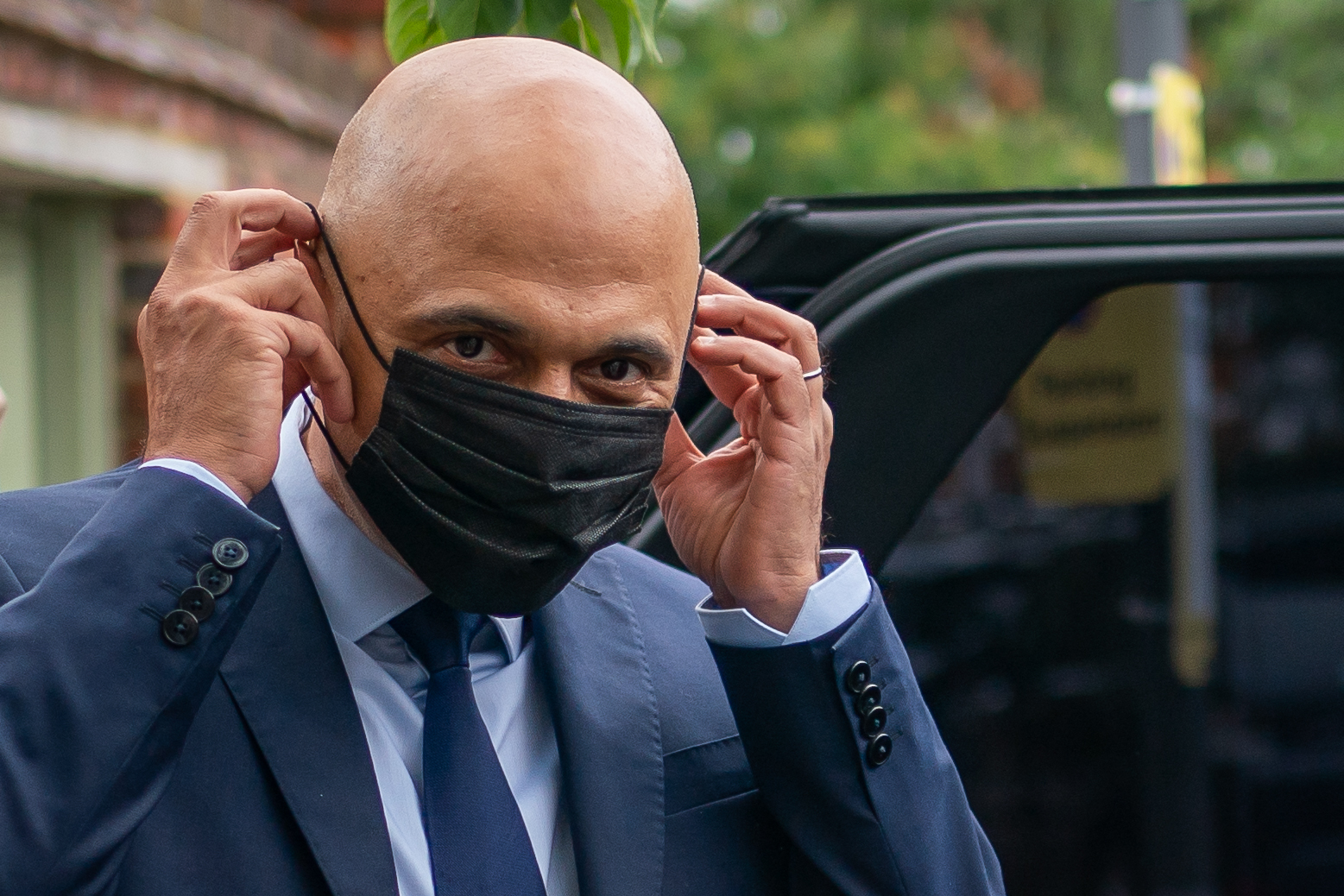
“For me, 19 July is not only the end of the line, but the start of an exciting new journey for our country.” Sajid Javid began his new career as health secretary with one of the upbeat travel metaphors that has become a verbal tic of this government.

Yet while Boris Johnson once talked of coming out of an Alpine tunnel and seeing “the sunshine and pasture ahead of us”, Javid’s more prosaic tone meant it felt like he was describing a bus replacement service. You get to the railway terminus then, er, you have a whole new journey by another means. Kinda.

When Sadiq Khan was elected Mayor of London in 2016, he joked to Javid: “You wait ages for a Pakistani bus driver’s son to come along, then two come along at once.” Javid has certainly proved politically very patient in waiting his turn for a recall to cabinet, and his Commons update on Covid was all about keeping the government show on the road.

Sounding much more bullish than Matt Hancock about the final end to lockdown, he upgraded recent caution about the Delta variant, revealing that he had seen the very latest data (on Sunday) and “I am very confident” about that date July 19. Tory backbenchers sounded mighty relieved that at last they had someone in post who was neither as preachy as Hancock, nor as trigger happy with the lockdown gun.

Javid even gave a valuable hint that he was as fed up as millions of parents with the current policy of sending whole classes of kids home after one positive test. Pointing to a more risk-based scheme of daily testing rather than isolation, it was a key clue of where he prefers to put his finger on the freedoms-restrictions weighing scales.

The new health secretary lacked the rhetorical polish of Hancock, but one got the feeling from MPs on all sides that was no bad thing. The danger, as his shadow Jonathan Ashworth pointed out, was that with cases rising to scary levels on Monday, any kind of bold confidence about the timetable for removing all restrictions could feel “hubristic”. We have been here before, of course.

Ashworth was putting down a marker that if things take a turn for the worse again, he’ll have said ‘I told you so’. As it happens it was Boris Johnson himself who sounded like ‘Captain Hindsight’ on Monday, not least when he implied that he had sacked Hancock this weekend. He read the story on Friday, Hancock was out by Saturday and that was “about the right pace, he said”.

Of course, this jars with No.10 having told us on Friday the matter was “closed” after Hancock’s initial apology. As tempting as it is to ridicule the PM’s revisionism, insiders say there was more than an element of Johnson making clear on Saturday he was leaving a pearl-handled revolver and a glass of whisky for his health secretary to pick up.

Let’s see if he’s more explicit when Keir Starmer inevitably mocks him in PMQs for his failure to act quickly and fire Hancock on Friday. Starmer has to maximise the sense of chaos and “one law for them, one for the rest of us”, even if the very next day the voters in Batley end up shrugging their shoulders and voting Tory (or Galloway).

The ministerial interchange from Hancock to Javid may once again prove the value of Johnson’s tactic of political hypnosis: look into my eyes, not around my eyes, this is a brand new government, with brand new ministers. Having asked the voters to forget that the Tories have been in power since 2010, he may now ask them to forget Hancock was running health since 2019.

And once lockdown is lifted (alongside a decent England Euros run?), there could well be a bounceback boom that will help sustain that Tory polling lead. The downside is that Javid is himself a re-tread. With the rare distinction of having been a cabinet minister under Cameron, May and Johnson, he could act as a reminder to the public that the same old faces have been in power for quite a long time now.

The scandals may change (Windrush, Snog-gate), but the personnel don’t really change in the Tory game of musical chairs, Labour may well argue. Javid himself may also suffer from being seen as a jack of all trades, but a master of none (critics ask whether he actually left a mark in any of his previous five cabinet posts). The slow-burn scandal over cronyism and transparency may yet cause some damage.

Still, there was a ruthlessness about the Tory party on Monday which many Labour MPs may envy. When Jeremy Hunt said of Hancock “the country is in his debt”, there was a deafening silence on the Conservative benches. Few Tory MPs were active allies of the former health secretary, and their loyalty seemed to be to the office, not the man.

As Keir Starmer starts to reset his own leadership this summer (read my in-depth piece on the party’s mood ahead of Batley), the lessons may not be lost on him. If he can ram home the idea that this is a tired government, he may inject some energy into his party’s morale. So far, the voters show no signs of wanting to sack the Tories any quicker than Johnson sacks his ministers.

Share Button

Covid Restrictions Will Not Be Lifted Before July 19, Sajid Javid Confirms

The new health secretary, Sajid Javid, has confirmed that the final Covid restrictions will not be lifted until July 19.

Javid revealed the government’s decision not to plump for an earlier easing of restrictions on July 5 in his first Commons statement since replacing his disgraced predecessor Matt Hancock in the job.

As the UK recorded 22,868 cases on Monday, the highest daily rise since January 30, Javid pointed out that hospitalisations had doubled since the start of May.

He said the government wanted the time to build up extra protection against the more transmissible Delta variant by ensuring two-thirds of England’s adults have received two doses of the jab before lifting restrictions.

“I spent my first day as health secretary, yesterday, looking at the data and testing it to the limit,” Javid told the Commons.

“Whilst we decided not to bring forward step four, we see no reason to go beyond July 19.

“Because in truth, no date we choose comes with zero risk for Covid.

“We know we cannot simply eliminate it, we have to learn to live with it.

“We also know that people and businesses need certainty so we want every step to be irreversible.

“And make no mistake, the restrictions on our freedoms, they must come to an end.

“We owe it to the British people, who have sacrificed so much, to restore their freedoms as quickly as we possibly can and not to wait a moment longer than we need to.” 

He added: “For me, July 19 is not only the end of the line, but the start of an exciting new journey for our country.”

Earlier, Javid said there would be “no going back” to Covid rules once England’s lockdown is lifted.

Boris Johnson meanwhile said England was “set fair” for the final easing of restrictions on July 19, four weeks after the initially scheduled date of June 21 for step four of the prime minister’s road map out of lockdown.

It came as shadow health secretary Jon Ashworth said junior health ministers Lord Bethell should follow Hancock through the exit door amid reports that they both used private email accounts for government business.

“Can he tell us whether he maintains confidence in that minister and isn’t it time that that particular health minister was relieved of their ministerial responsibilities as well?”

Javid replied: “I’ve got such a fantastic ministerial team.

“Every single one of them, it’s not even a question of confidence, it’s a group of ministers that are incredibly talented, that have delivered in both this House and the Lords.”

Share Button

Matt Hancock Deserves ‘Credit’ For Resigning Over Covid Rule Breach, Says Cabinet Minister

Jeff Overs via Getty Images

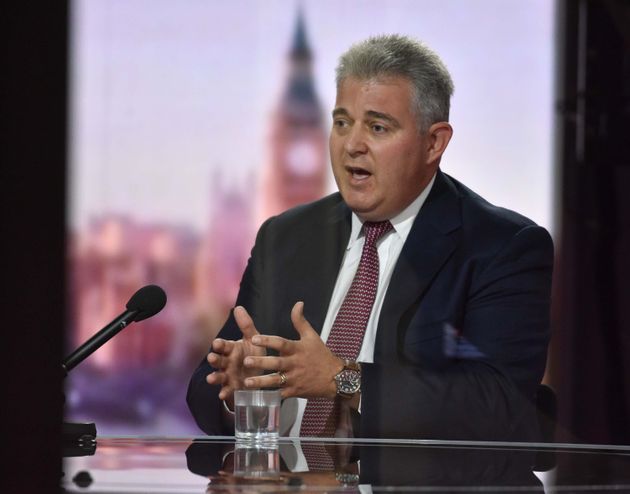
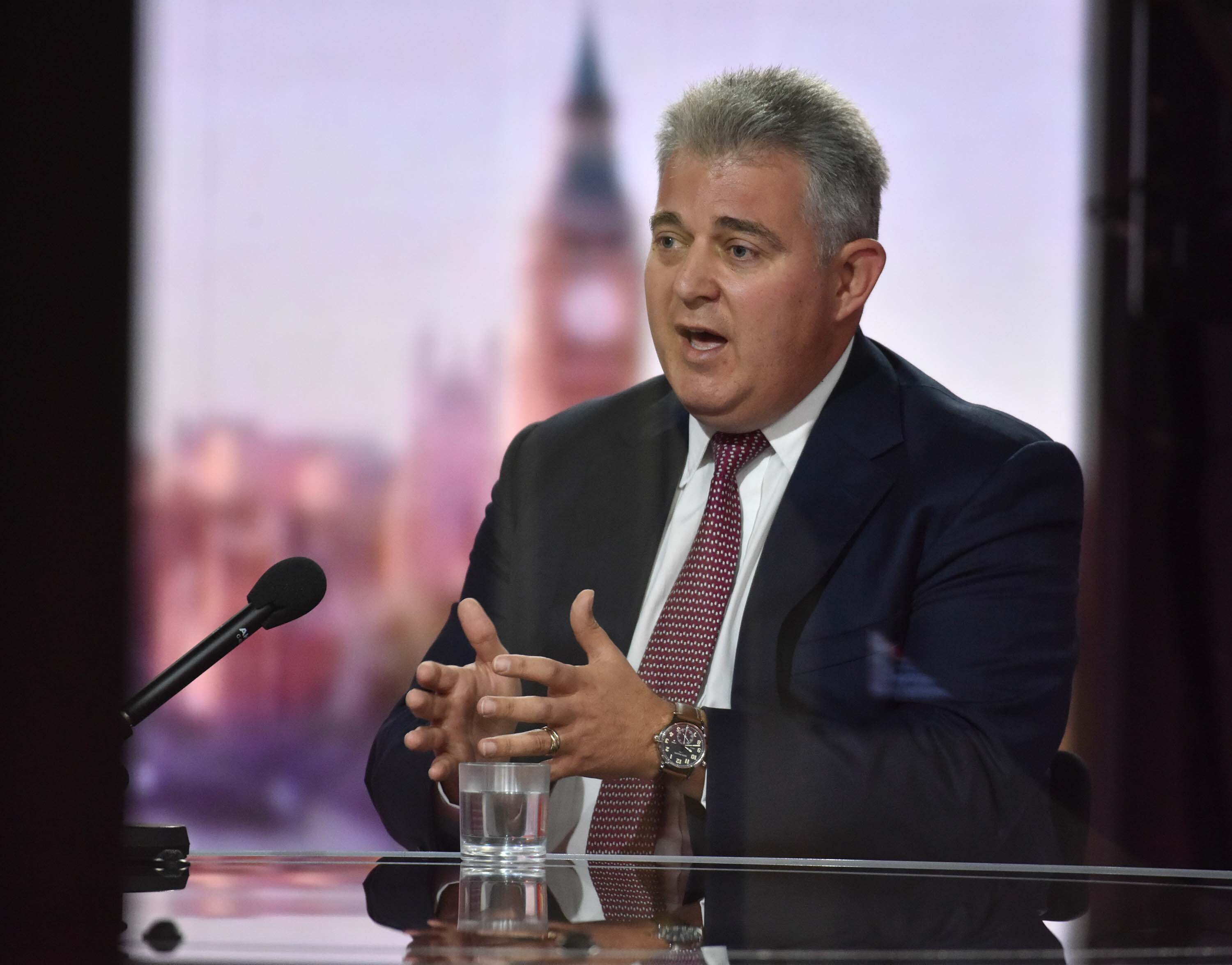
LONDON, ENGLAND – JUNE 27: Secretary of State for Northern Ireland, Brandon Lewis, appears on The Andrew Marr Show on June 27, 2021 in London, England. (Photo by Jeff Overs/BBC News & Current Affairs via Getty Images)

Matt Hancock put “all of us across the UK first” by resigning as health secretary after being caught breaking his own Covid rules and deserves “credit”, a cabinet minister has claimed.

Hancock quit on Saturday following the leaking of video footage showing him breaking social distancing rules by kissing an aide in his ministerial office.

He has been replaced as health secretary by former chancellor Sajid Javid.

Brandon Lewis, the Northern Ireland secretary, said on Hancock had rightly apologised.

“I think it’s a credit to Matt that his first thought is around making sure the country and the government can continue to do the work that we need to do as we are moving out of the Covid pandemic,” he told Sky News’ Trevor Phillips On Sunday programme.

“I think in doing that he has put his family and indeed, all of us across the UK first, because he wants to focus as the PM does, as we all do, to be getting out of this pandemic in the best possible way and as quickly as we can.”

Anneliese Dodds, the chair of the Labour Party, said it “speaks volumes about the total lack of integrity at the heart of Boris Johnson’s government” that Lewis could think Hancock deserved credit for resigning. 

“Hancock’s record includes wasting huge sums of taxpayers’ money, leaving care homes exposed and breaking his own Covid rules,” she said. “If Boris Johnson had any backbone, he would have removed​ him.” 

Reports suggested Hancock was made aware of the footage on Thursday evening, and he apologised on Friday following its publication but did not immediately resign.

No 10 said Johnson considered the matter closed following Hancock’s apology, but pressure mounted throughout the day and into Saturday, and Conservative MPs began to call for Hancock to go.

By just after 6pm on Saturday, Hancock said he had been to see Johnson to tender his resignation as his personal life threatened to distract from the pandemic effort.

And less than two hours later Javid had been confirmed in the post.

Share Button

Matt Hancock Video Leak To Be Investigated By Government

The government will be launching an internal investigation into how CCTV footage of Matt Hancock was leaked, a cabinet minister has said.

Northern Ireland Secretary Brandon Lewis said the Department of Health and Social Care (DHSC) will seek to find out how the footage became public, as former cabinet ministers have said they never had cameras in their offices.

The CCTV leak led to Hancock’s resignation as health secretary on Saturday after it exposed him in an embrace with aide Gina Coladangelo last month – breaking his own coronavirus rules.

Hancock had no idea that the camera in his office existed, according to The Daily Telegraph.

Asked on Sky News’ Trevor Phillips On Sunday programme about the leak, Lewis said: “It’s something we need to get to the bottom of.

“Quite rightly what happens in government departments can be sensitive and important.

“So, yes, I do know that is something the Department of Health will be taking forward as an internal investigation.”

It comes despite Downing Street refusing to comment on Friday on whether a probe will be launched.

Lewis also told BBC One’s Andrew Marr Show that the investigatory team will be looking into the issue “across government”, adding: “I have to say I always take the view it’s best to assume that everything you’re saying or putting in writing is going to be reported somewhere.”

Former health secretary Jeremy Hunt told the programme it is “completely unacceptable” that ministers are being filmed inside their offices.

The chairman of the Commons health committee said: “It’s completely unacceptable from a security point of view that ministers are being filmed inside their own offices without their knowledge.

“And so there’ll be issues that our intelligence agencies will want to look at very, very carefully.”

He added that there is an “another issue” – over ministers’ ability to have private conversations which would “enable them to make the right decisions” without being spied on.

Former cabinet ministers Alan Johnson and Rory Stewart both said there had never been cameras in their offices during their time in government.

Johnson told Trevor Phillips On Sunday: “I could never understand why there was a camera in the Secretary of State’s office.

“There was never a camera in my office when I was health secretary or in any of the other five cabinet positions.”

Stewart, who was International Development Secretary from May to July 2019, said in a tweet: “I definitely did not know that there were cameras in any of my ministerial offices (in fact I was told – when I asked if there were any cameras – that there were not cameras in my office in DfiD).”

He added: “If it were a departmental camera – perhaps focused on the door for security reasons – then it would be seen by the security officers.

“Someone else installing it would have some challenges – security passes, doors, access to ministerial office etc.”

Share Button

Matt Hancock Resigns As Health Secretary Over Covid Rules Breach

Yui MokPA

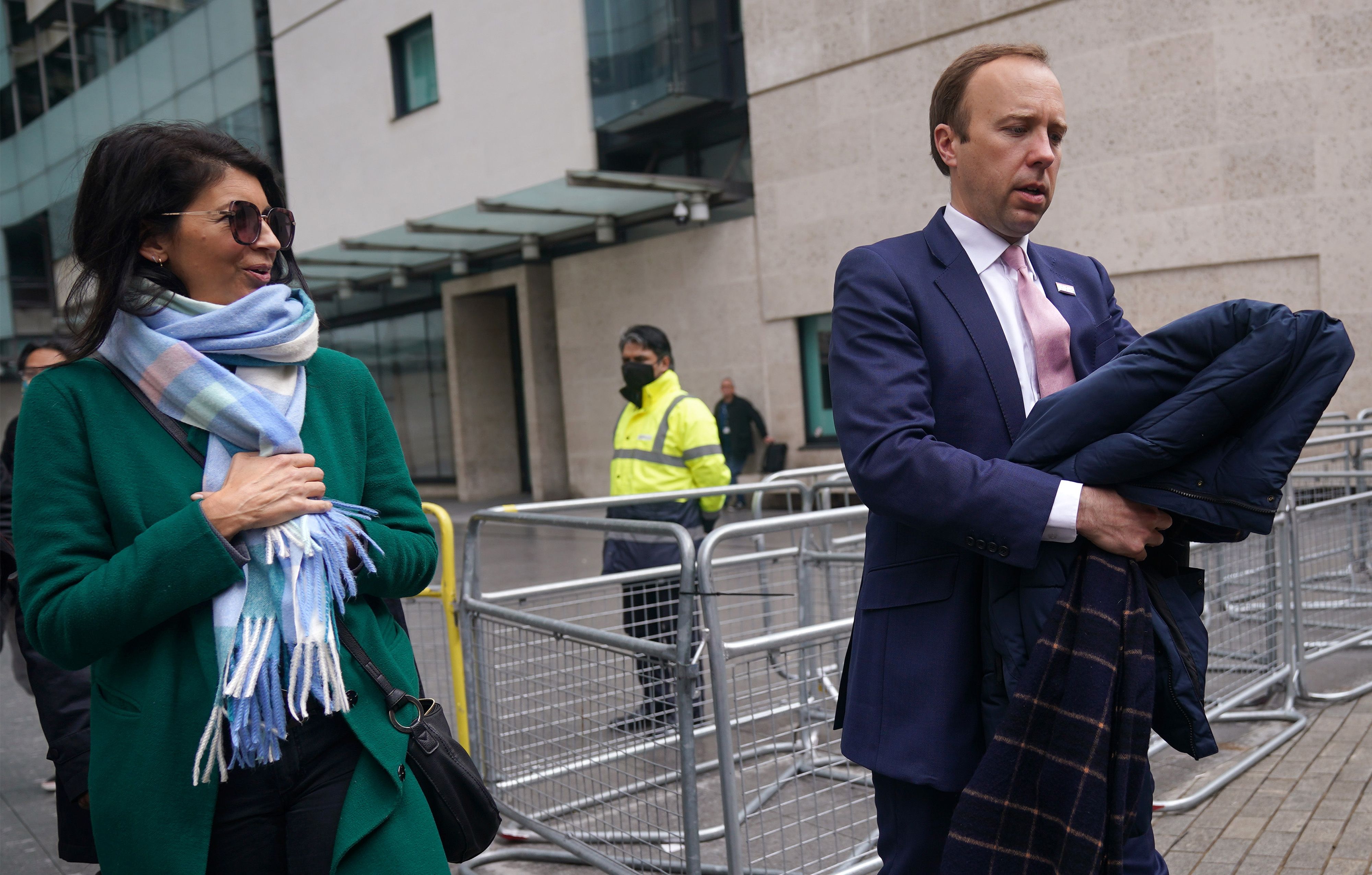
Health Secretary Matt Hancock with adviser Gina Coladangelo

Matt Hancock has resigned as Health Secretary over his breaking of Covid rules during his affair with an aide.

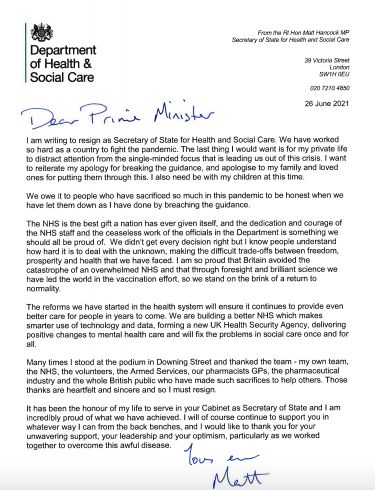
In a letter to Boris Johnson, he said the government “owe it to people who have sacrificed so much in this pandemic to be honest when we have let them down”.

Hancock was swiftly replaced by former chancellor Sajid Javid, who himself resigned from Johnson’s team in 2020 following a stand-off with Dominic Cummings.

He was forced to quit following a growing clamour from Tory MPs over his conduct, which was sensationally revealed when the Sun newspaper printed a photo of him kissing adviser Gina Coladangelo.

The paper published both images and video footage of the pair in a clinch in the minister’s office in the Department of Health last month – before lockdown rules were eased on social contact like hugging.

On Friday, the minister had defied calls to quit, simply saying he was “sorry” for breaching the rules that he had expected millions of others to abide by.

The PM had given him his full backing, but opinion polls showed that the public wanted him to quit.

In his letter, Hancock wrote: “The last thing I would want is for my private life to distract attention from the single-minded focus that is leading us out of this crisis.

“I want to reiterate my apology for breaking the guidance, and apologise to my family and loved ones for putting them through this. I also need (to) be with my children at this time.”

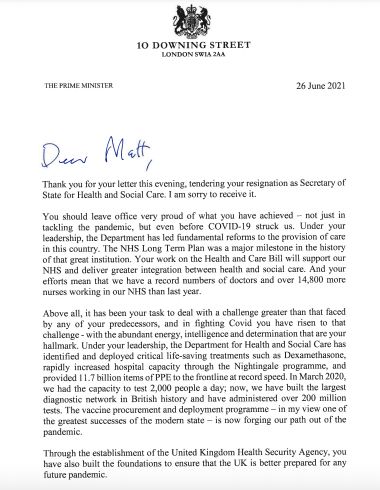
In response, the prime minister wrote: “You should leave office very proud of what you have achieved – not just in tackling the pandemic, but even before Covid-19 struck us.”

Johnson had refused to sack Hancock, with his spokesman saying the PM considered the matter closed after receiving the West Suffolk MP’s apology on Friday.

But a raft of Tory backbenchers demanded action, as their constituents were “seething” at the hypocrisy of the man in charge of Covid restrictions breaching them himself.

Labour leader Keir Starmer tweeted that the resignation was the right thing to do, but that Johnson should have sacked him.

In a video posted on Twitter, Hancock said: “I understand the enormous sacrifices that everybody in this country has made, you have made. And those of us who make these rules have got to stick by them and that’s why I’ve got to resign.

“I want to thank people for their incredible sacrifices and what they’ve done. Everybody working in the NHS, across social care, everyone involved in the vaccine programme and frankly everybody in this country who has risen to the challenges that we’ve seen over this past 18 months.”

Jonathan Ashworth, Labour’s shadow health secretary, said: “It is right that Matt Hancock has resigned. But why didn’t Boris Johnson have the guts to sack him and why did he say the matter was closed?

“Boris Johnson has demonstrated that he has none of the leadership qualities required of a Prime Minister.

“Hancock’s replacement cannot carry on business as usual. On Hancock’s watch waiting times soared, care homes were left exposed to Covid and NHS staff were badly let down. Our NHS deserves much better.”

Javid quit as Chancellor after Cummings persuaded the PM to merge Treasury and Downing Street teams of special advisers. 

Viewing the move as a threat to the independence of his department, Javid walked out despite pleas from Johnson for him to stay.

Cummings tweeted on Saturday that he had “tricked” the PM into firing Javid and suggested his return was due to Carrie Johnson.

Here is the resignation letter from Hancock:

PA

Hancock resignation letter

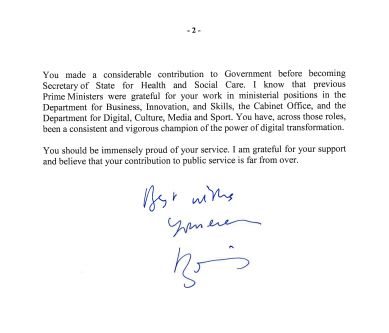
And here is Johnson’s reply:

Share Button

Derek Chauvin Sentenced To More Than 20 Years In Prison For Murder Of George Floyd

A Minnesota judge sentenced former Minneapolis police officer Derek Chauvin on Friday to 22.5 years in prison for the May 2020 murder of George Floyd.

He is also banned from possessing firearms, ammunition or explosives for the remainder of his life.

“Part of the mission of the Minneapolis Police Department is to give citizens ‘voice and respect,’” wrote Judge Peter Cahill in a 22-page brief laying out his rationale for the sentence. “Here, Mr Chauvin, rather than pursuing the MPD mission, treated Mr Floyd without respect and denied him the dignity owed to all human beings and which he certainly would have extended to a friend or neighbour.”

Cahill included an analysis of sentences in similar circumstances over the past decade to show that Chauvin’s sentence was not disproportionately long.

Chauvin was convicted in April of second- and third-degree murder as well as second-degree manslaughter in Floyd’s death. He has since been held at the Minnesota Correctional Facility in Oak Park Heights, the state’s only maximum-security prison, about 25 miles east of Minneapolis. 

Shortly before his sentence was handed down, the former officer stood up to address the court for the first time. 

“I want to give my condolences to the Floyd family,” Chauvin said, adding that he was not able to “give a full, formal statement” because of “some additional legal matters at hand.” He ended on a cryptic note.

“There’s going to be some other information in the future that would be of interest, and I hope things will give you some peace of mind,” Chauvin told the Floyd family.

Chauvin, who is white, was one of three officers to pin Floyd, a Black man, facedown on a street during an arrest attempt. Chauvin knelt on Floyd’s neck for 9 minutes and 29 seconds as Floyd repeatedly stated that he couldn’t breathe and eventually ceased breathing.

Four members of Floyd’s family spoke in court before the sentencing, including his young daughter, Gianna, who recalled how her father would help her brush her teeth every night before bed.

“I miss you and I love you,” Gianna said, addressing her father, in a video shown to the court.

Two of Floyd’s brothers, Terrence and Philonise Floyd, along with a nephew, Brandon Williams, asked Judge Peter Cahill to impose the maximum sentence on Chauvin.

Terrence Floyd said his family was now part of a group of Black people whose loved ones were killed by police in America, adding, “It’s not one of those fraternities that you enjoy.” He then told the judge how desperately he wanted answers from Chauvin: “What were you thinking? What was going through your head when you had your knee on my brother’s neck?”

Following Chauvin’s sentencing, the Floyd family and its legal team called the punishment “historic,” saying in a statement that it “brings the Floyd family and our nation one step closer to healing by delivering closure and accountability. For once, a police officer who wrongly took the life of a Black man was held to account. While this shouldn’t be exceptional, tragically it is.”

On Friday, the court heard for the first time from Chauvin’s mother, Carolyn Pawlenty, who read a statement that touched on her son’s childhood dream of becoming a police officer as well as how he has been portrayed in the media.

“The public will never know the loving and caring man he is, but his family does,” Pawlenty said. “Even though I have never spoken publicly, I have always supported him 100% and I always will.”

Floyd’s death sparked massive, monthslong protests across the country and an international reckoning with police brutality and racial injustice.

Hours before Friday’s sentencing, Judge Peter Cahill denied a defence motion for a new trial. He also ruled that Chauvin’s team failed to demonstrate prosecutorial or juror misconduct.

Prosecutors filed a memorandum earlier this month asking Cahill to sentence Chauvin to a minimum of 30 years behind bars. Chauvin’s legal team requested he receive probation or a shorter prison term. He will receive credit for time already served: 199 days. 

Cahill, who oversaw Chauvin’s high-profile trial, ruled last month that the former officer could receive an aggravated prison sentence ― one that would be tougher than Minnesota’s sentencing guidelines. The judge said Chauvin abused his position of authority and treated Floyd with particular cruelty. 

He reiterated this view in his brief, where Cahill said Chauvin’s actions “killed Mr. Floyd ‘slowly,’ and that the prolonged nature of the asphyxiation was by itself particularly cruel,” completely dismissing the defense’s argument that Chauvin had been forced to make decisions in a short time span.

“Determining the appropriate length of any felony sentence is not a mathematical calculation. Nor should it be a reflexive doubling of the presumptive sentence once aggravating factors are proven and found by the Court to be substantial and compelling. Each sentence should be an application of the law to the facts of the individual case without regard to sympathy, bias, passion, or public opinion,” Cahill wrote.

Chauvin’s legal troubles are far from over. In early June, he was ordered into federal custody pending federal charges over Floyd’s death.

Share Button

Will The Ridiculing Of Matt Hancock Skewer Him, Or Spare Him?

One of the tabloid-tastic details of The Sun’s jaw-dropping scoop on Matt Hancock was that “the office where the tryst happened is where Mr Hancock famously hangs his Damien Hirst portrait of the Queen”.

He committed adultery in front of Her Majesty, has the man no shame? Or did he dangle a facemask over the painting to spare her eyes? As one parliamentary source put it to me [in a phrase that now adorns LadBible, of all places]: “Matt Hancock’s new guidance: Hands. Face. A**e.”

The Queen of course namechecked Hancock herself this week, during that audience with Boris Johnson, pitying “the poor man” for his workload in the pandemic. One can only imagine how arched the Royal eyebrow will be when a courtier (or the PM) dares inform her of the news about his latest troubles.

So, yes, the jokes have taken off and the health secretary’s clinch has inevitably become a meme. Within minutes, his reputation was hung, drawn and slaughtered and it can only get worse in coming days. The forbidden snog has the potential to become a new Barnard Castle moment, which itself spawned every possible quip about eye tests.

No.10 will be hoping that the ridicule is where this ends, and that it somehow reduces the seriousness of the breach of Covid rules. Johnson himself knows all too well that being a figure of fun on ‘Have I Got News For You’ is hardly career-ending.

For satire to bite it has to carry an edge of cold anger, rather than offer just titillating laughs. The Thick Of It was superb, but Armando Iannucci had to cancel it when he saw politicians revelling in it, rather than being stung by it. The idea of a minister who banned grandparents from hugging their grandchildren then hugging his mistress is beyond parody.

Still, Cummings’ case showed that sheer fury can accompany mockery. Lots and lots of Tory MPs were emailed by constituents who didn’t find it funny at all that the PM’s former chief adviser had treated strict lockdown rules like the Pirates of the Caribbean code (“more what you’d call ‘guidelines’ than actual rules”).

Hancock has a rhinoceros-like political hide. He has proved in many ways he’s beyond embarrassment, just as his boss has proved he’s often beyond shame. Opposing prorogation of parliament only to back the idea later, brazening out the PM’s “hopeless Hancock” description, defending his claim that he threw a “protective ring” around care homes, all prove that.

Hancock’s statement today – “I accept that I breached the social distancing guidance in these circumstances. I have let people down and am very sorry” – was a masterclass in chutzpah masquerading as contrition. It felt very much like he knew Johnson could never sack any minister over an affair, and that vaccination success was all the public have focused on anyway.

Sorry used to be the hardest word for this government, but this was an apology without action. With the public and businesses suffering from lockdown fatigue, that may have consequences. Any pub that now lets people order at the bar, any shop that allows face masks to be ditched, any nightclub that illicitly opens to snogging couples, may now just say sorry. Then keep on keeping on.

The real difficulty for Hancock will be the one that dogs “beleaguered” ministers through history: the clamour around this affair may make it impossible for him to do his day job.

Whenever he is next putting out a good news story about the vaccine progress, or even trying to keep in place some remaining restrictions, he will face a barrage of questions. Did he share an illegal hotel room stay with ‘another household’ at any point in the past year? Did he breach travel rules to meet that household? Did he have a relationship he failed to declare when hiring her?

A large chunk of the public may be unfazed, and un-outraged, by all this. The danger of the jokes is that they obscure perhaps the bigger failings of the health secretary, not least his Test and Trace service.

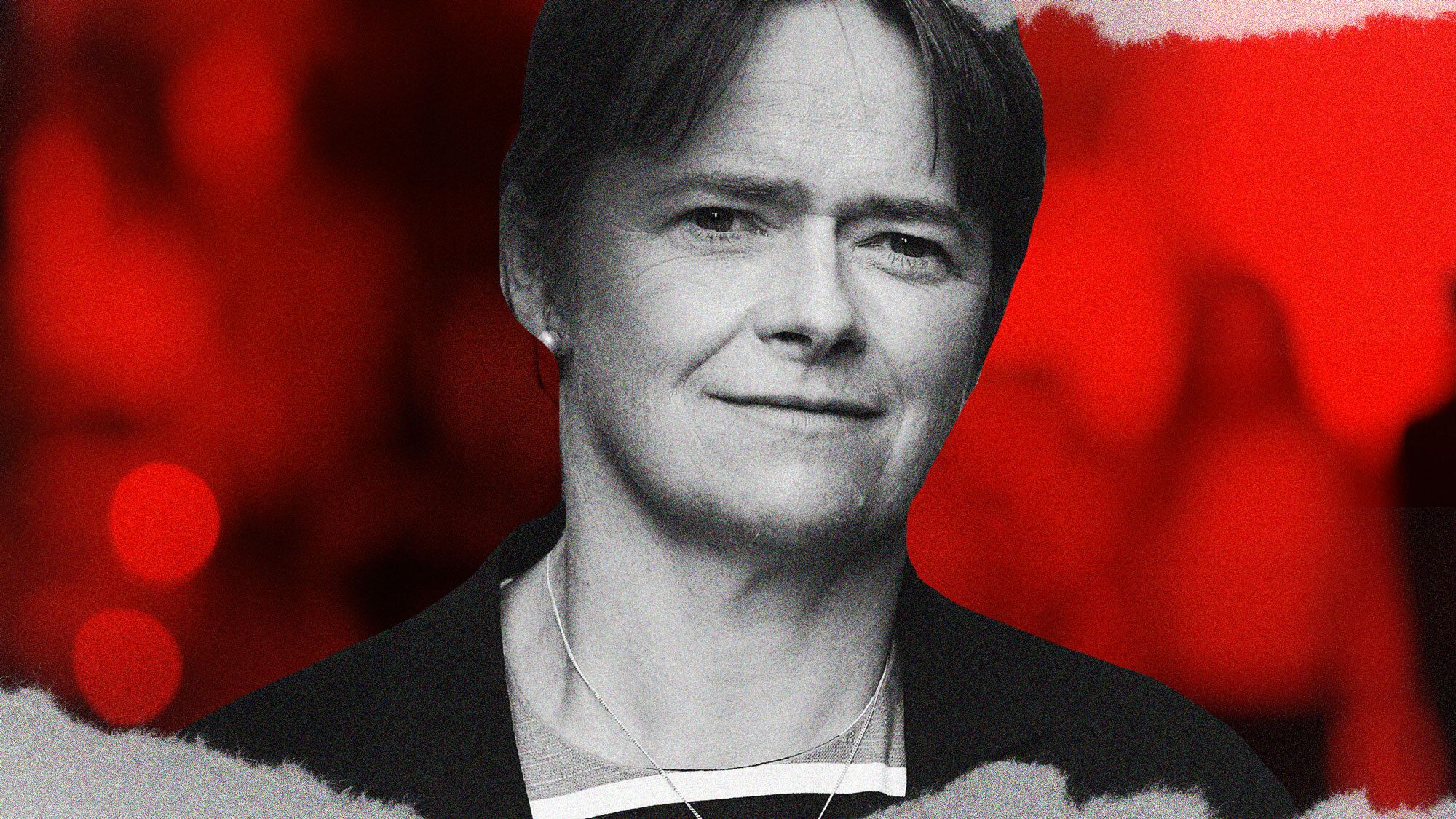
One irony of the Sun story is that the truly damning National Audit Office report into Dido Harding’s organisation was rapidly knocked off the headlines. Ministers in the Lords face questions on Monday about that report, and surely Hancock will face an Urgent Commons Question on it too.

In his latest blog, Cummings tried to twist the knife with yet more revelations about testing and tracing failures last year. And for all his tortuous stream-of-consciousness approach (I mean, who would want to read that stuff, rather than a short set of bullet points?), he had some important new revelations.

We learned that Cummings rightly warned that “quarantine must happen fast” and that it should be monitored. He correctly worked out that testing and even tracing was pointless unless people were actually isolating. He also stressed that testing asymptomatic cases was even more valuable than testing those with symptoms.

He also revealed a new Johnson message that confirmed these concerns, but left them unresolved: “The whole track and trace thing feels like whistling in the dark. Legions of imaginary clouseaus and no plan to hire them…And above all no idea how to get new cases down to a manageable level or how long it will take”.

In PMQs next week, Keir Starmer must surely quote Johnson’s own verdict that the lack of a viable test and trace system meant the “uk may have secured double distinction of being the European country w the most fatalities and the biggest economic hit”. Expect that to appear on every Labour leaflet and poster ahead of the next election.

The PM looks like he wants to brazen out the Hancock row as much as Hancock himself. He will try to make a virtue out of his dogged loyalty to his ministers and say “vaccines, vaccines, vaccines” a lot. Yet today’s No.10 stonewalling of Lobby journalists’ questions laid bare a contempt for not just the media but for the public.

That felt like the bullishness of a government with a big polling lead, but it also felt like the complacency of a party that has been in power so long that it thinks the normal rules really don’t apply to it. They may be right for now, but in the long run, that way lies ruin.

Share Button

Test And Trace Has Lost Track Of Nearly 600 Million Covid Tests

HuffPost/Getty Images

Test and Trace, which was run by Tory peer Dido Harding, has already come under fire for its use of private firms.

Boris Johnson’s £37bn Test and Trace service is facing fresh criticism after a damning new report found that it had lost track of nearly 600 million Covid tests.

The National Audit Office spending watchdog concluded that the system was still failing to “deliver value for taxpayers”, with a lack of any targets for self-isolation by the public and a continued reliance on private consultants.

Test and Trace, which was run by Tory peer Dido Harding, has already come under fire for its use of private firms Serco and Deloitte and its repeated failures in 2020 to track down contacts of people who had Covid.

The latest report sets out a raft of problems, including paying for tracing staff it does not use, the use of emergency procurement powers that dole out contracts without competition and a lack of data sharing with local public health chiefs that hinders efforts to tackle outbreaks.

In the six months from November last year to April this year, it failed to reach nearly 100,000 people who had tested positive for Covid and as result failed to identify their contacts who could potentially infect others.

The NAO also criticised Matt Hancock’s decision to absorb its functions into a new UK Health Security Agency, saying there was “a risk that the restructuring will divert NHST&T’s attention away from efforts to contain the spread of the virus”.

It has given the government until October to sort out the problems, including how it will “best support citizens to come forward for tests and comply with self-isolation requirements” – a clear signal that the watchdog believes the public need higher payments to home quarantine.

Labour pounced on the report and suggested that it ought to kill off the chances of former Test and Trace chief Harding’s bid to become the next chief executive of the NHS.

Shadow health minister Justin Madders said: “I would suggest this is essential reading for the interview panel in case there is even the slightest possibility that they are considering her appointment.

“This report is damning. The government has been told time and again that if we are going to bring down cases, it needs to ensure people can afford to self-isolate, but it has refused to listen.

“If lateral flow tests are going to play their part in helping society reopen, ministers need to make sure results are registered – it’s astounding that 550,000,000 tests have gone missing.”

Anadolu Agency via Getty Images

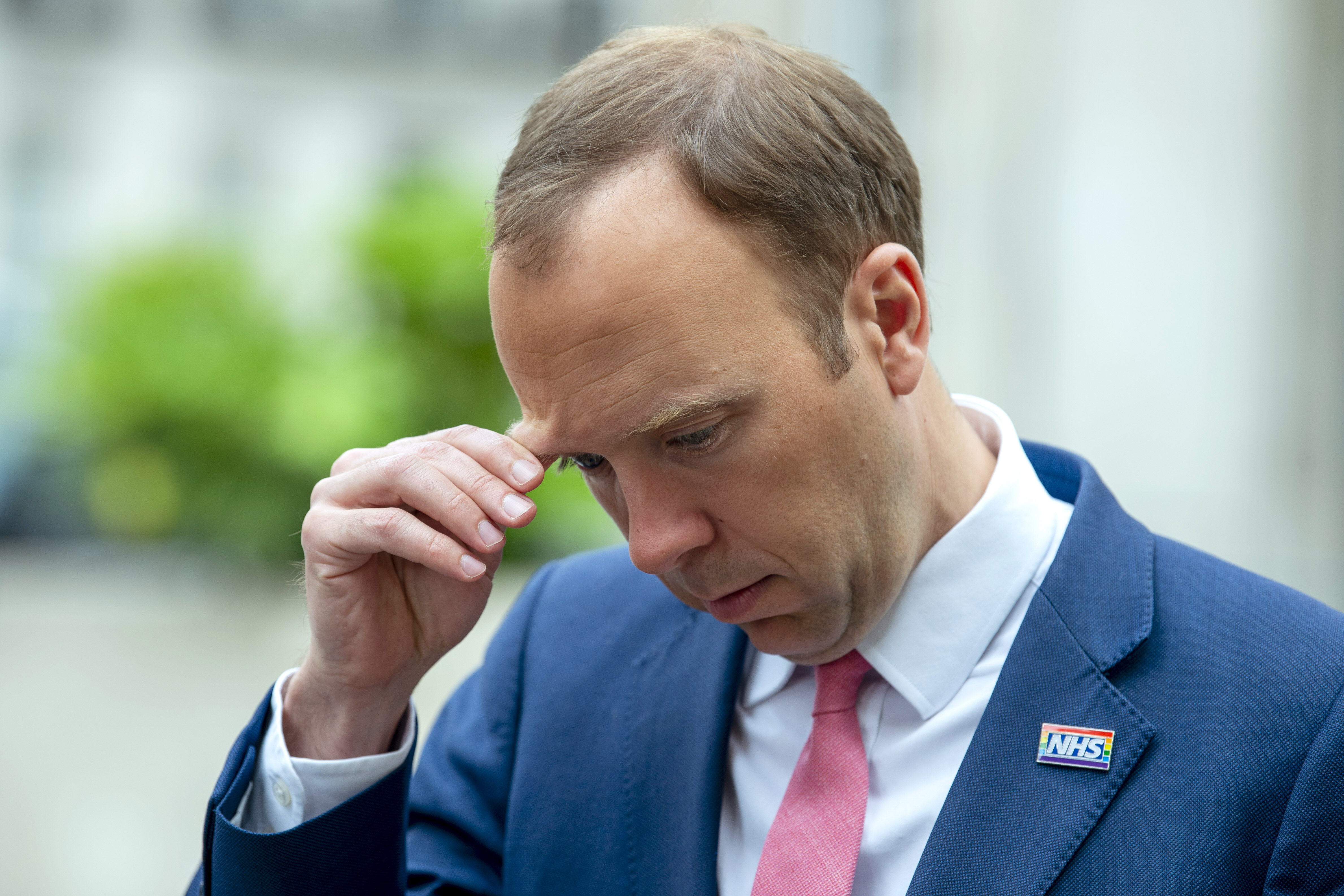
Health secretary Matt Hancock

The report found that only a small proportion of the Covid tests distributed have been registered as used.

Test and Trace had forecast that between March and May 2021, 655 million lateral flow tests would be used in the UK.

But up to 26 May, just 96 million (14%) of the 691 million tests distributed in England had been registered. “NHST&T does not know whether the tests that have not been registered have been used or not,” it said.

NAO head Gareth Davies said Test and Trace had introduced a lot of changes since its last withering report, including mass testing, closer working with local authorities and initiatives to identify and contain variant forms of Covid.

“However, some pressing challenges need to be tackled if it is to achieve its objectives and deliver value for taxpayers, including understanding how many lateral flow devices are actually being used and increasing public compliance with testing and self-isolation,” he said.

Public Accounts Committee chair Meg Hillier pointed out that the report had found that 45% of Test and Trace staff at its head office were still private consultants, despite Harding’s promises to reduce their number and to replace them with civil servants.

“Test and Trace employed more consultants in April 2021 than it did in November 2022. Despite being nearly a year old, nearly half the central staff are consultants,” Hillier said.

“Testing and tracing are likely to be around for some time yet and it’s hard to understand why these roles are not now permanent or fixed term contracts. The danger is that institutional memory will disappear as consultants walk off with their fat pay cheques.”

The latest report shows that although Test and Trace has introduced more flexibility into its contact centre contracts, across its testing and tracing activities it is “still paying for capacity it does not use”.

It’s “utilisation rate” – the proportion of time someone actively worked during their paid horse – had a target of 50% but in reality rates have been well below this since November 2020, peaking at 49% in January and falling to just 11% in February.

The unit cost per contact traced went up from around £5 in October to £47 in February.

The NAO found that Test and Trace had used £13.5 billion of its £22.2 billion budget in 2020-21, an underspend of £8.7 billion. Of this, £10.4 billion went on testing, £1.8 billion on identifying and containing local outbreaks and £900 million on tracing.

Test and Trace told the NAO that the underspend is because a predicted high level of demand for testing in January and February 2021 did not materialise due to the national lockdown.

A spokesperson for the Department of Health and Social Care said it had started a programme of research to understand the low rate of test registration and was working to increase public awareness of the need to register results and improve the ability to track tests.

“NHS Test and Trace has played an essential role in combating this pandemic and the NAO has recognised many of the rapid improvements we have made in the short lifespan of this organisation.

“The testing and tracing being delivered across the country is saving lives every single day and helping us send this virus into retreat by breaking chains of transmission and spotting outbreaks wherever they exist.

“While NHS Test and Trace continues to be one of the centrepieces of our roadmap to return life to normal, our new UK Health Security Agency is going to consolidate the enormous expertise that now exists across our health system so we can face down potential future threats and viruses.”

The government insists that the system has successfully identified over 3.4 million positive cases and notified a further 7.1 million contacts, to tell them to self-isolate, since 28 May 2020. Rapid tests have picked up over 213,082 Covid cases without symptoms.

It claims that the high number of consultants was critical for accessing specific skills and abilities in order to deliver operationally. DHSC is also evaluating several pilot approaches to improve compliance with self-isolation.

Pascale Robinson, campaigns officer at We Own It said: “It’s abundantly clear now that despite millions upon millions of pounds being handed to private companies, they have demonstrably failed to deliver a functioning system, leaving us without a crucial defence against Covid transmissions and needlessly putting lives at risk.

“With new variants spreading through our communities, it’s clear that even with the vaccination programme we desperately need a properly functioning contact tracing system.”

Share Button

Can The Two-Jabs-And-You’re-Outta-Here Policy Help Boris Johnson Save The Summer?

Woah, we’re going to Ibiza. Okay, I’m not, obviously. But if you want to, from next week you can jet off to the fun-loving island, along with a raft of places beginning with ‘M’ (Malta, Madeira, Mallorca, Menorca), without fear of that dreaded return quarantine that kills dead any holiday vibe.

There was, as ever, a catch. And this was that most of the countries on the new “green list” were simultaneously put on a “green watchlist” (keep up at the back). Nations or islands on the watchlist are “at risk of moving from green to amber”, we’re told. In other words, you’re rolling the dice when you dare book a trip there.

Just how many airlines, hotels and insurance companies think that system is viable will depend on whether they are prepared to offer refunds on a destination that could at very short notice flip from paradise to pariah. That won’t stop some people who are desperate for a bit of beach after a hard winter’s slog.

The idea of replacing the third wave of Covid for actual waves of the Med is clearly tempting. And while the greenlist/watchlist looks skinnier than the PM’s Brexit trade deal, it was the other big news from transport secretary Grant Shapps that was more significant: allowing double-jabbed travellers to avoid 10-day quarantine on return from “amber” list countries.

The plan is tentative and vaguely timetabled, and it was notable that the Department for Transport press release stated “our intention” is that “later in the summer” the two-jabs freedom could kick in. Still, getting high protection from Covid and being able to travel abroad is just the kind of cake-and-eat-it outcome this PM finds mouthwatering. Cake-and-vaxx and get your freshness back, Boris Johnson must be tempted to chirrup.

Even before the formal announcement, Johnson himself let slip that he wanted vaccinations to “open up” travel. And while warning this summer would be “different”, he sounded hopeful that he’d get his own sea-and-sangria (though in his case, it’s often a Croatian red) break, saying “my plans at this stage are at the unformed stage…I’m certainly not ruling it in or ruling it out”.

The shift to double-jabbed travel freedoms would effectively abolish the current amber-flashing green classification system, leaving just “red” list nations as the real danger spots. Pfizer or AstraZeneca would become the biological equivalent of Piz Buin and Ambre Solaire of our foreign travel, offering even better protection without any sticky sand downside.

In public health terms, there’s a virtuous circle effect too. Although lots of young people queuing up for jabs are indeed doing it out of a sense of communal duty as well as personal interest, there’s no question that the prospect of being allowed to go on holiday is a huge magnet too. Not for nothing have fiftysomething mums’ Whatsapp groups been exploding whenever a new walk-in vaccination centre opens for over-18s: the whole family could possibly go on hols in the first week of September.

For the majority who are resigned to holidaying at home, all this will look bizarrely risky. Yet it’s worth mentioning that there are plenty of Brits with family and friends overseas who have not seen them in more than a year. Overseas travel does not always mean beach holidays, it means real face time with your loved ones (five million EU citizens now make up nearly one in ten of our population, and there are millions more with family ties to Asia, Africa and the Americas).

Stil, the fact that neither Shapps nor the PM trumpeted this apparent good news in a major televised press conference told its own story. Both are very wary of sending out a premature signal that life is back to normal, particularly when we are still a way off the July 19 Freedom Day in the amended roadmap out of lockdown.

The race to get as many people second-jabbed as possible is also not done, as vaccines minister Nadhim Zahawi made clear on Wednesday. (Curiously, he revealed he had had to take a lateral flow test for England’s match against Croatia “because I hadn’t had enough time for my second vaccination”. The June 13 date of that match suggests Zahawi, who’s 54, had failed to follow the PM’s edict on May 14 for over-50s to get a new dose after eight weeks not 12, but that’s another story.)

The vague “later in the summer” timetabling of the two-jabs-and-you’re-outta-here policy points to its dependence on the path of the Delta variant. Fortunately, hospitalisations look like they are beginning to flatten in some parts of the UK, but the rise in cases can still look pretty scary to a hard-pressed NHS already coping with a backlog of non-Covid treatments. That’s why this announcement felt like the PM dipping a toe in the water, rather than risking a belly flop.

Johnson is under pressure from cabinet ministers like George Eustice and Jacob Rees-Mogg to use July 19 to implement total unlockdown. Eustice went public to call for “all of the legal requirements to do things, to be taken away completely”. Rees-Mogg again sounded like the Tory backbench lockdown sceptics’ tribune, saying “terminus is Paddington not Crewe. It is the end of the line, it is not an interchange”.

The PM knows more than anyone that he’s taking a political gamble with July 19, and removal of all restrictions may not be the advice of his scientists. Having tried to shrug off any link between the G7 and Cornwall’s spike in Delta cases, he could be on the ropes again if admitting thousands of UEFA bigwigs causes a fresh import just because he wants Wembley to host the Euros final.

The pressure to prove Brexit Britain is literally open for business, and pleasure, is strong. Yet the stakes are particularly high for a man who has promised the public that any move out of lockdown will be “irreversible”. He will be crossing his fingers that the second jabs really can squash the sombrero of hospitalisations in coming weeks.

Share Button

How Long Can Boris Johnson’s ‘Not Me, Govt’ Trick Keep On Working?

UK ParliamentPA

UK Parliament/Jessica Taylor/PA Wire

Like a striker lacking confidence from a goal drought (Harry Kane springs to mind), Keir Starmer was badly in need of a PMQs win. And thanks to Boris Johnson’s unique combination of complacency and tone deafness, he got one.

The Labour leader came in for some stick last week for failing to pick up on a late Dominic Cummings rant about Matt Hancock (I still think it was smarter to focus on the PM’s border policy and the Delta variant spike). But this week it appeared he was taking to heart the Substack Svengali’s latest advice to “Kick Tories up and down the street on violent crime.”

As it happens, I’m told Starmer wasn’t aware of that particular Cummings line and in fact the focus this week on criminal justice was part of his new strategy of picking a few topics and ramming them home. Asking Johnson, repeatedly with increasing cold anger, why 98.4% of reported rapes don’t end in a criminal charge left the PM stumbling and mumbling.

Johnson’s attempt to accuse Labour of being soft on sentencing looked as lame as it was obvious, with Starmer ridiculing the idea that sentencing was even relevant when so few rapists ended up in court in the first place.

The PM was the one who sounded like a quibbling lawyer when he cited “considerable evidential problems, particularly in recovering data from mobile phones” in his defence. “There is not a good enough join-up across the criminal justice system,” he then admitted, before claiming he was “addressing” the problem.

This was classic Johnson, distancing himself from previous Tory cuts as if this was the second year not the 11th year of Conservative rule. A mix of ‘not me, guv’ and ‘not my govt’, the tactic has worked effectively whenever the austerity charge is levelled at him. What the PM calls “the blessed sponge of amnesia” certainly worked a treat in the general election.

Often it feels like a Blairite trick, updated for the 2020s, a kind of ‘New Tories, new Britain’. One Labour MP tells me he attended a social event with some very confident Tory ministers recently, “and to hear them you would think it was like us in 1998, at the peak of our powers, not 11 years in”.

But for once, this was a social distancing too far. Johnson tried to cite a recent rise in Crown Prosecution Service staffing, but when set against the decade of failure it felt superfluous. Starmer was merciless in response, pointing out that years of cuts to the CPS, 25% cuts to the Ministry of Justice and closing half the courts collectively dwarfed a small increase in budget of late.

Starmer’s best line however was when he said: “I spent five years as Director of Public Prosecutions, prosecuting thousands of rape cases.” That’s a line his allies want him to say again and again and again, replacing ‘rape cases’ with ‘terrorist cases’, ‘violent crime cases’ and more.

Some around him have been frustrated at the lack of emphasis on his security credentials, especially when contrasted with Johnson’s own decadent life politics. In the coming months, the public may get to hear a lot more about the ex-DPP’s record (though he can’t give the full detail of the terror plots he managed to foil).

Starmer was also canny enough to use evidence to the Home Affairs committee just minutes before PMQs, when victims’ commissioner Vera Baird said the government’s current plans to improve rape conviction rates was “underwhelming”. It was Baird’s previous quote – “in effect, what we are witnessing is the decriminalisation of rape” – that Labour deployed with a Cummings-like brutality earlier this year.

When Johnson used his prepared line that “they jabber, we jab”, he invited further charges that he was dismissive of the lived experience of women up and down the land. And when he finally apologised for the way “the trauma” suffered by rape victims in the criminal justice system, it felt cursory and dragged out of him. Imagine if he had opened with a heartfelt apology instead.

Street security, national security and job security are key themes Labour believes it can use to prove the party really has changed, together with a “tough on the causes of crime” style approach to youth services and “preventive public services”. In coming months the party will need such sharp definition, and so will Starmer.

But the biggest task is to use every opportunity to tell the public this is not a ‘new’ government but an old government – with form as long as your arm.

Share Button