The clinic in London says it has “paused” its service following reports it sold several thousand tests.


The clinic in London says it has “paused” its service following reports it sold several thousand tests.
More than 300,000 cases have now been reported, as Covid-19 spreads to almost every country.
In Conscious Growth Club, we’ve been discussing the coronavirus situation since February 26, and our discussion thread called “Coronavirus preparation” is now up to 325 posts and still growing. Perhaps a half-dozen related threads have been started as well, as members are discussing topics like self-care in isolation, immunity boosting tips, and sharing updates on what’s happening in different countries. So we’ve had some visibility on it this sooner than most, which gave us a head start on mentally and emotionally preparing ourselves for it.
Contrast this with various local businesses that haven’t been as aware of what’s coming up and were thrown for a loop at the speed and surprise of changes coming at them.
Let me share some local Las Vegas businesses how have been adapting.
The casinos and hotels are shut down statewide. So the Vegas Strip is shuttered. This essentially turns off the flow of money coming into the city.
The larger operations seem to be paying their employees for the next 2 weeks up to 30 days, but the smaller ones are already laying people off. I read that about 206K casino employees are out of work now.
This is going to crash the cities economy, badly enough that I think it will take years to recover. When we reach the point that the bigger casinos have to start laying people off, it will take them a long time for them to rebuild afterwards. And it will take a while to rebuild tourism to the city.
These larger operations don’t have a lot of good adaptations right now other than laying everyone off. It’s not like they can convert their large spaces to other social uses. They’ve had to turn off just about every revenue stream: hotel stays, gambling, shows, restaurants, night clubs, spas, arcades, etc. The entire resorts are closed.
Some local places have remained open 24/7 for many years, so they literally had to hire a locksmith to come over and install locks. They’d never had cause to lock their front doors because they had never closed before.
Additionally Cirque du Soleil, which has many shows in Vegas, laid off 95% of its global workforce, basically letting go of all of its performers.
Presently the casinos seem to be begging the federal government for bailout money, along with many other businesses.
Some resorts actually have to pay rent because they don’t own the land they’re on. The Bellagio is in this situation, for instance. So what happens when rent is due, but there’s no money coming in?
My local fitness studio has adapted to this situation quickly. They converted their in-person classes to online streaming classes. They provided all active members with access to a private area of their website where we can watch streaming classes online. Each day they post a schedule of classes.
Today, for instance, there are 11 classes include various forms of yoga, pilates, bootcamp, and barre. There’s even an indoor cycling class, which I guess is suitable for people who have exercise bikes at home.
It looks like they may stream a class live the first time and also record it. Or maybe they just record them all – it’s hard to tell. But they’re streaming on a schedule with only one class available at a time, and you cannot pause a video in progress, so it simulates the feeling of live classes. It’s less flexible though because if they’re recording these anyway, they could just make all recordings available at all times.
They must be in a tough situation though. Rachelle and I have each done a few of the streaming classes. They’re well done, and I like that this option is available so I can continue what I started in February in some fashion. But it’s not as good as the in-person experience at the studio.
This studio is part of a growing chain across several states, so they can pool resources to create the online classes. The ones we watched looked like they’re being recorded in Vegas though. Some people were wearing Vegas shirts in one video, and another was done by an instructor we know from our local studio.
This must be a tough situation for them. If the online classes are only needed for a few weeks, hopefully it will help members keep their memberships going and not cancel. But if this situation goes on for months, I think more people will conclude that they should cancel their memberships. I think people will find it hard to justify paying as much for online video workouts as they do for the live in-studio experience.
One issue Rachelle and I both noted though is that on some of the videos they’re creating, they’re clearly not practicing good social distancing. They have an instructor and several students on yoga mats within arm’s length of each other sometimes. That’s a concern. I think a lot of people are having a hard time noting just how disciplined we need to be about social distancing.
Rachelle and I stopped going to classes at this studio about two weeks ago. We were sad to stop, but we saw this situation coming a while before it began to unfold locally. Initially after we stopped going, the studio tried to adapt with fewer classes and more sanitation procedures, but I knew it wasn’t going to matter.
That’s a pattern I’ve seen a lot locally. Businesses are trying to incrementally adapt, but often by the time they figure out their incremental adaptations and announce them to their customers or clients, the situation has already moved beyond that.
Initially the local music store where I take guitar lessons tried to keep their stores open but with more limited hours. Fortunately our Nevada Governor shut that idea down by ordering (instead of merely requesting) all nonessential businesses to shut down.
I did my last lesson there more than two weeks ago and canceled all upcoming lessons indefinitely, having a glimpse of what was about to unfold. I told someone at the store that I expected the store would be closed by the end of the month. I don’t think he believed me at the time.
During the past week, the store sent out a couple of emails announcing reduced hours for their physical locations and added the ability to continue lessons online, saying that the guitar teachers would follow up with their students individually about this. Their plan was to still have the teachers stream the lessons from the stores.
I knew this wouldn’t last long. A few days later the store had to completely by Governor’s orders.
I’m not sure if they’re going to try adapting to this now by letting their music teachers team and stream lessons from home. That seems a bit risky for them because they take a cut of the lesson tuition. So it’s like cutting themselves out of the loop, although they could still handle booking and billing lessons.
I like the in-person lessons, but I don’t think I’d want to do them remotely if given the options. There are other ways I could take online lessons that are more flexible. And I’d miss the face-to-face aspect.
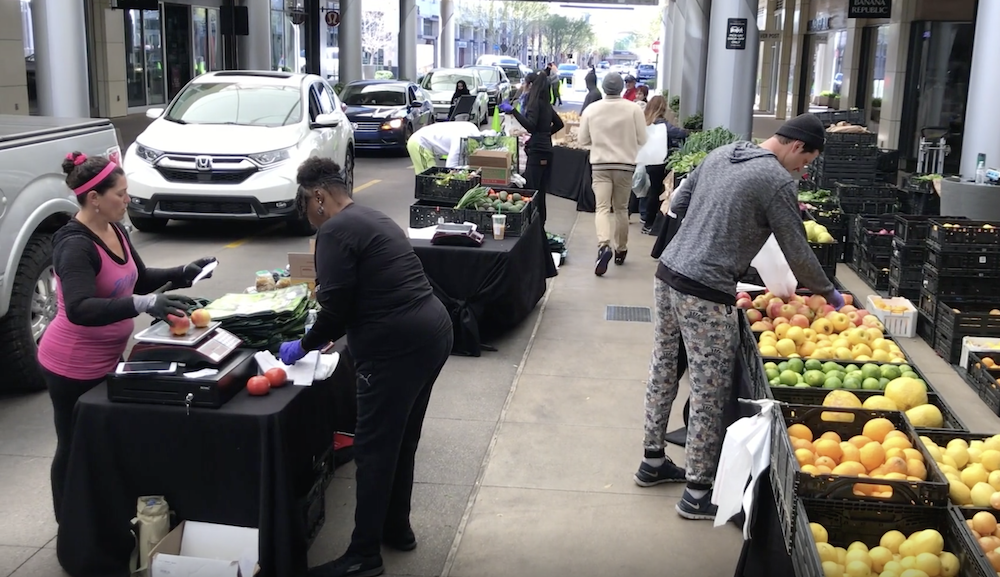
Close to our house they’ve converted the usual weekend farmers market into a drive-through version, so people can get fresh produce without leaving their cars. There’s a short video of it at the link below if you want to see how it works.
This seems like an okay adaptation at first, especially since the helpers wear gloves when they handle the produce and money. But the video still shows some examples of people not applying good social distancing as they move around the area, so while this may be better than going to an overcrowded grocery store, it’s still showing risky behavior.
An even worse issue is that when a local food bank announces that they’re giving away food, like in a parking lot, people swarm the area to acquire the food. These giveaways may be well-intentioned, but there’s a serious lack of awareness or discipline about the criticality of social distancing, which makes it easier for the virus to spread.
If we keep seeing this pattern locally, it’s just going to make the situation worse.
Vegas has a lot of strip clubs, and this situation puts many of them out in the cold. One local club quickly tried to adapt by offering drive-by strip shows. The idea was that patrons would stay in their cars, pay $100, pull up to a window, and a stripper would perform for them from a distance for 10 minutes. No touching allowed of course.
This idea generating some local press, maybe for its creativity or simply for its desperation, but was dead on arrival. The club didn’t have a chance to implement it before the it was ordered fully closed by the Governor, along with all other nonessential businesses.
Earlier today I learned that a strip club in Portland came up with a different idea. Partly as a joke, the club’s owner suggested on social media that they should convert to a food delivery service and have the strippers deliver food to people. Some people started to seriously inquire about the idea, so the owner decided to do exactly that. Now they have strippers with drivers (who also serve as security for them) taking food orders and delivering food. They say they’ll even deliver food to the coast (about an hour’s drive from Portland) if people are willing to pay enough for it. The name of the new service: Boober Eats.
Since strippers typically work as independent contractors, they’re not eligible for unemployment benefits. So while it’s to be expected that they may try to create new income streams, reporters have noted that the place in Portland isn’t practicing social distancing.
One source noted that while the owner is providing masks, disposable gloves, and sanitizing wipes, there are major problems present with social distancing:
But social distancing seemed to be a struggle for the women themselves. The club has turned into the headquarters for Boober Eats, and on Friday, it remained full of dancers, delivery drivers and members of the media. Some of the dancers greeted each other with hugs and took selfies together.
Source: Oregon Live
So there’s a genuine risk that this could become a coronavirus delivery service.
These adaptations, while understandable, creative, and perhaps even admirable in some situations, aren’t without issues, especially when it comes to social distancing.
I think we’ll likely run into more local businesses trying to make similar adaptations, and I caution everyone not to ignore social distancing since it remains so critical right now.
Some of these problems can be solved with better attention to detail. For instance, we don’t not need lots of students on a streaming yoga video to demonstrate the postures. One or two would be sufficient, separated by a generous distance. And the Farmers Market could assign one person to one or two tables, so their paths aren’t crossing each other and they stay in their own zones.
The USA has now surpassed 42K reported coronavirus cases. Three days ago (on March 20) we were at 16K cases, and on that day I predicted that we’d surpass 50K cases sometime on Tuesday (tomorrow). Unfortunately we’re right on schedule, even slightly ahead of schedule.
My other predictions were that we’d reaching 100,000 USA cases on March 27 and that we’d reach 1,000,000 cases on April 3rd. Of course it’s possible that we may not do enough testing to achieve those predictions on the reporting side, but the virus is still showing abundant momentum to get there whether or not testing can keep up with it. Many experts suggestion that the true cases are likely to be at least 10x higher than the reported cases, so we could be looking at 10M+ true cases (or more) sometime next week. That can and will overwhelm many hospitals.
I’ve also noticed that this virus is moving socially closer. Last week I learned that a friend of a friend of a friend died from it. Then last night a friend’s niece passed away from it. More people that I connect with on social media have been reporting their own confirmed or likely infections.
Now imagine all of this being 25X higher sometime next week. And then it will flow right into 50X and then 100X without stopping.
If the adaptations seem reasonable, they aren’t. If they seem ridiculously strict, they may be just barely adequate.
A team led by UC Riverside geologists has discovered the first ancestor on the family tree that contains most familiar animals today, including humans.
The tiny, wormlike creature, named Ikaria wariootia, is the earliest bilaterian, or organism with a front and back, two symmetrical sides, and openings at either end connected by a gut. The paper is published today in Proceedings of the National Academy of Sciences.
The earliest multicellular organisms, such as sponges and algal mats, had variable shapes. Collectively known as the Ediacaran Biota, this group contains the oldest fossils of complex, multicellular organisms. However, most of these are not directly related to animals around today, including lily pad-shaped creatures known as Dickinsonia that lack basic features of most animals, such as a mouth or gut.
The development of bilateral symmetry was a critical step in the evolution of animal life, giving organisms the ability to move purposefully and a common, yet successful way to organize their bodies. A multitude of animals, from worms to insects to dinosaurs to humans, are organized around this same basic bilaterian body plan.
Evolutionary biologists studying the genetics of modern animals predicted the oldest ancestor of all bilaterians would have been simple and small, with rudimentary sensory organs. Preserving and identifying the fossilized remains of such an animal was thought to be difficult, if not impossible.
For 15 years, scientists agreed that fossilized burrows found in 555 million-year-old Ediacaran Period deposits in Nilpena, South Australia, were made by bilaterians. But there was no sign of the creature that made the burrows, leaving scientists with nothing but speculation.
Scott Evans, a recent doctoral graduate from UC Riverside; and Mary Droser, a professor of geology, noticed miniscule, oval impressions near some of these burrows. With funding from a NASA exobiology grant, they used a three-dimensional laser scanner that revealed the regular, consistent shape of a cylindrical body with a distinct head and tail and faintly grooved musculature. The animal ranged between 2-7 millimeters long and about 1-2.5 millimeters wide, with the largest the size and shape of a grain of rice — just the right size to have made the burrows.
“We thought these animals should have existed during this interval, but always understood they would be difficult to recognize,” Evans said. “Once we had the 3D scans, we knew that we had made an important discovery.”
The researchers, who include Ian Hughes of UC San Diego and James Gehling of the South Australia Museum, describe Ikaria wariootia, named to acknowledge the original custodians of the land. The genus name comes from Ikara, which means “meeting place” in the Adnyamathanha language. It’s the Adnyamathanha name for a grouping of mountains known in English as Wilpena Pound. The species name comes from Warioota Creek, which runs from the Flinders Ranges to Nilpena Station.
“Burrows of Ikaria occur lower than anything else. It’s the oldest fossil we get with this type of complexity,” Droser said. “Dickinsonia and other big things were probably evolutionary dead ends. We knew that we also had lots of little things and thought these might have been the early bilaterians that we were looking for.”
In spite of its relatively simple shape, Ikaria was complex compared to other fossils from this period. It burrowed in thin layers of well-oxygenated sand on the ocean floor in search of organic matter, indicating rudimentary sensory abilities. The depth and curvature of Ikaria represent clearly distinct front and rear ends, supporting the directed movement found in the burrows.
The burrows also preserve crosswise, “V”-shaped ridges, suggesting Ikaria moved by contracting muscles across its body like a worm, known as peristaltic locomotion. Evidence of sediment displacement in the burrows and signs the organism fed on buried organic matter reveal Ikaria probably had a mouth, anus, and gut.
“This is what evolutionary biologists predicted,” Droser said. “It’s really exciting that what we have found lines up so neatly with their prediction.”
The information on Health24 is for educational purposes only, and is not intended as medical advice, diagnosis or treatment. If you are experiencing symptoms or need health advice, please consult a healthcare professional. See additional information.

After a stroke, there is an increased risk of suffering a second one. If areas in the left hemisphere were affected during the first attack, language is often impaired. In order to maintain this capability, the brain usually briefly drives up the counterparts on the right side. But what happens after a second attack? Medical researchers have now found an answer by using virtual lesions.
It is now widely known that the brain is much more malleable than once thought. Even after stroke or brain injury the brain often succeeds finding a new balance between the failed regions and the functions they serve. Commonly, neighbouring regions are activated as well as homologues on the other side of the brain side. During language processing, the homologues of the left-dominant language areas are usually less active and are kept in check by the dominant half — until the emergency case occurs.
Until now, it was unclear whether these mechanisms also apply in the event of a second attack. Does the brain retain its capacity to adapt? This is important as up to 15 percent of those affected will have a second stroke. In addition, there was disagreement about whether an activated right brain is generally good for healing. Some studies suggest that involvement of the right hemisphere helps recovery, at least in the short term. Others had shown, however, that a loss of language areas in the left half can literally inhibit the right half. In that case the contribution of the right hemisphere has nothing to do with language and can cause confusion. The brain gets out of step. Further, studies had also found that the patients are better off if the overactive half is restrained by inhibitory magnetic stimulation. The activity is more and more shifting back to the left hemisphere. It wins the upper hand again.
Scientists at the Max Planck Institute for Human Cognitive and Brain Sciences (MPI CBS) in Leipzig, Germany, have now found that the brain areas on the right side also become more active when there is a second injury in the left language areas. “In the recovered brain, the right side’s contribution was still little after the first impairment. After the second event, in which large parts of the left hemisphere are not working anymore, its role becomes much more important,” explains Gesa Hartwigsen, research group leader at the MPI CBS and first author of the article, which has been published in the high-ranking, open access journal elife. “The second lesion increased the contribution of the right brain,” Hartwigsen said.
The scientists examined these relationships using 12 patients in whom the regions for processing properties of sound in the left hemisphere were injured. The incident had happened to them at least six months prior. Their brain had the opportunity to regenerate and adapt to the new situation. The researchers simulated the second disruption using so-called transcranial magnetic stimulation, which can be used to briefly halt certain areas of the brain through electrical stimuli. It can be used to simulate how the brain would react if certain areas actually fail due to a stroke or other events — and how this affects the ability to recognize sounds, for example. To do this, Hartwigsen and her team used a simple decision task. The participants heard the word “cat” and had to decide whether it consisted of one or two syllables. The individual impairment predicted the activation on the right side.The researchers also found that the stronger the fibre connection between the sister areas on the right side, the less the patient was affected by the interruption on the left.
“These results show that after large-scale disturbances, in which large parts of the left hemisphere no longer function as they should, the right hemisphere probably plays a beneficial role. Often, there is a lot of tissue in the left half of the brain that only works to a limited extent and needs support from the right side. “Other studies show that recovery is helped when the activated right side later down regulates itself and thus contributes to normalization on the left side,” said Hartwigsen. On the other hand, if the right half remains permanently up-regulated, healing is delayed.
Findings on how the damaged brain adapts to repeated injury could help to improve the therapy of stroke patients in the long term. “This may make it possible, at some point, to assess whether it would be more helpful to regulate specific areas up or down,” says Hartwigsen, confidently.
Sometimes, fixing one problem can create another.
Concrete production contributes 8 percent of global greenhouse gases, and demand continues to rise as populations and incomes grow. Yet some commonly discussed strategies to reduce the sector’s global GHG emissions could, under some scenarios, increase local air pollution and related health damages, according to a study from the University of California, Davis.
For the study, published today in the journal Nature Climate Change, scientists quantified the costs of climate change impacts and of death and illness from air pollution. They found that concrete production causes about $335 billion per year in damages, a large fraction of the industry value.
The scientists also compared several GHG-reduction strategies to determine which are most likely to lower both global emissions and local air pollution related to concrete production. They found that a variety of available methods could, together, reduce climate and health damage costs by 44 percent.
“There is a high emissions burden associated with the production of concrete because there is so much demand for it,” said lead author Sabbie Miller, an assistant professor in the UC Davis Department of Civil and Environmental Engineering. “We clearly care a great deal about greenhouse gas emissions. But we haven’t paid as much attention to health burdens, which are also are driven in large part by this demand.”
ASSESSING THE DAMAGES
Among the most effective strategies include using cleaner-burning kiln fuel, more renewable energy and replacing a portion of the cement used in production with lower-carbon alternative materials.
While carbon capture and storage technologies could reduce GHG emissions from concrete production by up to 28 percent, the study found it could actually increase human health impacts from air pollutants unless the technology itself is powered by clean energy. It’s also not currently widely implementable.
“Air pollution and climate change problems are really intertwined when we talk about solutions,” said co-author Frances Moore, an assistant professor with the UC Davis Department of Environmental Science and Policy. “This paper takes these two problems and their joint nature seriously. It shows how different solutions have different effects for global climate change and local air pollution, which may matter a lot for policymakers.”
Cement production is responsible for about half of the total climate (32 percent) and health (18 percent) damages of making concrete. That is followed by aggregate production, which is responsible for 34 percent of health damages and 4 percent in climate damages.
Mixing concrete, or batching, contributes little to climate damages but represents 11 percent of health damages.
To reduce these impacts, the authors evaluated eight GHG reduction strategies and presented the options in ways policymakers can consider for feasibility.
REDUCING GHGS
Methods that can be readily implemented to reduce climate damages include:
Amine scrubbing and calcium looping, which are forms of carbon capture storage, could reduce climate damage costs over 50 percent and 65 percent, respectively. They are not yet readily implementable but may become so in the future.
REDUCING AIR POLLUTION
Cleaner combusting kiln fuel shows the greatest co-benefit, with a 14 percent reduction in health damages — four times as large as any other mitigation strategy for air quality benefits.
The authors note that additional strategies and policies that reduce particulate matter emissions may reduce air pollution impacts more directly.
Major concrete-producing communities include parts of the U.S., China, Brazil, India, Russia and other regions. While effectiveness of strategies varies by region, the study says that overall, a mixture of the strategies could reduce climate and health damages by 85 percent and 19 percent, respectively.
“As the cement and concrete industries make large efforts to reduce greenhouse gas emissions, it is critical that they remain mindful of the impacts decisions have on other environmental burdens to avoid undesired side effects,” Miller said.
It comes after some NHS staff complained of shortages and said they were being treated as “cannon fodder”.

Despite internet rumours to the contrary, the new coronavirus arose from natural causes and was not concocted in a lab, according to scientists who conducted a detailed genomic examination of the virus.
SARS-CoV-2, the virus that causes Covid-19 illness, shows zero evidence of being artificially engineered, reported a team who published their findings in Nature Medicine.
“By comparing the available genome sequence data for known coronavirus strains, we can firmly determine that SARS-CoV-2 originated through natural processes,” study co-author Kristian Andersen, an associate professor of immunology and microbiology at Scripps Research, said in an institute news release.
The research was a collaborative, international effort: Andersen was joined by scientists from Columbia University in New York City, the University of Sydney in Australia, and Tulane University in New Orleans.
As of Tuesday, the World Health Organization reports almost 185 000 known cases of Covid-19 worldwide, including 7 529 deaths.
As the pandemic spreads, rumours of nefarious plots of scientists creating SARS-CoV-2 in a lab have proliferated.
But Andersen’s team believes their investigation proves otherwise. They pointed out that coronaviruses have long existed, causing illnesses of varying severity.
The first severe coronavirus-linked illness – severe acute respiratory syndrome (SARS) – emerged in China in 2003, while another – Middle East respiratory syndrome (MERS) – arose in Saudi Arabia in 2012.
While both of those epidemics died out, Covid-19 continues to spread worldwide. Early on in the pandemic, Chinese scientists mapped the genome of SARS-CoV-2 and made that data freely available to scientists worldwide.
Using that genome map, Andersen and colleagues examined the genetic template for proteins on the outside of the virus, called spike proteins. SARS-CoV-2 uses these proteins to latch onto the host cell.
Digging deeper, the researchers looked at the evolution of key components of the spike protein.
One component, called the receptor-binding domain (RBD), is a kind of “grappling hook” that SARS-CoV-2 uses to grip human cells. The RBD of the new virus is incredibly effective at binding to the cell – so effective, in fact, that the scientists believe it could only have evolved through natural selection.
Another piece of evidence supporting a natural origin for the virus comes from what the researchers called the “backbone” of SARS-CoV-2 – its basic molecular structure.
The team reasoned that if scientists were going to synthetically create a new virus in a lab, they’d need to borrow its molecular underpinnings from a virus already known to make people sick.
But the molecular backbone of SARS-CoV-2 bears no resemblance to any known coronavirus that already infects humans. Instead, it closely resembles coronaviruses found in bats and armadillo-like mammals called pangolins – adding weight to the theory that the new virus made a recent jump in China from animals to people.
“These two features of the virus, the mutations in the RBD portion of the spike protein and its distinct backbone, rules out laboratory manipulation as a potential origin for SARS-CoV-2,” Andersen said.
Josie Golding directs epidemics research at the UK-based Wellcome Trust. Commenting on the new findings, she said they are “crucially important to bring an evidence-based view to the rumours that have been circulating about the origins of the virus (SARS-CoV-2) causing Covid-19.”
The researchers “conclude that the virus is the product of natural evolution, ending any speculation about deliberate genetic engineering,” Golding added in the news release.
So how did the virus now sweeping the globe emerge?
According to Andersen’s team, like SARS and MERS, SARS-CoV-2 probably evolved in another animal and mutated along the way to make the jump into people.
The virus is extremely similar to coronaviruses observed in bats, but probably moved into another mammalian host (for example, pangolins), before moving to humans.
The genetic key, according to the scientists, would have been an evolutionary modification in the RBD cellular “hook” while the virus was still in another species. Once that happened, SARS-CoV-2 became instantly infectious once it jumped to infect people.
However, in another scenario, the evolution of the illness-triggering RBD mechanism may have occurred only after SARS-CoV-2 infected humans.
These first infections – perhaps jumping from a pangolin to people – would have gone undetected because at this stage the virus did not trigger illness. Only later did the virus evolve to become capable of causing Covid-19, the researchers theorised.
Right now, it’s tough to confirm which of the two scenarios is the correct one, Andersen’s team said. But if the first example is true – a virus that’s ready to cause disease making the leap from animals to people – then it’s possible that future outbreaks, involving new strains of coronavirus, might still be ahead, the scientists warn.
Image credit: Getty Images

Leading chains say they’re acting immediately to help stop the spread of coronavirus.
