New Johns Hopkins University simulations offer an intriguing look into Saturn’s interior, suggesting that a thick layer of helium rain influences the planet’s magnetic field.
The models, published this week in AGU Advances, also indicate that Saturn’s interior may feature higher temperatures at the equatorial region, with lower temperatures at the high latitudes at the top of the helium rain layer.
It is notoriously difficult to study the interior structures of large gaseous planets, and the findings advance the effort to map Saturn’s hidden regions.
“By studying how Saturn formed and how it evolved over time, we can learn a lot about the formation of other planets similar to Saturn within our own solar system, as well as beyond it,” said co-author Sabine Stanley, a Johns Hopkins planetary physicist.
Saturn stands out among the planets in our solar system because its magnetic field appears to be almost perfectly symmetrical around the rotation axis. Detailed measurements of the magnetic field gleaned from the last orbits of NASA’s Cassini mission provide an opportunity to better understand the planet’s deep interior, where the magnetic field is generated, said lead author Chi Yan, a Johns Hopkins PhD candidate.
By feeding data gathered by the Cassini mission into powerful computer simulations similar to those used to study weather and climate, Yan and Stanley explored what ingredients are necessary to produce the dynamo — the electromagnetic conversion mechanism — that could account for Saturn’s magnetic field.
“One thing we discovered was how sensitive the model was to very specific things like temperature,” said Stanley, who is also a Bloomberg Distinguished Professor at Johns Hopkins in the Department of Earth & Planetary Sciences and the Space Exploration Sector of the Applied Physics Lab. “And that means we have a really interesting probe of Saturn’s deep interior as far as 20,000 kilometers down. It’s a kind of X-ray vision.”
Strikingly, Yan and Stanley’s simulations suggest that a slight degree of non-axisymmetry could actually exist near Saturn’s north and south poles.
“Even though the observations we have from Saturn look perfectly symmetrical, in our computer simulations we can fully interrogate the field,” said Stanley.
Direct observation at the poles would be necessary to confirm it, but the finding could have implications for understanding another problem that has vexed scientists for decades: how to measure the rate at which Saturn rotates, or, in other words, the length of a day on the planet.
This project was conducted using computational resources at the Maryland Advanced Research Computing Center (MARCC).
For all animals, eliminating some cells is a necessary part of embryonic development. Living cells are also naturally sloughed off in mature tissues; for example, the lining of the intestine turns over every few days.
One way that organisms get rid of unneeded cells is through a process called extrusion, which allows cells to be squeezed out of a layer of tissue without disrupting the layer of cells left behind. MIT biologists have now discovered that this process is triggered when cells are unable to replicate their DNA during cell division.
The researchers discovered this mechanism in the worm C. elegans, and they showed that the same process can be driven by mammalian cells; they believe extrusion may serve as a way for the body to eliminate cancerous or precancerous cells.
“Cell extrusion is a mechanism of cell elimination used by organisms as diverse as sponges, insects, and humans,” says H. Robert Horvitz, the David H. Koch Professor of Biology at MIT, a member of the McGovern Institute for Brain Research and the Koch Institute for Integrative Cancer Research, a Howard Hughes Medical Institute investigator, and the senior author of the study. “The discovery that extrusion is driven by a failure in DNA replication was unexpected and offers a new way to think about and possibly intervene in certain diseases, particularly cancer.”
MIT postdoc Vivek Dwivedi is the lead author of the paper, which appears today in Nature. Other authors of the paper are King’s College London research fellow Carlos Pardo-Pastor, MIT research specialist Rita Droste, MIT postdoc Ji Na Kong, MIT graduate student Nolan Tucker, Novartis scientist and former MIT postdoc Daniel Denning, and King’s College London professor of biology Jody Rosenblatt.
Stuck in the cell cycle
In the 1980s, Horvitz was one of the first scientists to analyze a type of programmed cell suicide called apoptosis, which organisms use to eliminate cells that are no longer needed. He made his discoveries using C. elegans, a tiny nematode that contains exactly 959 cells. The developmental lineage of each cell is known, and embryonic development follows the same pattern every time. Throughout this developmental process, 1,090 cells are generated, and 131 cells undergo programmed cell suicide by apoptosis.
advertisement
Horvitz’s lab later showed that if the worms were genetically mutated so that they could not eliminate cells by apoptosis, a few of those 131 cells would instead be eliminated by cell extrusion, which appears to be able to serve as a backup mechanism to apoptosis. How this extrusion process gets triggered, however, remained a mystery.
To unravel this mystery, Dwivedi performed a large-scale screen of more than 11,000 C. elegans genes. One by one, he and his colleagues knocked down the expression of each gene in worms that could not perform apoptosis. This screen allowed them to identify genes that are critical for turning on cell extrusion during development.
To the researchers’ surprise, many of the genes that turned up as necessary for extrusion were involved in the cell division cycle. These genes were primarily active during first steps of the cell cycle, which involve initiating the cell division cycle and copying the cell’s DNA.
Further experiments revealed that cells that are eventually extruded do initially enter the cell cycle and begin to replicate their DNA. However, they appear to get stuck in this phase, leading them to be extruded.
Most of the cells that end up getting extruded are unusually small, and are produced from an unequal cell division that results in one large daughter cell and one much smaller one. The researchers showed that if they interfered with the genes that control this process, so that the two daughter cells were closer to the same size, the cells that normally would have been extruded were able to successfully complete the cell cycle and were not extruded.
advertisement
The researchers also showed that the failure of the very small cells to complete the cell cycle stems from a shortage of the proteins and DNA building blocks needed to copy DNA. Among other key proteins, the cells likely don’t have enough of an enzyme called LRR-1, which is critical for DNA replication. When DNA replication stalls, proteins that are responsible for detecting replication stress quickly halt cell division by inactivating a protein called CDK1. CDK1 also controls cell adhesion, so the researchers hypothesize that when CDK1 is turned off, cells lose their stickiness and detach, leading to extrusion.
Cancer protection
Horvitz’s lab then teamed up with researchers at King’s College London, led by Rosenblatt, to investigate whether the same mechanism might be used by mammalian cells. In mammals, cell extrusion plays an important role in replacing the lining of the intestines, lungs, and other organs.
The researchers used a chemical called hydroxyurea to induce DNA replication stress in canine kidney cells grown in cell culture. The treatment quadrupled the rate of extrusion, and the researchers found that the extruded cells made it into the phase of the cell cycle where DNA is replicated before being extruded. They also showed that in mammalian cells, the well-known cancer suppressor p53 is involved in initiating extrusion of cells experiencing replication stress.
That suggests that in addition to its other cancer-protective roles, p53 may help to eliminate cancerous or precancerous cells by forcing them to extrude, Dwivedi says.
“Replication stress is one of the characteristic features of cells that are precancerous or cancerous. And what this finding suggests is that the extrusion of cells that are experiencing replication stress is potentially a tumor suppressor mechanism,” he says.
The fact that cell extrusion is seen in so many animals, from sponges to mammals, led the researchers to hypothesize that it may have evolved as a very early form of cell elimination that was later supplanted by programmed cell suicide involving apoptosis.
“This cell elimination mechanism depends only on the cell cycle,” Dwivedi says. “It doesn’t require any specialized machinery like that needed for apoptosis to eliminate these cells, so what we’ve proposed is that this could be a primordial form of cell elimination. This means it may have been one of the first ways of cell elimination to come into existence, because it depends on the same process that an organism uses to generate many more cells.”
Dwivedi, who earned his PhD at MIT, was a Khorana scholar before entering MIT for graduate school.
This research was supported by the Howard Hughes Medical Institute and the National Institutes of Health.
Conscious Growth Club had its best annual launch ever last week. We now have 108 members in the club for Year 5, including Rachelle and me. That a 20% increase from last year.
We only open for new members one week each year. We’ll open again for Year 6 in the last week of April 2022. From now till then, we’ll be serving and engaging with the CGCers who decided to share this journey together.
I love that each year in CGC is a different experience because there’s a different mix of people each year. CGC co-creatively adapts to the people who join. I think CGC Year 5 is likely to be our most co-creative and playful year since we started, especially since 45 people joined from the Amplify course on creativity.
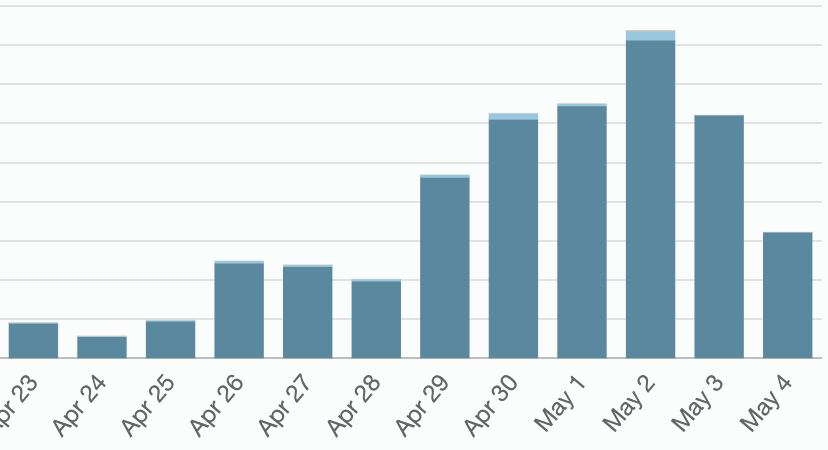
There’s been a huge surge in activity in the CGC private member forums since we opened for new members from April 25th to May 1st. This is what the daily page views have looked like recently. Today (May 4) isn’t even halfway over yet, so that will probably end up closer to the bar for May 3rd by the end of the day. This is a normal pattern for the first week or two of a new CGC year as members introduce themselves and start engaging with the community.
This launch was very different from previous years. Last year I spent more than $6K on Facebook ads for CGC, and I actively promoted CGC on social media (Facebook, Instagram, and YouTube).
This year I didn’t even mention CGC on social media, and I didn’t advertise it at all. I had deleted my Facebook and Instagram accounts in January. And even though I have thousands of YouTube followers, I decided not to mention CGC there this time.
This time I really wanted to focus on alignment. I wasn’t really trying to grow CGC in size, and I had no particular number goals for this launch. Growing CGC is nice, but it would have been fine if we ended up with a smaller group than last year. I just want to make sure we’re attracting people who strongly align with CGC’s values and culture.
This was also the simplest launch we’ve ever done. Not only were there no ads and social media to deal with, I also decided not to create an invitation video this time. The invitation web page was very straightforward. I also did a lot less blogging this year, and I sent fewer emails to invite people on my email list to join CGC this time.
So I approached this launch in a very chill way. Any parts of the launch process where I felt resistance to doing them, I simply skipped them this year.
What I noticed is that this freed up more emotional energy, and I was able to flow that energy elsewhere. I felt more relaxed than ever when inviting people to join CGC this year.
I really don’t think the launch would have gone this well if some of my energy was still wrapped up in social media. I’m really seeing that going for bigger reach isn’t what matters. This experience verifies what my intuition was telling me all along – that alignment is way more important than reach. Even if the numbers turned out smaller this time, I think I still would have feel that it was a wise decision to focus on improving the alignment by reducing the reach. All throughout the launch, it felt so nice not to being dealing with Facebook at all. That place is such a clutter of misaligned energies. I feel so much lighter without it. It’s pretty easy to compensate for the reduction in reach.
When I see the interactions that people are having in CGC now, as I’ve been reading the new member intros and welcoming people in, the vibe of the group feels different – as in better than ever. It’s pretty early in the new CGC year, so that vibe will surely shift along the way, but something just seems super promising about it. I feel like CGC Year 5 is likely to exceed my expectations, perhaps by a lot.
I thought that I’d be feeling pretty tired after finishing the Amplify course. I just published the 63rd and final lesson for it on Friday, April 30th. Even though I haven’t had a single day off in at least 10 weeks – lots of 12-16 hours days, 7 days a week – I don’t feel burned out. Quite the opposite – I feel energized and enthusiastic to dive right into more projects – and especially to engage with CGCers. I think this is because I’m picking up so much supportive energy from other people that it’s keeping my motivational batteries full. And I think that effect is extra strong because of the alignment of the group this year.
I just finished a major course and wasn’t intending to do another one till the first quarter of next year. But now I’m already starting to get a flow of ideas for a new course, coming from a direction I didn’t expect. I thought the Muse would give me some time off, but part of me just wants to keep dancing with her. I don’t think this is because of the ideas per se – I think it’s because of the super aligned people I get to co-create with.
When I reached out to attract future CGCers from social media in previous years, we did see some people joining from those services, but this included people who weren’t as familiar with my work or this community. They may never have done a course or a workshop with us. So they usually weren’t as aligned with CGC as the people who are more closely engaged with this community over a longer period of time.
Most CGCers have been familiar with my work for at least 10 years. Some have been reading my blog for 15+ years. Since those people share so many interests in common with me, they also have a lot in common with each other. Whatever I’ve blogged about in the past, you’ll find people with those interests in CGC – online business, Star Trek, veganism, non-monogamy, travel, sleep experiments, subjective reality, manifesting, productivity, Toastmasters, and more.
This year almost everyone who joined CGC has been through at least one of our 4 courses, and quite a few have gone through 3 or 4 of them. Many members have been to previous workshops as well. I can see why the courses attract so many people to eventually join CGC. If people like the courses and get value from them, they’re highly likely to find CGC worthwhile too. The Deep Abundance Integration and Amplify courses both had a social element, so people can get a much clearer sense of the community and what the people are like.
A lot of people in CGC are very intuitive and sensitive to energy flows, as am I (especially this year while I’m eating raw). I think it’s possible that by focusing on a more socially aligned launch for a course or CGC instead of trying to go for more reach, it helps to create a more focused energy pattern around the experience. I think some people in this community can pick up on that energy, at least subconsciously. This year in particular, they may have sensed a more aligned vibe than usual, like this was the perfect year for them to join.
When I eat raw like I’ve been doing this year, my intuition gets a significant boost. In some sense the signals are the same as before, but they’re much louder and clearer, so they grab my conscious attention more easily and more often. When I’m eating cooked food, I may have a background leaning or a suspicion that some particular direction might be worthwhile. Then after eating raw for several months, that same idea will seem closer to plain-as-day obvious, like it will surely work out. Consequently, I find it significantly easier to trust and act upon my intuition when I eat raw. Those decisions don’t seem nearly as risky because I can see that life is going to work out nicely just by following the energy flows.
I am not attached to growing CGC in size. It works wonderfully at or near its current size. I am willing to see it grow in future years, but not at the cost of alignment. I’m also willing to see it shrink, as long as the alignment of the group stays high. Alignment has been my priority from the beginning, but in past years I sensed that there might be a conflict between alignment and growth. Now it feels like this was an artificial conflict, and it’s evaporating. I think it may be very possible to do both, and that points to a different kind of path forward – one that remains free of social media and doesn’t involve going for more reach.
One unusual aspect of CGC is that we’re very much a Mile Wide, Mile Deep kind of group inside. We cover all aspects of personal growth – health, relationships, finances, work, etc – but this doesn’t water down the experience because we also go for depth in these areas too. Why settle for only breadth or depth? I see no conflict between these. By learning to go deep in one area, it’s easier to go deep into others. Otherwise it’s like saying to a scuba diver, “Because you went so deep in the Indian Ocean, you’ll have to stay on the surface when you visit other oceans.” Diving deep in one ocean just makes it easier to dive into others. The same goes for different personal growth investments. If you learn how to do a major transformation of your finances, for instance, you’ll actually get better at doing deep transformations in other areas of life too. Going deep into one area certainly doesn’t limit you to the surface of the others.
CGC has a bright future ahead. It’s a joy to be present to it each day and be part of its ongoing evolution. If you haven’t joined us for it yet, I invite you to keep CGC on your radar for future years. When the alignment is there for you, you’re welcome to join us in 2022 or beyond.
Scientists have developed a new “key-hole surgery” technique to extract metals from the earth — which could revolutionise the future of metal mining
A team of international researchers, including Dr Rich Crane from the Camborne School of Mines, University of Exeter, have developed a new method to extract metals, such as copper, from their parent ore body.
The research team have provided a proof of concept for the application of an electric field to control the movement of an acid within a low permeability copper-bearing ore deposit to selectively dissolve and recover the metal in situ.
This is in contrast to the conventional approach for the mining of such deposits where the material must be physically excavated, which requires removal of both overburden and any impurities within the ore (known as gangue material).
The researchers believe the new technique has the potential to transform the mining industry, because it has the capability to dissolve metals from a wide range of ore deposits that were previously considered inaccessible.
Furthermore, due to the non-invasive nature of the extraction, the research team are hopeful that the study will help usher in a more sustainable future for the industry.
advertisement
This is urgently required now in order to provide the plethora of metals required to deliver green technology, such as renewable energy infrastructure and electrified vehicles, whilst limiting any potential environmental damage associated with the mining of such vitally important metals.
The study was recently published in Science Advances.
Dr Rich Crane from the Camborne School of Mines, University of Exeter, and co-author of the study, said: “This new approach, analogous to “key-hole surgery,” has the potential to provide a more sustainable future for the mining industry, by enabling the recovery of metals, such as copper, which are urgently needed for our global transition to a new Green Economy, whilst avoiding unwanted environmental disturbance and energy consumption.”
The central principle behind most modern mining techniques has not fundamentally changed since their original conception, which marked the beginning of the Bronze Age: metals are recovered from the subsurface via physical excavation, i.e., the construction of tunnels to gain access to the deposits, or by creating “open cast” mines.
This technique demands large volumes of surface soil, overburden and gangue material to also be excavated, which can contain millions of tonnes of material — and can also lead to habitat destruction.
In this new publication, experts from the University of Western Australia, the Commonwealth Scientific and Industrial Research Organisation (CSIRO), the Technical University of Denmark and the University of Exeter, have demonstrated that a targeted electric field can be used to dissolve and then recover copper in situ from the ore — avoiding any requirement to physically excavate the material.
This new technology comprises the construction (drilling) of electrodes directly into an ore body. An electric current is then applied which can result in the transport of electrically charged metal ions, such as copper, through the rock via a process called electromigration.
The research team have now provided a Proof of Concept for this new technology at laboratory scale, which has also been verified using computer modelling. They are confident that the idea will work beyond the laboratory-scale.