[unable to retrieve full-text content]



[unable to retrieve full-text content]
[unable to retrieve full-text content]

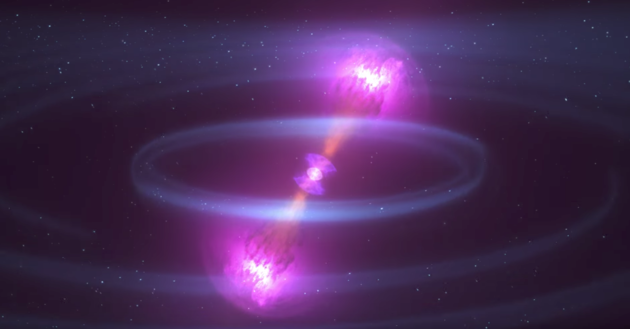
Scientists from NASA have witnessed a cosmic collision between two stars so powerful that it actually caused ripples in the fabric of the universe itself.
These ripples in spacetime are known as gravitational waves and were first theorised by Albert Einstein.
NASA
It is only in the last few years however that we have been able to prove that they exist and this is the very first time we’ve actually been able to see an event so powerful that it could create them.
The two objects were neutron stars, they are the crushed remains of a leftover star that has previously exploded in a supernova. So while only being just 12-miles wide they had a mass that was 60x that of our own Sun.
Both objects were pulled into each others gravity spinning around each other hundreds of times every second until they finally merged causing an explosion known as a kilonova.
It’s one of the universe’s most spectacular events and its power is so immense that not only were we able to see it from over 130 million light years away but we were able to actually detect the shockwaves through the fabric of spacetime itself.
What makes this discovery so important is the ability to both see and feel the shockwaves felt by the explosion.
“This is the one we’ve all been waiting for,” said David Reitze, executive director of the LIGO Laboratory at Caltech in Pasadena, California.
“Neutron star mergers produce a wide variety of light because the objects form a maelstrom of hot debris when they collide. Merging black holes ― the types of events LIGO and its European counterpart, Virgo, have previously seen ― very likely consume any matter around them long before they crash, so we don’t expect the same kind of light show.”
What’s even more impressive is that over a period of a little over a week you can actually see the explosion and then the light fade.
Remarkably scientists were able to detect the shockwave first, and then direct the world’s various telescopes to the exact location in the night sky where the explosion had originated from.
Hubble was then able to start capturing the visible light, clearly revealing the intensity of the explosion itself.
In addition to learning more about gravitational waves the scientists have also learned a great deal about a kilonova explosion. In fact it’s believed that neutron stars colliding is the universe’s dominant source for creating some of the heaviest elements including platinum and gold.
So next time you look down at a piece of jewellery remember that gold is probably created from one of the universe’s most powerful explosive events.

More than 300 individuals want compensation for injuries they claim were caused by DePuy metal-on-metal hips.
[unable to retrieve full-text content]

[unable to retrieve full-text content]

[unable to retrieve full-text content]

[unable to retrieve full-text content]

A team at MIT have developed a radical new “air breathing” battery that can store energy for months on end, comes at a fraction of the cost of our current technology and could be used en-masse, making it perfect for renewable energy.
Renewable energy is the future, there’s no doubt about that and while the technologies that produce the energy are plummeting in price there is still one area where we’re struggling.
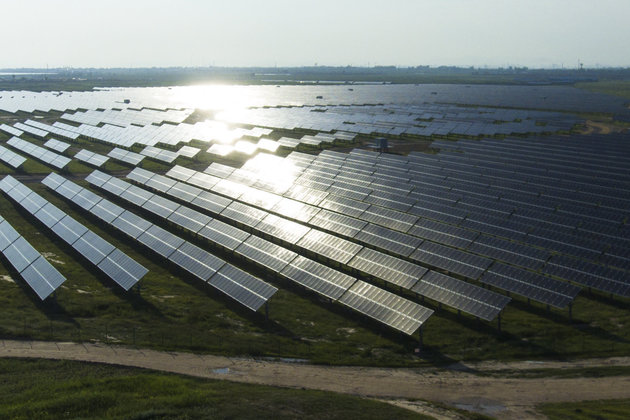
Wind and solar have incredible potential, but they both share a common hurdle which is that they’re seasonal. That means some days you might be able to power an entire city, others barely more than a village.
VCG via Getty Images
How then do you stop this excess energy from going to waste? At the moment we use expensive storage techniques ranging from heating molten salt to vast battery arrays like those we see being built by Tesla.
Both are expensive, which is why this new battery could give us not only a solution that’s cheaper but actually better for the planet too.
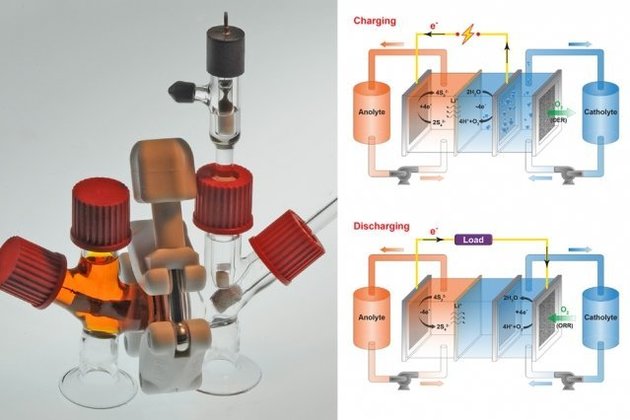
How the battery works is remarkably simple. For its anode the battery uses cheap, abundant sulphur dissolved in water. For the cathode an aerated liquid salt solution continuously takes in and then releases oxygen, effectively balancing the charge.
Felice Frankel
The oxygen flowing into the cathode causes the anode to discharge electrons to an exterior circuit while the exhaling oxygen send electrons back to the anode, recharging the battery.
“This battery literally inhales and exhales air, but it doesn’t exhale carbon dioxide, like humans — it exhales oxygen,” says Yet-Ming Chiang, the Kyocera Professor of Materials Science and Engineering at MIT.
Sulphur was an inspired choice by the team as it’s not only a major byproduct of natural gas and petroleum refining but also because it’s extremely energy dense which makes it extremely cheap.
The result of which is that you have a battery that costs around $20-30 per kilowatt hour. For comparison, conventional lithium-ion batteries cost a whopping $100 per kilowatt hour stored.
What does this all mean? Well it means you could finally harvest the vast wind energy waiting to be captured in the North Atlantic, store it for months on end and then release it into the grid for a fraction of the cost that we’re currently paying.
“The intermittency for solar is daily, but for wind it’s longer-scale intermittency and not so predictable. When it’s not so predictable you need more reserve — the capability to discharge a battery over a longer period of time — because you don’t know when the wind is going to come back next,” explains Chiang.
At present the prototype is no bigger than a coffee cup, but by proving that it can work, and that it can be scaled up, there is theoretically no limit to how much energy the batteries could store.

[unable to retrieve full-text content]

