Health24.com | This animal’s blue blood is going to be in high demand to test coronavirus vaccines

  • The blood of the horseshoe crab is used to test the safety of vaccines
  • There is an alternative test that’s more animal friendly
  • The numbers of horseshoe crabs have been declining

As the world races towards a vaccine for the potentially deadly Covid-19 virus, one key substance is set to become highly sought after.

The unique blue blood of the horseshoe crab is used in a vital process that checks whether or not intravenous drugs – like vaccines – have any antibacterial contaminants, to ensure they’re safe for humans.

And as pharmaceutical companies rush to test vaccines for the deadly coronavirus, demand for its blood is set to surge, according to the New York Times.

It has been used in the pharmacological industry for almost 50 years. According to a study of the ancient creature, its blood contains amebocytes – a mobile cell that defends against pathogens and is highly susceptible to endotoxins. These form part of bacteria that could lead to toxic shock or cause severe fever.

The extract from the blood is called limulus amebocyte lysate (LAL), and when added to medicine, it will thicken solutions contaminated with bacteria. Otherwise, the medicine continues its normal flow through the process. 

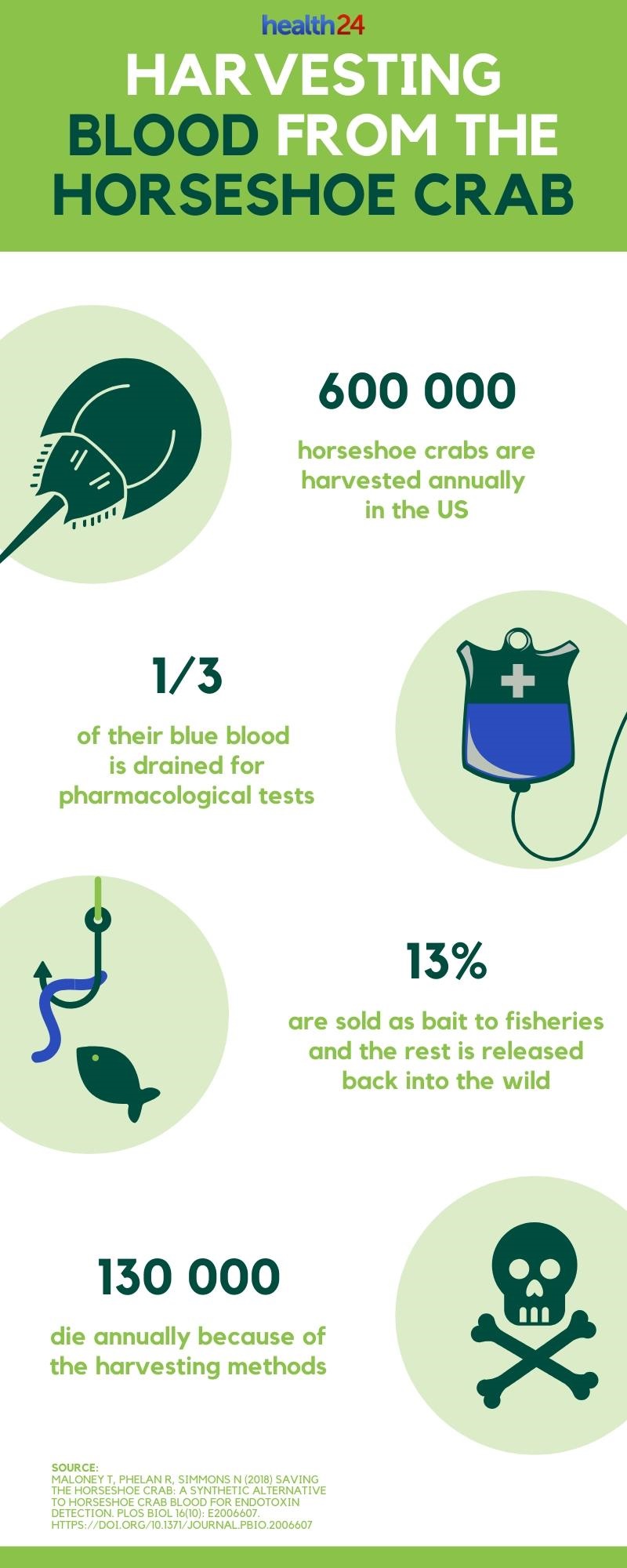
But what about the crabs? The harvesting practices and use of their blood have been hotly contested in the industry by conservationists, especially as an alternative test was developed 15 years ago called recombinant Factor C (rFC). 

It’s a synthetic equivalent grown in a lab, and while it’s accepted as a viable alternative in Europe, laboratories have to jump through extra hoops in the US if they use rFC instead of LAL according to wildlife conservation organisation Revive & Restore that focuses on the biotechnology field.

horseshoe crab infographic

Initially, the US Pharmacopeia – which has worldwide influence – had been working on putting rFC and LAL on an equal footing for approval of medicine, but backtracked at the end of May, scrapping the process and making rFC a separate charter to LAL, making it more arduous for companies to use the alternative. 

The New York Times reports that despite the expected surge in demand, companies that make LAL say that supplies of the crab blood are still adequate to handle the increase for now. Very little of the horseshoe crab’s blood is required to perform the tests, which are used multiple times during the medicine manufacturing process. 

Revive & Restore, alongside other organisations, launched a new partnership at the start of June – The Horseshoe Crab Recovery Coalition – which aims to implement best practices for the bleeding of horseshoe crabs and promote the use of rFC.

The populations of horseshoe crabs in North America are on the decline, and their smaller numbers have a knock-on effect on shorebirds dependent on the crab’s eggs.

Image credit: Pixabay

Share Button

Health24.com | Drug might curb dangerous urges in paedophiles

A testosterone-lowering drug can reduce male paedophiles’ risk of sexually abusing children, according to a new Swedish study.

The drug, called degarelix, is used to treat prostate cancer and turns off production of testosterone. It’s given by injection every three months and can lower testosterone levels within hours, according to researchers.

The study included 52 male paedophiles in Sweden who received either degarelix or a placebo. Treatment with degarelix reduced high sexual desire and sexual attraction to children – two major risk factors for committing child sexual abuse. These effects were noticeable within two weeks, the study found.

Many of the men who received the drug said they developed an inner calm, that thoughts of sex were no longer dominant, and that they lost their sexual interest in children.

Rates continue to rise

A majority who received the drug wanted to continue taking it after the trial, according to the study published online recently in the journal JAMA Psychiatry.

“It’s important to be able to offer a relatively fast-acting treatment, and the patients’ own experiences of the drug were overall positive,” said study leader Dr Christoffer Rahm, a researcher in the Department of Clinical Neuroscience at the Karolinska Institute in Stockholm.

“This study is an important step towards an evidence-based treatment for paedophilic disorder,” he said in an institute news release. “We’re now planning a new study to assay the longer-term effects of the drug and to compare them with psychotherapy.”

About one in 10 girls and one in 20 boys are sexually abused, primarily by male paedophiles, according to the Swedish team, though statistics have been reported higher in the United States. Despite law enforcement and prevention initiatives, the rates continue to rise, according to Rahm and his colleagues.

They said there is an urgent need for effective and scientifically proven treatments for people at risk of committing child sexual abuse.

Image credit: Getty

NEXT ON HEALTH24X

Share Button

Coronavirus: NHS trust bosses not consulted over new face mask rules

Hospital bosses in England felt “in the dark” after ministers said staff would have to wear surgical masks.

Share Button

Coronavirus: Is R number balanced on knife edge?

There are concerns coronavirus might be starting to spread in parts of England again.

Share Button

Coronavirus: WHO advises to wear masks in public areas

The World Health Organization changes its guidance saying masks can help stop the spread of the virus.

Share Button

Health24.com | Loss of smell and taste might be long-term for some Covid-19 survivors

  • Even people with mild Covid-19 infections experience loss of smell and taste
  • Some patients never entirely recover their sense of smell
  • It’s not a cure, but in some cases ‘smell training’ help people regain some of their olfactory ability

Since the start of the Covid-19 pandemic, it’s become clear that many people with the infection lose their sense of smell and taste. And doctors are concerned that some will never get back to normal.

At this point, it’s hard to know how common the symptom is. First, there were anecdotal reports of Covid-19 patients who had lost their ability to smell or taste, said Dr Nicholas Rowan, an assistant professor of otolaryngology-head and neck surgery at Johns Hopkins University in Baltimore.

And then, he said, studies started to confirm “there’s a lot of truth to it”.

Rowan pointed to one study of patients hospitalised for Covid-19 that used objective tests to detect smell “dysfunction”. Nearly all patients – 98% – showed some loss of smell.

Smell and taste intertwined

But the problem isn’t limited to severely ill patients. It appears to be common, and even a “cardinal” symptom, among people with milder Covid-19 infections. Cardinal symptoms are the key ones from which a diagnosis is made.

For example, in a study of European patients with mild-to-moderate Covid-19, 86% reported problems with their sense of smell, while a similar percentage had changes in taste perception.

As anyone who’s ever had a cold knows, smell and taste are closely intertwined, Rowan said. So the loss of smell – which doctors call anosmia – may be diminishing people’s perception of flavours.

But, Rowan noted, it’s also possible the coronavirus does have some direct effect on the sense of taste.

Respiratory viruses, including cold viruses and the flu, are known to sometimes trigger anosmia.

Fortunately, the issue resolves for most people. “But unfortunately,” Rowan said, “some patients are left with permanent olfactory [smell] dysfunction.”

Infects area of olfactory nerve

That’s what has doctors worried – particularly since these sensory problems appear unusually prevalent in people with Covid-19.

“It does happen with other viruses,” said Dr Daniel Coelho, a professor of otolaryngology-head and neck surgery at Virginia Commonwealth University in Richmond.

“But,” he added, “we’re seeing it a heck of a lot more with this virus.”

It’s not clear why, but Rowan said there’s some evidence that SARS-CoV-2 – the virus that causes Covid-19 – directly infects the area of the olfactory nerve. That might be how the virus gains entry into the body.

For some people, loss of smell and taste may be the first red flag that they are infected – or even the only symptom, both Rowan and Coelho said.

Coelho and his colleagues have undertaken a nationwide study to track changes in smell and taste related to Covid19. Preliminary results, based on 220 survey respondents, indicated that nearly 40% had loss of smell or taste as a first, or only, symptom of Covid-19.

For some, improvement has been slow.

“We’re assuming that not all of these patients are going to return to their pre-Covid level of function,” Coelho said.

And that’s a concern, Rowan said. “There’s a well-described correlation between anosmia and depression and anxiety,” he noted.

Smell training supported

Correlation doesn’t mean “cause-and-effect”, he added. On the other hand, Rowan said, there’s no doubt that much of the pleasure in life is related to the sense of smell – from enjoying meals to bonding with other people.

Coelho agreed that anosmia takes a toll on quality of life, and can even be dangerous – if a person can’t smell the smoke from a house fire, for example. “We really tend to take our sense of smell for granted,” he said.

As for treating lingering anosmia, the options are “not great”, according to Rowan. But some evidence supports smell training, he said. It works like other types of rehabilitation, where a person relearns a diminished ability – in this case by spending time each day sniffing essential oils or other scents.

“It’s not a cure, and it doesn’t work for everyone,” Rowan said. “But it’s a viable option and basically no-risk.”

As for people who develop a new problem with smelling ability, take it seriously, Rowan advised. “It might be the first sign of Covid-19,” he said.

Coelho echoed that point. “Presume you’re positive,” he said. “Then self-isolate and call your doctor about what to do next.”

Image credit:

Share Button

Health24.com | Coronavirus morning update: President calls for responsible drinking, and latest on schools

WHAT’S HAPPENING IN SA

Cases update: 

The latest number of confirmed cases is 43 434.

According to the latest update, 908 deaths have been recorded in the country, after 60 more Covid-19 related deaths were reported. 

There have been 23 088 recoveries.

So far, 850 871 tests have been conducted, with 30 196 new tests – the second consecutive report where more than 30 000 tests were conducted.

READ MORE | All the confirmed cases of coronavirus in SA

Latest news:

President Cyril Ramaphosa has called on South Africans not “to drink so much they injure others” – and put undue pressure on the national health system.

This, after reports this week alcohol-related injuries had spiked almost immediately after the restriction on its sale was lifted on Monday under Level 3 lockdown.

The president was speaking in Brackenfell, Cape Town, where he was inspecting a “Red Dot” transport initiative whereby 6 000 healthcare workers are transported safely in special taxis in the Western Cape.

When alcohol sales were legalised on Monday, “we suddenly saw a spike in the utilisation of hospital beds” due to alcohol-related harms, Ramaphosa said.

“It was always going to be a risk,” he added.

Ramaphosa said the government was not contemplating re-banning alcohol, “as yet”.

But he called on “all South Africans to behave in a manner that would take into account the rights of other people … we hope that message will sink in”.

READ MORE | Ramaphosa calls for responsibility: ‘Don’t drink so much that you injure others’

The coronavirus will be with South Africa for at least 18 months to two years, and governments should never be found wanting in securing essentials such as emergency beds.

This was the blunt warning by President Ramaphosa to South Africa on Friday as he officially opened a massive 862-bed “Hospital of Hope” in the Cape Town International Convention Centre (CTICC).

Western Cape Premier Alan Winde echoed Ramaphosa, saying: “Yes, Covid-19 is going to be a marathon.”But the president also called the Covid-19 crisis a “war”.

Ramaphosa said: “We are at war. A life-and-death war. Saving lives must remain the main issue. This is a war we must win,” he urged.

And he promised Winde a lack of funds would not be the obstacle towards ensuring enough testing kits, hospital beds, staff and budgets to pay for “all the tools” required to fight Covid-19.

Speaking of the need for more beds, Ramaphosa said: “We must always be ahead of the curve. We must never be found wanting. We must pull out all the stops.”

He added the Western Cape was being watched “extremely closely” as it led South Africa in Covid-19 cases by far.

READ MORE | Ramaphosa at opening of CTICC ‘Hospital of Hope’: We must pull out all stops for more beds

The Constitutional Court on Friday denied Mmusi Maimane’s One South Africa movement direct access, on an urgent basis, to challenge government’s decision to reopen schools.

It ruled that it had considered the application, but had concluded that the applicant did “not make out a case for direct access”. It was dismissed, as it was “not in the interests of justice to hear it as this stage”.

The apex court decided not to award costs.

OSA spokesperson Dipolelo Moime said the movement was consulting its legal team to consider its options, and not ruling out approaching the high court to seek an order to suspend the reopening of schools for 60 days, during which government must provide, under direct supervision of a court, proof of the existence of a comprehensive readiness and implementation plan which must preced the opening of any grade.

“We shall not back down in fighting for schools to be safe for students, for teachers and for support staff,” he said.

“This particular department must be held to account at every step.”

He said the movement respected the Constitutional Court’s decision.

READ MORE | Schools opening under Level 3: ConCourt rejects Maimane’s urgent application to stop schools reopening

Staff protested outside Tygerberg Hospital in Cape Town on Friday morning, asking for it to be closed and disinfected.

Since April, four staff members have died at the Western Cape’s largest hospital after contracting Covid-19.

Nurses, some still in their scrubs, stood outside the facility with placards to protest their working conditions.

They said management was not supporting them after staff complained about personal protective equipment (PPE).

Thina Bombi, who has been a nurse for 13 years, told News24 she feared for her life.

“We don’t have proper PPE and we are being exposed to the virus. We are fearing for our lives because we can be like our colleagues that have passed away,” she said.

WATCH | ‘We are losing colleagues’: Tygerberg nurses protest for better working conditions

A day after lawyers wrote to the state attorney to raise concerns about “contradictory statements” the Minister of Defence made about an army investigation into Collins Khosa’s death, her ministry has admitted that she got it wrong.

In a statement released on Friday, the ministry said that when the minister, Nosiviwe Mapisa-Nqakula, told Parliament’s Portfolio Committee on Defence that, in her opinion, there was no finalised report, she did so because she understood “that the investigation had been referred back by the chief of the South African National Defence Force (SANDF) and might be reopened for further investigation”.

“This understanding has turned out not to be correct as the SANDF will not be reopening the board of inquiry for further investigations.

“The minister regrets any confusion that might have been caused by her address to the Joint Standing Committee on Defence and by the subsequent public reporting of her address to the Joint Standing Committee,” read the statement.

READ MORE | Defence Minister Mapisa-Nqakula got it wrong on Collins Khosa inquiry, report is final – SANDF

WHAT’S HAPPENING IN THE REST OF THE WORLD 

Cases update:

For the latest global data, follow this interactive map from Johns Hopkins University & Medicine.

Late on Friday night, positive cases worldwide were more than 6.71 million, while deaths were close to 394 000.

The United States had the most cases in the world – more than 1.89 million, as well as the most deaths – closing in on 109 000.

READ MORE | All the confirmed cases worldwide

Latest news:

More than four months after identifying its first coronavirus case, Taiwan has reported less than 450 infections. Only seven people of the country’s 24 million have died.

Part of that success in fighting the virus was Taiwan’s quick response: The state began to monitor incoming travelers from Wuhan for signs of respiratory illness on December 30, after Chinese ophthalmologist Li Wenliang warned fellow doctors about a possible outbreak resembling SARS. Then in January, Taiwanese officials began isolating every infected patient and tracing their contacts.

But a second key element of Taiwan’s strategy was communicating with citizens through humorous stunts and digital campaigns. The state hired comedians to help craft viral memes, adopted animal mascots to inform the public about important safety information, and even used teddy bears to encourage social distancing at restaurants.

Audrey Tang, Taiwan’s digital minister, said at the TED 2020 conference that her mantra is “humour over rumour.” So Tang developed a strategy for delivering information about the virus in a fast, fair, and fun manner.

READ MORE | Taiwan successfully used viral memes, animal mascots, and teddy bears to fight its Covid-19 outbreak

LATEST HEALTH NEWS

As fabric masks are now mandatory when you exercise outside, buy groceries or work outside your house, you might find that you are still struggling getting used to them.

Not only do those who wear glasses complain that their masks make their lenses fog up, or runners struggle to breathe with masks while out running, but there is another side-effect that a lot of us are starting to experience – skin woes.

Our skin is delicate and can suffer from breakouts or rashes if we don’t take good care of it. Add a fabric mask to the equation, and there are several reasons why our skins could suffer. Here are some of the most common reasons why your skin might be acting out as a result of wearing a mask.

According to Dr Ian Webster, a dermatologist from Cape Town, wearing a cloth mask occludes your skin, causing a build-up of moisture, mainly because of constant warm breath on your skin. The skin’s top layer (stratum corneum), when exposed to relentless moisture, may result in blocked pores, resulting in an acne breakout. The increased temperature or moisture can also cause rosacea, a red inflammatory rash, to flare up.

READ MORE | Covid-19: Masks and your skin – what you should know

When South Africa moved to lockdown level 3 on 1 June 2020, the exercise window was extended to 18:00, allowing more time to exercise outdoors.

Runners and walkers now have more time to enjoy the fresh air, but wearing a mask outside is still mandatory. Unfortunately, it can take a while to get used to this. You may notice that your breathing is more laboured than usual (and this is not only because you lost fitness during lockdown level 5) and that you struggle to reach your usual pace.

Your face might also feel hot and the mask or buff might become damp during your run, leading to discomfort and even skin issues.

While the risk of SARS-CoV-2 infection remains greater indoors, especially in an area without proper ventilation, keeping your distance from others and covering your mouth and nose while out running are still encouraged.

READ MORE | Running with a mask – what you should know, and how to choose the right one

HEALTH TIPS (as recommended by the NICD and WHO)

• Maintain physical distancing – stay at least one metre away from somebody who is coughing or sneezing

• Practise frequent hand-washing, especially after direct contact with ill people or their environment

• Avoid touching your eyes, nose and mouth, as your hands touch many surfaces and could potentially transfer the virus

• Practise respiratory hygiene – cover your mouth with your bent elbow or tissue when you cough or sneeze. Remember to dispose the tissue immediately after use.

Image credit: Getty Images

Share Button

Is indulgence part of a healthy diet?

Mayo Clinic does not endorse companies or products. Advertising revenue supports our not-for-profit mission.

Advertising & Sponsorship

Mayo Clinic Marketplace

Check out these best-sellers and special offers on books and newsletters from Mayo Clinic.

Share Button

Coronavirus: Care home residents face steep hike in fees

Fee rises of more than £100 a week add “insult to injury” after the wave of infections, says Age UK.

Share Button

Coronavirus: Fully reopening schools ‘could cause second wave’

Scientists are concerned the test-and-trace system is not effective enough to prevent this.

Share Button