Health24.com | Why parents should raise their children to be bilingual

If you’re raising your kids to be bilingual so that they may maintain their heritage, it might be gratifying to know that you’re doing more than that for them.

According to a recent study by the University of Alberta, it can also open doors to being creative storytellers. The research was published in the journal Language, Cognition and Neuroscience.

The researchers found that bilingual children use as many words as monolingual children when telling a story.

“We found that the number of words that bilingual children use in their stories is highly correlated with their cognitive flexibility – the ability to switch between thinking about different concepts,” said Elena Nicoladis, lead author and professor in the Department of Psychology in the Faculty of Science. 

Bilingual since birth

Researchers examined a group of French-English bilingual children who were taught two languages since birth, rather than learning a second language later in life. A new, highly sensitive measure for examining cognitive flexibility was used, allowing researchers to examine participants’ ability to switch between games with different rules, while maintaining accuracy and reaction time.

It was found that bilingual children used just as many words to tell a story in English as monolingual children, and that they used just as many words in French as they did in English.

A change in understanding benefits of multiple languages

Although previous research has shown that bilingual children score lower than monolingual children on traditional vocabulary tests, the researchers say that the recent results are changing our understanding of the link between multiple languages and cognition in children.

“The past research is not surprising. Learning a word is related to how much time you spend in each language,” said Nicholadis. 

For bilingual children, time is split between languages, Nicholadis explained, which leads to the conclusion that they tend to have lower vocabularies in each of their languages. However, this research shows quite the opposite: that as a function of storytelling, bilingual children are equally strong as monolingual children.

The brain benefits from learning a second language

A 2014 study carried out by an international team of researchers based in Singapore looked at the cognitive abilities of 114 six-month-old babies. They found significant cognitive advantages of exposure to two languages, and that these advantages reveal themselves early on – irrespective of the languages spoken.

Research from 2016 by the University of Washington found that brains of babies (from the age of 11 months) exposed to two languages develop better, boosts their memory and solving skills. 

The study involved an experiment which found the area of the brain responsible for what is known as “executive function” to be more developed among babies in a bilingual home, than one with just one language.

Another 2017 study, reported by Health24, found that bilingual children have an easier time learning additional languages later in life than those who speak only one language, researchers report.

So if you were uncertain about whether to raise your child speaking more than one language, it should give you peace of mind to know that encouraging a bilingual education is actually a safe bet.

Image: iStock

NEXT ON HEALTH24X

Share Button

Launch Principles

In case you might find this interesting, these are the principles I use for designing course launches. I tweak this list for each new course, but overall it’s been pretty stable.

When I have a tricky design decision to make while developing the project design document (or during the launch itself), I consult this list. It’s a way of refreshing my alignment with the principles I want to follow. Careful thought went into coming up with this list, and they’ve already proven themselves to me, so I know that I can trust them.

Trust

Assume trust, and launch to people who trust me. Don’t chase low-trust people. Let people invest when they’re ready.

Encouragement

Encourage consumption of the pre-launch content. Encourage buying. Encourage consumption of the program.

Openness

Be open and up front about the offer. Don’t hide or obfuscate my desire for people to buy and appreciate what I’ve created.

Co-creativity

Stay flexible and adaptable throughout the launch. Invite feedback. Quickly incorporate worthwhile suggestions. Show that I’m listening and responding with action to improve our co-creative alignment.

Enthusiasm

Share enthusiasm for the co-creative experience. Help people feel proud of their investment.

Groundedness

Share logical reasons why participating and saying yes to the offer is a good idea for those who are aligned with it. Also point out the potential shortcomings of the offer and how that may affect people. Be straight with people, and don’t overplay the benefits. Building long-term trust is more important than a one-time sale.

Caring

Express genuine caring for people throughout the launch process, the delivery of the program, and beyond. Don’t stoop to tactics that amount to “pretending to care.”

Playfulness

Embrace light-hearted humor and fun, especially when it’s spontaneous.

Honor

Hold myself and others accountable to a high standard of honor. Hold people accountable to doing their part once they accept the offer.

Gentleness

Gently invite people to participate and invest. Open the door, and let them be free to walk through it.

Safety

Keep the process psychologically safe for participants. Don’t use tactics to trigger people emotionally. Connect with compassion, not forceful persuasion, and let them maintain emotional control.

Alignment

Favor alignment over sales volume. Filter for aligned people, and seek to dissuade misaligned people from participating. Attract people who are very likely to benefit from the offer. Make heart-aligned decisions at each step.

Win-Win-Win

Make win-win-win offers: good for them, good for me and my team, and good ripples for the world. Use this standard for pricing decisions too.

Boldness

Offer strong, bold, unique growth experiences that pack in a lot of value.

Simplicity

Don’t complicate the process unnecessarily. Don’t slow people down if they’re ready to progress faster.

Share Button

Health24.com | More evidence links social media use to poorer mental health in teens

Smartphones, and being on Facebook, Snapchat, TikTok and the like may be taking a big toll on teens’ mental health, a new survey of collected data on the subject shows.

Canadian researchers pored over dozens of studies and said the negative effects of social media on teens’ well-being is on the rise.

“Physicians, teachers and families need to work together with youth to decrease possible harmful effects of smartphones and social media on their relationships, sense of self, sleep, academic performance, and emotional well-being,” said study lead author Dr Elia Abi-Jaoude. He’s a staff psychiatrist at The Hospital for Sick Children and Toronto Western Hospital, both in Toronto.

As part of their research, Abi-Jaoude and his colleagues uncovered patterns across multiple studies. For example:

  • In one US study, the rate at which kids and teens arrive in hospitals due to suicidal thoughts or attempts “almost doubled between 2008 and 2015, with the highest increase among adolescent girls”, the researchers noted.
  • US overdose rates for young people ages 10 to 18, which has previously been on the decline, “increased substantially from 2011 to 2018, primarily among girls”, another study found.
  • At the same time “the proportion of [US] young people who between the ages of 13 and 17 years who have a smartphone has reached 89%, more than doubling over a 6-year period”, the data review said. At the same time, “70% of teenagers use social media multiple times per day, up from a third of teens in 2012”.

Of course, it’s tough to tell whether this rise in social media and smartphone use is actually causing an increase in rates of mental health issue among teens.

However, other data seems to suggest it might be.

Systematic review

For example, the Canadian researchers pointed to two studies – one conducted in the United States, the other in Germany – which found that kids who spent more time on Facebook were more prone to negative states such as envy and insecurity about their status, compared to others in their online network. Much of this was centred around “FOMO” – fear of missing out, those studies showed.

Another “systematic review of 20 studies found that use of social media was associated with body image concerns and disordered eating”, the research team reported. In one study, “female participants reported more negative mood after just 10 minutes of browsing their Facebook account”, Abi-Jaoude’s group said.

Social media “addiction” is also an emerging problem, and “several cross-sectional studies have shown that high proportions of youth appear to be addicted to their smartphones”, the Canadian researchers said. Seven other studies suggest that this kind of heavy reliance on smartphones is tied to a higher risk for suicidal thoughts or self-harm in school-age kids and teens, they added.

Numerous studies have also found that as hours per day increase on smartphones, laptops and other “screens,” rates of happiness, life satisfaction and self-esteem fall. Excessive screen time also seems to be eroding teens’ ability to get good sleep, which might also have negative mental health effects, according to the researchers.

The findings were published in the Canadian Medical Association Journal.

Abi-Jaoude’s team stressed that an all-out ban on kids’ smartphone use probably won’t help. And in some respects the internet might even be of some benefit to teens seeking information on mental health.

Excess may pose hazards

“For adolescents today, who have not known a world without social media, digital interactions are the norm, and [there are] potential benefits of online access to productive mental health information,” Abi-Jaoude said in a journal news release. Those benefits include “media literacy, creativity, self-expression, sense of belonging and civic engagement – as well as low barriers to resources such as crisis lines and internet-based talking therapies”, he said.

However, excessive internet use may pose hazards. Therefore, the researchers suggest doctors should advise teens to reduce their social media use rather than stop it completely, and should encourage parents to be part of such conversations. Parents should talk with teens about appropriate smartphone use and work with them to reduce risks and set boundaries. They should also set a good example for smartphone use. Schools should develop appropriate smartphone use policies.

Many teens might agree: One recent poll found that 54% of US teens think they spend too much time on their smartphones and about half said they’re cutting back on usage.

“Encouragingly, youth are increasingly recognising the negative impact of social media on their lives and starting to take steps to mitigate it,” the authors wrote.

Two experts unconnected to the new study agreed that social media is having an impact on teens’ mental health.

“Any paediatrician who has practiced for 20 years or more knows that primary care has changed almost beyond recognition, with an ever greater number of patients coming to the office with anxiety or depression,” said Dr Michael Grosso. He’s chair of paediatrics at Northwell Health’s Huntington Hospital in Huntington, New York.

A strong therapeutic relationship

“Counselling and psychiatric resources in many locales have been overwhelmed by the need,” Grosso said. “General paediatricians are called on more and more to try to fill these gaps themselves. What is going on?”

Grosso stressed that the rise in mental health woes probably doesn’t have just one cause. But social media may be part of the problem.

“The authors’ recommendations – to use a strong therapeutic relationship to coach our patients on cutting back their time on Facebook and other messaging applications – seems very sensible,” Grosso said. “They also suggest, very wisely, that parents not prescribe this kind of abstinence until they take that particular prescription themselves.”

Dr Victor Fornari is vice chair of child and adolescent psychiatry at Zucker Hillside Hospital in Glen Oaks, New York. He agreed that “youth today have not known a world without social media, and their lives are intensely related with their smartphones. Social media has been shown to be related to an increase in suicidality and self-harm in adolescents.”

According to Fornari, “Physicians need to counsel parents to monitor and limit smartphone use, especially on social media.”

Image credit: iStock

Share Button

These Alternative Treatments May Be The Answer To The Pain Of Aging

Illustration by Sara Andreasson for HuffPost

This story is part of Pain in America, a nine-part series looking at some of the underlying causes of the opioid addiction crisis and how we treat pain.

With age comes pain. Whether caused by injury, arthritis, cancer or any number of conditions, persistent pain affects up to four out of every five people age 65 and older.

While many turn to opioids and other medications, their risks, including the potential for abuse and overdose, are well known. Less well known (at least among the general public) are the added issues older adults can face when taking these drugs.

“The older you are, the more likely you are to develop an adverse side effect from a pain medication,” said Cary Reid, associate professor of medicine in the division of geriatric and palliative medicine at Weill Cornell Medicine and director at Cornell’s Translational Research Institute on Pain in Later Life (TRIPLL).

Those side effects, such as confusion and a heightened risk of falls, can be severe and can make doctors hesitant to prescribe pain medications to older adults. These drugs can also take longer to metabolize with age, meaning they can be more potent or stay in an elderly person’s system longer than expected. And because many older adults take other medications too, there’s also the risk of problematic drug interactions.

With the number of American seniors expected to almost double by 2060 — to nearly a quarter of the population — this all adds up to a growing need to find alternative treatments.

That’s where researchers like those at TRIPLL come in. One of 13 Roybal Centers that the U.S. government’s National Institute on Aging has funded to improve the lives of older Americans, TRIPLL focuses on nondrug approaches to managing and preventing chronic pain.

It’s casting a wide net, looking into alternatives that range from acupuncture and meditation to physical therapy, cognitive behavioral therapy and even mobile technologies.

Reporting Pain With Digital Health Technology

In one TRIPLL-funded project, Elizabeth Murnane, a postdoctoral scholar in the computer science department at Stanford University, and a team of researchers developed smartphone-based technology that adults 55 and older can use to self-report the intensity of chronic pain. The idea is to capture information about pain as it happens without burdening the patient, while serving as an alternative to pen-and-paper and verbal self-reporting measures commonly used in clinical settings or at-home methods that often suffer from low adherence or misreporting.

The test used nine different measures to capture the patient’s experience of pain, including a circle that fills with color when the interface is touched, and a widget for reporting pain with a numerical range of 0 to 10 that can be adjusted by tapping the screen. Early testing revealed some usability issues for older adults with low digital skills or motor, cognitive and visual impairments, so the researchers changed the design to be more touch and pressure-oriented, “in part motivated by how we’d sometimes observe our participants instinctually grasping the hand of a loved one or a chair or other object nearby in moments of pain,” Murnane explained. 

Now Murnane and her collaborators are working on a pain assessment tool that examines rhythms of pain intensity. 

Many factors can influence the experience of pain — age, gender, genes and how much sleep a person needs (and how much they actually get), Murnane said. “Healthy functioning and synchronization of the circadian system is known to deteriorate with age, contributing to a vicious cycle of sleep disruption and exacerbated pain in older adults.”

The researchers hope the data can be used to advance the basic understanding of pain and how it manifests in everyday life — behaviorally, psychologically and physiologically — as well as to design new tools for pain monitoring and management. For example, they hope to discover digital biomarkers of pain, which are bits of data collected with digital devices and wearables like smartwatches that can be used to explain or predict the presence of illness or disease. In Murnane’s case, these markers could be someone’s degree of forward flexion or how far they’ve walked on an inclined path, which researchers expect would correlate with pain severity, she said. 

Emotion Regulation Therapy

Negative emotions are also associated with chronic pain — typically, the more depression, anger, negativity and irritability that a patient feels, the more pain they report experiencing, Reid explained. 

Weill Cornell Medicine psychologist Dimitris Kiosses and a multidisciplinary team of researchers have been working on a psychosocial treatment called “problem adaptation therapy” that aims to provide elderly patients suffering from chronic pain with techniques — like deep breathing, relaxation and changing their perspective on a situation — to decrease the impact of negative emotions and increase the impact of positive ones. 

“The goal there is to have people recognize the kinds of emotions they experience and to develop strategies to minimize negative emotions, because research has demonstrated a strong link between negative emotions and increased pain and pain-related disability,” Reid said.

Barbara Chase, an 81-year-old New York City resident, learned valuable techniques for managing chronic back and nerve pain she experiences from Parkinson’s disease by participating in this program. She’s never liked taking medicine, she said, and is amazed by how helpful some nondrug alternatives — like listening to music and relaxing her body and mind — can be in managing pain. Chase now likes to go to the gym, turn off the lights, and listen to music through her phone while stretching and doing other movement exercises, which she says takes her to another place. 

“It makes me relax and I just forget,” Chase said. “I don’t think about it.”

Relaxing by lying on the floor, closing her eyes, and spreading out like a bird has a similar effect, she said, adding that she can often feel her pain coming on ahead of time, and now knows to use these emotion-regulation techniques to get rid of it. 

“It’s amazing,” she said. “And it’s free.”

Behavioral Treatment For Older Adults With HIV

Older adults with HIV are a growing population with high rates of chronic pain and substance use, and decreased physical function. To address these issues, researchers supported by TRIPLL developed an eight-week behavioral pilot study in 2016 that incorporated weekly tai chi and cognitive behavioral therapy sessions and used text messaging to facilitate behavior change.

Results from a small randomized control trial were positive — participants who took part in the CBT, tai chi and texting program experienced more pain relief, reduced substance use and improved physical performance compared to a control group who received standard care. Now the researchers are trying to obtain funding from the National Institutes of Health to support a similar but much larger trial.

Looking To The Future

Because many clinicians were trained to manage pain primarily with medication, educating them about nondrug approaches to pain management can be difficult, Reid said.

Another challenge is getting insurers to cover nonpharmacological pain management techniques, and without insurance coverage, many treatments become inaccessible for patients who can’t afford the out-of-pocket costs. 

Even finding places that offer those alternatives can be tough. “It’s often difficult in New York City, and if it’s difficult in New York City, imagine what it must be like if you’re living in a very rural state,” Reid said. “We’ve got to enhance the availability and dissemination of these kinds of tools.” 

Share Button

Dad ‘cannot speak’ to autistic son at mental health unit

Wayne Erasmus says he has not been able to see or speak to his son Huw for three years.

Share Button

How I Use Scrivener to Design Course Launches

Scrivener is an outlining and word processing app for writers. It’s especially suitable for large creative projects like a book or screenplay. It helps me organize and structure my thoughts, research, notes, and more as I gradually piece together a larger work.

I’ve been using the Mac version for many years, and I’ve been very pleased with it. It has way more features than I need, but the features that I do use work solidly. I like the flexibility of it, and the interface does a reasonable job of balancing accessibility and complexity. There’s a little bit of a learning curve at the beginning, but a good tutorial walks you through it. Afterwards with a little practice, it’s easy to settle into a more personalized way of using the software.

I create a new Scrivener doc for every large creative project. This is where I work through all aspects of a project, including the initial concept, the intended transformations, the offer, the launch, the marketing, the content, the delivery, the bonus material, and more. Every piece of the project has some representation in the associated Scrivener doc.

I have detailed Scrivener design docs for each course that we’ve published so far: Deep Abundance Integration, Submersion, and Stature. Each of those design docs would be 100 to 200 pages if I were to print them out.

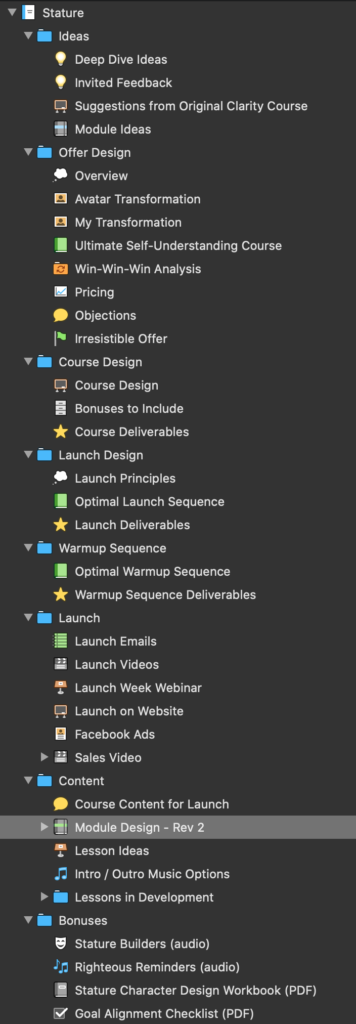
Here’s an example of what my left Scrivener sidebar looks like for the Stature design doc, just to give you an idea of how I structure the outline. There’s a bit more that’s not shown as the outline continues, but this is most of it.

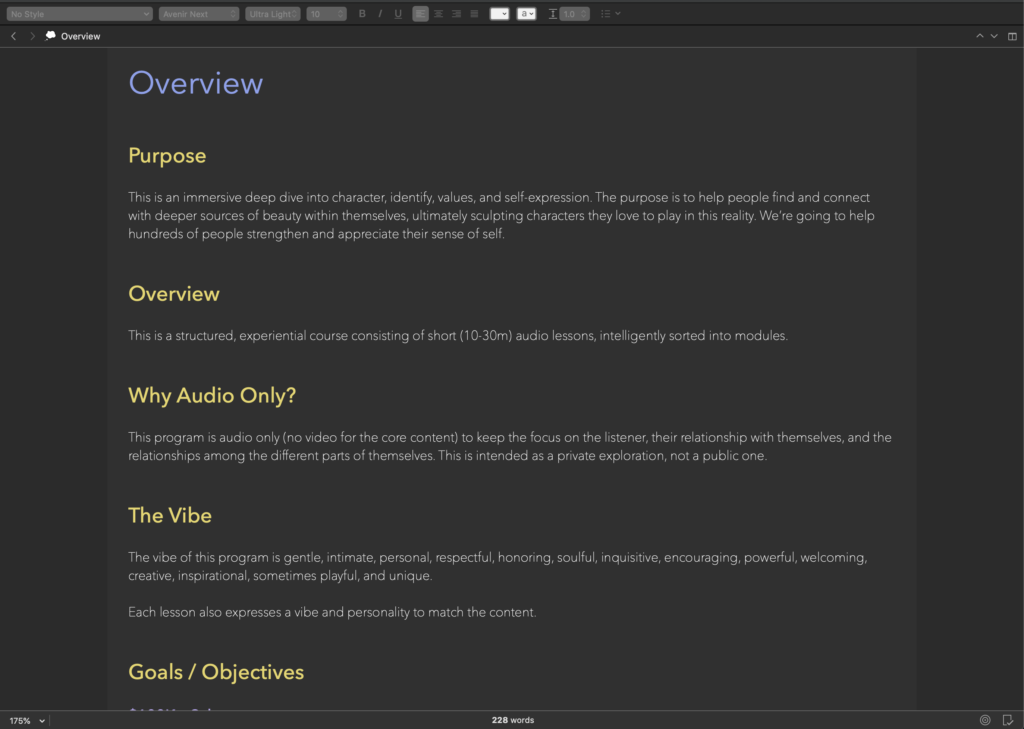
If I click on any of those items, it opens up the relevant part of the larger document that contains the details in a separate window pane on the right side, so it provides instant access to all the details. So it’s like each piece of the outline has its own associated text document.

Here’s an example of what the right window pane looks like, from the Overview section of the Stature course:

What I like about Scrivener is that it provides an expandable and collapsible outline structure, so I can delve into any one part of a project while hiding the other details. I can also click and drag these outline elements and move them around.

This is especially nice for jumping around a lot during the design phase, when I might get a random idea that I may wish to capture while working on some other part of the doc. Then can I click over to the appropriate section, add the idea to process and integrate later, and then return to work on the previous section. Sometimes early in a project, I’ll have a separate capture section, where I collect ideas to process later.

I don’t just use these docs to outline and create the course content. I use Scrivener to work through all of the relevant decisions for a large project. I spend a good bit of time clarifying the purpose of the project. I work through how it’s a win for the participants, a win for me, and a win for the world. I anticipate objections and decide how I’ll address them. I carefully decide what bonus content to create to provide a more well-rounded package. I go over the offer again and again, refining it till it looks really solid. I consider different pricing options.

Many weeks and often months of work go into the project before it’s ready to launch – there are just so many decisions to be made. A launch that looks smooth and simple on the front end is usually way more complex on the back end. If it looks simple, that’s because of all the careful thought that went into simplifying and improving the alignment. People don’t see all the alternative ideas that were considered, evaluated, and rejected along the way.

Some parts of the larger doc are like journal entries where I go over my reasoning for making certain decisions. Then if I ever feel doubtful about a choice later on, I can review my reasoning and see if it still seems sound or if I want to update it. This keeps me moving forward and prevents running in circles while still allowing room to make improvements to earlier ideas. It also gives me an archive where I can look back on previous decisions and see why I made them as I did, even years later. This helps me unearth my own best practices and learn from experience, especially after I’m able to assess the long-term feedback and results of a project.

As this larger document gets filled out, the overall project takes shape. It’s a lot of work to create this type of doc, but it gives me good progress visibility on how far along I am, and it ensures that I attend to every important detail. Most importantly, it helps me anticipate and address potential risks.

Risk reduction is a big reason that I invest so much in creating these design docs. There are lots of things that can go wrong with a launch, and it’s much better to anticipate potential problems early and develop plans for dealing with them. My design docs often include multiple options and contingency plans in case my original plans don’t quite work.

I probably put the most effort into designing the offer. The quality of the offer is the most sensitive part of a launch and the biggest risk in my opinion. It’s where I see many friends endure failed launches – their offer just didn’t land well with their audience. This is why I prefer to invest in co-creating the offer with my readers and especially with previous course participants. When I start seeing some interest and enthusiasm, I know the offer is becoming more solid. Much of this involves picking the right topic and the right transformations to focus on, so people can expect to gain real benefits from going through a course. It’s all about helping people move the needle forward in their lives.

I’ve found that a good way to choose topics is to focus on the relationships we all want to improve. Each course focuses on a different relationship dynamic in our lives. Deep Abundance Integration works on improving your relationship with abundance, money, and even with scarcity. Submersion seeks to improve your relationship with reality, including your relationship to past traumas and painful experiences. And Stature seeks to improve your relationship with yourself, including the relationships between different parts within you to create more synergy and reduce inner conflict and resistance. Our next course after Stature will delve into your relationship with work, especially the creativity and productivity aspects – there’s already a design doc underway for that one.

I think this level of thorough preparation is one reason that all of our course launches have gone very well, not just financially but in the deep satisfaction that people have been gaining and the happy emails about the results people have been achieving.

The launch and development of a major personal development course may look like ease and flow to some, but there really is a tremendous amount of careful thought and detailed consideration that goes into each decision, often long before the launch. Stature’s design doc, for instance, was begun in early 2018, almost two years before it actually launched. It went through several iterations before it converged to the point where it was ready to launch.

I also maintain separate Scrivener docs for Conscious Growth Club, for ongoing marketing and business strategy, and for my overall goals and plans. So I don’t only use these docs for courses and launches.

I often come up with more ideas that I can implement, so these Scrivener docs are good for capturing those “someday / maybe” ideas as well. For instance, I worked through the idea of hosting a free webinar during Stature’s launch week, but I just didn’t have time to work it in, so that had to be cut. However, by documenting the idea in the design doc, I could potentially transplant it into a future project, thereby benefitting from the work I’ve already put into this idea.

Moreover, design docs serve as a nice record of what worked and didn’t work. After a project is fully done, I conduct a postmortem to review what worked, what didn’t work, and what could be improved for next time. Then for future projects, I can keep doing more of what worked (without forgetting) and do less of what didn’t work.

I like to incorporate at least one new idea into each project, and then if it works well enough, I can continue doing it for future projects. It takes a lot of time and energy to develop and implement a new idea, but it takes a lot less effort to repeat the implementation of a good idea that worked before. For Stature, for instance, the new idea was to invite people to connect in a launch Facebook group. It worked well enough that I decided to keep the group open even after the launch finished in mid-January. People who are going through the course are still actively sharing their progress and realizations in the group. I wouldn’t say the group is super active, and a lot of my readers don’t like Facebook, but it was relatively easy to implement, and it provides a nice extra channel to interact with some of the people going through the course.

Each time I develop a new course, I begin with the previous project’s template, and then I can refine it from there. So this gives me an evolving skeleton template to carry over from one project to the next. Just carrying over the structure of the previous project helps to capture the wisdom accumulated thus far, and it makes egregious mistakes less likely.

Perhaps the main benefit of these design docs is that they help me focus. A course and its launch have so many pieces that I can’t keep all of the details in my mind. So I use Scrivener for my go-to capture and design system. This frees my mind to let go of the pieces that I know are already recorded, so I can focus on considering options, making decisions, and moving the project forward instead of being worried that I might forget something important.

Even though these projects are a lot of work, I really do enjoy the creative process. I like Scrivener’s nice touches like how it provides a choice of icons for different sections of a project, so it looks more visually appealing. Dark mode looks nice as well. When I find an app appealing, it reduces friction and makes it easier for me to want to engage with it.

Share Button

Coronavirus: UK businessman linked to China virus cases speaks out

Steve Walsh, linked to 11 cases in the UK, France and Majorca, says his thoughts are with other patients.

Share Button

New ‘universal’ target for antiviral treatment

As the coronavirus outbreak shows, viruses are a constant threat to humanity. Vaccines are regularly developed and deployed against specific viruses, but that process takes a lot of time, doesn’t help everyone who needs protection, and still leaves people exposed to new outbreaks and new viruses.

Now, researchers at Massachusetts General Hospital (MGH) have uncovered a novel potential antiviral drug target that could lead to treatments protecting against a host of infectious diseases — creating a pan, or universal, treatment. Their work suggests that the protein Argonaute 4 (AGO4) is an “Achilles heel” for viruses.

AGO4 is one of a family of AGO proteins. Until now, there has been little evidence of why they are important. The researchers, led by Kate L. Jeffrey, PhD, and her collaborators found that AGO4 plays a key role protecting cells against viral infections.

Specifically, this protein is uniquely antiviral in mammalian immune cells. The group studied the anti-viral effects of several Argonaute proteins, and found that only cells that were deficient in AGO4 were “hyper-susceptible” to viral infection. In other words, low levels of AGO4 make mammalian cells more likely to become infected.

This study was published today by Cell Reports.

The MGH researchers suggest that boosting levels of AGO4 could shore up the immune system to protect against multiple viruses. “The goal is to understand how our immune system works so we can create treatments that work against a range of viruses, rather than just vaccines against a particular one,” says Jeffrey.

Mammals have four Argonaute proteins (1-4), which act by silencing genes and which are remarkably conserved throughout multiple living things, including plants. These are RNAi and microRNA effector proteins and RNAi is the major antiviral defense strategy in plants and invertebrates. Studies of influenza infected mice have shown that AGO4-deficient animals have significantly higher levels of the virus.

The next steps are to “determine how broad spectrum this is to any virus type,” says Jeffrey. “Then we need to discover how to boost AGO4 to ramp up protection against viral infections.”

Story Source:

Materials provided by Massachusetts General Hospital. Note: Content may be edited for style and length.

Share Button

‘Atomic dance’ reveals new insights into performance of 2D materials

A team of Northwestern University materials science researchers have developed a new method to view the dynamic motion of atoms in atomically thin 2D materials. The imaging technique, which reveals the underlying cause behind the performance failure of a widely used 2D material, could help researchers develop more stable and reliable materials for future wearables and flexible electronic devices.

These 2D materials — such as graphene and borophene — are a class of single-layer, crystalline materials with widespread potential as semiconductors in advanced ultra-thin, flexible electronics. Yet due to their thin nature, the materials are highly sensitive to external environments, and have struggled to demonstrate long-term stability and reliability when utilized in electronic devices.

“Atomically thin 2D materials offer the potential to dramatically scale down electronic devices, making them an attractive option to power future wearable and flexible electronics,” said Vinayak Dravid, Abraham Harris Professor of Materials Science and Engineering at the McCormick School of Engineering.

The study, titled “Direct Visualization of Electric Field induced Structural Dynamics in Monolayer Transition Metal Dichalcogenides,” was published on February 11 in the journal ACS Nano. Dravid is the corresponding author on the paper. Chris Wolverton, the Jerome B. Cohen Professor of Materials Science and Engineering, also contributed to the research.

“Unfortunately, electronic devices now operate as a kind of ‘black box.’ Although device metrics can be measured, the motion of single atoms within the materials responsible for these properties is unknown, which greatly limits efforts to improve performance,” added Dravid, who serves as director of the Northwestern University Atomic and Nanoscale Characterization (NUANCE) Center. The research allows a way to move past that limitation with a new understanding of the structural dynamics at play within 2D materials receiving electrical voltage.

Building upon a previous study in which the researchers used a nanoscale imaging technique to observe failure in 2D materials caused by heat, the team used a high-resolution, atomic-scale imaging method called electron microscopy to observe the movement of atoms in molybdenum disulfide (MoS2), a well-studied material originally used as a dry lubricant in greases and friction materials that has recently gained interest for its electronic and optical properties. When the researchers applied an electric current to the material, they observed its highly mobile sulfur atoms move continuously to vacant areas in the crystalline material, a phenomenon they dubbed, “atomic dance.”

That movement, in turn, caused the MoS2’s grain boundaries — a natural defect created in the space where two crystallites within the material meet — to separate, forming narrow channels for the current to travel through.

“As these grain boundaries separate, you are left with only a couple narrow channels, causing the density of the electrical current through these channels to increase,” said Akshay Murthy, a PhD student in Dravid’s group and the lead author on the study. “This leads to higher power densities and higher temperatures in those regions, which ultimately leads to failure in the material.”

“It’s powerful to be able to see exactly what’s happening on this scale,” Murthy continued. “Using traditional techniques, we could apply an electric field to a sample and see changes in the material, but we couldn’t see what was causing those changes. If you don’t know the cause, it’s difficult to eliminate failure mechanisms or prevent the behavior going forward.”

With this new way to study 2D materials at the atomic level, the team believes researchers could use this imaging approach to synthesize materials that are less susceptible to failure in electronic devices. In memory devices, for example, researchers could observe how regions where information is stored evolve as electric current is applied and adapt how those materials are designed for better performance.

The technique could also help improve a host of other technologies, from transistors in bioelectronics to light emitting diodes (LEDs) in consumer electronics to photovoltaic cells that comprise solar panels.

“We believe the methodology we have developed to monitor how 2D materials behave under these conditions will help researchers overcome ongoing challenges related to device stability,” Murthy said. “This advance brings us one step closer to moving these technologies from the lab to the marketplace.”

Share Button

Ancient Antarctic ice melt increased sea levels by 3+ meters — and it could happen again

Mass melting of the West Antarctic Ice Sheet was a major cause of high sea levels during a period known as the Last Interglacial (129,000-116,000 years ago), an international team of scientists led by UNSW’s Chris Turney has found. The research was published today in Proceedings of the National Academy of Sciences (PNAS). The extreme ice loss caused a multi-metre rise in global mean sea levels — and it took less than 2°C of ocean warming for it to occur.

“Not only did we lose a lot of the West Antarctic Ice Sheet, but this happened very early during the Last Interglacial,” says Chris Turney, Professor in Earth and Climate Science at UNSW Sydney and lead author of the study.

Fine layers of ancient volcanic ash in the ice helped the team pinpoint when the mass melting took place. Alarmingly, the results indicated that most ice loss occurred within the first millennia, showing how sensitive the Antarctic is to higher temperatures.

“The melting was likely caused by less than 2°C ocean warming — and that’s something that has major implications for the future, given the ocean temperature increase and West Antarctic melting that’s happening today,” Professor Turney says.

During the Last Interglacial, polar ocean temperatures were likely less than 2°C warmer than today, making it a useful period to study how future global warming might affect ice dynamics and sea levels.

“This study shows that we would lose most of the West Antarctic Ice Sheet in a warmer world,” says Professor Turney.

In contrast to the East Antarctic Ice Sheet — which mostly sits on high ground — the West Antarctic sheet rests on the seabed. It’s fringed by large areas of floating ice, called ice shelves, that protect the central part of the sheet.

As warmer ocean water travels into cavities beneath the ice shelves, ice melts from below, thinning the shelves and making the central ice sheet highly vulnerable to warming ocean temperatures.

Going back in time

To undertake their research, Professor Turney and his team travelled to the Patriot Hills Blue Ice Area, a site located at the periphery of the West Antarctic Ice Sheet, with support from Antarctic Logistics and Expeditions (or ALE).

Blue ice areas are the perfect laboratory for scientists due to their unique topography — they are created by fierce, high-density katabatic winds. When these winds blow over mountains, they remove the top layer of snow and erode the exposed ice. As the ice is removed, ancient ice flows up to the surface, offering an insight into the ice sheet’s history.

While most Antarctic researchers drill down into the ice core to extract their samples, this team used a different method — horizontal ice core analysis.

“Instead of drilling kilometres into the ice, we can simply walk across a blue ice area and travel back through millennia. By taking samples of ice from the surface we are able to reconstruct what happened to this precious environment in the past,” Professor Turney says.

Through isotope measurements, the team discovered a gap in the ice sheet record immediately prior to the Last Interglacial. This period of missing ice coincides with the extreme sea level increase, suggesting rapid ice loss from the West Antarctic Ice Sheet. The volcanic ash, trace gas samples and ancient DNA from bacteria trapped in the ice all support this finding.

Learning from the Last Interglacial

Ice age cycles occur approximately every 100,000 years due to subtle changes in Earth’s orbit around the Sun. These ice ages are separated by warm interglacial periods. The Last Interglacial is the most recent warm period to our current interglacial period, the Holocene.

While human contribution to global warming makes the Holocene unique, the Last Interglacial remains a useful research point to understand how the planet responds to extreme change.

“The future is heading far beyond the range of anything we’ve seen observed in the scientific instrumental record of the last 150 years,” says Professor Turney. “We have to look further into the past if we’re going to manage future changes.”

During the Last Interglacial, global mean sea levels were between 6m and 9m higher than present day, although some scientists suspect this could have reached 11m.

The sea level rise in the Last Interglacial can’t be fully explained by the Greenland Ice Sheet melt, which accounted for a 2m increase, or ocean expansion from warmer temperatures and melting mountain glaciers, which are thought to have caused less than a 1m increase.

“We now have some of the first major evidence that West Antarctica melted and drove a large part of this sea level rise,” says Professor Turney.

An urgent need to minimise future warming

The severity of the ice loss suggests that the West Antarctic Ice Sheet is highly sensitive to future ocean warming.

“The West Antarctic Ice Sheet is sitting in water, and today this water is getting warmer and warmer,” says Professor Turney, who is also a Chief Investigator of the ARC Centre of Excellence for Australian Biodiversity and Heritage (CABAH).

Using data gained from their fieldwork, the team ran model simulations to investigate how warming might affect the floating ice shelves. These shelves currently buttress the ice sheets and help slow the flow of ice off the continent.

The results suggest a 3.8m sea level rise during the first thousand years of a 2°C warmer ocean. Most of the modelled sea level rise occurred after the loss of the ice shelves, which collapsed within the first two hundred years of higher temperatures.

The researchers are concerned that persistent high sea surface temperatures would prompt the East Antarctic Ice Sheet to melt, driving global sea levels even higher.

“The positive feedbacks between a warming ocean, ice shelf collapse, and ice sheet melt suggests that the West Antarctic may be vulnerable to passing a tipping point,” stressed Dr Zoë Thomas, co-author and ARC Discovery Early Career Research Award (DECRA) Fellow at UNSW.

“As it reaches the tipping point, only a small increase in temperature could trigger abrupt ice sheet melt and a multi-metre rise in global sea level.”

At present, the consensus of the Intergovernmental Panel on Climate Change (IPCC) 2013 report suggests that global sea level will rise between 40cm and 80cm over the next century, with Antarctica only contributing around 5cm of this.

The researchers are concerned that Antarctica’s contribution could be much greater than this.

“Recent projections suggest that the Antarctic contribution may be up to ten times higher than the IPCC forecast, which is deeply worrying,” says Professor Christopher Fogwill, co-author and Director of The Institute for Sustainable Futures at the UK University of Keele.

“Our study highlights that the Antarctic Ice Sheet may lie close to a tipping point, which once passed may commit us to rapid sea level rise for millennia to come. This underlines the urgent need to reduce and control greenhouse gas emissions that are driving warming today.”

Notably, the researchers warn that this tipping point may be closer than we think.

“The Paris Climate Agreement commits to restricting global warming to 2°C, ideally 1.5°C, this century,” says Professor Turney.

“Our findings show that we don’t want to get close to 2°C warming.”

Professor Turney and his team hope to expand the research to confirm just how quickly the West Antarctic Ice Sheet responded to warming and which areas were first affected.

“We only tested one location, so we don’t know whether it was the first sector of Antarctica that melted, or whether it melted relatively late. How these changes in Antarctica impacted the rest of the world remains a huge unknown as the planet warms into the future” he says.

“Testing other locations will give us a better idea for the areas we really need to monitor as the planet continues to warm.”

This work was support by Laureate and Future Fellowship and Linkage funding by the Australian Research Council.


Share Button