One of the UK’s leading cancer scientists said medical advances were making it possible.


One of the UK’s leading cancer scientists said medical advances were making it possible.
People say their lives have been ruined by long Covid, amid fears the number of sufferers is rising.
Vaccinations continue during the festive period as the UK’s daily Covid cases hit an all-time high.
In November I did a 30-day challenge regarding ideation, sharing progress updates in the CGC forums as I went along. My version of the challenge was to generate 100+ divergent ideas per day for each day of November. My intention was to stimulate some thinking in new directions.
Most of the ideas I generated weren’t useful. However, some notable ideas did lead to interesting results, as I shared in CGC along the way. One I’ll share here is that I ended up diving into the rabbit hole of figuring out how to set up a decent home theater system, which is a project I’ve wanted to do for a while but always found intimidating in the past. It seems like there are endless rabbits in there with so many options and combinations to consider.
I began by watching lots of YouTube videos about home theater systems and components, starting in late November. That was quite the educational experience. There was so much I didn’t know. I learned more about speakers, amps, subwoofers, and other audio tech in the past month than I ever knew before.
Within a few weeks, I gained enough knowledge and skills to put together a very nice new 7.2.4 Dolby Atmos system that works great. This includes Focal Chora speakers, a Yamaha Aventage RX-A8A receiver / amplifier, and dual SVS PB-3000 subwoofers.
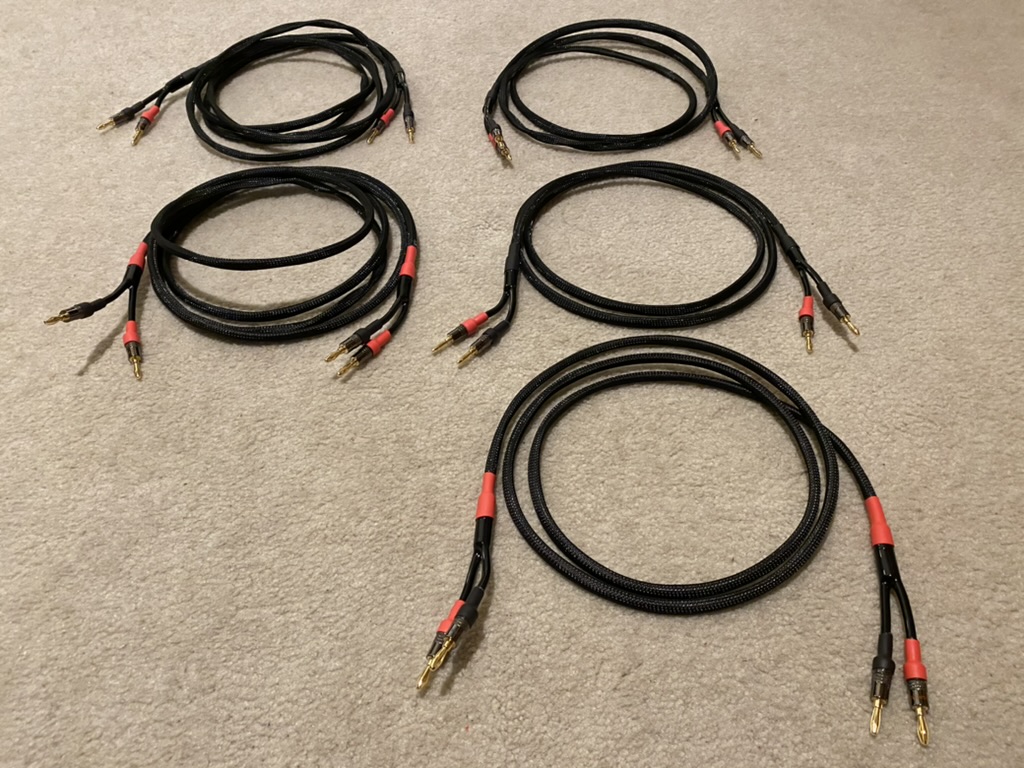
I even learned how to make speaker cables, so I made all the cables for the new system myself.
Here’s a pic of some speaker cables I made:
Here was my assembly space for the cables:

While I could have bought off-the-shelf cables, the ones I made are higher quality than most (due to using 12 gauge copper wife). This also made the experience more personally meaningful, and it’s nice to pick up an interesting new skill that I never had before. I like that I can make cables for whatever length I desire.
All-in the new home theater system was about $15K. Now I could have just bought everything outright, but that would have been boring, right? So I also used the November ideation challenge to come up with an idea to fully fund the project with an extra income source.
Partly I figured that reality could set the budget based on how well that income idea worked. I wasn’t really attached to how much to spend on the home theater project, especially since just about any improvement was going to be a meaningful upgrade.
So in late November I did a little income-generating project, which brought in more than enough to cover the whole cost of the upgrade. This involved doing a Black Friday offer just for newsletter subscribers, which I’d never done before. That brought in more than $21K extra in less than a week. It’s also good to know that people liked it, so this was a very nice win-win idea.
Even though this home theater project may seem like a totally personal endeavor, I’ve so often found that when I explore these rabbit holes that are personally meaningful for me, and perhaps no one else will care about or benefit from my exploration, that is so rarely the case. Such personal pursuits pretty much always have a tendency to loop around into new insights, ideas, and inspirations that do create positive ripples for others too. That’s one reason I like to give myself a lot of leeway to do these kinds of experiments.
I must say that it felt like reality provided a generous amount of support for this endeavor. Everything I needed felt into place pretty nicely.
Along the way I realized that the home theater project is a great metaphor for being more intentional. Instead of setting monophonic intentions, this change to my home will serve as a constant reminder to set immersive “surround sound” intentions.
Here are some thoughts on how to connect the different components of a home theater system with different types of intentions.
The television displays the moving picture of what you’re seeing and experiencing. This is your portal into the present reality of what’s happening right here, right now, right in front of you.
The TV reminds you to keep setting present moment intentions, even as you take action. Face and deal with what’s right in front of you, and clarify your intentions for what kind of experience you want to have.
Do your best to bring intentionality to each moment. Adjust your intentions as you act out your story scene by scene. Participate directly in the action flow of life.
The receiver / amplifier takes source signals as input, processes and amplifies them, and transmits them to the speakers to create sound.
The receiver reminds you to tune in and receive inspiration. Invite inspiration with intentionality. Ask life or reality to send you some inspired ideas, either generally or in a specific direction.
Don’t limit yourself to plain vanilla, obvious goals. Realize that you can stream inspired ideas from a variety of sources. Check out a few different streams, and then decide which streams to explore with greater intentionality.
Do your best to stay attuned to the flow of inspiration. Keep refreshing your alignment with your favorite source signals. Don’t get caught up in watching uninspired programming.
The left and right front mains define the boundaries of center stage. They hold the space for the front and center action, music, and dialogue. The mains anchor the story directly in front of you.
Realize that your intentions have some width to them. You always have options for how to proceed next. Sometimes you may continue straight ahead as you expected, while other times you may need to pan a bit left or right to advance the scene.
Good mains create a wide and immersive soundstage whereby the speakers essentially disappear, and you cannot localize the sound as coming from any one speaker. Good intentions give you direction while granting access to an array of options for advancement, so you’re not overly constrained. Just as you don’t want to fixate on just one or two speakers, it’s wise to avoid fixating on only one or two ways in which your goals can manifest. Let your soundstage on intentionality open up more.
Set intentions to open an expansive field of exploration in front of you. Don’t limit yourself to a narrow, overly linear and predictable path because that would create boring (and demotivating) story. Invite advancement in a worthy direction while giving yourself plenty of opportunity to swerve left or right as needed.
Give your intentionality reasonable boundaries, so you still have a pretty clear direction even as you explore. Dive into the story that’s unfolding in front of you, but don’t give yourself so much leeway that you abandon the story altogether and lose your connection to the soundstage of motivation.
This is the front-and-center part of the soundstage. A key purpose of the center channel is to provide crisp and clear dialogue.
The center channel is a reminder to interactively dialogue with life. Listen to life’s feedback, converse with life to deepen your understanding, and keep communicating your intentions and your feedback with life as you go. You always have a direct line of communication with life, so keep the dialogue channel open.
Speak your intentions aloud. Put your intentions front and center in your life. Make sure they’re always right in front of you, so you can’t lose sight of them. Make your intentions crisp, clear, and ever-present. Don’t keep your intentions locked away in some remote corner of your mind.
The side surrounds help to envelope you in a sound field from the sides. They also provide a sense of movement as sounds flow from front to back or vice versa. They help you feel aligned with the timing of a scene.
Just as sounds tend to traverse through the side fields instead of lingering there, this is a reminder to allow events and circumstances to pass through your experiential field instead of keeping them stuck. Allow whatever is misaligned to flow past you, so you can release it. Invite aligned experiences to flow towards center stage, so you can fully experience them.
Remember that the soundscape of your life is always in flux. You must release the misaligned to allow space for the aligned to flow through. Don’t be clingy with the misaligned. Keep the side channels open, and do your best to prevent and clear pile-ups of stuck energy.
The side surrounds remind you to set intentions for releasing, not just for adding. What must be shed or dropped in order to create space for the new?
The soundscape of your life is only so big. You cannot pack everything into it all at once without creating a cacophonous mess. It’s important to go with the flow of a scene, allowing some elements to recede so others can take center stage. The side surrounds remind you that in order to gain the new, you must also be willing to release the old. No scene gets to hold center stage forever.
The rear speakers provide presence from behind you. They define the back of the sound field.
The rears remind you to invite reality to back you up. Invite support from others. Invite whatever kind of backup you need or desire.
You do not have to go it alone. Life is here to support you. Invite all the support you could ever want at the level of intentionality.
Even when you begin with the most selfish intentions, also consider the framing that makes your intentions good for others and good for life. Upgrade your solo intentions into win-win intentions that create positive ripples in the world. Give life and other people worthy reasons to back you up.
Remember at the very least that whatever you gain for yourself can be turned into a win for others simply by teaching people what you’ve learned or by sharing what you’ve experienced along the way.
Overhead or height speakers add three-dimensionality to a soundscape, like the sound of a helicopter flying above. They free you of the limits of two-dimensional sound and create the experience of being fully inside of an immersive sound bubble.
What is the upper level of your intentionality space? What intentions feel like they’re flying overhead, but you can’t necessarily grasp them right now?
The overhead speakers remind you to set high-level intentions, not just at the ground level. Reach for the sky, and stretch beyond the plane of practicality and accessibility. What aspects of your intentions are so high up that you cannot currently reach them, even if you stretch your arms as high as you can?
Don’t chain yourself to what seems realistic. Be aspirational too. Be willing to reach for the unreasonable. Remember that more is possible.
Even intentions that you cannot reach can provide value by adding to the overall immersive effect. It’s important for some part of your intentionality to reach beyond your grasp. Remember you can set intentions far beyond the plane of accessibility. Make sure that some of your intentions are high above the ground level, so you can hear what’s flying overhead.
This is the deep bass of the system. It adds richness and detail to deep voices and sounds. It provides the frequencies that the other speakers cannot generate.
The subwoofer also creates the booming sounds and LFEs (low-frequency effects) like those stimulating chest-pounding pressure waves. It adds vibes of power and explosiveness. It’s the largest and heaviest speaker in the system.
A subwoofer adds liveliness and fun. It keeps you awake. It can rattle the walls and shake the house when cranked up high enough. If turned up too high, it will disturb the neighbors and generate unwanted side effects. But used in a measured way, it can add a lot of richness and extra stimulation.
The subwoofer blows up your old reality, demolishing what doesn’t belong. It thrives in the domain of the boldest and most intense action. It invites you to accept that some people will likely resist the fullest exploration of your intentionality, and you can simply let them whine while you enjoy yourself anyway. If you crank the subs up loud enough, you won’t even hear anyone banging on your door anymore.
Think of the subwoofer as infusing your intentions with raw power and explosiveness. This is a reminder to make your intentions fun, engaging, immersive, and edgy. Be willing to invite more risk, leaning into the space of potentially disturbing or upsetting other people. Invite disruption of the status quo. If you’re not particularly fond of the status quo, demolish it. Playing is safe all the time is weak.
To set a good subwoofer intention, access the part of you that feels bold, courageous, and disruptive. Access the part of you that’s ready to set the misaligned ablaze. Let go of the need to satisfy other people’s expectations, and incorporate what you find most stimulating. You can still be careful not to overdo it when a measured response seems wise, but give yourself enough room to throw caution to the wind and crank up the power when that seems like the most viable way to get the job done.
What do you think?
I still have a few more tweaks to do to the new system, such as using the Room EQ Wizard app to tweak the EQ, but I really like it so far. It’s a huge upgrade over what we had before. I love the clarity and detail of the Focal speakers, especially combined with the deep bass extension of the dual subs. The receiver provides ample power for all channels without needing any extra amps.
I’m glad we live in a house with well-insulated walls and double-paned windows. We absolutely couldn’t run this system if we were in an apartment or condo.
Our previous system was mainly just a TV and a pair of HomePods, so basically a 2.0 system. I feel like we skipped ahead several levels by advancing to a 7.2.4 Atmos setup, but I do tend to be all-in-or-nothing in many of my explorations. I find it fun to go into full immersion mode and really upgrade my knowledge and skills. I learned so much that I knew nothing about before. I spent hours just learning about the difference between ported and sealed subs, for instance.
What I found most challenging about this project was not having a good local outlet for being able to sample all the different possibilities with my ears before deciding what to get. I relied a lot on other people’s reviews and opinions. That can be pretty subjective, but when I found consistent impressions shared by different sources, that helped me make decent decisions. I also reminded myself that there’s an undo button for everything since I could return or exchange anything that didn’t work out. Now that I can hear the results, I’m pretty pleased with the specific choices I made.
I also learned something interesting about Rachelle along the way, namely that she’s quite the basshead. I had thought the dual PB-3000 subs would be a bit overkill if we cranked them up, but I wanted to have that excess headroom for really good bass detail. Rachelle, however, really enjoys the powerful bass slam that can be felt, not just heard. The Witcher’s season 2 finale was really over-the-top in that regard. With dual subs you really can’t localize the bass, so it sounds like it’s coming from all around, making it feel like there are monsters stomping and chomping in the same room with you. It’s downright scary at times.
This upgrade also showed me how much I’ve been missing. Rewatching old shows with an immersive sound field completely changes the experience. Instead of feeling like I’m watching a movie, I feel like I’m inside of it. The experience is a lot more emotional. Watching The Witcher or The Wheel of Time or The Expanse becomes is so much more intense now. Any Avengers movie is pretty awesome too.
Even more subdued shows feels more engaging too… like if a show is cozy, it feels even cozier when I can hear rainfall or birds coming from behind me and off to the sides.
I found this upgrade to be a nice reminder that reality is willing to offer us richer levels of engagement if we’re willing to reach out and invite it. A good place to begin is by setting surround sound intentions. If you’re going to invite a change, then really invite it. Don’t half-ass your intentionality with overly narrow mono or stereo versions. Open up your intentionality soundstage, and invite the full sensuality and emotionality of your desires. Intend what you need to shift right now. Intend long-term changes. Intend to release what you’ll surely need to release. Intend the support you’ll need. Intend to fully immersive yourself in a new way of living. Intend positive ripples beyond yourself.
After upgrading the home theater system, I also went a bit further by upgrading my home office sound system, including a new amp and speakers and some monitoring headphones to use for audio and video editing. I often find it wise to keep flowing with this upgrade energy while it lasts since it can be efficient to let it cascade into related upgrades as well.
Additionally, Rachelle and I sold our old couch and upgraded to a much nicer one. I’ve been sitting on it while writing this blog post, nice and cozy by the fireplace. So with all of the upgrades we did in the past 30 days, cost-wise it pretty much added up to the extra income manifested from the Black Friday idea. Needless to say, I’m really glad I did that ideation challenge – beyond what I’ve shared here, there were a bunch of other positive side effects from that challenge as well. It was a great way to break through some old mental constraints.
One tip here is that if you’ve ever gotten stuck trying to manifest money, try manifesting it in connection with a fun project, such that the money will immediately fund the project. I think reality gets bored with vanilla requests for money, such as to pay rent. See if you can make the request more playful. My experience is that reality absolutely loves playful requests. It also loves to reward exploration.
I find it especially important to pay attention to whatever forms of inspiration keep knocking on my mind, especially those ideas that I keep dismissing but which keep circling back to me, like they’re taunting me to finally give them some serious attention. This home theater project has been knocking on my mind for years, and it feels really good to have finally invested in it. I like that this project improves my relationship with a part of reality that I appreciate, such as enjoying movies with Rachelle.
Merry Christmas! 😊

NASA’s James Webb Space Telescope launched at 7:20 a.m. EST Saturday on an Ariane 5 rocket from Europe’s Spaceport in French Guiana, South America.
A joint effort with ESA (European Space Agency) and the Canadian Space Agency, the Webb observatory is NASA’s revolutionary flagship mission to seek the light from the first galaxies in the early universe and to explore our own solar system, as well as planets orbiting other stars, called exoplanets.
“The James Webb Space Telescope represents the ambition that NASA and our partners maintain to propel us forward into the future,” said NASA Administrator Bill Nelson. “The promise of Webb is not what we know we will discover; it’s what we don’t yet understand or can’t yet fathom about our universe. I can’t wait to see what it uncovers!”
Ground teams began receiving telemetry data from Webb about five minutes after launch. The Arianespace Ariane 5 rocket performed as expected, separating from the observatory 27 minutes into the flight. The observatory was released at an altitude of approximately 75 miles (120 kilometers). Approximately 30 minutes after launch, Webb unfolded its solar array, and mission managers confirmed that the solar array was providing power to the observatory. After solar array deployment, mission operators will establish a communications link with the observatory via the Malindi ground station in Kenya, and ground control at the Space Telescope Science Institute in Baltimore will send the first commands to the spacecraft.
Engineers and ground controllers will conduct the first of three mid-course correction burns about 12 hours and 30 minutes after launch, firing Webb’s thrusters to maneuver the spacecraft on an optimal trajectory toward its destination in orbit about 1 million miles from Earth.
“I want to congratulate the team on this incredible achievement — Webb’s launch marks a significant moment not only for NASA, but for thousands of people worldwide who dedicated their time and talent to this mission over the years,” said Thomas Zurbuchen, associate administrator for the Science Mission Directorate at NASA Headquarters in Washington. “Webb’s scientific promise is now closer than it ever has been. We are poised on the edge of a truly exciting time of discovery, of things we’ve never before seen or imagined.”
The world’s largest and most complex space science observatory will now begin six months of commissioning in space. At the end of commissioning, Webb will deliver its first images. Webb carries four state-of-the-art science instruments with highly sensitive infrared detectors of unprecedented resolution. Webb will study infrared light from celestial objects with much greater clarity than ever before. The premier mission is the scientific successor to NASA’s iconic Hubble and Spitzer space telescopes, built to complement and further the scientific discoveries of these and other missions.
“The launch of the Webb Space Telescope is a pivotal moment — this is just the beginning for the Webb mission,” said Gregory L. Robinson, Webb’s program director at NASA Headquarters. “Now we will watch Webb’s highly anticipated and critical 29 days on the edge. When the spacecraft unfurls in space, Webb will undergo the most difficult and complex deployment sequence ever attempted in space. Once commissioning is complete, we will see awe-inspiring images that will capture our imagination.”
The telescope’s revolutionary technology will explore every phase of cosmic history — from within our solar system to the most distant observable galaxies in the early universe, to everything in between. Webb will reveal new and unexpected discoveries and help humanity understand the origins of the universe and our place in it.
NASA Headquarters oversees the mission for the agency’s Science Mission Directorate. NASA’s Goddard Space Flight Center in Greenbelt, Maryland, manages Webb for the agency and oversees work on the mission performed by the Space Telescope Science Institute, Northrop Grumman, and other mission partners. In addition to Goddard, several NASA centers contributed to the project, including the agency’s Johnson Space Center in Houston, Jet Propulsion Laboratory in Southern California, Marshall Space Flight Center in Huntsville, Alabama, Ames Research Center in California’s Silicon Valley, and others.
For more information about the Webb mission, visit:
Vaccinations continue over the festive period after UK Covid cases hit a record on Christmas Eve.
But it is too early to downgrade the serious threat posed by the new variant, says Dr Jenny Harries.
Libby was operated on using equipment normally associated with brain surgery.

Scientists have found a way to prove that biochemical signals sent from cell to cell play an important role in determining how those cells develop.
The study from researchers at the USC Dornsife College of Letters, Arts and Sciences was published in the journal Development on Dec. 22.
A little background
What’s new
“We discovered that the communication process can change the formation of blood cell types dramatically, and that cells that are closer to one another have a greater influence on each other’s fate,” MacLean said.
A controversy resolved
Researchers trying to determine what early factors nudge a cell down one developmental path or another have wondered if random fluctuations within the cell are enough to decide which path is taken. Many models have suggested they were, but recent breakthrough studies showed that random fluctuations were not enough, that something else drives cells toward their fate.
The model MacLean and Rommelfanger have developed appears to put an end to the controversy altogether. They show that cell-to-cell communication can, in fact, be the deciding factor that sets cells along a certain path.
“By understanding how blood cell fate decisions are made,” MacLean said, “we get closer to being able to identify leukemia cells of origin, and in theory we can design strategies to control or alter cell fate decision-making and stop the development of cancer.”
The research could help improve cancer therapies such as bone marrow transplant.
“Better understanding stem cell fate decisions, as our study provides, could provide new insight to improve clinical outcomes for these diseases,” MacLean said.
This new model has important implications beyond the blood system.
“Our model is broadly applicable, so researchers working on other cell types can apply it to find out for those other cells how important cell-to-cell communication may be,” said MacLean.
What’s next
The role of cell-to-cell communication in determining cell fate is in its nascent stages, says MacLean, but further experiments — and future technologies to integrate these new types of data with sophisticated models — should help expand understanding.
In addition, the team is developing methods to study the regulation of key genes involved in cell fate decisions, which should further advance their overall theoretical model.
About the study
This work was supported by National Science Foundation grant DMS 2045327 and a USC Women in Science and Engineering Top-up Fellowship.
Story Source:
Materials provided by University of Southern California. Original written by Darrin S. Joy. Note: Content may be edited for style and length.
There are many things in our favour, but Omicron is spreading fast. What have we learned this week?
