Researchers are to investigate whether young people and those not in hospital could be affected.


Researchers are to investigate whether young people and those not in hospital could be affected.
Social media is full of coronavirus vaccine information – but how can you tell which is reliable?

To develop effective therapeutics against pathogens, scientists need to first uncover how they attack host cells. An efficient way to conduct these investigations on an extensive scale is through high-speed screening tests called assays.
Researchers at Texas A&M University have invented a high-throughput cell separation method that can be used in conjunction with droplet microfluidics, a technique whereby tiny drops of fluid containing biological or other cargo can be moved precisely and at high speeds. Specifically, the researchers successfully isolated pathogens attached to host cells from those that were unattached within a single fluid droplet using an electric field.
“Other than cell separation, most biochemical assays have been successfully converted into droplet microfluidic systems that allow high-throughput testing,” said Arum Han, professor in the Department of Electrical and Computer Engineering and principal investigator of the project. “We have addressed that gap, and now cell separation can be done in a high-throughput manner within the droplet microfluidic platform. This new system certainly simplifies studying host-pathogen interactions, but it is also very useful for environmental microbiology or drug screening applications.”
The researchers reported their findings in the August issue of the journal Lab on a Chip.
Microfluidic devices consist of networks of micron-sized channels or tubes that allow for controlled movements of fluids. Recently, microfluidics using water-in-oil droplets have gained popularity for a wide range of biotechnological applications. These droplets, which are picoliters (or a million times less than a microliter) in volume, can be used as platforms for carrying out biological reactions or transporting biological materials. Millions of droplets within a single chip facilitate high-throughput experiments, saving not just laboratory space but the cost of chemical reagents and manual labor.
Biological assays can involve different cell types within a single droplet, which eventually need to be separated for subsequent analyses. This task is extremely challenging in a droplet microfluidic system, Han said.
“Getting cell separation within a tiny droplet is extremely difficult because, if you think about it, first, it’s a tiny 100-micron diameter droplet, and second, within this extremely tiny droplet, multiple cell types are all mixed together,” he said.
To develop the technology needed for cell separation, Han and his team chose a host-pathogen model system consisting of the salmonella bacteria and the human macrophage, a type of immune cell. When both these cell types are introduced within a droplet, some of the bacteria adhere to the macrophage cells. The goal of their experiments was to separate the salmonella that attached to the macrophage from the ones that did not.
For cell separation, Han and his team constructed two pairs of electrodes that generated an oscillating electric field in close proximity to the droplet containing the two cell types. Since the bacteria and the host cells have different shapes, sizes and electrical properties, they found that the electric field produced a different force on each cell type. This force resulted in the movement of one cell type at a time, separating the cells into two different locations within the droplet. To separate the mother droplet into two daughter droplets containing one type of cells, the researchers also made a downstream Y-shaped splitting junction.
Han said although these experiments were carried with a host and pathogen whose interaction is well-established, their new microfluidic system equipped with in-drop separation is most useful when the pathogenicity of bacterial species is unknown. He added that their technology enables quick, high-throughput screening in these situations and for other applications where cell separation is required.
“Liquid handling robotic hands can conduct millions of assays but are extremely costly. Droplet microfluidics can do the same in millions of droplets, much faster and much cheaper,” Han said. “We have now integrated cell separation technology into droplet microfluidic systems, allowing the precise manipulation of cells in droplets in a high-throughput manner, which was not possible before.”
Story Source:
Materials provided by Texas A&M University. Original written by Vandana Suresh. Note: Content may be edited for style and length.

Early populations shifted from quasi-egalitarian hunter-gatherer societies to communities governed by a centralized authority in the middle to late Holocene, but how the transition occurred still puzzles anthropologists. A University of Maine-led group of researchers contend that population size and density served as crucial drivers.
Anthropology professor Paul “Jim” Roscoe led the development of Power Theory, a model emphasizing the role of demography in political centralization, and applied it to the shift in power dynamics in prehistoric northern coastal societies in Peru.
To test the theory, he, Daniel Sandweiss, professor of anthropology and Quaternary and climate studies, and Erick Robinson, a postdoctoral anthropology researcher at Utah State University, created a summed probability distribution (SPD) from 755 radiocarbon dates from 10,000-1,000 B.P., or before present.
The team found a correlation between the tenets of their Power Theory, or that population density and size influence political centralization, and the change in power dynamics in early Peruvian societies.
The team shared their findings in a report published in Philosophical Transactions of the Royal Society B.
“I’ve always been interested in how, in the space of just five to 10,000 years, humans went from biddy little hunter-gatherer groups in which nobody could really push anyone else around to vast industrial states governed by a few people with enormous power. From my fieldwork and other research in New Guinea, it became clear that leaders mainly emerged in large, high-density populations, and Power Theory explained why,” Roscoe says. “Unfortunately, it was difficult until recently for archaeologists to get a handle on the size and densities of populations in the past. SPD techniques are a major help in bringing these important variables into understanding how human social life underwent this dramatic transformation.”
Scientists have previously posited that population in northern coastal Peru rose during the Late Preceramic, Initial, Early Horizon and Early Intermediate periods, or between about 6,000-1,200 B.P. The SPD from Roscoe and his colleagues validates the notion.
The people who settled in the coastal plain first lived as mobile hunter-gatherers or incipient horticulturalists in low density groups, according to researchers. Millennia afterward in the Late Preceramic period, however, several developments brought increased interaction and shareable resources. People began farming, developed irrigation systems and became more settled as time passed. Eventually, some of the world’s first ‘pristine’ states formed in the plain.
The onset and growth of agriculture, irrigation and sedentism, propelled by upticks in population size and density, fostered the capacity of political agents to interact with and manipulate others. Political centralization and hierarchy formed as a result, according to researchers.
Roscoe and his colleagues demonstrated through their radio-carbon SPD that the rise in centralized authorities in early Peruvian communities that resulted from farming, irrigation and settlement coincided with an uptick in population size. The results of their work demonstrate “a broad, low-resolution congruence between the expectations of Power Theory and what is currently known about coastal Peruvian antiquity,” they wrote in their study.
The project also highlights the capability of SPDs for examining the influence of demography in the growth of prehistoric political centralization. Determining the extent of that influence, however, requires additional study.
“We’re hoping this work demonstrates the value of SPDs for understanding the role of demography in the emergence and development of power centers on Earth,” Roscoe says. “What we need now is to increase the size of our SPD databases and filter out some of the weaknesses we know they contain.”
The former chief medical officer says high rates of obesity, deprivation and overcrowding have cost lives.
Today is the final day of NaNoWriMo. I added about 2000 more words to my novel-in-progress this morning. My final word count for the month came in at 55,051 words. The challenge of NaNoWriMo (National Novel Writing Month) is to write 50,000 words of a new novel in 30 days, so I exceeded this target by about 10%.
Here’s my daily progress log, showing my total word count (darker color) versus the daily pacing needed to hit 50K words (lighter color).
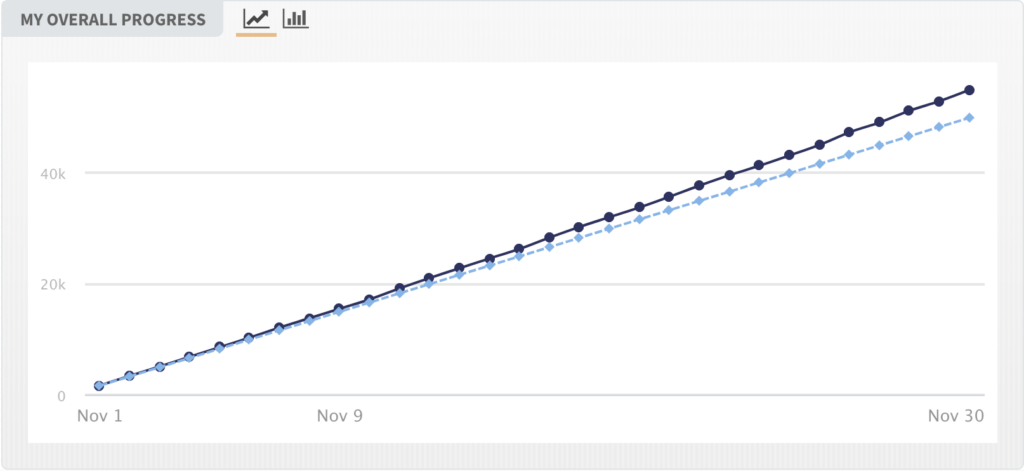
I surpassed the target pacing by a small amount on Day 1 and then padded my lead every day afterwards. It felt good to always be a little bit ahead throughout the challenge. I knew that if I just maintained this steady pacing, I’d never need to do any catch-up writing at the end.
Before starting this challenge, I learned that a major reason people fail at NaNoWriMo is that they fall behind in the first couple of weeks, and then they feel disheartened when facing the extra effort needed to catch up. Even skipping one day means you’ll have to write more in the remaining days. Most people who fall behind give up and don’t complete the challenge. This is an easily preventable point of failure.
My strategy was to approach this as a daily challenge, which plays to my strengths. I’ve done lots of 30-day challenges where I practice a specific behavior for 30 days in a row. In this case the desired behavior was to add at least 1667 words to my novel each day. If I just focused on that, the monthly goal would be accomplished too. It’s just typing after all.
Here’s what my daily word count looked like for all 30 days.

As you can see, I was pretty consistent throughout the month.
I averaged 1835 words per day, which works out to an extra 10% per day. Once I passed the 1667 words for the day, I kept writing till I felt like stopping, such as when I got to the end of a scene. If I felt like stopping but I wasn’t at 1667 words yet, I took a short break and then continued writing.
This was a wonderful personal growth experience, and I’m glad I did it. The novel isn’t done and will need a lot of work to finish, but the daily writing got me well into the project.
I don’t have a completed book yet, and it would take a lot more work to drive this towards a version ready for publishing, but NaNoWriMo got me moving forward with meaningful progress. It helped me turn a mere idea into something a lot more tangible.
At this point I don’t have a completed story. I’ve written a first draft of many scenes. I have several well-developed characters. I have a well-structured three-act story with interesting plot twists. But there are still many more details to work out.
This is a very rough first draft. I’d say it’s not bad for a month’s work. I estimate that I averaged about 75 minutes per day of writing time (including thinking about what to write). I’m very pleased with how far I got for about 40 hours of effort. There was also some incubation time when I’d be thinking about characters or plot ideas while doing unrelated tasks.
The “words are cheap” mindset worked very well. It’s easy to throw words onto the screen, read them back the next day, and learn something useful. I’ll end up throwing away much of what I wrote this month, and I don’t lament that at all. Everything I wrote helped in some way. Each day I gained more clarity about the story, the characters, and the world. Even when what I wrote seemed like a chaotic mess, it still felt like forward progress.
Other writers have said that you write the first draft for yourself, not for anyone else. I adopted that mindset from Day 1, and I found it very helpful. I didn’t expect to show this early draft to anyone, not even Rachelle. So I just wrote whatever came to mind. It was my own personal exploration of the ideas and possibilities, nothing more. By framing it that way, I felt totally free to experiment and to make lots of mistakes. This helped me figure out what kind of story I wanted to tell. I let the words flow without any concern about who might read them.
One clear gain was that I understand my characters so much better than when I first started. Now I can write their words and actions much more easily, as if they tell me what they would say and do in every situation. So the writing got easier as I went along. The first few days were the most challenging; after that it was smooth sailing.
Another gain was that my “why” for writing this story improved as I kept writing. Around halfway through the month, I developed a stronger sense of purpose for why I wanted to write and share such a story. I had a more compelling answer to the questions: Why bother with this project? What’s the point? Who would want to read this? My purpose was more exploration-based in the beginning, but by the end I felt like I was creating something I really wanted to share with the world to see how it landed with people. I had a clearer sense of the story’s potential impact.
This was similar in some ways to designing a new video game from scratch, but the medium is very different. I liked how easy it was to explore the characters, story ideas, and world without having to deal with tech constraints. I could play around with any ideas I could imagine. I really enjoyed that type of experience – it was like pure play.
Most days I looked forward to my writing sessions. I didn’t experience much inner resistance after the first week, and that small resistance was just due to being too green at this type of writing. I think having lots of nonfiction writing experience – and a healthy willingness to make plenty of mistakes – was helpful. I never had writer’s block. I could connect with inspired ideas for fiction writing as easily as for nonfiction articles or courses.
I’m going to set aside the novel writing and coast into a more relaxed December since I want to focus on other aspects of life for the rest of the year. That includes finishing up my one-year daily blogging challenge, which has 31 days left to go.
Stephen King recommends setting aside a novel for at least 6 weeks after writing the first draft and then coming back it to fresh. He says it’s wise to get some distance from the story, so you can see it with fresh eyes before you start editing.
My first draft isn’t good enough that I can just edit it into a finished book. It’s way too messy for that, especially since there are a lot of scenes I’ll need to cut or rewrite differently. I’m still going to set this aside for 6+ weeks, probably until after our next deep dive is complete, but my next steps will different than Stephen King’s.
Sometime next year I’d like to revisit this novel project, re-read everything I wrote, and then begin working on a second draft. I’d like to do a round of more detailed plotting before I add more words to the book. I think the story would benefit a lot by clarifying the scene-by-scene layout.
The pantser approach was great for getting started since it helped me map out the possibility space for the story by writing a lot of scenes. Now I have enough understanding of the story and that characters that a good next step would be to map out the scenes for the story in the right order. I’d also like to fill out character and location sheets to fine-tune the characters and settings. Then I can write the second draft.
It’s going to be a long process, and I’m not in a rush to race through this. I do want to see this through to publishing. It’s an original story with some fun characters that I think people would enjoy reading. I might approach this project as a series of 30-day challenges to push it forward through different stages of development.
I’m especially happen that I framed NaNoWriMo in a way that made the experience enjoyable, especially by always being ahead of schedule. This makes me eager to re-engage with the novel when I’m ready. There are other priorities I want to engage with next, so I’m happy to put this aside for now, but I do look forward to getting back into it with fresh eyes.
My first big priority for 2021 is to launch and develop our new creative productivity deep dive, which is tentatively called Amplify. This is for people who do creative work and want to increase their productive output. It’s also for people who’d like to get into a better creative flow. You could think of it as a course in how to be a prolific creator who publishes frequently. How can you express yourself creatively year after year without burning out?
I have tons to share about this topic that I believe would be unique and different from anything else out there. I’ve gone through many books and courses on creativity and on productivity, but I still haven’t seen really good coverage regarding connecting the dots between creativity and productivity. It’s like creativity is play, and productivity is work. There’s a lot of conflicting advice that treats creativity as inherently unproductive and productivity as inherently uncreative.
What if you want to excel at both together? What if you want to be a fountain of creative expression?
How can you be super creative and highly productive without sacrificing too much on either side? How can you get into the flow of creating and publishing – and stay there consistently without burning out?
There’s a lot to unpack here, and I’m convinced that this is an area where I can add some real value to people’s lives. I’ve created and published across many different media: articles, videos, podcasts, a book, video games, music, live events, and more. This year I’ve published something new every single day, adding hundreds of thousands of words to my collective work, which is already well into the millions of words, not counting translations into other languages.
I love to keep exploring new media too, such as I just did with NaNoWriMo. Partly I did NaNoWriMo as an experiment to test some of the ideas for this upcoming deep dive.
I’d love to do this new deep dive co-creatively too, like we did with our previous ones, so the lessons will be created as we go, designed for the specific needs of the people who enroll.
I haven’t decided on the exact the format yet. My intuition says it will likely be something different from our previous courses, perhaps a combination of live interactive parts along with structured audio lessons. People loved the audio format of Submersion and Stature, and there was also something special about the live sessions that we did for Deep Abundance Integration. So I’m thinking of merging those for the new deep dive. Would that appeal to you?
I’ll share more info on this new deep dive next year as we get closer to launching it. We’ll be launching it during the first quarter of 2021. I tend to get an intuitive ping when the timing is right for launching. In the meantime, I’d like to clear my plate of some other projects first, mostly on the personal side.
Regulators will decide if it is safe and effective enough to recommend for widespread use.
There were an estimated 72,000 new cases of coronavirus a day in England between 13 and 24 November.
I crossed the 50K-word NaNoWriMo finish line yesterday morning, writing 51,262 words in 28 days, so I achieved this goal 2 days ahead of schedule.
When I updated my word count yesterday, I received a congratulatory video, a bunch of links to claim the NaNoWriMo “prizes” (discounted promotions for various writer tools and services), and this completion certificate.
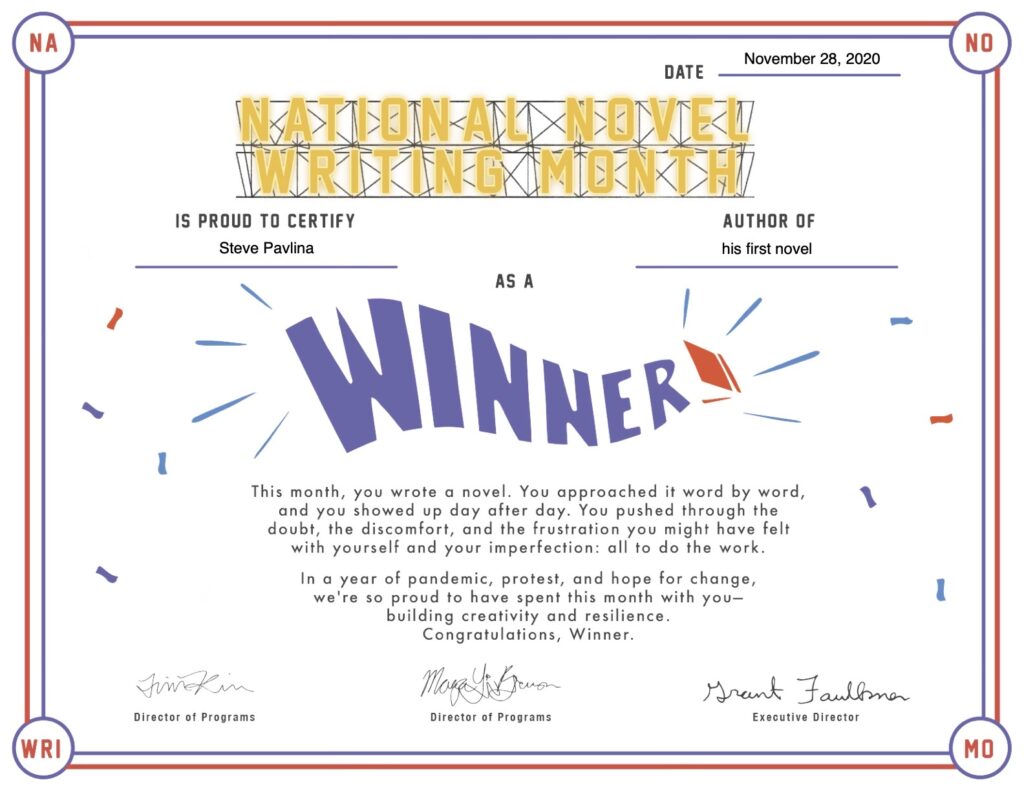
The way I framed this goal, however, was to add at least 1667 words per day to the novel for the full 30 days, so I didn’t stop after 28 days. After this morning’s writing session (Day 29), the novel is at 53,007 words. So tomorrow I’ll likely land around 55K words for this 30-day challenge.
This was my first NaNoWriMo and certainly a good year to do it. It was a great way to get started on a fiction book. I’m way further along now than I would have been if I hadn’t signed up for Nano. It’s been a rewarding experience overall.
One aspect I found less exciting than I expected was connecting with the Nano community. I thought it would be cool to connect with other novelists during Nano, but I felt a bit disconnected from that aspect of the experience. I didn’t feel like connecting with other writers while working on my novel. I browsed through some of the community posts but largely found it to be a distraction from actual writing, so most days I just did the writing on my own.
I enjoyed the challenge more when I stuck with introvert mode. It may be nice to connect with other writers before or after Nano, but I wasn’t inspired to do that while in the midst of figuring out the novel. I felt more motivated to connect with the characters I was developing.
I had no trouble feeling motivated to write each day. I didn’t write at same time each day, but I normally got each day’s writing done before 10am, often before 8am.
Most people who sign up for Nano don’t finish, but I never had any doubt that I’d do it. I do my best to win 30-day challenges in my mind before Day 1, and Nano was no different. The same goes for 365-day challenges like my 2020 daily blogging challenge (which is more than 90% done now). If you combine the blogging with the Nano writing, I probably wrote around 75K words this month.
Overall the combined writing experience flowed pretty well. Some days I blogged first and then did Nano, some days I flipped the order. But usually I finished both in the morning. Last Monday and Tuesday, I also did some batch blogging, queuing up several posts in advance, so I could enjoy the 4-day holiday weekend with a bit less daily writing – that was extra nice.
One thing I love about having a career focused on exploring personal growth is how much time I have to spend practicing the fundamentals and how nicely that investment pays off over time.
This helps me leverage what I’ve learned to explore something new and be relatively productive from the start – and have fun doing it. Even when I’m a total newbie diving into an area where I have tons to learn, it feels like I have some extra advantages going in. A big one is just knowing that I can trust myself to follow through.
I expect to run into some difficulties or surprises along the way, and I also expect that I’ll be able to handle them. I’ll take action, persist, and learn as I go. I’m not afraid of failure, and I don’t tend to have issues with perfectionism. I prefer to just go, explore, and experience.
I like to play life the same way I like to play video games. Rachelle and I are about halfway through the new Zelda game, Hyrule Warriors: Age of Calamity, and I like that the game rewards my style of play – Rush in headfirst and slash away at every obstacle like there’s nothing to fear. We also pace ourselves, playing a little bit each day instead of rapidly binging through the whole thing.
The point of playing games is to have fun. This is a good way to approach life experiences too, including writing a novel.
I saw so many people in the Nano community struggling in ways that aren’t specific to writing. They struggle with personal development basics like setting clear goals, establishing productive habits, adopting empowering frames, creating confidence, eating healthfully, and so on.
But most of all, they struggle with making the journey fun, engaging, and rewarding each day. They inject far more suffering into the experience than necessary. Then they try to exert more discipline to push through that self-created drag, which can be very draining. I saw a number of “I give up” and “I’m quitting” updates along the way, and it looked to me that those people had already lost before Day 1. They approached the challenge in a way that was doomed from the start.
I saw plenty of uptightness in the Nano community. Some participants got bogged down in over-analysis and perfectionism. I think they could progress faster if they lightened up and learned to reframe failure as part of the fun. Some play the game so tightly that they prevent much of the joy of discovery from flowing through. It’s like playing a video game with someone who’s deathly afraid of losing a life, so they make the game more work than fun.
I actually found it stressful to read some of the community posts, but it was a good reminder that a long-term investment in personal growth fundamentals really does pay nice dividends. When you don’t practice the fundamentals enough, you’re likely to experience a lot of friction whenever you try to do something outside your comfort zone.
Practicing the fundamentals isn’t always sexy, but it helps us grow stronger, more capable, and more flexible. What good does it do to train up your writing skills if you can’t get yourself to apply those skills consistently? What if you lack the courage to create something unique that adds value to people’s lives? What if you aren’t able to handle criticism?
You can soak up domain-specific knowledge and skills, but what’s the point if you can’t get yourself to use it to create results?
This Nano experience helped me appreciate just how valuable it is to keep investing in the fundamentals. They grant access to new life experiences that would otherwise seem too far out of reach.
Easing rules months before vaccines take effect would be a “huge mistake”, Sage expert says.
