Emails reveal how officials described pressure to approve protective suits for the NHS.


Emails reveal how officials described pressure to approve protective suits for the NHS.
Initial study shows tests done by care home staff are as accurate as those done in hospitals.
Surgeons warn patients are left in pain, as experts predict the situation will worsen during winter.

Rice is a worldwide essential. In fact, more than half of the world’s population depends on it as a staple food, according to a 2019 study published in Nature.
However, rice also naturally contains arsenic – a toxic substance – from the soil, and while there is a simple way to reduce the quantity, it lowers the level of nutrients in the process.
Arsenic is classified as a Group 1 carcinogen by the International Agency for Research on Cancer, and the World Health Organization (WHO) identifies exposure to arsenic as a major public health concern.
The carcinogen is water-soluble, which means it accumulates in rice, and exposure to it affects almost every organ in the body and can cause skin lesions, cancer, diabetes and lung disease.
On the bright side
Previous research from the University of Sheffield in the UK found half of the rice consumed in the UK exceeded European Commission regulations for levels of arsenic in rice meant for the consumption for infants or young children.
On the bright side, though, researchers from the University of Sheffield’s Institute for Sustainable Food investigated four different rice-cooking methods in order to determine which offered the best way of reducing arsenic while preserving nutrients.
All four methods involved cooking rice via the absorption method (as the rice cooks, it absorbs all the cooking water) using either unwashed rice, washed rice, pre-soaked rice, or parboiled rice.
According to their findings, the parboiling with absorption method (PBA) removed the largest amount of arsenic from the rice, while preserving nutrients like phosphorus, potassium, magnesium, zinc, and manganese.
The study was published in Science of The Total Environment.
The method
“With our new method we are able to significantly reduce the arsenic exposure while reducing the loss of key nutrients,” lead author and soil scientist Manoj Menon from the University of Sheffield said in a university statement.
This method, the researchers note, removes over 50% of the naturally occurring arsenic in brown rice, and 74% in white rice, while maintaining micronutrients.
To do this at home, you can do the following, the researchers advise:
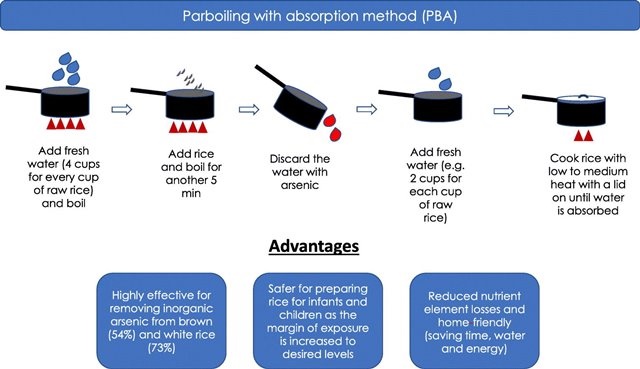
Image credit: Menon et al., Science of The Total Environment, 2020napong detraphiphat
Experiment should be repeated, but a good first step
“We highly recommend this method while preparing rice for infants and children as they are highly vulnerable to arsenic exposure risks,” Menon said.
The researchers say the PBA method also uses less water, energy and cooking time than other cooking methods that can remove the arsenic.
They also encourage additional investigation into using this method in different environments, using different kinds of regional rice types, as well as different levels of water quality – although their experiment is a good first step.
READ | Eating with your eyes – food that looks good doesn’t mean it’s healthier
READ | New device detects heat levels in chillies – so you can avoid the burn
Image: Getty/krisanapong detraphiphat
NEXT ON HEALTH24X


The most effective way to stop the spread of a virus is to prevent contact with everyone who is infected. Those who are infected can be isolated and treated if necessary. To determine who they are, it’s necessary to actively look for and manage cases.
During the Covid-19 pandemic, emerging technologies are being repurposed to help trace whoever has been in contact with an infected person.
Some of these technologies, such as the Global Positioning System (GPS), wi-fi and Bluetooth, are not new. GPS has been used to find accident victims at precise geographic locations. Some of the uses of wi-fi are oxygen monitoring devices, smart beds, access to electronic medical records and real-time access to X-rays and magnetic resonance imaging scans.
Now these tools can also help do one of the most important jobs in the pandemic: track and trace. They allow people some movement and economic activity, with the ability to manage their own risk of being exposed to possible infection or spreading any infection.
The South African government recently introduced a mobile application, COVID Alert SA, to help people notify their close contacts if they are infected.
The app is based on smartphone technology enabled by readily available functions developed by Apple or the Google Exposure Notification System. It uses a phone’s signal to generate a random code. The code is then exchanged with other users of the same app within a two metre radius. These codes are stored on the respective devices for two weeks.
People testing positive for Covid-19 in these two weeks can anonymously alert others by simply clicking a button.
The exchanged and saved codes will, when activated this way, locate and match each other and alert whoever the infected person has been in contact with. This information will allow people to test for Covid-19 and isolate, if necessary, to prevent further infections.
But there are concerns about accuracy, privacy and integration across regions. Questions have also been raised about whether the uptake will be sufficient for the app to function as intended.
In a recent analysis my colleagues and I looked at the legal and ethical aspects of tracing people who might have been in contact with an infected person. Our analysis may provide useful insights when deciding whether to use the app, and help people understand tracking and tracing principles in general.
The first concern is accuracy of the technology. This matters because people’s freedom of movement and ability to go to work or attend school will be affected by an alert.
Cell tower metadata are supplied by electronic communication service providers. The data rely on signal strength and delay times to triangulate the position of a cellular phone. This method often provides inaccurate information because signals are scattered by buildings. There aren’t many towers in rural areas in South Africa, so triangulation may not even be possible there. There’s also a concern that the app might not detect other nearby smartphones accurately.
But there’s no evidence to suggest that the app is not working.
Second, there’s the issue of privacy. The invasive nature of tracking, tracing and surveillance is a real concern.
Before introducing the app, South Africa established a tracing database to serve the same purpose as the current app. The database collected names, identity and cellphone numbers, and the results of people who tested for Covid-19 and their known or suspected contacts. The database had the potential to greatly assist with contact tracing. But it immediately infringed upon the constitutional right to privacy.
To deal with this, the new COVID alert app does not record a person’s geolocation, or any personal or health information. It only uses the location to determine how close another person was and for how long. Even the randomly generated codes cannot be linked to the phone user’s identity. No personal information is recorded or stored anywhere. Hence no privacy rights are at risk of being infringed.
A UK study found that people were more concerned about who was in charge of tracing than they were about their information being stolen. The majority preferred that a health organisation, as opposed to the government, collect and process information. The COVID Alert SA app is officially owned and managed by the South African government.
People also preferred a combination of technology and an old-fashioned human approach to contact tracing.
Public distrust is one of the problems affecting the contact tracing drive in the US. Another is discrepancies in data from different states.
A number of European countries have launched contact tracing apps also using the Google-Apple standard like South Africa. France and Hungary launched different types of apps which will make inter-operability and subsequent tracing across countries in Europe increasingly difficult.
The UK has only very recently joined the countries using the Apple and Google model.
Similarly to the UK and during the early days of the pandemic, China managed to contain the spread of the virus by manual tracing and rapid isolation of positive cases. Now, scientists are calling for technology-based measures to make a long-term response possible.
The winning strategy came from South Korea, whose comprehensive testing and contact tracing was so effective that the country never had to impose a strict lockdown. South Korea used a combination of face-to-face and digital geolocation tracing. It was criticised for infringing on privacy, however. Other countries were more sensitive towards privacy rights.
Digital contact tracing apps can be designed to protect privacy rights and to work across borders.
Research models have found that the more people use these apps, the more transmission of the disease can be reduced and the more scope there is to ease quarantine measures. But the models have also found that the apps are effective even at low uptake levels.
For purposes of managing a pandemic these apps have been tried and tested and evolved to the point where they can do more good than harm if used on a large scale.
Dr Marietjie Botes, Post Doctoral Researcher, University of Pretoria
This article is republished from The Conversationunder a Creative Commons license. Read the original article.
Image credit: Unsplash


Researchers from the American Museum of Natural History have identified a new “hidden” gene in SARS-CoV-2, the virus that causes Covid-19, and say this may explain why it is so highly infectious.
The discovery of the “overlapping gene”, named ORF3d, could have a significant impact on how we combat the virus, the research team wrote. Overlapping genes (OLGs) are a type of ‘gene within a gene’, effectively concealed in a string of nucleotides, ScienceAlert explains.
“Overlapping genes may be one of an arsenal of ways in which coronaviruses have evolved to replicate efficiently, thwart host immunity, or get themselves transmitted,” said lead author Chase Nelson, a postdoctoral researcher at Academia Sinica in Taiwan and a visiting scientist at the American Museum of Natural History.
“Knowing that overlapping genes exist and how they function may reveal new avenues for coronavirus control, for example through antiviral drugs.”
Their findings were published in the journal eLife.
ORF3d unlikely to be detected by T-cells
According to the team’s findings, the newly discovered gene is present in a previously discovered pangolin coronavirus. This, they say, possibly reveals repeated loss or gain of this gene during the evolution of the new coronavirus, as well as related viruses.
The gene has also shown to elicit a strong antibody response in Covid-19 patients, the researchers said, demonstrating that its protein is manufactured during human infection.
“We don’t yet know its function or if there’s clinical significance,” Nelson said. “But we predict this gene is relatively unlikely to be detected by a T-cell response, in contrast to the antibody response.
“And maybe that has something to do with how the gene was able to arise.”
T-cells are “natural killers”, whose job is to find infected cells in the human body and destroy them, Professor Thomas Scriba, deputy director of immunology and laboratory director at the South African Tuberculosis Vaccine Initiative, University of Cape Town, previously told Health24.
Mysterious genes explained
Overlapping genes are hard to spot, the researchers explained, as they are virtually hidden from view in the virus’s genome, and therefore easily overlooked.
Most scientific computer programmes are not designed to find them, they said, although OLGs are relatively common in DNA and RNA viruses – partly because RNA viruses (such as SARS-CoV-2) have a high mutation rate.
“Missing overlapping genes puts us in peril of overlooking important aspects of viral biology,” Nelson said.
“In terms of genome size, SARS-CoV-2 and its relatives are among the longest RNA viruses that exist. They are thus perhaps more prone to ‘genomic trickery’ than other RNA viruses.”
Previous discoveries on hidden mutations
Earlier this year, scientists from a separate study also suggested that SARS-CoV-2 exploits a rare, ‘silent’ (hidden) gene mutation in certain people, and said it may provide clarity on why two young and healthy individuals can be so differently affected by the virus, Health24 reported.
In another breakthrough study, researchers uncovered a second receptor, called neuropilin-1, which may explain why the virus is so highly infectious.
This receptor is widespread in human tissues, they said, and explained that the new coronavirus has a convenient advantage when infecting human cells. These discoveries are all critical in the race to develop a vaccine and treatment for Covid-19.
READ | Leading Covid-19 vaccine candidate 90% effective in Phase 3 trial
READ | Global experts cautiously welcome news of top Covid-19 vaccine candidate’s effectiveness
Image: Getty/Andriy Onufriyenko


Mayo Clinic does not endorse companies or products. Advertising revenue supports our not-for-profit mission.
Advertising & Sponsorship
Check out these best-sellers and special offers on books and newsletters from Mayo Clinic.

Researchers studying the Bering and Chukchi seas for three weeks in October found no ice and a surprisingly active ecosystem as they added another year’s data to a key climate change record.
The research vessel Norseman II carried scientists from the University of Alaska Fairbanks, the University of Maryland Center for Environmental Science and Clark University.
Maintaining the continuity of long-term observations is crucial as the region is affected by climate change. For example, the researchers collected sediments and small bottom-dwelling animals to help document harmful algal blooms that are becoming more common as Arctic waters warm. The blooms pose a threat to the humans and marine mammals that eat them.
Because of pandemic-related delays, the cruise began on Oct. 2 — a much later start than originally planned. Historically, the Bering and Chukchi sea ecosystem transitioned to lower-level activity as sea ice formed in October.
This year, unseasonably warm ocean temperatures delayed sea ice formation by several weeks. The lack of ice likely allowed the greater biological activity observed by the researchers.
“The recovered data are already showing the effects of oceanic heat that extends further into the fall and early winter,” said Seth Danielson of UAF’s College of Fisheries and Ocean Sciences.
The scientists collected data for several marine science programs monitoring the Pacific Arctic ecosystem.
The Distributed Biological Observatory, led by Jacqueline Grebmeier of UMCES, has been sampling productive hot spots since the late 1980s in U.S. Arctic waters.
The Arctic Marine Biodiversity Observing Network, led by Katrin Iken at UAF’s College of Fisheries and Ocean Sciences, is part of a national network studying how biodiversity and species distributions are changing as a result of climate change in the U.S. Arctic.
The researchers also visited the Chukchi Ecosystem Observatory, a set of highly instrumented oceanographic moorings that monitor the ecosystem year-round. “We only get one chance each year to deploy fresh sensors with new batteries, so this cruise was important to avoid interruptions to the observations,” said Danielson, who leads the project.
“This was a really worthwhile effort that paid off in making biological data available from a part of the year where there have been historically few observations,” said Grebmeier, the cruise’s chief scientist.
To protect communities in the Bering Strait from potential exposure to the COVID-19 virus, the team completed quarantines and multiple tests in Anchorage before the cruise. They traveled by chartered aircraft to Nome and were taken directly to the research vessel, bypassing the passenger terminal.
Everyone aboard also adhered to COVID-19 health and safety mandates from their institutions and followed an isolation and travel plan in accordance with the Port of Nome and the State of Alaska.
Funding for the cruise was provided by the National Oceanic and Atmospheric Administration, the North Pacific Research Board and the National Oceanic Partnership Program, which also includes funding by the Bureau of Ocean Energy Management.
Story Source:
Materials provided by University of Alaska Fairbanks. Note: Content may be edited for style and length.

Think about your favorite t-shirt, the one you’ve worn a hundred times, and all the abuse you’ve put it through. You’ve washed it more times than you can remember, spilled on it, stretched it, crumbled it up, maybe even singed it leaning over the stove once.
We put our clothes through a lot and if the smart textiles of the future are going to survive all that we throw at them, their components are going to need to be resilient.
Now, researchers from the Harvard John A. Paulson School of Engineering and Applied Sciences and the Wyss Institute for Biologically Inspired Engineering have developed an ultra-sensitive, seriously resilient strain sensor that can be embedded in textiles and soft robotic systems.
The research is published in Nature.
“Current soft strain gauges are really sensitive but also really fragile,” said Oluwaseun Araromi, a Research Associate in Materials Science and Mechanical Engineering at SEAS and the Wyss Institute and first author of the paper. “The problem is that we’re working in an oxymoronic paradigm — highly sensitivity sensors are usually very fragile and very strong sensors aren’t usually very sensitive. So, we needed to find mechanisms that could give us enough of each property.”
In the end, the researchers created a design that looks and behaves very much like a Slinky.
“A Slinky is a solid cylinder of rigid metal but if you pattern it into this spiral shape, it becomes stretchable,” said Araromi. “That is essentially what we did here. We started with a rigid bulk material, in this case carbon fiber, and patterned it in such a way that the material becomes stretchable.”
The pattern is known as a serpentine meander, because its sharp ups and downs resemble the slithering of a snake. The patterned conductive carbon fibers are then sandwiched between two prestrained elastic substrates.
The overall electrical conductivity of the sensor changes as the edges of the patterned carbon fiber come out of contact with each other, similar to the way the individual spirals of a slinky come out of contact with each other when you pull both ends. This process happens even with small amounts of strain, which is the key to the sensor’s high sensitivity.
Unlike current highly sensitive stretchable sensors, which rely on exotic materials such as silicon or gold nanowires, this sensor doesn’t require special manufacturing techniques or even a clean room. It could be made using any conductive material.
The researchers tested the resiliency of the sensor by stabbing it with a scalpel, hitting it with a hammer, running it over with a car, and throwing it in a washing machine ten times. The sensor emerged from each test unscathed.
To demonstrate its sensitivity, the researchers embedded the sensor in a fabric arm sleeve and asked a participant to make different gestures with their hand, including a fist, open palm, and pinching motion. The sensors detected the small changes in the subject’s forearm muscle through the fabric and a machine learning algorithm was able to successfully classify these gestures.
“These features of resilience and the mechanical robustness put this sensor in a whole new camp,” said Araromi.
Such a sleeve could be used in everything from virtual reality simulations and sportswear to clinical diagnostics for neurodegenerative diseases like Parkinson’s Disease.
Harvard’s Office of Technology Development has filed to protect the intellectual property associated with this project.
“The combination of high sensitivity and resilience are clear benefits of this type of sensor,” said Robert Wood, the Charles River Professor of Engineering and Applied Sciences at SEAS and senior author of the study. “But another aspect that differentiates this technology is the low cost of the constituent materials and assembly methods. This will hopefully reduce the barriers to get this technology widespread in smart textiles and beyond.”
“We are currently exploring how this sensor can be integrated into apparel due to the intimate interface to the human body it provides,” says Conor Walsh, the Paul A. Maeder Professor of Engineering and Applied Sciences at SEAS and co-author of the study. “This will enable exciting new applications by being able to make biomechanical and physiological measurements throughout a person’s day, not possible with current approaches.”
The research was co-authored by Moritz A. Graule, Kristen L. Dorsey, Sam Castellanos, Jonathan R. Foster, Wen-Hao Hsu, Arthur E. Passy, James C. Weaver, Senior Staff Scientist at SEAS and Joost J. Vlassak, the Abbott and James Lawrence Professor of Materials Engineering at SEAS.
It was funded through the university’s strategic research alliance with Tata. The 6-year, $8.4M alliance was established in 2016 to advance Harvard innovation in fields including robotics, wearable technologies, and the internet of things (IoT).

University of Alabama at Birmingham researchers have discovered a previously undescribed population of neurons that help control our eyes as they view in three-dimensional space.
During normal viewing, we direct our eyes between objects in the three-dimensional space many times a minute. With each change, the left and right eyes will rotate, generally in the same direction, but mostly by different degrees of rotation. These unequal movements are known as disjunctive saccades.
Disjunctive saccades differ from two other eye movements: one, called conjugate saccades, where the eyes rotate in unison, and one called symmetrical vergence eye movements, where the eyes rotate in equal but opposite directions. The underlying mechanism for disjunctive saccades is not known.
Several models of eye movement predicted the existence of a population of neurons called saccade-vergence burst neurons, or SVBNs, that would produce a burst of activity solely during disjunctive saccades, while not firing during the other two types of eye movements.
The UAB researchers, led by Julie Quinet, Ph.D., hunted for these putative neurons in a region of the midbrain located near to the oculomotor nucleus called the central mesencephalic reticular formation, or cMRF. Recent anatomical studies had suggested that the cMRF might contain premotor neurons involved in the neural control of disjunctive saccades.
Using brain recordings from trained rhesus monkeys, Quinet and colleagues found and recorded 18 SVBNs in the cMRF. “To our knowledge,” said Quinet, a researcher V in the UAB Department of Ophthalmology and Visual Sciences, “no such class of cells has been reported in prior recording studies.”
This novel population of SVBNs displayed three unique characteristics that were predicted by models: 1) The neurons discharged when animals performed a disjunctive saccade; 2) The neurons remained silent during the unison eye movement called conjugate saccades and also during the eye movement when the eyes rotate in equal but opposite directions, called symmetric vergence eye movement, and; 3) The neurons burst without regard to the direction — rightward or leftward — of the disjunctive saccade. Furthermore, the bursts of spikes during disjunctive saccades were highly correlated with vergence velocity — the speed at which the eyes move toward or away from each other.
Intriguingly, half of the recorded cells increased their firing rate for convergence disjunctive saccades, while half increased their firing rate for divergence disjunctive saccades.
Quinet and colleagues say that further studies of disjunctive saccades in brain areas that may supply input to SVBNs can help explain and advance solutions to treat strabismus, a condition in which eyes do not properly align with each other while looking at an object.
The results of this study and previous studies elsewhere and at UAB, Quinet says, suggest that SVBNs could play a role in all the components of the near triad responses — lens accommodation, pupillary constriction and vergence.
Story Source:
Materials provided by University of Alabama at Birmingham. Original written by Jeff Hansen. Note: Content may be edited for style and length.
