Parents often put their own relationship on the back burner to concentrate on their children, but a new study shows that when spouses love each other, children stay in school longer and marry later in life.
Research about how the affection between parents shapes their children’s long-term life outcomes is rare because the data demands are high. This study uses unique data from families in Nepal to provide new evidence. The study, co-authored by researchers at the University of Michigan and McGill University in Quebec, was published in the journal Demography.
“In this study, we saw that parents’ emotional connection to each other affects child rearing so much that it shapes their children’s future,” said co-author and U-M Institute for Social Research researcher William Axinn. “The fact that we found these kinds of things in Nepal moves us step closer to evidence that these things are universal.”
The study uses data from the Chitwan Valley Family Study in Nepal. The survey launched in 1995, and collected information from 151 neighborhoods in the Western Chitwan Valley. Married couples were interviewed simultaneously but separately, and were asked to assess the level of affection they had for their partner. The spouses answered “How much do you love your (husband/wife)? Very much, some, a little, or not at all?”
The researchers then followed the children of these parents for 12 years to document their education and marital behaviors. The researchers found that the children of parents who reported they loved each other either “some” or “very much” stayed in school longer and married later.
“Family isn’t just another institution. It’s not like a school or employer. It is this place where we also have emotions and feelings,” said lead author Sarah Brauner-Otto, director of the Centre on Population Dynamics at McGill University. “Demonstrating and providing evidence that love, this emotional component of family, also has this long impact on children’s lives is really important for understanding the depth of family influence on children.”
Nepal provides an important backdrop to study how familial relationships shape children’s lives, according to Axinn. Historically, in Nepal, parents arranged their children’s marriage, and divorce was rare. Since the 1970s, that has been changing, with more couples marrying for love, and divorce still rare, but becoming more common.
Education has also become more widespread since the 1970s. In Nepal, children begin attending school at age 5, and complete secondary school after grade 10, when they can take an exam to earn their “School-Leaving Certificate.” Fewer than 3% of ever-married women aged 15-49 had earned an SLC in 1996, while nearly a quarter of women earned an SLC in 2016. Thirty-one percent of men earned SLCs in 2011. By 2016, 36.8% of men had.
The researchers say that their next important question will be to identify why parental love impacts children in this way. The researchers speculate that when parents love each other, they tend to invest more in their children, leading to children remaining in education longer. The children’s home environments may also be happier when parents report loving each other, so the children may be less likely to escape into their own marriages. Children may also view their parents as role models, and take longer to seek similar marriages.
These findings still stood after researchers considered other factors that shape a married couple’s relationship and their children’s transition to adulthood. These include caste-ethnicity; access to schools; whether the parents had an arranged marriage; the childbearing of the parents; and whether the parents had experience living outside their own families, possibly being influenced by Western ideas of education and courtship.
“The result that these measures of love have independent consequences is also important,” Axinn said. “Love is not irrelevant; variations in parental love do have a consequence.”
Roses are red, violets are blue, sleep experts have a Valentine’s Day gift idea for you.
A box of chocolates and a candlelight dinner might seem romantic, but your partner might also embrace a lifestyle change: no more snoring.
“While snoring is disruptive to bed partners and can cause frustration in a relationship, it can also be an indicator of a serious health problem,” said Dr Kelly Carden, president of the American Academy of Sleep Medicine (AASM).
“Snoring is a common symptom of obstructive sleep apnoea, a chronic disease that involves the repeated collapse of the upper airway during sleep,” she explained in an AASM news release. “When sleep apnoea is untreated, it can increase the risk of heart disease, high blood pressure, type 2 diabetes, stroke and other health problems.”
For occasional snorers, the AASM offers this advice:
Lose weight. Weight gain can worsen snoring and lead to obstructive sleep apnoea. Shedding a couple of kilograms might eliminate your snoring.
Change positions. Some people find that they snore while sleeping on their back. If this is the case, try sleeping on your side instead.
Avoid alcohol, muscle relaxants and certain medications. Substances like these can relax your throat or tongue muscles, leading to snoring.
Get a diagnosis. If you’re snoring loudly each night, talk to your doctor about it or consult a sleep specialist.
If you’re raising your kids to be bilingual so that they may maintain their heritage, it might be gratifying to know that you’re doing more than that for them.
According to a recent study by the University of Alberta, it can also open doors to being creative storytellers. The research was published in the journal Language, Cognition and Neuroscience.
The researchers found that bilingual children use as many words as monolingual children when telling a story.
“We found that the number of words that bilingual children use in their stories is highly correlated with their cognitive flexibility – the ability to switch between thinking about different concepts,” said Elena Nicoladis, lead author and professor in the Department of Psychology in the Faculty of Science.
Bilingual since birth
Researchers examined a group of French-English bilingual children who were taught two languages since birth, rather than learning a second language later in life. A new, highly sensitive measure for examining cognitive flexibility was used, allowing researchers to examine participants’ ability to switch between games with different rules, while maintaining accuracy and reaction time.
It was found that bilingual children used just as many words to tell a story in English as monolingual children, and that they used just as many words in French as they did in English.
A change in understanding benefits of multiple languages
Although previous research has shown that bilingual children score lower than monolingual children on traditional vocabulary tests, the researchers say that the recent results are changing our understanding of the link between multiple languages and cognition in children.
“The past research is not surprising. Learning a word is related to how much time you spend in each language,” said Nicholadis.
For bilingual children, time is split between languages, Nicholadis explained, which leads to the conclusion that they tend to have lower vocabularies in each of their languages. However, this research shows quite the opposite: that as a function of storytelling, bilingual children are equally strong as monolingual children.
The brain benefits from learning a second language
A 2014 study carried out by an international team of researchers based in Singapore looked at the cognitive abilities of 114 six-month-old babies. They found significant cognitive advantages of exposure to two languages, and that these advantages reveal themselves early on – irrespective of the languages spoken.
Research from 2016 by the University of Washington found that brains of babies (from the age of 11 months) exposed to two languages develop better, boosts their memory and solving skills.
The study involved an experiment which found the area of the brain responsible for what is known as “executive function” to be more developed among babies in a bilingual home, than one with just one language.
Another 2017 study, reported by Health24, found that bilingual children have an easier time learning additional languages later in life than those who speak only one language, researchers report.
So if you were uncertain about whether to raise your child speaking more than one language, it should give you peace of mind to know that encouraging a bilingual education is actually a safe bet.
In case you might find this interesting, these are the principles I use for designing course launches. I tweak this list for each new course, but overall it’s been pretty stable.
When I have a tricky design decision to make while developing the project design document (or during the launch itself), I consult this list. It’s a way of refreshing my alignment with the principles I want to follow. Careful thought went into coming up with this list, and they’ve already proven themselves to me, so I know that I can trust them.
Trust
Assume trust, and launch to people who trust me. Don’t chase low-trust people. Let people invest when they’re ready.
Encouragement
Encourage consumption of the pre-launch content. Encourage buying. Encourage consumption of the program.
Openness
Be open and up front about the offer. Don’t hide or obfuscate my desire for people to buy and appreciate what I’ve created.
Co-creativity
Stay flexible and adaptable throughout the launch. Invite feedback. Quickly incorporate worthwhile suggestions. Show that I’m listening and responding with action to improve our co-creative alignment.
Enthusiasm
Share enthusiasm for the co-creative experience. Help people feel proud of their investment.
Groundedness
Share logical reasons why participating and saying yes to the offer is a good idea for those who are aligned with it. Also point out the potential shortcomings of the offer and how that may affect people. Be straight with people, and don’t overplay the benefits. Building long-term trust is more important than a one-time sale.
Caring
Express genuine caring for people throughout the launch process, the delivery of the program, and beyond. Don’t stoop to tactics that amount to “pretending to care.”
Playfulness
Embrace light-hearted humor and fun, especially when it’s spontaneous.
Honor
Hold myself and others accountable to a high standard of honor. Hold people accountable to doing their part once they accept the offer.
Gentleness
Gently invite people to participate and invest. Open the door, and let them be free to walk through it.
Safety
Keep the process psychologically safe for participants. Don’t use tactics to trigger people emotionally. Connect with compassion, not forceful persuasion, and let them maintain emotional control.
Alignment
Favor alignment over sales volume. Filter for aligned people, and seek to dissuade misaligned people from participating. Attract people who are very likely to benefit from the offer. Make heart-aligned decisions at each step.
Win-Win-Win
Make win-win-win offers: good for them, good for me and my team, and good ripples for the world. Use this standard for pricing decisions too.
Boldness
Offer strong, bold, unique growth experiences that pack in a lot of value.
Simplicity
Don’t complicate the process unnecessarily. Don’t slow people down if they’re ready to progress faster.
Smartphones, and being on Facebook, Snapchat, TikTok and the like may be taking a big toll on teens’ mental health, a new survey of collected data on the subject shows.
Canadian researchers pored over dozens of studies and said the negative effects of social media on teens’ well-being is on the rise.
“Physicians, teachers and families need to work together with youth to decrease possible harmful effects of smartphones and social media on their relationships, sense of self, sleep, academic performance, and emotional well-being,” said study lead author Dr Elia Abi-Jaoude. He’s a staff psychiatrist at The Hospital for Sick Children and Toronto Western Hospital, both in Toronto.
As part of their research, Abi-Jaoude and his colleagues uncovered patterns across multiple studies. For example:
In one US study, the rate at which kids and teens arrive in hospitals due to suicidal thoughts or attempts “almost doubled between 2008 and 2015, with the highest increase among adolescent girls”, the researchers noted.
US overdose rates for young people ages 10 to 18, which has previously been on the decline, “increased substantially from 2011 to 2018, primarily among girls”, another study found.
At the same time “the proportion of [US] young people who between the ages of 13 and 17 years who have a smartphone has reached 89%, more than doubling over a 6-year period”, the data review said. At the same time, “70% of teenagers use social media multiple times per day, up from a third of teens in 2012”.
Of course, it’s tough to tell whether this rise in social media and smartphone use is actually causing an increase in rates of mental health issue among teens.
However, other data seems to suggest it might be.
Systematic review
For example, the Canadian researchers pointed to two studies – one conducted in the United States, the other in Germany – which found that kids who spent more time on Facebook were more prone to negative states such as envy and insecurity about their status, compared to others in their online network. Much of this was centred around “FOMO” – fear of missing out, those studies showed.
Another “systematic review of 20 studies found that use of social media was associated with body image concerns and disordered eating”, the research team reported. In one study, “female participants reported more negative mood after just 10 minutes of browsing their Facebook account”, Abi-Jaoude’s group said.
Social media “addiction” is also an emerging problem, and “several cross-sectional studies have shown that high proportions of youth appear to be addicted to their smartphones”, the Canadian researchers said. Seven other studies suggest that this kind of heavy reliance on smartphones is tied to a higher risk for suicidal thoughts or self-harm in school-age kids and teens, they added.
Numerous studies have also found that as hours per day increase on smartphones, laptops and other “screens,” rates of happiness, life satisfaction and self-esteem fall. Excessive screen time also seems to be eroding teens’ ability to get good sleep, which might also have negative mental health effects, according to the researchers.
The findings were published in the Canadian Medical Association Journal.
Abi-Jaoude’s team stressed that an all-out ban on kids’ smartphone use probably won’t help. And in some respects the internet might even be of some benefit to teens seeking information on mental health.
Excess may pose hazards
“For adolescents today, who have not known a world without social media, digital interactions are the norm, and [there are] potential benefits of online access to productive mental health information,” Abi-Jaoude said in a journal news release. Those benefits include “media literacy, creativity, self-expression, sense of belonging and civic engagement – as well as low barriers to resources such as crisis lines and internet-based talking therapies”, he said.
However, excessive internet use may pose hazards. Therefore, the researchers suggest doctors should advise teens to reduce their social media use rather than stop it completely, and should encourage parents to be part of such conversations. Parents should talk with teens about appropriate smartphone use and work with them to reduce risks and set boundaries. They should also set a good example for smartphone use. Schools should develop appropriate smartphone use policies.
Many teens might agree: One recent poll found that 54% of US teens think they spend too much time on their smartphones and about half said they’re cutting back on usage.
“Encouragingly, youth are increasingly recognising the negative impact of social media on their lives and starting to take steps to mitigate it,” the authors wrote.
Two experts unconnected to the new study agreed that social media is having an impact on teens’ mental health.
“Any paediatrician who has practiced for 20 years or more knows that primary care has changed almost beyond recognition, with an ever greater number of patients coming to the office with anxiety or depression,” said Dr Michael Grosso. He’s chair of paediatrics at Northwell Health’s Huntington Hospital in Huntington, New York.
A strong therapeutic relationship
“Counselling and psychiatric resources in many locales have been overwhelmed by the need,” Grosso said. “General paediatricians are called on more and more to try to fill these gaps themselves. What is going on?”
Grosso stressed that the rise in mental health woes probably doesn’t have just one cause. But social media may be part of the problem.
“The authors’ recommendations – to use a strong therapeutic relationship to coach our patients on cutting back their time on Facebook and other messaging applications – seems very sensible,” Grosso said. “They also suggest, very wisely, that parents not prescribe this kind of abstinence until they take that particular prescription themselves.”
Dr Victor Fornari is vice chair of child and adolescent psychiatry at Zucker Hillside Hospital in Glen Oaks, New York. He agreed that “youth today have not known a world without social media, and their lives are intensely related with their smartphones. Social media has been shown to be related to an increase in suicidality and self-harm in adolescents.”
According to Fornari, “Physicians need to counsel parents to monitor and limit smartphone use, especially on social media.”
Scrivener is an outlining and word processing app for writers. It’s especially suitable for large creative projects like a book or screenplay. It helps me organize and structure my thoughts, research, notes, and more as I gradually piece together a larger work.
I’ve been using the Mac version for many years, and I’ve been very pleased with it. It has way more features than I need, but the features that I do use work solidly. I like the flexibility of it, and the interface does a reasonable job of balancing accessibility and complexity. There’s a little bit of a learning curve at the beginning, but a good tutorial walks you through it. Afterwards with a little practice, it’s easy to settle into a more personalized way of using the software.
I create a new Scrivener doc for every large creative project. This is where I work through all aspects of a project, including the initial concept, the intended transformations, the offer, the launch, the marketing, the content, the delivery, the bonus material, and more. Every piece of the project has some representation in the associated Scrivener doc.
I have detailed Scrivener design docs for each course that we’ve published so far: Deep Abundance Integration, Submersion, and Stature. Each of those design docs would be 100 to 200 pages if I were to print them out.
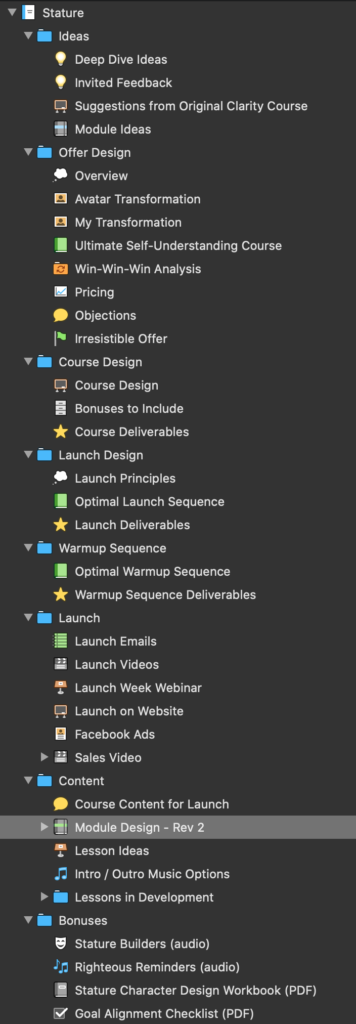
Here’s an example of what my left Scrivener sidebar looks like for the Stature design doc, just to give you an idea of how I structure the outline. There’s a bit more that’s not shown as the outline continues, but this is most of it.
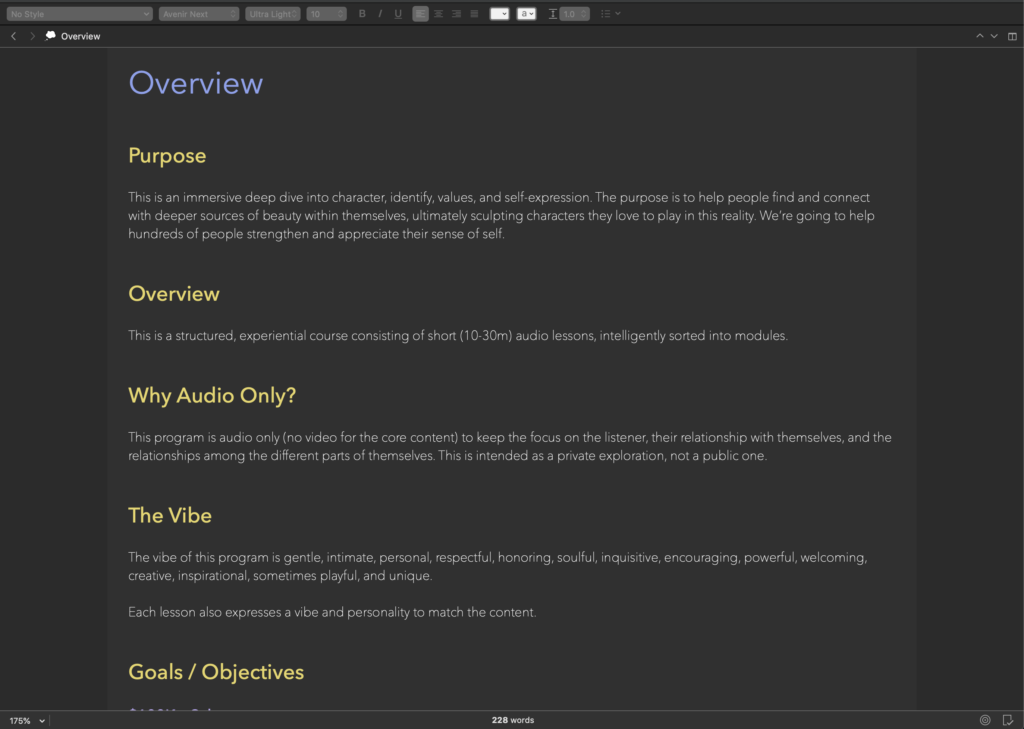
If I click on any of those items, it opens up the relevant part of the larger document that contains the details in a separate window pane on the right side, so it provides instant access to all the details. So it’s like each piece of the outline has its own associated text document.
Here’s an example of what the right window pane looks like, from the Overview section of the Stature course:
What I like about Scrivener is that it provides an expandable and collapsible outline structure, so I can delve into any one part of a project while hiding the other details. I can also click and drag these outline elements and move them around.
This is especially nice for jumping around a lot during the design phase, when I might get a random idea that I may wish to capture while working on some other part of the doc. Then can I click over to the appropriate section, add the idea to process and integrate later, and then return to work on the previous section. Sometimes early in a project, I’ll have a separate capture section, where I collect ideas to process later.
I don’t just use these docs to outline and create the course content. I use Scrivener to work through all of the relevant decisions for a large project. I spend a good bit of time clarifying the purpose of the project. I work through how it’s a win for the participants, a win for me, and a win for the world. I anticipate objections and decide how I’ll address them. I carefully decide what bonus content to create to provide a more well-rounded package. I go over the offer again and again, refining it till it looks really solid. I consider different pricing options.
Many weeks and often months of work go into the project before it’s ready to launch – there are just so many decisions to be made. A launch that looks smooth and simple on the front end is usually way more complex on the back end. If it looks simple, that’s because of all the careful thought that went into simplifying and improving the alignment. People don’t see all the alternative ideas that were considered, evaluated, and rejected along the way.
Some parts of the larger doc are like journal entries where I go over my reasoning for making certain decisions. Then if I ever feel doubtful about a choice later on, I can review my reasoning and see if it still seems sound or if I want to update it. This keeps me moving forward and prevents running in circles while still allowing room to make improvements to earlier ideas. It also gives me an archive where I can look back on previous decisions and see why I made them as I did, even years later. This helps me unearth my own best practices and learn from experience, especially after I’m able to assess the long-term feedback and results of a project.
As this larger document gets filled out, the overall project takes shape. It’s a lot of work to create this type of doc, but it gives me good progress visibility on how far along I am, and it ensures that I attend to every important detail. Most importantly, it helps me anticipate and address potential risks.
Risk reduction is a big reason that I invest so much in creating these design docs. There are lots of things that can go wrong with a launch, and it’s much better to anticipate potential problems early and develop plans for dealing with them. My design docs often include multiple options and contingency plans in case my original plans don’t quite work.
I probably put the most effort into designing the offer. The quality of the offer is the most sensitive part of a launch and the biggest risk in my opinion. It’s where I see many friends endure failed launches – their offer just didn’t land well with their audience. This is why I prefer to invest in co-creating the offer with my readers and especially with previous course participants. When I start seeing some interest and enthusiasm, I know the offer is becoming more solid. Much of this involves picking the right topic and the right transformations to focus on, so people can expect to gain real benefits from going through a course. It’s all about helping people move the needle forward in their lives.
I’ve found that a good way to choose topics is to focus on the relationships we all want to improve. Each course focuses on a different relationship dynamic in our lives. Deep Abundance Integration works on improving your relationship with abundance, money, and even with scarcity. Submersion seeks to improve your relationship with reality, including your relationship to past traumas and painful experiences. And Stature seeks to improve your relationship with yourself, including the relationships between different parts within you to create more synergy and reduce inner conflict and resistance. Our next course after Stature will delve into your relationship with work, especially the creativity and productivity aspects – there’s already a design doc underway for that one.
I think this level of thorough preparation is one reason that all of our course launches have gone very well, not just financially but in the deep satisfaction that people have been gaining and the happy emails about the results people have been achieving.
The launch and development of a major personal development course may look like ease and flow to some, but there really is a tremendous amount of careful thought and detailed consideration that goes into each decision, often long before the launch. Stature’s design doc, for instance, was begun in early 2018, almost two years before it actually launched. It went through several iterations before it converged to the point where it was ready to launch.
I also maintain separate Scrivener docs for Conscious Growth Club, for ongoing marketing and business strategy, and for my overall goals and plans. So I don’t only use these docs for courses and launches.
I often come up with more ideas that I can implement, so these Scrivener docs are good for capturing those “someday / maybe” ideas as well. For instance, I worked through the idea of hosting a free webinar during Stature’s launch week, but I just didn’t have time to work it in, so that had to be cut. However, by documenting the idea in the design doc, I could potentially transplant it into a future project, thereby benefitting from the work I’ve already put into this idea.
Moreover, design docs serve as a nice record of what worked and didn’t work. After a project is fully done, I conduct a postmortem to review what worked, what didn’t work, and what could be improved for next time. Then for future projects, I can keep doing more of what worked (without forgetting) and do less of what didn’t work.
I like to incorporate at least one new idea into each project, and then if it works well enough, I can continue doing it for future projects. It takes a lot of time and energy to develop and implement a new idea, but it takes a lot less effort to repeat the implementation of a good idea that worked before. For Stature, for instance, the new idea was to invite people to connect in a launch Facebook group. It worked well enough that I decided to keep the group open even after the launch finished in mid-January. People who are going through the course are still actively sharing their progress and realizations in the group. I wouldn’t say the group is super active, and a lot of my readers don’t like Facebook, but it was relatively easy to implement, and it provides a nice extra channel to interact with some of the people going through the course.
Each time I develop a new course, I begin with the previous project’s template, and then I can refine it from there. So this gives me an evolving skeleton template to carry over from one project to the next. Just carrying over the structure of the previous project helps to capture the wisdom accumulated thus far, and it makes egregious mistakes less likely.
Perhaps the main benefit of these design docs is that they help me focus. A course and its launch have so many pieces that I can’t keep all of the details in my mind. So I use Scrivener for my go-to capture and design system. This frees my mind to let go of the pieces that I know are already recorded, so I can focus on considering options, making decisions, and moving the project forward instead of being worried that I might forget something important.
Even though these projects are a lot of work, I really do enjoy the creative process. I like Scrivener’s nice touches like how it provides a choice of icons for different sections of a project, so it looks more visually appealing. Dark mode looks nice as well. When I find an app appealing, it reduces friction and makes it easier for me to want to engage with it.
As the coronavirus outbreak shows, viruses are a constant threat to humanity. Vaccines are regularly developed and deployed against specific viruses, but that process takes a lot of time, doesn’t help everyone who needs protection, and still leaves people exposed to new outbreaks and new viruses.
Now, researchers at Massachusetts General Hospital (MGH) have uncovered a novel potential antiviral drug target that could lead to treatments protecting against a host of infectious diseases — creating a pan, or universal, treatment. Their work suggests that the protein Argonaute 4 (AGO4) is an “Achilles heel” for viruses.
AGO4 is one of a family of AGO proteins. Until now, there has been little evidence of why they are important. The researchers, led by Kate L. Jeffrey, PhD, and her collaborators found that AGO4 plays a key role protecting cells against viral infections.
Specifically, this protein is uniquely antiviral in mammalian immune cells. The group studied the anti-viral effects of several Argonaute proteins, and found that only cells that were deficient in AGO4 were “hyper-susceptible” to viral infection. In other words, low levels of AGO4 make mammalian cells more likely to become infected.
This study was published today by Cell Reports.
The MGH researchers suggest that boosting levels of AGO4 could shore up the immune system to protect against multiple viruses. “The goal is to understand how our immune system works so we can create treatments that work against a range of viruses, rather than just vaccines against a particular one,” says Jeffrey.
Mammals have four Argonaute proteins (1-4), which act by silencing genes and which are remarkably conserved throughout multiple living things, including plants. These are RNAi and microRNA effector proteins and RNAi is the major antiviral defense strategy in plants and invertebrates. Studies of influenza infected mice have shown that AGO4-deficient animals have significantly higher levels of the virus.
The next steps are to “determine how broad spectrum this is to any virus type,” says Jeffrey. “Then we need to discover how to boost AGO4 to ramp up protection against viral infections.”