Health24.com | Listeriosis: No new outbreak, annual cases actually below expected range

The National Institute for Communicable Diseases said on Wednesday that reported listeriosis cases in the last year were below what could reasonably be expected, despite 21 deaths.

This comes after the 2017/2018 outbreak that killed more than 180 South Africans.

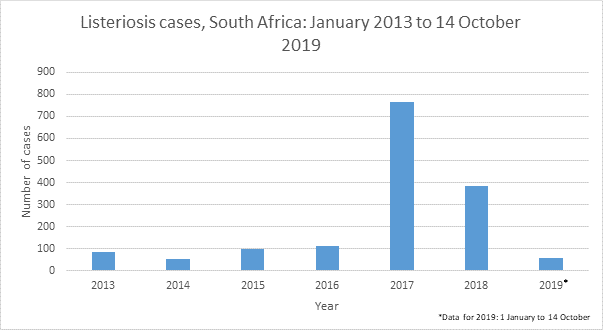
Data for South Africa from 2013 show that prior to the 2017/2018 listeriosis outbreak, 55 to 113 cases per year were reported (see below). 
listerioris

                                                                                                                                  Supplied (NCID)

By the end of December 2018, 640 cases had been confirmed and deaths had doubled to 60, according to News24. Three months later, at the beginning of March this year, 180 people had died and just under 1 000 cases had been confirmed. The outbreak sparked panic among South Africans, considering it was the largest ever in South Africa.

SEE: How SA’s deadly listeriosis outbreak unfolded

However, rumours of another listeriosis outbreak were put to bed yesterday after the National Institute for Communicable Diseases (NCID) released a statement, saying that there is no evidence of another outbreak.

In fact, the release states that for the 12 months following the official end of the 2017/2018 outbreak (3 September 2018 – 18 September 2019), a total of 87 laboratory-confirmed listeriosis cases were reported – a number that is below the expected range for sporadic disease. 

No unusual trends

Data to detect possible clusters or outbreaks are analysed on an ongoing basis and the institute further explains that there have been no unusual trends in the epidemiological patterns of disease, or in the whole genome sequencing analysis in order to detect possible clusters or outbreaks. 

The NCID also added that since listeria monocytogenes is ubiquitous in the environment, it is likely that accidental contamination of food occurs fairly frequently, and that consumption of contaminated food may lead to listeriosis particularly in vulnerable people.

At our current population size of 58.8 million, we would expect 117 to 294 sporadic cases in South Africa per year. 

Class action suit could take years

The source of the listeriosis outbreak had been traced back to a factory owned by Tiger Brands unit Enterprise Foods in March last year. After the discovery, the manufacturer of processed meats shut down a number of its factories and had a massive recall of cold meat products.

Following this, they found themselves in a class action brought against them by more than 1 000 people affected by the outbreak, News24 reports. 

However, the article goes on to mention that Richard Spoor Attorneys, who are representing those that were affected, explained the case could be delayed “for years” as Tiger Brands had issued subpoenas against food-testing laboratories.

Their aim is to obtain information about the identities of people or parties who submitted samples for testing listeriosis and the results of those tests during the period of the outbreak. 

A statement by the company in December last year said it would follow the legal process to bring closure to all parties, and that no liability has been established against the company for the listeriosis outbreak.

“However, should liability be determined, the company will respond appropriately to any legitimate claims,” the statement read.

Image: iStock

NEXT ON HEALTH24X

Share Button

Liquid food shortage left woman’s hair falling out

Jenny Evans is fed intravenously, but says a lack of deliveries left her without essential nutrition.

Share Button

Royal Papworth Hospital rated ‘outstanding’ in all categories

Royal Papworth Hospital in Cambridge is the first in the UK to achieve the rating in all five areas.

Share Button

Health24.com | Losing your job can be a real heart breaker

Money may not buy happiness, but a bigger pay check is good for your heart. And new research suggests the reverse is also true: When income drops, your risk for heart attack, stroke and heart failure goes up.

“One could argue that the fraying social and economic fabric of American society is, quite literally, killing us,” said Dr Edward Havranek, a professor of medicine and cardiology with the Denver Health Medical Center. He added that the link between income and heart health has significant “public policy” implications.

Plummeting household income

For the study, researchers tracked income and heart health among nearly 9 000 adults in four areas in the United States. Their income was checked twice: from 1987 to 1989, and again between 1993 and 1995. Heart health was monitored through 2016.

Over that time, one in 10 saw their household income plummet by more than 50%. And the loss of income corresponded to a “significantly” higher risk of cardiovascular disease (including heart attack, fatal coronary heart disease, heart failure or stroke) compared to participants whose earnings were stable, the findings showed.

In contrast, cardiovascular disease risk dropped significantly among the 20% of households who saw their income rise by more than 50%.

Lead study author Stephen Wang, a medical student at Dartmouth College in Hanover, New Hampshire, described the study as the largest of its kind and the findings as “robust”.

The study included men (43%) and women in Jackson, Mississippi; Washington County, Maryland; suburban Minneapolis; and Forsyth County, North Carolina. Twenty percent of the participants were black, and the average age at the start of the study was 53 years.

Wang acknowledged that the findings do not prove cause and effect. It’s a chicken-or-the-egg problem, he said. It’s unclear whether income or job loss leads to poor heart health, or whether a prior onset of heart illness can lead to financial trouble.

Government safety nets

There are many potential reasons an income loss would affect the heart, he added.

“First, an unanticipated drop in income may affect changes in health behaviours, such as eating more calorically dense foods, or increasing alcohol or cigarette use,” Wang said. Loss of health insurance could make it harder to get good medical care, and lower incomes may increase stress or depression, which are both associated with heart disease, he noted.

Wang said wage earners in countries with stronger government safety nets might see a smaller rise in heart risk after an income loss. If so, he said, it could mean that strengthening the US safety net could help reduce the heart risk during times of financial instability.

A greater focus on “deteriorating social conditions” could also help, Wang suggested.

“Our society needs to pay closer attention to the effects of the social determinants of health,” he said.

That thought was seconded by Havranek, who wrote an editorial that accompanied the findings, which were published online in JAMA Cardiology.

Try to stay positive

The link between plunging income and heart health is definitely “a public policy issue”, Havranek said. “Perhaps those privileged enough to have little vulnerability bear some responsibility to those who don’t have that privilege,” he said.

Even so, the link between income loss and worsening health is “not a completely new idea”, he added.

“We have known for a long time that in the United States, people with low income have poorer health and shorter lives,” Havranek said.

Stress brought about by declining income is likely driving the income-heart connection, even if jobs themselves were stressful. Spouse loss, which often leads to income loss, can be another factor, he added. So, too, is the social isolation that unemployment can trigger.

His advice? When money is tight, “avoid the trap of poor health habits,” Havranek said.

“Explore your options for maintaining health care coverage,” he suggested. “Stay connected with other people. And try to stay positive, recognising that’s easy advice from people who are not going through what you are.”

Image credit: iStock

Share Button

How dad saved son from ‘scalding cuppa’ scars

Each year hundreds of young UK children end up in hospital with severe but avoidable coffee and tea scalds, like Archie.

Share Button

NHS screening ‘needs to fit with busy lives’

Mobile clinics and evening and weekend opening could help increase uptake of NHS screening programmes.

Share Button

Don’t have an exercise budget? Go cheap!

Mayo Clinic does not endorse companies or products. Advertising revenue supports our not-for-profit mission.

Advertising & Sponsorship

Mayo Clinic Marketplace

Check out these best-sellers and special offers on books and newsletters from Mayo Clinic.

Share Button

Stress during pregnancy may affect baby’s sex, risk of preterm birth

It’s becoming well established that maternal stress during pregnancy can affect fetal and child development as well as birth outcomes, and a new study from researchers at Columbia University Vagelos College of Physicians and Surgeons and NewYork-Presbyterian now identifies the types of physical and psychological stress that may matter most.

The study was published online in the journal PNAS, the Proceedings of the National Academy of Sciences.

“The womb is an influential first home, as important as the one a child is raised in, if not more so,” says study leader Catherine Monk, PhD, professor of medical psychology at Columbia University Vagelos College of Physicians and Surgeons and director of Women’s Mental Health in the Department of Obstetrics & Gynecology at NewYork-Presbyterian/Columbia University Irving Medical Center.

Because stress can manifest in a variety of ways, both as a subjective experience and in physical and lifestyle measurements, Monk and her colleagues examined 27 indicators of psychosocial, physical, and lifestyle stress collected from questionnaires, diaries, and daily physical assessments of 187 otherwise healthy pregnant women, ages 18 to 45.

About 17% (32) of the women were psychologically stressed, with clinically meaningful high levels of depression, anxiety, and perceived stress. Another 16% (30) were physically stressed, with relatively higher daily blood pressure and greater caloric intake compared with other healthy pregnant women. The majority (nearly 67%, or 125) were healthy.

Fewer Baby Boys with Mental Stress?

The study suggested that pregnant women experiencing physical and psychological stress are less likely to have a boy. On average, around 105 males are born for every 100 female births. But in this study, the sex ratio in the physically and psychologically stressed groups favored girls, with male-to-female ratios of 4:9 and 2:3, respectively.

“Other researchers have seen this pattern after social upheavals, such as the 9/11 terrorist attacks in New York City, after which the relative number of male births decreased,” says Monk. “This stress in women is likely of long-standing nature; studies have shown that males are more vulnerable to adverse prenatal environments, suggesting that highly stressed women may be less likely to give birth to a male due to the loss of prior male pregnancies, often without even knowing they were pregnant.”

Other Impacts of Stress

  • Physically stressed mothers, with higher blood pressure and caloric intake, were more likely to give birth prematurely than unstressed mothers.
  • Among physically stressed mothers, fetuses had reduced heart rate-movement coupling — an indicator of slower central nervous system development — compared with unstressed mothers.
  • Psychologically stressed mothers had more birth complications than physically stressed mothers.

Social Support Matters

The researchers also found that what most differentiated the three groups was the amount of social support a mother received from friends and family. For example, the more social support a mother received, the greater the likelihood of her having a male baby.

When social support was statistically equalized across the groups, the stress effects on preterm birth disappeared. “Screening for depression and anxiety are gradually becoming a routine part of prenatal practice,” says Monk. “But while our study was small, the results suggest enhancing social support is potentially an effective target for clinical intervention.”

An estimated 30% of pregnant women report psychosocial stress from job strain or related to depression and anxiety, according to the researchers. Such stress has been associated with increased risk of premature birth, which is linked to higher rates of infant mortality and of physical and mental disorders, such as attention-deficit hyperactivity disorder and anxiety, among offspring.

How a mother’s mental state might specifically affect a fetus was not examined in the study. “We know from animal studies that exposure to high levels of stress can raise levels of stress hormones like cortisol in the uterus, which in turn can affect the fetus,” says Monk. “Stress can also affect the mother’s immune system, leading to changes that affect neurological and behavioral development in the fetus. What’s clear from our study is that maternal mental health matters, not only for the mother but also for her future child.”

Share Button

Two new porcelain crab species discovered

Two new porcelain crab species have been described in the ZooKeys journal by scientists from the Smithsonian Tropical Research Institute (STRI) and the Institut fur Tierokologie und Spezielle Zoologie der Justus-Liebig-Universitat Giessen. One of the new species, Polyonyx socialis, was discovered in the South China Sea of Vietnam. The other, Petrolisthes virgilius, has a new identity, after initially being taken for a similar-looking species — Petrolisthes tonsorius — four decades ago in the Colombian Caribbean.

Porcelain crabs belong to a highly diverse family of marine crustaceans, distributed in the shallow waters of oceans worldwide. They also are known as “false crabs,” because they evolved a crab-like form independently of true crabs. A relatively large number of porcelain crab species are symbiotic with other organisms, allowing scientists to tell a story of a long-time relationship between species from distantly related taxa.

“Most porcelain crabs live on the hard substrates of shallow waters like the surface of corals or rocks overgrown by algae, microbes and decaying material,” said STRI research associate Alexandra Hiller, co-author of the papers. “Others live as symbionts of invertebrates like sponges, anemones, sea urchins, polychaete worms and other crustaceans.”

The two recently described species are examples of these symbiotic porcelain crabs. P. socialis derives its name from the Latin word for “social” because it was found living with other organisms — including the larger porcelain crab species, Polyonyx heok — in the compact tube-like shelters built by the polychaete worm Chaetopterus sp. Its broad, flat walking legs and claw-bearing extremities appear to have been adapted for living tightly-attached to the worm tube walls and avoid being perceived as an obstacle for the other organisms.

Although initially mistaken for P. tonsorius in the 1970s, the uncommon colors and atypical habitat of P. virgilius — intertidal vermetid snail formations in the Colombian Caribbean — led the scientists to corroborate through genetic analyses that it was a new species. As a symbiont, P. virgilius has evolved in tight association to its distinctive surroundings: a reef-like microhabitat exposed to wave action and consisting of snail shells cemented to each other and to a hard substrate.

Despite the relatively high number of known symbiotic porcelain crab species, such as P. socialis and P. virgilius, the researchers believe this aspect of their ecology could hinder their long-term survival, particularly in the shallow-water ecosystems where they typically occur. These habitats are often more vulnerable to climate change, ocean acidification and contamination.

“Symbiotic species are thought to be more vulnerable to environmental challenges than free-living organisms,” said Prof. Dr. Bernd Werding, from the Institut fur Tierokologie und Spezielle Zoologie der Justus-Liebig-Universitat Giessen, and co-author of the studies. “Their fate depends on the fate of their host, which may also be affected by local and global conditions and abrupt changes.”

Story Source:

Materials provided by Smithsonian Tropical Research Institute. Note: Content may be edited for style and length.

Share Button

Deadly parasite ‘jumped’ from gorilla to humans

Discovery of mutation 50,000 years ago could help in the fight against malaria.

Share Button