As well as being socially isolating, having no visitor to help with the “small” things can delay recovery, say NHS nurses.


As well as being socially isolating, having no visitor to help with the “small” things can delay recovery, say NHS nurses.
Mayo Clinic does not endorse companies or products. Advertising revenue supports our not-for-profit mission.
Advertising & Sponsorship
Check out these best-sellers and special offers on books and newsletters from Mayo Clinic.
Scientists have shown for the first time a link between two types of heart problems and one of the most commonly prescribed classes of antibiotics.
In a study published today in the Journal of the American College of Cardiology, researchers at the University of British Columbia (UBC) in partnership with the Provincial Health Services Authority’s (PHSA) Therapeutic Evaluation Unit found that current users of fluoroquinolone antibiotics, such as Ciprofloxacin or Cipro, face a 2.4 times greater risk of developing aortic and mitral regurgitation, where the blood backflows into the heart, compared to patients who take amoxicillin, a different type of antibiotic. The greatest risk is within 30 days of use.
Recent studies have also linked the same class of antibiotics to other heart problems.
Some physicians favour fluoroquinolones over other antibiotics for their broad spectrum of antibacterial activity and high oral absorption, which is as effective as intravenous, or IV, treatment.
“You can send patients home with a once-a-day pill,” said Mahyar Etminan, lead author and associate professor of ophthalmology and visual sciences in the faculty of medicine at UBC. “This class of antibiotics is very convenient, but for the majority of cases, especially community-related infections, they’re not really needed. The inappropriate prescribing may cause both antibiotic resistance as well as serious heart problems.”
The researchers hope their study helps inform the public and physicians that if patients present with cardiac issues, where no other cause has been discovered, fluoroquinolone antibiotics could potentially be a cause.
“One of the key objectives of the Therapeutic Evaluation Unit is to evaluate different drugs and health technologies to determine whether they enhance the quality of care delivered by our programs or improve patient outcomes,” said Dr. Bruce Carleton, director of the unit and research investigator at BC Children’s Hospital, a program of PHSA. “This study highlights the need to be thoughtful when prescribing antibiotics, which can sometimes cause harm. As a result of this work, we will continue working with the BC Antimicrobial Stewardship Committee to ensure the appropriate prescribing of this class of antibiotics to patients across British Columbia, and reduce inappropriate prescribing.”
For the study, scientists analyzed data from the U.S. Food and Drug Administration’s adverse reporting system. They also analyzed a massive private insurance health claims database in the U.S. that captures demographics, drug identification, dose prescribed and treatment duration. Researchers identified 12,505 cases of valvular regurgitation with 125,020 case-control subjects in a random sample of more than nine million patients. They defined current fluoroquinolone exposure as an active prescription or 30 days prior to the adverse event, recent exposure as within days 31 to 60, and past exposure as within 61 to 365 days prior to an incident. Scientists compared fluoroquinolone use with amoxicillin and azithromycin.
The results showed that the risk of aortic and mitral regurgitation, blood backflow into the heart, is highest with current use, followed by recent use. They saw no increased risk aortic and mitral regurgitation with past use.
Etminan hopes that if other studies confirm these findings, regulatory agencies would add the risk of aortic and mitral regurgitation to their alerts as potential side effects and that the results would prompt physicians to use other classes of antibiotics as the first line of defense for uncomplicated infections.
This study was funded and conducted by the department of ophthalmology and the Therapeutic Evaluation Unit at the Provincial Health Services Authority.
Story Source:
Materials provided by University of British Columbia. Note: Content may be edited for style and length.

Small gestures of kindness by employers can have big impacts on employees’ health and work performance, according to an international team of researchers. The team specifically examined the effects of employers enhancing the lunches of bus drivers in China with fresh fruit and found that it reduced depression among the drivers and increased their confidence in their own work performance.
“An ultimate solution to improve worker performance and health could be big pay raises or reduced workloads, but when those solutions aren’t feasible, we found that even small offerings can make a big difference,” said Bu Zhong, associate professor of journalism at Penn State.
According to Zhong, bus drivers are vulnerable to specific health problems due in large part to their stressful working environment, which often includes irregular shift schedules, unpredictable traffic conditions and random meal times. In addition, the sedentary nature of driving and continuous whole-body vibration contributes to fatigue, musculoskeletal problems such as lower-back pain, cardiovascular diseases and gastrointestinal issues.
Zhong and his colleagues conducted an experiment with 86 Shenzen bus drivers. During the experiment, on-duty bus drivers were given, in addition to their typical box lunch which includes no fruit, a serving of fresh fruit — either an apple or a banana — for three weeks. The cost of the fruit was 73 cents per meal.
The team distributed surveys to the bus drivers at three time intervals — one week before the experiment began, once in the middle of the three-week-long experiment and one week following the end of the experiment. The findings appear today in the International Journal of Occupational Safety and Ergonomics.
The researchers assessed depression with a personal health questionnaire that is recommended by the U.S. Centers for Disease Control and Prevention. The scale consisted of eight items, asking the participants to rate, for example, how often during the past two weeks they felt down, depressed or hopeless, and had trouble falling or staying asleep.
“Bus drivers reported significantly decreased depression levels one week after the experiments ended compared to one week before it began,” said Zhong.
The team measured self-efficacy — perceived confidence and ability to implement the necessary actions and tasks so as to achieve specific goals — using the 10-item General Self-Efficacy Scale. Items on this scale included, “I can always manage to solve difficult problems if I try hard enough” and “I can usually handle whatever comes my way.”
“We found that self-efficacy was significantly higher in the middle of the experiment week than in the week after the experiment ended,” said Zhong.
Zhong concluded that while eating an extra apple at lunchtime may seem trivial, its impact can be large.
“This research suggests that employees can be sensitive to any improvement at the workplace,” he said. “Before an ultimate solution is possible, some small steps can make a difference — one apple at a time.”
Story Source:
Materials provided by Penn State. Note: Content may be edited for style and length.
On trucks, drones and airplanes, 10 promising technologies for finding natural gas leaks swiftly and cheaply competed in the Mobile Monitoring Challenge, the first independent assessment of moving gas leak detectors at well sites. The organizers of the contest — Stanford University’s Natural Gas Initiative and the Environmental Defense Fund — describe the outcomes in a study published Sept. 10 in Elementa by University of California Press.
While billed as a “challenge,” the organizers had no intention of declaring a winner, as the technologies focused on different aspects of leak detection, such as exact location or size of the leak. While the technologies are still in development, overall, they all found gas leaks quite well.
Leaks in the production, processing and transport of natural gas emit methane — the main constituent of natural gas — into the atmosphere. A greenhouse gas, methane is 36 times more potent than carbon dioxide. In 2016, the U.S. Environmental Protection Agency moved to reduce methane emissions across the natural gas industry, which spurred the development of faster, less expensive detection technologies. Late last month, however, the EPA moved to roll back these methane regulations.
“The technologies are generally effective at detecting leaks, and can act as a first line of defense,” said Adam Brandt, an associate professor of energy resources engineering and the senior author of the study. “Gas system operators will often want to confirm leaks with conventional optical gas imaging systems, but these mobile technologies usually tell you where to look for leaks very quickly.”
A crew of two people using a conventional imaging system can visit four to six well pads a day. All the mobile technologies are considerably faster than that, though their speeds vary a lot. Plane-based systems work more quickly than trucks, which are faster than drones. Because worker time is a large part of detection cost, speeding up detection allows oil and gas companies to find more leaks while spending less money.
Results
As part of the Mobile Monitoring Challenge, nine corporations and a university research team participated last year at controlled testing facilities in Fort Collins, Colorado, and near Sacramento, California. All technologies were effective at detecting leaks. Eight of nine detected leaks correctly 75 percent of the time. (One technology did not have enough flights to be included in the study’s summary.) Five of nine systems detected 90 percent or more of the leaks, including tiny emissions of one cubic foot of gas per hour.
However, most of the systems tested need to improve their ability to quantify the size of the leaks. Also, the technologies varied in their ability to detect the precise location of the leaks, though this is often by design.
For example, one startup’s drone-based system detected 100 percent of leaks and had no false positives. Further, it accurately identified the leaking piece of equipment — rather than just the well pad — 84 percent of the time. However, when quantifying the size of leaks, the system’s estimates were relatively close just 36 percent of the time. For the other eight systems, by the same relatively strict measure, quantification accuracy ranged from 18 to 53 percent.
“This is only the first step to demonstrating that these technologies could help reduce emissions on a level equivalent to existing approaches,” Brandt said. “The tests were run in the spring of 2018, and I’m sure most — if not all — of these technologies have been improved since then.”
Further advances could be in jeopardy, however.
“The recent U.S. EPA announcement about rolling back methane regulations is not just bad for the environment, but also deprives oil and gas communities of high-paying, local jobs that these innovative technology companies could create. Rolling back the regulations could stifle development of these technologies,” said Arvind Ravikumar, lead author of the study. Ravikumar was a postdoctoral scholar at Stanford at the time of the project and is now an assistant professor at the Harrisburg University of Science & Technology.
An assessment like this can help regulators better understand these systems and provide a possible path to large-scale adoption for compliance purposes, the researchers said. The study examined finding leaks at production equipment that can be found in a gas field, not on finding below-ground leaks that might occur from pipes in cities.
Designs for different uses
The Mobile Monitoring Challenge was not a head-to-head competition because the technologies tested are designed to accomplish different things.
“No single technology can meet all the requirements for leak detection and quantification across the natural gas supply chain,” Ravikumar said. “The key to large-scale deployment is to match the strength of each technology, like speed, accuracy and cost, with the right leak detection application. What works for a complex processing facility might not work for long-distance transmission pipelines.”
The systems of some participants focus on identifying leaks only as coming from a cluster of equipment, which could include a wellhead, a separator and a tank, for example. In such cases, operators would use optical gas imaging systems or similar technology to identify the specific source of the leak before initiating repairs.
Similarly, two of the technologies tested are designed to quickly find big leaks, rather than all leaks. More than half the methane lost in natural gas production and processing comes from just 5 percent of leaks. Finding and fixing these “super-emitters” is critical to reducing methane emissions.
Even without strict regulations, natural gas companies could reduce emissions voluntarily. Inexpensive detectors combined with focused use of optical gas imaging systems could pay for themselves by reducing losses of company product. This is particularly true in parts of the world where natural gas prices are higher than in North America.
This research was funded by Stanford’s Natural Gas Initiative and the Environmental Defense Fund.

There is no single cause for suicide, although depression is cited as the most common associated condition. And while there has been progress in national suicide prevention strategies in some countries within the past five years, much more is needed.
The total number of countries with suicide prevention activities stands at a low 38, notes the World Health Organization (WHO), and governments need to step up.
“Despite progress, one person still dies every 40 seconds from suicide,” said WHO Director-General, Dr Tedros Adhanom Ghebreyesus.
“Every death is a tragedy for family, friends and colleagues. Yet suicides are preventable. We call on all countries to incorporate proven suicide prevention strategies into national health and education programmes in a sustainable way.”
The facts are worrying:
If a friend or family member mentions suicide or self-harm, take them seriously.
Suicide warning signs usually include:
Always take a disclosure of suicidal thoughts seriously. It is a myth that people who talk about suicide are less likely to follow through with it, or are simply doing it in an attempt to seek attention.
For a complete guide on suicide awareness guide, check out this list.
Don’t try to argue with the person. Instead, empathise with their expressed emotions: try to listen to what they’re saying to you, and, most importantly, avoid interrupting them until you are certain that they are finished. Be compassionate and make it known that you are there to listen.
Try to keep your loved one occupied by giving them engaging and constructive things to do. A suicidal person will often feel hopeless, helpless and isolated. Encourage them to contact their local GP, local counselling service or an anonymous phone line such as the Suicide Crisis Line or the LifeLine crisis service (see contact information below).
Research has shown that pets can help reduce stress anxiety and depression, although veterinary social worker Dr Magdie van Heerden says that there is no standard intervention with therapeutic animals that will work for everyone.
“Each case of depression needs to be treated differently and an emotional support dog can play a significant role in the treatment process.”
A pet alone may not prevent suicide, but can provide healing. However, van Heerden cautions that these animals are not therapeutic tools to be used only when needed, as they too experience stress and their quality of life also needs to be considered.
Even after your loved one has sought help and seems to be on a healthy path to healing, encourage others to check in on them during this vulnerable time. Many suicides occur during a period of apparent improvement, so never underestimate this step.
*September 10 marks World Suicide Prevention Day – a day dedicated to raising awareness of the risks of suicide and the challenges faced when trying to prevent death by suicide.
Image: iStock

The actress shares 6 ways she lives a healthy lifestyle.

In some parts of the world, camel milk is a local specialty. Dubbed the “white gold of the desert”, it’s been popular in the Middle East and certain parts of Africa for thousands of years, but has only recently made its way to South Africa. But what makes the milk so unique, compared to other kinds of milk on the shelves?
What does it contain?
Camel milk is highly nutritious and full of proteins and organic compounds with powerful anti-bacterial, antiviral and anti-microbial abilities, Carin Smit, clinical environmental and metal toxicologist told Health24.
“The protein in camel milk is totally different to the protein in cow’s milk. The protein in cow’s milk prunes neurocirculatory in the brain. That’s why when cow’s milk is given to an autistic child, the autism deepens, whereas camel milk does not contain that protein.”
Although most of the evidence on the link between camel milk and autism is anecdotal, there are a few small studies indicating potential therapeutic effects in children with autism.
Smit adds that the milk is also a rich source of insulin as there are 52 units of insulin-like protein in every litre of camel’s milk, making it a potential natural solution for diabetes.
If you have trouble digesting lactose (the natural sugar found in cow’s milk), or have milk allergies, camel milk can make you forget all about your excruciating digestive issues as it is lower in lactose and doesn’t contain the protein that causes an allergic reaction to cow’s milk.
Camel milk also has five times the amount of vitamin C and ten times more iron than its bovine counterpart, making it ideal for those with anaemia. Besides this, it’s also anti-inflammatory, can help treat skin disorders such as eczema and psoriasis, and can boost immunity.
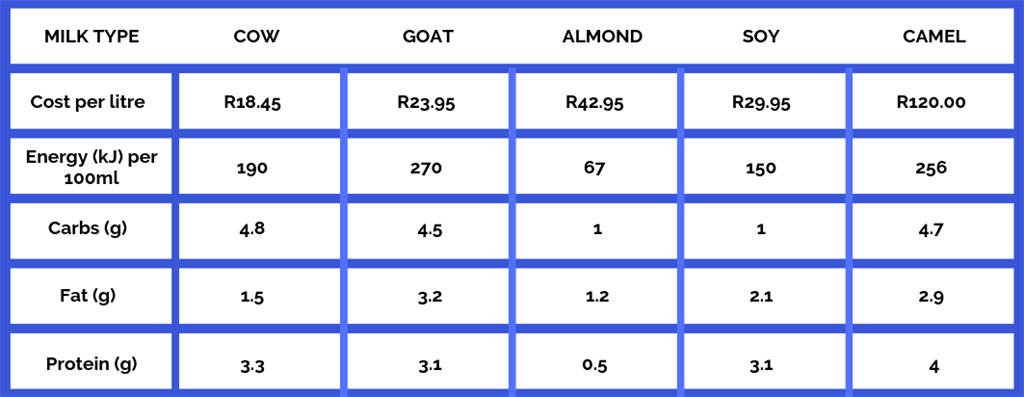
We asked dietitian and Health24 expert, Ria Catsicas, to compare the nutritional benefits and average price of (long-life) cow’s milk and common milk alternatives.
Why the high cost?
When compared to other kinds of the milk on the shelves, camel milk is considerably more expensive. This is because camels produce only a fraction of what a cow produces, and the fact that demand far outweighs supply.
Where can I find it?
This novelty dairy contender hasn’t yet headed to the refrigerated section of South African supermarkets. It’s currently available fresh, as unpasteurised frozen milk in one litre bottles, and in milk powder form from Camel Milk South Africa. It has recently been released in its pasteurised form in Cape Town, but has yet to roll out to stores across the country.
The milk comes from free-ranging camels in the remote district of Askham in the Kalahari. It’s the only camel milk dairy in South Africa and is run by Hans Knoesen, a former banker whose family has been involved with farming for many years.
The camels were once-wild camels that have become adapted to the Kalahari over the past 100 years and have been tamed, Smit tells us. “Once they’ve given birth, they don’t eat anything that is non-organic. They live on 50 Kalahari bushes, so it’s the purest, most ethically-raised milk that you can find in Southern Africa.”
At the moment, the farm has a total of 44 camels that are milked. If you compare that to the fact that there are more than one million milking cows in South Africa, it helps to explain the high cost.
What does it taste like?
Camel milk looks almost identical to cow’s milk. In the video above, we asked people to try camel milk and most of them found it to be sweet and a little salty, but quite creamy. Most of the tasters said it tastes very similar to cow’s milk. Camels eat plants rich in salt, hence the hint of salt.
The raw milk debate
Raw or pasteurised – which is better?
A big concern about camel milk for consumers is that many products are unpasteurised. Nutrition experts caution against drinking unpasteurised camel milk, which, like other kinds of raw milk, can cause food-borne illnesses.
Pasteurisation doesn’t change the milk’s nutrition profile; it only makes it safer to drink. However, Smit explains that the moment you heat the milk above 54 degrees Celsius, it loses its health benefits.
“When you pasteurise milk, you’re heating it to temperatures where nothing remains alive in the milk, so if there were good bacteria, they’d be lost.” It’s reduced to a sterile form. And although during the pasteurisation process, from heating to bottling, to capping, bacteria still get in, these bacteria are not probiotic, but pathogenic.
This is why milk putrifies (rots) when it’s been pasteurised and doesn’t ferment, explains Smit, and emphasises that the camel milk ferments because of the probiotics. If you intend to use the milk as a wellness advancement, Smit suggests it’s used in its pure form and not heated when added to tea or coffee, for example.
On the question of diseases affecting cattle, Knoesen explained to Health24:
“We test our camels once a year for Brucella and TB. The previous test was done in April 2018. It’s a closed herd and we try not to bring new animals into the herd – and if we do, the new camels are tested and kept separate until the test results are known.”
Smit also weighs in:
“Nobody wants salmonella and Brucella, but that’s why all herds that produce the milk are tested by the state vet, and they are tested on a regular basis to see that none of the more serious conditions like brucellosis are passed on to a population of drinkers.
“We also have to understand that camels have a very unique benefit in that they don’t get sick with the diseases that cows get. They don’t get foot-and-mouth disease (FMD); they aren’t affected by tick bites,” she says.
The worst sickness that can affect camels is the Middle Eastern Respiratory Virus (MERS). However, Smit mentions that this happens in the Middle East and that our camels in Southern Africa are not contaminated. If you want to err on the cautious side, it is best to purchase the powdered milk. Although it may not contain all the immunoglobulins that confer health and immunity, you will have peace of mind, says Smit.
The verdict
The main body of research about camel milk was initially published in Arabic, so very few people in the West knew about it and its efficacy. Although subsequent additional research looks promising, more studies are needed to ascertain its nutritional characteristics and for the camel milk sector to flourish in Southern Africa.
But one thing is certain: the camel milk hype is real and this unorthodox milk product is surging in popularity. According to market research firm Technavio, camel milk consumption is projected to grow by 7% globally each year for the next five years. People are embracing healthier foods and are turning away from industrial cow’s milk for several reasons, which means that camel milk might become a popular health fad in South Africa sooner than we think.
Image: iStock
NEXT ON HEALTH24X


In South Africa the numbers are staggering: we have the highest number of babies in the world (111 per 1 000) born with foetal alcohol syndrome (FAS), with the Western Cape at the front of the pack. To put it into perspective, the global average is only 7.7 per 1 000.
What is FAS?
Foetal Alcohol Syndrome Disorders (FASD) is an umbrella term for a group of permanent, life-long and irreversible conditions caused by the effects of alcohol on a foetus, with foetal alcohol syndrome (FAS) being the most extreme.
FAS is permanent brain damage caused by alcohol intake during pregnancy. Alcohol passes from the mother’s blood into the baby’s blood (via the placenta), and can damage a baby’s developing brain and body. It can result in serious physical and mental defects.
According to the KZN Department of Health, FAS is thought to be the third highest cause of congenital mental retardation – it is more common than spina bifida, autism and Down syndrome combined.
Symptoms include learning difficulties, hyperactivity, poor concentration, poor impulse control, and bad memory, among others. Unfortunately, the syndrome is permanent and irreversible, which means there is no cure or treatment.
What about just a bit of alcohol?
Drinking any type of alcohol during pregnancy can cause irreversible brain damage in an unborn child. This is backed by scientific evidence, proving that these activities can have negative impacts on the health of the foetus.
While some studies suggest that a bit of alcohol during early pregnancy is safe, we don’t truly have the ability to accurately say what level of alcohol consumption is risk-free. So why take the risk?
Kids with FAS really struggle
While activities like holding a pencil and drawing come easy to most kids, it can be a frustrating struggle for kids with FAS. This is because children with FAS experience delayed motor development and impaired fine motor skills. Apart from this, poor growth and seizures are also associated with the condition.
Kids in the FAS spectrum can have intellectual disability, but can also have IQ’s above the normal range and be very smart. They might, however, at the same time be lacking in certain other areas such as abstract reasoning or the ability to control impulses. Basic learning can be a struggle, and they may need lifelong support because, cognitively, they’re unable to process things in a normal way.
Can fathers also be responsible for FAS?
Whether fathers’ drinking habits can cause significant foetal abnormalities has for long been a topic of discussion, but there are some studies that indicate that dads may need to put down the bottle as well, as his diet and lifestyle may also lead to birth defects. However, it’s not yet clear how much alcohol can make a difference for men, and until that is known, doctors suggest it’s best for fathers-to-be to also minimise their alcohol intake.
The best analogy for the risk associated with alcohol consumption in pregnancy, as Jen Gunter wrote in the NY Times, is driving with your newborn unbuckled in the back seat: Perhaps you’ll meet with a car accident, perhaps you won’t. But if you do, it could be a minor collision, or it could be catastrophic.
*Each year on September 9th, World Foetal Alcohol Spectrum Disorders Day is observed in an effort to bring necessary awareness to the detrimental impact of the consumption of alcohol during pregnancy.
Image: iStock
NEXT ON HEALTH24X


Speaking on behalf of the families who lost their loved ones in the Bank of Lisbon fire, Robert Moropane says that he won’t be able to find closure until he knows what led to the death of his son, firefighter Simphiwe Moropane.
“Three hundred and sixty-five days later, the mother [my daughter-in-law] of Simphiwe’s kids is still struggling for fend for those children. We are helping her here and there but it’s not enough because their father loved them and if he was still here, they wouldn’t be in the situation they are in.”
Moropane says it took him a while to receive the counselling promised to him and other families.
“They gave us numbers of people from Emergency Medical Services (EMS) to phone so that they can arrange counselling for us. I made about four to five phone calls [but] they gave me excuses, so I stopped because I was the one making the effort and I didn’t know where else to turn to help the children.”
Despite finally receiving counselling through the provincial department of health, Moropane says not knowing what led to his son’s death makes it difficult for him to heal.
“Talking to the psychologist, I found that it isn’t easy to heal if there is something left behind, [in this case] the report of what happened. I called the EMS at least a hundred times just to find out what happened to my son so that we as a family can get our conclusion and move on.”
Gauteng Health MEC, Dr Bandile Masuku says the commemoration of the fire is a way of signifying the change that the department wants to make.
“In terms of our priorities, we want to engage on issues that relate to Occupational Health and Safety (OHS) and one of the commitments we have made is that by the end of this financial year, all of our facilities across the province will be OHS compliant. We are [also] going to renovate and refurbish them.”
He also acknowledges the work that the firefighters were doing when they met their untimely deaths.
“We hope that this plaque will be put in one of our boardrooms where it will constantly remind everyone about the commitments that we have made to the public about our dedication and the sacrifice that civil servants put into their work.”
Democratic Nursing Organisation of South Africa deputy provincial chairperson, Thabang Sonyathi, says that the death of the firefighters should not be in vain.
“What happened here last year must be a stepping stone [upon] our reflection, how do we do things better, how do we protect workers and how do we protect the people that we serve in general? May it be that our colleagues who have fallen here, that their death is not in vain but encourages us to thrive towards OHS excellence.”
He also calls on the investigation of the cause of the fire to be concluded.
“We are still waiting very eagerly for the report… so that it can give us closure.”
The unions are also calling on employers to ensure that the families of the deceased firefighters are taken care of, particularly their children’s education costs.
The other two firefighters who died in the tragedy are Mduduzi Ndlovu and Khathutshelo Muedi.
– Health-e News
Image credit: iStock
NEXT ON HEALTH24X