Do you worry a lot? Besides the anxiety it’s causing you emotionally, it can threaten your health.
Whether you worry over actual problems or the fear of future ones, it interferes with sleep and quality of life. And, according to research done at Case Western Reserve University, it can be so intrusive that it harms your important relationships, too.
Lose yourself in exercise
Here’s what you can do to ease your worries and protect your mental and physical health.
Take action for true concerns. For instance, if you’re worried about money for retirement, learn more about investments. Work with a certified financial planner to help you meet goals.
If you’re nervous about a health condition or an upcoming medical test, bone up on the procedure, experts at the University of California, Berkeley, suggest. Don’t be afraid to ask your medical providers questions so you understand what you’ve read and how it applies to you.
On the other hand, if you find that you look for things to worry about and can’t seem to shake the bad habit, try to lose yourself in exercise. Physical activity boosts mood and improves health – that’s one less worry right there.
You might also investigate mindfulness, a technique that teaches you to live in the moment and not worry about “what ifs”. There are self-help approaches to try on your own, or you can work with a therapist to learn ways to turn off worrying by retraining your attention.
People who aren’t overwhelmed by worry use positive thoughts or actions to keep negative ones at bay. So, look for activities you can do to divert your attention rather than letting worry increase and overtake your practical side.
The way you view ageing can affect how well you manage stress.
Older people who see ageing negatively have stronger (negative) emotional reactions to day-to-day stresses, while such events have little effect on the moods of adults who are more positive about getting older. Their sunny outlook acts as a buffer against little annoyances.
Increasing worry among the young
That’s not all. People who carry negative views also have lower levels of satisfaction and well-being. And they’re more likely to be hospitalised or die young, according to research published in the Journal of Gerontology: Psychological Sciences.
Surveys by the non-profit West Health Institute and the National Opinion Research Center (NORC) at the University of Chicago found that the time to gain a positive perspective on ageing is early in life – your 30s and 40s. This is when many people start to have general concerns about the future, such as facing health and financial issues, developing memory problems and losing their independence.
The survey found increasing worry among younger people that government programmes don’t – and won’t – do enough for seniors.
What can you do to ward off such worries? Stay on top of lifestyle habits that help you avoid serious health threats, like diabetes and heart disease, and that maintain mental sharpness. These include eating a healthful diet, doing regular exercise and getting enough sleep.
But beyond activities that benefit your physical side, add in those that boost mental health. Consider volunteering to develop “emotional capital”, as in mentoring programmes that allow you to share what you’ve learned in life with the next generation.
The term uncontrollable orgasms might sound like a blessing of good fortune, but trust us: It’s far from it.
Uncontrollable orgasms—or the actual medical name, persistent genital arousal disorder (PGAD)—is a legit condition that describes when a woman experiences genital arousal without any sexual or genital stimulation, according to The International Society of Sexual Medicine (ISSM).
And PGAD is by no means fun: Spontaneous orgasms are often not even the satisfying kind. Not only can these orgasms be painful, but they can also leave the woman feeling on the brink of another orgasm with no relief, says WH advisor Dr Jessica Shepherd, an obstetric gynaecologist and founder of Her Viewpoint.
What’s more, uncontrollable orgasms are only one part of the disorder. Other symptoms include tingling in the clitoris; genital irritation, pain, pressure, and throbbing; increased blood flow to the genitals; and vaginal contractions — all of which can last for hours or even days at a time. That makes it difficult for women with PGAD to live normal lives, Dr Shepherd adds.
Exactly how many women suffer from the condition is unclear, since many are too embarrassed to talk about it, says Dr Shepherd. In fact, it’s common for women with PGAD to feel anxious and depressed because of their symptoms, according to the ISSM.
If you’re curious to hear what living with PGAD is like, one woman, Cara Anaya, shared her story with Barcroft Media to raise awareness of the disorder. PGAD causes her to have up to 180 orgasms in two hours, or two or three in a minute, effectively taking over her body and her life.
[embedded content]
Omg. So what causes uncontrollable orgasms?
Make no mistake: Uncontrollable orgasms are completely unrelated to sexual desire. “PGAD is not the same as hypersexuality,” says Dr Shepherd. “It’s a pain disorder, and that’s an important distinction to make.”
That said, doctors and researchers aren’t totally sure what causes the condition. But experts think that, at least for some women, PGAD may be triggered by stress, or neurological or vascular changes.
“There’s also research into how PGAD may develop in addition to other pelvic pain disorders like endometriosis, interstitial cystitis, and vulvodynia,” says Dr. Shepherd.
How do you treat uncontrollable orgasms?
There’s no known cure (at least, not yet) for PGAD, but symptoms can be managed in a variety of ways.
Since stress may be a culprit, cognitive behavioural therapy is helpful for some women.
In therapy sessions, women can identify triggers that cause their PGAD to flare up and learn how to handle the embarrassment and anxiety that uncontrollable orgasms can cause. Anxiety about the condition can often make physical symptoms even worse, according to the ISSM.
SSRIs are also a common treatment since they can help dull sensation in the area and may interact with the hormones, receptors, and nerves that cause or exacerbate symptoms, says Dr Shepherd.
Not to mention, these drugs, typically prescribed for depression and anxiety, could help ease psychological stress surrounding uncontrollable orgasms.
Pelvic-floor exercises, as well as numbing agents or ice applied to the genitals, can also ease physical symptoms for some.
If you experience uncontrollable orgasms or any of the other PGAD symptoms, Dr Shepherd (and I) urge you to open up to your doctor or gyno.
“Because it’s a pelvic condition, there’s a lot of shame around that,” she adds. “I think a lot of women are suffering in silence.”
As I noted in last week’s post on self-trust, I’ve been thinking about the next 20-25 years of my life and what regrets I might have if I don’t make certain changes soon. This may surprise you, but one of my biggest regrets in life is that I never learned to play a musical instrument.
Why Music?
Music is a form of self-expression that I’d love to explore and add to my repertoire of long-term skills. I love listening to music, and I often feel that there are ideas I’d love to express musically, but I lack the skills to do so.
I’m friends with many musicians, and I love watching them perform live. I often feel envious of their skill. Well… it’s not exactly envy per se. It’s more this recognition that I could invest in this skill path as well, and I’d surely enjoy the rewards if I did so.
I keep sensing that there’s a lot of opportunity to connect music with personal growth. Obviously it would be a growth experience to learn how to play. But I also see opportunities in how music could be used to express certain ideas and feelings that aren’t as suitable for writing and speaking.
When I was younger, I had to work a lot on building the courage to express myself, even when I had the technical skills to do so. With music it’s not about the courage but rather the skill set. I’m very comfortable on a stage due to lots of public speaking experience, so I think that comfort level could serve me well when it comes to exploring music. I often feel like I’m missing out a major aspect of what can be expressed from a stage without the ability to express some ideas musically. I see friends who weave together speaking and music, and it just seems like such a delicious and meaningful combo.
I would love to be able to do a live event where we incorporate live music as we go, including something I wrote – and not hurt people’s ears. I’d love to have another way to help people tune in to their own insights and feelings. I’d also love to invite other musicians at the event to come up on stage and share their music as well. I think that could add much more liveliness, fun, and co-creativity to these experiences.
Just as I can tune in to inspired ideas for new articles, I sometimes get song ideas as well. But I don’t know how to give them form and substance. I might pick up a melody that I can hum, but I don’t know how to play the same sequence on an instrument, and I sometimes have some lyrics running through my mind as well. So I’d like to build the skills that would allow me to express these inspirations as well.
I’ve also been helped a lot by music. Sometimes it inspires and energizes me. Sometimes I find it comforting. I remember feeling a special kind of healing from listening to R.E.M.’s “Everybody Hurts” during a particularly dark time when I was younger. I’m sure I’m not the only one. I would so love to gain the skills to create a song like that. I just don’t think that expressing “Everybody Hurts” as an article or a speech would have the same impact.
I often find myself thinking musically about other areas of life too. When mapping out the flow of Conscious Growth Club’s structure over the course of a year, I thought about the rhythm, tempo, and beats, like a year-long song where each week is a different measure. I’ve gained a lot of value from this approach, and I see great potential for developing better musical intelligence.
So that’s my why.
Which Instrument?
Learning guitar appeals to me more than other instruments right now. Guitars have also been popping up in my reality a lot lately, so I also feel like I’ve been getting some extra nudges to go in that direction. I could learn multiple instruments down the road, but for now I feel drawn to focus on just one for a while.
I have many friends who can play guitar very well, including one who is world-class and has played at Carnegie Hall multiple times. I feel like the presence of so much talent is inviting me to at least get started. It just looks like so much fun once you reach a decent level of skill.
I also like the casual nature of an acoustic guitar. Just grab it and play anywhere. Sit outside on the back patio, and just play. Bring it on a road trip.
I’ve never owned a guitar before, and I don’t know how to play one at all. So my starting point is that of a total newbie.
I know from experience that the early phase of learning a skill can be a bit of a slog. You have to learn the basics first. That’s fine. I can be patient. I’ve already been through this long-term learning process with other skills.
With time and practice, I’ve learned how to express any thought through writing and speaking. I’d love to learn how to express inspired ideas musically too.
Getting Started
Last week in the Conscious Growth Club forums, I shared my intention to start learning guitar, and I asked some newbie questions. There are many musicians in the group, so this was a good first step. By sharing the intention, I invited other people to add extra energy to the intention. The early feedback and encouragement also helped me feel more committed to the idea. Sharing an idea makes it more real.
I realized that if I could create a consistent thread of action on this, starting now, my future self would be immensely grateful for it. I want my future self to have this skill set, even if it takes many years of practice. I see him playing music and still having fun with it 20 years from now.
On Saturday morning I awoke with an inspired idea to go out and get a guitar and look into lessons. I had previously tried browsing online for one, but there were so many choices and options that I didn’t understand yet. I figured that a better way to lean into this was to go to a local guitar store. So Rachelle and I went to Guitar Center shortly after it opened.
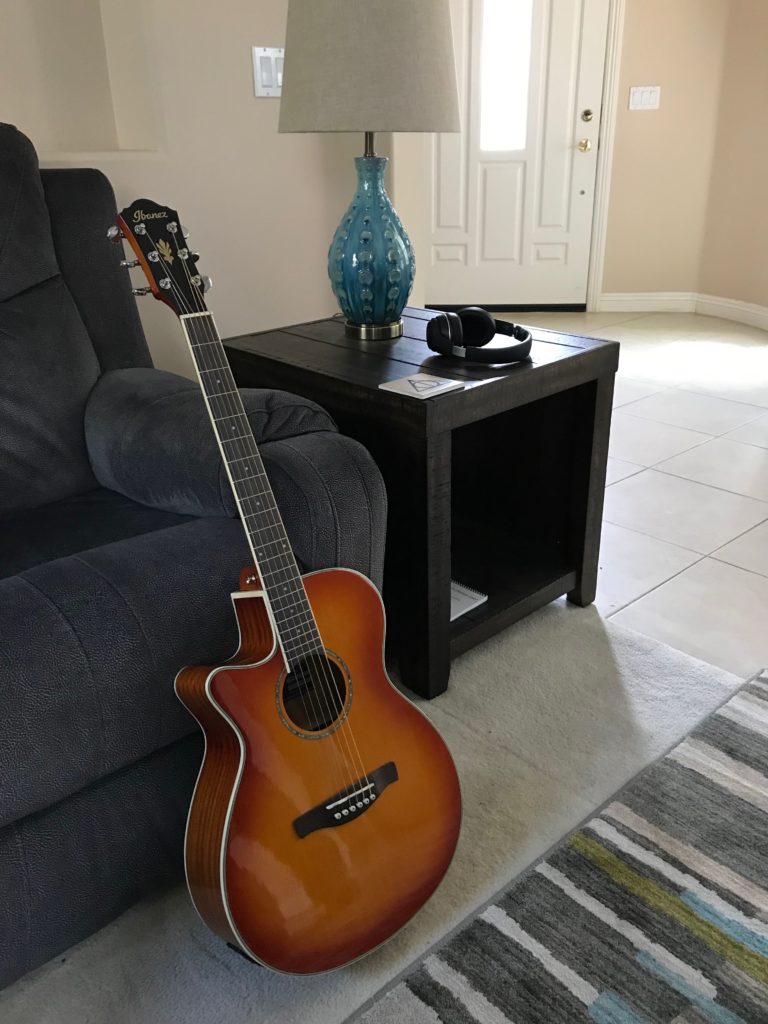
There were dozens of acoustic guitars in the store, but there were only two left-handed ones. The first one I didn’t really like, but the second one I liked a lot. So that was an easy choice.
Here’s my new guitar. It’s an acoustic-electric model.
The experience of buying my first guitar felt like picking a wand at Ollivanders Wand Shop, where the wand picks the wizard. I feel like this guitar picked me. Of course it probably wanted a left-handed wizard, so its options were narrowed too. I like the symmetry of that.
Thanks to this being Memorial Day weekend, it was also on sale. 🙂
The universe helped me out even more though. Shortly before we were going to leave, I was commenting to Rachelle that I don’t even know how to tune a guitar, and a guy behind us (who turned out to be a guitar teacher at the store) overheard my remark and spontaneously showed me how to do it. He used a free app called “Guitar Tuna,” but the guitar also has a built-in battery-powered tuner, which I later learned to use.
We got to chatting, and I told him I was starting out with zero experience and that I was interested in lessons too. He immediately offered to teach Rachelle and me how to play the song “Happy Birthday,” so we went into a private teaching room and had a free lesson, which was fun.
I liked his enthusiastic teaching style, so I signed up for lessons on the spot. I’ll be doing weekly lessons every Saturday, starting June 1st. So that’s perfect to align with the June monthly challenge in Conscious Growth Club. The theme for our June challenge is overcoming procrastination. So my commitment is that in addition to doing the lessons, I’m also going to practice every day for at least the month of June.
The teacher’s name is Max. He’s 42 years old. And he’s been playing guitar since age 10 and teaching since age 15. He also performs in live shows and works at a recording studio. Music is basically his life.
So now I have a guitar, a very upbeat instructor, and I already learned to play a simple song. It only took one morning to really get things rolling. I’m a lot further along than I was when I woke up that morning, and there’s some nice momentum carrying things forward.
I learned that for beginners, developing calluses is an early part of the experience. So even before I know how to play any chords (other than E minor), I’ve already started doing 10 minutes per day of pressing on the strings with my fingers, just enough that they start feeling tender but not so much as to create blisters. I’m also practicing tuning the guitar since that’s about the only skill I know so far.
With just a few hours of action, I feel like I’ve switched dimensions. Now I get to explore the dimension where I learn to play guitar, which sounds like a fun and rewarding path.
What’s Your Preventable Regret?
What will you likely regret 20-25 years if you don’t put something into motion today? If you commit yourself and lean in with courage, could you get some momentum going and switch dimensions in a few hours, much like I did with creating this thread of learning guitar?
What could you do today to add a new thread of skill-building to your life, such that your future self will be beaming you the energy of gratitude and appreciation?
At least start by sharing your intention with people who will encourage you and add some positive energy to it, so it starts to feel more real. And if you don’t have people in your life like that, then you have some extra clarity on what it’s costing you to maintain an unsupportive social circle… and what you stand to gain by upgrading this area of your life.
What is the deal with celery juice? With 129k plus #celeryjuice posts on Instagram, it’s clearly a thing.
Is this another fad diet that dieticians are rolling their eyes at, or is there some science backing up the new trend? We did some research to get to the juice of the craze.
First up, it’s an aphrodisiac. For many years it was believed to be a myth. However, recent studies show that this may in fact be true. Celery contains the steroid hormone androsterone which causes the hypothalamus and pituitary gland to increase levels of 1-testosterone. Androsterone is found in sweat and it is believed that men who eat a diet rich in fruit and vegetables- as opposed to meat- smell better.
Not only does celery amp up your libido, it has also been used as a medicine over the past 3000 years. In fact, it was used as medicine way before it was used as food. Why? For starters it has been known to help lower blood pressure, improves cholesterol, and improves blood flow. The stringy, bitter vegetable contains a bunch of nutrients such as vitamin K, potassium, folate, and fibre and has at least 12 kinds of antioxidants. In a study done on rats, the antioxidants that are present in celery proved to heal stomach ulcers caused by the consumption of alcohol. Hanging? Try eating some celery.
What are the dieticians saying?
Registered Nutritionist Rachel Goodman says “Celery is a good source of potassium, vitamin K, and flavonoids—compounds that have been shown in studies to help keep electrolyte balance, function as antioxidants, and can help lower blood pressure and inflammation” but she also states that celery is full of water (95% to be exact) and the extra hydration obviously plays an important role in the health benefits.
Other dieticians beg to differ, suggesting that there is nothing special about the vegetable and it is another diet craze that is being fueled by pseudoscience. As for juicing it, you’re losing what it’s truly rich in… fibre.
Registered Dieticians, Jessica Cox and Clarissa Mason from the JCN Clinic shared their two cents on the topic: “It has some amazing qualities, but so does an apple”. Although it’s a diuretic and it’s good for your kidneys, there are plenty other fruits and vegetables out there that have amazing health benefits too.
The global search for a group A streptococcal (Strep A) vaccine has narrowed after researchers identified a common gene signature in almost all global Strep A strains by sequencing thousands of genomes in a project spanning 10 years and more than 20 countries.
Strep A, is a bacterial pathogen that in some regions of the world is a very common cause of skin sores and sore throats. In these endemic regions, a large proportion of the population is constantly exposed to Strep A — left untreated can lead to rheumatic heart disease. Aboriginal Australians experience one of the highest incidence of rheumatic heart disease in the world.
Globally, Strep A is estimated to cause more than half a million deaths per year due to invasive and immune-mediated diseases.
Published today in Nature Genetics, a research project by the Peter Doherty Institute for Infection and Immunity (Doherty Institute), the Wellcome Sanger Institute in the UK and the University of Queensland, collated Strep A isolates from endemic areas around the world.
Lead author, University of Melbourne Dr Mark Davies, Doherty-Sanger Fellow at the Doherty Institute and the Wellcome Sanger Institute, said there is a knowledge gap of Strep A in endemic settings with most of the information on the bacterial pathogen coming from high-income settings in Australia, the UK and the US.
“We have little knowledge of the bugs that live and drive disease in endemic areas. So for the past 10 years we have been collating isolates from all over the world — Africa, the Pacific, New Zealand and Australian Aboriginal communities — to determine the specifics of the pathogen, how it causes disease and why it is different in the endemic regions to high-income regions,” Dr Davies explained.
“Using large-scale genomic sequencing, we identified the existence of more than 290 genetically different lineages of clinically important Strep A, highlighting the challenges of designing an effective global vaccine.”
The project found that current leading Strep A vaccine candidates would have limited coverage in the areas where the vaccine is most needed, in streptococcal endemic settings.
“However, using all the data we collected, we narrowed down common gene signatures in almost all strains of Strep A globally, which is a tremendous step forward in identifying what may work as a global vaccine candidate,” Dr Davies said.
Professor Gordon Dougan, an author from the Wellcome Sanger Institute and University of Cambridge, said millions of people around the world are affected by Strep A.
“It can cause a range of conditions, from sore throats and outbreaks of scarlet fever in the UK, to infections leading to rheumatic heart diseases in populations such as the Australian Aboriginal population,” Professor Dougan said.
“In addition to aiding research into a vaccine, genomic data from our study will help researchers understand how Strep A causes disease and why it is different in high-income areas to endemic regions.”
In February this year, the Australian Medical Research Future Fund announced an injection of $35 million to advance the development of a Strep A vaccine.
Australian Infectious Diseases Research Centre Director, Professor Mark Walker of the University of Queensland, said this research has the potential to fast track a Strep A vaccine.
“Vaccine developers and the wider scientific community can now use the database that we have created to identify the most common genes to aid in the development of what could be an effective group A strep vaccine,” Professor Walker said.
“I believe a global vaccine is possible — renewed momentum through our and other research findings, in addition to increased funding commitments, will enhance the drive for a global vaccine.”
Story Source:
Materials provided by University of Melbourne. Note: Content may be edited for style and length.