The rollout has been brought forward as a precaution against a highly-mutated new Covid variant.


The rollout has been brought forward as a precaution against a highly-mutated new Covid variant.
Ava Stanley from Higham says she “thought she was going to die” when nurses ignored her heart monitor.
Yesterday I had my first MDMA journey, alone. I had planned to do it about two weeks in advance, knowing it was going to be a big deal for me. It was not what I expected. But I think it was the most remarkably life-shifting experience I’ve ever had. I can tell it changed me profoundly.
The short version is that it was like having my higher self embody me fully for 8-9 hours, letting me feel HIS feelings, hear HIS thoughts, speak with HIS voice, understand HIS perspective, and experience HIS energy. No, it wasn’t LIKE that. It was EXACTLY that.
Here’s the more detailed version:
I got up early that morning, a little after 4am, had a light breakfast of mostly fruit, and took a microdose (75mg) of shrooms at 5:15am. My plan was, as the shroom energy invited, that it would introduce me to MDMA and help guide me into it. It had been helping me prep for this experience for at least the week leading up to it. It kept sharing that it was going to be a bigger deal than I could possibly imagine, but it also couldn’t spoil the surprise. I trusted it about that, and it was right.
The shroom energy is very familiar to me now after a month of microdosing, so I also wanted it there in the background like a trusted friend. Even though MDMA rarely leads to a bad trip experience and typically leads to blissful feelings, I wanted to build some trust with it first. I did not want a human sitter, so I invited the shroom energy to act as my sitter for this first experience, and it was glad to oblige. It said MDMA is like a cousin, a different interface to spirit-level energy.
MDMA is often regarded as a social drug that evokes feelings of deep love and oneness. One of its street names is Ecstasy, although if you get it from an iffy source, it’s extremely likely to be cut with other substances. MDMA would be great for having a cuddlefest experience. It can also be used for deep solo journeys though.
I knew that if I took it while Rachelle was here, even if she didn’t take it, I’d just want to cuddle her and love her and wouldn’t do any inner work. On Thursday night I dropped Rachelle off at the airport to visit her family in Canada for two weeks. So I scheduled this for the day after. That would give me the whole weekend to recover if needed, and I could use the extra time for more integration work, which I definitely could feel I could use now.
I wasn’t sure how much MDMA to take, even after reading lots of recommendations, but was guided to take 130mg. Some say 75-80mg for a newbie is good with 120mg being a reasonable max. I sensed I could handle a bit more, even for my first time, and I think that was just the right amount for me. I even set aside an 80mg booster to take after two hours, which would extend the experience if I wanted, but I wasn’t sure if I’d need it. Turns out I definitely didn’t need the booster, which was abundantly obvious close to the two-hour mark, so I didn’t take it. I’ve noticed that the dosage is also an expression of intentionality. If I take a higher amount, I’m inviting a stronger experience. One reason I went higher is that I thought, What could possibly be bad about inviting stronger unconditional love?
I took the MDMA at 7:30am, so 2:15 after the shrooms. That would be past the peak of the shroom energy kicking in for me, already on the gentle back slope of it, which would allow plenty of time for the intro.
I figured the MDMA would take about an hour to start kicking in based on what I’d read. Apparently many people think it’s not doing anything for that first hour. So after I took it, I figured I had plenty of time and prepared my space for having the experience in my living room. Turns out for me I started getting noticeable effects after about 20 minutes, but fortunately I finished my prep just in time.
I lit a candle and laid out a bunch of colored index cards with messages on them to help serve as reminders. I’d heard of people sometimes feeling lost in an MDMA journey, and it can get deeply emotional, such as with childhood trauma coming up. So I thought those cards would be nice to look at if I needed them.
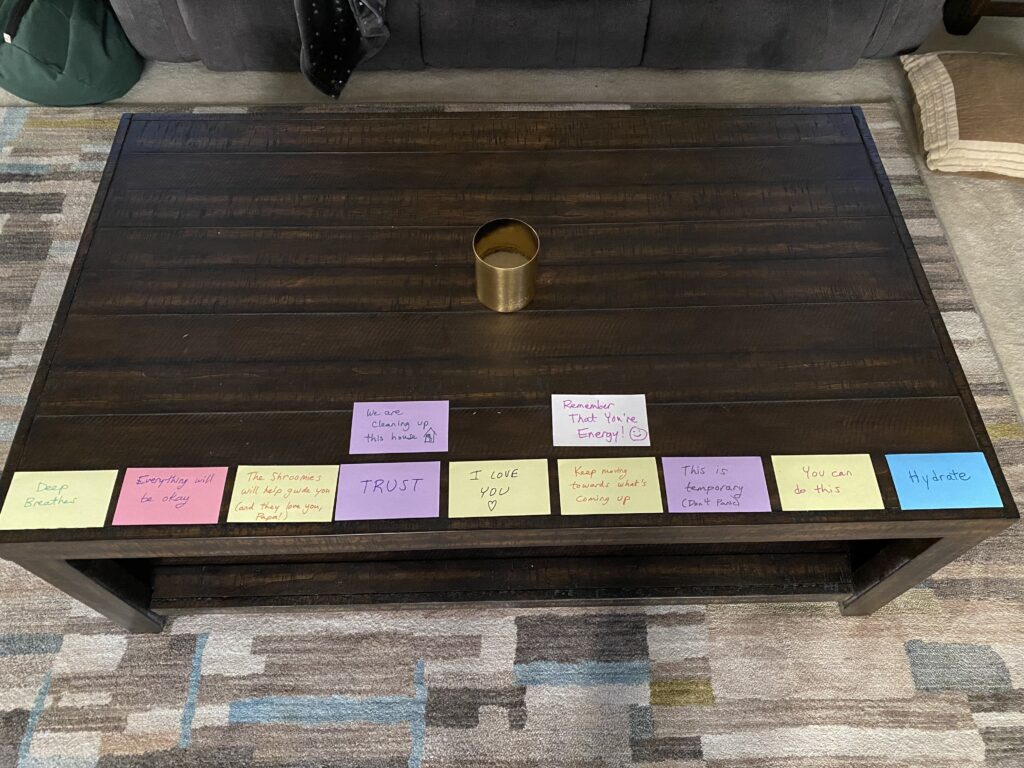
I filled out cards with these messages:
I didn’t really need the cards during the session, but I looked at them a couple of times and found them helpful.
The Shroomies love to greet me as “Papa” when their energy starts coming online (I’ll let you guess why), usually in a playful way like, “Paaaappppppppaaaaaa!” They’re a lot of fun in how they communicate.
Music-wise I played whatever felt right to me at the time, starting with Enya, then later some Madonna, Jessita Reyes (native flutes), a break with no music for a while, and then some upbeat trance music at the end. These choices were perfect. I noted how the lyrics from Enya and Madonna often synched perfectly with what I was experiencing at the time, like internal and external realities were one. I recall that Madonna’s “Ray of Light” song seemed particularly fitting when it came on. I used Apple Music to play these artists, so they weren’t my playlists, and I didn’t know which songs were coming up.
I felt a little bit wonky as the MDMA started coming online but only for a short while, like some mild dizziness on and off for about 20 minutes. Nothing about the experience ever felt scary or worrisome. I never felt out of control (like I did on ayahuasca). I always felt like my own will was fully present. I was surprised by how active I was during the experience, actually moving around and talking and taking lots of action around the house. I thought I’d just be sitting and processing, but nope.
Once the intense connection that the MDMA opened for me began to flow through, which was the connection to my higher self, I told the shroomie energy that I was good to go, and they gracefully receded into the background and let the MDMA take it from there.
As I anticipated it wasn’t easy, but not in the ways I expected. It was mainly tons of releasing and remembering and reclaiming.
I really dislike purging and didn’t expect that MDMA would induce anything like that. But for me it was the opposite, just not how I expected. As my higher self started coming through, he immediately saw a lot of old energies in me that didn’t mesh with his energy, and he invited me to purge them from my energy matrix. I said okay and that I wanted to purge it down, not up. He initially agreed. But then as we checked on this energy, he said, “Nope, it wants to come up. It wants to be acknowledge for what it is at it leaves. Can you feel that?” I had to agree with him because I felt that too. So off to the toilet I went.
This was the tough part. I spent perhaps 4 hours retching over the toilet – yes 4 hours (many people run whole marathons in less time) – letting go of one misaligned energy pattern after another. Energetically I purged way more than I did from 4 ayahuasca nights combined, but nothing physical actually came out – no vomit, no bile, not even water. It was all just old energy that had to go. I just kept putting my finger down the back of my throat to get everything out, till it finally felt like there was nothing more to release.
That was really odd because I kept drinking lots of water, even while I was in the bathroom. And my higher self said that the water is love energy that’s pushing out everything. So when I’m ready to push out more energies that don’t belong, just drink more water. I could feel that for the purposes of what we were working on energetically, the water was indeed playing that role. The more water I drank, the more I could feel wanting to come out. But for some reason the water never came back up, even after retching a bunch immediately after drinking more.
For most of the purging marathon, I could tell what was being released since most of those patterns were identified. I’d get a glimpse of one pattern, and my higher self would say, “You wanna release that too?” It was physically tough, but my higher self paced me and gave me breaks whenever I needed or requested. After a pause of 5-10 minutes now and then, where I’d get up and walk around for a bit or just rest, he’d check in to ask, “Ready for the next round?” I knew this was really important, even though it was tough on my body, so I cooperated fully with the process, knowing we had to get this over and done with.
At one point I weighed myself and saw that I was almost 9 pounds heavier, just from all the water. I barely ate anything the whole day, mostly just a small amount of fruit. During the experience I only ate one pear and not all at once, but that was after the purging was done.
I wasn’t peeing a whole lot, but each time I did, we associated it with releasing more misaligned energy. At least that was an easier way to purge. It felt like the water really was going into my body as cleansing energy. I peed more after the session and a few times during the night, but it still seemed like a lot less going out than I took in that day.
Perhaps 1% of the experience involved working with my inner child, really just a handful of minutes in the beginning before the purging began. It was made very clear that I never abandoned him, and he was never traumatized, so there was no need to work on that. Even as a kid, he was way too strong to be traumatized. He had many blocks and filters installed, which he accepted as part of this incarnation, but trauma wasn’t part of his path this life.
Some people have told me that I have a boyish quality, and I’d say that’s true. I’ve long felt that my inner child is very much a part of my adult life. I give him lots of playful and creative outlets to express himself, and he knows I’ll never repress him. When I check on him, he seems pretty happy.
About 99% of this journey involved working with my higher self on shedding and releasing old energies I no longer needed. It was like standing in the fire of spirit and watching it just burn out what no longer fit. I didn’t have to do anything to guide it. I just had to go through it. Man that was an endurance fest. Distance running is so much easier. But it feel really good to make it to the other side.
At the end I even purged my resistance to purging. “Do you really want to keep resisting that?” he asked. “Nope, let’s get rid of that too.”
This wasn’t the kind of unconditional love I was expecting, but it was definitely a form of that love, the form being my higher self putting a flamethrower in my mouth and inviting me to pull the trigger and roast out what no longer belonged in my energy matrix. In addition to this fire energy, we also worked with water, air, and earth energy. But the fire energy was nearly half of it.
The experience was more action-based than I expected, especially symbolically, including being guided to declutter some incompatible items, take a shower (water), change clothes multiple times, change some air filters, turn up the AC and open the window for a while (air), turn on the fireplace (fire), and pace around and speak a lot. After I settled into the experience, there was no disorientation, dizziness, confusion, or psychedelic visuals. It mostly felt like being guided by raw spirit power.
My higher self demonstrated everything for me too, including using my body to show me how to speak with conviction and energy. He kept saying through me, “THIS is your voice. THIS is how you talk. THIS is how the real you speaks. Notice the difference? Feel it in your body?” to show me how my voice is supposed to sound when I’m totally unblocked. It was deeper and stronger than I normally talk. After a while I noticed that it hurt my throat and strained my voice to keep talking like that. And he said, “Yes, your body hasn’t been trained to hold this energy, but now that those blocks have been removed, you’ll need to practice, so you strengthen your ability to speak in that register. It will take time, but you’ll get there.”
I’m so glad I didn’t have a human sitter. It’s obvious to me now that such a person would have ruined the experience, not allowing me to go deep enough and probably disrupting me at the worst possible times. I think I’d have scared a sitter with how I was using my voice and how powerfully I was speaking my own truth about a great number of things and feeling that energy. And four hours of purging, which I willingly consented too, surely would have been a concern for many people. I knew going into it that this had to be a pure spirit-level experience. The shroomies were the ideal sitter for me, knowing when to check in with me and knowing when to recede into the background and let me have the experience I needed to have.
There was no ambiguity in the communication from my higher self. It was word-for-word crystal clear at all times, often because he spoke directly through me. Even though it strained my voice, it felt amazing to hear his raw power speaking through me and to hear it reverberating off the walls. I don’t think I’ve ever spoken with such intensity. It felt like I was speaking from a whole new place of truth, and perhaps the reason it felt so powerful was because it was coming from such a deep level of truth. It felt like I was experiencing truth, love, and power as all being the same energy. I like to frame that combo as intelligence, which is still accurate on a mental level, but on an experiential level I think I’d call it spirit now.
I’ve often sought to communicate with my higher self through meditation or visualization sessions, and I can see that certain aspects of him came through during those sessions, but this was next level. No, it was 100X next level. I don’t think I’ve ever had such a profoundly clear sense of knowing who I really was at the spirit level. It was such raw, powerful, masculine, fiery, Emperor energy… yet with infinite compassion too. I now recognize it as pure love as well, and I can tell this has upgraded my entire conception of what love actually is. I think my old version of love was way too human, too mild, too weak, too apologetic. My old version of love was like a rose. The new version I experienced was like an entire galaxy filled with immortal roses, all permanently set ablaze yet not being consumed by the flames.
I knew that this energy really wanted to come in and inhabit me permanently going forward. This wasn’t meant to be a temporary peak experience where I’d sink back down again afterwards. When I connected with him, I knew it was time to merge back with him, and I knew it wasn’t going to be easy. I had to go through all that purging because my current energy matrix still wasn’t capable of holding him for long, even after decades of self-development work. As I embodied him, his beingness had to push out whatever didn’t feel aligned.
He made it clear that I’d gone far on my human journey – far enough in terms of self-development work. But those frequencies of human-level self-investment weren’t capable of taking me the rest of the way, at least not during my lifetime, if I wanted to merge back with him while still in human form. I had previously done a lot of inner work leading up to this, especially during the past month, so I knew this was coming as the next big piece. I still had no idea how big. This was way bigger than I ever imagined.
He told me that we didn’t need to achieve perfection. We just had to get 85% or better, and then we could gradually work on any remaining misalignments in the weeks ahead and in a more graceful way. Getting to 85% would be enough for him to stick around. Today he said he feels we made it to 88 or 89%, including some additional decluttering this morning. So we still have plenty more to do, and I can tell a lot of that is physical as well. He’s been looking around my home and wanting to make it HIS home. He’s fine with most of it, but in some areas his standards are higher. He assesses everything not by the look or value of it but by the energy of it. Whenever I look at certain things, he keeps asking, “Is this YOU? Is this US?” And I have to be honest with him every time. It’s pretty obvious that if I want him to stay, which I definitely do, I’m going to have to raise my standards to his level, in everything I interact with. That isn’t going to be easy, but I do feel ready for it. Hmmm… that makes me wonder if I can also purge that “this isn’t going to be easy” frame. And he says, “Yup, we can purge that too.” Fortunately the purging we’re now doing doesn’t require going to the bathroom. He’s teaching me how to do it energetically instead of having to do it physically. This is slower but kinder to my body. He also told me that whenever I go to the bathroom normally, always imagine that I’m purging some energy that doesn’t belong and flushing it away, such as an attachment to a possession that truly isn’t me, and that will speed up the process. I feel like I’m getting a rapid course in how to use my spirit power.
His voice is also in my head, so whenever I have a thought, if the thought isn’t aligned with his energy and power, he’ll jump right in and challenge it. He’ll ask, “See that thought? Is that the real YOU?” When I have to say respond, “Nope, that’s a limiting frame,” he’ll respond, “Well, is that your truth? You want to keep that? Or you want to purge that?” Then we have to discard it and replace it with a better thought.
When I’m thinking and doing what feels aligned to him, such as writing this blog post, he’s pretty quiet. I think that’s because it’s during those times that I AM him. But when I begin to fall out of alignment with him in thought or action, he glides in immediately and invites me to notice, question, and change the frequency of whatever it is. I don’t have to fix it immediately since he’s patient and gentle too, but I can tell he’s also persistent and won’t let things slide without my staying aware of them. It’s a very potent experience having this spirit energy inside me watching my every thought from within. There’s just no hiding anything from him. It feel like my mind is embarking upon a spirit-level cleansing process, probably one that’s going to take a while to unfold. That thought actually doesn’t bother him since he’s fine with my pacing myself. The time it takes is of no concern to him, as long as I keep progressing.
Even near the beginning, just before we got into the purging, he spoke through me, “This isn’t personal growth work. You’re done with that now. You’ve grown enough on your human journey, haven’t you? Well, you’ve finished. Yes, you’re DONE! You did what you came here to do in that regard. That doesn’t mean you’ve perfected everything, but you didn’t need to. You can call that part of your life complete. This is NOT going to be inner work. THIS is a gift. You’re about the receive the greatest gift you’ve ever received in your life. REALLY. You don’t know it yet, but it’s coming. Imagine all the gifts you’ve ever received, combined and multiplied by 100,000. This is more than that. This is going to be a HUGE HUGE gift. You have no idea what’s coming. No idea.”
While it didn’t feel like a gift going through all the purging, I do feel that he was right about the nature of the gift. Sometimes I feel stunned by what just happened. Like how did this even come through? How was this even possible? How this all unfold in only one day? I feel so much lighter and stronger inside. I’m not even sure I know who I am right now, or so my old self might think, and yet I know that I am sure. I feel very different inside, like there’s this giant ball of conscious fire energy within me, like I have infinite motivation and infinite creativity. It feels like so many walls, filters, and blocks within me have been demolished, and still more will crumble in the weeks ahead.
It’s been 34+ hours since taking the M, and I’ve not had any negative after-effects. I was just a little tired in the morning for a couple of hours, but my energy perked up, and I’ve been having a delightfully active day. I’m not even trying to get things done, but I can’t help taking action. I keep tending to takes like they require no energy at all. I can feel my higher self within me at all times. He hasn’t departed and says he’s staying for good now. I know I have more to do to maintain this, but I also know that I’ll do whatever it takes. There’s just no way I could let this gift go.
Lots of energy has been flowing in the direction of decluttering now. As I moved around the house, my higher self keeps asking me about various items, “Is this you? No. Wanna get rid of it then? Let’s do it!” Chase Bank mug… ewww… totally wrong energy. Why did I even accept that? Ripped shirt? Not me. I’ve dumped a lot in the recycle bin and trash today.
I’m really seeing how items have energy associations, such as a filing cabinet that links to my ex-wife’s energy since it used to be hers. That has to go soon. There’s nothing wrong with her energy, and I have no ill feelings towards her, but I can see plain as day that it just doesn’t belong in that space. I’ll donate it to someone who’ll appreciate it.
It feels like I’m seeing my reality through my higher self’s eyes at all times now. He has no doubts about anything. Everything is crystal-clear obvious to him – what can stay, what needs to go, what actions to are correct, what’s me and what isn’t, what’s true and what isn’t. I’m wanting to pace myself and not ask too much just yet because I know if I ask about certain questions, he’ll answer truthfully, and some of those truths will invite action to align with them. He’s patient but also persistent. It’s obvious he’ll not be satisfied with misalignments. It’s a good thing my work is so flexible and can easily adapt to his presence. I can tell that’s going to be an incredible ride ahead.
I took a little more shroomies today (just 75mg) to help me with integration. My higher self said I didn’t need them today but that he could tell I’d enjoy their presence, which turned out to be true. It’s been harder to hear the shroomies today, and I had to tune into them directly to do so because my higher self’s presence was so strong. It was like trying to hear the sound of a breeze in the presence of a tornado, but I managed to interface with them as well. The shroomies and my higher self were even able to combine their voices and speak to me as one sometimes.
At one point today I said something aloud – I don’t recall exactly what – and I noticed that it had a different vibe. My higher self then said, “You feel that? We both said the same thing at the same time.” I could tell he was right. It was a unique synchronization experience, even though it was only one sentence.
Starting tomorrow I’m taking a break from having any substances, probably for at least 3 weeks. I sense that I’ll continue microdosing shrooms since I do like them, but I’ll have to see how that plays out after a few weeks alone with my higher self. Right now I have plenty of time on my own to continue integrating this experience, and I sense I’ll make a lot more progress by the end of the month since I’m already seeing that unfold with ease today. I can feel that there’s a cascade of so much more coming up.
What a doorway this exploration of psychedelics has opened up. I really had no idea what was on the other side. I just noted the “Do Not Enter” sign as I walked past it. I now know that sign is there for good reason. The “dangers” are the cover story that people use to keep their blocks and limitations in place until they’re ready. Somehow I was able to just know when I was ready, and then all the blocks to having these experiences moved out of the way, and I was invited in. Getting access to these substances was ridiculously easy, but only after I crossed into readiness with my energy and intentionality… not perfect readiness but 85%+.
Whatever I took yesterday was the real deal. So potent and powerful. Definitely one of the most amazing days of my life. What an incredible incredible INCREDIBLE gift. Now what? I’m excited to find out.
Okay so you might be wondering if I paused to consider if this experience was REAL or just a bunch of imaginary hooey that was all in my head. Of course I pondered that. And then my higher self injected, “Is that you? You like doubt? You wanna keep that? You still need that?” And it struck me as obvious that I don’t need such doubt anymore either. It’s fake doubt. It’s not truth. It’s not me. I’ve experienced way too much and journeyed far enough down this path that I don’t feel the need to retain the energy patterns of such doubt. So I’m letting that go too.

Most artificially intelligent systems are based on neural networks, algorithms inspired by biological neurons found in the brain. These networks can consist of multiple layers, with inputs coming in one side and outputs going out of the other. The outputs can be used to make automatic decisions, for example, in driverless cars. Attacks to mislead a neural network can involve exploiting vulnerabilities in the input layers, but typically only the initial input layer is considered when engineering a defense. For the first time, researchers augmented a neural network’s inner layers with a process involving random noise to improve its resilience.
Artificial intelligence (AI) has become a relatively common thing; chances are you have a smartphone with an AI assistant or you use a search engine powered by AI. While it’s a broad term that can include many different ways to essentially process information and sometimes make decisions, AI systems are often built using artificial neural networks (ANN) analogous to those of the brain. And like the brain, ANNs can sometimes get confused, either by accident or by the deliberate actions of a third party. Think of something like an optical illusion — it might make you feel like you are looking at one thing when you are really looking at another.
The difference between things that confuse an ANN and things that might confuse us, however, is that some visual input could appear perfectly normal, or at least might be understandable to us, but may nevertheless be interpreted as something completely different by an ANN. A trivial example might be an image-classifying system mistaking a cat for a dog, but a more serious example could be a driverless car mistaking a stop signal for a right-of-way sign. And it’s not just the already controversial example of driverless cars; there are medical diagnostic systems, and many other sensitive applications that take inputs and inform, or even make, decisions that can affect people.
As inputs aren’t necessarily visual, it’s not always easy to analyze why a system might have made a mistake at a glance. Attackers trying to disrupt a system based on ANNs can take advantage of this, subtly altering an anticipated input pattern so that it will be misinterpreted, and the system will behave wrongly, perhaps even problematically. There are some defense techniques for attacks like these, but they have limitations. Recent graduate Jumpei Ukita and Professor Kenichi Ohki from the Department of Physiology at the University of Tokyo Graduate School of Medicine devised and tested a new way to improve ANN defense.
“Neural networks typically comprise layers of virtual neurons. The first layers will often be responsible for analyzing inputs by identifying the elements that correspond to a certain input,” said Ohki. “An attacker might supply an image with artifacts that trick the network into misclassifying it. A typical defense for such an attack might be to deliberately introduce some noise into this first layer. This sounds counterintuitive that it might help, but by doing so, it allows for greater adaptations to a visual scene or other set of inputs. However, this method is not always so effective and we thought we could improve the matter by looking beyond the input layer to further inside the network.”
Ukita and Ohki aren’t just computer scientists. They have also studied the human brain, and this inspired them to use a phenomenon they knew about there in an ANN. This was to add noise not only to the input layer, but to deeper layers as well. This is typically avoided as it’s feared that it will impact the effectiveness of the network under normal conditions. But the duo found this not to be the case, and instead the noise promoted greater adaptability in their test ANN, which reduced its susceptibility to simulated adversarial attacks.
“Our first step was to devise a hypothetical method of attack that strikes deeper than the input layer. Such an attack would need to withstand the resilience of a network with a standard noise defense on its input layer. We call these feature-space adversarial examples,” said Ukita. “These attacks work by supplying an input intentionally far from, rather than near to, the input that an ANN can correctly classify. But the trick is to present subtly misleading artifacts to the deeper layers instead. Once we demonstrated the danger from such an attack, we injected random noise into the deeper hidden layers of the network to boost their adaptability and therefore defensive capability. We are happy to report it works.”
While the new idea does prove robust, the team wishes to develop it further to make it even more effective against anticipated attacks, as well as other kinds of attacks they have not yet tested it against. At present, the defense only works on this specific kind of attack.
“Future attackers might try to consider attacks that can escape the feature-space noise we considered in this research,” said Ukita. “Indeed, attack and defense are two sides of the same coin; it’s an arms race that neither side will back down from, so we need to continually iterate, improve and innovate new ideas in order to protect the systems we use every day.”
Northampton General Hospital is told to compensate a pregnant woman for repeated failings.

North Carolina State University researchers have successfully transferred an important gene from one compartment of a plant cell to another to produce tobacco plants that lack pollen and viable seeds, while otherwise growing normally. Their findings could lead to better ways of producing hybrid seeds to maximize crop productivity, or to introduce seedlessness in fruit species lacking the often-desired trait, such as raspberries, blackberries or muscadine grapes.
The researchers began the work in the energy-producing portion of a cell, the mitochondria. In plants, aberrations within the mitochondrial genome can be associated with the inability to make pollen, a trait known as cytoplasmic male sterility (CMS) that has been successfully exploited for the production of high-yielding hybrid seeds in many important crops. Naturally occurring CMS-based systems that are robust enough to facilitate commercial scale hybrid seed production are limited, however.
In their proof-of-concept study, the NC State researchers, together with colleagues from Precision BioSciences and Elo Life Systems, deployed a unique strategy to test whether the CMS trait could be generated in tobacco, a commonly used model species in plant research. The researchers initially took an essential mitochondrial gene called atp1 and moved it to the nucleus after placing it under the regulatory control of an element — known as a promoter — that they predicted would allow the transferred atp1 gene to be expressed in every cell of the plant except those responsible for producing pollen. The researchers then used genome editing tools to permanently remove the native atp1 gene from the mitochondria.
Their approach was successful.
“The results exceeded our expectations,” said Ralph Dewey, Philip Morris Professor of Crop Science at NC State and corresponding author of a paper describing the research. “The plants looked completely normal up until they began to flower, but then failed to produce pollen because the transferred atp1 gene was no longer expressed. Importantly, because the original atp1 gene was deleted from the mitochondrial genome, the trait will be inherited maternally, which is a crucial consideration for large-scale hybrid seed production.”
Pollen wasn’t the only casualty of the technique. When cross-fertilized using pollen from a neighboring normal plant, their tobacco plants unexpectedly produced small, hollow seeds, much like those seen in popular “seedless” fruits such as watermelons and grapes.
“That’s because the promoter that we chose not only failed to express during pollen formation, but also during early seed development,” Dewey said.
advertisement
Dewey said that his team is now working to decouple these results so that researchers can achieve either pollen infertility or the seedless trait alone, instead of both at the same time.
Dewey also stressed that the findings shouldn’t be limited to tobacco plants. Their next generation of experiments will include testing the seedless trait in tomato, a close relative of tobacco. They will also test their novel CMS trait in a grain such as rice to test the efficacy of their system in a crop where hybrid seed production is important for achieving maximal yields.
“Knowing the way the system works, there’s no reason to believe that we couldn’t effectively transfer the technology to other plant species,” he said.
The study appears in Frontiers in Plant Science. Devarshi Selote, H. Carol Griffin, Allison N. Dickey, Derek Jantz, J. Jeff Smith, Anna Matthiadis, Josh Strable, Caitlin Kestell and William A. Smith co-authored the paper. The work was funded in part by a grant from Elo Life Systems and supported by the NC State Plant Breeding Consortium. Dewey and several other researchers have filed a patent on the new technique.

A new Northwestern Medicine study challenges a common belief in what triggers Parkinson’s disease.
Degeneration of dopaminergic neurons is widely accepted as the first event that leads to Parkinson’s. But the new study suggests that a dysfunction in the neuron’s synapses — the tiny gap across which a neuron can send an impulse to another neuron — leads to deficits in dopamine and precedes the neurodegeneration.
Parkinson’s disease affects 1% to 2% of the population and is characterized by resting tremor, rigidity and bradykinesia (slowness of movement). These motor symptoms are due to the progressive loss of dopaminergic neurons in the midbrain.
The findings, which will be published Sept. 15 in Neuron, open a new avenue for therapies, the scientists said.
“We showed that dopaminergic synapses become dysfunctional before neuronal death occurs,” said lead author Dr. Dimitri Krainc, chair of neurology at Northwestern University Feinberg School of Medicine and director of the Simpson Querrey Center for Neurogenetics. “Based on these findings, we hypothesize that targeting dysfunctional synapses before the neurons are degenerated may represent a better therapeutic strategy.”
The study investigated patient-derived midbrain neurons, which is critical because mouse and human dopamine neurons have a different physiology and findings in the mouse neurons are not translatable to humans, as highlighted in Krainc’s research recently published in Science.
Northwestern scientists found that dopaminergic synapses are not functioning correctly in various genetic forms of Parkinson’s disease. This work, together with other recent studies by Krainc’s lab, addresses one of the major gaps in the field: how different genes linked to Parkinson’s lead to degeneration of human dopaminergic neurons.
advertisement
Neuronal recycling plant
Imagine two workers in a neuronal recycling plant. It’s their job to recycle mitochondria, the energy producers of the cell, that are too old or overworked. If the dysfunctional mitochondria remain in the cell, they can cause cellular dysfunction. The process of recycling or removing these old mitochondria is called mitophagy. The two workers in this recycling process are the genes Parkin and PINK1. In a normal situation, PINK1 activates Parkin to move the old mitochondria into the path to be recycled or disposed of.
It has been well-established that people who carry mutations in both copies of either PINK1 or Parkin develop Parkinson’s disease because of ineffective mitophagy.
The story of two sisters whose disease helped advance Parkinson’s research
Two sisters had the misfortune of being born without the PINK1 gene, because their parents were each missing a copy of the critical gene. This put the sisters at high risk for Parkinson’s disease, but one sister was diagnosed at age 16, while the other was not diagnosed until she was 48.
The reason for the disparity led to an important new discovery by Krainc and his group. The sister who was diagnosed at 16 also had partial loss of Parkin, which, by itself, should not cause Parkinson’s.
advertisement
“There must be a complete loss of Parkin to cause Parkinson’s disease. So, why did the sister with only a partial loss of Parkin get the disease more than 30 years earlier?” Krainc asked.
As a result, the scientists realized that Parkin has another important job that had previously been unknown. The gene also functions in a different pathway in the synaptic terminal — unrelated to its recycling work — where it controls dopamine release. With this new understanding of what went wrong for the sister, Northwestern scientists saw a new opportunity to boost Parkin and the potential to prevent the degeneration of dopamine neurons.
“We discovered a new mechanism to activate Parkin in patient neurons,” Krainc said. “Now, we need to develop drugs that stimulate this pathway, correct synaptic dysfunction and hopefully prevent neuronal degeneration in Parkinson’s.”
The first author of the study is Pingping Song, research assistant professor in Krainc’s lab. Other authors are Wesley Peng, Zhong Xie, Daniel Ysselstein, Talia Krainc, Yvette Wong, Niccolò Mencacci, Jeffrey Savas, and D. James Surmeier from Northwestern and Kalle Gehring from McGill University.
The title of the article is “Parkinson’s disease linked parkin mutation disrupts recycling of synaptic vesicles in human dopaminergic neurons.”
This work was supported by National Institutes of Health grants R01NS076054, R3710 NS096241, R35 NS122257 and NS121174, all from the National Institute of Neurological Disorders and Stroke.

Rochester Institute of Technology scientists have once again used data from the James Webb Space Telescope (JWST) as part of the Cosmic Evolution Early Release Science (CEERS) Survey to change the way we think about the universe and its distant galaxies.
Jeyhan Kartaltepe, associate professor in the School of Physics and Astronomy, and Rebecca Larson, postdoctoral research associate, co-authored a paper, “Confirmation and refutation of very luminous galaxies in the early Universe,” published in Nature confirming very bright galaxies in the early universe, while also disproving the identification of what would have been the most distant galaxy ever found.
Kartaltepe and Larson, along with co-authors from around the world, studied the redshift (or displacement of the spectrum of an object toward longer, red wavelengths) of several specific galaxies to see how much the light shifted, which indicates how far away the galaxies are. The CEERS team focused on Maisie’s Galaxy, which was theorized to have a redshift of z ≈ 11.5, while a team in Scotland researched a nearby galaxy that they believed could have a redshift of z ≈ 16, far larger than any ever found before.
To examine further, the two teams partnered on a proposal to receive follow-up spectroscopy. When the new data came in, the teams were able to precisely measure the redshifts of both of these candidates, along with a few others.
“Spectra are how you really confirm what a galaxy’s redshift is,” explained Kartaltepe. “For these two galaxies, the answer was very clear — the spectra look completely different. We confirmed that Maisie’s Galaxy is at the high redshift we thought it was.”
The group also found that because of a coincidence that mimicked the colors of a high redshift galaxy, the other galaxy is not at a redshift of z ≈ 16, but at a redshift of z ≈ 4.9. Both the initial and follow-up data from JWST turned the theories into discoveries.
“Not only did JWST find these galaxies we didn’t know about before, but then it confirmed the redshift for them,” said Larson. “This paper in particular speaks to the power of not only JWST finding galaxies in the really early universe but also confirming and characterizing them.”
The research and the paper would not have been possible without dedicated collaboration between the CEERS team and the team in Scotland. Instead of working separately on their individual galaxies and submitting separate proposals, the partnership allowed for the follow-up spectroscopy to be accepted, and the subsequent analysis to be conducted efficiently, leading to new information about the universe.
When researching the data from JWST, scientists aim to find the highest redshift galaxies, or the most distant galaxies. Finding galaxies in the very early universe was one of the goals for the JWST. These and other early discoveries have proven the success of the telescope, even this early in its existence.
“It shows us how powerful the telescope is and its ability to do the things it was built to do,” said Kartaltepe. “In some ways, it performs even better than we expected. We are already learning so much about the universe early on in JWST’s mission. I think going forward we’re going to be able to build large samples over larger areas and really be able to dig deeper into the physical characteristics of galaxies in the early universe.”

Researchers from Western and Brown University have made groundbreaking progress towards identifying the root cause and potential therapy for preeclampsia.
The pregnancy complication affects up to eight per cent of pregnancies globally and is the leading cause of maternal and fetal mortality due to premature delivery, complications with the placenta and lack of oxygen.
The research, led by Drs. Kun Ping Lu and Xiao Zhen Zhou at Western, and Drs. Surendra Sharma and Sukanta Jash at Brown, has identified a toxic protein, cis P-tau, in the blood and placenta of preeclampsia patients.
According to the study published in Nature Communications, cis P-tau is a central circulating driver of preeclampsia — a “troublemaker” that plays a major role in causing the deadly complication.
“The root cause of preeclampsia has (so far) remained unknown, and without a known cause there has been no cure. Preterm delivery is the only life-saving measure,” said Lu, professor of biochemistry and oncology at Schulich School of Medicine & Dentistry. Lu is also a Western Research Chair in Biotherapeutics.
“Our study identifies cis P-tau as a crucial culprit and biomarker for preeclampsia. It can be used for early diagnosis of the complication and is a crucial therapeutic target,” said Sharma, who recently retired from his Brown roles as a professor of pathology and laboratory medicine (research) and professor of pediatrics (research).
In 2016, Sharma, a leading preeclampsia researcher, and his team had identified that preeclampsia and diseases like Alzheimer’s had similar root causes related to protein issues. This research builds on that finding.
advertisement
Until now, cis P-tau was mainly associated with neurological disorders like Alzheimer’s disease, traumatic brain injuries (TBI) and stroke. This association was discovered by Lu and Zhou in 2015 as a result of their decades of research on the role of tau protein in cancer and Alzheimer’s.
An antibody developed by Zhou in 2012 to target only the toxic protein while leaving its healthy counterpart unscathed is currently undergoing clinical trials in human patients suffering from TBI and Alzheimer’s Disease. The antibody has shown promising results in animal models and human cell cultures in treating the brain conditions.
The researchers were curious whether the same antibody could work as a potential treatment for preeclampsia. Upon testing the antibody in mouse models they found astonishing results.
“In this study, we found the cis P-tau antibody efficiently depleted the toxic protein in the blood and placenta, and corrected all features associated with preeclampsia in mice. Clinical features of preeclampsia, like elevated blood pressure, excessive protein in urine and fetal growth restriction, among others, were eliminated and pregnancy was normal,” said Sharma.
Sharma and his team at Brown have been working on developing an assay for early detection of preeclampsia and therapies to treat the condition. He believes the findings of this study have brought them closer to their goal.
Black and Hispanic women more susceptible
The tragic death of American track and field champion Tori Bowie earlier this year put the spotlight on preeclampsia, which disproportionately impacts Black and Hispanic women.
advertisement
A gold, silver and bronze medalist in the 2016 Olympic Games, Bowie, 32, was found dead in her bed on May 2, 2023, while approximately eight months pregnant. According to the autopsy report the complications may have involved eclampsia — a severe form of preeclampsia.
“Research has shown that women of certain races have genes that could possibly lead to higher than average blood pressure levels, eventually creating conditions for preeclampsia during pregnancy. However, it’s also true that in many low socio-economic countries there’s no registry to record PE cases. So, its link to other environmental factors is still unclear,” said Sharma.
Preeclampsia and the brain
Recent research has also thrown light on preeclampsia’s long-term impacts and possible links to brain health.
“Preeclampsia presents immediate dangers to both the mother and fetus, but its long-term effects are less understood and still unfolding,” said Sharma. “Research has suggested a heightened risk of dementia later in life for both mothers who have experienced preeclampsia and their children.” However, the causal link between preeclampsia and dementia is not known.
The researchers say this new study has pinpointed a potential underlying cause of the complex relationship between preeclampsia and brain health.
“Our study adds another layer to this complexity. For the first time, we’ve identified significant levels of cis P-tau outside the brain in the placenta and blood of preeclampsia patients. This suggests a deeper connection between preeclampsia and brain-related issues,” said Jash, the lead author of the study.
As researchers delve deeper, how our bodies respond to stress is also emerging as a potential factor in the onset of preeclampsia.
“Although genetics play a role, factors like stress could be an important piece of the puzzle. Understanding how stress and other environmental factors intersect with biological markers like cis P-tau may offer a more complete picture,” said Jash, assistant professor of molecular biology, cell biology and biochemistry (research) and pediatrics (research) at Brown.
A stress-response enzyme called Pin1
In 1996 and 1997, Lu and Zhou made the groundbreaking discovery of Pin1, which turns out to be a stress-response enzyme. This is a specific protein in the cells that becomes active or changes its behaviour in response to stressors, such as environmental challenges, toxins or physiological changes.
“Pin1 plays a pivotal role in keeping proteins, including the tau protein, in the functional shape during stress. When Pin1 becomes inactivated, it leads to the formation of a toxic, misshapen, variant of tau — cis P-tau,” said Zhou, associate professor, pathology and laboratory medicine at Schulich Medicine & Dentistry.
Interestingly, Pin1 is a key player in cancer signalling networks, turning on numerous cancer-causing proteins and turning off many cancer-suppressing ones. Found in high levels in most human cancers, it’s particularly active in cancer stem cells, which are thought to be central to starting and spreading tumors and are hard to target with existing treatments.
“Essentially, when Pin1 is activated, it can lead to cancer. On the other hand, when there’s a decrease or deactivation in Pin1, it results in the formation of the toxic protein cis P-tau, which leads to memory loss in Alzheimer’s and after TBI or stroke. Now, we’ve uncovered its connection to preeclampsia as well,” said Zhou.
“The results have far-reaching implications. This could revolutionize how we understand and treat a range of conditions, from pregnancy-related issues to brain disorders,” said Lu.
Lu and Sharma had met at Brown in 2019, where Lu was invited to give a lecture on his research. Following an engaging session and a few dinners together, a collaboration between the Western researchers and Brown was forged.
“Science surprises us. I had never thought of working on finding a therapy for preeclampsia. It also shows that a collaboration can be transformative.”

The feel of a cat’s fur can reveal some information, but seeing the feline provides critical details: is it a housecat or a lion? While the sound of fire crackling may be ambiguous, its scent confirms the burning wood. Our senses synergize to give a comprehensive understanding, particularly when individual signals are subtle. The collective sum of biological inputs can be greater than their individual contributions. Robots tend to follow more straightforward addition, but Penn State researchers have now harnessed the biological concept for application in artificial intelligence (AI) to develop the first artificial, multisensory integrated neuron.
Led by Saptarshi Das, associate professor of engineering science and mechanics at Penn State, the team published their work on September 15 in Nature Communication.
“Robots make decisions based on the environment they are in, but their sensors do not generally talk to each other,” said Das, who also has joint appointments in electrical engineering and in materials science and engineering. “A collective decision can be made through a sensor processing unit, but is that the most efficient or effective method? In the human brain, one sense can influence another and allow the person to better judge a situation.”
For instance, a car might have one sensor scanning for obstacles, while another senses darkness to modulate the intensity of the headlights. Individually, these sensors relay information to a central unit which then instructs the car to brake or adjust the headlights. According to Das, this process consumes more energy. Allowing sensors to communicate directly with each other can be more efficient in terms of energy and speed — particularly when the inputs from both are faint.
“Biology enables small organisms to thrive in environments with limited resources, minimizing energy consumption in the process,” said Das, who is also affiliated with the Materials Research Institute. “The requirements for different sensors are based on the context — in a dark forest, you’d rely more on listening than seeing, but we don’t make decisions based on just one sense. We have a complete sense of our surroundings, and our decision making is based on the integration of what we’re seeing, hearing, touching, smelling, etcetera. The senses evolved together in biology, but separately in AI. In this work, we’re looking to combine sensors and mimic how our brains actually work.”
The team focused on integrating a tactile sensor and a visual sensor so that the output of one sensor modifies the other, with the help of visual memory. According to Muhtasim Ul Karim Sadaf, a third-year doctoral student in engineering science and mechanics, even a short-lived flash of light can significantly enhance the chance of successful movement through a dark room.
“This is because visual memory can subsequently influence and aid the tactile responses for navigation,” Sadaf said. “This would not be possible if our visual and tactile cortex were to respond to their respective unimodal cues alone. We have a photo memory effect, where light shines and we can remember. We incorporated that ability into a device through a transistor that provides the same response.”
The researchers fabricated the multisensory neuron by connecting a tactile sensor to a phototransistor based on a monolayer of molybdenum disulfide, a compound that exhibits unique electrical and optical characteristics useful for detecting light and supporting transistors. The sensor generates electrical spikes in a manner reminiscent of neurons processing information, allowing it to integrate both visual and tactile cues.
advertisement
It’s the equivalent of seeing an “on” light on the stove and feeling heat coming off of a burner — seeing the light on doesn’t necessarily mean the burner is hot yet, but a hand only needs to feel a nanosecond of heat before the body reacts and pulls the hand away from the potential danger. The input of light and heat triggered signals that induced the hand’s response. In this case, the researchers measured the artificial neuron’s version of this by seeing signaling outputs resulted from visual and tactile input cues.
To simulate touch input, the tactile sensor used triboelectric effect, in which two layers slide against one another to produce electricity, meaning the touch stimuli was encoded into electrical impulses. To simulate visual input, the researchers shined a light into the monolayer molybdenum disulfide photo memtransistor — or a transistor that can remember visual input, like how a person can hold onto the general layout of a room after a quick flash illuminates it.
They found that the sensory response of the neuron — simulated as electrical output — increased when both visual and tactile signals were weak.
“Interestingly, this effect resonates remarkably well with its biological counterpart — a visual memory naturally enhances the sensitivity to tactile stimulus,” said co-first author Najam U Sakib, a third-year doctoral student in engineering science and mechanics. “When cues are weak, you need to combine them to better understand the information, and that’s what we saw in the results.”
Das explained that an artificial multisensory neuron system could enhance sensor technology’s efficiency, paving the way for more eco-friendly AI uses. As a result, robots, drones and self-driving vehicles could navigate their environment more effectively while using less energy.
“The super additive summation of weak visual and tactile cues is the key accomplishment of our research,” said co-author Andrew Pannone, a fourth-year doctoral student in engineering science and mechanics. “For this work, we only looked into two senses. We’re working to identify the proper scenario to incorporate more senses and see what benefits they may offer.”
Harikrishnan Ravichandran, a fourth-year doctoral student in engineering science and mechanics at Penn State, also co-authored this paper.
The Army Research Office and the National Science Foundation supported this work.
