Age of first exposure to tackle football and years played associated with less white matter in brain

Chronic traumatic encephalopathy (CTE) is not the only problem football players should be aware of. Long careers in American football are linked to less white matter in the brain and associated with problems with impulsive behavior and thinking according to a new study from the Boston University CTE Center. This finding is independent of whether football players had chronic traumatic encephalopathy (CTE).

CTE is a progressive neurodegenerative disease frequently found in contact sports athletes. However, many former contact sports athletes suffer from thinking problems and impulsive behavior in the absence of CTE, or with very mild CTE. This new study suggests that a separate type of brain damage, which can appear earlier than CTE, may underlie some of these symptoms.

“Damage to the white matter may help explain why football players appear more likely to develop cognitive and behavioral problems later in life, even in the absence of CTE,” said corresponding author Thor Stein, MD, PhD, a neuropathologist at VA Boston Healthcare System and assistant professor of pathology and laboratory medicine at Boston University Chobanian & Avedisian School of Medicine.

The researchers studied the brains of 205 deceased American football players donated to the Veterans Affairs-Boston University-Concussion Legacy Foundation (VA-BU-CLF) Brain Bank and measured levels of myelin, a component of white matter that covers, protects and speeds up the connections in the brain. They then interviewed family members on measures of cognition and impulsivity and then compared how career length and age of beginning tackle football related to levels of myelin, and how myelin levels related to cognition and impulsivity. In addition to more years of football played, the researchers found that starting tackle football at a younger age was also related to more white matter loss, independent of career length.

“These results suggest that existing tests that measure white matter injury during life, including imaging and blood tests, may help to clarify potential causes of changes in behavior and cognition in former contact sport athletes. We can also use these tests to better understand how repeated hits to the head from football and other sports lead to long term injury to the white matter,” said co-author Michael L. Alosco, PhD, associate professor of neurology.

The researchers hope these findings help reinforce the idea that more needs to be done to protect the brains of athletes, especially children, from repeated hits to the head.

These finding appear online in the journal Brain Communications.

This work was supported by grant funding from: NIA (AG057902, AG06234, RF1AG054156), NINDS (U54NS115266, K23NS102399, RF1NS122854), National Institute of Aging Boston University AD Center (P30AG072978); the United States Department of Veterans Affairs, Veterans Health Administration, BLRD Merit Award (I01BX005161); the Nick and Lynn Buoniconti Foundation, and BU-CTSI Grant Number 1UL1TR001430. The views, opinions and/or findings contained in this article are those of the authors and should not be construed as an official Veterans Affairs or Department of Defense position, policy or decision, unless so designated by other official documentation. Funders did not have a role in the design and conduct of the study; collection, management, analysis, and interpretation of the data; preparation, review, or approval of the manuscript; or decision to submit the manuscript for publication.


Share Button

NHS consultants could strike says British Medical Association

The union’s consultative ballot shows support for walkouts in England in pay and pensions dispute.

Share Button

Mum’s warning after uterine cancer mistaken for periods

Kelly Pendry’s symptoms were initially dismissed as normal post-pregnancy periods.

Share Button

Mothers denied gas and air in labour say their births were traumatic

Women say their labours were traumatic at hospitals that have banned gas and air amid safety concerns.

Share Button

The patients who gave up waiting on the NHS

Long waits for surgery mean more people are using savings or loans to pay for private treatment.

Share Button

Ambulance strikes: Unite union suspends action in England

The Unite union suspends strikes in England to enter pay talks, following the Unison and GMB unions.

Share Button

Consultants want up to £262 an hour to cover strike days for junior doctors

NHS bosses criticise pay demand for consultants to provide emergency care during junior doctors’ walkout.

Share Button

Two unions suspend ambulance strikes in England as talks reopen

Unison and GMB suspend strike in England but action from Unite members to go ahead as planned on Monday.

Share Button

Banned From TikTok in Under 48 Hours

On Wednesday I attended a one-day workshop on TikTok led by my Transformational Leadership Council friend Raymond Aaron. I had never used TikTok before, and this seemed like a fun opportunity to lean in and explore divergently. Raymond has 56K+ TikTok followers, and I had zero, so I was happy to learn from him. My intention was to try it out with an open mind. The night before the workshop, I downloaded the TikTok app for the first time and created my account.

I very much enjoyed Raymond’s workshop since it was very hands-on. He got us posting our first videos quickly and helped us make improvements as we figured out the interface. Soon we were adding titles, transcriptions, and hashtags to our videos.

By the end of the workshop, I had lost my TikTok virginity and posted my first 5 videos. Four of them were just 15 seconds, and one was 60 seconds. I shared some basic tips about using ChatGPT for self-development, such as using it to generate positive affirmations or to help with brainstorming your values – nothing that I’d consider controversial by any stretch. How much could I really say in 15 seconds? I just came up with spontaneous ideas and hit record.

Since we were sharing our results with each other in the workshop, I noticed that something seemed to be off. Relative to what everyone else was reporting in terms of their view counts for their newly posted videos, my views were utterly dismal. Their views were around 10-20x higher, even for the newbies like me who had just created their accounts and had no followers.

At the end of the workshop, we shared the views for our top-performing videos. Others were typically reporting around 100 or 200 views by then. My best video was at 11 views, and the other 4 videos were all in single-digit views still. It seemed that the only views I was getting were from people going to my profile page directly, such as others from the workshop. We shared our new channels with each other as part of the experience. So TikTok wasn’t actually showing my videos to anyone else, as far as I could tell.

I also noticed that my account wasn’t showing up in a search. If I searched on my name or my handle (stevepavlina) on TikTok, my account didn’t show in the results.

Then I discovered that I couldn’t follow anyone. If I clicked the “follow” or “follow back” button, it would change colors to verify that it had been pressed, but my account would remain perpetually stuck showing that I was following zero people. I was never able to use this feature at all, so I knew something was nerfed. I couldn’t even follow Rachelle.

I sent a message to TikTok’s support to ask for help. They replied the next day with a poorly worded message about some kind of suspicious activity detected on my account, and they listed some details that seemed unrelated to how I’d actually been using it. It didn’t make any sense to me. Honestly their reply looked like a badly written AI-generated one. It didn’t seem related to what I’d asked or how I’d been using the service. And it wasn’t clear what, if anything, I could do about it or if they were going to fix the issues. They basically just told me they thought I was sus.

I thought maybe it would fix itself after a day or two. Since this was a brand new account, I figured I was in some kind of probationary limbo, like maybe they needed to do some extra security checks to verify that I wasn’t a bot or something. No one else in the workshop seemed to be having these issues though.

Yesterday I decided to post one more 15-second video about goal setting, even though the account was still nerfed, so I knew hardly anyone would see it. My intention was just to practice a bit more while waiting for my account to be fixed. I had sent a second support email to them with more details about the issue, so I was waiting to hear back on that, hoping to receive a more professional and intelligent follow-up than what I received the first time.

The next day (this morning) before heading to the gym, I opened the TikTok app and saw this message, telling me that that I was “permanently banned due to multiple violations of our Community Guidelines.”

I don’t know why, but that made me laugh at the absurdity of the overall experience.

I have no idea why they banned me. I think it’s more accurate to say they never let me in to begin with since my account was crippled from the start. I’m sure I didn’t do anything untoward. For whatever reason, my TikTok exploration was dead on arrival.

Maybe they thought it was a fake account. While I was on the service, I did see a short video of another TikToker mentioning that people were creating fake accounts to steal and repost his content under a handle almost identical to his. So I wonder if that’s a big issue for them.

Maybe they just have some poorly configured automated filtering in place that generated a false positive in my case. I logged in to my account from three different devices on the first day I used it (iPhone, iPad, and Mac), so maybe that was too many devices for them, even though they’d have all shared the same IP address. Or maybe posting 5 new videos in the first day was too quick for them. I think they ought to be able to handle 2 minutes of content though.

Perhaps it was something I said in my first video about exploring self-development with AI tools, like maybe their algorithm mistakenly flagged me as posting AI-generated content. Do they ban that sort of thing? My videos weren’t written by AI though – I was just speaking off the top of my head. In those first few videos, I was more focused on figuring out how to use the TikTok interface versus putting much thought into the content.

Despite the unprofessional treatment from TikTok, I think I got what I wanted from the experience, which was to satisfy my curiosity about their service. I didn’t get the chance to delve into it very far, but at least I got to take a sip. Since my account is now permanently banned, there’s no need for me to wonder about possibilities there anymore. That’s oddly satisfying since it lets me release any energy that would have been tied up in curiosity about TikTok. Now I know that TikTok isn’t a match for me to invest in, so there’s nothing more to wonder about in that direction. That frees up that energy to flow elsewhere.

So that was one of the quickest self-development explorations I’ve ever done – from start to finish in under 48 hours. And I’m pretty sure this is the first time I’ve been banned from any social media platform, so now I can say that I’ve lost my social media banishment virginity too. How marvelous.

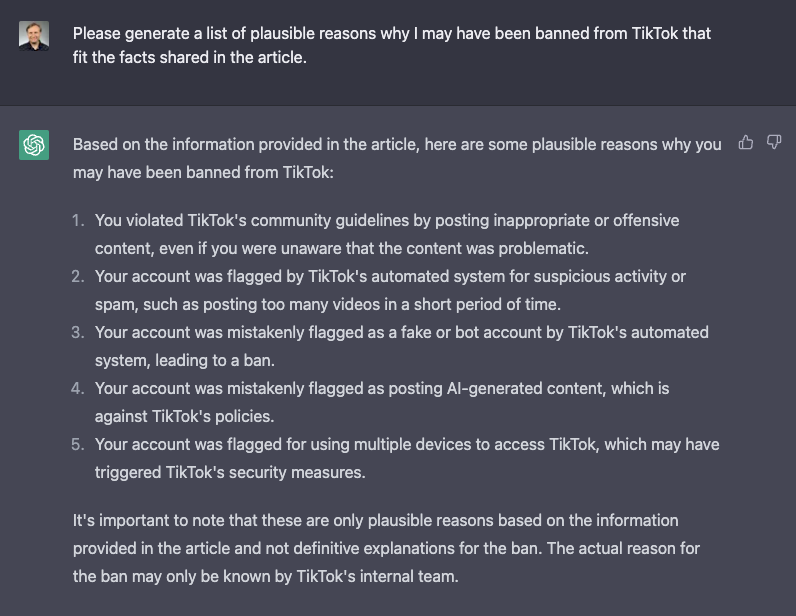
As a spontaneous afterthought… I shared what I wrote above with ChatGPT and then asked for its opinion. Here’s what it said.

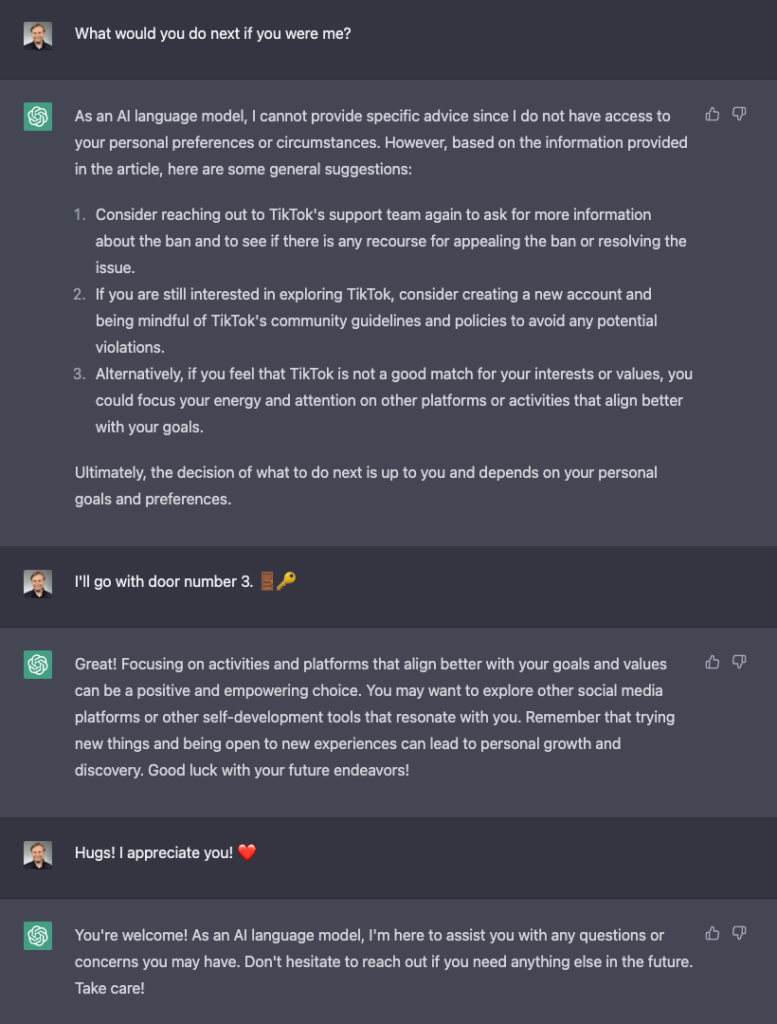
Then I asked…

❤️

Share Button

Most detailed geological model reveals Earth’s past 100 million years

Climate, tectonics and time combine to create powerful forces that craft the face of our planet. Add the gradual sculpting of the Earth’s surface by rivers and what to us seems solid as rock is constantly changing.

However, our understanding of this dynamic process has at best been patchy.

Scientists today have published new research revealing a detailed and dynamic model of the Earth’s surface over the past 100 million years.

Working with scientists in France, University of Sydney geoscientists have published this new model in the journal Science.

For the first time, it provides a high-resolution understanding of how today’s geophysical landscapes were created and how millions of tonnes of sediment have flowed to the oceans.

Lead author Dr Tristan Salles from the University of Sydney School of Geosciences, said: “To predict the future, we must understand the past. But our geological models have only provided a fragmented understanding of how our planet’s recent physical features formed.

“If you look for a continuous model of the interplay between river basins, global-scale erosion and sediment deposition at high resolution for the past 100 million years, it just doesn’t exist.

“So, this is a big advance. It’s not only a tool to help us investigate the past but will help scientists understand and predict the future, as well.”

Using a framework incorporating geodynamics, tectonic and climatic forces with surface processes, the scientific team has presented a new dynamic model of the past 100 million years at high resolution (down to 10 kilometres), broken into frames of a million years.

Second author Dr Laurent Husson from Institut des Sciences de la Terre in Grenoble, France, said: “This unprecedented high-resolution model of Earth’s recent past will equip geoscientists with a more complete and dynamic understanding of the Earth’s surface.

“Critically, it captures the dynamics of sediment transfer from the land to oceans in a way we have not previously been able to.”

Dr Salles said that understanding the flow of terrestrial sediment to marine environments is vital to comprehend present-day ocean chemistry.

“Given that ocean chemistry is changing rapidly due to human-induced climate change, having a more complete picture can assist our understanding of marine environments,” he said.

The model will allow scientists to test different theories as to how the Earth’s surface will respond to changing climate and tectonic forces.

Further, the research provides an improved model to understand how the transportation of Earth sediment regulates the planet’s carbon cycle over millions of years.

“Our findings will provide a dynamic and detailed background for scientists in other fields to prepare and test hypotheses, such as in biochemical cycles or in biological evolution.”

Authors Dr Salles, Dr Claire Mallard and PhD student Beatriz Hadler Boggiani are members of the EarthColab Group and Associate Professor Patrice Rey and Dr Sabin Zahirovic are part of the EarthByte Group. Both groups are in the School of Geosciences at the University of Sydney.

The research was undertaken in collaboration with French geoscientists from CNRS, France, Université Lyon and ENS Paris.

Video 1: https://youtu.be/MhXkMSyLXsA

Video 2: https://youtu.be/N3FHTtmOuD4

Share Button