There is an extraordinary difference between GP data and what people say in surveys, researchers say.


There is an extraordinary difference between GP data and what people say in surveys, researchers say.
Life expectancy declined more in the North West in 2020 than in England overall, a report finds.

The oldest strain of Yersinia pestis — the bacteria behind the plague that caused the Black Death, which may have killed as much as half of Europe’s population in the 1300s — has been found in the remains of a 5,000-year-old hunter-gatherer. A genetic analysis publishing June 29 in the journal Cell Reports reveals that this ancient strain was likely less contagious and not as deadly as its medieval version.
“What’s most astonishing is that we can push back the appearance of Y. pestis 2,000 years farther than previously published studies suggested,” says senior author Ben Krause-Kyora, head of the aDNA Laboratory at the University of Kiel in Germany. “It seems that we are really close to the origin of the bacteria.”
The plague-carrying hunter-gatherer was a 20- to 30-year old man called “RV 2039.” He was one of two people whose skeletons were excavated in the late 1800s in a region called Rinnukalns in present-day Latvia. Soon after, the remains of both vanished until 2011, when they reappeared as part of German anthropologist Rudolph Virchow’s collection. After this re-discovery, two more burials were uncovered from the site for a total of four specimens, likely from the same group of hunter-fisher-gatherers.
Krause-Kyora and his team used samples from the teeth and bone of all four hunter-gatherers to sequence their genomes and then tested them for bacterial and viral pathogens. They were surprised to find evidence of Y. pestis in RV 2039 — and after reconstructing the bacteria’s genome and comparing it to other ancient strains, the researchers determined that the Y. pestis RV 2039 carried was indeed the oldest strain ever discovered. It was likely part of a lineage that emerged about 7,000 years ago, only a few hundred years after Y. pestis split from its predecessor, Yersinia pseudotuberculosis.
“What’s so surprising is that we see already in this early strain more or less the complete genetic set of Y. pestis, and only a few genes are lacking. But even a small shift in genetic settings can have a dramatic influence on virulence,” says Krause-Kyora.
In particular, this ancient strain lacked one crucial thing: the gene that first let fleas act as vectors to spread the plague. This gene was responsible for efficient transmission of the bacterium to human hosts, which resulted in the growth of the infamously grotesque pus-filled buboes in the sick associated with the medieval bubonic plague. Flea-based transmission also required the death of the human host, which means that the appearance of the gene could have driven the evolution of a deadlier disease.
From RV 2039, it likely took more than a thousand years for Y. pestis to acquire all the mutations needed for flea-based transmission. And it’s not clear to what extent RV 2039 experienced the effects of the plague at all.
Y. pestis was found in his bloodstream, meaning he most likely died from the bacterial infection — although, the researchers think the course of the disease might have been fairly slow. They observed that he had a high number of bacteria in his bloodstream at his time of death, and in previous rodent studies, a high bacterial load of Y. pestis has been associated with less aggressive infections. Additionally, the people he was buried near were not infected and RV 2039 was carefully buried in his grave, which the authors say also makes a highly contagious respiratory version of the plague less likely.
Instead, this 5,000-year-old strain likely was transmitted directly via a bite from an infected rodent and probably didn’t spread beyond the infected person. “Isolated cases of transmission from animals to people could explain the different social environments where these ancient diseased humans are discovered. We see it in societies that are herders in the steppe, hunter-gatherers who are fishing, and in farmer communities — totally different social settings but always spontaneous occurrence of Y. pestis cases,” says Krause-Kyora.
These conclusions — that the early form of Y. pestis likely was a slow-moving disease and wasn’t very transmissible — challenge many theories about the development of human civilization in Europe and Asia. For example, some historians have suggested that infectious diseases like Y. pestis evolved mostly in megacities of over 10,000 people near the Black Sea. However, 5,000 years ago — the age of RV 2039’s strain — was long before the formation of large cities. Instead, agriculture was just beginning to appear in Central Europe, and populations were much sparser.
This timeline, plus the less contagious and deadly nature of this early Y. pestis strain, also contradicts the hypothesis that Y. pestis led to the large population declines in Western Europe at the end of the Neolithic Age.
The authors say that examining the history of Y. pestis could also potentially shed light on human genomic history. “Different pathogens and the human genome have always evolved together. We know Y. pestis most likely killed half of the European population in a short time frame, so it should have a big impact on the human genome,” says Krause-Kyora. “But even before that, we see major turnover in our immune genes at the end of the Neolithic Age, and it could be that we were seeing a significant change in the pathogen landscape at that time as well.”
Story Source:
Materials provided by Cell Press. Note: Content may be edited for style and length.

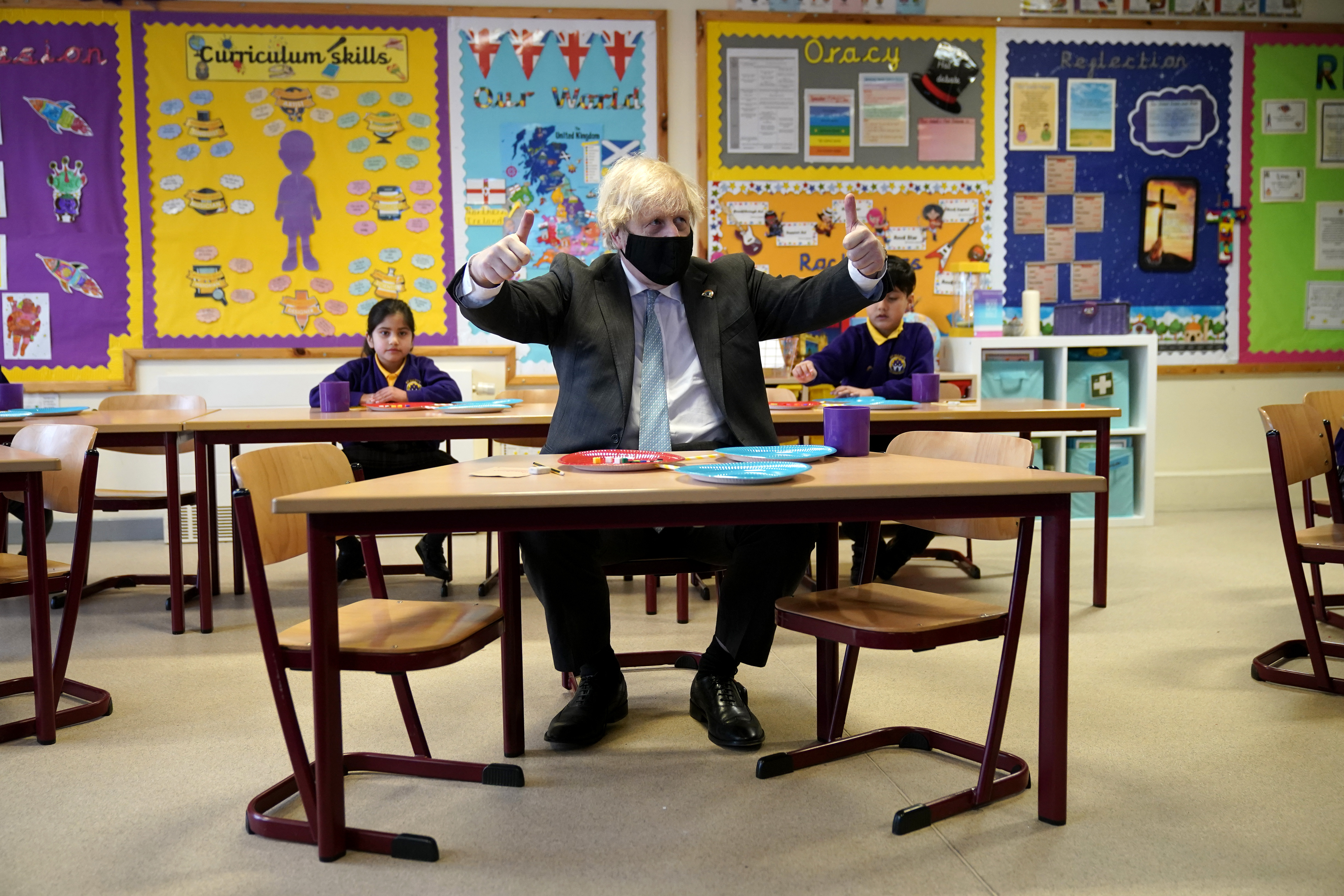
Maybe it’s because Boris Johnson’s children are either too old or too young to be in school anymore. Maybe it’s because he’s more focused on rolling the dice on his July 19 freedom day. Maybe it’s because his education secretary lacks any real clout within the cabinet.
But whatever the reason, the growing anger among parents, pupils and teachers at the Covid chaos within schools right now is something any government would be wise to heed. New figures from the Department for Education laid bare the problem, with a massive 330,000 pupils forced to self-isolate in the past week.
The return of remote learning and home-schooling is difficult for the children but also for their parents, particularly if they’re losing income because they cannot go out to work. Just as important is the social loss incurred, with many missing those longed-for end-of-year trips, sports events and school productions.
And yet there is a solution. Schools have been taking part in clinical trials of a system of daily testing that prevents the need for Covid close contacts to automatically isolate at home. Instead of an entire class of 30, or even a whole year group, having to quarantine, only those who actually test positive have to stay home. Staff and pupils who test negative can turn up as normal.
The headteacher of Westhoughton High School in Bolton (yes, which was a Delta hotspot) revealed today just what a success the pilot had been. More than 500 pupils and staff had avoided having to isolate, with a huge 3,500 “saved learning hours” as a result.
The academic gains from classroom time are obvious. But I was struck most of all by Patrick Ottley-O’Connor’s remark, to Radio 4’s World At One, that “the mental health of students has been massively impacted positively by being able to stay in school”.
Fortunately, Sajid Javid has hinted he wants to act on such pilots. And sources in the DfE hint that from September such testing will be the norm. Yet many wonder why there isn’t any action right now. When asked if the government had given up on any changes for this term, the PM’s spokesman told us: “That’s not at all how I characterise it, obviously.” Except it wasn’t obvious.
The pilots will need assessing, but they have been running for several weeks and it’s worth asking why there hasn’t been a fast-tracked assessment for testing just as there was for vaccines. The JCVI managed to give the UK a head start on approval of vaccines precisely because it took a sensible view of risk.
The great irony about the current school testing inertia is that it was always the PM’s early preferred route out of the pandemic. It was mass testing that was his ‘moonshot’, even though in the end it was the Matt Hancock’s early gamble on vaccines that really reached for the stars (and don’t forget Dominic Cummings ridiculed Hancock for it last autumn).
Yet just as baffling for some Tory MPs has been the inertia around school catch-up policy too. Boris Johnson told us last June, a whole year ago, that there would be “a massive summer catch-up operation” for schools. (Spoiler: it did not materialise). In March, he said: “The legacy issue I think for me is education.” It was “an opportunity to make amends”, he said.
But as former catch-up czar Sir Kevan Collins made plain today, that promise has not yet been met. Collins’ evidence to the Education Committee was as politically devastating as it was patient and methodical. The cost-benefit analysis (£100bn and maybe £420bn could be lost in a hit to the economy from education losses) was overwhelming, even for a Treasury beancounter.
Ultra-reasonable, grounded in his own long experience in dealing with schools and social policy for children, he simply said the PM’s response had been “feeble” in the face of the enormity of the challenge. He pointed out he had presented his £15bn case for a longer school day to the PM, the chancellor and Gavin Williamson (and intriguingly Michael Gove too).
With only £1.4bn pledged so far, Collins said the PM’s signal of even more money later this year was not made in “bad faith”. His complaint was that later this year would be too late. And he squarely blamed the Treasury too for sticking to its spending review timetable (of November) instead of focusing on the school year timetable (starting in September).
As with school testing, this was about a lack of urgency. Children are on average two months behind in reading and three months behind in maths, and those averages mask even worse stats for the poorest kids. Collins pointed out that a child arriving from primary school to secondary next year could fall into a spiral of decline. With more textbooks, more subjects, the risk was “they don’t catch up” and instead go backwards.
Collins called for a 10-year spending strategy for schools, which is precisely the kind of bold ambition the Johnson government may need to run alongside similar ambitions for the NHS. Not for nothing has Labour’s new shadow chancellor Rachel Reeves made the £15bn catch-up funding her main spending pledge to date.
The Treasury has been privately dubious about Collins’ extra hours plan, suggesting teachers may not wear it. But the real obstacle may be the long-term nature of the hard cash needed. Because once you start spending real money to tackle educational inequalities, it can’t be a ‘one-off’ that you can then take away later.
Spending reviews are indeed usually the kind of place for such commitments. Yet when an emergency furlough scheme can be drafted (brilliantly by HMT officials) in such short order as it was last year, why not a ‘summer education plan’ to match the ‘winter economic plan’?
As I wrote last year, the pandemic response should not just be about lives and livelihoods, it should be about life chances. And if the PM can’t even deliver on what’s supposed to be his personal “legacy issue”, the public may wonder what happens to all those issues he doesn’t care about.

Fireworks are synonymous in the United States with the celebration of Independence Day and other special events, but the colorful displays have caused a growing risk to public safety in recent years, according to a study by environmental health researchers at the University of California, Irvine.
Relying on real-time air quality measurements crowdsourced from a network of more than 750 automated sensors distributed throughout California, scientists from UCI’s Program in Public Health found that short-term, extremely high-particulate-matter air pollution from the widespread use of fireworks spiked during the periods of late June through early July in 2019 and 2020.
The increase was most pronounced in Southern California counties where fireworks regulations are less strict than in northern parts of the state and where the illegal use of do-it-yourself pyrotechnics is also more prevalent. This and other findings are the subject of a study published recently in the International Journal of Environmental Research and Public Health.
“You may have seen discussions on social media lately about people worrying for their pets on nights when the skies are filled with exploding fireworks, but we’ve found that there is a real threat to human well-being too,” said co-author Jun Wu, UCI professor of public health. “And like many other environmental justice issues, we find the worst impacts among residents of low-income communities.”
Aerial explosions cause the release of fine particles less than 2.5 micrometers in diameter. Airborne particulate matter of this size is hazardous because when inhaled, it can be absorbed by the lungs and passed to other tissues inside the body. Fireworks get their distinct colors from compounds containing barium, copper, magnesium, potassium and strontium. As rockets burst in the sky, they release these chemicals, trace redox-active metals and water-soluble ions, which inevitably fall on those below.
“These fine particles are known to cause a wide range of adverse health effects, including premature mortality, respiratory and cardiovascular diseases, adverse pregnancy outcomes, and neurological diseases,” Wu said.
The UCI team used data accumulated via a statewide network of PurpleAir sensors, low-cost devices deployed in households. Utilizing this method, the researchers built a high-resolution map tracking levels of airborne particulate matter less than 2.5 micrometers in diameter before, during and after Fourth of July fireworks during the study period.
“The PurpleAir network includes sensors that monitor air continuously, which offers advantages over the traditional monitoring installations that are often positioned away from residential areas and take intermittent measurements that may miss peak days such as the Fourth of July,” said lead author Amirhosein Mousavi, a postdoctoral scholar in UCI’s Program in Public Health. “By taking data from a large, distributed sensor network that’s always collecting data in neighborhoods where people from various socioeconomic profiles live, we were able to get a much clearer characterization of the health risks posed by do-it-yourself fireworks.”
The team found that among all 58 California counties, Los Angeles County experienced the highest daily PM2.5 levels around the Fourth of July holiday in both 2019 and 2020. They believe this was the result of larger numbers of individuals shooting off their own rockets in neighborhoods where they lived, as well as the nature of L.A.’s topography, which has long been known to facilitate the buildup of air pollution.
In addition, researchers believe they detected a COVID-19 effect in their data. PM2.5 concentrations on July 4 and 5 in 2020 were, on average, 50 percent higher than in 2019, likely due to the increased use of household-level fireworks during the pandemic lockdowns.
The team also learned that peak fireworks pollution was two times higher in communities with lower socioeconomic status, larger minority-group populations and higher asthma rates.
“This work highlights the important role that policy and enforcement can play in reducing fireworks-related air pollution and protecting public health,” Wu said. “As there is a patchwork of different restrictions and regulations regarding fireworks in our state, it’s clear that a more coordinated approach would help people breathe easier during times of celebration.”

For many years, researchers have been focused on developing technologies that can help us fight the imminent climate change crisis. They have one goal in common: finding sustainable energy sources that can replace the environmentally toxic fossil fuels. “Photocatalysts” that drive an artificial process that replicates photosynthesis (in which solar energy is converted to useful materials) are promising in this regard, given that we are able to develop the technology needed for them. Crystalline materials, such as strontium titanate (SrTiO3), which can serve as “photocatalysts” in solar devices, can lead us in the direction.
SrTiO3 is attractive owing to various other reasons too, such as its potential applications in resistive switches and fuel cell components. The versatile nature of SrTiO3 has motivated physicists to study its various materials properties in detail. But to dig deeper into the properties of SrTiO3, we need to understand a little more about them.
Photocatalytic materials such as SrTiO3 are usually “doped” with chemicals like niobium (Nb) that help to improve their electrical properties. But a process called “charge recombination” can occur in photocatalysts, which hampers with their efficiency. In this process, mobile charge carriers present in the material, such as “electrons” and “holes,” when exposed to light, can annihilate each other. Some studies have shown that charge recombination is affected by the presence of defects in crystals. So how does Nb doping affect the material properties of SrTiO3? This is exactly what a team of researchers at Nagoya Institute of Technology, Japan, led by Prof. Masashi Kato, wanted to find out.
In their study published in Journal of Physics D: Applied Physics, the researchers looked at the effects of low-concentration Nb doping, as well as no doping, on the surface recombination in SrTiO3 crystals. Prof. Kato explains, “Quantitatively measuring the effects of surfaces and niobium impurities in SrTiO3 on carrier recombination can help us design photocatalysts with an optimal structure for artificial photosynthesis.”
The scientists first analyzed the surface recombination, or “decay,” patterns of undoped SrTiO3 samples as well as those doped with different concentrations of Nb, using a technique called “microwave photoconductivity decay.” To further probe into the bulk carrier recombination properties of doped samples and different energy levels introduced by Nb doping, another technique called “time-resolved photoluminescence” was used.
The researchers found that the recombination of excited carriers was not dependent on their concentration, indicating that they recombined via “surface”” and “Shockley-Read-Hall” processes (which are insensitive to exciting carrier concentration). Moreover, the doped sample showed faster decay curves, which could be due to the introduction of a recombination center by Nb doping. Doping the material with high concentrations of Nb showed negative effects on carrier doping. Moreover, the size of the photocatalyst, and not its shape, influenced surface recombination and ultimately its overall efficiency.
The study concluded that moderately Nb-doped SrTiO3 could actually be more beneficial than pure SrTiO3, especially when operated at higher operating temperatures. These findings can help us design SrTiO3 photocatalysts with a lower surface recombination and higher energy conversion, leading to the development of efficient, sustainable sources of energy.
Prof. Kato optimistically concludes, “We are confident that our findings can accelerate the development of artificial photosynthesis technologies, ultimately contributing towards a greener, more sustainable society.”
Story Source:
Materials provided by Nagoya Institute of Technology. Note: Content may be edited for style and length.
Aaron Chown – PA Images via Getty Images
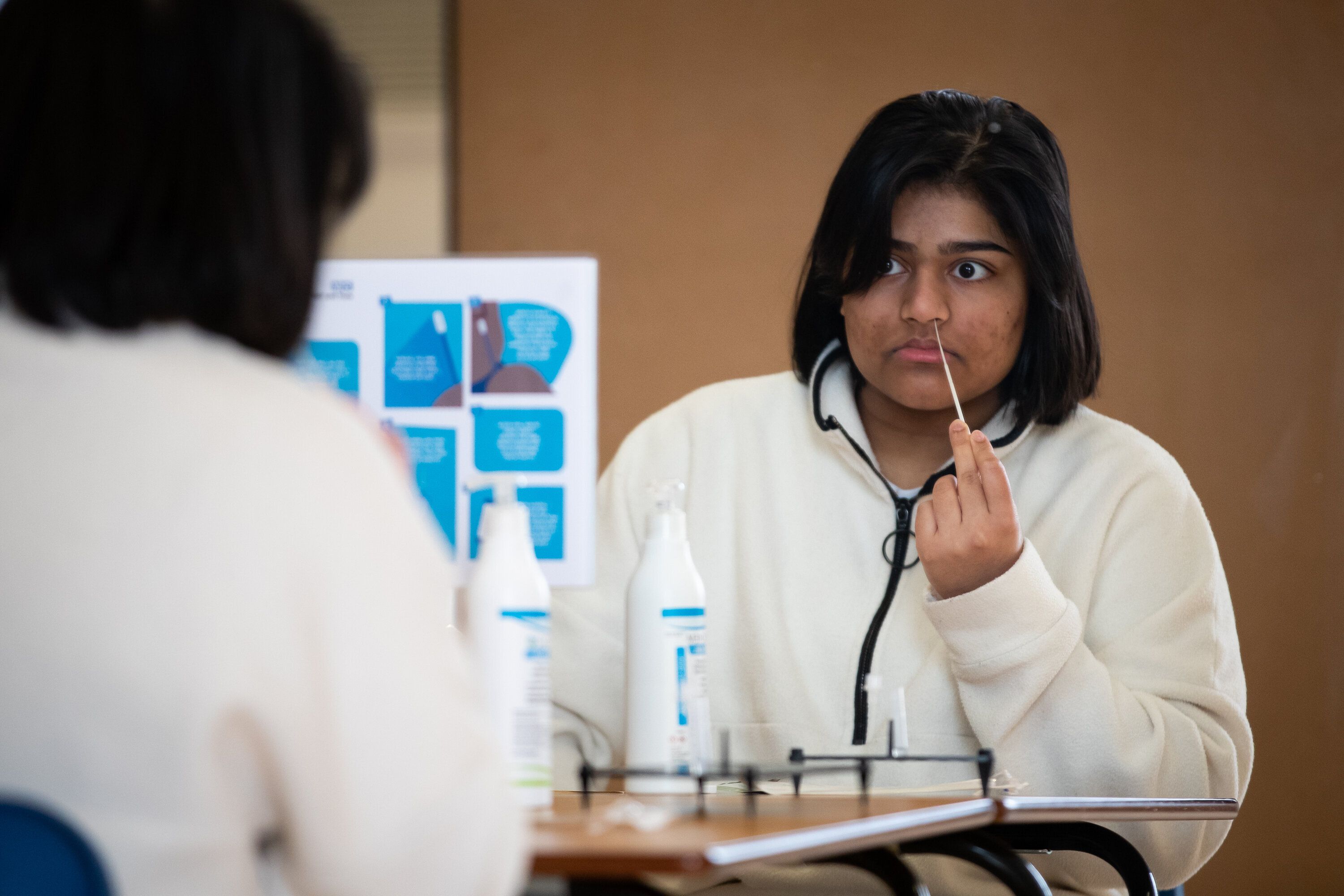
A school that trialled a radical Covid testing regime has spared more than 500 pupils and staff from having to isolate at home, its headteacher has revealed.
Westhoughton High School in Bolton allows even “close contacts” of positive cases to keep on attending class, provided they can show negative daily lateral flow tests and negative PCR tests every five days.
Headteacher Patrick Ottley-O’Connor told the BBC there had been a “massively” positive impact on students’ mental health as well as on their ability to keep learning in person.
The school, which ended its government pilot scheme last Thursday, reported more than 3,500 “saved learning days” thanks to its system of allowing pupils to attend even if they were in the same class as someone who tested positive.
Under the clinical trial, only those staff and students who test positive are required to stay at home.
Others in their 30-strong “bubble” are allowed to keep on attending, with parental consent, as long as they have a negative lateral flow test for seven days.
On day two and day seven, they have to also show a negative PCR test. Pupils taking part in the scheme still have to stay at home in the evening and at weekends.
The success of the programme is sure to be pounced on by MPs and parents, many of whom are now calling for a more risk-based approach and the end of the practice of forcing a whole class to quarantine if one child contracts the virus.
Latest figures showed pupil absence due to Covid had hit a record high since classes went back in March, with more than 330,000 children in England forced to isolate at home in the past week.
Data from the Department for Education, covering England, shows that around one in 20 (5.1%) state school pupils did not attend class for Covid-19-related reasons on June 24, up from 3.3% on June 17 and 1.2% on June 10.
Health secretary Sajid Javid revealed on Monday that he had asked for the evidence from pilot schemes.
Ottley-O’Connor told BBC Radio 4’s World at One programme that “when we had the opportunity to take part in the clinical trial we jumped at it”.
“It’s really helped obviously the learning, but the mental health of students has been massively impacted positively by being able to stay in school.
“Two weeks ago within Bolton there were rising cases, I had two positive cases within staff and that affected 18 staff in total close contacts, myself included.
“But only those two people had to be at home, the rest of us could come in, do our daily testing in the morning…[and] test negative and continue our daily work.”
Shadow education secretary Kate Green said the latest absence figures showed the need for action.
“Ministers must work with their expert scientific advisers now to review the bubbles system ahead of the summer holidays to ensure as many children can be in the classroom as possible.”

Parents’ frustration is mounting over the disruption to children’s education and their own working lives.
They should form part of the curriculum for girls aged 12 to 17, suggests health watchdog.
Wearing a high grade FFP3 mask can almost entirely protect health workers from Covid, research finds.
