Analysis: Mandelson Documents Leave Keir Starmer’s Reputation In Tatters

So now we know.

Keir Starmer was given every excuse he needed not to make Peter Mandelson the UK’s ambassador to Washington, but did it anyway.

There are few fresh revelations contained within the 137 pages of documents released by the government about Mandelson’s appointment.

The biggest one – that the disgraced peer wanted a pay-off of more than half a million pounds for a job that he was sacked from – simply confirms what we already knew about his character.

In the end, he received £75,000 – a third of which was tax free.

However, it is the confirmation of what the prime minister was told by his own civil servants before appointing him which is most damning of all.

The Cabinet Office due diligence report presented to the PM on December 11, 2024, shortly before Mandelson’s appointment, is clear about the extent of his relationship with the convicted paedophile, Jeffrey Epstein.

It shows that a report commissioned by JP Morgan in 2019 found that Epstein “appeared to maintain a particularly close relationship” with Mandelson and the now-equally disgraced Andrew Mountbatten-Windsor.

Most shockingly, that report found that Epstein and Mandelson relationship continued between 2009 and 2011, after the billionaire financier’s conviction for procuring an underage girl in 2008.

Mandelson also stayed at Epstein’s house in New York when he was still in jail.

In addition, Mandelson went on to become a “founding citizen” of an ocean conservation group funded by Epstein and founded by his close associate, Ghislaine Maxwell.

The document says that Mandelson’s relationship with Epstein represented a “general reputational risk” for the government.

What more evidence did the PM need that he should give Mandelson a very wide berth?

However, on the advice of his chief of staff, Mandelson ally Morgan McSweeney, Starmer opted to ignore this warning and appoint him anyway.

The political decision was taken that Mandelson’s ability to curry favour with Donald Trump was more important than standing with Epstein’s victims.

McSweeney ultimately paid for that calculation with his job.

For now at least, Starmer remains in place. But his reputation as a cautious politician who, for all his faults, at least does things by the book, is in tatters.

The vetting document prepared for the PM.

UK Government

By no means coincidentally, the Mandelson documents were not released until after prime minister’s questions, meaning Starmer could not be personally grilled about their contents.

Instead, chief secretary to the PM Darren Jones was sent out to face the music.

He claimed that the “due diligence process fell short of what is required”, which is undoubtedly true.

It is also the case that Mandelson was less than forthcoming about his links to Epstein when personally asked about them by the prime minister.

Nevertheless, this does not change the fact that the details which were already in the public domain should have been sufficient to bar him from the plum diplomatic role.

Jones told MPs that Epstein “was a despicable criminal who committed the most horrifying and disgusting crime that destroyed the lives of countless women and girls”.

And yet, knowing this, Starmer still opted to make his friend Mandelson the UK’s ambassador to Washington.

It is a decision which should haunt him for the remainder of his time in office, and beyond.

Share Button

Endometriosis study aims for safer diagnosis

Researchers in Worcestershire are using electrodes as a non-invasive diagnosis tool.

Share Button

Alternative to HRT for menopausal hot flushes now on NHS

The non-hormonal daily pill could benefit 500,000 women for whom HRT is not suitable.

Share Button

Scientists may have found a pill for sleep apnea

A medication called sulthiame may help people with obstructive sleep apnea breathe more easily during the night and sleep better overall. The findings come from a European clinical trial in which the University of Gothenburg played an important role. Researchers say the results raise the possibility of a drug treatment for patients who struggle to tolerate breathing masks.

The study results were published in The Lancet. A total of 298 people with moderate to severe sleep apnea participated in the trial. One quarter of the participants received a placebo, while the rest were treated with different doses of sulthiame. The study took place across four European countries and followed a double blind design, meaning neither the participants nor the researchers knew who was receiving the active drug.

Study Shows Major Reduction in Breathing Pauses

Patients who received higher doses of sulthiame experienced up to 47 percent fewer breathing interruptions during sleep compared with those given a placebo. They also showed improved oxygen levels overnight.

Sulthiame appears to work by stabilizing the body’s control of breathing and increasing respiratory drive. This helps lower the likelihood that the upper airway will collapse during sleep, which is the main cause of obstructive sleep apnea. Most side effects reported during the trial were mild and temporary.

Jan Hedner, senior professor of pulmonary medicine at the Sahlgrenska Academy, University of Gothenburg, has played a leading role in the study.

“We have been working on this treatment strategy for a long time, and the results show that sleep apnea can indeed be influenced pharmacologically. It feels like a breakthrough, and we now look forward to larger and longer studies to determine whether the effect is sustained over time and whether the treatment is safe for broader patient groups,” says Jan Hedner.

Ludger Grote and Kaj Stenlöf from the University of Gothenburg also made important contributions to the research.

Many Patients Cannot Tolerate CPAP Treatment

Obstructive sleep apnea happens when the upper airway repeatedly collapses during sleep. These episodes cause breathing to stop temporarily, reduce oxygen levels, and repeatedly disrupt sleep. Over time, untreated sleep apnea raises the risk of serious health problems, including high blood pressure, cardiovascular disease, stroke, and type 2 diabetes.

Even though sleep apnea is common, there is currently no medication that directly treats its underlying cause. The most common therapy is continuous positive airway pressure (CPAP), which uses a mask to keep the airway open during sleep. While CPAP is highly effective, many patients find it difficult to use. Up to half stop using the device within a year because the mask can feel uncomfortable or interfere with sleep.

Sulthiame is an existing medication that has previously been approved to treat a form of childhood epilepsy. Researchers are now investigating whether it could also become a drug treatment for sleep apnea.

Share Button

Scientists discover tiny plant trick that could supercharge crop yields

An international team of scientists has uncovered a surprising molecular strategy used by a rare group of land plants. The finding could one day help researchers redesign important crops such as wheat and rice so they convert sunlight into food far more efficiently.

The research was led by scientists at the Boyce Thompson Institute (BTI), Cornell University, and the University of Edinburgh. It addresses a major limitation in agriculture involving Rubisco, the enzyme that captures carbon dioxide from the air during photosynthesis.

Rubisco and the Limits of Photosynthesis

Rubisco plays a central role in life on Earth, but it has a major flaw. The enzyme works slowly and can easily interact with oxygen instead of carbon dioxide, which wastes energy and reduces how effectively plants grow.

“Rubisco is arguably the most important enzyme on the planet because it’s the entry point for nearly all carbon in the food we eat,” said BTI Associate Professor Fay-Wei Li, who co-led the research. “But it’s slow and easily distracted by oxygen, which wastes energy and limits how efficiently plants can grow.”

Over time, some organisms have evolved ways to overcome this inefficiency. Many types of algae, for example, place Rubisco inside small structures in their cells called pyrenoids. These microscopic compartments concentrate carbon dioxide around the enzyme, allowing it to operate more efficiently.

Researchers have long hoped to introduce this type of carbon concentrating system into food crops, which do not naturally have pyrenoids. However, transferring the complex machinery from algae into land plants has proven extremely difficult.

Hornwort Plants Reveal an Unexpected Strategy

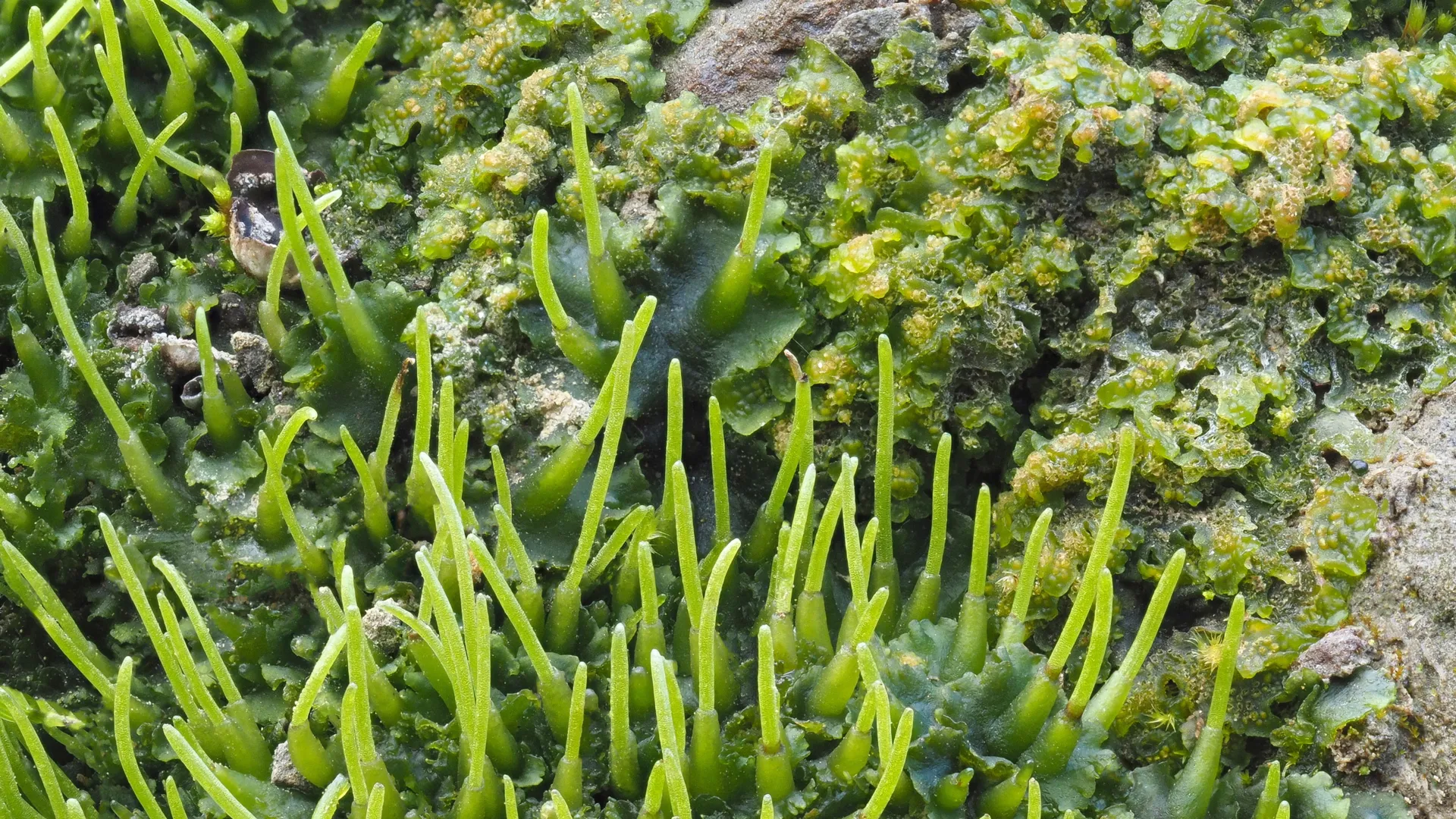
A breakthrough came when scientists examined hornworts, the only land plants known to contain carbon concentrating compartments similar to those found in algae. Because hornworts share a closer evolutionary relationship with crop plants than algae do, researchers suspected their molecular tools might be easier to transfer.

What they discovered turned out to be very different from what they expected.

“We assumed hornworts would use something similar to what algae use — a separate protein that gathers Rubisco together,” said Tanner Robison, a graduate student working with Li and a co-first author of the paper. “Instead, we discovered they’ve modified Rubisco itself to do the job.”

The RbcS-STAR Protein and Rubisco Clustering

The key element is an unusual protein component the researchers named RbcS-STAR. Rubisco itself is built from both large and small protein pieces. In hornworts, one version of the small component includes an extra segment called the STAR region.

This additional tail behaves like molecular velcro. It causes Rubisco proteins to stick together and form clustered structures inside the cell.

To determine whether STAR could function in other plants, the researchers ran several experiments. They first introduced the RbcS-STAR component into a closely related hornwort species that does not naturally form pyrenoids. After the change, Rubisco shifted from being spread throughout the cell to forming concentrated structures resembling pyrenoids.

The scientists then tested the same idea in Arabidopsis, a plant widely used in laboratory research. Once again, Rubisco gathered into dense compartments inside the chloroplasts.

“We even tried attaching just the STAR tail to Arabidopsis’s native Rubisco, and it triggered the same clustering effect,” said Alistair McCormick, professor at the University of Edinburgh, who co-led the research. “That tells us STAR is truly the driving force. It’s a modular tool that can work across different plant systems.”

Potential Path Toward More Efficient Crops

The fact that this mechanism works across different plant species makes the discovery especially important for agriculture. It suggests that scientists may be able to trigger Rubisco clustering in crop plants simply by adding this universal velcro component.

However, researchers emphasize that more work is still needed. In addition to clustering Rubisco, plants must also efficiently deliver carbon dioxide to the enzyme.

“We have built a Rubisco house, but it won’t be an efficient house unless we update the HVAC,” said Laura Gunn, assistant professor at Cornell University, who co-led the research. The team is now working to address this challenge.

A Step Toward More Sustainable Food Production

Even so, the discovery represents an important advance in the effort to improve photosynthesis. Increasing photosynthetic efficiency even slightly could raise crop yields while reducing the environmental impact of farming. This goal is increasingly important as scientists seek ways to produce more food sustainably for a growing global population.

“This research shows that nature has already tested solutions we can learn from,” said Li. “Our job is to understand those solutions well enough to apply them where they’re needed most — in the crops that feed the world.”

The study was published in Science, with equal contributions from four early-career scientists: Tanner A. Robison, Yuwei Mao, Zhen Guo Oh, and Warren S.L. Ang. The corresponding authors were Laura H. Gunn, Alistair J. McCormick, and Fay-Wei Li.

Share Button

Mother given wrong antibiotics died from sepsis

Bank cashier Aleisha Rochester died two weeks after undergoing a routine procedure to remove an abscess.

Share Button

A massive asteroid hit the North Sea and triggered a 330-foot tsunami

A long running scientific dispute about the origin of the Silverpit Crater beneath the southern North Sea has now been settled.

New research shows that the structure formed when an asteroid or comet struck the region roughly 43 to 46 million years ago.

The investigation was led by Dr. Uisdean Nicholson of Heriot-Watt University in Edinburgh and supported by the Natural Environment Research Council (NERC). The team combined seismic imaging, microscopic analysis of rock fragments, and computer modeling to produce the clearest evidence yet that Silverpit is one of Earth’s rare impact craters.

The study appears in the journal Nature Communications.

A Hidden Crater Beneath the North Sea

Silverpit lies about 700 meters beneath the seabed in the North Sea, roughly 80 miles off the coast of Yorkshire.

Since geologists first identified the formation in 2002, the three kilometer wide crater and its surrounding ring of circular faults spanning about 20 km have sparked intense debate.

Early research proposed that the feature was created by a high speed asteroid impact. Supporters of that idea pointed to its round shape, central peak, and surrounding concentric faults, which are often seen in known impact craters.

Other scientists suggested different explanations. Some proposed that underground salt movement distorted the rock layers and created the structure. Others argued that volcanic activity may have caused the seabed to collapse.

In 2009, geologists even voted on the issue. According to a report in the December 2009 issue of Geoscientist magazine, most participants rejected the asteroid impact explanation at the time.

The latest findings now overturn that conclusion.

New Seismic Data Reveals Evidence of Impact

Nicholson’s team analyzed newly available seismic imaging and geological samples taken from beneath the seabed.

Dr. Uisdean Nicholson, a sedimentologist in Heriot-Watt University’s School of Energy, Geoscience, Infrastructure and Society, said: “New seismic imaging has given us an unprecedented look at the crater.

“Samples from an oil well in the area also revealed rare ‘shocked’ quartz and feldspar crystals at the same depth as the crater floor.

“We were exceptionally lucky to find these — a real ‘needle-in-a-haystack’ effort. These prove the impact crater hypothesis beyond doubt, because they have a fabric that can only be created by extreme shock pressures.”

These microscopic minerals form only under the extreme pressures generated during asteroid impacts, providing strong confirmation of the event.

Asteroid Strike Triggered a Massive Tsunami

The evidence indicates that an asteroid about 160 meters wide slammed into the seabed at a shallow angle from the west.

Dr. Nicholson said: “Our evidence shows that a 160-meter-wide asteroid hit the seabed at a low angle from the west.

“Within minutes, it created a 1.5-kilometer high curtain of rock and water that then collapsed into the sea, creating a tsunami over 100 meters high.”

The impact would have produced a violent explosion at the seafloor and sent enormous waves spreading across the region.

The “Silver Bullet” That Ended the Debate

Professor Gareth Collins of Imperial College London attended the 2009 debate about the crater’s origin and contributed the numerical simulations used in the new research.

Professor Collins said: “I always thought that the impact hypothesis was the simplest explanation and most consistent with the observations.

“It is very rewarding to have finally found the silver bullet. We can now get on with the exciting job of using the amazing new data to learn more about how impacts shape planets below the surface, which is really hard to do on other planets.”

A Rare and Well Preserved Impact Crater

Dr. Nicholson said, “Silverpit is a rare and exceptionally preserved hypervelocity impact crater.

“These are rare because the Earth is such a dynamic planet — plate tectonics and erosion destroy almost all traces of most of these events.

“Around 200 confirmed impact craters exist on land, and only about 33 have been identified beneath the ocean.

“We can use these findings to understand how asteroid impacts shaped our planet throughout history, as well as predict what could happen should we have an asteroid collision in future.”

Confirming Silverpit as an impact crater places it in the same category as well known structures such as the Chicxulub Crater in Mexico, which is linked to the dinosaur mass extinction, and the Nadir Crater off the coast of West Africa that was recently identified as another impact site.

The research was funded by the Natural Environment Research Council (NERC).

Share Button

‘My daughter died in her sleep, with no warning’

Jo-Ann Burns says her daughter Nicola wasn’t told about Sudden Unexpected Death in Epilepsy.

Share Button

Labour MP Attacks Plan To Scrap Most Jury Trials After Revealing She Was Raped

A Labour MP has condemned David Lammy’s plan to scrap most jury trials after revealing for the first time that she had been raped.

Charlotte Nichols accused the justice secretary of using victims as a “cudgel” to force the controversial reforms through.

The government wants to get rid of juries in cases where the sentence is expected to be less than three years.

Ministers say the move is necessary to clear the huge backlog of court cases in England and Wales.

But critics say the planned reforms, contained in the Court and Tribunals Bill, will remove a fundamental right while not actually solving the problem.

During a Commons debate on the bill, Nichols said she had waited 1,088 days for her case to get to court.

The MP for Warrington North said: “Every single one of those days was agony, made worse by having a role in public life that meant that the mental health consequences of my trauma were played out in public, with the event that led to my eventual sectioning for my own safety still being something that I receive regular social media abuse from strangers about to this day.

“But here’s the kicker, in this debate, experiences like mine feel like they’ve been weaponised and are being used for rhetorical misdirection, for what this bill actually is.

“The violence against women and girls sector haven’t had the opportunity to come together to discuss it, and the government’s framing and narrative has been to pit survivors and defendants against each other in a way I think is deeply damaging.

“We have been told that if we have concerns about this bill, it is because we have not been raped or because we don’t care enough for rape victims.

“The opposite is true in my case, it is because I have been raped that I am as passionate as I am about what it means for a justice system to be truly victim focused.

“It is because I have endured every indignity that our broken criminal justice system could mete out that I care what kind of reform will actually deliver justice for survivors and victims of crime more widely.”

She added: “There is so much that we can be doing for rape victims that isn’t [David Lammy] using them as a cudgel to drive through reforms that aren’t directly relevant to them.”

Share Button

Maternity inquiry chair named in government U-turn

Donna Ockenden is appointed to lead the maternity services inquiry at Leeds hospitals.

Share Button