General Sir Richard Shirreff warned Sky News that the Americans’ lack of strategy following the US-Israeli strikes on Iran could have far-reaching consequences for anyone who gets involved.
Advertisement
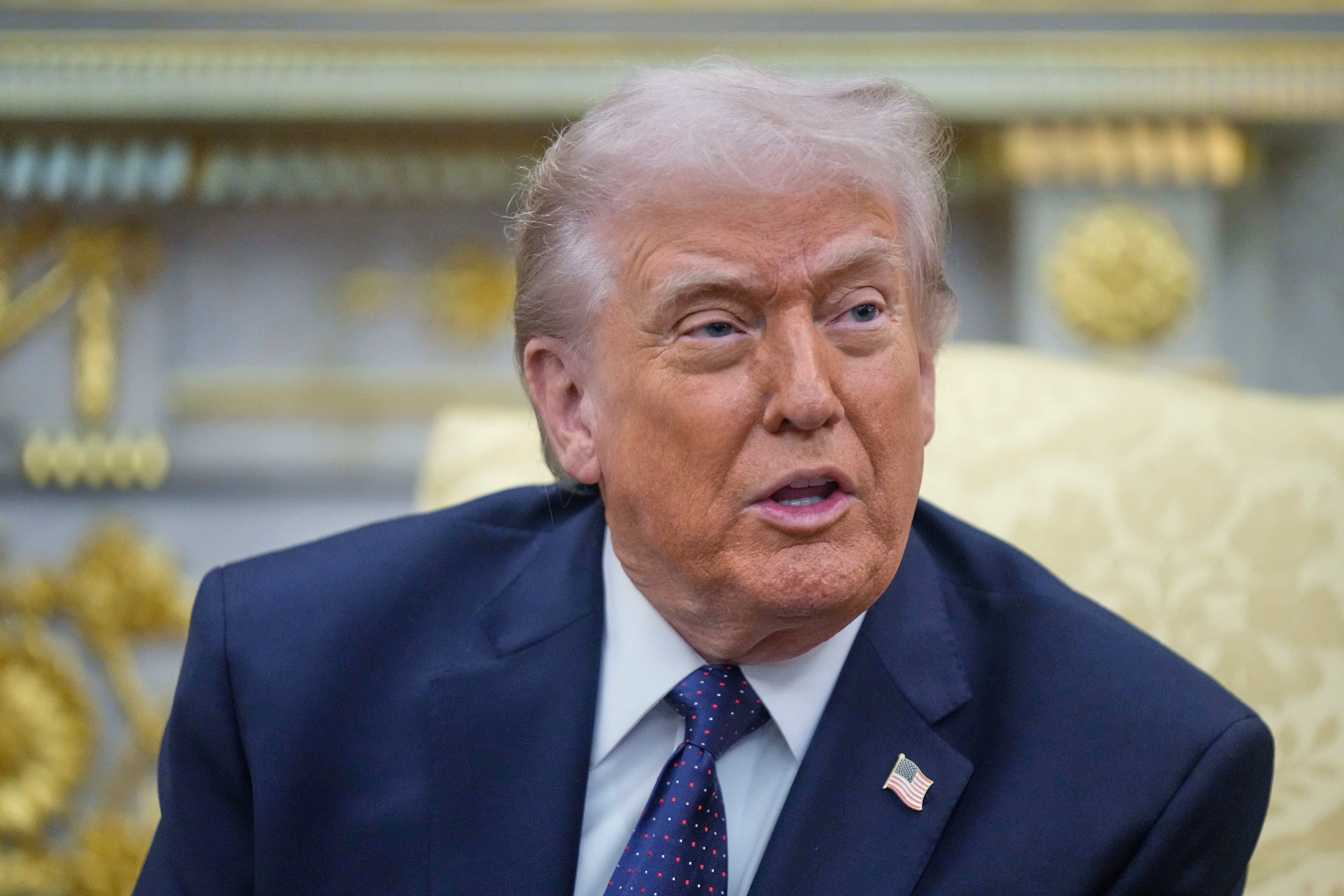
Trump has lashed out at Keir Starmer after the prime minister hesitated over US requests to use British military bases to attack Iran.
Former deputy supreme allied commander of Nato, Sir Richard suggested to Sky News that it was not wise for Britain to get involved in the war.
He said any idea of a “special relationship” between the UK and US does not exist, adding: “It is a complete fantasy. America does what America wants to do and Britain’s got to look after its interests.”
“Britain shooting drones, Britain engaging in offensive or defensive operations is invidious, frankly,” the former commander continued. “We should not in any way, shape or form, be involved with the Americans closely because they are being led by a couple of gung-ho nutters, like Trump and [US Secretary of War Pete] Hegseth, without a proper strategy, without serious thought about what end-state for this war is.”
Advertisement
“Unless we keep cool heads, as the prime minister is attempting to do, and think things through very very carefully this thing could go in the way of Iraq,” he said.
“Yet again we have an American president who has gone to war, a war of choice, a war of hubris frankly, without any clear idea of how the war ends, without a clear strategy.”
Starmer has so far managed to draw a distinctive line between the UK and the US’s aggression, even though Britain has just sent a warship to Cyprus.
Similarly, Sir Richard said: “The Americans might be getting frightfully excited about sinking submarines, X number of missions bombing the Iranians to bits, but unless there’s a strategy, unless they have thought about what they are doing on the minds of the Iranian people, this thing is going to go south very quickly.”
He said: “The idea of assassinating the Ayatollah, Khamenei, not just Iran’s head of state but the religious symbol for Shiites worldwide during the month of Ramadan, is about as subtle as murdering the Pope on the steps of St Peter’s during holy week.
Advertisement
“It will enflame the Shiite world and what you’re doing by doing that is probably putting large numbers of Iranians who might have been reconcilable back into the folds of the irreconcilable.”
With an ongoing attack on high-profile targets in Iran that began on Thursday, Israel has presented President Donald Trump with his most significant foreign policy crisis yet. Trump now has to decide how — and whether — to prevent an all-out war across the Middle East that could spiral, endangering millions of people, drawing in US forces and worsening the global economic slowdown fuelled by Trump’s trade policies.
Israeli jets have already struck more than 100 sites, including in the Iranian capital of Tehran, killing at least three military commanders and two nuclear scientists, as well as civilians including children, according to Iranian state media. Israeli officials have told their US counterparts they plan to continue strikes for “several days or up to two weeks,” a US official, speaking on condition of anonymity, told HuffPost.
Advertisement
Israeli officials call their offensive “preemptive,” noting that Iran, a longtime foe of Tel Aviv, is closer than ever to being able to develop a nuclear weapon. There was no sign of an imminent Iranian attack on Israel, however, and Iran denied it intends to build a bomb.
For months, Washington and Tehran have been discussing a possible agreement to limit Iranian nuclear development in exchange for easing sanctions on the country.
On Friday morning, Trump appeared to call for diplomacy on his social media platform Truth Social: “There is still time to make this slaughter, with the next already planned attacks being even more brutal, come to an end. Iran must make a deal, before there is nothing left.”
Advertisement
The Trump administration may struggle to shape what comes next, given its limited policy-making circle, the president’s unpredictability and its hollowing out of government expertise. The administration recently slashed staff at the National Security Council at the White House, has urged thousands of professional diplomats to resign and plans to fire hundreds more as early as next week, and top positions at the Pentagon and State Department are lying empty.
Still, some leading officials, like White House chief of staff Susie Wiles and Vice President JD Vance, have previously questioned those who wanted the US to help Israel attack Iran, like the demoted former national security adviser Mike Waltz. The administration may decide it must take the reins from Israeli Prime Minister Benjamin Netanyahu — defying him as Trump has notably done on Syria, and as some conservative voices, like commentator Tucker Carlson, have urged him to.
“The split on the right is already obvious,” said Reid Smith, the vice president of foreign policy at Stand Together, an organisation founded by the right-wing billionaire Charles Koch.
Advertisement
“Friends of Israel, and I number myself among them, should tread warily, as a casualty of this conflict could be essentially unanimous support for Israel on not just a bipartisan but a conservative basis,” Smith told HuffPost.
This picture shows a building damaged in an Israeli strike on Tehran on June 13, 2025.
ATTA KENARE via Getty Images
While Trump’s preference for an agreement has been relatively consistent, so has Netanyahu’s opposition to one. He is joined by some influential foreign policy hawks in the US, including leading Republican lawmakers, who argue Iran cannot be trusted and insist the only possible compromise would include a clause that Tehran calls unacceptable: a ban on any uranium enrichment. Those voices say force is the only way to cripple Iran’s nuclear program and pressIran to make concessions.
Advertisement
Since Trump abandoned the last international deal to limit Iranian nuclear development, negotiated by President Barack Obama, Iran’s capabilities have dramatically increased.
As Israel’s chief military backer and the key player in enforcing sanctions on Iran, the US is deeply implicated in the dispute. Trump is convening national security officials at the White House on Friday and calling Netanyahu to discuss next steps.
Meanwhile, developments outside the U.S. control may shape his choices, the US official told HuffPost, pointing to the chance that Iran’s plan for “severe” retaliation kills one of the tens of thousands of American troops deployed in the Middle East or prompts Israel to request additional US military involvement in the region, creating even more tension. Iran has already launched drones at Israel, which were intercepted. The US evacuated some personnel from the region earlier this week.
Advertisement
American and Israeli officials say they coordinated on the barrage against Iran, which hit sensitive figures and military sites, demonstrating extensive and effective Israeli espionage. Anti-Iran hard-liners who have long sought regime change in Tehran are, for now, echoing Trump’s line that the Israeli attack is linked to his diplomacy.
Still, a fundamental disconnect between the goals of Trump and Netanyahu persists, and will make it hard for the administration to de-escalate. The situation reflects a contest within Trump-linked foreign policy circles that has been significant in shaping policy throughout the administration and may no longer be tenable.
Trump has, for years, claimed he will limit global conflict, promising “peace through strength” and accusing his political rivals of enabling bloodshed in contexts like Ukraine and Gaza, while questioning deployments of American troops abroad. That political brand seemed reflected in the State Department’s Thursday night statement about the Israeli attack, which emphasized that it was “unilateral” and urged Iran not to “target US interestsor personnel.”
Advertisement
On Friday, the president told CNN “hard-liners” in Tehran had been killed, boosting chances for diplomacy. And Tom Barrack, the US ambassador in Turkey and one of the personal friends Trump is relying on as a top Middle East deal-maker, posted on X: “Even in tension, there’s always a moment for dialogue to weave peace.”
Barrack and Steve Witkoff, another business figure who is leading the US–Iran negotiations for Trump, are seen as more pragmatic than many in the traditional Republican national security establishment — and their influence has grown as Trump has repeatedly fired officials whom members of his MAGA movement say are too bellicose and tied to the so-called “deep state.”
“Trump has, for years, claimed he will limit global conflict, promising ‘peace through strength’ and accusing his political rivals of enabling bloodshed in contexts like Ukraine and Gaza.”
Advertisement
But Netanyahu and influential hawks are openly speaking of increasing pressure on Iran, not of compromise.
The Israeli leader appears to be betting that, as he did under President Joe Biden, he can treat the US as primarily an enabler of his goals through military support, reacting to Israeli moves rather than being the force driving events.
Netanyahu has been able to do that with his ongoing, devastating US-backed offensive in the Gaza Strip, pummelling Palestinians and avoiding a settlement with the Gaza-based militant group Hamas even as Trump has repeatedly expressed frustration. Under the Biden administration, Israel was able to use continued claims of interest in diplomacy and dramatic PR-focused moments — like its deadly pager attack in Lebanon — to sustain US backing and defuse criticism as it pursued sweeping military campaigns.
Advertisement
Now, George Washington University professor Marc Lynch wrote on Friday, “Israel’s attack on Iran is best understood neither as pre-emptive nor preventive, but as a continuation of its attempt to remake the Middle East through force.”
“The pattern of attacks in the first day of Israeli strikes actually suggests that the target of the attack is the regime itself, not necessarily the nuclear programme,” Lynch continued.
It’s unclear if Netanyahu’s playbook will work under Trump and against a far more capable opponent than Hamas or Hezbollah. As Iran faces greater pain and reputational damage, it could deploy a wide range of tactics, across the Middle East or even globally, to push back against Israel and the U.S. as its patron. That could create painful, unexpected consequences and a mounting, deadly, tit-for-tat cycle of violence.
Advertisement
Some observers claim a military-focused approach is the way to achieve Trump’s stated goal of preventing a nuclear Iran. “Israel should be hailed by nonproliferation organisations,” Jonathan Conricus, a former spokesperson for the Israel Defense Forces who now works at the hawkish Foundation for Defense of Democracies think tank in Washington, wrote on X.
Yet experts have, for years, said force alone cannot destroy Iran’s expertise in nuclear technology, and could instead spur its leaders to see developing weapons as the only way to protect their rule.
“If the Trump administration truly wants to avoid Iran’s path to a bomb, it should clarify its involvement in these strikes and work to strike a deal. This will be exponentially more difficult if strikes continue,” Nicole Grajewski, a fellow at the Carnegie Endowment for International Peace think tank, wrote on Bluesky.
A Russian official claimed the attacks on Hezbollah’s pagers were intended to “provoke a major war”.
Nine people died and thousands more were wounded in Lebanon and Syria on Tuesday after communication devices, used by the militant group Hezbollah, abruptly exploded.
A similar event unfolded on Wednesday when two-way radios and more pagers were detonated again across Lebanon.
Advertisement
There are fears these acts of violence could escalate tensions in the region.
The Iranian-backed militants in the Lebanese group are already blaming Israel, as the two have been exchanging fire over their border for months.
Israel is yet to comment on the incident.
According to the Russian news agency TASS, the foreign ministry spokesperson Maria Zakharova said the act was a “gross violation of its sovereignty”, but avoided blaming any one party.
She continued: “We strongly condemn the unprecedented attack on friendly Lebanon and its citizens, which constitutes a gross violation of its sovereignty and a serious challenge to international law with the use of unconventional weapons.
“We offer our sincere condolences to the families of the victims and wish prompt recovery to the injured.”
Advertisement
Zakharova claimed it was “another act of hybrid warfare against Lebanon, which has affected thousands of innocent people.”
“In all likelihood the organisers of this high-tech attack purposefully sought to foment a large-scale armed confrontation with the aim to provoke a major war in the Middle East,” she speculated.
The Kremlin official added: “Such irresponsible actions are fraught with extremely dangerous consequences, as they provoke a new round of escalation.”
Zakharova took the chance to take a dig at the West, too, saying: “It is necessary to conduct a comprehensive investigation into this crime and bring all those responsible to justice to ensure that this act of terrorism should not be swept under the carpet, which the Western countries have been trying to do in relation to the investigation of the Nord Stream gas pipeline explosions.”
The Nord Stream pipelines exported natural gas from Russia to Germany for distribution across Europe, but were attacked in 2022.
Advertisement
The Kremlin also said on Wednesday that it was “necessary to get to the bottom” of what happened with the pagers in Lebanon.
“What happened – whatever it is – is certainly leading to an escalation of tensions. The region is in a volatile state. Of course, each of these incidents can become a trigger for the situation to get out of control,” the Kremlin’s spokesman Dmitry Peskov said.
Defence secretary Grant Shapps was put in the hot seat on Sunday when he was questioned over the two Royal Navy warships which recently crashed into each other.
The two warships were there as part of the UK’s ongoing presence in the Gulf when they collided off the coast of Bahrain on Friday.
Advertisement
The Ministry of Defence has confirmed no one was injured in the crash.
Speaking to Shapps on Sunday morning, Sky News’ Trevor Phillips said: “In the Middle East, we have three mine hunters – and two of them collided in the last few days.
“One backed into the other, thinking it was going forward, but somebody wired the engine up in the wrong way, and instead of going forward it went into reverse.
“So now, instead of having three mine hunters, we’ve only got… one.
“It’s pretty humiliating, isn’t it?”
Shapps deflected by saying just as with “all walks of life, accidents happen”.
“This was incompetence,” Phillips said.
“You may know more about it than I do,” the defence secretary said. “I’ve spoken to the First Sea Lord [Admiral Sir Ben Key] who is in charge of the Navy, and he has assured me there is an investigation under way.
“And as with all these things, we don’t say it is incompetence when we see an aircraft come down – a very rare occasion – just as this would be a rare occasion.”
HuffPost is part of Verizon Media. Click ‘I agree‘ to allow Verizon Media and our partners to use cookies and similar technologies to access your device and use your data (including location) to understand your interests, and provide and measure personalised ads. We will also provide you with personalised ads on partner products. Learn more about how we use your data in our Privacy Centre. Once you confirm your privacy choices here, you can make changes at any time by visiting your Privacy dashboard.
Click ‘Learn more‘ to learn and customise how Verizon Media and our partners collect and use data.
HuffPost is part of Oath. Oath and our partners need your consent to access your device and use your data (including location) to understand your interests, and provide and measure personalised ads. Oath will also provide you with personalised ads on partner products. Learn more.
How Oath and our partners bring you better ad experiences
To give you a better overall experience, we want to provide relevant ads that are more useful to you. For example, when you search for a film, we use your search information and location to show the most relevant cinemas near you. We also use this information to show you ads for similar films you may like in the future. Like Oath, our partners may also show you ads that they think match your interests.