Researchers dramatically downsize technology for fingerprinting drugs and other chemicals

As new infectious diseases emerge and spread, one of the best shots against novel pathogens is finding new medicines or vaccines. But before drugs can be used as potential cures, they have to be painstakingly screened for composition, safety and purity, among other things. Thus, there is an increasing demand for technologies that can characterize chemical compounds quickly and in real time.

Addressing this unmet need, researchers at Texas A&M University have now invented a new technology that can drastically downsize the apparatus used for Raman spectroscopy, a well-known technique that uses light to identify the molecular makeup of compounds.

“Raman benchtop setups can be up to a meter long depending on the level of spectroscopic resolution needed,” said Dr. Pao-Tai Lin, assistant professor in the Department of Electrical and Computer Engineering and the Department of Materials Science and Engineering. “We have designed a system that can potentially replace these bulky benchtops with a tiny photonic chip that can snugly fit within the tip of a finger.”

In addition, Lin said that their innovative photonic device is also capable of high-throughput, real-time chemical characterization and despite its size, is at least 10 times more sensitive than conventional benchtop Raman spectroscopy systems.

A description of their study is in the May issue of the journal Analytical Chemistry.

The basis of Raman spectroscopy is the scattering of light by molecules. When hit by light of a certain frequency, molecules perform a dance, rotating and vibrating upon absorbing the energy from the incident beam. When they lose their excess energy, molecules emit a lower-energy light, which is characteristic of their shape and size. This scattered light, known as the Raman spectra, contains the fingerprints of the molecules within a sample.

Typical benchtops for Raman spectroscopy contain an assortment of optical instruments, including lenses and gratings, for manipulating light. These “free-space” optical components take a lot of space and are a barrier for many applications where chemical sensing is required within tiny spaces or locations that are hard to reach. Also, benchtops can be prohibitive for real-time chemical characterization.

As an alternative to traditional lab-based benchtop systems, Lin and his team turned to tube-like conduits, called waveguides, that can transport light with very little loss of energy. While many materials can be used to make ultrathin waveguides, the researchers chose a material called aluminum nitride since it produces a low Raman background signal and is less likely to interfere with the Raman signal coming from a test sample of interest.

To create the optical waveguide, the researchers employed a technique used by industry for drawing circuit patterns on silicon wafers. First, using ultraviolet light, they spun a light-sensitive material, called NR9, onto a surface made of silica. Next, by using ionized gas molecules, they bombarded and coated aluminum nitride along the pattern formed by the NR9. Finally, they washed the assembly with acetone, leaving behind an aluminum waveguide that was just tens of microns in diameter.

For testing the optical waveguide as a Raman sensor, the research team transported a laser beam through the aluminum nitride waveguide and illuminated a test sample containing a mixture of organic molecules. Upon examining the scattered light, the researchers found that they could discern each type of molecule within the sample based on the Raman spectra and with a sensitivity of at least 10 times more than traditional Raman benchtops.

Lin noted since their optical waveguides have very fine width, many of them can be loaded onto a single photonic chip. This architecture, he said, is very conducive to high-throughput, real-time chemical sensing needed for drug development.

“Our optical waveguide design provides a novel platform for monitoring the chemical composition of compounds quickly, reliably and continuously. Also, these waveguides can be easily manufactured at an industrial scale by leveraging the already existing techniques to make semiconductor devices,” said Lin. “This technology, we believe, has a direct benefit for not just pharmaceutical industries but even for other industries, like petroleum, where our sensors can be put along underground pipes to monitor the composition of hydrocarbons.”

Other contributors to this research are Megan Makela from the Department of Materials Science and Engineering; and Paul Gordon, Dandan Tu, Cyril Soliman, Dr. Gerard Coté and Dr. Kristen Maitland from the Department of Biomedical Engineering.

Share Button

Grain-Free, Legume-Free, Sugar-Free Experiment

For the month of August, I’ve been doing a new dietary experiment. I’m eating grain-free, legume-free, and sugar-free. I’m doing this mainly out of curiosity to see what effect it has. I think I’m far enough along (about four weeks) that this would be a good time to share what I’ve learned.

The biggest adjustment was switching some common food sources, especially carbs. Instead of brown rice or rice noodles, I’ve been eating more potatoes, sweet potatoes, and starchy squash. Instead of beans or tofu, I’m eating more fruit, nuts, and veggies.

While I’ve removed refined sugar sources like coconut sugar and maple syrup, I’m still having some sweet fruit, including bananas, berries, and peaches. I’m allowing but limiting dried fruits, so I normally won’t eat more than 2-3 dates in a day.

This was a fairly modest adjustment. I still like all the foods I get to eat, so it doesn’t feel like a sacrifice. I just focus on a different subset of the wide range of foods I like. One favorite meal I’ve been eating more often is a big plate of roasted potatoes, red peppers, and sweet onions.

I’ve also been eating a lot of salads. One of my favorites includes romaine or mixed greens, shredded cabbage, cherry tomatoes, cucumber, avocado, 10g olive oil, 24g balsamic vinegar, and a sprinkling of seasoning (nori, kelp, sesame seeds). I often eat this with some olives on the side.

I haven’t noticed too much difference in terms of mental and physical differences, but there is some.

The main difference is that I feel less hungry for much of the day, especially between meals. I’m eating slightly less because of that, but most days I’m still coming in between 2000 and 2200 calories. At first I felt some cravings for certain foods, like a rice bowl, but those went away after the first week.

Exercise-wise I haven’t noticed any meaningful difference. I like to begin most days with a 5-mile run, and my runs have felt about the same this month. If there’s a difference one way or another from this dietary change, it’s too minor to detect. Or it’s possible it may take longer for there to be enough of a difference to notice.

The main effect I do notice on my runs is that if I don’t eat enough on the previous day, I feel more tired and sluggish during my run the next morning. So if I only eat 1800 or 1850 calories instead of 2000+, I feel less energetic the next day when I go running. Running feels a bit harder, especially when going uphill. That’s true even if I have a big dinner the previous day; the day’s total calories matters more than the size of the previous meal. So even if I don’t feel hungry enough to need those extra calories, I find it best to eat at least 2000 calories per day. I also experienced this same effect before doing this dietary experiment, but with this different way of eating, it’s easier for me to feel satisfied on fewer calories, so I’ve “run” into this issue more often this month.

I also notice a difference in mental performance if I eat too little. Some days I’ve felt a little mentally sluggish and then observed that I haven’t been eating enough relative to the time of day. So I’ll eat some more food, maybe 200 calories if I just want a snack, and this helps my mind feel sharper. It’s been interesting to observe this connection between food intake and mental performance. Multiple times I’ve made the mistake of eating too little, but I didn’t notice that I wasn’t eating enough till I tried to do some mental work and felt unmotivated to do it. Fixing the problem is as easy as eating some fruit or nuts.

Emotionally I haven’t noticed any discernible difference. I normally feel emotionally stable and positive, and I don’t sense any changes in that area this month. When I eat 100% raw, I notice a significant improvement in mood within the first few days, but that hasn’t happened with this diet.

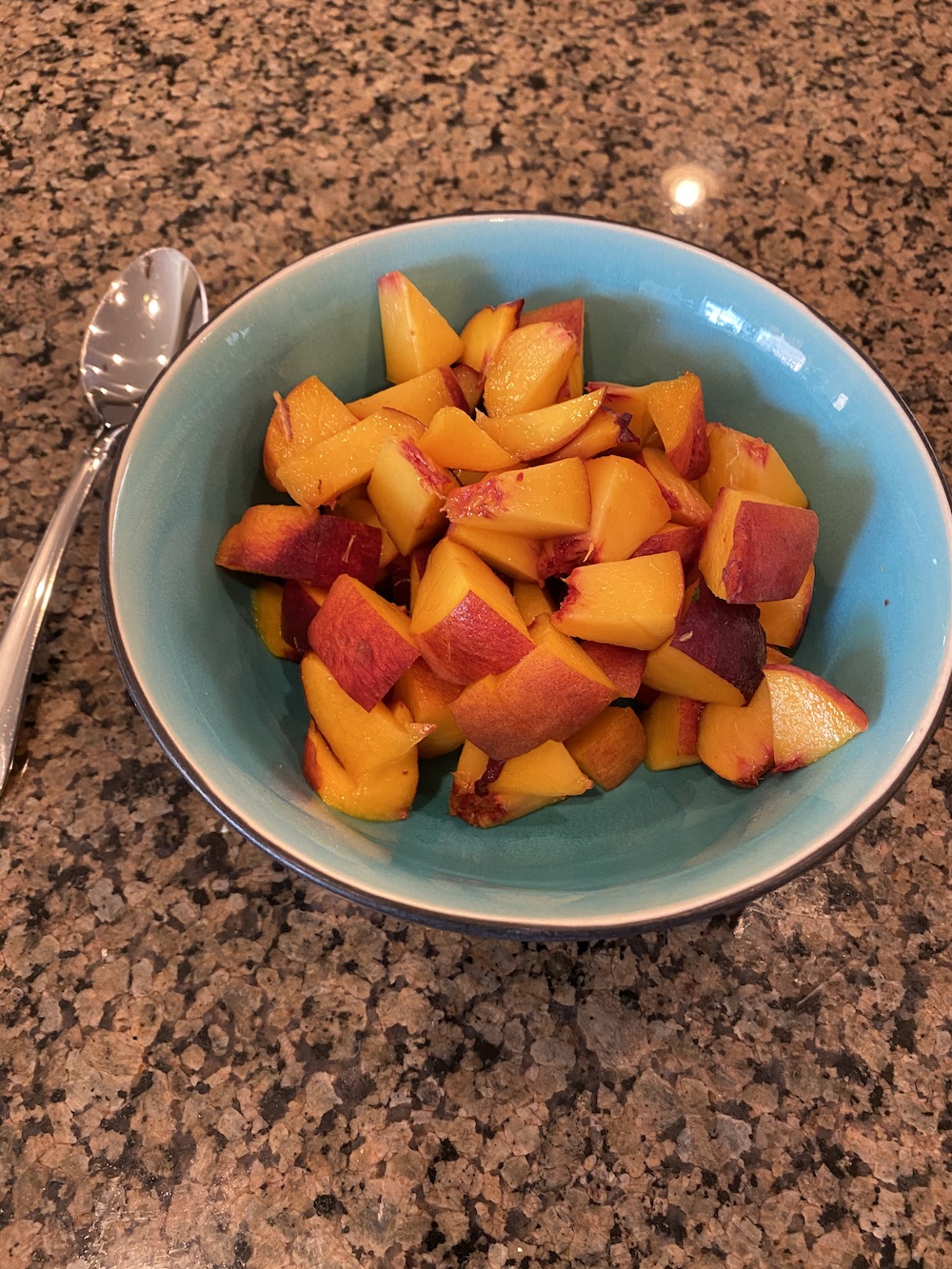
After about four weeks of this dietary experiment, I feel the benefits are relatively modest, given the trade-off of narrowing my food choices. I do like that this different way of eating has encouraged me to explore different meal options, like the peach bowl I shared yesterday (which I had again this morning). I’ll at least finish off the full month, but I’m not seeing enough benefits to warrant a long-term change here.

I am curious, however, if the reduction in hunger between meals is due to removing grains, legumes, sugar, or some combo of those. So I may try reintroducing some foods slowly next month to see if I can gain more awareness there. You may have your guesses, as do I, but I gain the best insights from seeing how my body and mind actually respond, which often doesn’t match people’s predictions.

In terms of results, tweaking which plant foods I eat doesn’t seem like nearly as big of a deal as getting all animal products out of my diet. That was the most important step, especially given the long-term mental and emotional gains, many of which were very noticeable in the first week or two. The biggest deal beyond that was to eat 100% raw for a while.

I’ve continued to lose weight this month (I lost another 5.8 pounds during the 4 weeks of this experiment), so this diet hasn’t interfered with that. I have been losing weight a bit faster this month than before, but it’s hard to say if that’s significant. I think it’s too little time to know for sure.

I’m still keeping a food log of everything I eat, and that simple habit alone has made it really easy to lose weight. I’ve been doing daily food logging for 15 weeks now, and I’ve lost 18.8 pounds in that time, which is an average of 1.25 pounds per week. This has felt practically effortless. Just taking a few minutes per day to write down what I eat has raised my awareness of exactly how much I’m eating each day.

Food logging has been such a nice tool for raising awareness that it’s creating results without my having to deliberately do anything more. It’s very different doing it for 15 weeks in a row versus doing it for only a few days or a week. I intend to maintain this tracking habit at least through the rest of the year because I’m still learning from it, and it really is super easy to keep doing it after 105 days of consistency. Another 100+ days seems like a breeze.

Share Button

A coffee and catnap keep you sharp on the nightshift, study suggests

A simple coffee and a quick catnap could be the cure for staying alert on the nightshift as new research from the University of South Australia shows that this unlikely combination can improve attention and reduce sleep inertia.

In Australia, more than 1.4 million people are employed in shift work, with more than 200,000 regularly working night or evening shifts.

Lead researcher, Dr Stephanie Centofanti from UniSA Online and the Sleep and Chronobiology Laboratory at UniSA says the finding could help counteract the kind of sleep inertia that is experienced by many shiftworkers.

“Shift workers are often chronically sleep-deprived because they have disrupted and irregular sleep patterns,” Dr Centofanti says.

“As a result, they commonly use a range of strategies to try to boost their alertness while on the nightshift, and these can include taking power naps and drinking coffee — yet it’s important to understand that there are disadvantages for both.

“Many workers nap during a night shift because they get so tired. But the downside is that they can experience ‘sleep inertia’ — that grogginess you have just after you wake up — and this can impair their performance and mood for up to an hour after their nap.

“Caffeine is also used by many people to stay awake and alert. But again, if you have too much coffee it can harm your overall sleep and health. And, if you use it to perk you up after a nap, it can take a good 20-30 minutes to kick in, so there’s a significant time delay before you feel the desired effect.

“A ‘caffeine-nap’ (or ‘caff-nap’) could be a viable alternative — by drinking a coffee before taking a nap, shiftworkers can gain the benefits of a 20-30-minute nap then the perk of the caffeine when they wake. It’s a win-win.”

The small pilot study tested the impact of 200 mg of caffeine (equivalent to 1-2 regular cups of coffee) consumed by participants just before a 3.30am 30-minute nap, comparing results with a group that took a placebo.

Participants taking a ‘caffeine-nap’ showed marked improvements in both performance and alertness, indicating the potential of a ‘caffeine-nap’ to counteract sleep grogginess.

Dr Centofanti says this shows a promising fatigue countermeasure for shift workers. She says the next move is to test the new finding on more people.

Story Source:

Materials provided by University of South Australia. Note: Content may be edited for style and length.

Share Button

Study explains multipronged SARS-CoV-2 attack and widepread COVID-19 infection

A study of a gateway receptor for SARS-CoV-2 led by Walter Lukiw, PhD, Professor of Neuroscience, Neurology and Ophthalmology at LSU Health New Orleans’ Neuroscience Center of Excellence and School of Medicine, may help explain the wide variety of symptoms and organs involved with SARS-CoV-2 infection and COVID-19. The results suggest that a multi-organ infection with SARS-CoV-2 may be via the angiotensin-converting enzyme 2 (ACE2) receptor, which is found almost everywhere throughout the body. The findings are published in the journal Cellular and Molecular Neurobiology.

To better understand the mechanism and pathways of SARS-CoV-2 infection and susceptibility to specific cell and tissue types as well as organ systems, the research team analyzed 85 human tissues for the presence of ACE2 receptors. ACE2 is a protein that is found on the surface of many immune and nonimmune cell types. An enzyme, it is part of the system that regulates blood pressure and fluid and electrolyte balance. It may also help regulate cardiovascular, neurovascular and renal function, as well as fertility. ACE2 receptors act like locks on cells, and the SARS-CoV-2 spike proteins act like keys that open the locks letting the virus enter cells to rapidly multiply. As well as controls, tissues tested included lung, digestive, renal-excretory, reproductive, eye tissues, and 21 different regions of the brain.

“Besides strong ACE2 expression in respiratory, digestive, renal-excretory and reproductive cells, high ACE2 expression was also found in the amygdala, cerebral cortex and brainstem,” reports Dr. Lukiw. “This may help explain cognitive deficits associated with SARS-CoV-2 infection. Some of the highest ACE2 expression levels were found in the pons and medulla oblongata in the human brainstem, an anatomical region of the brain containing the medullary respiratory centers, and this may in part explain the susceptibility of many CoV-19 patients to severe respiratory distress.”

The team further noted that ACE2 receptor activity was also easily detected in the eye, suggesting that the visual system may provide an additional entry point for SARS-CoV-2 invasion and that under certain conditions, eyeglasses or face shields may be as important as face masks in reducing SARS-CoV-2 transmission and infection.

“Several important research gaps remain,” Lukiw concludes. “A real danger of SARS-CoV-2 infection is not only its highly transmissible and contagious nature and lethality, but also its simultaneous and multipronged attack on many human cell and tissue types involving vital and critical respiratory, immunological, vascular, renal-excretory and neural systems as well as an unprecedented coordinated disruption of the complex neurophysiology, neurochemistry, neurobiology and neurology of the cells of the brain and central nervous system (CNS) that normally regulate these multiple physiological systems.”

The authors credit the late Dr. James M. Hill (formerly a Professor in the Departments of Microbiology, Ophthalmology and Pharmacology at LSU Health New Orleans School of Medicine) with whom they had a longstanding research collaboration on the expression of the ACE2 receptors, including those found in the Alzheimer’s disease brain. Aileen Pogue, from Alchem Biotech Research in Toronto, also participated in the research data tabulation, bioinformatics and statistical analysis.

The research was supported by grants from Research to Prevent Blindness (RPB); the Louisiana Biotechnology Research Network (LBRN); and NIH grants NEI EY006311, NIA AG18031 and NIA AG038834.

Share Button

Coronavirus cases continue to level off in England – ONS

The figures are based on tests on people in their homes, whether they have symptoms or not.

Share Button

The northern quoll: An amazingly versatile survivor?

The northern quoll, one of Australia’s most adorable and endangered native carnivores, appears to be adapted to dramatically different landscapes — which may be key to the species’ survival.

University of Queensland PhD candidate Pietro Viacava co-led a study that found similarities between northern quoll skulls across a 5000 kilometre range, which has raised hopes scientists will be able to cross-breed isolated populations.

“Northern quolls are in danger — a lot has been thrown at them,” Mr Viacava said.

“They’ve been victims of a devastating cane toad invasion, increases in bushfires and habitat fragmentation, all while facing stiff competition from other carnivores such as dingoes and cats.

“The problem we are facing with conserving the northern quoll is that there may be too little genetic diversity in these handful of remaining populations, scattered across Australia.

“If we cross-bred them, we might run the risk that they wouldn’t be ideally suited to these diverse environments.

“Their skulls, for example, might not be properly adapted to eat local prey, as it differs across Australia.

“Luckily, this doesn’t seem to be the case — these quolls seem to be incredibly versatile.”

The research team used a technique known as ‘geometric morphometrics’ to characterise skull shape variation in museum specimens of northern quolls.

They looked for shape differences between populations, or whether environmental conditions coincided with changes in skull shape.

Dr Vera Weisbecker from the Flinders University College of Science and Engineering supervised the study, and said the results appeared to be a win for northern quoll conservation.

“Quoll skull shapes were mostly similar across their entire range, although the shapes did vary with the size of the animals,” Dr Weisbecker said.

“This means, for example, that a quoll skull from Pilbara region in WA looked nearly the same as a similar-sized one from south-eastern Queensland, 5000 kilometres apart.

“Although other parts of the animal’s body and genetic factors need to be considered, we will most likely be able to breed animals from different populations for conservation without losing adaptations to feeding.”

However, there is also a much less positive potential explanation for the results.

“Scientists have long suspected that marsupial mammals — such as quolls, kangaroos and koalas — are seriously limited in the degree to which they can adapt their skull and skeleton,” Dr Weisbecker said.

“This is because newborn marsupials require a specifically shaped snout to be able to latch onto the mother’s teat.

“In that case, what we see may actually be a serious limitation on the ability of quolls to adapt, rather than the much more hopeful multipurpose solution we propose.”

To further explore this possibility, the team is now looking at how closely related species of antechinus — smaller quoll relatives — differ in skull shape.

The team includes researchers from UQ, Flinders University, Queensland University of Technology and the University of New England, with funding from the Australian Research Council.

Share Button

Coronavirus: Health workers’ army to be trained to deliver Covid vaccine

They would include midwives, physiotherapists and possibly even dentists, the government says.

Share Button

Health24.com | Anorexia often stunts girls’ growth, study finds

  • Girls with anorexia tend not to achieve their potential height in adulthood
  • Additionally, height impairment is a marker for other complications of anorexia nervosa 
  • Early diagnosis and treatment could prevent this from happening

Girls with the eating disorder anorexia nervosa may have stunted growth, new research suggests.

People with anorexia nervosa believe they weigh too much, even if they’re underweight. They may lose a dangerous amount of weight by dieting, exercising excessively, or binge-eating and purging.

“Our findings emphasise the importance of early and intensive intervention aiming at normalisation of body weight, which may result in improved growth and allow patients to reach their full height potential,” said researcher Dr Dalit Modan-Moses of Chaim Sheba Medical Center in Tel Hashomer, Israel.

Height impairment a marker

For the report, the researchers studied 255 girls around age 15 who were hospitalised for anorexia nervosa.

The investigators measured the patients’ height at the time of hospitalisation and again at adulthood. The women’s adult height was much shorter than expected compared with the genetic potential gauged by their parents’ height, the study authors said.

“We suggest that the height impairment is a marker for other complications of anorexia nervosa affecting the person’s overall health in several aspects: bone health, cognitive [mental] function, and problems with pregnancy and childbirth later in life. Early diagnosis and treatment could prevent, or at least reduce, the risk of these complications,” Modan-Moses said in a news release from the Endocrine Society.

“This study may have implications for the management of malnutrition in adolescents with other chronic diseases in order to achieve optimal adult height and bone health,” Modan-Moses added.

The report was published online in the Journal of Clinical Endocrinology & Metabolism.

Image credit: iStock

NEXT ON HEALTH24X

Share Button

Coronavirus: Wales has ‘one of lowest’ Covid-19 mortality rates

Figures also show 14 Welsh communities have not registered any deaths involving Covid-19.

Share Button

Health24.com | Frequent hand-washing tough on those with eczema

  • Regular hand-cleaning is essential to prevent the spread of Covid-19
  • Soaps and hand sanitisers can, however, irritate the skins of people with eczema
  • An American expert recommends regular application of moisturiser to prevent skin drying out

Hand-washing is one of the best ways to prevent the spread of Covid-19 and other viruses, but for people with skin conditions like eczema, lathering up frequently can lead to dryness, cracking, itchiness, pain and even an infection.

If you’re struggling to balance pandemic hand-washing and skin conditions, Dr Jonathan Silverberg, a dermatologist at George Washington University School of Medicine in Washington, D.C., offers some advice.

  • Regular washing is better than hand sanitiser: When you cleanse with soap and water, then immediately apply moisturiser, you can “offset much of the drying effects of hand-washing”, Silverberg said in a news release from the Asthma and Allergy Foundation of America. He recommends carrying a pocket tube of moisturiser so you can apply it on the go.
  • Avoid antiseptic and antibacterial soaps: You may not need them, as long as you scrub thoroughly with soap for at least 20 seconds and then rinse.
  • Moisturise properly: After washing, pat your hands until they are mostly dry, using a paper towel or tissue. “Once mostly dry, [i.e., your skin is still a little damp], apply a generous amount of moisturiser to coat the entire surface of your hands and fingers,” Silverberg said.
  • Beware of gloves plus sanitiser: To avoid irritation from hand-washing, some people with skin conditions wear disposable gloves and then use sanitiser on them – an approach Silverberg does not recommend. “When we apply hand sanitiser on our bare skin, we can feel if we covered the entire surface of the hands and fingers,” he said. “But when wearing gloves, we limit the ability to feel this and might miss some spots on the gloves and then accidentally carry some germs.” It makes more sense to change gloves and/or wash or sanitise hands often, Silverberg said.
  • Wear gloves when cleaning: Cleaning products are especially harsh on the skin. “People should always wear gloves when using antiseptic wipes and cleaning products,” Silverberg said.
  • Sterilise containers: If you carry bottles of soap and moisturiser with you, clean and sterilise the containers to remove harmful germs. And remember: Moisturiser should not be applied unless hands are clean, to prevent contaminating the product.

Image credit: Shutterstock

Share Button