Your Weekly Priority Card

When you have a lot of quarterly goals, it can be tricky to keep them prioritized, especially since priorities can shift as you go through the quarter. So it’s good to have a reliable practice to refocus your attention on your top priorities.

One simple practice I’ve been using lately is to create a priority card at the start of each week. It’s just an index card with my top priorities for the week listed on it. I keep it near my desk and normally review it to begin each workday, along with reviewing my other quarterly goals. This helps me see the week’s priorities in the context of bigger goals, which makes me feel more committed to progress.

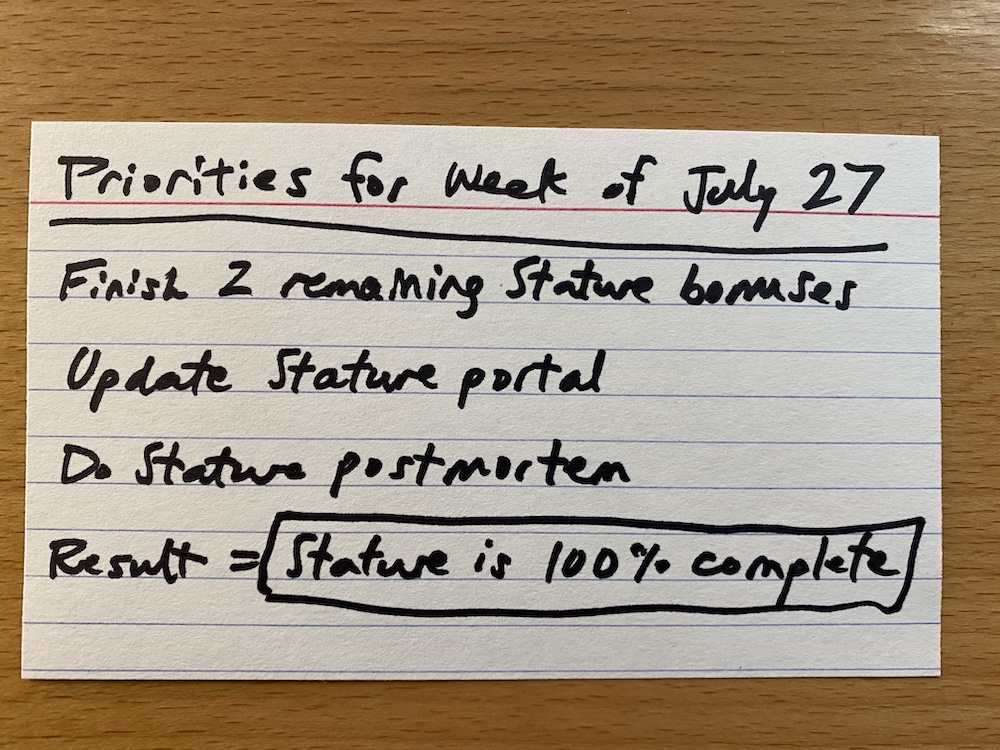
Here’s what my priority card for this week looks like:

It only takes seconds to fill out one of these cards, so it’s very straightforward. This week my #1 priority is to finish and publish the two remaining bonuses for the Stature course. One bonus is a short text document – basically a character design sheet – which is almost done. I expect to have that one done and published today or tomorrow. The final bonus is a collection of audios (Stature builders) that will likely take me a few days to finish.

My other priorities include making some improvements to the Stature portal and doing a postmortem for the Stature project.

I expect to do these in the order listed. I’ll have the Stature project 100% done when these items are completed, which will be a nice result. It feels good to bring a long project to full completion.

Do I know I can complete these items in a week? I know I can work on them a decent amount this week, but since they involve some creative work that’s tricky to predict time-wise, I may need more than a week to finish. That’s okay. I can continue working on them next week if necessary. But the priority for this week is to move these projects forward towards completion.

These projects have detailed action steps listed in Nozbe, so the priority card items refer to known projects that have already been mapped out. I know what needs to be done, so the main decision is to flow through these particular action steps this week.

There are dozens of other projects that I won’t touch this week – eventually they’ll get their turns as well, but I can only fit so much into a single week. While I could jump around and make progress on lots of different projects in a week, this week I’d like to maintain more of a mono-focus and move this one project forward, especially since it’s so close to the finish line.

I can still maintain habit-based activities such as daily blogging and other pre-scheduled commitments each week. The priority card helps me make good use of my discretionary work time – i.e. those blocks of time that aren’t already spoken for.

Setting priorities also helps to clarify posteriorities. Anything not listed on my priority card for a given week isn’t a priority for that week. I may still be able to work it in, but I’d rather make progress on the priorities first. This doesn’t mean that other items aren’t important, but it does mean that I’ve decided they aren’t as important for me to attend to in the current week.

To make meaningful progress on interesting projects, something else has to wait. If you don’t decide in advance what has to wait, your focus is more likely to become scattered or chaotic throughout the week. You’ll still have to make those prioritization decisions at some point, but your decisions may be ad hoc and inconsistent if you don’t maintain a reliable process for weighing options and deciding.

Filling out a weekly priority card after reviewing my quarterly goals works well for me. I’m basically breaking off a chunk of my quarterly goals to set priorities for the upcoming week.

I encourage you to make your own priority card for this week. Test this idea to see if it helps you focus better and improve your results. Grab and index card and a marker or pen right now, and make it so.

After you fill out your priority card, keep it somewhere convenient, so you’ll review it each day. I recommend that you use one of your devices to set a daily reminder to review it at a certain time, so you’ll have a convenient trigger for the review action.

As I noted earlier, it’s best to set priorities for the week after reviewing your quarterly goals. If you don’t have quarterly goals intelligently defined, you can still apply this idea without them, but it’s best to set weekly priorities based on long-term goals. Also consider joining us in Conscious Growth Club next year, and we’ll walk you through a 5-step process to define and update your goals at the start of every calendar quarter. It does take some practice to get into the rhythm of doing this, but it makes a world of difference in the progress you can make. A delightful benefit of this kind of investment is being able to set and achieve meaningful goals and advancing them week by week and quarter by quarter.

Update (several hours later): As expected I got one of the remaining Stature bonuses completed and published today. So that’s a very nice start to the week!

Share Button

Graduating From $20 Problems to $20K Problems

One simple tip for inviting more abundance into your life is to elevate the cost of the problems you normally focus on.

Suppose you order groceries online and have them delivered. And suppose the company screws up several items in your order. Maybe you feel inclined to complain and get a refund on those items.

Perhaps you take some time do the following:

  1. Feel upset.
  2. Vent to someone else about it.
  3. Think about following up with customer service, wondering how they’ll respond.
  4. Actually write to customer service.
  5. Feel distracted while awaiting a response.
  6. Read the response from customer service.
  7. Receive a polite apology and $20 refund on your order.
  8. Finally let it go.

So you successfully processed and solved a $20 problem.

That’s fine. You can do that, but be wary of making a long-term habit of this. Ten years from now you may still be dealing with $20 problems. Is that what you want? Or would you like to graduate to more expensive problems?

The more time you spend thinking about $20 problems, the less time you spend dealing with different classes of problems – $200 problems, $2K problems, $20K problems, $200K problems, etc.

Even if you solve lots and lots of $20 problems, you’d have to solve 1000 of them to equate to the financial impact of solving one $20K problem. You can ignore hundreds of $20 problems and solve just one $20K problem now and then, and you’ll still come out way ahead financially.

Of course there are other considerations. Solving lots of $20 problems could add up to a significant mental and emotional impact. It’s not only about the money. But it can still be helpful to consider the financial impact of each problem you’re dealing with to consider if it’s really worth your time.

I still deal with $20 problems now and then, but I try to limit myself to the ones that matter to me. For instance, Rachelle and I recently spent some time considering new pillows to buy for our bed. This was a $50 problem. But since we’ll be spending a lot of time sleeping on those pillows and since a bad choice could cause some angst, including physical discomfort and lower quality sleep, we wanted to take the time to select some really good pillows. Taking an hour to weigh options and make that choice seemed reasonable. So even though it looks like a $50 problem, we could also see it as a $50K problem for the potential productivity and lifestyle impact.

However, if the impact of a decision is really just $20 or $50, then it’s best to work on your framing. Realize and accept that the more time and energy you spend dealing with decisions at this level of financial impact, the more you steal time from investing in bigger, more impactful decisions.

I know it can be hard to let go of $20 decisions, but this is an important skill to develop if you want to progress financially. You can’t keep collecting coupons year after year – unless you start finding $20K coupons.

Here are some frames you may want to progress towards:

  • Your Starbucks points don’t mater. If some of them expire, you’ve lost a few dollars. It’s not even worth caring about. It’s not even worth your time to check their latest promotions.
  • It doesn’t matter who pays for dinner. You can pay. The other person can pay. It’s better not to spend much time thinking about it since that just wastes neural energy.
  • Buy the best quality tech you can afford. Then you needn’t waste time wondering if you should have bought something better. Don’t skimp on your tools.
  • Take all the mental energy you would have spent fussing over $20 decisions, and use it to negotiate a meaningful raise at work, or do a new marketing campaign for your business. Even if you just bring in an extra $5K per year, that’s equivalent to solve 100 $50 problems or 250 $20 problems.
  • Solve fewer, bigger problems. Let lots of little problems die unsolved.
  • Instead of solving lots of little problems, solve the problem of finding someone to solve those little problems for you.

Keep progressing. At some point you have to stop fussing over $20K problems and opportunities, so you can focus on $50K or $100K issues.

At one point a $20K opportunity may excite you, but to progress beyond that level, you eventually have to start seeing $20K opportunities as partial matches and let them go. It’s really hard to see $50K opportunities when you’re still tempted by $20K ones, just as it’s harder to spot paper money when you’ve trained your mind to notice coins on the ground.

When you’re dealing with a problem or an opportunity, pause and ask yourself: Is this a $20 issue? A $2K issue? A $200K issue?

Which class of problems and opportunities feels aligned for you to deal with right now? What kinds of problems make you feel really good when you solve them (versus feeling empty or dissatisfied)? Are you keeping your focus at your desired level? Are you reminding yourself to let go of the partial matches?

Share Button

Studying Yourself

You can make a lot of interesting personal growth gains by studying yourself and your own responses instead of trying to follow someone else’s behavioral prescriptions. Studying yourself is especially useful in the areas of health and productivity habits.

What actually creates good results for you? Quite often you’ll find that what works best for you in real life won’t be found in any book or seminar. You can learn ideas from others to inspire your own experimentation, but you may get the best gains by assembling your own unique collection of behaviors and practices.

When doing self-experimentation, it’s important to protect your self-esteem from your behavioral results. Look at your behaviors and their effects separately, and honestly assess their impacts and results. Don’t wrap your self-esteem into the effects of your behaviors because problem behaviors can be changed. Beating yourself up for having a problematic behavior will only slow you down. Let the behavior be the problem you want to work on; don’t weave it into your self-image.

As I mentioned previously, I’ve been engaging in a detailed self-study of my diet for the past 7.5 weeks. I’m raising my awareness about what I’m actually eating and how different meals affect me. Based on what I’m learning, I’m making lots of micro-adjustments and doing small tweaks to optimize my eating habits.

The main part of this is food logging, which involves writing down everything I’m eating, so I can see the rational truth as it really is. Pen and paper is far superior to memory here. I also add up the calories to get a sense of how calorically dense each meal is.

This helps me do little experiments, such as seeing what happens if I eat 500, 700, or 1000 calories before noon. Is it better to have a lighter 300-calorie dinner or a denser 700-calorie one? What happens if I mix walnuts into my steel cut oats versus a little coconut oil versus not adding any fat? Soon I’ll test eliminating the oats and eating something else for breakfast, like roasted potatoes, onions, and peppers with zucchini hummus.

Later this month I also plan to start testing what happens if I go grain-free and legume-free at the same time. I’ve done grain-free and legume-free tests before, but I haven’t done both at the same time except while I was also eating 100% raw.

One result I pay attention to, which is partly subjective, is how my morning runs feel. Do I feel energetic or sluggish? Do I feel motivated or run, or do I feel like skipping more days? I can also check my pacing since my watch records that. I’ve learned, for instance, that if I have a relatively low-calorie day (like 1600-1700 calories), I’m likely to run slower and feel less energetic during an early morning run the next day. Skimping on calories just makes me feel less energetic.

I can also see that just the act of measuring and paying more attention to what I’m eating is making it very easy to lose weight. I’ve now dropped 10.8 pounds since I started on May 14. This seems like a very easy way to slim down. It’s really about paying attention, which leads to better choices.

I like that there are no rules with this approach. I’m just paying closer attention to some of my body’s responses, and I’m making refinements based on that.

Another side effect is that I’m enjoying good food more than ever.

I’m really loving peaches and typically eat a few each day now, as long as we have some ripe ones. I’m buying 24 of them at a time to make sure I don’t run out so quickly. Costco has been having some really amazing yellow peaches in stock lately. I’m also eating lots of blueberries, strawberries, apricots, broccoli, zucchini, yellow squash, bok choy, kale, mixed greens, celery, and spinach.

You can extend this kind of experimentation to other areas of life. This can lead to some real breakthroughs.

I love the way I generate income, which I arrived at through many years of experimentation. I enjoy the combination of doing launches a few times per year plus passive income streams in the background.

I also love having an unusual relationship. I don’t know of any other couples who relate to each other like Rachelle and I do. Our relationship is rich is laughter, cuddling, affection, playfulness, and sexiness. Even after 10+ years together, the relationship still feels spicy. To make that possible, we just had to go our own way and do what works for us.

Some people resist going off script to experiment because of judgment from other people. But improving your results is a good antidote to that. If someone complains that you’ve gone off the deep end, poke fun at them for only playing in the shallow end where all the kids are peeing. The deep end is where you’ll find better results.

If you’re really worried about other people’s approval, however, you’ll likely get more of it from the people you respect if you stop chasing approval from people you don’t respect. Why on earth would you respect someone who criticizes you for using the perfectly valid and rational tool of self-study?

Share Button

How Long to Install a New Habit?

Some sources used to say that it takes 21 days to form a new habit, which most people are likely to find overly optimistic. Even 30 days is on the optimistic side.

The truth is that the time to install a new habit depends on the person, the habit, the environment, and the motivation.

How much experience do you already have with habit formation? How much have you trained those discipline muscles?

What temptations are present that could draw you away from the habit? How tempting are they?

What’s your purpose for installing the habit? Is it really compelling, or does it barely register?

As a general rule of thumb, I’d say 60 days is a decent average ballpark estimate for getting a new habit reasonably well installed, but some habits could take twice as long to put on autopilot. Furthermore, some habits will never be properly installed no matter how much time passes – they’ll always require a nontrivial amount of conscious willpower to keep executing day by day.

Moreover, even a habit that gets installed for months or years can still be broken eventually.

I’m often surprised at the range of times it takes to install a new habit. There’s a lot of variability.

When I first went from vegetarian to vegan, I started with a 30-day trial. I’d been vegetarian for 3.5 years at that point. The last item I dropped was cheese. I’d say it only took me about a week to feel like I was permanently vegan. I lost seven pounds in that first week as my body finally had a chance to purge years of built-up dairy clog. Seeing what was coming out of me made it easy to decide to never put it back again. That was 23.5 years ago, and it’s been a no-brainer to maintain that habit ever since. I doesn’t require any willpower to stay vegan. I’m never tempted to go back to the old world I left. That would feel like undoing a graduation.

I had figured that going fully vegan would take more practice and adjustment, but it was actually one of the breeziest habit changes ever. The purpose aspect made this habit way easier than most.

Becoming an early riser was more challenging. I struggled with this one for years till I stumbled upon the counter-intuitive technique I shared in How to Become an Early Riser. That led to success. I do occasionally fall out of this habit now and then, usually by choice to experience something different for a while, like having more nighttime hours. But I still love those early morning hours and keep returning to the long-term stability of this habit. I think that in the past 90 days, I’ve stayed in bed past 5am perhaps two or three times to cuddle with Rachelle for an extra hour or two. So this one is very stable.

Whenever I want to reboot this habit, I’d say it takes me less than a week to feel like I’m back in the flow with it. Remembering the benefits surely helps.

Oddly a very simple habit like doing proper hygiene for my teeth took 1-2 months of consistent practice to feel like I’d really installed to the point where I do it automatically without thinking much about it.

For my daily blogging habit this year, it took about 45-60 days before I felt like I’d woven it into the fabric of my days, and it didn’t feel like some external task that I was wedging in. If I had an unusual schedule that disrupted the timing for the habit, then it might feel a little misaligned, but that’s been relatively rare.

Zeroing out my email inbox was another easy habit to install, taking virtually no time at all. I was never the kind of person who’d allow hundreds of emails to pile up in my inbox though. I feel like it’s a lot to have more than 5-10 messages in there at once. I prefer to bring my email inbox back to empty whenever I check it, and leaving even one message in there doesn’t feel right. If I’m not going to reply to a message right away, I move it to a different folder to be processed later. I never use my email inbox as a to-do list.

Frankly I don’t understand people who allow thousands of emails to pile up in their inboxes. They must use very different framings because I could never imagine allowing that to happen. I’d feel like I was priming myself to feel stressed and undisciplined whenever I had to look at such a mess. I wonder how people are able to frame a cluttered inbox without having it lower their confidence and self-image. Do you really feel like you’re on top of your projects when you look at that giant list of messages? Wouldn’t it feel so much nicer to leave it empty each time if you could do that on autopilot without having to think about it?

What made the email habit easy to install was actually a different habit that took way longer to install properly – at least several months to get it going and perhaps a few years to get it down consistently. That habit was to maintain a structured personal management system for my projects and tasks. I use Nozbe for that, and I’m still happy with it.

Another related habit is that I question whether certain emails should even be sent to me in the first place. If I had an inbox piling up with emails that I wasn’t even opening, I’d unsubscribe from them, tell the senders to stop sending those kinds of messages, or add an automated filter to block them. That’s the main reason there’s no pile-up – such emails are nuked before I even see them. That means fewer distractions and no negative priming for clutter. Think of how much time and focus is wasted by looking at the same messages repeatedly.

The habit of daily exercise also took a while to install – about six months to really get it ingrained. I may still fall out of this habit now and then, but it’s easy to reboot. For a proper reboot, at least a six-week commitment is warranted. Exercising for 30 days won’t necessarily make it stick.

Some habits are so worthwhile that even if they take a long time to install, and even if they remain vulnerable afterwards, they’re still worth the investment. Getting my personal organizing systems in order was one of those. I struggled with that for a long time, but it pays off with so much delightful flow and long-term confidence. It’s so great to be able to trust such habits to follow through on bigger commitments. This makes life more rewarding and fun, and it grants more freedom for spontaneity. If you like freedom, fall in love with order.

In my 20s I was way too impatient with many habits. If I couldn’t get something working in a few weeks, I’d often drop it and try something else. Now that I’m in my late 40s, I’ve learned to think more long-term, knowing that even if it takes many months or years to tame a new habit, that habit could be paying dividends for decades. So it doesn’t phase me to think about investing in a new habit for several months, just to get started with it. When you think about a habit enduring for decades, who cares if it took a few weeks or six months to acquire it?

Don’t worry so much about how long it takes to install a habit. Instead, consider which habits could so enrich your life that they’re worth a six-month commitment to get them installed and running on autopilot. When a habit is on autopilot, it feels uncomfortable not to do it, and your day doesn’t feel complete without it.

Remember that the months ahead are going to pass anyway. Depending on the investments you initiate today, you could find yourself with a really awesome long-term habit on autopilot by the end of the year – or your autopilot could be about the same as it is now. If you expect that there will be some challenges, and you conquer those hills anyway, you’ll get to enjoy some nice results. Think of this as a gift for your future self.

Share Button

No ❌ Days!

I’m more than half done with my 374-day blogging challenge, which started on Dec 24, 2019. I’ve done 191 days and have 183 days to go. My blog currently has 1517 published posts, so there will be an even 1700 at the end of the year.

These types of daily challenges are mentally won or lost before Day 1 begins. It’s best to remove the doubt first. This includes anticipating the objections that various parts of your mind will come up with and how you’ll deal with them as they arise. If you’re unprepared for those objections, they may surprise you along the way and make you want to quit, which you’ll likely regret.

One simple internal defense against quitting is to see your daily commitment as an issue of honor. I tell the whiny parts of myself that we can’t quit because that would be dishonorable, so we’re not going to go there. They have no good counter-argument for the honor issue, so they surrender to it. Many of those parts care about honor as well.

Another defense mechanism is that I tell myself that when it gets difficult, it’s a growth experience. It’s easy to write when I feel inspired. It’s harder to write when I’d rather not write, but in those writing sessions, I build more self-discipline, confidence, and the ability to surrender to what I’ve already decided to do. I also stretch my creativity to work with whatever level of energy and motivation I have, which makes it more efficient and reliable.

Here’s an especially powerful skill to add to this collection. Acknowledge the tremendous negative memory that would be created by quitting partway through. Going six months and then stopping isn’t half a win. It’s a loss, one that will still be remembered decades from now. That would be a terrible curse to bestow upon my future self. I’d rather gift him with a lifetime memory of success. While some may look back on 2020 as a cursed year, I want to remember this as the year I wrote and published more than I ever have in any other year. For me it’s a year of stretching my self-discipline and building more creative confidence.

You can let circumstances write the story of this year for you, or you can choose to write your own story. This year is only half written so far. What will you write for the second half? Have you already made that second half a win or a loss in your mind? Are you already regretting tomorrow?

When I’ve quit on certain challenges in the past, many years before I started blogging, I still hold those memories today. I’d have preferred to look back upon memories of pushing through to meaningful successes and accomplishments instead of stopping before crossing the finish line. The enduring sting of those memories motivates me not to create more of them.

Remember that whenever you quit on yourself, you curse your future self with the lifelong memory of quitting, and your confidence takes a hit. That’s a big price to pay. It’s easier to just do one more day of discipline, again and again, till you achieve your goal. That’s always the basic decision, isn’t it? One more day of discipline or a lifetime of regret – which do you want?

Quitting on a personal commitment isn’t neutral. It doesn’t just drop you back down to even, as if you never started in the first place. It’s a genuine setback, especially for your long-term self-trust and self-confidence. It gives you a negative result, and it can take a while to recover from that.

One reason I chose to do this blogging challenge is so that I’ll always have the memory of 2020 being the year I published to my blog every single day. I want to add that to my life as a cherished reference experience, just like I cherish the memory of exercising every single day some years, the first one being 1997.

This daily blogging goal isn’t 100% under my control. Something could happen to me along the way that physically prevents me from completing it. If such an event were to occur, I could forgive myself if there wasn’t a realistic option to do otherwise. But I’m not going to quit on myself since that would create a lifelong disappointment.

When you do 30-day, 90-day, or 365-day challenge, what’s your defense against quitting partway through? Figure that out before you begin. It’s part of the early game of success. Create the victory in your mind before you step up to the starting line; otherwise you’ve already defeated yourself.

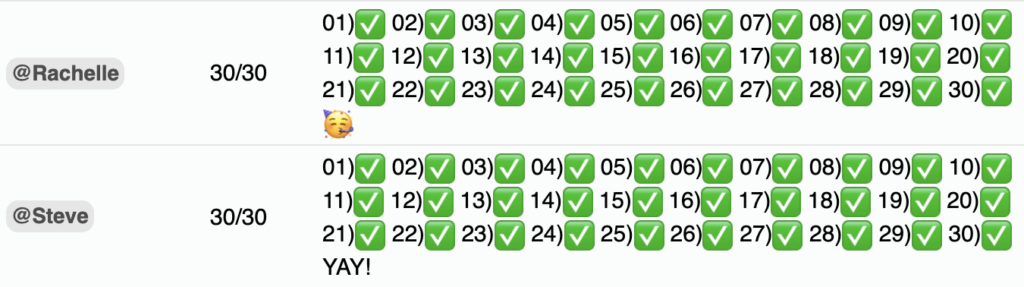
In Conscious Growth Club, we do fresh 30-day challenges at the beginning of every month, so 12 times per year. Members who choose to participate chart their progress, either by adding a checkmark or an X for each day of the month, like this:

I like to tell people: Decide before you begin that there will be no ❌’s. An ❌ is not an option.

Really I think we shouldn’t even have ❌’s as part of the challenges. We should use a skull and crossbones ☠️ emoji instead to drive home the point that if you miss a day, you failed the challenge, and now you’re wallowing in freakish misery forever.

That kind of framing may sound harsh, and I’ll agree that it is, but it really helps to prevent ❌’s.

Ideally the only progress logs we should see for these challenges ought to look like this:

I’d love to see this become the standard for every member who does them. And this is why we train on these challenges again and again – to kill the ❌’s for good.

No ❌ days – ever! It’s all ✅’s – or the lifelong misery of ☠️.

With this post that’s 192 days in a row… 182 to go. 🙂

Share Button

Goal Traps

The end of a calendar quarter and the start of a new one is a great time to set fresh goals for the next 90-days.

In Conscious Growth Club we go through a 5-step quarterly planning process each quarter, whereby our members review their recent progress and then set and share their goals for the coming quarter. As part of this process, I host a live Zoom call to review the goals that members have set and to highlight best practices and potential pitfalls. The intention is to help members set goals they’re more likely to achieve.

We just did one of those calls this morning. I find them motivating and inspiring because they unearth a lot of insights into how we set worthwhile goals and make real progress, one quarter at a time. It’s especially rewarding to watch members improving in this area each time they go through the process. Some have made impressive strides in the past year, getting a lot more clarity about what actually inspires them and what doesn’t. We pay a lot of attention to the relationship between goals and actual results, and that’s a big part of what we explore on these calls.

During these calls, I like to point out some best practices as well as traps to avoid. I thought a nice topic for today’s blog post would be to share some of those tricky traps to avoid, which can reduce the effectiveness of goal setting. This is really just scratching the surface because today’s call was 3 hours long, so we really go into a lot of depth in CGC, but I’ll aim to share some of the less obvious yet still important items instead of those you’ve likely encountered elsewhere.

Deferred Decisions

A goal is a decision and a commitment. Setting goals can be uncomfortable because you’re narrowing your options and tightening your focus, and it’s common to try to keep your options open by pretending to commit. A common way to water down your goals is by defining a goal as a decision to be made and thereby not really committing yourself.

A telltale sign that you’re doing this is your goal includes words like define, decide, identify, figure out, determine, research, etc. Your framing is that your goal is really to make a decision instead of to implement a decision. But if you don’t know what result you’re trying to achieve, you haven’t really set a goal yet.

It’s fine to research a decision if you really need to do that first. But is your research in service to an end result, or are you just waffling and delaying because you feel uncomfortable – and calling it research?

If people can set a goal to go to Mars and then do the research along the way, what’s your excuse for needing to do the research before you’ve committed to a result? Your destination can still be reasonably clear even before the research is done. That takes courage, so be courageous, decide, and commit.

I recommend making the decision when you do your goal setting. That’s part of what setting a goal is about. Make your choice then and there. Don’t punt your decision into the future, or you’ll end up doing that every quarter. Declare the results you intend to achieve before the quarter begins.

If you choose wrong, you’ll find out soon enough, and you can choose a different goal if it’s really that bad. Or keep the same goal, and plot a different course to it. But it’s usually better to start making progress towards one clear target that may not be the best choice, and then change course while you’re in motion, than to keep your target definition unclear to begin with.

Head-Based Goals

While it’s good to set goals that are rational and sensible, recognize that motivation is emotional in nature. You don’t actually have to pursue any goals for rational reasons. Logic alone can’t even say that your survival matters. So goals that are too head-based tend to be weak in terms of their motivational effect.

Head-based goals look great on a screen, and that’s usually where they’ll remain till you abandon them.

Goals need an emotional context to be motivating. It really helps if you associate a sense of meaning, purpose, character transformation, or story progression with your goals. Otherwise you’re likely to remain stuck in your head when you think about acting on a goal, running yourself in circles and not really progressing towards a worthwhile result.

Numbers goals are a common issue here, like making a certain amount of money or hitting a particular exercise target. If there’s no emotional context to the numbers, they may be demotivating instead of motivating. Some numbers may feel significant to you – perhaps earning $10K per month feel coolers than earning $8K per month – but often such goals are better defined from the heart side rather than the head side.

You can still hit your financial targets if you come at them from a story-based angle, and doing so will probably be more fun too. Picture Apple explaining what you can do on one of their new devices, putting the numbers in context and sharing why they matter: This speed means you can now edit 4K videos, and isn’t that super duper cool?

Remember the marketing campaign for the original iPod? Do you remember how much storage it had? What I remember is: 1000 songs in your pocket. Isn’t that a better context for the number than saying it has 5GB of storage?

It’s wise to do the same for your own numbers. Otherwise the numbers probably won’t give you a strong enough reason to care.

You can do this for exercise goals too. Running for 60 minutes each morning is nice, but I find it more meaningful to know that I can run a loop around the nearest casino and back home again because it’s a meaningfully bigger loop that I used to run. Or I can run to a particular park and say hi to a half dozen rabbits I’ll usually see there. Running to the rabbit park and back is a more emotional way to define a goal than running for an hour.

If you’re going to bother with numerical goals, make damned well sure to give them an emotionally meaningful context. That will significantly increase your likelihood of success.

Some processes of goal achievement are more heart-aligned than others too. Your destination may feel emotionally inspiring, but if the process to get there is dreadfully dull, you’ll likely have trouble with consistency.

The actual emotion linked to your goal isn’t that important, as long as it’s meaningful for you and gets your heart in the game. Some people love the energy of edgy or risky goals. Others prefer playful goals. And still others like linking their goals to social connections, so pursuing their goals involves deepening their relationships. What matters is that you feel something that stirs you to act. That something is emotional.

Splatter Goals

Usually people don’t do so well with splatter goals, where it looks like a random list created by throwing darts at a dartboard. Such lists might include a health goal, a social goal, a career goal, a financial goal, and a lifestyle goal. But they may not mesh well together or support each other. It looks like someone just picked a random token goal for each area of life.

Instead of trying to splatter your energy in multiple directions, consider a hub and spoke model for goal setting. Have one clear central goal for your quarter (the hub) and a few more related goals that support and enhance that hub goal. This is especially useful when you’re working towards a transition like a career, relationship, or lifestyle change.

Trying to make too many unrelated changes in a quarter will likely dilute your focus. But if you know there’s just one central goal to accomplish, and getting that done is the key result that matters to you, arrange your goals to keep your eyes on that prize. You know that your priority is to keep moving towards that goal each day. If that’s all you get done during the whole quarter, it will likely be a memorable and worthwhile quarter.

Suppose your hub goal is to quit your job and start a new business. Then your spoke goals may include doing setup projects for your new business idea, exercising daily to help burn off stress, wrapping up projects at your job, training your replacement, finding a mentor, etc. That can be a lot to pack into a quarter already, so it’s probably not helpful to pile on other goals like building your dating skills or learning a musical instrument. Just focus on the big transition. When that’s done then consider other goals.

The “Big System” Goal

One final problem I’ll share is when you set a goal to plan and implement your “big system” for radically upgrading some part of your life – usually your workflow, your finances, or your business processes.

People rarely succeed with this approach because it’s too much change all at once. Many won’t even be able to implement their systems for a day, let alone a week, a month, or longer.

While a calendar quarter may seem like a long time, it’s actually pretty short and can blow by faster than you expect. It’s so easy to bite off way too much, especially when it comes to habit changes, and those “big system” goals tend to disguise a lot of smaller changes that will likely take way longer than one more calendar quarter to effectively install.

Instead of trying to transform so many habits at once, pick just 2-3 small habits to change first, maybe even just one. Land a beachhead with a 5-minute or 10-minute change in your day. Do that for at least 30 days first. Once you get it established, and it feels like you don’t need much discipline to maintain the habit, then you can build it out more.

Otherwise if you’re trying to change many parts of your day to fit into some beautifully designed system, you’ll probably find that you never get any sort of implementation to stick. Training yourself to implement that whole system and to be consistent with it will probably take more than a year, so bite off small pieces each quarter, work them into habits, and only add more when you’re able to be strongly consistent with the few pieces you’ve added so far.

Realize that the game of life is long. A year or two isn’t so bad for making a long-term improvement that could serve you well for decades. It’s worth the time to build the foundation one piece at a time.

I hope you found these goal traps insightful. Setting well-formed goals is a skill that takes years of practice to develop proficiency, so please be patient with yourself. Keep practicing this skill one quarter at a time, and study the relationship between the goals you set and the actual results you experience, so you can keep improving year by year.

Share Button

Direct Exploration

While we can learn a lot from other people, such as from books, courses, classes, and online resources, I often find it valuable to learn from direct experience, even when doing so is slower and more error-prone.

There’s something special about exploring in the dark, gradually figuring out your own ways to accomplish something instead of having ready-made solutions spoon fed to you.

You can always look up a recipe for any dish you can imagine, but it can be more rewarding to set the cookbooks aside and bumble your way through. Maybe you’ll discover a dish you really like making. One of my favorites – the ultimate rice bowl – wasn’t discovered in any recipe book. I figured it out from personal experimentation. It’s simple and easy to make, and I love making it now and then. And since I figured it out myself, I also know many different ways to vary the recipe and have it still work, and my understanding of rice bowls is more robust because of that. I feel more confident and competent in this area because I’ve mapped much of the territory personally, as opposed to relying on a guide to tell me the highlights.

The risks of experimenting on your own include making more mistakes, getting stuck in pitfalls you could have avoided, and doing extra work to “reinvent the wheel.” But even when you’re rediscovering what’s already known to many other people, the personal experience of discovery can be more rewarding, and your knowledge will likely be less fragile. Your discovery of the wheel will be uniquely your own – and a lot more special than just buying a wheel.

Many years ago I decided to build my own PC by buying all the component parts from various sources and assembling it myself – motherboard, CPU, RAM chips, graphics card, hard drive, case, power supply, etc. It wasn’t worth the effort to save a little money, but I felt a special connection to that PC for years because I assembled it myself. It wasn’t just some mass market machine I’d bought from Dell. And the machine I built worked better and lasted longer than the pre-built ones I bought around the same time.

This month I’ve been experimenting with music composition again, mostly by messing around in Logic Pro. There’s a lot I don’t understand about how to layer a composition, so some of my experiments didn’t sound very good. But even though I could learn this skill faster from people with experience, I like fumbling around to see what I can figure out on my own. The discoveries feel more rewarding when I stumble upon them versus if I learn them from someone else.

This skill comes in handy in business too, especially when diving into something new. I didn’t know how to generate income from blogging when I first started in 2004 because blogging was still relatively new. So I experimented with income generation to figure how to make my work financially sustainable. I still got ideas from other people, but I had to test them in different ways to understand how to apply them to my business. Since I directly experimented a lot, I now know many effective ways to cover expenses and then some, so I feel confident and secure with income generation too. It’s just another rice bowl to me.

When you learn from other sources, you may acquire knowledge that’s more structured but also more fragile and rigid. You probably won’t gain the range and flexibility that comes from direct personal exploration.

I have degrees in computer science and mathematics, but what I learned in school wasn’t very helpful when I set out to design and program computer games. Most of the academic knowledge I’d gained was way too narrow and brittle. I advanced faster by studying programming on my own – often just by messing around to see what I could do. I also coded in different languages and on different types of devices. I learned so much more about coding by tackling dozens of small projects than by studying techniques from others. And learning coding on my own was way more fun, engaging, and interesting than formally studying it in school.

This isn’t an either-or proposition. Learning from others can be immensely valuable too. I’ve had some wonderful breakthroughs on that side as well. Just watch out for areas of life where you lean too heavily on the side of structured study and overlook the incredible long-term value of direct exploration. Use formal study to seed your own experimentation, not as a replacement for it.

Share Button

Fun Is a Personal Standard

Whatever you’re currently doing to earn money, is it fun for you?

Would you still enjoy your income-generating activities even if they paid half as much?

Still fun with less pay? Or does the fun depend on the money?

Earning money can be fun. Spending money can be fun too.

But what if earning money isn’t fun? Then to earn more, you have to push yourself to do even more work that isn’t fun. Your reward is very mixed then – more money perhaps but also less fun. That creates a drag that will likely cause your income – and your ambition – to stagnate.

A lot of the world’s offers for income generation aren’t particularly fun. In fact, many of them seriously suck. Do this boring-as-hell work for a paycheck. That’s a crappy ass offer. Who’d be desperate enough to say yes to that? Lots of people apparently since most people don’t like their jobs – don’t become one of them.

You don’t have to accept a crappy ass offer that isn’t fun. You can either keep looking till you find a fun and inspiring offer, or better yet, create your own offer.

Safe Isn’t Fun

To bring some fun into this picture, I think it helps to choose income generation strategies that challenge you to grow. If you make it too easy, you’ll be bored.

A fun game is at least semi-challenging. Challenge alone won’t make the experience fun, but it will surely help.

Many people look to their past hobbies and strengths for income ideas. That tends to be a relatively weak approach that can easily lead to boredom. What if instead you develop income ideas based around what you’d like to explore and experience? Why rehash the past that you’ve already explored when you could lean into something new and adventurous?

What new challenges fascinate you? What seems a bit out of reach?

When I created my current business in 2004, my background was in programming and game design, having already invest 10 years in that path professionally. I could have generated income from my programming skills, but I saw that it would be more fun to figure out how to earn income from writing and speaking instead. Those income streams would be more challenging, growth-oriented, rewarding, and fun.

The edginess of making money from communication skills made the process more fun. Getting paid for my first professional speech was more fun and rewarding than getting paid the same amount from leveraging my programming skills.

Programming was safer, and speaking was scarier. Safe isn’t fun. Scary is often fun. Would you rather safely sit in your car in the parking lot of an amusement park… or would you prefer to go on the rides?

Earning decent income isn’t that hard if you’re having fun and enjoying fresh growth experiences from your work. Then it’s largely a matter of finding and testing the right strategies. But it can be really hard to earn good income if you don’t enjoy and appreciate the work you’re doing.

The Standard of Fun

You can earn income doing what isn’t fun. Or you can earn it doing what is fun. If you want the second option, don’t be a person who tolerates the first option. You get the lowest standard you’re willing to tolerate.

Fun work is essential to me. In Conscious Growth Club yesterday, we did a two-hour group coaching call, and it was fun, not just for me but for many of the members too. We shared a lot of laughs and silliness along the way, which actually enhances the coaching experience and doesn’t detract from the value. Would you rather be on a fun coaching call or a boring one? Don’t you think that fun is more motivating and inspiring than boredom?

Does your work spark joy for you? Do you look forward to showing up? Do you get excited when Monday morning comes up again, and you get to sink your teeth into some juicy and interesting projects? If that’s not your reality, then why the heck are you still showing up? Are you doing it for the income that will be perpetually held back by your lack of motivation? That’s a lame investment of your time and energy. What’s the long-term payoff? Sadness and regret? Step off!

Work doesn’t have to be a dreadful slog. You can choose to make it edgier and more fun. You can bring more of your playful personality to the experience. If you get fired for that, I’d say that’s a great reason to be fired. If your workplace can’t handle your having fun while doing your work, fuck ’em! Leave those dreadfully dull people behind, and work with fun-loving people instead. They’re out there if you’re willing to look and if you’re willing to rise to that standard and not accept less.

Share Button

Committing Before You See the Solution

A simple yet common common difference I’ve repeatedly seen between various friends could be described like this:

  • Some friends commit themselves to a problem before they’ve figured out the solution.
  • Some friends try to figure out the solution before they commit themselves to the problem.

By and large the first group makes significantly faster progress while the second group so often gets bogged down and stuck.

Consider on which side you normally fall here.

Are you able to commit yourself to tackling a problem or undertaking a lifestyle transition before you have it all figured out?

Or do you need to have all of the major pieces figured out first before you can get moving?

I like committing to challenges where I don’t know how everything will work out in advance. Life feels more fun and adventurous that way. Risk adds some nice edginess to life.

Another advantage to committing first is that it upgrades your motivation. When you feel committed to a problem, you push yourself harder to solve it versus when you’re still in pre-commitment. And so you come up with more creative solutions because you have more pressure to do so.

Some people fear and avoid this kind of pressure, but used judiciously it can be a tremendous ally. You find out what you’re really made of when you have to come up with a solution or suffer some significant consequences. You’ll do a lot more to figure out the how-to details once you’re in motion.

Will you always pull through and avoid failure? Probably not. I sure didn’t. Sometimes I over-committed myself and failed. But I still prefer that option because the more I commit first, the more I can fine-tune my calibration. I get better at figuring out when I’m really over-committing and when I should lean in, stretch, and trust myself more.

There’s still uncertainty and risk though. You could always guess wrong. But it’s okay to have some failures. You can recover and learn a lot from a spectacular failure.

Note that there’s a character sculpting effect here too. Each option causes you to develop into a different type of character. It takes more trust and self-confidence to commit before you can see the full solution, so the first option is good if you want to play that kind of character. If, however, you’d prefer to play a slower moving and more cautious character who skips a lot of opportunities and is very selective, the second option might be a better fit for you.

Just be aware that you do have options. Some problems can be pre-solved before you commit to them. Some problems are way too difficult to pre-solve until you’re fully committed, especially when the details or circumstances keep fluctuating.

Many times when people pre-solve a problem, they have to throw out their solution when it doesn’t actually work. But at least it may get them moving towards and eventual solution.

Especially take note of any areas in your life where you’ve been trying to figure out a solution for such a long time, and you’ve gotten stuck because you really haven’t committed yourself yet. Do you think it’s time to commit first and just move forward before you’ve figured out the details, trusting that you’ll solve whatever needs to be solved along the way? Remember that you always have that option, and it’s a powerful one.

Share Button

Your Relationship with Failure

Here are some quotes from J.K. Rowling about the fear of failure:

Part of the reason there were seven years between having the idea for Philosopher’s Stone and getting it published, was that I kept putting the manuscript away for months at a time, convinced it was rubbish.

Fear of failure is the saddest reason on earth not to do what you were meant to do. I finally found the courage to start submitting my first book to agents and publishers at a time when I felt a conspicuous failure. Only then did I decide that I was going to try this one thing that I always suspected I could do, and, if it didn’t work out, well, I’d faced worse and survived.

Ultimately, wouldn’t you rather be the person who actually finished the project you’re dreaming about, rather than the one who talks about ‘always having wanted to’?

The notion that you might fail can really slow you down. But it’s not the failure itself that’s the problem. The problem is your relationship with failure.

Consider the grand opening of Disneyland, which happened about 65 years ago on July 17, 1955. It was supposed to be a press preview day with limited attendance, and it was a spectacular failure.

Here are some things that happened that day:

  • Disney was expecting 11,000 guests because they sent out a limited number of invitations, but 28,000 people showed up. Someone sold thousands of counterfeit tickets. Another guy set up a ladder in the back of the park and charged people $5 to sneak in that way – and many did.
  • The crowds trying to reach Disneyland caused a 7-mile backup on the Santa Ana Freeway. People were stuck in their cars for so long that they had to relieve themselves on the side of the freeway – not sexually, you slut! It was too hot that day.
  • The temperature topped 100 degrees (38 C), hot enough to melt the fresh asphalt on Main Street into a sticky tar that ensnared women’s high-heeled shoes.
  • Some paint in the park wasn’t quite dry, and some people were getting paint on their clothes.
  • Due to the huge crowds, the park’s snack stands and restaurants ran out of food at lunchtime.
  • Due to a plumbers’ strike, the park wasn’t able to install enough drinking fountains before opening, so people weren’t finding enough access to water. Many accused Disney of doing this deliberately to gouge them for the expense of sodas.
  • Due to the heat and the crowds, most of the rides broke down at least once, causing more frustrations.
  • The Mark Twain riverboat was so overloaded with guests that it ran low in the water, and water from the river was sloshing up onto the deck.
  • The park was full of press, who canned the experience, which was referred to as Black Sunday. Some press predicted the park wouldn’t survive.

Things didn’t immediately improve. Disneyland had more problems in the weeks after the opening, including people smashing up most of the cars on the Autopia ride by driving them too aggressively.

But these many failures didn’t matter that much. Disneyland still did a lot of things right. They eventually fixed the problems, which was like a game of Whack-a-Mole since new problems kept arising. Disneyland was always going to be a work in progress.

Our lives are like this too. Just because you have a spectacular failure doesn’t mean the game is over. You take your licks and get right back to working on your goals. Acknowledge and fix problems one by one. Keep learning and adapting.

Imagine being Walt Disney on Disneyland’s grand opening day. Tons of press are there. The park bears your name. It’s been a 20-year journey to evolve your vision for a theme park into a reality. You’ve struggled endlessly just to get the financing in place, and then there were even more struggles to get the place designed and built. So many people have doubted you, including your brother and business partner Roy. You’ve been preparing for and anticipating this glorious day for a long time. And then some asshole screws up your plans by making thousands of counterfeit tickets, and your people can’t tell the real tickets from the fake ones. Your plans for a wonderful opening start falling apart right before your eyes, and all the attention and the cameras are on you – not to mention all the investors who want to know whether investing in your vision was a good idea.

And what do you do? You shrug it off and get right back to work the next day.

Failures happen. This is part of life. While other people may make a huge deal out of it, is it really that big of a deal? So what if you have a spectacularly bad failure! That isn’t the end. It’s just a learning experience, so learn from it. Life continues the next day.

People may criticize you. You may be embarrassed. Accept the consequences, and then get right back to it and re-engage.

You needn’t retreat and slink away in shame. Be proud that you failed. So many people are too cowardly to even try working on something meaningful. They talk themselves out of pursuing bold ideas before they begin. They treat the prospect of failure as a reason to quit before they start.

Many of Disney’s ideas, including some rides they tried, had to be scrapped and replaced. Each ride was a big project unto itself, so some of those failures ended in the death of a project. But the death of a project doesn’t have to kill the big picture vision.

Take this idea to heart. You can fail a lot with your projects, but your big picture goal can remain intact and achievable. Some ideas and projects along the way will be dead ends, and you’ll have to let them go. So you’ll need different projects and ideas to help you reach your goal. Don’t equate the failure of your projects with the death of your long-term goal.

Don’t pursue your goals as if you know you can’t fail. Of course you can fail! But don’t make such a big deal out of failure. It will happen. You’ll rack up plenty of failures if you do anything interesting in life. Let each failure be a badge of honor. It means you’re making a good effort. A good failure is a powerful learning experience.

Share Button