NaNoWriMo – Day 30

Today is the final day of NaNoWriMo. I added about 2000 more words to my novel-in-progress this morning. My final word count for the month came in at 55,051 words. The challenge of NaNoWriMo (National Novel Writing Month) is to write 50,000 words of a new novel in 30 days, so I exceeded this target by about 10%.

Here’s my daily progress log, showing my total word count (darker color) versus the daily pacing needed to hit 50K words (lighter color).
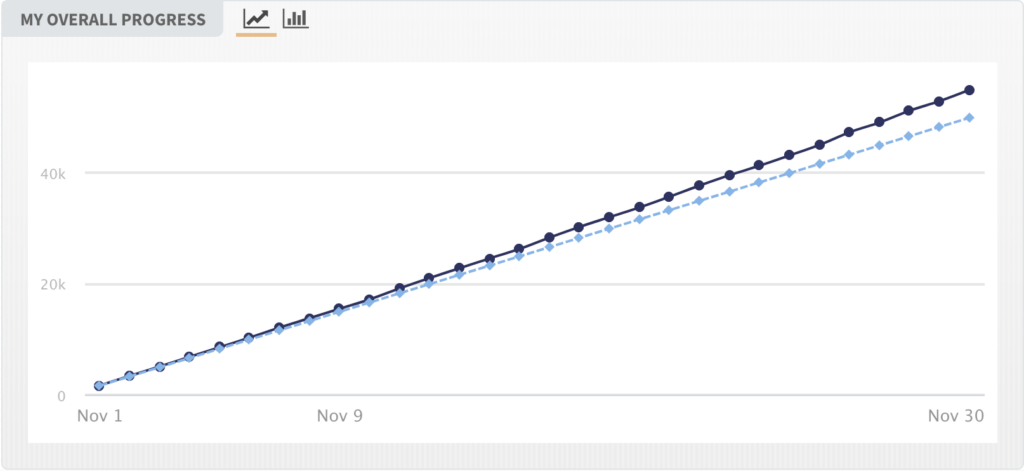
I surpassed the target pacing by a small amount on Day 1 and then padded my lead every day afterwards. It felt good to always be a little bit ahead throughout the challenge. I knew that if I just maintained this steady pacing, I’d never need to do any catch-up writing at the end.

Before starting this challenge, I learned that a major reason people fail at NaNoWriMo is that they fall behind in the first couple of weeks, and then they feel disheartened when facing the extra effort needed to catch up. Even skipping one day means you’ll have to write more in the remaining days. Most people who fall behind give up and don’t complete the challenge. This is an easily preventable point of failure.

My strategy was to approach this as a daily challenge, which plays to my strengths. I’ve done lots of 30-day challenges where I practice a specific behavior for 30 days in a row. In this case the desired behavior was to add at least 1667 words to my novel each day. If I just focused on that, the monthly goal would be accomplished too. It’s just typing after all.

Here’s what my daily word count looked like for all 30 days.

As you can see, I was pretty consistent throughout the month.

I averaged 1835 words per day, which works out to an extra 10% per day. Once I passed the 1667 words for the day, I kept writing till I felt like stopping, such as when I got to the end of a scene. If I felt like stopping but I wasn’t at 1667 words yet, I took a short break and then continued writing.

Final Reflections

This was a wonderful personal growth experience, and I’m glad I did it. The novel isn’t done and will need a lot of work to finish, but the daily writing got me well into the project.

I don’t have a completed book yet, and it would take a lot more work to drive this towards a version ready for publishing, but NaNoWriMo got me moving forward with meaningful progress. It helped me turn a mere idea into something a lot more tangible.

At this point I don’t have a completed story. I’ve written a first draft of many scenes. I have several well-developed characters. I have a well-structured three-act story with interesting plot twists. But there are still many more details to work out.

This is a very rough first draft. I’d say it’s not bad for a month’s work. I estimate that I averaged about 75 minutes per day of writing time (including thinking about what to write). I’m very pleased with how far I got for about 40 hours of effort. There was also some incubation time when I’d be thinking about characters or plot ideas while doing unrelated tasks.

The “words are cheap” mindset worked very well. It’s easy to throw words onto the screen, read them back the next day, and learn something useful. I’ll end up throwing away much of what I wrote this month, and I don’t lament that at all. Everything I wrote helped in some way. Each day I gained more clarity about the story, the characters, and the world. Even when what I wrote seemed like a chaotic mess, it still felt like forward progress.

Other writers have said that you write the first draft for yourself, not for anyone else. I adopted that mindset from Day 1, and I found it very helpful. I didn’t expect to show this early draft to anyone, not even Rachelle. So I just wrote whatever came to mind. It was my own personal exploration of the ideas and possibilities, nothing more. By framing it that way, I felt totally free to experiment and to make lots of mistakes. This helped me figure out what kind of story I wanted to tell. I let the words flow without any concern about who might read them.

One clear gain was that I understand my characters so much better than when I first started. Now I can write their words and actions much more easily, as if they tell me what they would say and do in every situation. So the writing got easier as I went along. The first few days were the most challenging; after that it was smooth sailing.

Another gain was that my “why” for writing this story improved as I kept writing. Around halfway through the month, I developed a stronger sense of purpose for why I wanted to write and share such a story. I had a more compelling answer to the questions: Why bother with this project? What’s the point? Who would want to read this? My purpose was more exploration-based in the beginning, but by the end I felt like I was creating something I really wanted to share with the world to see how it landed with people. I had a clearer sense of the story’s potential impact.

This was similar in some ways to designing a new video game from scratch, but the medium is very different. I liked how easy it was to explore the characters, story ideas, and world without having to deal with tech constraints. I could play around with any ideas I could imagine. I really enjoyed that type of experience – it was like pure play.

Most days I looked forward to my writing sessions. I didn’t experience much inner resistance after the first week, and that small resistance was just due to being too green at this type of writing. I think having lots of nonfiction writing experience – and a healthy willingness to make plenty of mistakes – was helpful. I never had writer’s block. I could connect with inspired ideas for fiction writing as easily as for nonfiction articles or courses.

Next Steps

I’m going to set aside the novel writing and coast into a more relaxed December since I want to focus on other aspects of life for the rest of the year. That includes finishing up my one-year daily blogging challenge, which has 31 days left to go.

Stephen King recommends setting aside a novel for at least 6 weeks after writing the first draft and then coming back it to fresh. He says it’s wise to get some distance from the story, so you can see it with fresh eyes before you start editing.

My first draft isn’t good enough that I can just edit it into a finished book. It’s way too messy for that, especially since there are a lot of scenes I’ll need to cut or rewrite differently. I’m still going to set this aside for 6+ weeks, probably until after our next deep dive is complete, but my next steps will different than Stephen King’s.

Sometime next year I’d like to revisit this novel project, re-read everything I wrote, and then begin working on a second draft. I’d like to do a round of more detailed plotting before I add more words to the book. I think the story would benefit a lot by clarifying the scene-by-scene layout.

The pantser approach was great for getting started since it helped me map out the possibility space for the story by writing a lot of scenes. Now I have enough understanding of the story and that characters that a good next step would be to map out the scenes for the story in the right order. I’d also like to fill out character and location sheets to fine-tune the characters and settings. Then I can write the second draft.

It’s going to be a long process, and I’m not in a rush to race through this. I do want to see this through to publishing. It’s an original story with some fun characters that I think people would enjoy reading. I might approach this project as a series of 30-day challenges to push it forward through different stages of development.

I’m especially happen that I framed NaNoWriMo in a way that made the experience enjoyable, especially by always being ahead of schedule. This makes me eager to re-engage with the novel when I’m ready. There are other priorities I want to engage with next, so I’m happy to put this aside for now, but I do look forward to getting back into it with fresh eyes.

Our Next Deep Dive

My first big priority for 2021 is to launch and develop our new creative productivity deep dive, which is tentatively called Amplify. This is for people who do creative work and want to increase their productive output. It’s also for people who’d like to get into a better creative flow. You could think of it as a course in how to be a prolific creator who publishes frequently. How can you express yourself creatively year after year without burning out?

I have tons to share about this topic that I believe would be unique and different from anything else out there. I’ve gone through many books and courses on creativity and on productivity, but I still haven’t seen really good coverage regarding connecting the dots between creativity and productivity. It’s like creativity is play, and productivity is work. There’s a lot of conflicting advice that treats creativity as inherently unproductive and productivity as inherently uncreative.

What if you want to excel at both together? What if you want to be a fountain of creative expression?

How can you be super creative and highly productive without sacrificing too much on either side? How can you get into the flow of creating and publishing – and stay there consistently without burning out?

There’s a lot to unpack here, and I’m convinced that this is an area where I can add some real value to people’s lives. I’ve created and published across many different media: articles, videos, podcasts, a book, video games, music, live events, and more. This year I’ve published something new every single day, adding hundreds of thousands of words to my collective work, which is already well into the millions of words, not counting translations into other languages.

I love to keep exploring new media too, such as I just did with NaNoWriMo. Partly I did NaNoWriMo as an experiment to test some of the ideas for this upcoming deep dive.

I’d love to do this new deep dive co-creatively too, like we did with our previous ones, so the lessons will be created as we go, designed for the specific needs of the people who enroll.

I haven’t decided on the exact the format yet. My intuition says it will likely be something different from our previous courses, perhaps a combination of live interactive parts along with structured audio lessons. People loved the audio format of Submersion and Stature, and there was also something special about the live sessions that we did for Deep Abundance Integration. So I’m thinking of merging those for the new deep dive. Would that appeal to you?

I’ll share more info on this new deep dive next year as we get closer to launching it. We’ll be launching it during the first quarter of 2021. I tend to get an intuitive ping when the timing is right for launching. In the meantime, I’d like to clear my plate of some other projects first, mostly on the personal side.

Share Button

Covid vaccine: Moderna seeks approval in US and Europe

Regulators will decide if it is safe and effective enough to recommend for widespread use.

Share Button

Covid infections in England fall by 30% over lockdown – React study

There were an estimated 72,000 new cases of coronavirus a day in England between 13 and 24 November.

Share Button

NaNoWriMo – Days 24-29

I crossed the 50K-word NaNoWriMo finish line yesterday morning, writing 51,262 words in 28 days, so I achieved this goal 2 days ahead of schedule.

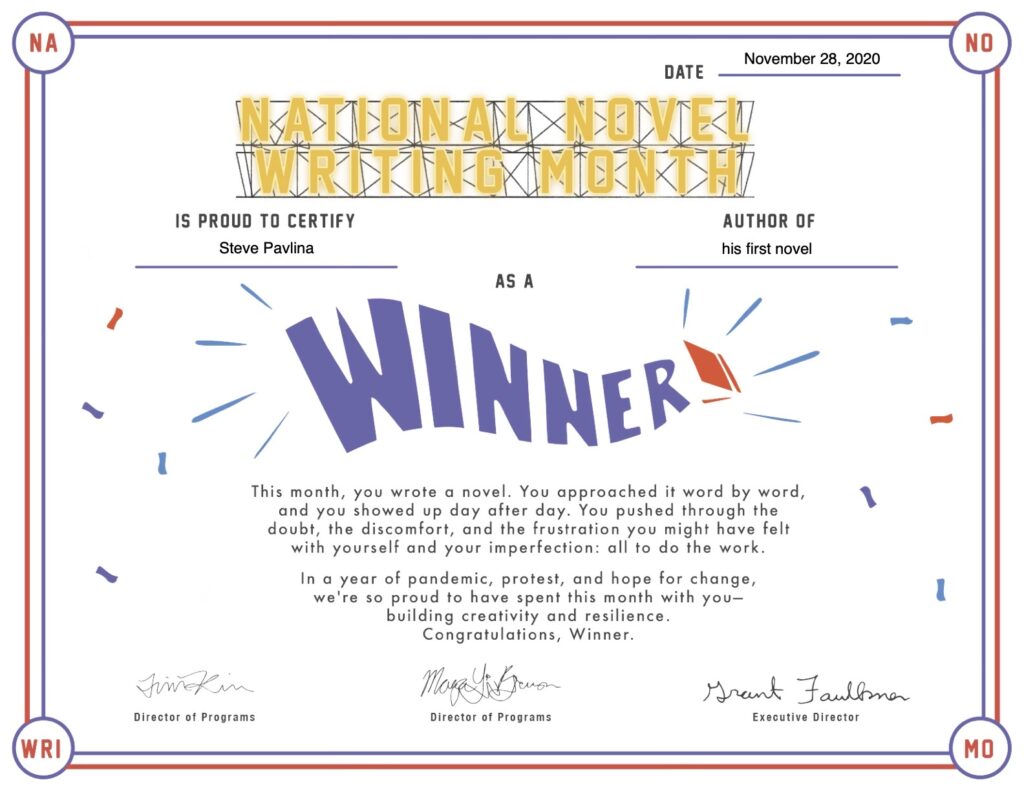
When I updated my word count yesterday, I received a congratulatory video, a bunch of links to claim the NaNoWriMo “prizes” (discounted promotions for various writer tools and services), and this completion certificate.

The way I framed this goal, however, was to add at least 1667 words per day to the novel for the full 30 days, so I didn’t stop after 28 days. After this morning’s writing session (Day 29), the novel is at 53,007 words. So tomorrow I’ll likely land around 55K words for this 30-day challenge.

Completing NaNoWriMo

This was my first NaNoWriMo and certainly a good year to do it. It was a great way to get started on a fiction book. I’m way further along now than I would have been if I hadn’t signed up for Nano. It’s been a rewarding experience overall.

One aspect I found less exciting than I expected was connecting with the Nano community. I thought it would be cool to connect with other novelists during Nano, but I felt a bit disconnected from that aspect of the experience. I didn’t feel like connecting with other writers while working on my novel. I browsed through some of the community posts but largely found it to be a distraction from actual writing, so most days I just did the writing on my own.

I enjoyed the challenge more when I stuck with introvert mode. It may be nice to connect with other writers before or after Nano, but I wasn’t inspired to do that while in the midst of figuring out the novel. I felt more motivated to connect with the characters I was developing.

I had no trouble feeling motivated to write each day. I didn’t write at same time each day, but I normally got each day’s writing done before 10am, often before 8am.

Most people who sign up for Nano don’t finish, but I never had any doubt that I’d do it. I do my best to win 30-day challenges in my mind before Day 1, and Nano was no different. The same goes for 365-day challenges like my 2020 daily blogging challenge (which is more than 90% done now). If you combine the blogging with the Nano writing, I probably wrote around 75K words this month.

Overall the combined writing experience flowed pretty well. Some days I blogged first and then did Nano, some days I flipped the order. But usually I finished both in the morning. Last Monday and Tuesday, I also did some batch blogging, queuing up several posts in advance, so I could enjoy the 4-day holiday weekend with a bit less daily writing – that was extra nice.

Leveraging the Fundamentals

One thing I love about having a career focused on exploring personal growth is how much time I have to spend practicing the fundamentals and how nicely that investment pays off over time.

This helps me leverage what I’ve learned to explore something new and be relatively productive from the start – and have fun doing it. Even when I’m a total newbie diving into an area where I have tons to learn, it feels like I have some extra advantages going in. A big one is just knowing that I can trust myself to follow through.

I expect to run into some difficulties or surprises along the way, and I also expect that I’ll be able to handle them. I’ll take action, persist, and learn as I go. I’m not afraid of failure, and I don’t tend to have issues with perfectionism. I prefer to just go, explore, and experience.

I like to play life the same way I like to play video games. Rachelle and I are about halfway through the new Zelda game, Hyrule Warriors: Age of Calamity, and I like that the game rewards my style of play – Rush in headfirst and slash away at every obstacle like there’s nothing to fear. We also pace ourselves, playing a little bit each day instead of rapidly binging through the whole thing.

The point of playing games is to have fun. This is a good way to approach life experiences too, including writing a novel.

I saw so many people in the Nano community struggling in ways that aren’t specific to writing. They struggle with personal development basics like setting clear goals, establishing productive habits, adopting empowering frames, creating confidence, eating healthfully, and so on.

But most of all, they struggle with making the journey fun, engaging, and rewarding each day. They inject far more suffering into the experience than necessary. Then they try to exert more discipline to push through that self-created drag, which can be very draining. I saw a number of “I give up” and “I’m quitting” updates along the way, and it looked to me that those people had already lost before Day 1. They approached the challenge in a way that was doomed from the start.

I saw plenty of uptightness in the Nano community. Some participants got bogged down in over-analysis and perfectionism. I think they could progress faster if they lightened up and learned to reframe failure as part of the fun. Some play the game so tightly that they prevent much of the joy of discovery from flowing through. It’s like playing a video game with someone who’s deathly afraid of losing a life, so they make the game more work than fun.

I actually found it stressful to read some of the community posts, but it was a good reminder that a long-term investment in personal growth fundamentals really does pay nice dividends. When you don’t practice the fundamentals enough, you’re likely to experience a lot of friction whenever you try to do something outside your comfort zone.

Practicing the fundamentals isn’t always sexy, but it helps us grow stronger, more capable, and more flexible. What good does it do to train up your writing skills if you can’t get yourself to apply those skills consistently? What if you lack the courage to create something unique that adds value to people’s lives? What if you aren’t able to handle criticism?

You can soak up domain-specific knowledge and skills, but what’s the point if you can’t get yourself to use it to create results?

This Nano experience helped me appreciate just how valuable it is to keep investing in the fundamentals. They grant access to new life experiences that would otherwise seem too far out of reach.

Share Button

Covid-19: Don’t ‘take brakes off’ Covid measures, says leading scientist

Easing rules months before vaccines take effect would be a “huge mistake”, Sage expert says.

Share Button

Covid: Nadhim Zahawi appointed as vaccine rollout minister

Nadhim Zahawi will oversee distributing the vaccine in England until at least summer 2021.

Share Button

Covid: Hospitals could be overwhelmed without new tiers, says Gove

Michael Gove warns MPs strict rules are still needed in England despite lockdown ending on 2 December.

Share Button

When Friends Turn Nutter

What do you do when friends of yours turn nutter on you, such as when they descend into conspiracy theories, Trumpism, etc?

If they’ve otherwise been good friends, it can be distressing to watch them go down such a dark path. You may wonder if something happened to their brains, like a buildup of toxicity that made them turn. You may wonder if you could have done something to prevent their excursion into anti-truth. You may wonder how on earth they could be so ridiculously deluded.

You may ponder how to frame this situation going forward. Did they just turn stupid? Turn into assholes? Get sucked down some racist rabbit hole?

Start by accepting the obvious. So they went nutter on you. Let that sink in. Maybe it’s from ignorance. Maybe it’s from stupidity. Maybe it’s some latent assholishness that’s currently flexing itself. Maybe they did this to themselves, or maybe they got sucked into it.

Sometimes people go nutter. It happens – a lot. Perhaps it finally happened to people you know, including some friends, family, or coworkers. And maybe this is surprising or upsetting for you.

Asking Why

You can make yourself crazy trying to answer the “why” question. You’re not really going to know the whole truth about their descent (or the revelation of a pre-existing descent that you were previously unaware of). Regardless of what your friends say and regardless of how you try to explain their nutter descent, those answers aren’t going to satisfy you.

One problem is that even if you ask and probe, you’re unlikely to hear the real truth. You may get a sanitized answer, and it probably won’t make much sense. When someone goes nutter, they’re unlikely to see it or admit it. But you see it plain as day, and maybe it pains you that they can’t see it.

Another problem is that you don’t want it to be true, and that desire clouds your ability to see and accept the simplest version of the truth. You probably believed in a more idealistic world than the one we actually inhabit. So the realization that so many people are total nutters is hitting you hard. Your world doesn’t fit your expectations.

Maybe you thought the nutters were around 2% or less of the population, possibly surging to 5% in a bad year. But 40%+ is unfathomable. Do you really live in that kind of reality?

Yes, perhaps you do. Let’s stipulate that you do live in that kind of reality. Let’s accept for the moment that this reality happens to be abundant in nutters.

I know – it’s not what you wanted, but it’s here, it’s real, and it’s what you’ve got to deal with.

For the sake of simplicity and your own sanity, I suggest you let go of the why question because it will only run you in circles. Accept the obvious. Your friends have gone nutter. Maybe it’s temporary. Maybe it’s permanent. Maybe you could someday come up with a satisfactory explanation. But first just accept the simple truth that’s staring you in the face: their undeniable descent into nutterdom.

Here’s another tip: When asking “why” doesn’t give you good answers at one level, it will likely make sense at another level of asking. So instead of asking, “Why did my friend go nutter?” as if they went down some crazy rabbit hole, ask questions like, “Why is reality poking my boundaries like this right now? Where’s the lesson or invitation to grow here?”

Many people are realizing that the answer in this case isn’t just to see things from the other person’s perspective, shake hands, and go on about your business as if nothing happened. That works with disagreements where both people are reasonably aligned with truth and when both are willing to communicate honestly. It doesn’t work well when someone is over-invested in falsehoods. When someone is willing to accept a lie as their truth and defend it emotionally, you’re at an impasse, in which case you may be better off questioning why you’re tolerating having a relationship with a nutter in your life at all. Is it time to socially graduate to spending more time with intelligent and sensible grown-ups?

A nutter, almost by definition, will violate your boundaries. How do you want to relate to people who behave like that?

Nutterland

After the recent election, the L.A. Times invited Trump supporters to share their reasons for supporting Trump, devoting a significant amount of editorial coverage to this purpose. As you might imagine, it was a shit show, full of the usual disinformation and vapid nonsense you’d expect from such nutters. The Times took a lot of flak from their readers for this stunt, especially for legitimizing nutterdom as if it’s on the same level as intelligent discourse. Some even felt that featuring this content was cruel to the nutters, like gawking and poking at zoo animals.

This has been a nutter-rich world for a very long time. Look at how many different religions teach falsehoods that millions of people profess to believe, even though those beliefs make no sense. It’s not particularly difficult to find nutters just about anywhere.

Perhaps the problem is that you didn’t realize and accept this. Maybe you thought you’d carved out a social space separate from Nutterland. You thought your friends were smarter, nicer, and less delusional than they actually were. Their descent (or revelation) took you by surprise.

So you had some faulty assumptions that you need to bring back in sync with reality. You were simply wrong about those people and about the allure of Nutterland for them. The reason they surprised you is that your predictions and expectations about them were wrong. You’ve probably been wrong about those people for a long time, and you’re just realizing it this year.

So update your predictions and expectations. Now you know. It’s unlikely that the nutters are just going to flip around and start satisfying your erroneous expectations again, although you can slide into that pretense if you want. It’s better not to wallow in denial though. Let the truth have its say. Okay, so they’re nutters. You can still accept that and deal with it.

Choosing Your Response

Grieve if you must, but what you’re really grieving is the death of your own inaccurate expectations.

You didn’t think your friends would turn nutter, but they did anyway.

You didn’t think so many millions of people could go nutter, but they did anyway.

When reality surprises you, don’t blame reality. Confront your own false expectations. So you were wrong. Reality behaved differently than you expected. That happens sometimes.

When reality surprises you, see it as an invitation to upgrade your thinking and to improve your alignment with truth.

Accept the truth as presented to you, even when you think it’s an ugly truth that you’d rather not have to deal with.

When the truth sinks in, it’s easier to choose a sensible response. If your response is an honest one, you can also make it compassionate and empowering. But don’t try to be compassionate while turning your back on truth. Keep truth alignment front and center. Don’t pretend someone isn’t a nutter when it’s plain as day that they are.

If you want to continue having a relationship with nutters, then relate to them on that basis. Don’t pretend that they’re smart, kind, and caring people with minor character glitches that just need “healing”… while they continue to share the most ridiculous conspiracy theories.

Maybe you want to keep connecting with certain nutters for secondary benefits while keeping them at arms length, figuring you can limit your exposure to their worst aspects. Or perhaps you may conclude that nutters are beneath your standards for genuine friendship and let them go, so you can build or maintain a more truth-aligned, nutter-free social network. Maybe you can still appreciate their emotional expressiveness, even if it’s mostly fear and anger, and then you can decide what kind of relationship you want to have with people who wallow in fear and anger.

Are nutters worth your ongoing investment? Are they worthy of your friendship?

The scarier question to ask is: If you release the nutters, then what? Then you might build stronger relationships with smart people who care. And that’s a lot more difficult than you might assume.

Nutters have lower social standards. They’re more likely to accept you as you are, even when you succumb to delusional thinking. They’re less likely to hold you accountable to be your best, think your best, and do your best. They won’t really challenge you to grow, except in your tolerance for nonsense.

So that’s a temptation to watch out for. Nutter friends are easier in a way because once you accept that they’re nutters, they start looking pretty predictable after a while. They’re fountains of nonsense. Yes, it’s ridiculous what they believe, but it’s also easy in a way because you know it isn’t true. So they don’t really challenge you in the realm of truth.

It’s like being a 10-year old in a friendship with a 5-year old. You have the advantage because you’re older and smarter. You can see the 5-year old’s personal zoo of silliness for what it is. And there’s safety in that. Now flip it around and imagine being in a friendship with a 15-year old while you’re still 10. That’s going to through you off balance – that friendship is likely to challenge you a lot more.

So just consider how you’re using your relationship with nutters. Have you been getting clingy with them because you don’t feel as safe playing with the older, smarter kids who challenge you? It’s all too tempting to spend a lot of time poking and gawking at the nutters and lamenting their predicament… especially when this lets you avoid more daunting social challenges.

In that regard you can think of your relationships with nutters as a form of social porn. What’s the non-porn alternative? If you stopped fussing over the nutters and just let them conspiracy-circle-jerk to their heart’s content, what would you want to do and experience instead, especially socially? That’s a much harder question to answer. Visiting the zoo is often easier.

Consider taking just 5-10 minutes today to ponder these questions. Stare off into space to let your mind float, or actively journal about this. If you released the nutters from your life, where would you want to take your social life instead? What kinds of people would you want to connect with? Where does your social attention actually want to go?

In general a great question to ask whenever you get confused about what reality is doing (or the people within it) is: What’s the bigger invitation here?

I’ll bet if you face the honest truth here, it’s going to scare you a bit. And you’ll likely see that you’ve been leaning on your relationships with nutters to keep you from exploring a bigger realm of uncertainty.

Let the nutters push you away. They could be doing you a huge favor. Now you can leave that old comfort zone behind (because it’s broken), and go explore the unknown. And oddly this will transform your relationships with nutters for the better. They won’t bother you so much when you recognize and acknowledge their “why” in your reality and start acting in alignment with that understanding.

Share Button

Covid: Free Vitamin D pills for 2.5 million vulnerable in England

There is no evidence that it protects against Covid-19 but it could boost the health of the vulnerable.

Share Button

Scientists reveal regions of the brain where serotonin promotes patience

We’ve all been there. Whether we’re stuck in traffic at the end of a long day, or eagerly anticipating the release of a new book, film or album, there are times when we need to be patient. Learning to suppress the impulse for instant gratification is often vital for future success, but how patience is regulated in the brain remains poorly understood.

Now, in a study on mice conducted by the Neural Computation Unit at the Okinawa Institute of Science and Technology Graduate University (OIST), the authors, Dr. Katsuhiko Miyazaki and Dr. Kayoko Miyazaki, pinpoint specific areas of the brain that individually promote patience through the action of serotonin. Their findings were published 27th November in Science Advances.

“Serotonin is one of the most famous neuromodulators of behavior, helping to regulate mood, sleep-wake cycles and appetite,” said Dr. Katsuhiko Miyazaki. “Our research shows that release of this chemical messenger also plays a crucial role in promoting patience, increasing the time that mice are willing to wait for a food reward.”

Their most recent work draws heavily on previous research, where the unit used a powerful technique called optogenetics — using light to stimulate specific neurons in the brain — to establish a causal link between serotonin and patience.

The scientists bred genetically engineered mice which had serotonin-releasing neurons that expressed a light-sensitive protein. This meant that the researchers could stimulate these neurons to release serotonin at precise times by shining light, using an optical fiber implanted in the brain.

The researchers found that stimulating these neurons while the mice were waiting for food increased their waiting time, with the maximum effect seen when the probability of receiving a reward was high but when the timing of the reward was uncertain.

“In other words, for the serotonin to promote patience, the mice had to be confident that a reward would come but uncertain about when it would arrive,” said Dr. Miyazaki.

In the previous study, the scientists focused on an area of the brain called the dorsal raphe nucleus — the central hub of serotonin-releasing neurons. Neurons from the dorsal raphe nucleus reach out into other areas of the forebrain and in their most recent study, the scientists explored specifically which of these other brain areas contributed to regulating patience.

The team focused on three brain areas that had been shown to increase impulsive behaviors when they were damaged — a deep brain structure called the nucleus accumbens, and two parts of the frontal lobe called the orbitofrontal cortex and the medial prefrontal cortex.

“Impulse behaviors are intrinsically linked to patience — the more impulsive an individual is, the less patient — so these brain areas were prime candidates,” explained Dr. Miyazaki.

Good things come to those who wait (or not…)

In the study, the scientists implanted optical fibers into the dorsal raphe nucleus and also one of either the nucleus accumbens, the orbitofrontal cortex, or the medial prefrontal cortex.

The researchers trained mice to perform a waiting task where the mice held with their nose inside a hole, called a “nose poke,” until a food pellet was delivered. The scientists rewarded the mice in 75% of trials. In some test conditions, the timing of the reward was fixed at six or ten seconds after the mice started the nose poke and in other test conditions, the timing of the reward varied.

In the remaining 25% of trials, called the omission trials, the scientists did not provide a food reward to the mice. They measured how long the mice continued performing the nose poke during omission trials — in other words, how patient they were — when serotonin-releasing neurons were and were not stimulated.

When the researchers stimulated serotonin-releasing neural fibers that reached into the nucleus accumbens, they found no increase in waiting time, suggesting that serotonin in this area of the brain has no role in regulating patience.

But when the scientists stimulated serotonin release in the orbitofrontal cortex and the medial prefrontal cortex while the mice were holding the nose poke, they found the mice waited longer, with a few crucial differences.

In the orbitofrontal cortex, release of serotonin promoted patience as effectively as serotonin activation in the dorsal raphe nucleus; both when reward timing was fixed and when reward timing was uncertain, with stronger effects in the latter.

But in the medial prefrontal cortex, the scientists only saw an increase in patience when the timing of the reward was varied, with no effect observed when the timing was fixed.

“The differences seen in how each area of the brain responded to serotonin suggests that each brain area contributes to the overall waiting behavior of the mice in separate ways,” said Dr. Miyazaki.

Modelling patience

To investigate this further, the scientists constructed a computational model to explain the waiting behavior of the mice.

The model assumes that the mice have an internal model of the timing of reward delivery and keep estimating the probability that a reward will be delivered. They can therefore judge over time whether they are in a reward or non-reward trial and decide whether or not to keep waiting. The model also assumes that the orbitofrontal cortex and the medial prefrontal cortex use different internal models of reward timing, with the latter being more sensitive to variations in timing, to calculate reward probabilities individually.

The researchers found that the model best fitted the experimental data of waiting time by increasing the expected reward probability from 75% to 94% under serotonin stimulation. Put more simply, serotonin increased the mice’s belief that they were in a reward trial, and so they waited longer.

Importantly, the model showed that stimulation of the dorsal raphe nucleus increased the probability from 75% to 94% in both the orbital frontal cortex and the medial prefrontal cortex, whereas stimulation of the brain areas separately only increased the probability in that particular area.

“This confirmed the idea that these two brain areas are calculating the probability of a reward independently from each other, and that these independent calculations are then combined to ultimately determine how long the mice will wait,” explained Dr. Miyazaki. “This sort of complementary system allows animals to behave more flexibly to changing environments.”

Ultimately, increasing our knowledge of how different areas of the brain are more or less affected by serotonin could have vital implications in future development of drugs. For example, selective serotonin reuptake inhibitors (SSRIs) are drugs that boost levels of serotonin in the brain and are used to treat depression.

“This is an area we are keen to explore in the future, by using depression models of mice,” said Dr. Miyazaki. “We may find under certain genetic or environmental conditions that some of these identified brain areas have altered functions. By pinning down these regions, this could open avenues to provide more targeted treatments that act on specific areas of the brain, rather than the whole brain.”

Share Button