An outreach worker helping homeless women at risk of violence in a Somerset town.


An outreach worker helping homeless women at risk of violence in a Somerset town.
Integration is the process of extracting core lessons and insights from your lived experiences and intelligently applying those insights to your life, so you feel, think, and act in alignment with whatever you’ve gained from your lived experiences.
Integration especially matters when you have a stretchy experience that feels inconsistent with your previous conceptions of your inner and outer worlds. Your old mindset has fallen out of step with your lived experiences. That happens sometimes. The good news is that you’ve stumbled upon a new truth – a surprise that you didn’t expect. Integration invites you to gracefully expand your base-level thinking to accommodate the new truths you discover as you have new experiences.
Your brain will attempt some integration automatically as it tries to make sense of a surprising new event. However, it will often do a so-so job of it. These unintegrated or partially integrated experiences may cause some problems for you. You’ll still have the memories of those experiences while their full wisdom and insights remain un-extracted. You may even feel unsettled when you recall those types of memories.
I’ve had many stretchy experiences that caused me to re-examine big parts of my life and reality. Whamo! I was slammed by something I did not expect to happen. Some events fell outside my old predictions of how I thought life was supposed to work. For a while I felt like my old way of thinking about reality was broken, and sometimes I didn’t yet see what else I could replace it with.
One example was when it finally dawned on me that much of what I’d been taught all throughout my childhood didn’t mesh with my lived experiences. My Catholic model of reality eventually crumbled. Why? Because it wasn’t true. A mindset built upon falsehood will eventually fall apart when confronted with contradictory lived experiences. In order to integrate those experiences, I had to accept some hard-to-accept truths about people I thought I could trust. That was tough to go through at the time. I had to release my old childhood models of reality and quickly grow up. I needed to be more responsible for my own world views and overall life philosophy. I couldn’t keep receiving what was being offered once I could see that it didn’t line up with my actual reality. I needed to be in my real reality, not in someone else’s fanciful concept of one. That was one of my biggest integration experiences as a teenager.
Initially I shifted to atheism since that was the only meaningful alternative that I really knew much about. I figured if my old reality was a lie, maybe the opposite (which I concluded was atheism) would be the truth. That approach worked okay for a while until I started having new experiences that didn’t fit with that model either. That sent me deeper into further integration work.
I had to make sense of my old mindsets and clarify why they weren’t good enough. I also had to find some other way to think about my life and reality that gave me some stability. Otherwise I’d be stuck in confusion, and it would be hard to advance or direct my life in any meaningful way.
Another challenge was avoiding cynicism. I did my best to avoid falling into dead-end thinking like “Life sucks and then you die.” I could at least predict that sort of mindset wasn’t going to give me a particularly good or interesting life. I’m happy I gave this some real thought, and I think it made a huge difference in how my life path evolved. Over time I grew increasingly happy and satisfied with my life. I still feel that way today.
Note that it’s pretty important to avoid mindsets that may get you stuck in some form of helplessness. If you fall into such a mindset, even accidentally, it may take lots of extra work to dig yourself back out again. You might need some therapy or someone else’s help if you go that far into a problematic mindspace or heartspace.
I figured that a constructive mindset and heartset would help me make wiser, more intelligent decisions that would more likely lead to positive outcomes and a nice life overall. And the best way to get there seemed to be to keep learning from my experiences. Don’t blow past a challenging event without doing my best to extract the core lessons from it. This helped steer me down some constructive paths. I gave some attention to how my thoughts, feelings, actions, and results all influenced each other.
Back then I didn’t have the integration label in mind, nor did I understand it as well as I do now. I often struggled to make sense of experiences that didn’t add up to me. This included trying to understand my own behaviors sometimes. When I was 18, I began thinking of myself as a criminal because I was doing crimes and sometimes getting arrested, and friends who knew me started referring to me that way. Integrating that into my self-image did not serve me very well, as you might imagine. It nudged me deeper into those behaviors, and I needed some difficult experiences and lessons to finally save me from that mode of thinking. I now see that as a precious and valuable time in my life because it gave me so many strong revelations and insights about my life and helped me discover who I actually wanted to be. Difficult experiences can shift tremendously as we integrate them over time. A tragedy or mistake may eventually be seen as a blessing.
Integration can be tricky business. If we let our minds handle it subconsciously, we can end up in some dark places. Running into these sort of traps was ultimately what got me interested in self-development. I realized that if I didn’t keep my mindset adaptable and growth-oriented, I could really mess up my life. That’s when I began to manage my life more consciously.
Although I wasn’t thinking of it in these terms back then, I figured out that in order to live more intelligently, I had to maintain more conscious awareness and supervision over my own integration process. It wasn’t wise to always let that run by itself. My integration turned out better when I took some time to reflect upon my experiences. I’d do my best to figure out what those experiences meant to me and why. That’s when I started getting into journaling (with pen and paper). I began filling up notebooks to reflect upon my experiences and to take a closer look at my thoughts and feelings. I’ve been an avid journaler ever since. In fact, many of my blog posts actually started as private journal entries, and then I turned them into published posts.
Through this process I learned good ways to protect my self-esteem, even when going through difficult experiences. When I was younger, I would journal some pretty dark thoughts on occasion, even suicidal ones. However, writing about my lived experiences and what I thought they meant to me helped me shift my perspective. Observing my own thinking caused my thinking to change. One change was that I became a lot more optimistic and less pessimistic, and I’m very grateful for that. All that journaling and conscious integration created a nice feedback loop, where my mind learned to be calmer, more centered, and more positive and constructive.
My integration needs are more complex these days because I do more deliberate exploring than I did when I was younger. One way I choose interesting experiments is by picking something that I probably wouldn’t do. By this I mean doing something new that doesn’t quite fit my old self-concept. I know that if I explore beyond my old self-concept, I’m going to have an interesting growth experience. I’ll have more integration work to do as well.
Have you every tried doing something you wouldn’t do? Just getting yourself to conceive of something like that can be a very interesting thought exercise. That alone will teach you something valuable, like where you sense your limits to be. Then you can ask yourself if you want to keep those limits. You don’t have to.
One example was going to Disneyland for 30 days in a row. I’d never done anything like that before, so it was a stretch to get myself to commit to it. Rachelle and I did that together. We had a fabulous time all throughout – it turned out to be one of our best experiments ever. I was very happy with how it impacted me, her, and our relationship afterwards too. We also opened Conscious Growth Club six months later, which is now in its 9th year and still going strong. CGC was inspired in part by that Disneyland experience.
If you deliberately court stretchy experiences, it will probably make your life less predictable. I mostly see that as a good thing. I know it’s not everyone’s cup of tea though. The downside is that if you overdo it, you could end up with a big backlog of unintegrated or partially integrated experiences. People often experience this as a burnout phase of some kind, and their motivation can drop a lot (especially the desire to keep having new experiences). When they’re ready, they may start working through the integration backlog one little piece at a time, hopefully emerging with a fresher mindset on the other side of that.
I love stretchy experiences very much. I love how they surprise me. I love how they poke, prod, and challenge my old models of self and reality. I love how they help me grow. Having so many of these kinds of experiences has helped me develop rich, flexible, multi-faceted models of myself and reality. I adapt to change more easily as a result. I’m happier too. But it really does take a lot of integration work afterwards in order to avoid burnout. I find it helpful to keep reminding myself that the risk of burnout is very real if I don’t take sufficient time for integration, so fortunately I’ve been landing squarely and consistently on the pro-integration side for many years now. I can sense when I’m getting close to overdoing the in-flow of new experiences, and I know when I need to back off and do more conscious integration. An inner signal that warns me to pump the brakes is when I start feeling a little overwhelmed by having too many things going on, and I feel like I just want to retreat from it all for a while. Then I know it’s time to do my own version of an integration retreat, and I go much deeper into introvert mode and do lots of extra processing and reflecting on recent thoughts, feelings, and experiences. This takes time. It works very well though, and I always emerge with a renewed sense of motivation to go out and have even more new experiences. I’ve gotten used to the waviness of living this way.
Most weeks I prefer to gently sip from the land of stretchy experiences. This works very nicely too. It gives me ample time to integrate without creating too much of a backlog. I love to sip and integrate, sip and integrate, sip and integrate. Take a drink from the fountain of new experiences and let the effects ripple through me till they settle. Then take another sip when I feel ready. Nice and easy. Not too fast.
We’re all unique though, so what feels stretchy for one person might be fairly mild (or too intense) for someone else. One person’s sip could be an overflowing mug for a different person.
My integration process usually involves building new models that are more accurate. I keep upgrading my models to account for the totality of what I’ve experienced in this life. It’s like I’m on a lifelong search for my own Theory of Everything.
How can I explain everything I’ve experienced in my life thus far? If all of those experiences were real, then what kind of universe makes all of that possible? I find these to be very interesting questions to ponder.
I always have a working set of models that I use as my defaults, and whenever I bend them by having experiences that don’t fit their predictions, I know I’m about embark on a fresh round of integration as I search for new models that fit the new info. So the word “model” here simply refers to my current best understanding of myself and my reality. Who or what am I? What kind of reality do I actually inhabit?
The benefits of having a more accurate model of reality are enticing, which is why I’m so hooked on this approach.
Today I tend to think of myself as a psychonaut – as someone who consciously explores the nature of reality and tries to understand it better. I love to keep exploring in this way, which is why I keep courting new experiences that I need to integrate.
This way of living is very rewarding yet also a lot of work. In any given year now, I may spend several weeks just integrating my experiences from that year. This year has been particularly heavy with integration work. That’s the main reason I took a break from sharing publicly for the past few months. I’ve been in a strong flow of stretchy new experiences this year. I wanted to keep other areas of life simpler during this time, so I mostly paused the public side while still staying very active in CGC and in other areas of life. Now I feel ready to open that back up again, yet in a different way than before. I’m easing back into it gently with this post, and when I’m ready I’ll flow back into making some fresh videos for the Engage course as well. I’m very much looking forward to that.
The rest of this post invites you deeper into a more personal walk-through of how I go through a real-life stretchy experience and begin to integrate it. It’s up to you if you want to immerse yourself in that level of detail. It may give you more of an insider’s perspective (if you appreciate that sort of thing). There’s a good chance that just reading through this will activate thoughts and feelings within you that invite you to do some integration work of your own. The experience I’ll share has to do with letting go of limits.
I get stretchy ideas from all over the place. Sometimes I ponder them for years before I finally do them. Much of the time though, I like to begin a challenge within a pretty short time after I get the idea. There’s a certain energy to an idea when it’s freshly minted. If I incubate an interesting idea for too long, I may lose the connection to it.
The idea for my most recent stretchy challenge actually came through during another stretchy experience. Back in March I took part in a three-night ayahuasca ceremony, which was intense and also just what I needed. I still love full-cup experiences in addition to sips, just not too often.
My inner journey on the second night of that ceremony was all about sex and sex energy. Aya showed me a very spirity, energy-level perspective on sex and the role it’s been playing in my life. The overall three-night arc focused upon the theme of letting go of old limits, so that was part of the second night’s envelope as well.
This was a powerful experience for me. It also built upon some explorations in this direction I’d previously done with MDMA. Aya surprised me because I didn’t know that a plant energy could go so deep into sexuality. I don’t have any sexual trauma, so this was a beautiful area of life to explore with Aya. The third night was especially intense when Aya gave me the experience of trying to flood all my cells with way more love energy that I felt capable of receiving. She did that to show me that I had limits as to how much love I was allowing to flow through to me, and one way I was resisting it had to do with seeing myself as too much of a human and not enough as a energy being. My human body (or my conception of my body) found that much love way too intense, as if every cell was charged with excess static electricity that I couldn’t discharge yet badly needed to get rid of. So that was a very visceral demonstration of how I was limiting myself in this area without realizing I was doing that. Now integrating this might have been tricky or confusing if Aya hadn’t also helped me with some next steps to translate this into a specific human-level challenge to attempt. So she let me feel the energy side of it first, and then she translated her lesson into the human level as well.
Sometimes I think of Aya’s energy as that of Mother Nature. So I had to update my mental model of Mother Nature to include being able to talk to her for many hours about sex. Sex is obviously part of nature, so that aspect wasn’t too hard to integrate.
Aya’s nudge – really the core lesson that came through across all three days – was not to stop at good or great. There’s more growth beyond the good. I was encouraged to open up and expand my experiential range even in areas of life that were flowing along beautifully. Don’t stop exploring just because some aspect of life is already so nice.
This general invite was pretty interesting to me at the time. I have a tendency to experiment based on what seems fresh and new to me, like whatever I may be curious to try. Aya invited me to look at going deeper into what’s already familiar. Take something I already like or that’s already going well, and experiment with opening it up even more. Just integrating that lesson made me look at how I’d been limiting myself by not thinking in those directions very much. For instance, once I reached a certain level of abundance in life, I didn’t really try to push it much beyond that. I let myself rest in what felt plentiful and mainly did other kinds of explorations in different directions.
As part of the experience, Aya invited me to take on a specific challenge: Have sex for 100 days in a row. She made it clear that sex in this case meant intercourse; oral sex or other types of sexual play wouldn’t count. It wasn’t necessary to have an orgasm each time though. If I skipped or missed a day, I’d have to start over again at Day 1. It had to be 100 days in a row. That was not in the range of what I expected Aya to bring through.
MDMA’s energy had already been working with me in this direction last year. It was also nudging me to have sex more frequently when I would dialogue with it. More than once it recommended five sex days per week minimum. One way it framed this was to make daily sex the default, and allow one or two days off each week as an option. That still seemed like a lot. Rachelle and I managed to do 14 days in a row last year, and we both liked it at the time. It just seemed tough to sustain that kind of frequency for very long. Plus it wasn’t clear why we ought to do it that often. Those 14 days were pleasurable and very loving, and I did have the sense that it we’d continued at that frequency, there might be something more to be learned, perhaps more than we could predict. I didn’t think it would be that big of a deal though, so we didn’t really push further in that direction.
Aya’s 100-day challenge idea seemed like a LOT of sex yet also didn’t seem like that big of a deal. I’d never done anything like that before. Somehow it felt more accessible because it was temporary; after 100 days we’d be finished and then could integrate the experience. I felt that Aya looked at what MDMA was trying to do and then gave me an idea that was similar yet somehow felt more doable.
I shared and discussed the idea with Rachelle, and we both readily agreed to actually do it. We knew that if we didn’t like it, we could quit at any time. So why not at least begin and see how far we could go? Plus if we made it the full 100 days, we’d probably learn something interesting about ourselves. Relative to other experiences we’ve had together, this one felt relatively tame and easy. The main challenge was just to make time for it, especially while traveling and sometimes having very busy days schedule-wise.
We’ve been together for 15+ years, and we’ve always found each other very attractive, so this wasn’t that difficult of a yes for us. There was no convincing involved. We both felt curious and intrigued enough to try it, knowing we’d surely learn and grow from the shared experience.
Admittedly it also seemed like a silly thing to attempt. We like having some silly experiences together though, so we were fine with the potential silliness of it. In fact, that turned out be a beautiful aspect of the journey. Sex is pretty silly anyway, isn’t it? More than once we had a good laugh during a session. The shared laughter just made us feel even closer.
We started on April 3rd, which was our 7-year anniversary. Today is Day 98, so it’s an easy coast to the finish line now. It’s been an amazing journey, giving me a lot more to reflect upon that I expected.
This experiment didn’t go as I thought it would. I was a bit concerned it might make sex feel too routine, yet somehow it took us way deeper into intimacy, love, belongingness, really caring for each other’s needs, and a whole bunch of energy work. I’m still taking stock of how much this particular challenge opened up. Perhaps a simple way to describe it is that it became way more tantric and spirity feeling as it went along. We’re both very in love with each other, and we know how lucky we are to have this be our reality. This exploration deepened and enriched those feelings even more – it went well beyond the physical aspects. So Aya was spot on in offering this challenge. How did she know?
I still have much to integrate after this experiment concludes. Overall it’s been a very good for us. It may look like a sexual challenge on the surface, yet the lived experience of it was like doing lots of intimate energy work with a partner and going deeper into our feelings for each other. Sometimes we’d pause partway through a session and flow into an intimate conversation together. Every week there were new layers to explore together. It’s been such a great experience to have together as a couple. No regrets about it. Definitely one of my favorite explorations. Way nicer than going 40 days without food – that’s for sure.
After this I imagine we’ll need to do some couple-level integration too. It’s not clear to us how it will affect us going forward. Even after all these weeks of daily sex, we can’t yet say what we’ll do with this aspect of our lives from Day 101 onward. I feel we’ll probably take a fresh look at ourselves, reflect upon what we just experienced together, talk it through a bunch more, and then flow into a fresh phase of our relationship going forward. I don’t feel it will be majorly different than before we started, but somehow I feel very certain that it won’t be the same as our previous reality. My felt sense of this right now is that we accumulated a lot of subtle shifts along the way.
Another way to think about integration is that it’s how you resolve the contrast between your predictions and your actual lived experiences. My experiences for the past 98 days didn’t fit within the range of my old predictions. I now have a different understanding of what it’s actually like to make sex a daily habit for so many weeks. It had its challenges sometimes, like trying to keep it going when we were both really tired after a long day out, yet there was something about the daily commitment that was quite special. In may ways it was like an incredible gift that we gave to each other, but not in any way that felt like a reciprocal trade.
My understanding of sex is a lot more spirity now, thanks to this challenge. I see sex as being more about sharing and appreciating each other’s love, energy, and full presence than about the physical act. Sex feels even more loving, intimate, flexible, and even mysterious or magical to me now. It’s become something that I look forward to and cherish as a part of each day, and I accept that it affects me in ways that are very positive yet hard to predict.
Interestingly this experiment also made our sex life simpler because we didn’t have to decide whether to have sex or not on any given day. Instead of talking about making love, we just make love. Sometimes we start by sharing our intentions for what kind of experience we want to have together. I’ve been impressed with how in-tune and cooperative we’ve been with our intentions all along the way.
So that’s an example of having a stretchy experience that requires some integration. Consciously choosing to have stretchy experiences is one of the best ways to keep growing. Keep exploring in the directions where your predictions may be weak or inaccurate, and you’re sure to learn something.
What if you do something stretchy that others might criticize? One way to think about criticism is that it’s a way many people process their own integration experiences. Some people will attack what they’re struggling to integrate or understand. It’s temporary though. So I’d recommend feeling some compassion towards your critics (or potential naysayers). The criticism isn’t likely personal. Those critics may be processing their own unresolved, unintegrated thoughts and feelings about some aspect of life. You may just be the latest person who (perhaps accidentally) invited them to face something they’d rather not face just yet. Another possibility is that if the criticism feels like it may have a shred of truth to it, then it may indeed offer you something worthwhile to look at as part of your own integration process.
In my experience the most important key to integration is usually acceptance. My integration work typically involves reaching some new place of acceptance and being able to hold myself there without backsliding.
What do I need to accept? For starters, I need to accept what actually happened and how I’m reacting to it. Allow my lived experience to be fully felt. Let it surprise me. Let it impact me. Let it ripple me. Even let myself become the experience.
Next I need to accept that my old thinking needs to be updated. This may include how I think about myself, other people, and aspects of reality.
And then I need to accept the integration work ahead. This includes accepting the time and energy it will take to do it well.
Whenever I get myself into a lived experience that knocks me off balance, I like to focus on acceptance of whatever is coming through. Let it in as fully as I can. Listen. Observe. Let myself experience my own judgments if judgments arise. Allow. Allow. Allow. Let the new energy flow while doing my best not to resist it. Be present. Be here now.
Eventually this acceptance leads to some new ideas and new decisions. What do I do with this new knowledge? Knowing what I now know, how will I act differently? What new decisions make sense now?
After acceptance, an even better place to reach for is love. In addition to accepting the changes and their effects, I look for how I can love all of it too. Can I love the lessons? Love the insights? Love everyone who contributed to the lived experiences? Love the growth process? Love the ripples?
The more love I can bring to an exploration, the better it integrates.
Some people also find forgiveness to be powerful here. So consider using forgiveness if you find it helpful. Personally I prefer love and find it more resonant and flexible than forgiveness. Forgiveness is pretty popular in integration circles though.
Another benefit of using love as part of your integration process is that you can also use it on the front end. Try focusing on love when choosing your next stretchy adventure. Seek out stretchy explorations that may help you better align with love or understand or work with love energy. Explore where your love takes you. I already loved sex before this 100-day challenge, so Aya’s invitation was actually to delve deeper into a space that was already very love-infused. I really didn’t expect there to be so many subtle and nuanced lessons and insights about love coming through week after week. It was very different to make love inside of this specific 100-day container, especially after we got beyond the first month of it. It went way beyond just feeling like we were making love more often.
I knew the 100-day sex challenge would surely involve love energy as a big part of it. That was clear from the beginning, and it certainly turned out to be true. It had a stronger emotional impact on me than I expected though. This journey has made me feel kinder, more loving, more caring, more patient, and gentler towards other people in my life. I also feel way more loved. How could I not feel super loved in such a situation? Someone I was already in love with agreed to make love for 100 days in a row. Then I got to receive and enjoy that yes and bask in those wonderful feelings and sensations with her for all that time. For me this type of exploration has been heavenly.
Now my integration process involves helping my mind catch up to what’s been unfolding, so I can better make sense of why it played out as it did and what it means for us going forward.
I’m at the point in my psychonaut journey where exploring love energy more deeply and in different directions feels very appealing. Love is such a delightful type of energy to engage with. This particular exploration of it has been a true delight and makes me want to explore even more ways to dance with love energy in this life. This was just one interesting way of consciously exploring in that direction.
Integration is a very rich and complex aspect of our human journeys. It takes time and thoughtfulness to do it well. I invite you to give some thought to the role that integration plays in your life – and also to the value of choosing your own stretchy experiences. I hope my share on this has offered you some meaningful insights that you can apply to advance your own integration efforts. Remember that we’re all in this together.
Payments need to be made fairer and faster, the chair of the public inquiry into the disaster says.
The medics say the walkout can still be avoided if the government enters pay negotiations.

A Los Alamos collaboration has replicated an important but largely forgotten physics experiment: the first deuterium-tritium (DT) fusion observation. As described in Physical Review C, the reworking of the previously unheralded experiment confirmed the role of University of Michigan physicist Arthur Ruhlig, whose 1938 experiment and observation of deuterium-tritium fusion likely planted the seed for a physics process that informs national security work and nuclear energy research to this day.
“As we’ve uncovered, Ruhlig’s contribution was to hypothesize that DT fusion happens with very high probability when deuterium and tritium are brought sufficiently close together,” said Mark Chadwick, associate Laboratory director for Science, Computation and Theory at Los Alamos. “Replicating his experiment helped us interpret his work and better understand his role, and what proved to be his essentially correct conclusions. The course of nuclear fuel physics has borne out the profound consequences of Arthur Ruhlig’s clever insight.”
The DT fusion reaction is central to enabling fusion technologies, whether as part of the nation’s nuclear deterrence capabilities or in ongoing efforts to develop fusion for civilian energy. For instance, the deuterium-tritium reaction is at the center of efforts at the National Ignition Facility to harness fusion. Los Alamos physicists developed a theory about where the idea came from — Ruhlig — and then built an experiment that would confirm the import and accuracy of Ruhlig’s suggestion.
Tracking down the origin of DT fusion
In 2023, Chadwick was working with colleagues, including theoretical physicist Mark Paris, on a compendium of the early history of the development of fusion. A reasonably well-known part of that history is the suggestion — at a meeting at future Manhattan Project-director J. Robert Oppenheimer’s July 1942 Berkeley physics conference — by physicist Emil Konopinski that DT fusion, among numerous possible fusion reactions, would be particularly advantageous as a component of a fission-reaction weapon.
But Chadwick and his Los Alamos colleagues wondered: How did Konopinski arrive at this insight about DT fusion? Seizing on the most viable fusion process among several options this early in the program — the Manhattan Project had started in earnest only months before — certainly proved a fortuitous decision.
Searching the National Security Research Center archive one night, Chadwick came across a 1986 audio recording of Konopinski recounting the decision making around deuterium-tritium reactions. (The team made the Konopinski recording available on YouTube.) His voice coming out of the past, reflecting on an even further past, Konopinski several times attributed his motivation to explore deuterium-tritium research to his knowledge of “pre-war” research.
Tritium was discovered in 1934 by experimental physicist Ernest Rutherford’s team. Rutherford was a titan of early physics, having advanced the model of the atom with Neils Bohr, and also having overseen work by James Chadwick to discover the neutron. Starting with 1934, Paris scoured the published physics literature, eventually coming across Ruhlig’s single-author, 1938 letter to the editor published in Physical Review about a gamma-ray experiment.
Ruhlig was working with deuterium-on-deuterium interactions: blasting deuterium with a beam of deuterons and studying gamma-ray effects. (A deuteron is the nucleus — one neutron and one proton — of a deuterium atom.) In what is nearly an aside in the final paragraph of the letter, Ruhlig described observing protons with extremely high energies, inferring that they were generated by secondary reactions: tritium-on-deuterium fusion neutrons scattering protons out of a thin cellophane foil placed inside a cloud chamber. He cited a private conversation with Hans Bethe in unpacking what he’d seen. The DT reaction “must be an exceedingly probable one,” he concluded, offering a quantitative estimate of one in 1,000 energetic protons against lower-energy protons.
And there the matter dropped; Ruhlig’s paper was infrequently cited, with the few citations bearing mostly on the gamma-ray issues. But Konopinski appears to have remembered the work.
Paris and Chadwick put together the pieces: As it happens, Ruhlig and Konopinski were both University of Michigan students, overlapping in their doctoral studies in the 1930s. Ruhlig’s thesis adviser, Richard Crane, was a colleague of Bethe, and Konopinski served on a research fellowship overseen by Bethe. They also shared a mentor in University of Michigan physicist George Uhlenbeck, co-discoverer of electron spin. And though Ruhlig’s paper was not often cited, that does not necessarily mean it was unknown — the journal would have been part of many physicists’ regular reading.
“The evidence for Konopinski interpreting and taking up Ruhlig’s suggestion of the probability of DT fusion is circumstantial, but nonetheless strong,” Paris said. “We’re left to ask, what did Ruhlig actually observe? Are his conclusions consistent with what we would arrive at with a computational approach and an understanding of modern cross sections? Ultimately, the way to answer those remaining questions is to replicate the experiment.”
Chadwick mentioned the Ruhlig paper, and their theories about the 1938 experiment’s role in the development of DT fusion, to Lab Director Thom Mason, who insisted on the team conducting an experiment — not just a simulation — to validate their conclusions.
Replicating the experiment
The team collaborated with experimental physicists from Duke University, based at the Triangle Universities Nuclear Laboratory in North Carolina, to replicate Ruhlig’s work with a modern, rigorously executed duplication of the original experiment. The reproduction would be accompanied by theoretical and computational analysis.
The team used the laboratory’s Tandem accelerator at its lowest operating power, producing a 3.5-mm deuteron beam. They paired that beam with a thin, cobalt-alloy foil between the accelerator vacuum and target that effectively duplicated as best as possible Ruhlig’s 500 keV beam. As in 1938, the beam was directed at a target of deuterated phosphoric acid, with a liquid scintillator neutron detector tracking the neutrons of interest to gauge the secondary reactions.
“In contrast to fusion experiments such as in the inertial confinement fusion efforts at the National Ignition Facility, we were able to perform, for the first time at a low-energy nuclear physics facility, a DT fusion experiment as a secondary reaction following the initial deuterium-deuterium interaction which provides the tritium,” said Werner Tornow, Duke University physicist for the Triangle Universities Nuclear Laboratory. “This work helps answer some intriguing questions about physics history, but it’s also impactful in extending our ability to work with DT fusion in a considerably more challenging environment.”
Confirming Ruhlig’s essential observations
In analyzing their results, the modern experiment did observe secondary DT reactions, although it also suggests that Ruhlig overestimated the ratio at which he was seeing excess neutron production, the products of fusion; the researchers detected a much smaller ratio. As Ruhlig’s 1938 letter describing the experiment provides only sparse details as to how he arrived at his determination, though, it is ultimately difficult to decisively gauge the Michigan physicist’s accuracy against the modern results. The team’s calculated value using modern methods did agree with the measure value gleaned from the replicated experiment.
Importantly, the measurements derived from the experimental techniques employed by Ruhlig and re-tested by the Los Alamos and Triangle Universities Nuclear Laboratory researchers can be applied to active fusion efforts such as at NIF.
“Regardless of the inconsistency of Ruhlig’s rate of fusion against our modern understanding, our replication leaves no doubt that he was at least qualitatively correct when he said that DT fusion was ‘exceedingly probable,'” Chadwick said. “Ruhlig’s accidental observation of DT fusion, together with subsequent Manhattan Project cross section measurements, contributed to the peaceful application of DT fusion in tokamaks focused on energy projects and in inertial confinement fusion experiments like NIF. I think we’re all proud to lift Arthur Ruhlig up again out of history as an important contributor to ongoing, vital research.”
Notably, the team published its results in Physical Review — the same journal that published Ruhlig’s first observation of DT fusion in 1938.
Arthur J. Ruhlig: A Physics Life
While Arthur (Art) Ruhlig never received wide acclaim for his initial observation of deuterium-tritium fusion, he was an important contributor to essential physics for many years. Born June 13, 1912, in Michigan, he graduated from high school in Fort Wayne, Indiana, before setting off for the University of Michigan. Studying under H. Richard Crane, Ruhlig was awarded a doctorate in physics in January 1938 for his thesis, “The Passage of Fast Electrons and Positrons Through Lead.” Ruhlig’s critical publication in Physical Review, “Search for Gamma-Rays from the Deuteron-Deuteron Reaction,” with its observation of DT fusion, followed in August of that year.
Ruhlig’s career spanned government and private industry research across a few disciplines. He joined the Naval Research Laboratory in 1940 as an electrical engineer, and he was with the Laboratory for more than 15 years. In 1946, he was with the Rocket Sonde Research Branch, an arm of the Naval Research Laboratory charged with developing rocketry that uses instruments to study the atmosphere. He went on to become the branch head first of the radiation division and then the electron tubes group. Much of his work from this time was and remains classified, though he occasionally published in open literature.
In a serendipitous turn, Ruhlig was a member of a Naval Research Laboratory team that supported Los Alamos’ 1951 Operation Greenhouse in the Pacific. Ruhlig led a diagnostic group responsible for amplifiers and transmission lines. Having been the first to observe DT fusion in 1938, he was thus among the first to observe ignited burning fusion plasma as deployed in the series of thermonuclear tests. Ruhlig developed a formula, widely used for decades, to infer the temperature of a burning plasma from the observed neutron spectrum.
In 1956, Ruhlig joined the engineering and research company Aeronutronic (later purchased by Ford and merged with Philco), managing a radar and electronics laboratory. In 1960, Ruhlig was named manager of physics and computing for what was now the Aeronutronic division of Ford Motor Company in Newport Beach, California, and then in 1961 was named a senior staff scientist. The company noted Ruhlig’s “wide-ranging competence” on display during his tenure there in the 1960s, including his valuable role in developing a laser system proposal for the U.S. Air Force. He could fluently read in German, French and Russian and was praised as a “brilliant scientist,” whose “company loyalty and (…) personal and professional integrity are of the highest order.”
A family-oriented man, Ruhlig married his wife, Emily, in 1934, and they were married for nearly 67 years before her death in 2001. Arthur Ruhlig died in 2003 in Santa Ana, California. The Los Alamos-Duke University research team replicating the experiment connected with Ruhlig’s daughter Vivian Lamb, living in North Carolina. She had been searching family history to share with her granddaughter, and, seeing the team’s request for information about Ruhlig online, reached out to the research team and graciously shared her time and memories. She also passed along a picture of her hardworking father, likely from sometime following his 1938 work — a portrait of, in Vivian’s words, the “consummate scientist,” one who paired a “lifelong curiosity about problems in physics” with abiding “respect for careful scientific experiments.”
A fascinating glimpse into how a solar system like our own is born has been revealed with the detection of planet-forming ‘pebbles’ around two young stars.
These seeds to make new worlds are thought to gradually clump together over time, in much the same way Jupiter was first created 4.5 billion years ago, followed by Saturn, Uranus, Neptune, Mercury, Venus, Earth and Mars.
The planet-forming discs, known as protoplanetary discs, were spotted out to at least Neptune-like orbits around the young stars DG Tau and HL Tau, both around 450 light-years from Earth.
The new observations, revealed at the Royal Astronomical Society’s National Astronomy Meeting 2025 in Durham, are helping to fill in a missing piece of the planet formation puzzle.
“These observations show that discs like DG Tau and HL Tau already contain large reservoirs of planet-forming pebbles out to at least Neptune-like orbits,” said researcher Dr Katie Hesterly, of the SKA Observatory.
“This is potentially enough to build planetary systems larger than our own solar system.”
The latest research is part of the PEBBLeS project (Planet Earth Building-Blocks — a Legacy eMERLIN Survey), led by Professor Jane Greaves, of Cardiff University.
By imaging the rocky belts of many stars, the team are looking for clues to how often planets form, and where, around stars that will evolve into future suns like our own.
The survey uses e-MERLIN, an interferometer array of seven radio telescopes spanning 217 km (135 miles) across the UK and connected by a superfast optical fibre network to its headquarters at Jodrell Bank Observatory in Cheshire.
It is currently the only radio telescope able to study protoplanetary discs — the cosmic nurseries where planets are formed — at the required resolution and sensitivity for this science.
“Through these observations, we’re now able to investigate where solid material gathers in these discs, providing insight into one of the earliest stages of planet formation,” said Professor Greaves.
Since the 1990s, astronomers have found both disks of gas and dust, and nearly 2,000 fully-formed planets, but the intermediate stages of formation are harder to detect.
“Decades ago, young stars were found to be surrounded by orbiting discs of gas and tiny grains like dust or sand,” said Dr Anita Richards, of the Jodrell Bank Centre for Astrophysics at the University of Manchester, who has also been involved in the research.
“Enough grains to make Jupiter could be spread over roughly the same area as the entire orbit of Jupiter, making this easy to detect with optical and infra-red telescopes, or the ALMA submillimeter radio interferometer.
“But as the grains clump together to make planets, the surface area of a given mass gets smaller and harder to see.”
For that reason, because centimetre-sized pebbles emit best at wavelengths similar to their size, the UK interferometer e-MERLIN is ideal to look for these because it can observe at around 4 cm wavelength.
In one new e-MERLIN image of DG Tau’s disc, it reveals that centimetre-sized pebbles have already formed out to Neptune-like orbits, while a similar collection of planetary seeds has also been detected encircling HL Tau.
These discoveries offer an early glimpse of what the Square Kilometre Array (SKA) telescope in South Africa and Australia will uncover in the coming decade with its improved sensitivity and scale, paving the way to study protoplanetary discs across the galaxy in unprecedented detail.
“e-MERLIN is showing what’s possible, and SKA telescope will take it further,” said Dr Hesterly.
“When science verification with the SKA-Mid telescope begins in 2031, we’ll be ready to study hundreds of planetary systems to help understand how planets are formed.”
The company is getting the funding to collect local stories of experiences of menopause.
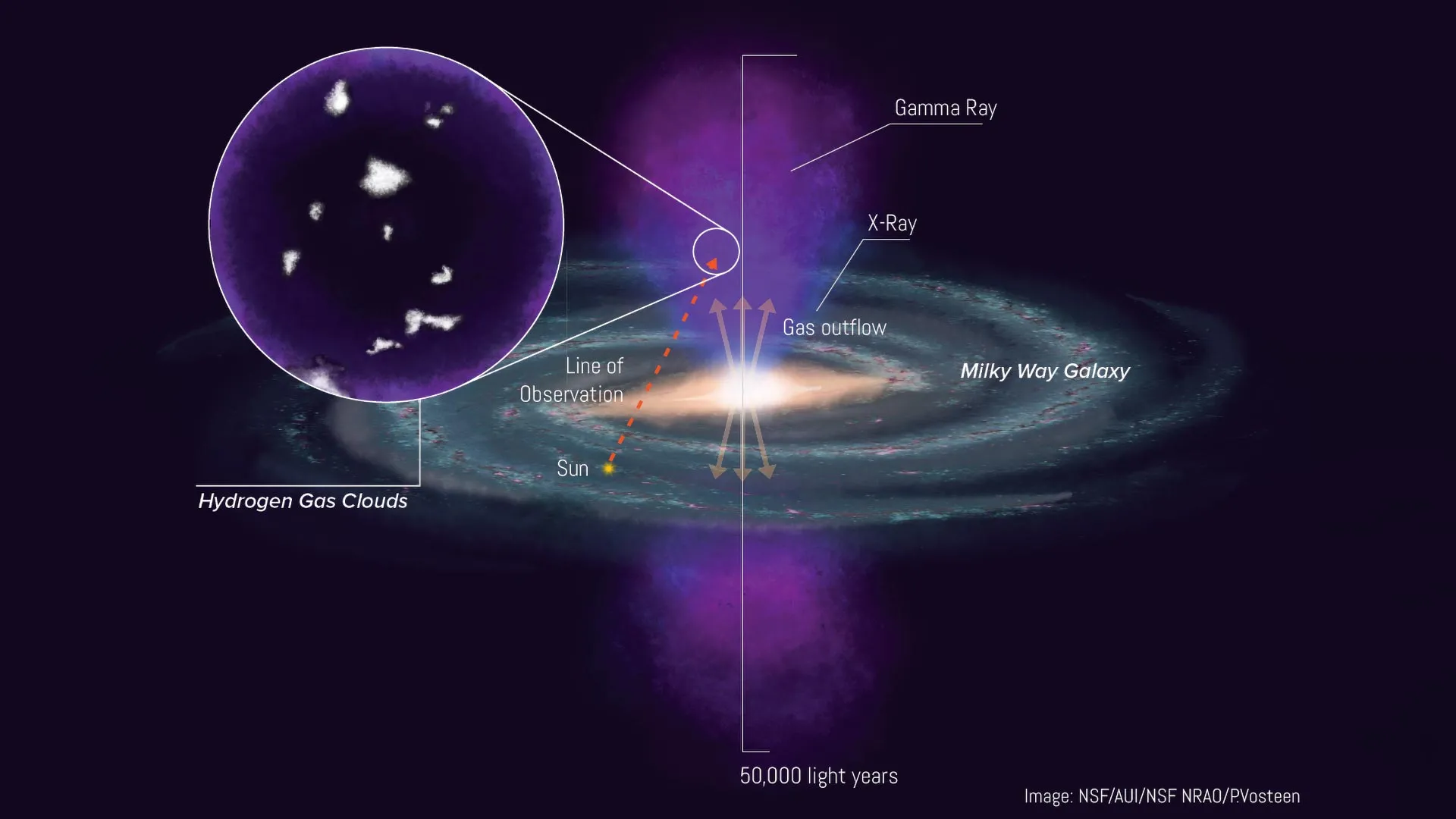
Researchers have found clouds of cold gas embedded deep within larger, superheated gas clouds — or Fermi bubbles — at the Milky Way’s center. The finding challenges current models of Fermi bubble formation and reveals that the bubbles are much younger than previously estimated.
“The Fermi bubbles are enormous structures of hot gas that extend above and below the disk of the Milky Way, reaching about 25,000 light years in each direction from the galaxy’s center — spanning a total height of 50,000 light years,” says Rongmon Bordoloi, associate professor of physics at North Carolina State University and corresponding author of the research.
“Fermi bubbles are a relatively recent discovery — they were first identified by telescopes that ‘see’ gamma rays in 2010 — there are different theories about how it happened, but we do know that it was an extremely sudden and violent event, like a volcanic eruption but on a massive scale.”
Bordoloi and the research team used the U.S. National Science Foundation Green Bank Telescope (NSF GBT) to observe the Fermi bubbles and get high resolution data about the composition of the gas within and the speed at which it is moving. These measurements were twice as sensitive as previous radio telescope surveys of the Fermi bubbles and allowed them to observe finer detail within the bubbles.
Most of the gas inside the Fermi bubbles is around 1 million degrees Kelvin. However, the research team also found something surprising: dense clouds of neutral hydrogen gas, each one measuring several thousand solar masses, dotted within the bubbles 12,000 light years above the center of the Milky Way.
“These clouds of neutral hydrogen are cold, relative to the rest of the Fermi bubble,” says Andrew Fox, ESA-AURA Astronomer at the Space Telescope Science Institute and coauthor of the paper.
“They’re around 10,000 degrees Kelvin, so cooler than their surroundings by at least a factor of 100. Finding those clouds within the Fermi bubble is like finding ice cubes in a volcano.”
Their existence is surprising because the hot (over 1 million degrees Kelvin), high-velocity environment of the nuclear outflow should have rapidly destroyed any cooler gas.
“Computer models of cool gas interacting with hot outflowing gas in extreme environments like the Fermi bubbles show that cool clouds should be rapidly destroyed, usually within a few million years, a timescale that aligns with independent estimates of the Fermi bubbles’ age,” Bordoloi says. “It wouldn’t be possible for the clouds to be present at all if the Fermi bubbles were 10 million years old or older.
“What makes this discovery even more remarkable is its synergy with ultraviolet observations from the Hubble Space Telescope (HST),” Bordoloi says. “The clouds lie along a sightline previously observed with HST, which detected highly ionized multiphase gas, ranging in temperatures from a million to 100,000 Kelvin — which is what you’d expect to see if a cold gas is getting evaporated.”
The team was also able to calculate the speed at which the gases are moving, which further confirmed the age.
“These gases are moving around a million miles per hour, which also marks the Fermi bubbles as a recent development,” Bordoloi says. “These clouds weren’t here when dinosaurs roamed Earth. In cosmic time scales, a million years is the blink of an eye.”
“We believe that these cold clouds were swept up from the Milky Way’s center and carried aloft by the very hot wind that formed the Fermi bubbles,” says Jay Lockman, an astronomer at the Green Bank Observatory and coauthor of the paper. “Just as you can’t see the motion of the wind on Earth unless there are clouds to track it, we can’t see the hot wind from the Milky Way but can detect radio emission from the cold clouds it carries along.”
This discovery challenges current understanding of how cold clouds can survive the extreme energetic environment of the Galactic Center, placing strong empirical constraints on how outflows interact with their surroundings. The findings provide a crucial benchmark for simulations of galactic feedback and evolution, reshaping our view of how energy and matter cycle through galaxies.
The work appears in Astrophysical Journal Letters and is supported by the National Science Foundation under grant number AST-2206853.
The weather alert service warns the public when high or low temperatures could damage their health.
The star illegally advertised prescription-only weight loss drugs, the advertising watchdog found.
