UK’s Vaccine Rollout ‘On Track’ Despite Sharp Slowdown In Jabs

Yui MokPA

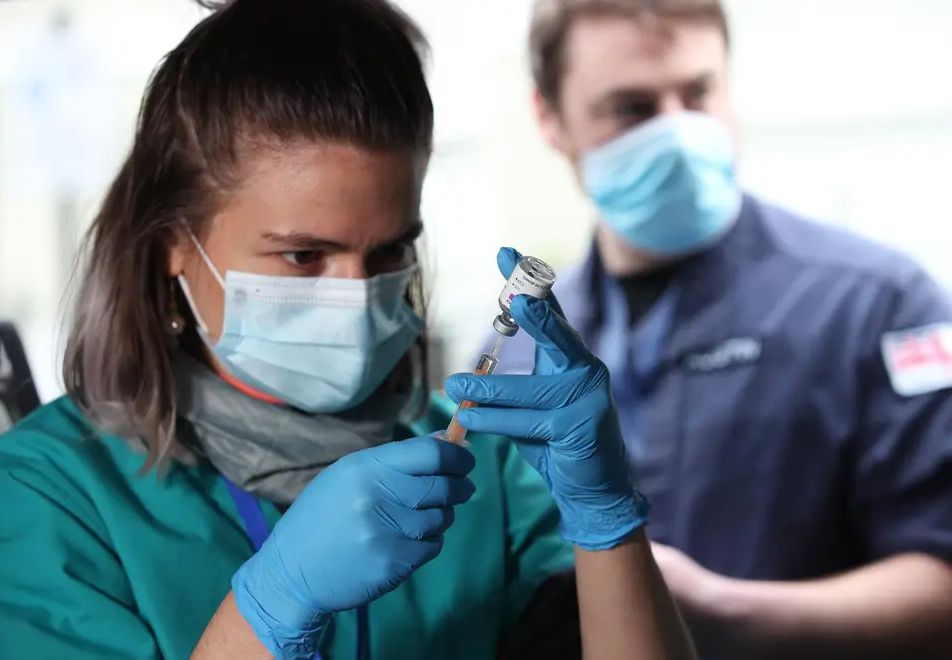
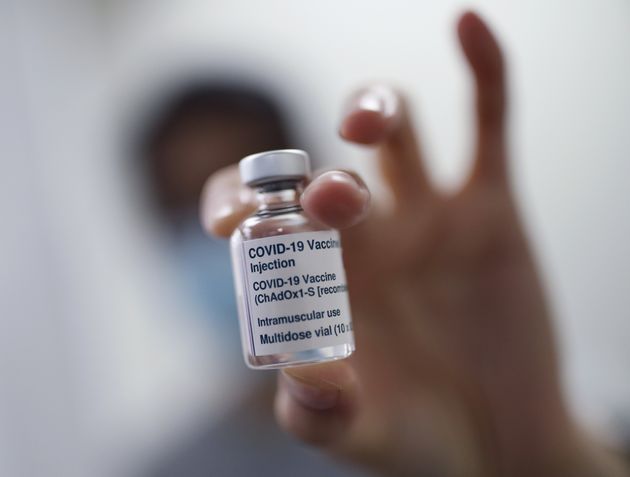
A vial of the Oxford/AstraZeneca coronavirus vaccine.

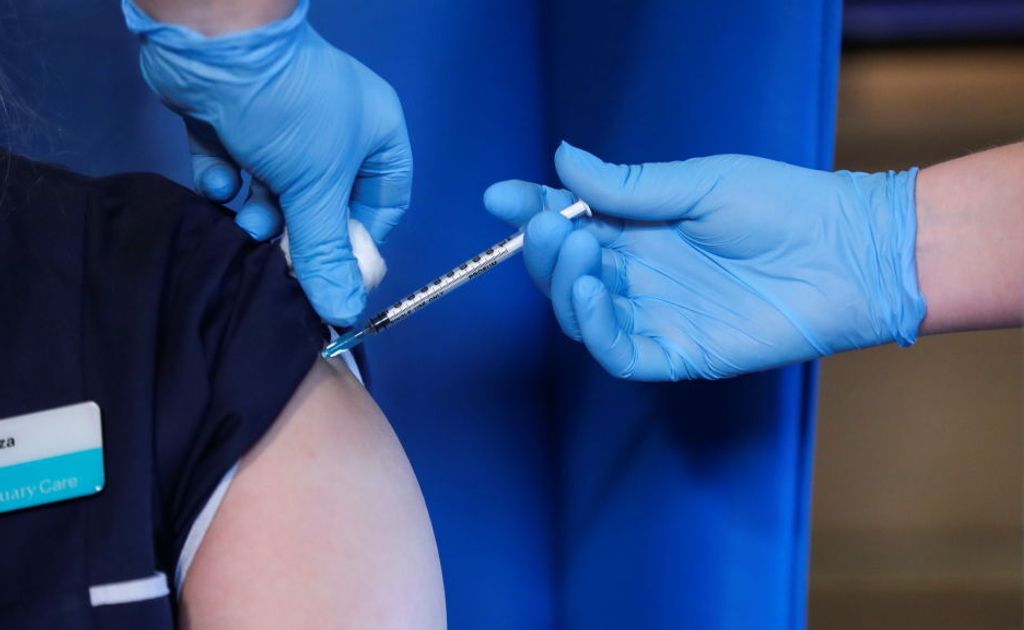
The number of people receiving a Covid-19 vaccine in the UK daily has fallen by around 75% in the last week as the supply of the jab has been squeezed.

Minsters revealed last month there would be a “significant reduction” in doses from the end of March, raising questions about whether the programme’s target dates will be met and when under-50s would be innoculated.

Supplies of vaccines in April have been constrained by the need to test a batch of 1.7 million doses and delays in a shipment of around five million from India.

Government data up to April 5 shows that first doses were given to 40,744 people on the previous day, and 64,590 got a second dose – or 105,334 in total. The number of people being injected with their first shot was the lowest since records began on January 10. A day earlier, just 95,763 people received one of their two doses. 

By contrast, just a week earlier – March 29 – 405,039 doses were distributed. And on March 5, the figure stood at 494,235. 

While the fall may seem steeper than billed, Downing Street on Tuesday moved to allay fears – insisting all adults will be offered a coronavirus vaccine by the end of July as planned.

Some 25m people have so far had a first dose of either the AstraZeneca or the Pfizer vaccine in the UK, while just under 1.8m have had both shots. The government is aiming to vaccinate all over-50s by mid-April and everyone else by the end of July.

The Cabinet Office has indicated that an average of 2.7 million doses a week will be given in England until the end of July, down from a previous estimate of 3.2 million.

The prime minister’s official spokesperson refused to be drawn on “details around supplies and deliveries” of vaccine doses but said “we remain on track” to meet the targets set for the programme.

But the Cabinet Office scenario, provided to experts on the Scientific Pandemic Influenza Group on Modelling (Spi-M) suggests the squeeze on supplies may continue for months.

Papers produced by Spi-M on February 17 were based on an average of 3.2 million doses a week until the end of July and 3.9 million thereafter.

Spi-M said the central scenario provided by the Cabinet Office for its March 31 paper was “considerably slower”, with 2.7 million weekly doses until the end of July and two million from then on.

A slower scenario suggested that just 2.5 million weekly doses might be available.

The Spi-M summary notes that the two scenarios produced by the Cabinet Office “may not reflect the situation most likely to occur”.

The PM’s spokesperson added: “The health secretary set out a couple of weeks ago now the fact that there will be a slight reduction in April but the key thing to remember is that doesn’t mean that we are not on track to hit our pledges.

“We remain on track to vaccinate all those in phase one by April 15, we remain on track to vaccinate or provide the first dose to all adults by the end of July.”

The rollout will be boosted by the introduction of Moderna jabs later in April alongside the Pfizer and AstraZeneca vaccines already being used.

“I’m not going to get into the specifics of how many we will get this month,” the spokesperson said, but “we will have three vaccines that we are able to distribute and that will ensure that we can continue to make sure we are giving people their first doses as well as giving more and more people their second doses”.

Some 26.7 million people in England have had a first dose, the equivalent of 60% of the adult population, leaving around 17.5 million adults needing their initial jab to meet the end-of-July target.

Share Button

How Controversial Covid Vaccine Passports Could Work

The possible introduction of domestic vaccine passports in England has been hailed as “useful for us as we go forward” but also been branded “dangerous” and “discriminatory”.

Prime minister Boris Johnson has suggested that vaccine certification has a role to play as the nation seeks ways to safely ease out of lockdown.

But a cross-party group of politicians, including some Conservative MPs, fear a vaccine passport scheme could be “divisive”.

This is how they might work and why they are controversial.

How could a vaccine passport scheme work?

Any scheme is likely to go beyond just showing whether someone has had a vaccine – as jabs are not mandatory – but would also cover whether they have had Covid-19, and so are likely to have antibodies, or if they have had a recent negative test.

The finer details of how any scheme could work remain unclear but the Government is expected to issue an update on its plans this month.

Where could they be used?

Culture secretary Oliver Dowden has suggested that vaccine passports will not be introduced on a “permanent basis” but they could be a beneficial “tool in the short term” to safely reopen venues.

This could potentially include hospitality venues, music events and theatres.

Johnson has suggested a certificate could give “maximum confidence” to businesses and customers as society reopens.

Last week, he said it “may be up to individual publicans” whether they carry out health certificate checks on punters before allowing them into their premises.

It could mean pub landlords may be able to scrap social distancing if they check Covid health certificates on entry, and allow them to operate at much higher capacity.

On an international level, some countries are already working on requirements for people to prove their status before arriving. The European Union is working on a digital green certificate showing if someone is vaccinated, has a negative test or has recovered from Covid-19.

Has there been opposition to the idea?

More than 70 MPs, including 40 Conservatives, as well as peers from the House of Lords, have launched a campaign to oppose the introduction of vaccine passports in England, claiming they would be “divisive and discriminatory”.

A pledge, signed by former Labour leader Jeremy Corbyn as well as other prominent figures such as Conservative former leader Sir Iain Duncan-Smith, Labour former shadow chancellor John McDonnell and ex-Lib Dem leader Tim Farron, warns the Government against bringing in the scheme.

Baroness Chakrabarti, who warns that using coronavirus certificates could create a “checkpoint Britain,” told BBC Radio 4’s Today programme: “It’s one thing to have a passport to travel internationally, that is a privilege, even a luxury, but participating in local community life is a fundamental right.”

What about the hospitality industry?

The British Beer and Pub Association (BPPA) fears that a move to recommend that pubs and other hospitality venues must demand proof of immunity from people to allow them to enter – with the threat of fines for venues if non-compliant – could prevent millions of young people visiting the pub for months, unless they get themselves tested in advance.

BBPA chief executive Emma McClarkin says vaccine passports could feel like they are discriminating against sections of the population who have not had the jab, such as pregnant women.

Are any test events planned?

Reports suggest a series of pilot tests for certificates are being planned, which could include the FA Cup final and other sporting events in May.

The England and Wales Cricket Board is also exploring the possibility of using coronavirus passports to allow fans into County Championship games this summer.

With a date of June 21 in mind, the ECB’s managing director of county cricket, Neil Snowball, said: “It is going to be a question of balancing three things.

“One, if there is going to be some sort of passport or Covid certification, second is testing, third is some sort of social distancing and we have said we will do whatever we are asked to do to make sure we can get the maximum number of people back.

“The ideal would be some sort of certification with an element of social distancing and probably wearing masks.”

What issues could delay the plans?

The easing of restrictions is dependent on the continued success of the coronavirus vaccine rollout and further reductions in infection rates.

Capacities at sporting events will also be determined by the success of a number of pilot events taking place from mid-April.

Share Button

Covid Vaccine Passports: Boris Johnson Facing Tory Rebellion Over Certification Scheme

More than 70 MPs as well as peers from the House of Lords have launched a campaign claiming coronavirus vaccine passports would be “divisive and discriminatory”.

The cross-party opposition includes 40 Tories and former Labour leader Jeremy Corbyn.

A pledge has been signed by Conservative former leader Sir Iain Duncan-Smith, Labour former shadow chancellor John McDonnell and ex-Lib Dem leader Tim Farron.

It has also been backed by a string of Tory former ministers including Esther McVey, Nus Ghani, Mark Harper and Harriett Baldwin.

Former shadow attorney general Baroness Shami Chakrabarti said the scheme would be “dangerous, discriminatory and counter-productive”.

The government has insisted no final decisions have been taken on whether Covid-status certification could play a role in reopening the economy.

It comes as a report in The Daily Telegraph suggested a series of pilot tests for certificates were being planned, which could include the FA Cup final and other sporting events in May.

Boris Johnson has defended the idea and suggested a certificate could give “maximum confidence” to businesses and customers as society reopens.

Any scheme is likely to go beyond just showing whether someone has had a vaccine – as jabs are not mandatory – covering whether they have had Covid-19, and so are likely to have antibodies, or if they have a negative recent test.

Baroness Chakrabarti, the former director of human rights organisation Liberty, told BBC Radio 4’s Today programme: “It’s dangerous, it’s discriminatory, it’s counter-productive.”

The Labour peer warned that using coronavirus certificates could create a “checkpoint Britain” as she urged for the country to “open up together” as restrictions ease.

“It’s one thing to have a passport to travel internationally, that is a privilege, even a luxury, but participating in local community life is a fundamental right,” she added.

The group’s pledge has been backed by Big Brother Watch, Liberty, the Joint Council for the Welfare of Immigrants (JCWI) and Privacy International.

Senior Tory MP Sir Graham Brady, who is also a signatory to the pledge, which has been backed by a string of Conservative former ministers, insisted the aim should be to return to normal life.

The chair of the 1922 Committee of backbench Conservative MPs said: “Covid-status certification would be divisive and discriminatory.

“With high levels of vaccination protecting the vulnerable and making transmission less likely, we should aim to return to normal life, not to put permanent restrictions in place.”

Earlier this week, Labour leader Keir Starmer indicated there could be opposition to the move among the public if death rates are near zero and hospital admissions are very low.

A government spokeswoman said: “The review is considering a range of issues, including the ethical, equalities, privacy, legal and operational aspects, and what limits, if any, should be placed on organisations using certification.”

Emma McClarkin, chief executive of the British Beer and Pub Association, said that introducing vaccine passports could potentially “scupper things” for hospitality venues which are trying to reopen.

On the possible use of coronavirus certificates, she told BBC Breakfast: “This would be an additional burden put on to the pubs. We are desperate to get back open again. We are desperate to do that.

“We will play our part in test and trace but the additional burden of the vaccine passport could really, really scupper things.

“It is a difficult process for us to implement in venues and yet today we have not had a consultation with the government about how we would do this in pubs.”

Share Button

Tory Councillor Says £500 Self-Isolation Payment Could Be ‘Incentive’ To Spread Covid

PAUL ELLIS via AFP via Getty Images

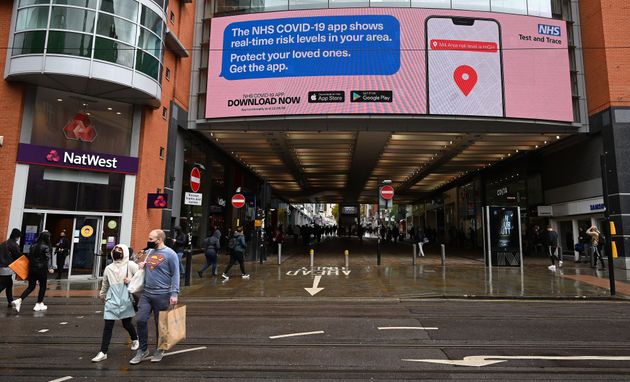
Shoppers pass beneath an electronic sign promoting the NHS Covi-19 app, outside the Arndale Centre in Manchester.

A Tory councillor has come under fire after suggesting £500 Covid-19 self-isolation payments would be an “incentive to spread” the virus.

John Fuller OBE, who is the Conservative leader of South Norfolk Council, told BBC Newsnight on Thursday: “Let’s not have a system whereby if you catch Covid, you get £500.

“That is an incentive to actually spread the disease, and that’s not in anybody’s interests.”

When asked by host Kirsty Wark, “Are you really saying £500 is an incentive for people to spread the disease?” he replied: “What I’m saying is… let’s not… I said let’s not have the incentive, I didn’t say it was, let’s not have an incentive that would encourage people to catch the disease.

“Our job is to bear down on it as quickly as we can.”

His words were condemned by Liverpool metro mayor Steve Rotherham, who described the suggestion as “shocking” and “an insult” to the people who have died as a result of Covid-19. 

People who have been told to self-isolate by NHS Test and Trace are entitled to a £500 Test and Trace Support Payment.

But Labour has said the payment – which can be claimed by those who cannot work from home but need to isolate – should be available to everyone without access to workplace sick pay.

The Test and Trace Support Payment applies to both employed and self-employed people in England, but there is concern that some people who need it are unable to access it.

On Thursday’s BBC Newsnight, the Liverpool mayor cited figures showing 70% of applications for the payment were being rejected.

“There is no one-off £500 payment that would convince anybody, even on low pay, to actually get Covid,” he said in response to Fuller.

Share Button

Senior Tory Warns Against Forcing Care Home Staff To Have Vaccines

A Tory former cabinet minister has warned the government against forcing care home staff to have coronavirus vaccinations. 

David Davis claimed mandating jabs for healthcare workers would be “illegal” and in breach of international law.

But Downing Street pointed out that some NHS staff are already required to get the hepatitis B vaccine, providing a “clear precedent” for mandatory Covid vaccines.

The clash came as health secretary Matt Hancock confirmed the government was considering legally requiring care home workers in England to be vaccinated against Covid-19.

Hancock insisted “no final decision” had been made amid a review into so-called vaccine passports, but confirmed that ministers were looking at jabs being made compulsory for care workers in England.

The plans have emerged amid concerns of low uptake from staff in care homes looking after those who are among the most vulnerable of death the disease, with around 24% of care workers remaining unvaccinated.

However, Davis’s comments highlighted the potential for the proposals to run into strong opposition from civil liberties Tories, who are already preparing to vote against the extension of Covid restrictions on Thursday.

It came after the Telegraph reported leaked details of a paper submitted to the “Covid O” sub-committee of Cabinet which said that prime minister Boris Johnson and Hancock had agreed to the proposal.

Hancock told LBC: “Because people who are looking after elderly residents in care homes, who we know to be the most vulnerable to Covid, they have a duty of care not to pass on the disease and it is a reasonable question.”

He said “many” care homes had asked for this to happen, adding: “There’s a legal change that’s required and, as you can see, I’m open to that, but no final decision has been taken.”

Davis, who is a staunch civil liberties campaigner, conceded there were “precedents” for mandatory vaccines, including hepatitis B vaccines. 

But the former Brexit secretary suggested the comparison with hepatitis B vaccines was unfair, insisting these have been in use since the 1980s and have a long-term safety record.

Davis argued that the best way to protect care home residents was to ensure that they themselves are vaccinated and are therefore at far less risk of death or serious illness.

Barcroft Media via Barcroft Media via Getty Images

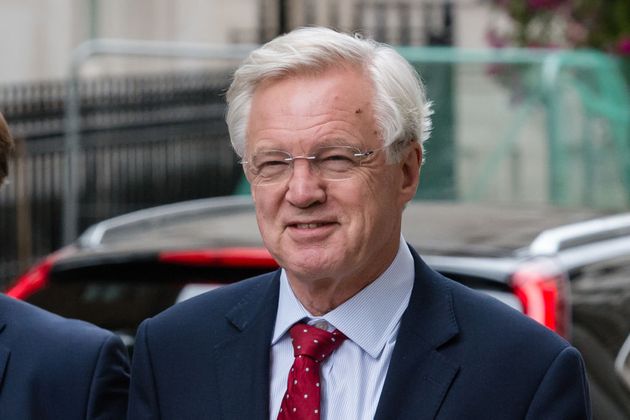
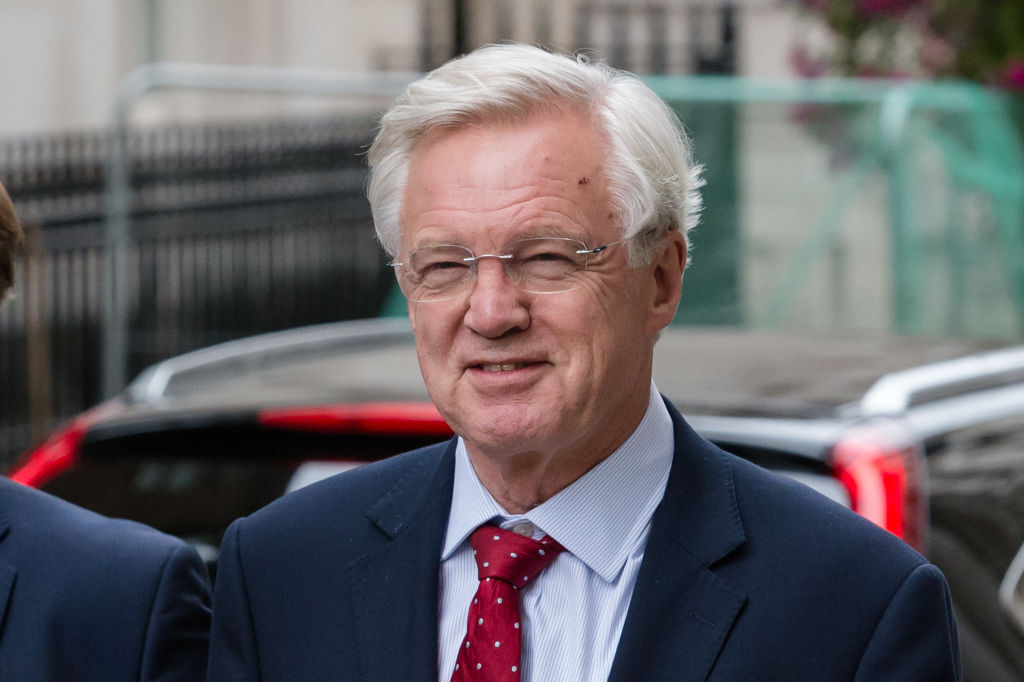
Tory former cabinet minister David Davis

He told the Commons public administration committee (PACAC): “It’s illegal to require vaccination at the moment.

“We are bound ourselves by both UN and European international agreements to the use of medical treatment.

“Medical treatment as it stands must only be for the benefit of the person it’s administered to.

“Medical treatment must not be administered for, as it were, communal purposes – otherwise we’ll all be giving mandatory blood transfusions and so on.

“I give blood anyway, but you’d have requirements like that.

“So that’s against both international and national laws.

“The answer… is to solve the problem by the method which is legal and acceptable, which is to vaccinate the people who are at risk.

“Look, if I were running a care home, and I am very pro-vaccines, I would say to all my workers – I would like you to vaccinate in the interests of our clients.

“But I couldn’t force it, and I don’t foresee a way which we can force it.

“And if you tried to say it’s now a requirement of your job, I don’t think the courts would uphold it – apart from anything else because you are costing someone their job for a requirement which can’t be enforced in law.” 

Responding, the prime minister’s official spokesperson said: “This is something that happens already, for example doctors are required to have the hepatitis B vaccine. 

“So there is a clear precedent for this proposition, elderly people in care homes are the most vulnerable to this disease. 

“And this is something that care homes have actually called for.”

It came as the Independent Care Group, which represents providers in York and North Yorkshire, said making the vaccine mandatory for care workers could put people off from joining the sector.

WPA Pool via Getty Images

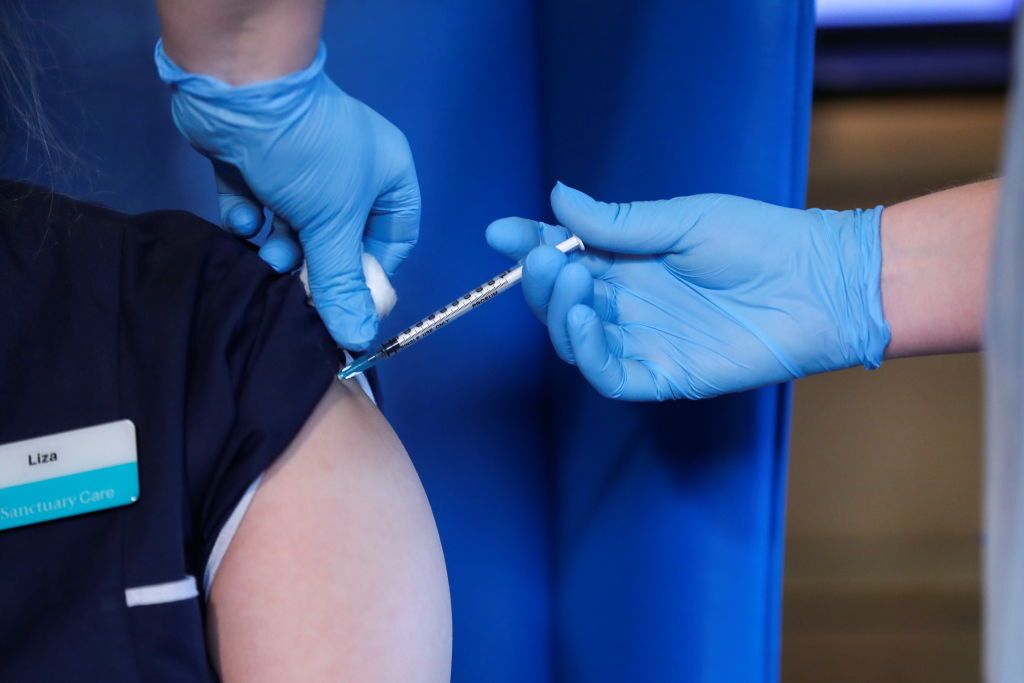
A member of staff receives the Pfizer/BioNTech COVID-19 vaccine at the Abercorn House care home in Scotland on December 14

Chair Mike Padgham said it is vital care workers get vaccinated but it should be voluntary, adding: “I think rather than force it through legislation, the government has more work to do in terms of persuading everyone, not just care workers, about how important it is that the whole country has the vaccine so that we are all protected.”

Davis also cautioned the government against introducing so-called vaccine passports to allow immunised people to do certain activities, for example visiting a pub or attending a football match.

He said introducing Covid status certificates, which are currently being reviewed by the government, could be discriminatory against communities reluctant to take up the vaccine.

Davis told MPs: “The impact of this would be discriminatory. Under the law, it would be indirectly discriminatory and that is illegal. 

“You may well find, it has been said, that Black and ethnic minority communities are less inclined to get vaccinated, well that would be indirect discrimination.”

Younger people were also less likely to have the jab and “some people have ethical or religious objections”, he said.

“There are a variety of good reasons for people not to take a vaccine. I’ve had a vaccine and I think most of the reasons are not ones I would subscribe to.

“But people have that freedom. What this proposal does is, in effect, coerce those people.”

Share Button

Europe’s Third Wave Of Covid Will ‘Wash Up On Our Shores As Well’, Warns Boris Johnson

Boris Johnson has warned the third wave of coronavirus that has hit Europe will “wash up on our shores as well”.

Speaking on Monday afternoon, the prime minister said the UK “will feel those effects in due course”.

But he said the government would “bash on with the roadmap” it set out to gradually lift lockdown restrictions over the next few months.

It comes as EU leaders are set to meet on Thursday to decide whether to ban the export of Oxford/AstraZeneca vaccines to the UK.

There is frustration in the EU, which is lagging behind the UK in the rollout of its vaccination programme, over whether member states will get the supplies they expected.

Johnson is expected to ask European leaders this week to avoid triggering a vaccine supply war between the UK and EU.

The Oxford/AstraZeneca vaccine is manufactured in several different factories, including two in the UK and two in the EU.

Downing Street said it remained “confident” in the UK’s vaccine supplies and repeated that the NHS was “on track” to offer first doses to all over-50s by April 15, and all other adults by the end of July. 

Johnson said: “I’ve talked to our (European) friends repeatedly over the period — we’re all facing the same pandemic, we all have the same problems.

“If there is one thing that is worth stressing is that on the continent right now you can see sadly there is a third wave under way.

“People in this country should be under no illusions that previous experience has taught us that when a wave hits our friends, it washes up on our shores as well.

“I expect that we will feel those effects in due course.

“That’s why we’re getting on with our vaccination programme as fast as we can but a vaccination campaign and developing vaccines, rolling them out— these are international projects and they require international co-operation.”

Tuesday marks a year since the first lockdown was imposed in the UK. MPs will this week be asked to grant a six-month extension to the government’s lockdown powers.

Share Button

The UK’s Coronavirus R Rate Has Risen Slightly This Week

The UK’s Covid R rate has risen slightly to between 0.6 and 0.9, scientists advising the government have said.

Last week the estimated R rate was 0.6 and 0.8.

R measures the number of people, on average, that each sick person will infect.

If R is greater than 1 the epidemic is generally seen to be growing; if R is less than 1 the epidemic is shrinking.

The estimate was published on Friday and provided by the Scientific Advisory Group for Emergencies (Sage) and the Department for Health and Social Care (DHSC).

Here’s what the R rate is in each region of England

In England, the R rate is 0.7 to 0.8.

Regionally it is as follows:

East of England – 0.6 to 0.9 (up from 0.6 to 0.8 last week)

London – 0.6 to 0.9 (up from 0.6 to 0.8)

Midlands – 0.6 to 0.9 (up from 0.6 to 0.8)

North-east and Yorkshire – 0.7 to 0.9 (no change)

North-west – 0.7 to 0.9 (no change)

South-east – 0.7 to 0.9 (up from 0.6 to 0.8)

South-west – 0.6 to 0.9 (up from 0.5 to 0.8)

Here’s what the R rate is in the devolved nations

In Scotland the latest figures estimate the R rate is between 0.7 and 1.0, last week it was between 0.6 and 0.8.

In Wales it is believed to be between 0.6 and 0.8, last week it was between 0.7 and 0.9.

And in Northern Ireland, the R is estimated to be between 0.9 and 1.1, last week it was between 0.75 and 0.95.

Share Button

No Evidence AstraZeneca Vaccine Causes Blood Clots, Says UK Regulator

There is no proven link between the AstraZeneca vaccine and rare blood clotting, the Medicines and Healthcare products Regulatory Agency (MHRA) has said.

Following a “rigorous scientific review” of all the available data, the regulator said the available evidence does not suggest that blood clots in veins are caused by the jab and it has urged people to take it when invited to do so.

It follows a detailed review of cases as well as data from hospital admissions and GP records. Experts from the government’s independent advisory group, the Commission on Human Medicines, also reviewed the data.

It comes after more than a dozen countries, including France, Germany, Italy and Spain suspended its use.

Dr June Raine, MHRA chief executive, said: “Our thorough and careful review, alongside the critical assessment of leading, independent scientists, shows that there is no evidence that that blood clots in veins is occurring more than would be expected in the absence of vaccination, for either vaccine.”

The regulator said it has received five reports of a rare blood clot after five men aged between 19 and 59 received the Oxford/AstraZeneca vaccine.

The clot – cerebral venous sinus thrombosis (CVST) – prevents blood from draining out of the brain.

One of these cases was fatal, experts from the regulator told a press briefing.

“We have received a very small number of reports of an extremely rare form of blood clot in the cerebral veins (sinus vein thrombosis, or CSVT) occurring together with lowered platelets soon after vaccination,” said Dr Raine. “This type of blood clot can occur naturally in people who have not been vaccinated, as well as in those suffering from Covid-19.”

A further, detailed review into the five cases is ongoing. This has been reported in less than 1 in a million people vaccinated so far in the UK, and can also occur naturally – a causal association with the vaccine has not been established.

Phil Bryan, MHRA vaccine safety lead, said: “We take every single report of a suspected side effect seriously.

“We have received five reports of what is a very unique, specific form of blood clot … and this is similar to some of the cases that have been reported in Europe in the past week or so.

“What we don’t know is whether these cases have been caused by the vaccine.

“We are working closely with our experts and haematologists to try to gather more information to determine this.”

He added that these clots do happen very rarely naturally.

Bryan added: “Where we are now is that no proven causal association with what is still an extremely rare medical event has been proven for the AZ vaccine.

“But we do know that these are highly effective vaccines. We still have a huge burden of Covid disease in the population.

“So, right now, the balance of benefits and known risks of the vaccine are favourable.”

Professor Sir Munir Pirmohamed, chair of the Commission on Human Medicines, said: “Having reviewed all the data that was available to us, as well as reports, what we concluded was that there was no increased risk of peripheral venous thromboembolism based on all the data that’s available to us at the moment.

“We will still recommend that the vaccine is taken when you’re offered the vaccine.”

The World Health Organisation has also stated that the benefits of the vaccine “far outweigh the risks”. 

Dr Hans Kluge, WHO regional director for Europe, said it was “routine to signal adverse events” but reiterated that people should “have confidence” in the protection given by vaccines.

Share Button

The UK’s Coronavirus R Rate Has Fallen This Week

The UK’s Covid R rate has fallen to between 0.6 and 0.8, scientists advising the government have said.

Last week the estimated R rate was 0.7 to 0.9, which had been a slight rise on the previous week’s estimate of 0.6 and 0.9.

R measures the number of people, on average, that each sick person will infect.

If R is greater than 1 the epidemic is generally seen to be growing; if R is less than 1 the epidemic is shrinking.

The estimate was published on Friday and provided by the Scientific Advisory Group for Emergencies (Sage) and the Department for Health and Social Care (DHSC).

The DHSC also provides a breakdown of the estimated R rate in regions of England.

Here’s what the R rate is in each region

In England, the R rate is 0.6 to 0.8.

Regionally it is as follows:

East of England – 0.6 to 0.8 (no change from last week)

London – 0.6 to 0.8 (no change)

Midlands – 0.6 to 0.8 (from 0.7 to 0.9)

North-east and Yorkshire – 0.7 to 0.9 (from 0.7 to 1.0 )

North-west – 0.7 to 0.9 (no change)

South-east – 0.6 to 0.8 (no change)

South-west – 0.5 to 0.8 (from 0.6 to 0.8 )

It comes as the number of people infected with coronavirus continues to fall across England, but appears to be levelling off in Northern Ireland and Scotland.

New estimates from the Office for National Statistics (ONS) show that around one in 270 people in private households in England had Covid-19 between February 28 and March 6 – the equivalent of 200,600 people.

This is down from around one in 220, or 248,100 people, for the period February 21 to 27.

It is the lowest figure since the week to September 24 when the estimate stood at one in 470, or 116,600 people.

However, the number of people infected in England is still high when compared to last summer. In the week to August 25 around one in 2,000 people had coronavirus.

Meanwhile, the latest data for Wales shows around one in 365 people are estimated to have had Covid-19 between February 28 and March 6 – down from one in 285 the week before.

In Northern Ireland, around one in 310 people were infected, up from one in 325.

The estimate for Scotland was around one in 320 people, up from one in 335 the previous week.

Share Button

Boris Johnson Lies About Labour Voting Against Nurses’ Pay Rise

Press Association

Prime minister Boris Johnson

Boris Johnson has refused to apologise after falsely claiming Labour voted against a pay rise for nurses. 

The prime minister, who is under fire for his offer to give hard-pressed NHS staff a 1% pay rise, had claimed that Keir Starmer’s party had opposed earlier government plans to give health workers a 2.1% hike. 

The move, part of the NHS funding bill, was never put to a vote but Johnson’s aides have rejected calls for the PM to say sorry or even correct his mistake. 

During prime minister’s questions on Wednesday, Johnson told MPs: “The last time we put it to a vote, he (Starmer) voted against it.” 

Shadow health secretary Jonathan Ashworth raised a point of order with Commons speaker Lindsay Hoyle after the session. 

He said: “The prime minister twice from that despatch box said that the Labour opposition voted against the NHS Funding Bill and the 2.1% increase for NHS staff – this is not the case.

“Indeed, in the debate, as Hansard will show, I was explicit that we would not be dividing the House.” 

Hoyle ruled that it was “certainly a point of clarification” but by that point Johnson had left the chamber. 

Johnson’s press secretary Allegra Stratton, who later faced questions from journalists, refused to offer any apology from the PM. 

She said: “The speaker addressed it in the House immediately after the shadow health secretary and the speaker regarded it as a point of clarification, and he regarded it as having been dealt with.” 

Pressed more than 10 times on whether Johnson would accept he was wrong about claiming there was a vote, Stratton repeated the line and said simply said it was “appropriate” for the speaker to clarify the point. 

She insisted that Johnson was “concerned about the truth of these matters”, she added “it would be difficult if the speaker had not addressed it”. 

Asked about the ministerial code, which says government ministers should correct any error “at the earliest opportunity”, Stratton insisted that “the system worked”, suggesting the speaker corrected the mistake. 

During PMQs, Johnson hinted nurses may be in line for a bigger rise than the 1% proposed by the government. 

Labour has called for a larger rise for all NHS staff and has demanded the government put plans to a vote. 

Share Button