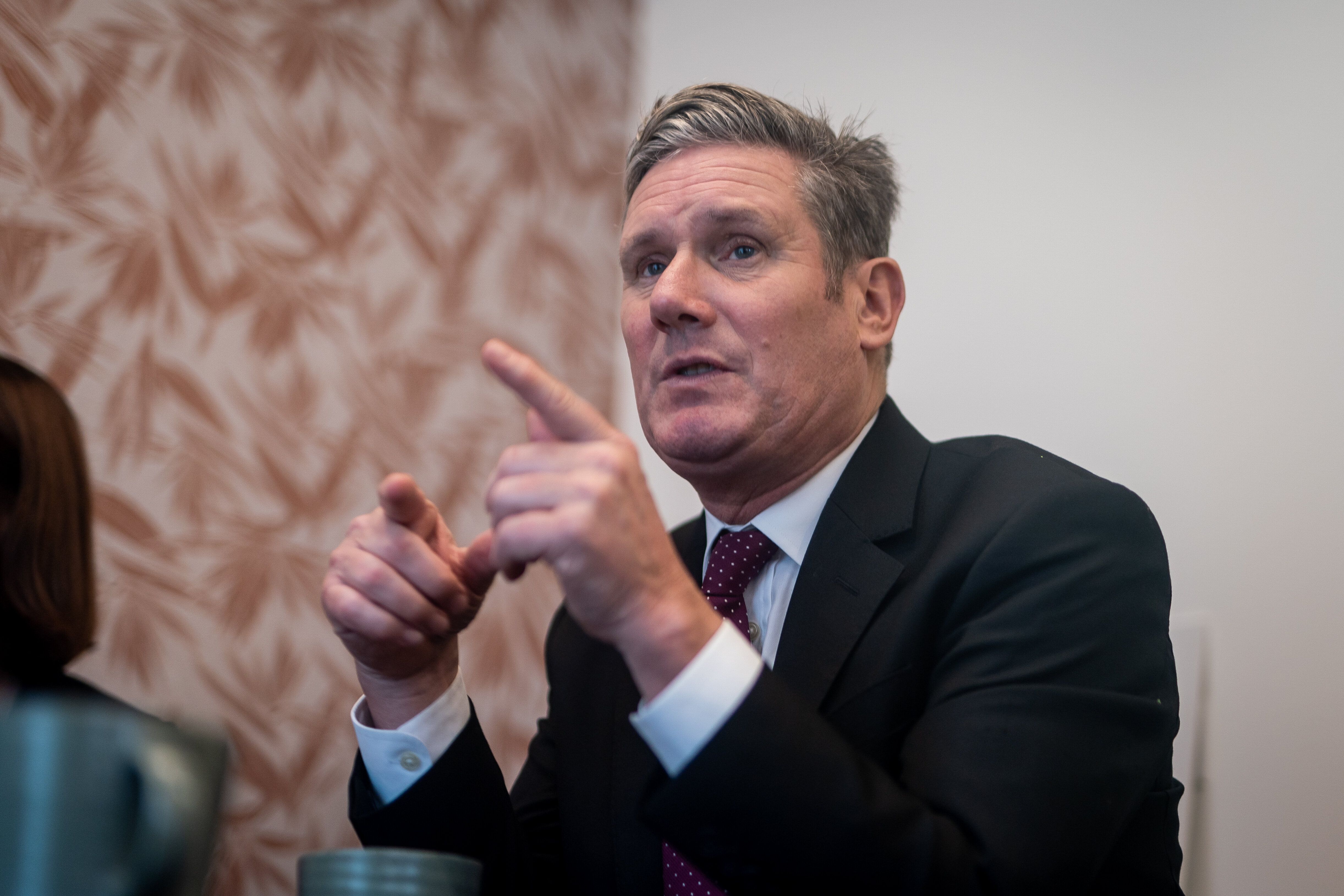
Keir Starmer is to urge businesses to wean Britain off “immigration dependency” as he will warn the days of “low pay and cheap labour” have to end.
The Labour leader will tell firms to train up UK workers in a speech to the Confederation of British Industry conference where he outlines his vision to smash the “low pay model”.
Advertisement
Starmer will vow not to ignore the need for skilled individuals to come into the country if he forms a Labour government, as he sets out plans to “start investing more in training up workers who are already here”.
But he will stress that any changes to a points-based migration system “will come with new conditions for business”.
“We will expect you to bring forward a clear plan for higher skills and more training, for better pay and conditions, for investment in new technology,” he is expected to tell business leaders gathered in Birmingham.
“But our common goal must be to help the British economy off its immigration dependency. To start investing more in training up workers who are already here.
Advertisement
“Migration is part of our national story – always has been, always will be. And the Labour Party will never diminish the contribution it makes to the economy, to public services, to your businesses and our communities.
“But let me tell you – the days when low pay and cheap labour are part of the British way on growth must end.”
Starmer will set out Labour’s plans for reform, which include:
– Ensuring all employers able to sponsor visas are meeting decent standards of pay and conditions
– Speed up visa delays to avoid labour shortages damaging the economy
– Introduce training and plans for improving pay and conditions for roles that require international recruitment
– Reform the migration advisory committee that reports to the Government so it better projects future trends.
Advertisement
He will warn that businesses cannot be “more comfortable hiring people to work in low paid, insecure, sometimes exploitative contracts” rather than investing in new technology to boost productivity.
Starmer’s speech comes as Rishi Sunak moved to deny plans ministers could look to realign Britain with EU laws.
Some Tories have been angered by suggestions the government was weighing up a Swiss-style relationship with Brussels.
But the prime minister told the CBI conference on Monday that the UK “will not pursue any relationship with Europe that relies on alignment with EU laws”.
Starmer is understood to be sticking to his opposition of rejoining the EU’s single market.
Matt Hancock’s stay in the jungle is to be extended after surviving the first I’m A Celebrity… Get Me Out Of Here! public vote.
Journalist Charlene White was voted off after receiving the fewest votes.
The 42-year-old Loose Women star told hosts Anthony McPartlin and Declan Donnely: “This is really, really weird.”
Advertisement
It means the former health secretary will continue his pursuit of “a bit of forgiveness”, which he said was his reason for appearing on the show.
Hancock broke coronavirus social distancing rules during the pandemic by having an affair in his ministerial office with aide Gina Coladangelo, and has told campmates it was caused by the fact he “fell in love”.
The serving MP has faced criticism from opposition politicians and from within his own party for heading to Australia, with the Tory whip suspended.
Prime minister Rishi Sunak said Hancock’s decision to enter the jungle was not “noble” because he was failing to prioritise his “constituents and our country”.
Advertisement
Broadcasting watchdog Ofcom says it has received almost 2,000 complaints about the ITV show – the majority objecting to the former health secretary’s participation.
It came after Boy George had told Hancock on that he has been “hating on” the former health secretary during their time in the jungle.
The 61-year-old Culture Club singer apologised to the MP for his behaviour to him and said he found it difficult to “separate” the politician from the person.
On Friday, Boy George told comedian Seann Walsh: “(I) can’t stand Matt. I have tried to like him and I’ve failed. I find him slimy, I find him slippery.
“I find him just … I made a joke about chocolate. He just looked at me like … I wanted to say, ‘What are you looking at? Don’t you look at me like that’.”
Advertisement
Hancock then joined the conversation and Boy George told him: “I was making a joke about the chocolate. For god’s sake I was like … let’s have a bit of fun.
“I didn’t like the way you looked at me. I made a joke and you were like…”
Hancock said it was not his “intention” and he was sorry for making him feel “uncomfortable”.
Boy George then told the Bush Telegraph: “He’s probably going to be quite upset and I was kicking off a bit and I just thought, ‘you know what, just tell him to his face what you feel’.”
The singer then told Hancock: “I just feel everyone’s trying to be too nice. It’s getting on my tits. I don’t want arguments … I’m just like come on guys, have a laugh.
“I’ll be honest with you, I think your presence has made everyone very compliant.”
Hancock replied: “Compliant, it’s a funny word.”
Boy George said: “I have been hating on you, I have to be honest. I sometimes feel like you don’t say what you mean and you’re not particularly direct.”
He added: “I’m trying to separate you as a human being and you as a politician, and I’m struggling with it. We don’t share the same politics.
Advertisement
“I am struggling a little bit with you. That’s not your problem, that’s my problem. I apologise because I was really slagging you off a minute ago.”
Hancock said he would prefer the truth and has “enjoyed spending time with” Boy George.
The chancellor included almost £25 billion in tax increases in his package to fill the UK’s financial blackhole, with the most well-off taking a hammering.
Advertisement
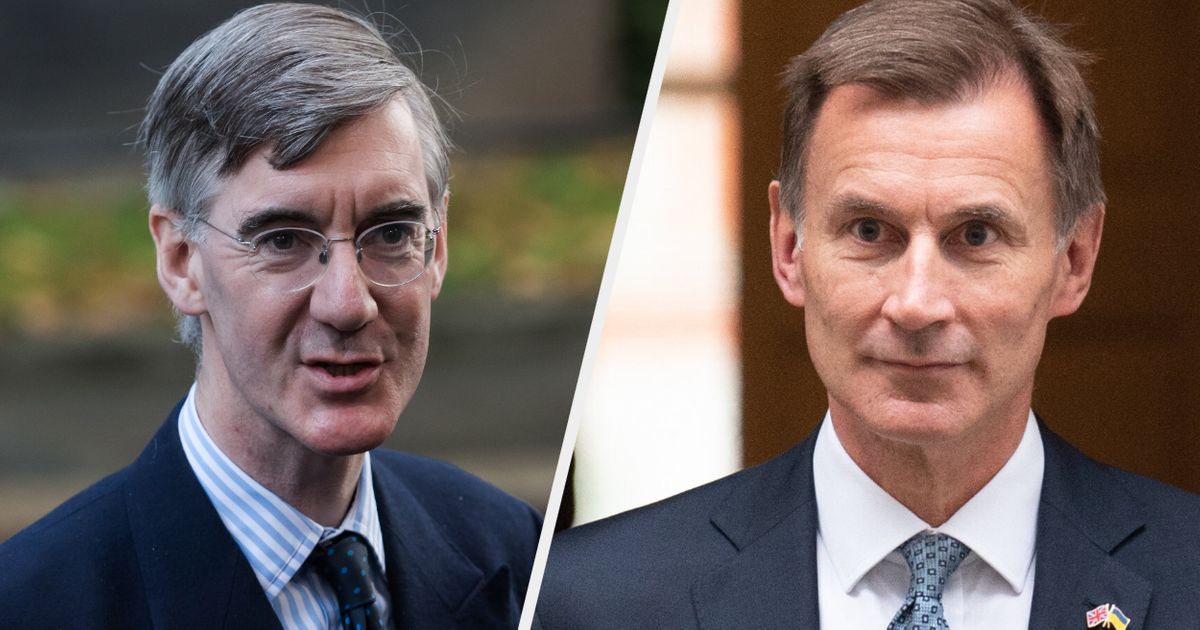
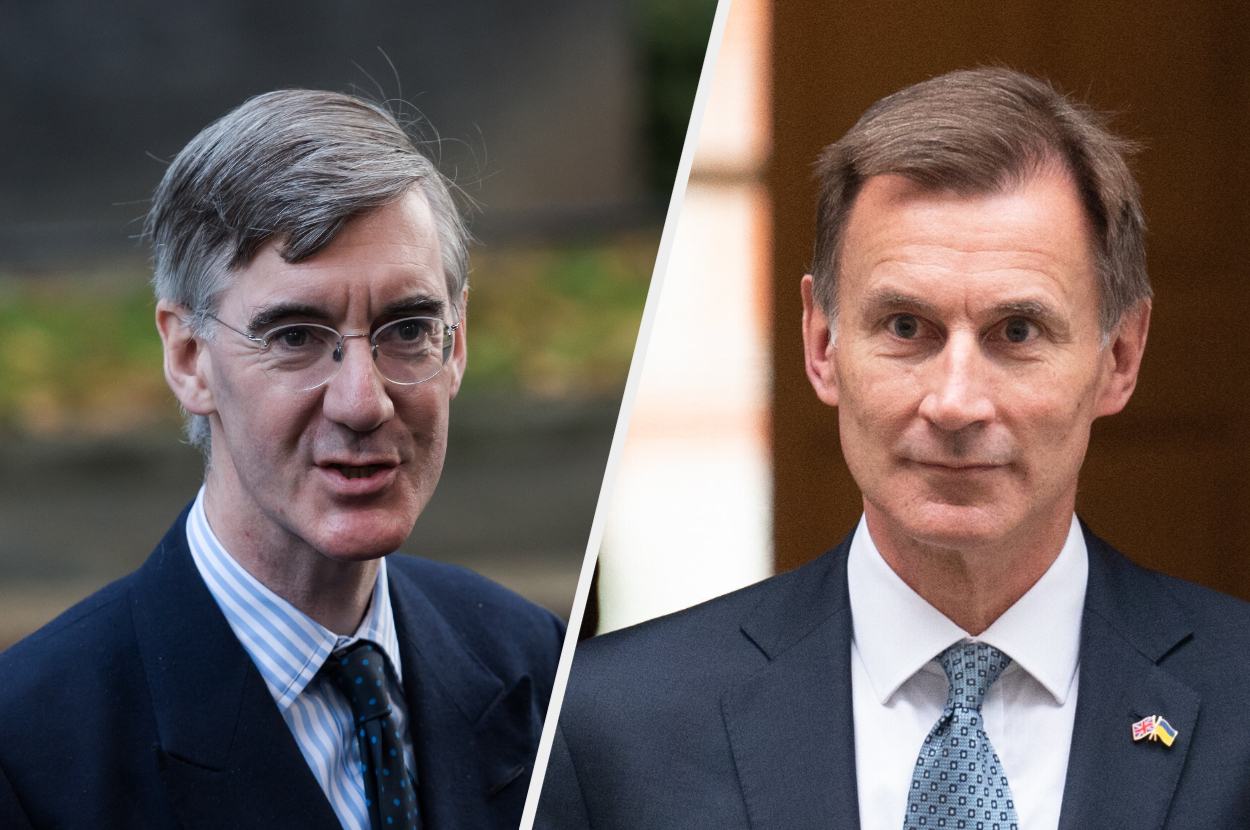
The Rishi Sunak administration will fear the comments by Rees-Mogg, the former cabinet minister and low-tax enthusiast, reflects wider concerns from the right of the party over raising taxes as the country is entering a recession.
Rees-Mogg, whose time on the ministerial benches was marked by controversial attempts to reduce the headcount of the civil service, said ministers should be seeking to cut spending through efficiency savings in public services.
He told Channel 4 News: “Taxation has got too high and there are issues with the level of expenditure that we have got.
“I think there is a real problem with fiscal drag bringing more and more people into the 40p (tax) band who, particularly if they are living in the south of England, are not necessarily particularly well-off.
Advertisement
“That is going to be hard for them paying an extra level of tax on top of what they are already paying.
“Also freezing the basic band is going to be a burden for all taxpayers, even those who are still in receipt of benefit.
“I think we need to look at the efficiency of government to make sure money is well spent before reaching for the easy option of putting up taxes.
“What we actually need to be doing is having a strategy for growth and looking to lower taxes.”
Responding to today’s Autumn Statement, Conservative MP Jacob Rees-Mogg says that “we need to look at the efficiency of government to make sure money is well spent before reaching for the easy option of putting up taxes”. pic.twitter.com/0iQi1JuGFY
Rees-Mogg is a long-standing critic of prime minister Rishi Sunak, having previously described him as a “socialist” over his record of raising taxes when he was chancellor. He quit the cabinet when Sunak became PM
Advertisement
His comments will cause concern among ministers after another former minister, Esther McVey, warned she could not support tax rises if the government continued to press ahead with the HS2 rail link.
Rees-Mogg insisted however that he still supported the government.
“I am a Conservative member of parliament and I support the leader of the party. We’ve had three leaders in the last few months – it would be ridiculous to have another,” he said.
Hunt has increased the windfall tax on oil and gas giants and reduced the salary threshold at which workers begin paying the 45p top rate of income tax.
Among a string of little-noticed measures, the chancellor also plans a 23% increase in fuel duty, which adds £5.7 billion to his coffers and is the first tax rise of its kind since 2011.
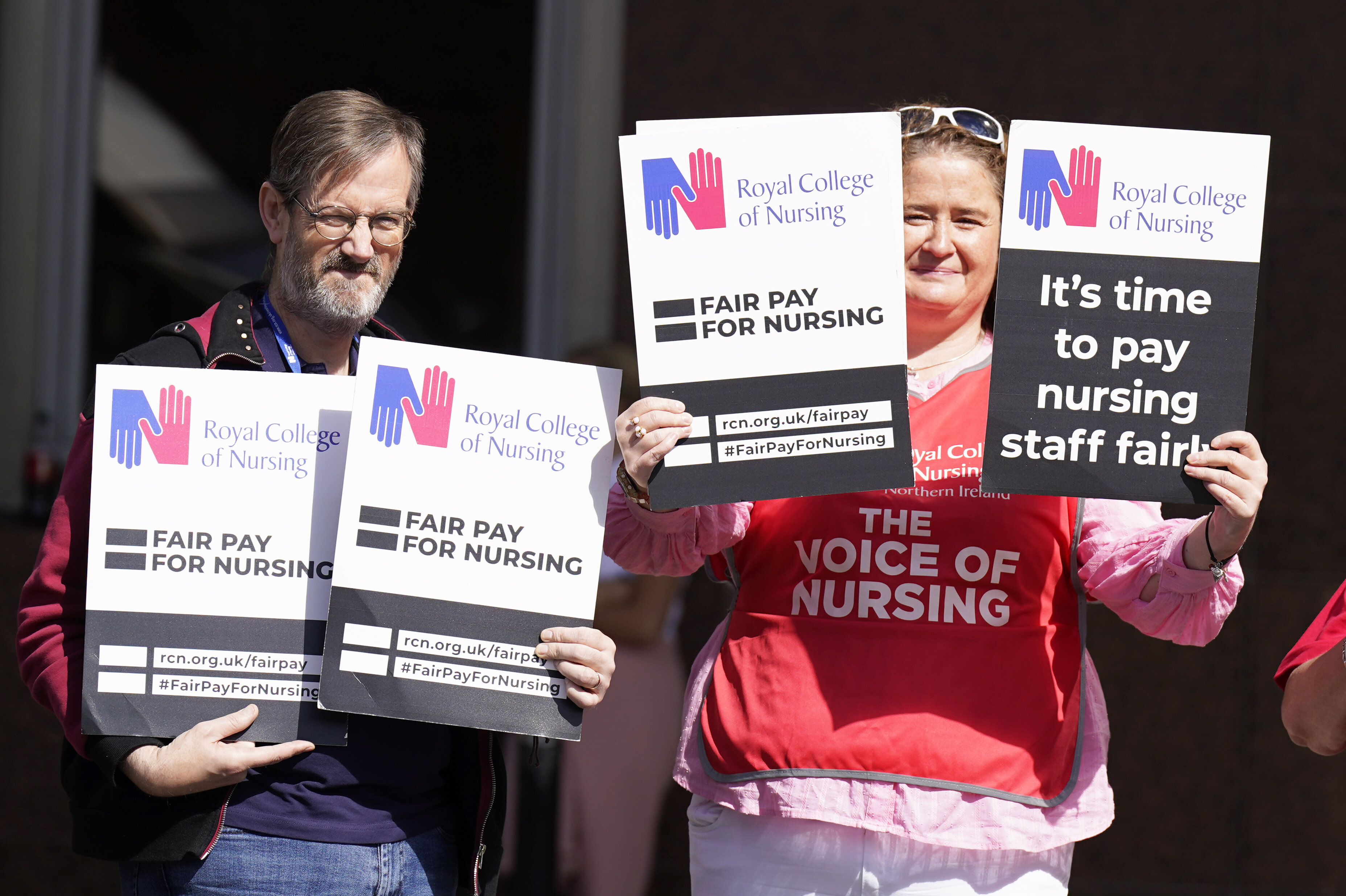
Nurses have called for “detailed negotiations” on pay in the next five days or it will announce strike dates for December.
In a letter to health secretary Steve Barclay following the autumn statement, Royal College of Nursing (RCN) general secretary Pat Cullen said the chancellor demonstrated that “the government remains unprepared to give my members the support they need at work and at home”.
Advertisement
She said that recent meetings with the minister had been “cordial in tone”, but had not resolved the issues at the heart of proposed strike action.
Last week, the RCN announced that nursing staff at the majority of NHS employers across the UK had voted to take strike action over pay and patient safety.
⏱️ Ministers have days to act before we announce December strike action.
ICYMI – 1 in 8 nursing posts are vacant in England alone. The government can choose #FairPayForNursing for patient safety.
In the letter, she added: “It is with regret that I write to say that unless our next meeting is formal pay negotiations, beginning within the next five days, we will be announcing the dates and locations of our December strike action.”
Advertisement
The RCN is calling for a pay rise of 5% above inflation, saying that despite a pay rise earlier this year, experienced nurses were worse off by 20% due to successive below-inflation awards since 2010.
Cullen said recent meetings with Barclay were welcome, but added: “I must not let my members nor the public confuse these meetings for serious discussions on the issues of NHS pay and patient safety.
“You have again asked to meet in the coming days and for this third occasion I must be clearer in my expectation.
“There is only value in meeting if you wish to discuss – in formal, detailed negotiations – the issues that have caused our members to vote for strike action.
“It is now more than a week since we announced our ballot outcome and your department has dedicated more time to publicly criticising our members’ expectations than finding common ground and a satisfactory conclusion.
Advertisement
“I also point out that this stands in contrast to the approach taken by governments and executives in other parts of the United Kingdom.”
Health secretary Barclay said: “We are all hugely grateful for the hard work and dedication of healthcare staff, including nurses, and we have prioritised the NHS in the autumn statement with an additional £6.6 billion over the next two years, alongside a commitment to publish a comprehensive workforce strategy next year with independently verified forecasts.
“We deeply regret some union members have voted for industrial action.
“These are challenging times, which is why we accepted the recommendations of the independent NHS Pay Review Body in full and have given over one million NHS workers a pay rise of at least £1,400 this year.
“This is on top of a 3% pay increase last year when public sector pay was frozen, and wider government support with the cost of living.”
Jeremy Hunt has set out his plans for almost £25 billion in tax increases and more than £30 billion in spending cuts to fill the UK’s financial blackhole – but some measures have received more attention than others.
While increasing the windfall tax on oil and gas giants and reducing the salary threshold at which workers begin paying the 45p top rate of income tax were highlighted by the chancellor, many striking moves were buried within the pages of autumn statement green book. Here are just five:
Advertisement
1. Fuel duty set to go up by 23% next year.
How motorists will be affected by a budget is typically one of the headline-grabbing announcements, and yet Hunt failed to mention fuel duty.
But based on a forecast from the Office for Budget Responsibility, which combines the forecast for RPI inflation next year and the assumption that the 5p cut to fuel duty will end, the chancellor could hike the tax for the first time since 2011.
As the Office for Budget Responsibility said: “The planned 23% increase in the fuel duty rate in late-March 2023, which adds £5.7 billion to receipts next year.
“This would be a record cash increase, and the first time any government has raised fuel duty rates in cash terms since January 1, 2011.
Advertisement
“It is expected to raise the price of petrol and diesel by around 12 pence a litre.”
Tory MPs are likely to continue their campaign urging the chancellor to keep prices at the pumps down.
2. Big win for banks.
The tax surcharge on banks is to be slashed to 3% from 8%.
The move aligns with the government’s decision to hike up corporation tax from 19% to 25% from April, which banks pay on top of the surcharge.
It means banks will still be paying a higher rate of tax than they were previously, but by just 1% rather than the 6% that they could have faced had the surcharge stayed the same.
Advertisement
3. Police and school building cuts.
Home Office spending is set to be slashed by £100m in real-terms by 2024-25, which is likely to affect frontline policing.
And while Hunt said the government will invest an extra £2.3 billion per year in schools, there will be a £1 billion (14%) real-terms cut in capital spending on education in 2024-25 – meaning crumbling schools left in disrepair.
4. Stealth taxes.
The now six-year freeze in income tax thresholds is a favourite “stealth tax” of the government – mainly because it avoids announcing a rise, and it tends to affect money people haven’t yet earned, so are less likely to notice the change.
Thursday’s change means a total of 3.2 million new income taxpayers and 2.6 million more people dragged into the higher 40p tax bracket, according to the OBR.
INCOME TAX
The six year freeze in income tax will drag 3.2million into paying basic rate and 2.6million into paying higher rate
It will take the *real* value of the personal allowance back to 2013-14 levels
The chancellor has said he will cap the increase in social housing rents at a maximum of 7% in 2023/24, saving the average tenant £200 next year. Hunt said that without the cap, families living in the social rented sector could face rent hikes of up to 11%
But with the government refusing to cover the shortfall, social housing providers will have to fill the gap somehow, and could lead to a reduction in investment in properties and building new homes by £630 million over five years.
Good scoop but social rents *could* rise to 7% not definitely *will*. Social landlords will still – I hope – measure affordability. That said, cap is higher than ppl were expecting. Problem is…without social rent it’s difficult to fund social housing without…Govt investment https://t.co/fgZwbxwQU6
Sarah Olney, Treasury spokesperson of the Liberal Democrats, which highlighted many of the little-mentioned changes, said: “Underneath the surface of this terrible ‘cost of chaos’ budget are yet more hidden horrors.
“Everything from police to social housing to our crumbling schools is being left in the dust by this Conservative government.
Advertisement
“Everyone will be forced to pay for this cost of chaos budget with their public services being slashed more each year.
“Banks are being given a huge tax giveaway while millions are dragged into a higher rate of tax.
“The accumulated impact of these cuts will mean a bleak recession for years to come caused by an out of touch Conservative government.”
Jeremy Hunt will say the UK is facing an economic “storm” as he prepares to unveil £60 billion-worth of tax rises and spending cuts in his autumn statement.
The chancellor will tell MPs that the government must “take difficult decisions now” to repair the public finances, which have been battered by Covid-19, the war in Ukraine and the effects of Kwasi Kwarteng’s disastrous mini-budget.
Advertisement
HuffPost UK understands Hunt will confirm that he is slashing public spending by around £35 billion and increasing taxes by £25 billion as he tries to balance the nation’s books.
But he will also insist that the government will “protect the vulnerable, because to be British is to be compassionate”.
That could mean that welfare benefits and the state pension will rise in line with inflation, meaning they will not be cut in real terms.
The chancellor will deliver Thursday morning’s autumn statement against a backdrop of rising interest rates, as well as soaring energy bills and inflation.
Advertisement
He is expected to increase taxes for the highest earners by reducing the threshold at which they start paying the 45p top income tax rate from £150,000 to £125,000.
But he has already admitted that everyone in the country will have to pay more tax as the government tried to fill a £55 billion financial black hole.
In his statement to the Commons, Hunt will say: “As countries all over the world grapple with inflation, our plan reflects British values: we are both honest about the challenges, and fair in our solutions.
“We are taking difficult decisions to deliver strong public finances and help keep mortgage rates low, but our plan also protects our long-term economic growth.
Advertisement
“At the same time, we protect the vulnerable, because to be British is to be compassionate.
“There is a global energy crisis, a global inflation crisis and a global economic crisis.
“But the British people are tough, inventive, and resourceful. We have risen to bigger challenges before.
“We aren’t immune to these global headwinds, but with this plan for stability, growth and public services – we will face into the storm.”
In a clear repudiation of September’s mini-budget – which saw Kwarteng implement former prime minister Liz Truss’s plan for huge tax cuts funded by extra borrowing – Hunt will say the government’s priority is to bring down inflation, which has hit 11.1%, the highest rate in 40 years.
He will say: “High inflation is the enemy of stability. It means higher mortgage rates, more expensive food and fuel bills, businesses failing and unemployment rising.
“It erodes savings, causes industrial unrest, and cuts funding for public services. It hurts the poorest the most and eats away at the trust upon which a strong society is built.”
Advertisement
Hunt will say the Bank of England has his “wholehearted support” as it tried to tackle inflation by increasing interest rates.
“Families across Britain make sacrifices every day to live within their means, and so too must governments because the United Kingdom will always pay its way,” the chancellor will say.
“We are taking a balanced path to stability: tackling the inflation that eats away at a pensioner’s savings and increases the cost of mortgages to families, at the same time supporting the economy to recover. But it depends on taking difficult decisions now.”
Shadow chancellor Rachel Reeves said the UK had been “held back by 12 years of Tory economic failure and wasted opportunities”.
She said: “What Britain needs in the autumn statement today are fairer choices for working people, and a proper plan for growth.”
Donald Trump’s announcement that he will make a third run for the White House has been met with the coolest of reactions from the media – with one once supportive newspaper trolling the former US president.
On Tuesday, Trump made public the worst kept secret in politics by unveiling his 2024 campaign from his Mar-a-Lago club in Florida. He appeared to preview a campaign slogan – “Make America Great And Glorious Again” or “MAGAGA” – that raised plenty of eyebrows on social media.
Advertisement
The announcement came despite the disappointing midterm election results that saw the majority of the candidates he endorsed defeated, and his low energy performance on Tuesday only added to the lack of enthusiasm around Trump’s latest pitch.
Step forward the New York Post, the newspaper owned by conservative media magnate Rupert Murdoch.
“Florida Man Makes Announcement,” was the headline running across the bottom of the front page of its Wednesday edition, directing readers to an article on buried on page 26.
April 2016: “The Post endorses Trump” Today: “Florida man makes announcement”
Last week: “Trumpty Dumpty” Intriguing developments in the Murdoch-Trump relationship… pic.twitter.com/fbXZR1yKPY
The tone of the story, under the headline Been There, Don That, was even more savage.
The copy refers to Trump as a “Florida retiree” and his Mar-a-Lago resort as a “classified-documents library”, a reference to the investigation Trump faces for retaining government records, some of which were marked as highly classified.
It adds: “His cholesterol levels are unknown, but his favorite food is a charred steak with ketchup.”
The reporter also points out that Trump himself has stated that “his qualifications for office include being a ‘stable genius’.”
Maggie Haberman, reporter for The New York Times and author of Confidence Man: The Making of Donald Trump and the Breaking of America, said on CNN: “There is nobody who knows better than Rupert Murdoch that the way to upset Donald Trump is not to say his name.”
Best lines in New York Post write-up of Trump’s announcement, buried as filler on page 26
“Florida retiree”
“Mar-a-Lago, his resort and classified-documents library”
“His cholesterol levels are unknown, but his favorite food is a charred steak with ketchup.”
Last week, the Post put the blame for the Republican Party’s showing in the midterm elections squarely on the former president and his choice of candidates.
On its Thursday front page, the Post depicted Trump as the hapless nursery rhyme character Humpty Dumpty.
“Don (who couldn’t build a wall) had a great fall — can all the GOP’s men put the party back together again?” the tabloid newspaper asked.
New York Post
On Wednesday, the Post suggested Florida’s Republican governor Ron DeSantis was “DeFUTURE” of the GOP with this front page.
Advertisement
DeSantis is widely tipped to run for president in 2024 and convincingly won reelection in the midterms.
Donald Trump has launched his campaign to be US president again in 2024.
His third run for the White House comes despite the disappointing midterm election results that saw the majority of the candidates he endorsed defeated, and raised questions over his grip on the Republican Party.
“America’s comeback starts right now,” he said from his club in Palm Beach, Florida. “We were a great and glorious nation. Now we are a nation in decline. We are a failing nation.”
Advertisement
Trump’s sole term as president ended with his supporters violently storming the US Capitol in a deadly bid to halt the peaceful transition of power on January 6, 2021.
Trump, who was impeached twice, is facing a series of intensifying criminal investigations, including a Justice Department probe into the hundreds of documents with classified markings that were discovered in boxes and drawers at his Mar-a-Lago club.
After Republicans failed to take control of the Senate – and may only retake control of the House with the narrowest of majorities – senior figures in the party and Conservative commentators started to question whether it was time to place their faith in a fresh candidate.
Florida governor, Ron DeSantis, who cruised to re-election last week, is now being urged by many in his party to run for president as well. He has already been given a derogatory nickname by Trump – “Ron DeSanctimonious”.
Advertisement
DeSantis is likely to be one of many ambitious Republicans – perhaps including former vice president Mike Pence – who Trump would have to defeat in the state-by-state primary elections to secure the party’s presidential nomination. But polls suggest Trump could win the Republican nomination.
Trump has received the brunt of criticism for elevating candidates in states like Pennsylvania and Arizona who were unappealing to general election voters because they embraced his lies about 2020 election fraud or held hard-line views on issues such as abortion that were out of step with the mainstream.
This is a breaking news story and will be updated. Follow HuffPost UK on Twitter, Facebook and Instagram.
Parliament’s standards watchdog has received dozens of complaints about Matt Hancock swapping Westminster for I’m A Celebrity – including one criticising his decision to eat “a buffet of animal genitalia” in a Bushtucker Trial on Remembrance Day.
Parliamentary commissioner for standards Kathryn Stone told MPs on Tuesday that her office had receive “dozens of complaints” about the former health secretary’s decision to join the reality TV show.
“It raises really important questions about members’ proper activities while they’re supposed to be fulfilling their parliamentary duties and representing their constituents,” she said.
“One member of the public contrasted the dignity of veterans on Remembrance Sunday with a former secretary of state and they said this individual was waiting for a buffet of animal genitalia and they wondered what had happened to the dignity of public office.”
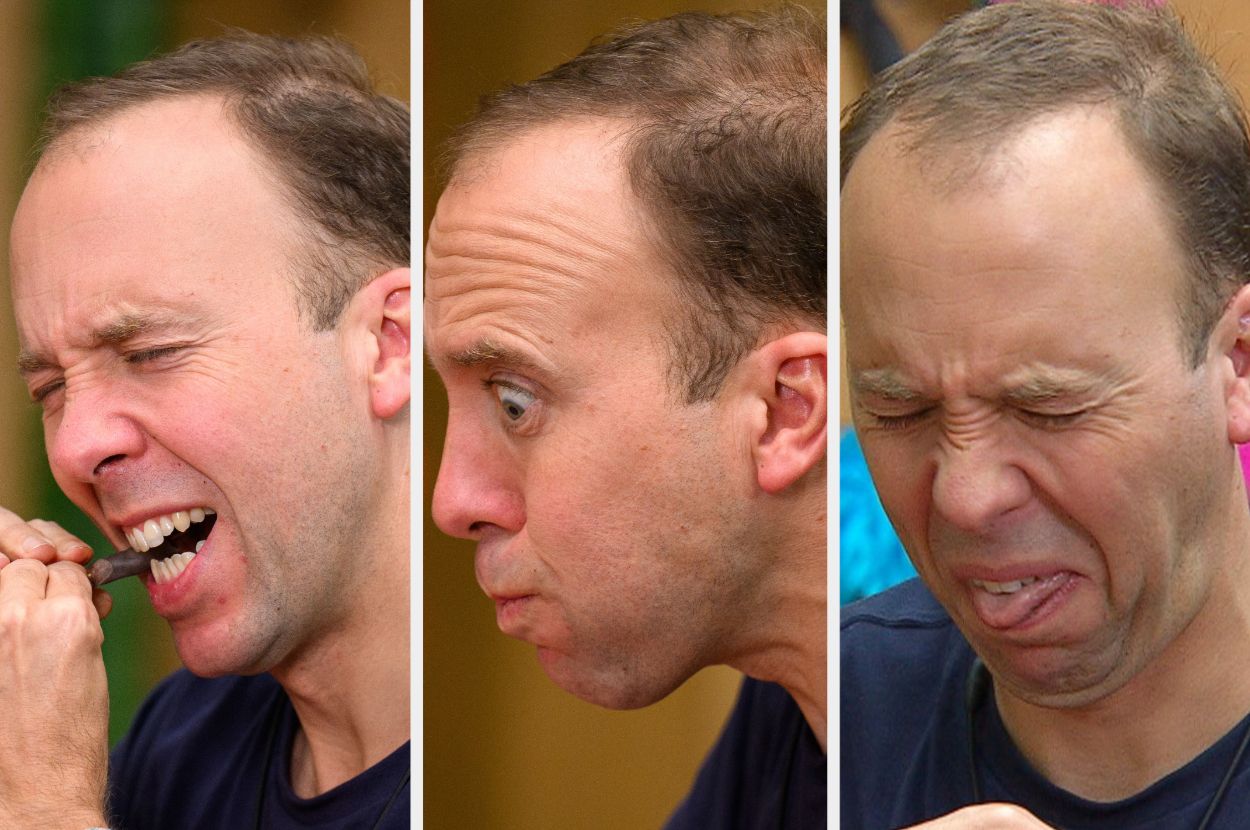
On Remembrance Day on Friday, Hancock munched on a camel’s penis, sheep’s vagina and cow’s anus.
Stone, who is soon to leave her role, said “there is no job description for MPs but we have to think very carefully about the conflict between public and private interests, bringing the House into disrepute and so on”.
But she said it was not something that would fall to her office to investigate, telling the Commons Standards Committee, “it doesn’t breach a rule per se, unless we are thinking about the conflict between personal and public interest, and settling that conflict in the interests of the public”.
Hancock has come in for widespread criticism for his decision to fly out to compete on the popular ITV show, which has seen him take part in several Bushtucker Trials already.
Reports that Russian missiles have crossed into Nato member Poland, killing two people, have prompted alarm over the possibility of the war in Ukraine escalating into a much wider conflict.
A violent act on a Nato member – which Ukraine is not, but neighbouring Poland is – could trigger Article 5 of the military alliance’s charter. This “one-for-all and all-for-one” principle of collective defence means an attack on one is seen as an attack on all, and all members are expected to respond to assist their ally.
Advertisement
What makes this especially worrying is triggering the article would increase tensions between the US and Russia, the world’s two biggest nuclear powers.
But, with details of the incident yet to be confirmed, the prospects of a World War Three-like scenario very much depends on whether it was a deliberate act or an error.
What is Nato and Article 5?
The military alliance goes by the acronym of Nato.
The North Atlantic Treaty Organisation was formed in 1949 to prevent a resurgence of nationalism and militarism in Europe after two world wars, and to deter the Soviet Union’s expansion.
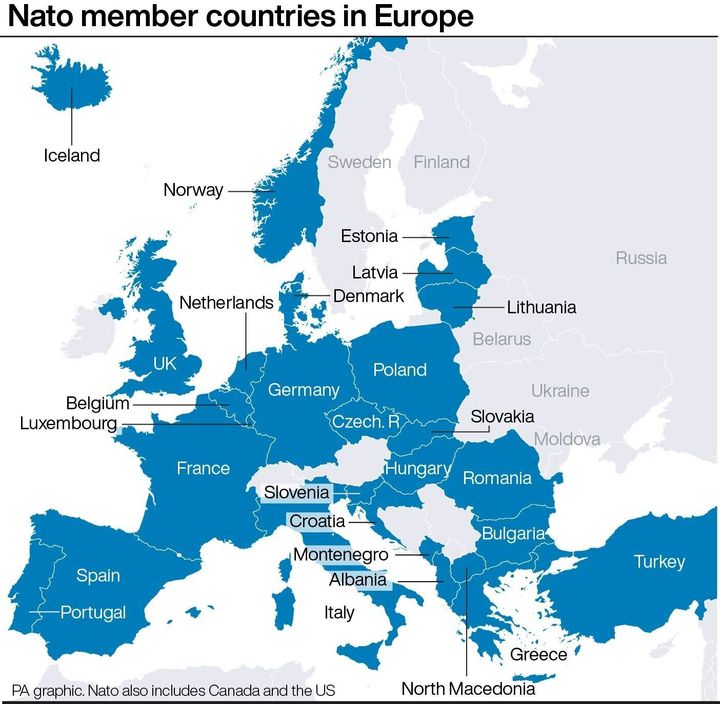
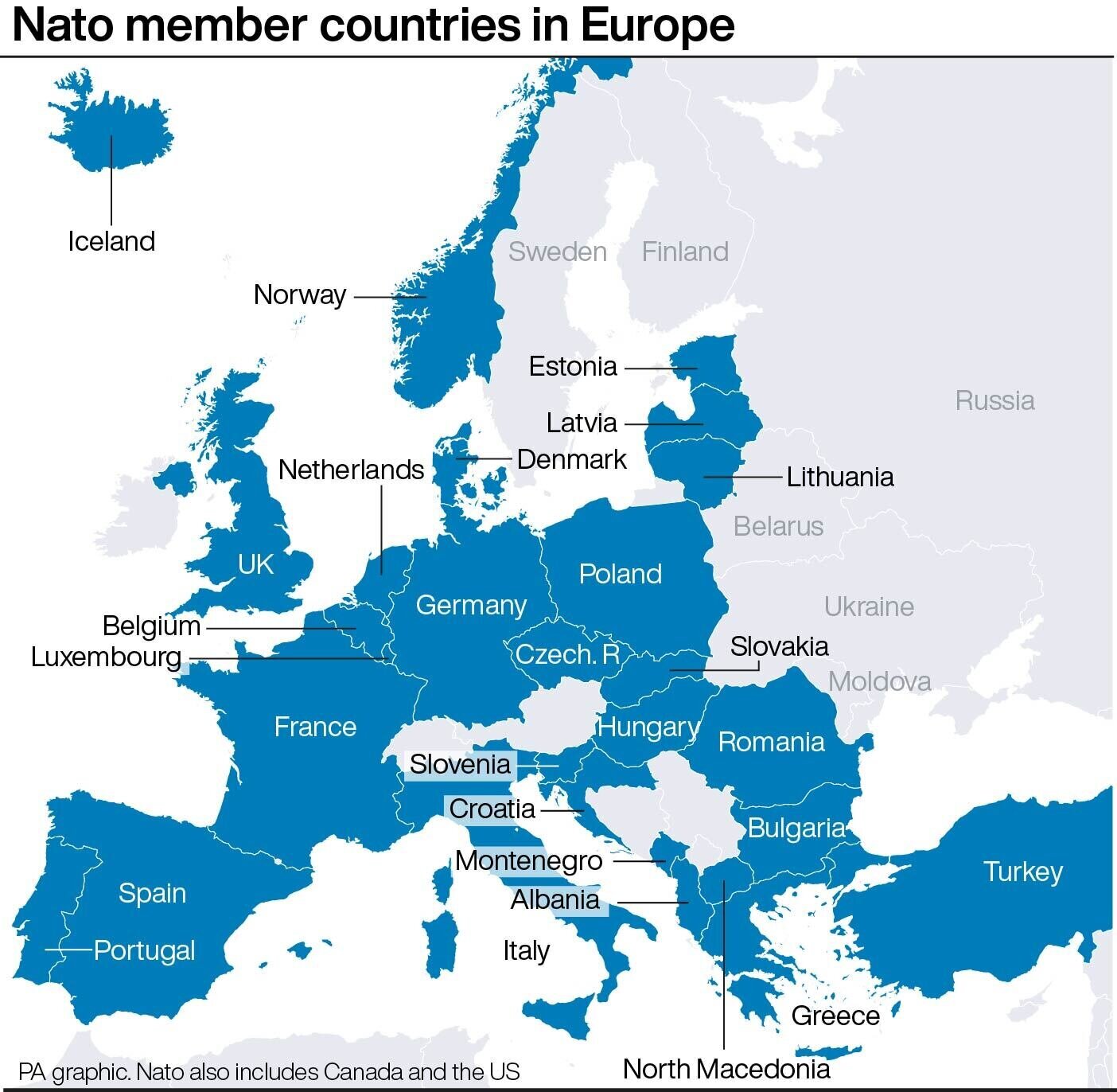
Its membership has swelled to 30 member nations, and over the 1990s and 2000s its enlargement stretched further east to include the former Soviet republics of Estonia, Latvia and Lithuania. Poland joined in 1999.
Advertisement
Since the start of the Ukraine war, Sweden and Finland, which shares a 1,300-km (810-mile) border with Russia, have sought membership, marking a radical break in the policy of both north east European countries given their staunch military neutrality.
Members agree to mutual defence – military action – in response to an enemy attack. The principle goes: “An attack against one ally is considered as an attack against all allies.” This is Article 5 of the Nato constitution.
Nato member countries in Europe.
PA Graphics via PA Graphics/Press Association Images
Because Ukraine is not a member of Nato, Western support for Volodymyr Zelenskyy has fallen short of putting their troops on the ground. US president Joe Biden has made clear his concern about further escalating tensions with Russian president Vladimir Putin.
Ukraine’s admission to Nato has been a stated goal going back to its constitution in 2002. And while Zelenskyy has announced Ukraine is formally applying for fast-track membership, it seems unlikely Nato will accept his application while a war is raging.
Advertisement
Nato invoked Article 5 for the first and only time in its history after the 9/11 terrorist attacks against the US.
What has happened in Poland?
Since the war began eight months ago, there have been fears clashes with neighbouring countries such as Poland would up the ante dramatically.
On Tuesday, two people were killed in an explosion in Przewodow, a village in eastern Poland near the border with Ukraine. The Associated Press cited a senior US intelligence official as saying the blast was due to Russian missiles crossing into Poland.
The Polish Foreign Ministry late on Tuesday said that a Russian-made missile fell in eastern Poland and killed two people.
The ministry said foreign minister Zbigniew Rau summoned the Russian ambassador and “demanded immediate detailed explanations”.
Advertisement
Biden, in his call with Polish president Andrzej Duda, “offered full US support for and assistance with Poland’s investigation” and “reaffirmed the United States’ ironclad commitment to Nato”.
Biden also spoke to Nato secretary general Jens Stoltenberg, who was among those to hold a call with Duda.
The Russian defence ministry denied being behind “any strikes on targets near the Ukrainian-Polish border” and said in a statement that photos of purported damage “have nothing to do” with Russian weapons.
So will it mean all-out war?
Experts seem to think the gravity of the situation depends on whether it was a deliberate attack – either to escalate the war or to test the West’s response – or an accidental misfire. In any case, it is up to Poland to decide the next steps.
Poland could instead invoke Article 4 – consultation with fellow Nato members if they fear their territorial integrity has been breached. This would likely give Poland more clout within the alliance and encourage the West to offer more military support to both Poland and Ukraine – support that falls short of attacking Russia.
Advertisement
Too early to say if 🇷🇺 missiles/rockets hitting Polish territory were intentional or unintended.
But enough ground for Poland to invoke Article 4 – one ally consulting all others – followed by clear defensive actions such as augmenting 🇵🇱 air defence to re-draw @nato red line
Fabrice Pothier, former director of policy planning for Nato, told Sky News: “It’s too early to say if this was an intended attack, an intended strike on a Nato territory, or whether it was the misfiring of a missile or a rocket.
“However, even if that were the case, I think there is enough grounds for triggering what is just below Article 5, which is Article 4, which is Poland asking all Nato members to come to the Nato headquarters to consult each other to assess the threat and to take concrete action.
“This can be defensive, not going after Russia, but augmenting Poland’s air defence and obviously also augmenting Ukraine’s air defence, because Ukraine is the de facto first line of defence of the alliance.”
In October, British defence secretary Ben Wallace explained that the government is “deliberately ambiguous” about scenarios under Article 5 being triggered.
Advertisement
He said: “Article 5 is very clear, an attack on one is an attack on all, that is solid and in concrete and will be stood by.
“Article 5 doesn’t necessarily mean all-out war, people sometimes think it means the whole thing, but nevertheless there would be a response to an attack on Nato.”