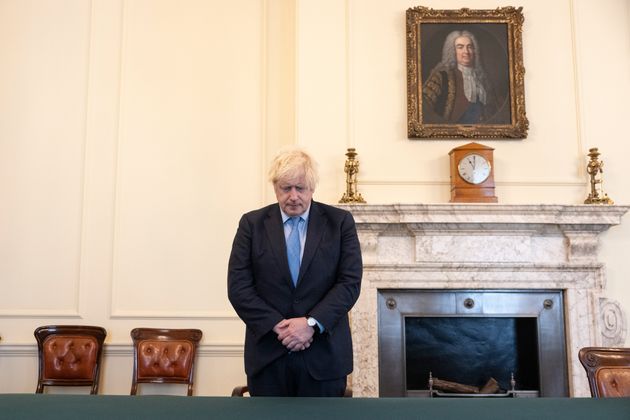
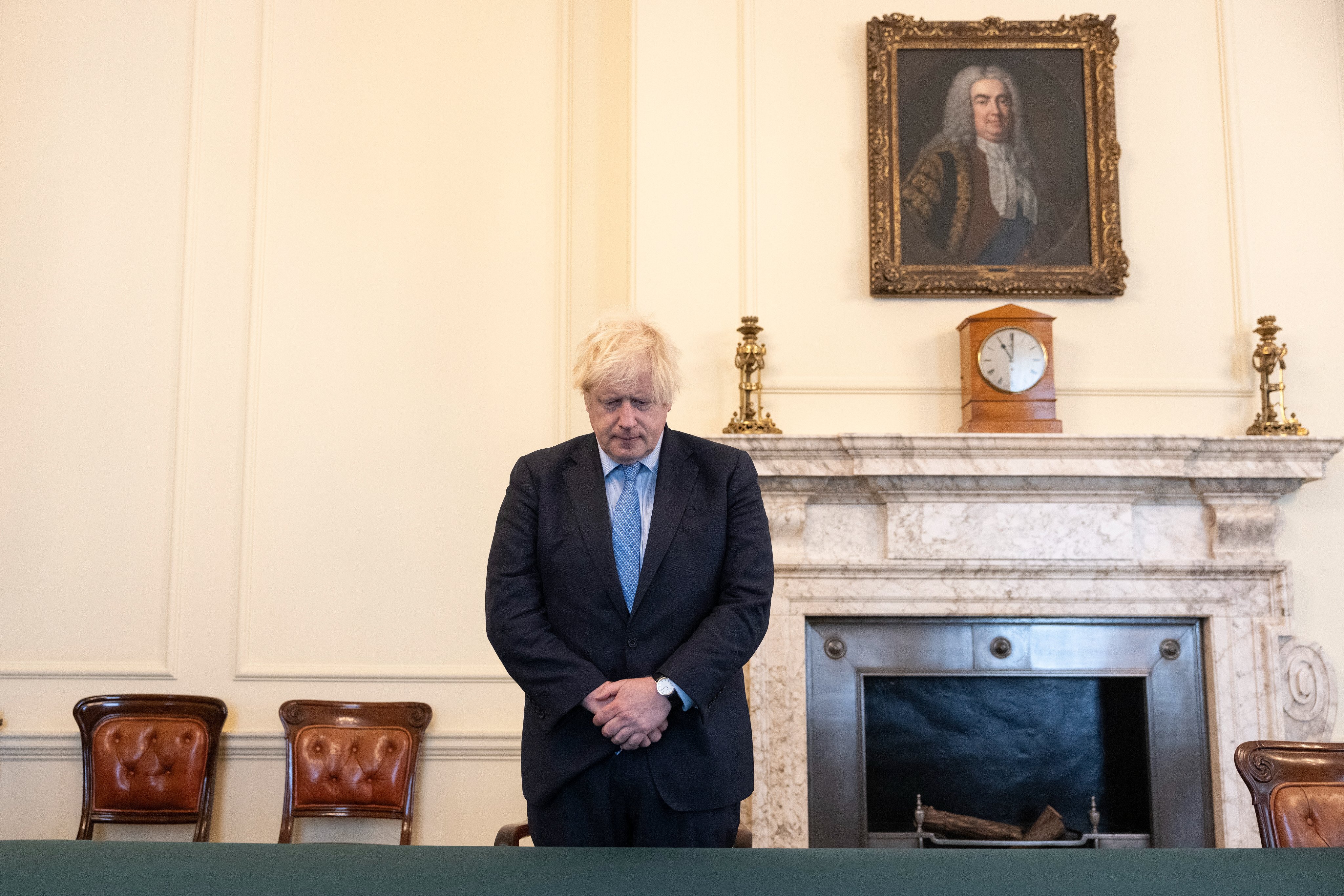
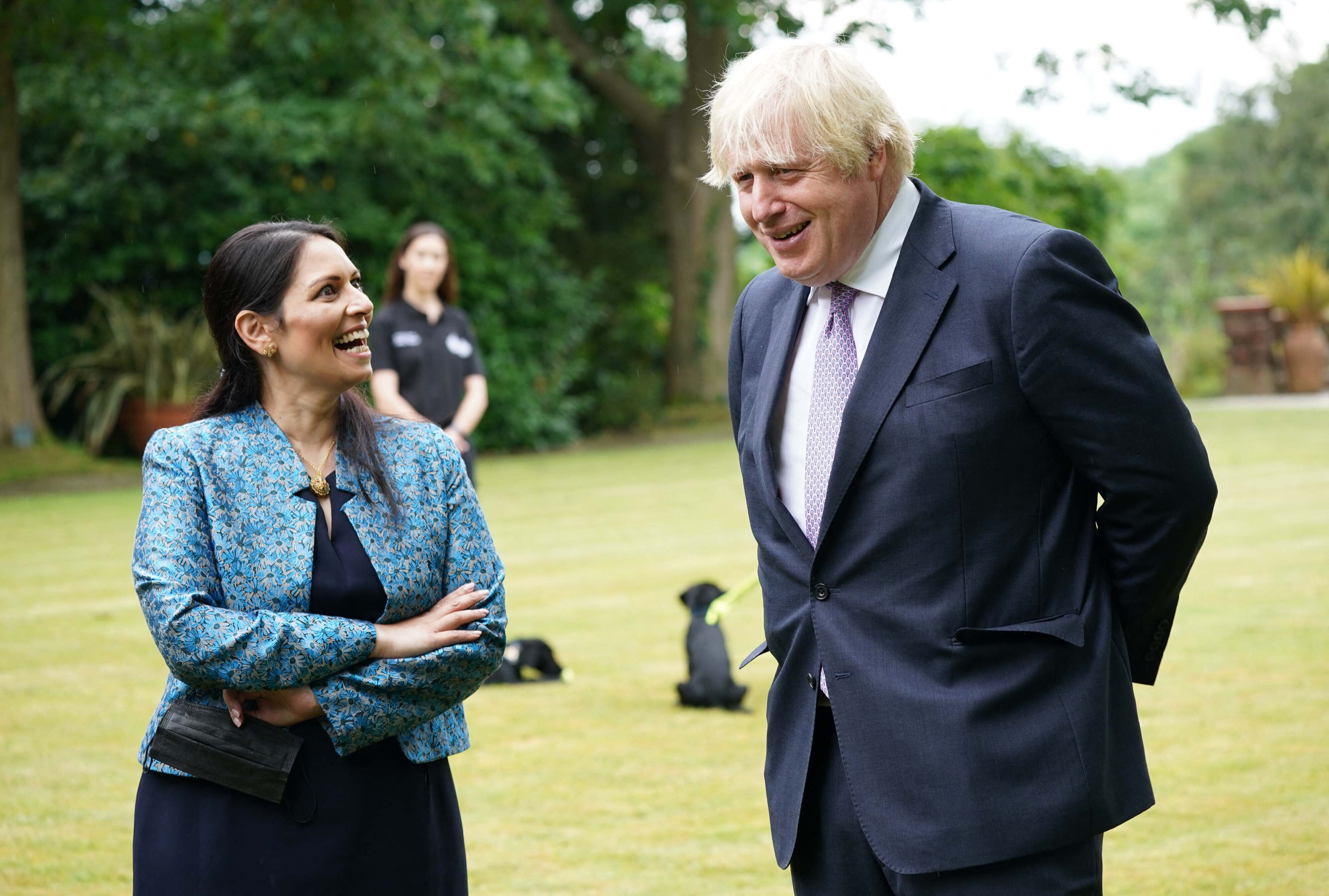
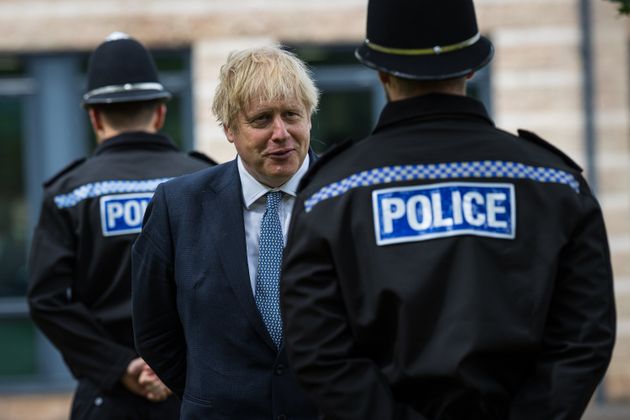
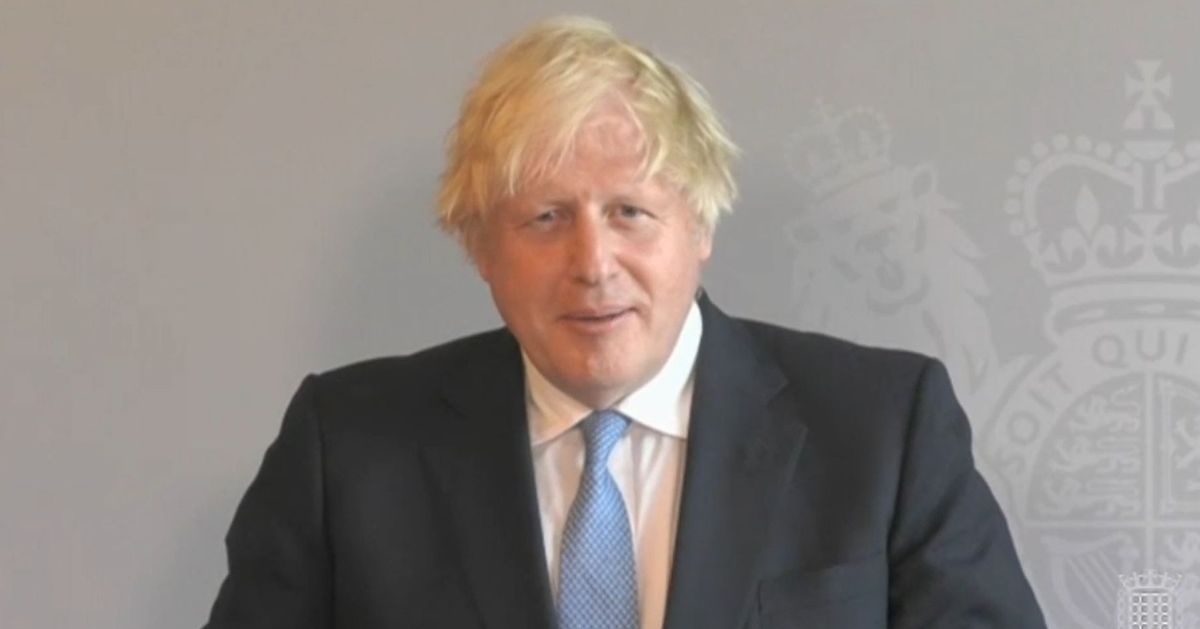
Twitter @10DowningStreetBoris Johnson marking the 11am silence for victims of the Plymouth shooting.
Twitter users were unimpressed when the prime minister posted a photograph of himself marking Monday’s 11am silence when his watch clearly said it was 11.14am – but just how accurate were these criticisms?
Boris Johnson released the images as a tribute to the five victims of last week’s devastating Plymouth shooting on Monday.
One Twitter user commented: “They cared enough to turn back the clock on the mantelpiece but forgot his wrist watch.”
Another account criticised the claim that the prime minister was honouring the 11am silence, and compared the two different times on the mantlepiece clock and on Johnson’s watch. They asked in their caption: “You sure about that?”
— TenchiResistsAgain🇪🇺🏴 #FBPE #REJOIN (@ResistingTenchi) August 16, 2021
Others questioned why it took so long for the photograph to be uploaded to social media as it appeared online at 12.37pm.
One account noted: “Took one hour and 36 minutes to write this tweet and upload this photo? Or maybe, given the different times on the clock and watch, it was a belated, hastily assembled piece of gesture politics?”
Another account dubbed the photograph as “embarrassing”.
Journalist Chris Stokel-Walker also weighed in on the debate, and tweeted: “Absolutely incredible scenes as Boris Johnson’s watch gives away that this wasn’t actually taken at 11am, despite the clock in the background.”
However, he later tweeted in defence of the photograph after reportedly hearing more about the photograph’s origins.
He deleted his original tweet, and added: “For transparency: deleting the screenshotted tweet below before it gets picked up by conspiracists after being told the EXIF data shows the watch is wrong, the clock is right.”
The EXIF data means the Exchangeable Image File Format and refers to the accurate data about the image’s origins stored in the camera when a photograph is taken.
For transparency: deleting the screenshotted tweet below before it gets picked up by conspiracists after being told the EXIF data shows the watch is wrong, the clock is right https://t.co/kQ8moFGLMMpic.twitter.com/4szkoGdKoc
A Downing Street official also claimed that it was actually the watch which was running 14 minutes fast, and that the image was taken at 11am.
Johnson also acknowledged the horrendous incident last week, tweeting: “My thoughts are with the friends and family of those who lost their lives and with all those affected by the tragic incident in Plymouth last night. I thank the emergency services for their response.”
The prime minister was not the only one to honour the horrifying shooting in Plymouth, which was the worst seen in the UK for a decade.
Approximately 200 people gathered outside Plymouth city centre at 11am on Monday to mourn the lives lost.
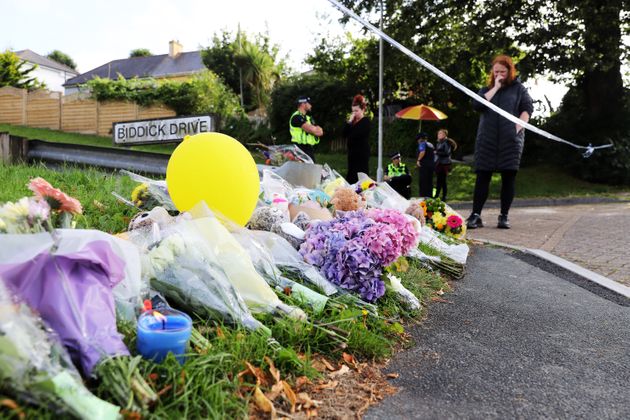
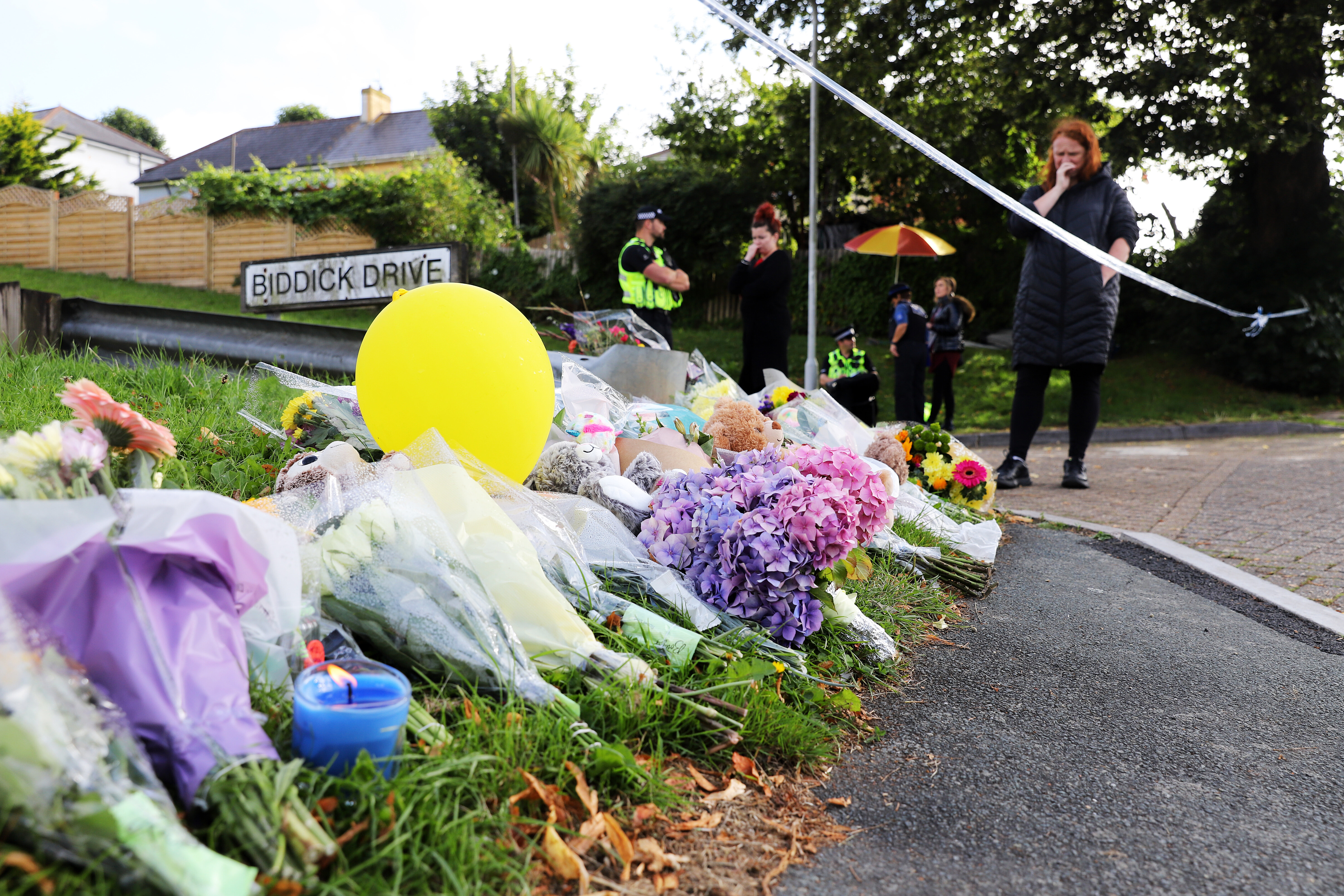
William Dax via Getty ImagesMembers of the public place flowers at the entrance of Biddick Drive, where Davison began his killing spree last week
Jake Davison, a 22-year-old, shot his mother Maxine Davison, 51, dead in Biddick Drive, before shooting 3-year-old Sophie Martyn, and her father 43-year-old Lee Martyn on the street.
Davison went on to kill Stephen Washington, 59, and 66-year-old Kate Shepherd.
The government has confirmed that it is preparing statutory guidance to help promote high standards of decision-making within gun licensing applications.
The Home Office wants future gun applications to cover the social media of individuals too.
Davison’s YouTube channel and Facebook account showed he referred to himself as the “terminator” and held misogynistic views.
All police forces in England and Wales have been advised to review their current processes and assess existing licences.
Ministers have tightened up the law to raise standards for Covid tests sold privately in England – but have exempted Chinese-made tests which have cost the taxpayer billions, HuffPost UK can reveal.
New regulations from the department of health and social care (DHSC) aim to stamp out “poor quality tests” that could give the public a false sense of security and allow people to spread the virus unwittingly.
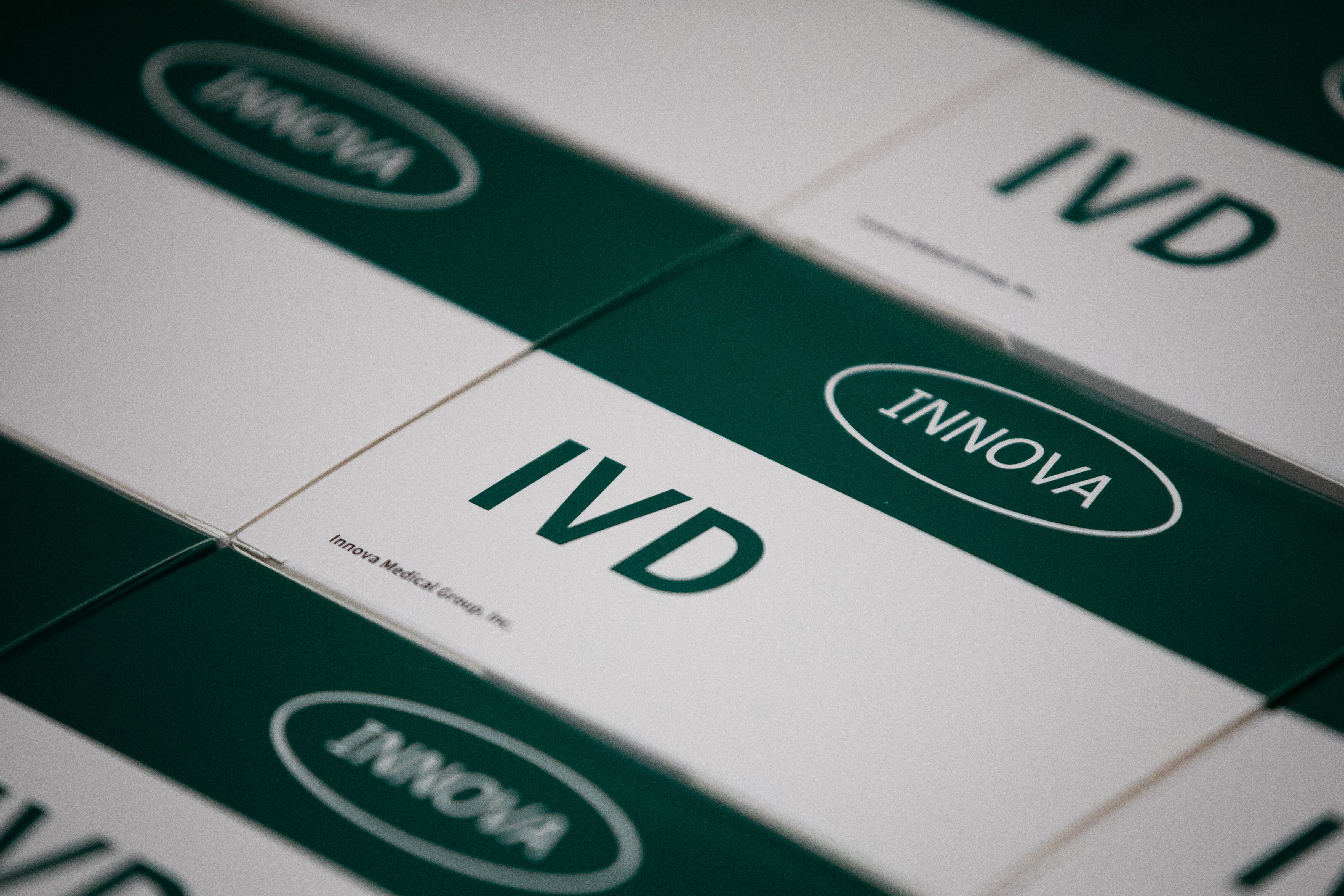
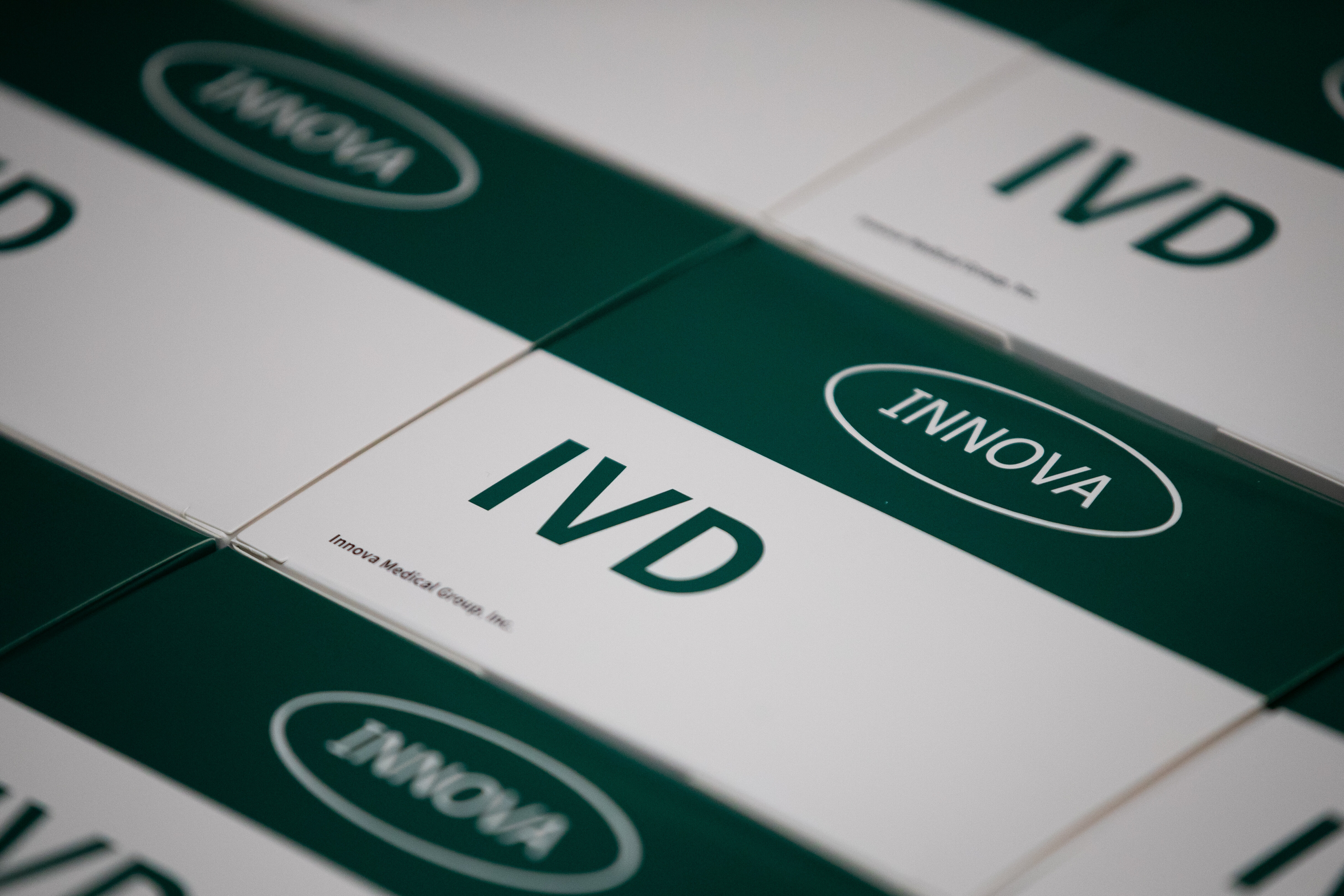
But the higher performance standards, quietly introduced this week, include a loophole that explicitly excludes lateral flow tests previously bought by the government such as those bought from Innova Medical Group at a cost of more than £3bn.
British manufacturers privately welcome the new regime as they believe their home-grown tests are cheaper and more reliable than the Innova tests.
But many in the UK bio industry question why ministers are exempting the Chinese-made devices from the same high standards.
The rules, which will kick in from September 1, have also prompted fresh suspicions that the government is moving away from giving the public and businesses free rapid tests and will instead expect them to pay for the devices commercially.
Firms will have to pay the government £14,000 for any application and any tests not deemed up to the grade will be removed from sale by law.
Retailers, distributors and manufacturers of tests that attempt to sell unvalidated tests would face sanction.
Currently, PCR or lateral flow tests can go on commercial sale in England as long as they carry a CE mark, which means they meet EU and UK requirements, but each manufacturer designs their own data collection and analysis methods to validate them.
Under the new proposals, the government will require that “all COVID-19 tests placed on the UK market undergo a mandatory validation process”, with the same standards applied equally to allow consumers to make a fair comparison.
A new DHSC document states: “It would undermine current public health goals if people used poor quality tests that give them a false sense of security.
“In the case of a false negative, this could see an infected individual unknowingly spread the virus. Conversely false positives could require business to close and people to isolate unnecessarily.”
But an explanatory memorandum to the new legislation states that “tests supplied by government will be exempt” from the new validation process.
The memo adds that contracts agreed by the government to supply NHS hospitals “can continue to be honoured by the manufacturer even if the test has failed validation”.
This has prompted anger among UK bioscience insiders, who believe that the Innova tests would compare badly with British-made rivals and who complain that ministers have done everything to favour the Chinese-manufactured products since last year.
Innova, which is based in California and funded by a private capital group by a Chinese-born businessman, uses tests produced by Chinese Biotime Biotechnology, in Xiamen city, Fujian province.
Publicly available contracts on the government’s website shows that £3.3bn has been spent to date on the company, as part of the £37bn allocated to the controversial Test and Trace service.
Innova’s 30-minute tests have been used for regular weekly testing of NHS and care home staff and in schools. Since April, any member of the public has also been able to order twice-a-week tests for free.
Yet concerns about cost and reliability have been raised repeatedly by critics, underscored when the US Food and Drug Administration (FDA) issued an alert about the test in June.
The FDA told Americans to “destroy the tests by placing them in the trash”, saying it had “significant concerns that the performance of the test has not been adequately established, presenting a risk to health”.
The UK’s Medicines and Healthcare products Regulatory Agency (MHRA) – which critics claim is an arm of the DHSC and not fully independent – then did its own risk assessment and found no similar action was needed here.
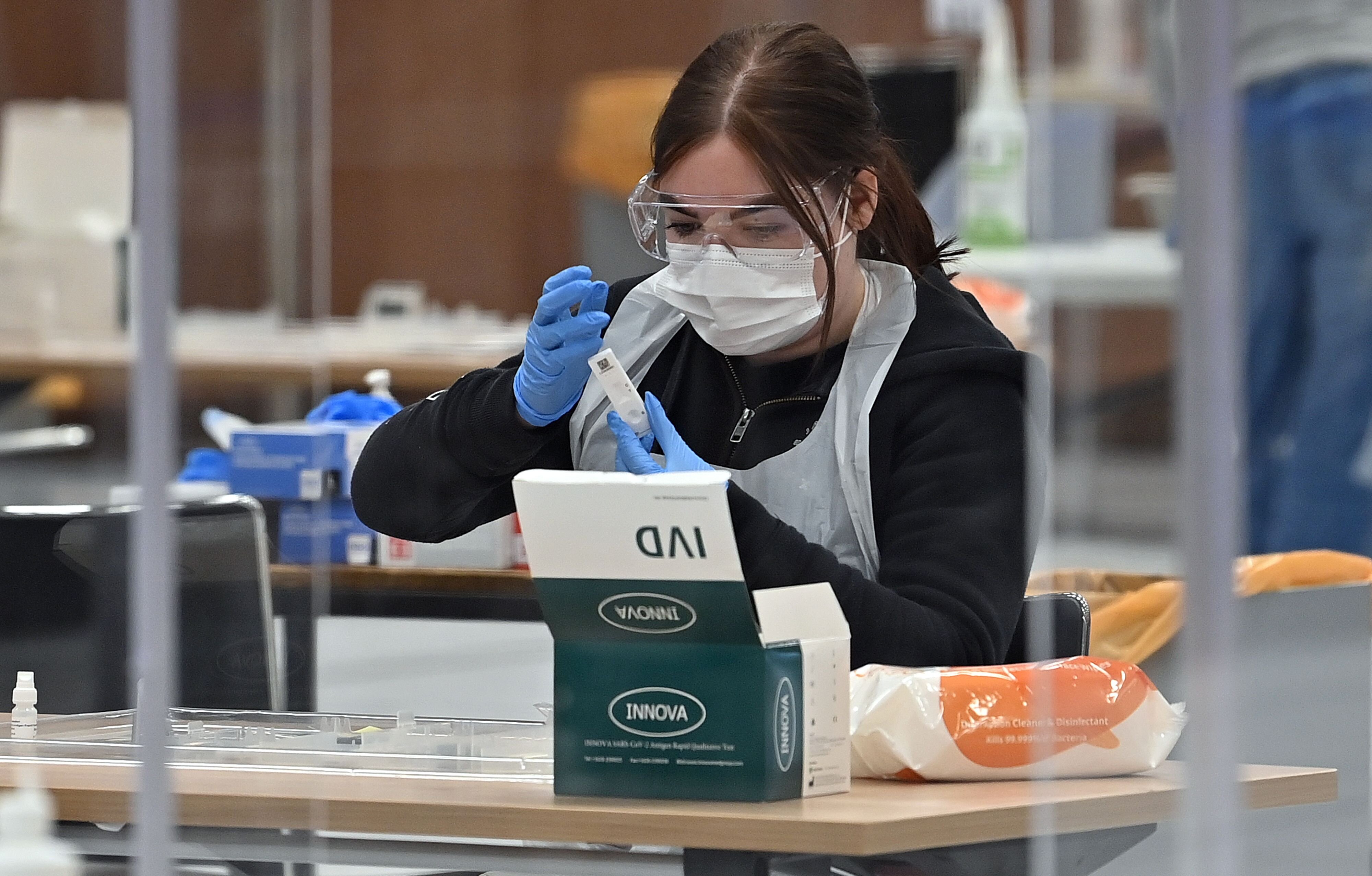
Aaron Chown – PA Images via Getty ImagesInnova Covid-19 testing kit
Critics further point out that Innova’s own manufacturer’s instructions make clear the tests were designed for use only in symptomatic Covid cases, but the UK government allowed them to be used in asymptomatic cases as part of its “Operation Moonshot” plan to mass test the population.
Authorisation for the Innova test to be used by asymptomatic people at home was due to expire on June 22 but has been extended until August 28, but the new regulations have sparked hope that they can gradually be replaced by British alternatives.
But controversy dogs the Innova tests and the way the UK government has effectively taken ownership of its products. Innova branding has been dropped from the boxes used to deliver tests, replacing it with NHS branding. Eyebrows were further raised when the DHSC decided to tweak the way in which the Innova test could be used.
Although the manufacturer’s “instructions for use” insist on the invasive and uncomfortable practice of taking a swab from the back of the throat, the government has quietly changed the rules to allow it to take swabs from the nose only.
Similarly, the original instructions for use made clear the tests were never intended for home use and were designed to be administered by a clinical professional.
The exemption for Innova from the new validation rules is seen by some British manufacturers as a way of avoiding the potential huge embarrassment of seeing their tests fail to match the standards of others, not least given large sums spent on them to date.
The legislation mandates a “desktop review” be undertaken of all Covid tests placed on the UK market and defines a set of minimum standards that these tests should meet.
One industry insider said the guidance document states that tests should achieve a minimum sensitivity rating of 95%, whereas the Innova test sensitivity rating achieved at Public Health England’s Porton Down lab was 57.5%.
One industry source said: “This means that the tests already selected won’t need to go through this exercise. It’s a disgrace. One rule for them…”
Another bioscience source said: “The UK industry was not totally confident with the way tests were evaluated for the NHS in the first place.”
Yet another said: “By appointing themselves ‘judge and jury’ of the Innova test, the DHSC has allowed itself to make fundamental changes to the Innova test’s characteristics, implementing them without any follow up Porton Down assessment.
“[These are] changes that would inevitably have had a significant detrimental impact on the test’s already underwhelming performance. Notably, to date, the government have not seen fit to publicly assess the impact of these wholesale changes.”
Shadow health minister Justin Madders told HuffPost UK: ”Given the concerns in the USA over the Innova tests and the fact they are only on a temporary approval here it does seem extraordinary that this legislation could allow Sajid Javid to let them carry on being used without being subject to the same approval processes as everyone else. Far more transparency is needed.
“This also seems to suggest that the government intends to move away from having Covid tests being provided free of charge. This has massive implications for public health and could seriously undermine efforts to reduce transmission of the virus. The government needs to come clean on whether they intend to introduce a charging regime for Covid test.”
The DHSC and the department for education raised suspicions that the distribution of free lateral flow tests could cease at the end of September, when a “review” will take place of their twice-weekly use in schools and to the wider public.
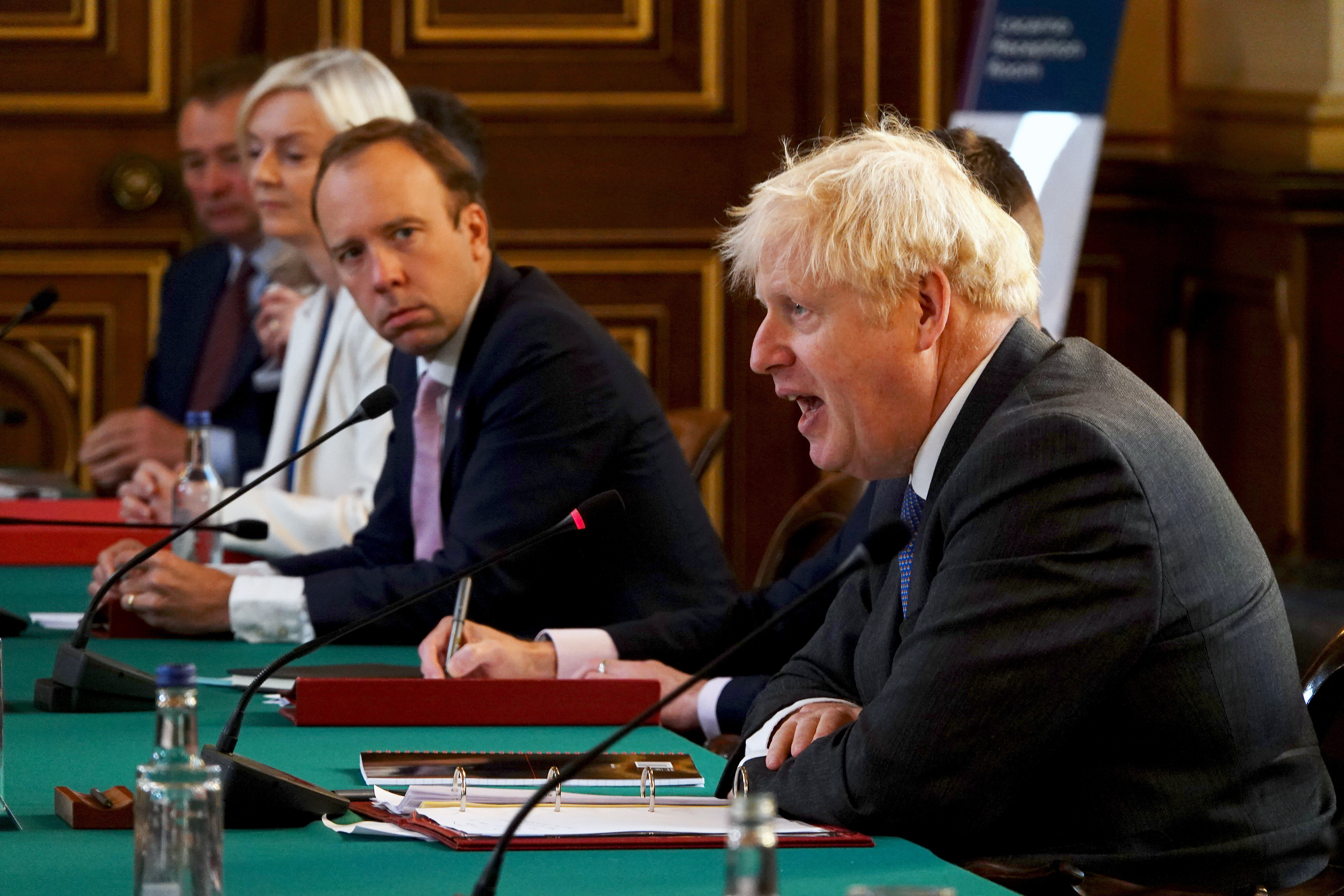
WPA Pool via Getty ImagesFormer health secretary Matt Hancock and Boris Johnson pushed ‘moonshot’ mass testing
Allyson Pollock, professor in public health at the University of Newcastle, said the bigger issue was that there was little evidence that testing of asymptomatic people – at home or in the workplace – was effective at all.
“This is about creating a market in tests which have questionable performance but above all, it’s still unknown despite the billions spent whether tests as part of a screening intervention actually help to prevent transmission,” she said.
“This isn’t a public health strategy, this is a commercial strategy. They want the public to get hooked on tests and employers to believe that testing is the way out. This is increasingly ridiculous given that the prevalence is low and falling now that immunity is being established.
“Secondary attack rates are low in the immunised population and infection likely to be mild and risks of transmission commensurately lower. Mass testing with lateral flow tests is an enormous waste of resources and it’s the antithesis of good public health.”
One key criticism of lateral flow tests is that their negative readings are being used as a “green light” to allow people to go about their daily lives, when in fact they were only ever designed as a “red light” test – when a positive reading tells people when they may have Covid and to get a gold-standard PCR test to check.
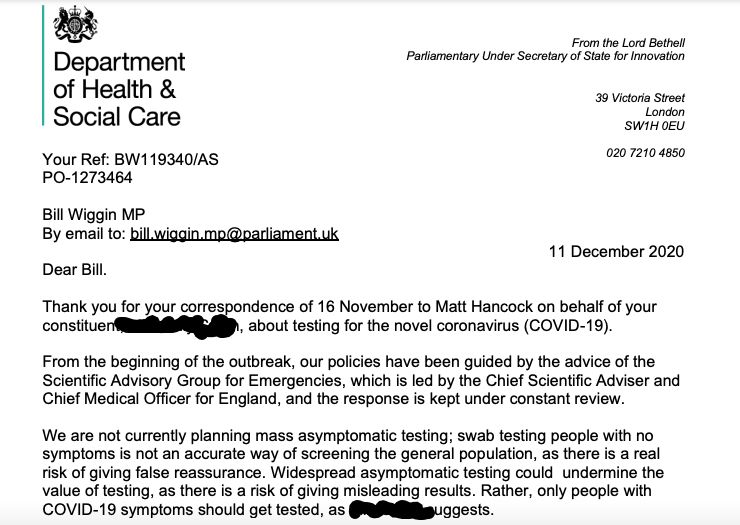
HuffPost UK has seen a letter from health minister Lord Bethell, sent last December to Tory backbencher Bill Wiggin, in which he makes clear the real risks to public health from asymptomatic mass screening.
In the letter, Bethell said: “We are not currently planning mass asymptomatic testing; swab testing people with no symptoms is not an accurate way of screening the general population, as there is a real risk of giving false reassurance.
“Widespread asymptomatic testing could undermine the value of testing, as there is a risk of giving misleading results. Rather, only people with COVID-19 symptoms should get tested.”
HuffPost UKLord Bethell letter on asymptomatic testing risks
Alba MP Neale Hanvey, who has raised the issue of Innova’s big government contracts and the failure to use rival tests made by Scottish-based firms such as Omega Diagnostics, said the letter was telling.
“This letter supports everything that I have said to [former health secretary] Matt Hancock and to other members of the department of health, that this is a grand folly. It’s giving people false reassurance and a huge cost to the public purse for no perceivable benefit.”
Hanvey added that the new mandatory guidance for commercial tests was “a fig-leaf for the government’s misdeeds”.
“What the government needs to do now is to cease supporting tests that we know are not designed for their current use, not picking up enough infectious cases and move swiftly to open the doors for the domestic market, to get access not just to private purchase, but to NHS supplied tests. Where is the global Britain and all of this mess?”
Boris Johnson has repeatedly declared that he wants home-grown rapid tests to be developed, but the UK bioscience industry has been increasingly frustrated that their tests were not approved by Porton Down labs despite other independent validation.
The UK government raised hopes earlier this year when it loaned manufacturing equipment to British companies and earmarked £1.15bn for a programme that would see rapid production. But virtually none of the money has been spent because British tests have not been approved.
One firm, Mologic, was so frustrated with the lack of validation of its tests that it threatened to sue the government. It has since been bought by the Bill & Melinda Gates Foundation and turned into a not-for-profit to help develop rapid tests to combat tropical diseases such as dengue, bilharzia, and river blindness, as well as Covid.
One UK bio industry source said: “They completely screwed the UK diagnostic industry. They invested in LFD [lateral flow device] machinery and are refusing to allow the factories to use them. Our firms are having to export world leading tests, two are in the top ten globally, while we import inferior ones.”
One bio industry source said: “I’m really unhappy that the government was signaling particularly to the UK manufacturers that we will provide you with a lot of support, and we’d like you to help us be self-sufficient in lateral flow tests by spring 2020.
“The companies all took them at their word. Then the government basically says well we didn’t actually promise we’d buy anything from you. That is a little two faced.”
A diagnostics expert said that the new commercial validation process was at least a signal that there would be a shift to getting the public to buy their own tests and that the cheaper price and better performance of British tests would mean that from the autumn “everyone will get a market share”.
“The lateral flow tests being provided to the population free of charge at the moment, at some point, people will either have to start buying themselves or employers will have to start buying them for their employees and there will be only be a certain amount that are provided free of charge.”
Dan Kitwood via Getty ImagesHealth secretary Sajid Javid now has sweeping powers over commercial tests
Industry insiders believe that firms like Mologic and Omega will submit their tests under the new system and expect to get approval. “This is all in readiness for when DHSC stop giving away free tests for a lot of use cases and reopens the private market,” one said.
Some insiders believe that the Innova test was adopted by the government early in the pandemic simply because it could be provided in mass numbers and that even though its performance is “not perfect” it was “good enough for what it does”.
Defenders of the Innova test believe it can be effective at detecting high viral loads quickly, claiming there is evidence to back this up.
The DHSC has in recent months pivoted to using another Chinese-made test produced by OrientGene, which some in Whitehall believe produces more reliable results than Innova.
Doris-Ann Williams, chief executive of the British In-Vitro Diagnostics Association (BIVDA) said one problem with the new mandatory system was that it would add needless regulation when existing systems could have been updated.
“While we appreciate the government is acting with the best of intentions by introducing this legislation, we still feel a better solution would have been to amend the existing regulation so that the MHRA, who are a world leading regulator for medicines and medical devices, could have ensured the right products are available to the British population.
“However, industry is committed to working under the legislation and alongside UKAS [UK Accreditation Service] to ensure COVID antigen tests are reliable and safe.”
The government insists that its own tests should be exempt from the new mandatory testing standards in an effort to avoid duplication of previous validations.
“This is because the market validation is based on the validation DHSC has been doing for public procurement of tests as such these two validation process are judged to be equal,” according to the explanatory memorandum accompanying the new regulations.
“As such DHSC will place tests onto to the market without undergoing the regulatory validation process conducted by DHSC to control access to the UK market.”
A spokesperson for the DHSC said: “Private testing continues to play an important role in managing COVID-19 by supplementing and supporting NHS Test & Trace as we learn to live with this virus.
““As we ease restrictions, including for travel, the role of private testing is increasing and our regulations are ensuring consumers can be confident tests they buy give accurate results and are of sufficient quality.”
They added that private testing will continue to play a role as part of the overarching strategy for managing COVID-19.
The department believes that it is important to introduce a regulatory regime to ensure those tests available on the market are validated for performance, regardless of whether the government is also providing free tests.
A spokesperson for Innova Medical Group said: “Our tests have proven by independent studies to be very effective in detecting individuals who are considered infectious regardless of symptoms.”
They said that the latest UK test had shown it “detects nearly 100% of infected asymptomatic individuals who are considered infectious to others, and there was very little difference in the specificity between self-testing (99.1%) and testing performed or observed by a professional (99.8%)”.
“We understand FDA’s health risk concern for the US market as they have not evaluated or authorised the Innova test in the US.
“In simple terms, the regulator won’t confirm a product is safe to use until it has evaluated and authorized a product itself. None of the FDA inspectional observations concern the performance of the test.”
The company said that its test had been widely used, studied, tested, scrutinised and analysed. Its point of care test had been approved in Germany, France, Netherlands, Finland, Sweden, UK, Austria, Estonia, Finland, Israel, Malaysia, and Sultanate of Oman. Its self-test kit had been approved in Austria and the UK.
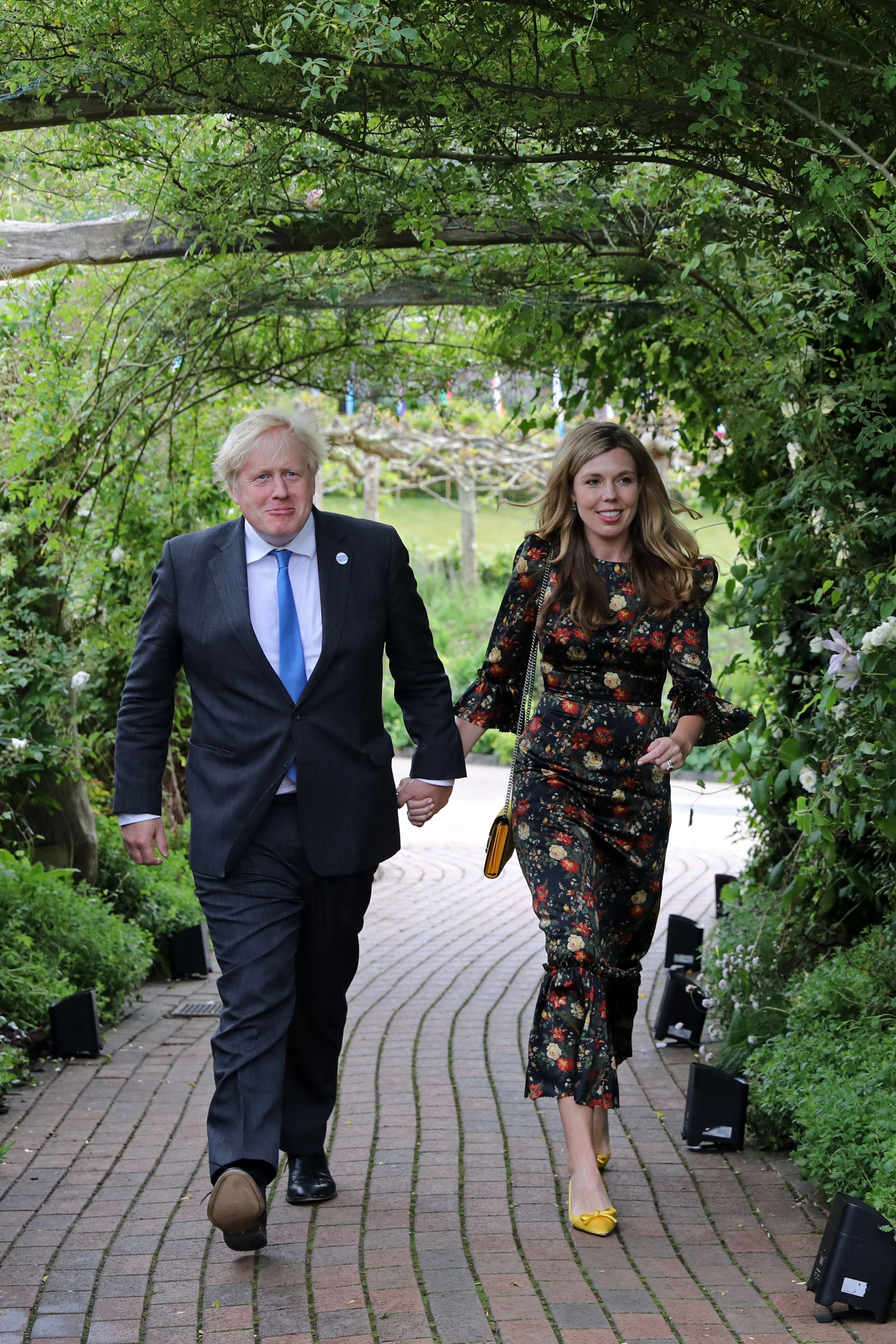
The prime minister and his wife are expecting a second child after Carrie Johnson revealed the heartbreak of a miscarriage at the start of the year.
In a statement on social media, Ms Johnson said the brother or sister to their first child Wilfred was due to arrive “this Christmas”.
The 33-year-old environmental campaigner added: “At the beginning of the year, I had a miscarriage which left me heartbroken.
“I feel incredibly blessed to be pregnant again but I’ve also felt like a bag of nerves.”
JACK HILL via Getty ImagesPrime Minister Boris Johnson and Carrie Johnson
The couple made the announcement only two months after they tied the knot during a low-key wedding at Westminster Cathedral.
Ms Johnson, a former Conservative Party communications director, said she wanted to share the personal news about her miscarriage to “help others”.
She added: “Fertility issues can be really hard for many people, particularly when on platforms like Instagram it can look like everything is only ever going well.
“I found it a real comfort to hear from people who had also experienced loss so I hope that in some very small way sharing this might help others too.”
Labour leader Sir Keir Starmer put politics aside to send congratulations to the couple and said he was “very sorry” to hear about the earlier miscarriage.
“I’m sure that Carrie speaking out will be of comfort to others and make them feel less alone,” the Opposition leader added.
Downing Street said the Prime Minister had been due to work this weekend from his official country residence Chequers in Buckinghamshire, although it is not known if the couple are there together.
Handout via Getty ImagesThe pair married earlier this year
The new arrival is set to be Mr Johnson’s seventh child at least, having had four children with second wife Marina Wheeler, who he divorced last year following their separation in September 2018.
In 2013 it emerged during another court hearing that Mr Johnson fathered a daughter during an adulterous liaison while Mayor of London in 2009.
The 57-year-old’s son Wilfred Lawrie Nicholas Johnson – named partly after a doctor who helped save the Tory leader’s life when he contracted coronavirus in spring 2020 – was born in April of the same year.
Mr Johnson has looked to brush off questions about whether he has any more children.
The former journalist met his first wife, Allegra Mostyn-Owen, while they were students at Oxford. They married in 1987 but the marriage was annulled in 1993.
In 2004, he was sacked from the Tory frontbench over a reported affair with journalist Petronella Wyatt.
The divorce from lawyer Ms Wheeler, who he married in 1993, and subsequent marriage to his now third wife is understood to make Mr Johnson the first prime minister to get divorced and marry in office in modern times.
Mr Johnson and his then girlfriend also made history as the first unmarried couple to officially live together in Downing Street when they moved into the flat in Number 11 in 2019.
Formerly known by her maiden name of Symonds, the PR expert first found herself making headlines when she was romantically linked to Mr Johnson in early 2019.
But her association with Mr Johnson dates back to when she worked on his successful re-election bid at City Hall in 2012.
After her husband’s arrival in Downing Street, she was involved in a power struggle with the former de facto chief of staff in No 10, Dominic Cummings, which led to his ousting in the autumn.
Mr Cummings has accused Ms Symonds of looking to interfere in the running of the Government and recommending to her husband who to hire and fire, allegations that Downing Street deny.
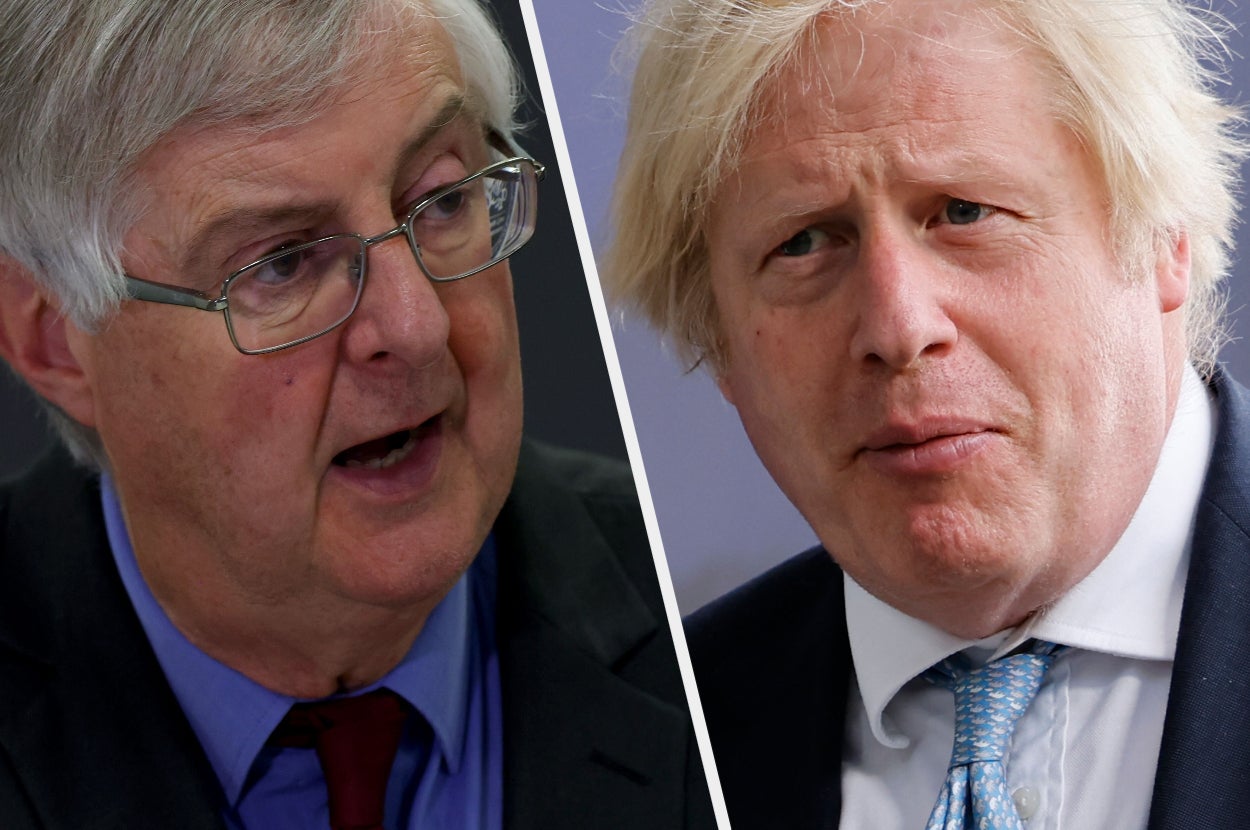
Huw Fairclough/Getty Images / TOLGA AKMEN/POOL/AFP via Getty ImagesWales first minister Mark Drakeford and prime minister Boris Johnson
Boris Johnson is under fresh pressure to fast-track plans to exempt fully vaccinated adults from Covid quarantine after the Welsh government announced it would introduce the move from August 7.
Double-jabbed adults in Wales will no longer have to self isolate after coming into contact with someone with the virus, with the change kicking in a full nine days earlier than England’s August 16 deadline.
The prime minister has this week insisted that his own date for the major shift in policy is “nailed on” and Downing Street confirmed on Thursday that he was “pretty emphatic” about his timetable.
But Tory MPs and businesses crippled by staff shortages are sure to demand a similar acceleration in England after fresh figures showed the “pingdemic” has hit record numbers.
Welsh first minister Mark Drakeford announced that NHS Wales’ Test Trace Protect (TTP) service will use the Welsh Immunisation Service to identify fully-vaccinated adults who will no longer be required to self-isolate.
He added that children in Wales will also be exempted from the need to home quarantine from August 7 – the day that the country is expected to finally come out of most Covid restrictions, known as “level zero”.
Drakeford stressed that everyone who tests positive for coronavirus or has symptoms must continue to isolate for 10 days, whether they have been vaccinated or not.
“We know a full course of the vaccine offers people protection against the virus and they are far less likely to contract it when they are identified as close contacts. This means they no longer need to self-isolate for 10 days,” he said.
“We can remove the need for self-isolation for the two million adults who have completed their vaccine course, helping to keep Wales safe and working.”
Wales is keen to ease pressure on vital services caused by the recent rapid rise in Covid cases, driven by the delta variant over the last two months.
Cases have risen by 800% since the end of May, when they were at very low levels. Over the last week case rates have started to fall in all parts of Wales.
The acceleration of the exemption date is also in part because 80% of adults in Wales have been fully vaccinated – the best rates in the UK and some of the best in the world. In England, the double-jabbed figure is 71%.
Some 689,313 alerts were sent to users of the NHS Covid-19 app in England and Wales, telling them they had been in close contact with someone who had tested positive for coronavirus.
The latest NHS figures, for the week to July 21, were an 11% rise on the previous record high of 619,733 alerts a week earlier.
From 7 August, instead of instructing fully-vaccinated adults to isolate, contact tracers and advisers in Wales will provide them with advice and guidance about how to protect themselves and stay safe.
The TTP service will provide a “warn and inform” service for all fully-vaccinated adults and under-18s, who are identified as close contacts.
Some extra safeguards will be put in place for those working with vulnerable people, particularly health and social care staff, including a risk assessment for staff working in health and care and daily lateral flow tests.
Members of the public will be strongly advised not to visit hospitals and care homes for 10 days.
Everyone identified as a contact of a positive case will continue to be advised – but not required – to have a PCR test on day two and day eight, whether they are fully vaccinated or not.
The new policy will affect adults where 14 days have passed since their last dose of the vaccine.
Separately, on Thursday the Welsh government announced that young adults aged from 17 years and 9 months were now being invited to book a jab or attend walk-in vaccination clinics for their first dose.
Again, this is ahead of England and appears to be due to the country’s higher vaccination rate.
Boris Johnson has come under fire from a leading businessman over plans to humiliate offenders by making them work in “fluorescent-jacketed chain gangs”.
The prime minister unveiled plans to put more people doing community service into hi-viz jackets as they cleared rubbish and graffiti.
At the launch of his new crime crackdown plan, Johnson said that he wanted a more visible way of showing offenders working in the streets.
“If you are guilty of antisocial behaviour and you are sentenced to unpaid work, as many people are, I don’t see any reason why you shouldn’t be out there in one of those fluorescent-jacketed chain gangs visibly paying your debt to society,” he said.
“So you are going to be seeing more of that.”
But James Timpson, who runs the Timpson’s shoe repair and key cutting chain that is one of the largest employers of ex-offenders in the country, hit out at the PM’s plan on Twitter.
“Instead of making offenders wear high viz jackets in chain gangs, how about helping them get a real job instead?” he wrote.
“In my shops we employ lots of ex offenders and they wear a shirt and tie. Same people, different approach, a much better outcome.”
Instead of making offenders wear high viz jackets in chain gangs, how about helping them get a real job instead? In my shops we employ lots of ex offenders and they wear a shirt and tie. Same people, different approach, a much better outcome.
Timpson’s brother Edward is a Tory MP and the firm has frequently been cited by the government for its social enterprise work.
Campaigners and some Labour MPs also criticised the plan, which Johnson first floated when he ran for Mayor of London in 2008 but didn’t implement.
Civil rights group Liberty said the proposal would not make communities safer but was designed “to create more stigma and division” and was “a short-term stunt that will cause long-term generational harm”.
Talk of chain gangs shows this plan has nothing to do with making communities safer.
The Home Office itself had not used the phrase “chain gangs” in its announcement.
It preferred instead to say it would be “making unpaid work more visible by getting offenders to clean up streets, alleys, estates, and open spaces, and ensuring justice is seen to be done”
Johnson’s “Beating Crime” plan, which also included proposals to expand controversial Stop and Search powers, follows Labour’s own campaigns to highlight rising levels of anti-social behaviour across the UK.
During the launch, the PM appeared to admit that the problem was getting worse, but partly blamed Covid lockdowns.
Speaking at Surrey Police HQ, he said: “I do think that the lockdown has driven some anti-social behaviour and we need to deal with it. That’s why we are backing the police in the way that we are.”
Draconian stop and search powers are to be made permanent under Boris Johnson’s latest crime crackdown.
So-called “Section 60” powers, which allow police to search in an area without having reasonable grounds for suspicion against an individual, will be made easier as part of the “Beating Crime” plan unveiled on Tuesday.
The powers have long been controversial because they have had a disproportionate impact on black communities, but the prime minister has decided to ramp up their use to combat knife crime.
The usual pre-conditions for such searches have been temporarily watered down in recent years and now Johnson wants to make permanent police forces’ ability to deploy them with fewer checks.
The major shift, which finally buries Theresa May’s policy as home secretary to cut the number of stop and searches, is part of a wider package of policies aimed at making the Tories look tougher on crime.
Other plans include:
expanding the use of 24-hour electronic tags for all burglars and thieves who leave prison
trialling “alcohol tags”, which detect alcohol in the sweat of offenders guilty of drink-fuelled crime
getting more offenders to clean up streets and open spaces
every neighbourhood having contactable, named police officers
league tables for 101 and 999 call answering times to be introduced for each police force
When Johnson was Mayor of London, his use of stop and search was curtailed by May as she drove through reforms aimed at boosting community relations with the police.
Backers of the tougher powers say they are a useful deterrent in response to incidents involving knives in a defined area and stress that safeguards are built into the system to ensure they are not based on race or ethnicity.
But critics argue that “no suspicion” stop and search powers are abused by police officers, with black people nine times more likely to be searched overall than white people.
Campaigners also point out there is little evidence to suggest that “draconian” stop and search provides an effective deterrent to offending, and most searches result in officers finding nothing.
Only around 20% of searches in 2019/20 resulted in a criminal justice outcome – an arrest and an out of court solution – linked to the purpose of the search.
Most stop and searches are used under ‘Section One’ powers, which require officers to have “reasonable grounds” to conduct the search.
Around 5% of searches are ‘Section 60’, often where police had no grounds for suspicion but used them in a blanket fashion in a particular area for a limited time.
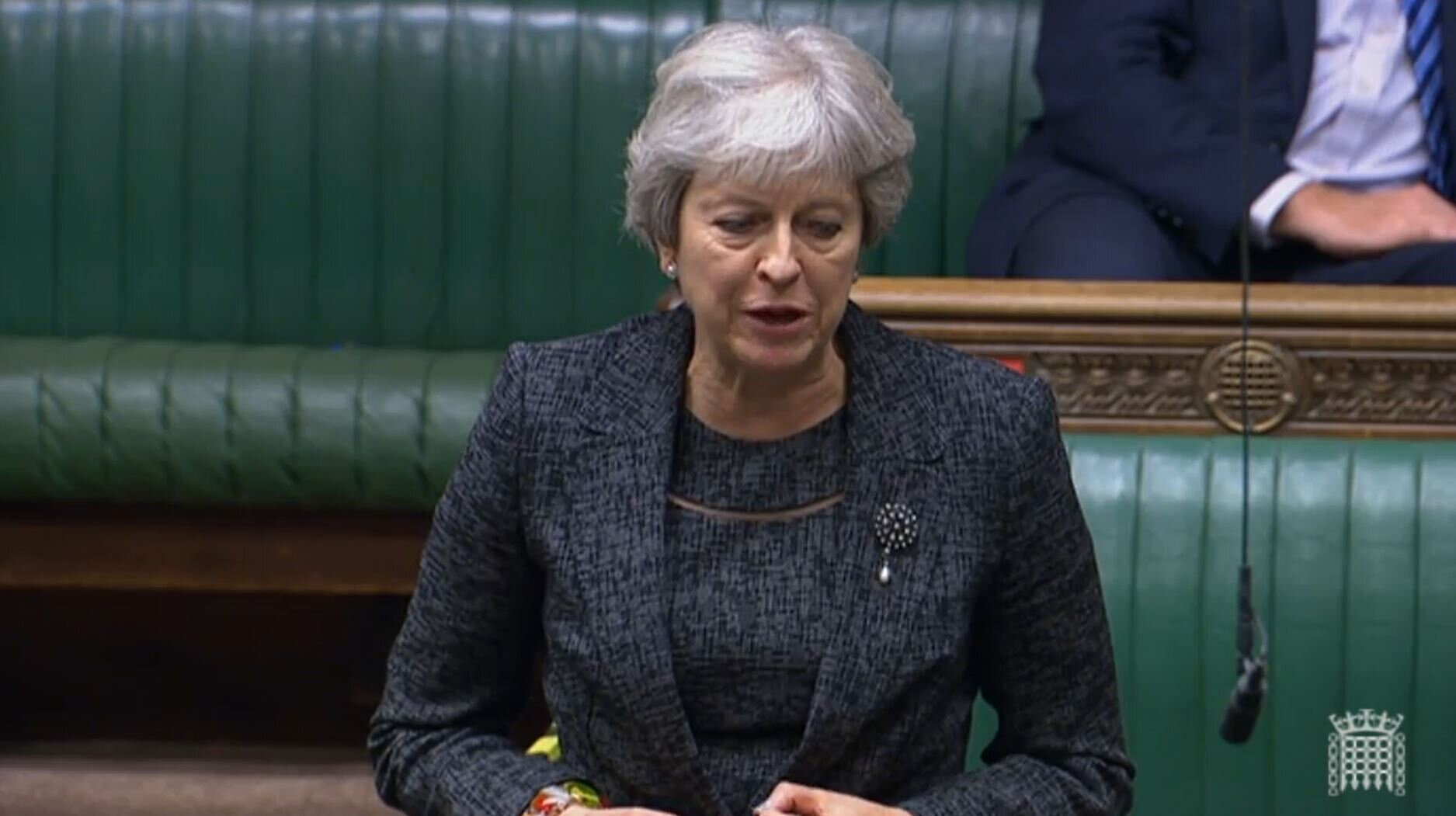
House of Commons – PA Images via Getty ImagesTheresa May reduced stop and searches as home secretary
In recent months, police forces in Wales and in London have used such “Section 60” powers to search an entire area after a particular violent incident or disturbance.
In London there were 11,412 searches under Section 60 by the Metropolitan Police in the year ending March 2020, government data shows.
A total of 530 people arrested following these searches, which is an arrest rate of 4.6%. This is compared to an arrest rate of 12.3% for other forms of stop and search.
Shadow home secretary Nick Thomas-Symonds told HuffPost UK: “The government must be transparent about any potential for disproportionality with these measures.
“It’s vital with any new powers comes proper oversight, especially as building community trust is so vital to tackling crime.
“They must also get on with implementing recommendations from the Lammy review and also look to learn from innovative work being done to improve trust in policing.”
Johnson said: “When I first stood on the steps of Downing Street as prime minister I promised to back the police and make people safer, because we cannot level up the country when crime hits the poorest hardest and draws the most vulnerable into violence.
“That is why my government has remained unstinting in its efforts to protect the British public and this plan delivers a fresh commitment, as we emerge from the impacts of the pandemic, to have less crime, fewer victims and a safer society.”
The Home Office said that it was important to remember that data showed that young black men are disproportionately more likely to be the victims of knife crime.
A spokesperson said: “Stop and search is a vital tool for tackling violence and saving lives.
“The Beating Crime Plan shows we are taking a twin-track approach which combines tough enforcement to get knives off our streets together with early intervention programmes that steer young people onto better paths for the future.
“An assessment of the pilot relaxing conditions on the use of section 60 stop and search showed it gave police officers greater confidence to make use of the power, better reflected the realities and uncertainties officers face on the ground around predicting serious violence, and acted as a deterrent.
“The government is giving the police these powers but ultimately it is an operational decision to use them and we expect officers to use their discretion.”
The pilot scheme assessment – which has yet to be published – covered both qualitative interviews with police officers and community scrutiny leads, and a bespoke data collection from forces including outcomes, authorisation rationale and geographical data.
Analysis of the geography of authorisations in London found “some correlation” between areas with high levels of hospital admissions for assault with a sharp object and section 60 authorisations.
Officers felt there was a deterrent effect of the use of section 60 as they communicate the authorisation to would-be offenders.
Among safeguards to prevent disproportionate impact on minority groups are statutory codes of practice, the use of body worn video and College of Policing guidance ensuring accountability and guidance on fair use.
It’s been a few weeks since Boris Johnson jibed Keir Starmer with his alliterative soundbite of choice: “we vaccinate, they vacillate!” And given the past week of wibbly-wobbly, hokey-cokey pronouncements from him and his government, it’s perhaps fitting that the PM has laid off that particular attack line.
In a dizzying few days of dithering, Johnson exempted himself from isolation rules then isolated himself, his ministers contradicted him on the need to obey Covid ‘pings’ and key policy on critical workers changed by the hour.
The National Insurance rise to pay for social care was on and then off. The NHS pay rise was off and then on. Compulsory Covid passports were revived from the dead, just weeks after being quietly euthanised by Michael Gove.
At times, the PM looked like Gromit desperately trying to lay new track in front of his train of state as it sped towards the parliamentary recess. But although getting over the line of the summer break may stop backbenchers from gathering in grumbly groups in the Commons tea room, ministers know there are gruelling weeks ahead.
At the heart of the problem lies a fundamental confusion in Johnson’s pandemic strategy. He (backed by Chris Whitty and Patrick Vallance, to be fair) has decided England will become the first country in the world to open up a country from lockdown precisely at the point when cases are soaring.
But instead of honestly admitting that his objective is a form of herd immunity – ie “hybrid immunity” stemming from infections and vaccinations – the PM is telling the public to be cautious and “slowly” take full advantage of all the freedoms he has now granted.
There’s an easy answer to the “if not now, when?” question about full unlocking: mid-September, when all of the adult population has been offered a second jab. The PM counters that keeping restrictions in place until then would simply delay the covid wave, not suppress it. And a wave in summer is easier for the NHS to cope with than a wave in winter, he adds.
Yet on that logic, being cautious and not “tearing the pants out of it” simply delays the wave too. Isolating after “ping” from the App delays the wave. Wearing masks delays the wave. Meeting outdoors delays the wave. But the PM says he doesn’t want to delay it. It’s hard to think of a more confused and chaotic public health policy, especially during a pandemic.
It would be more honest if Johnson admitted he wants the maximum number of infections this summer, just short of tipping the NHS into a serious crisis. And helpful if the department of health told us just what level of infections it thinks the NHS can cope with before lurching into that meltdown.
The other objective for opening up fully is to help ease the pain of businesses and all those who work in them. But if you’re then effectively telling the public not to use those businesses, because they should be “careful”, what is the point? That’s why, whenever Johnson was asked to define what tearing the pants out of it meant, he struggled with specifics.
It’s possible that the real, unstated reason for Freedom Day was not just “hybrid immunity”, but because ministers can see that young people simply aren’t going to be double jabbed in big numbers by mid-September anyway. Take-up rates are worryingly lower than older age groups, so if government waits for the magic 80% double-jabbed figure, it could be waiting indefinitely.
I suspect that’s what really lies behind Johnson’s drive for compulsory Covid passports. They will drive up jab rates, while giving attendees of nightclubs, football matches, music gigs (and cinema and theatre goers, and maybe indoor pub goers?) the security that they will be mixing with similarly protected people. Compulsion will also drive demand for booster jabs over the winter.
The big issue however over coming weeks will be just when restrictions are reintroduced. Johnson has already tried to soften up opinion this week by saying he merely “hoped” his roadmap would be “irreversible”.
Would it make sense to have a roadmap back into lockdown, just as he had one out of lockdown? I used to think so, as it would allow individuals and businesses to plan their next steps.
But the problem may fundamentally be that the virus doesn’t respond to graduated steps. If you really want to flatten (not delay) a sombrero of cases, a hard and fast lockdown may be the only answer. Just reimposing masks and working from home may not cut it.
Yet given how confused and contradictory the current policy is, it wouldn’t be surprising if the policy that replaces it is similarly incoherent. Learning to “live with Covid” is obviously where we need to end up, but that requires maximum vaccinations for genuine herd immunity. It also requires more honesty from government about what its real strategy is.
The latest data on Friday suggests the third wave may, just, be peaking. But I’ve genuinely no idea if that’s what No.10 wants, or if it wants to ride the wave for a few more weeks.
Deputy chief medical officer Jonathan Van-Tam this week repeated his advice to avoid places with the ‘3 Cs’ overlapping: closed settings, with crowds and close contacts. Unfortunately, the real ‘3 Cs’ that have defined Johnson’s policy are chaos, confusion and contradiction.
Connoisseurs of parliamentary proceedings will know that while ministers use an opening statement to set out broad policy, the devilish detail is often held back until their answer to their opposition shadow. And for anyone interested in the scale of the government’s planned ‘Covid passports’, today was a perfect example.
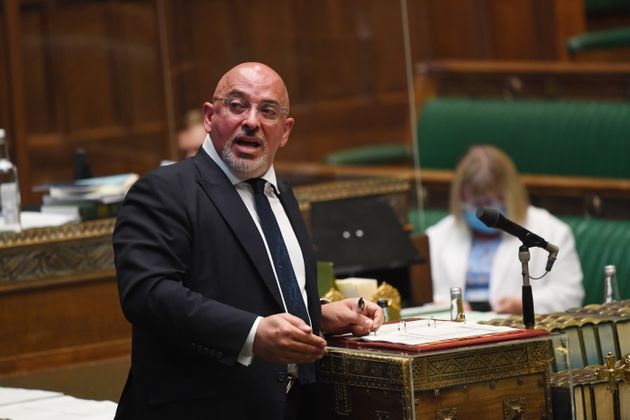
In answer to Labour’s Jonathan Ashworth, vaccinations minister Nadhim Zahawi gave a very strong hint that it was not just nightclubs that would require the NHS Covid pass as a condition of entry. He said indoor music venues, as well as “large unstructured outdoor events such as business events”, “music and spectator sport events” were “the ones that we are most concerned about”.
That will ring alarm bells among Labour’s party conference organisers I suspect (it’s due to have a full in-person conference in Brighton, whereas the Tories have pointedly planned a hybrid event and the LibDems a fully online one), as well the UK’s huge but struggling events business. Football matches, gigs, all sound like they’ll need a passport for entry.
And despite suspicions that the nightclub plan for late September was just a bluff to get young people jabbed, it looks like it really is going ahead. One of the few areas where business secretary Kwasi Kwarteng stuck to the script on Thursday was when he said that instead of a specific vote for nightclub passes, there might be “a general vote on the concept”. “I’m very confident we can pass the legislation we require,” he added.
With many Tories worried that a blanket Covid ‘ID card’ could be used for entry to pubs (and with Labour going for the populist line that it would be “unfair” on pubs and pubgoers), Kwarteng’s confidence will be subjected to a serious stress test when the Commons returns after its summer break.
But given Zahawi’s detailed hints, the PM’s own line on Monday – “some of life’s most important pleasures and opportunities are likely to be increasingly dependent on vaccination” – now feels like it’s not a threat but a promise. Zahawi also put Covid passports at the heart of the government’s strategy to be the first country in the world to “transition” from pandemic to endemic, “from pandemic to manageable menace”.
Vaccination does remain the best hope of getting there (new stats showed it had prevented 52,600 hospitalisations), yet there are real worries in Whitehall at the slowing uptake among under-30s. Some 34% of 18-29s have not had their first jab. And as NHS England warns hospitals they may be entering the “most difficult period” of the pandemic for more than a year, it also said high rates of admissions are ”closely linked” to low vaccine uptake.
Just as worrying, the surge in Covid cases has a direct impact on the vaccination programme because anyone infected has to wait 28 days until they can be given the jab. PHE said a total of 1154.7 infections per 100,000 people were recorded among those aged 20 to 29 – the highest figure recorded for any age cohort since the beginning of the pandemic.
In a bitter twist on the PM’s line this week that he’s “turning jabs, jabs, jabs into jobs, jobs, jobs”, the pingtastic third wave is forcing young people to not only delay vaccination but also forcing them to stay off work, with all the consequences for the economy that entails.
One subject that Zahawi didn’t want to touch in any detail on Thursday was NHS pay. He ignored both Ashworth and Jeremy Hunt when they asked just where the £2.2bn needed to fund the 3% rise was coming from. Downing St confirmed for the first time the cash would come from the DHSC budget but not from money “earmarked for the NHS front line”.
The cash will probably come from a mixture of the extra emergency Covid funding for this financial year for the NHS (although trusts are still waiting for the post-September half of that), plus the long term plan. But given the massive £37bn earmarked for Test and Trace over two years, I wonder if Sajid Javid will see that as a target?
Few people realise that Test and Trace actually reported a huge, 39% underspend of its 2020-21 budget of £22bn, mainly because the lockdown earlier this year meant “cancelled activity”. That’s a cool £4.3bn, more than double the pay rise bill.
The Treasury will probably just bank the underspend, but politically just imagine what a win-win it would be to hand cash from a failing service to pay the wages of the tired, heroic staff of the NHS?
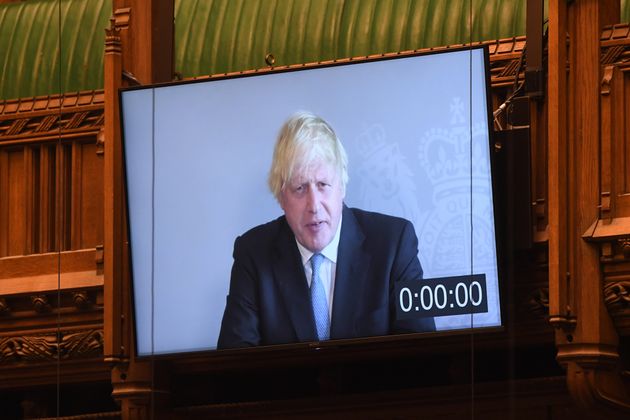
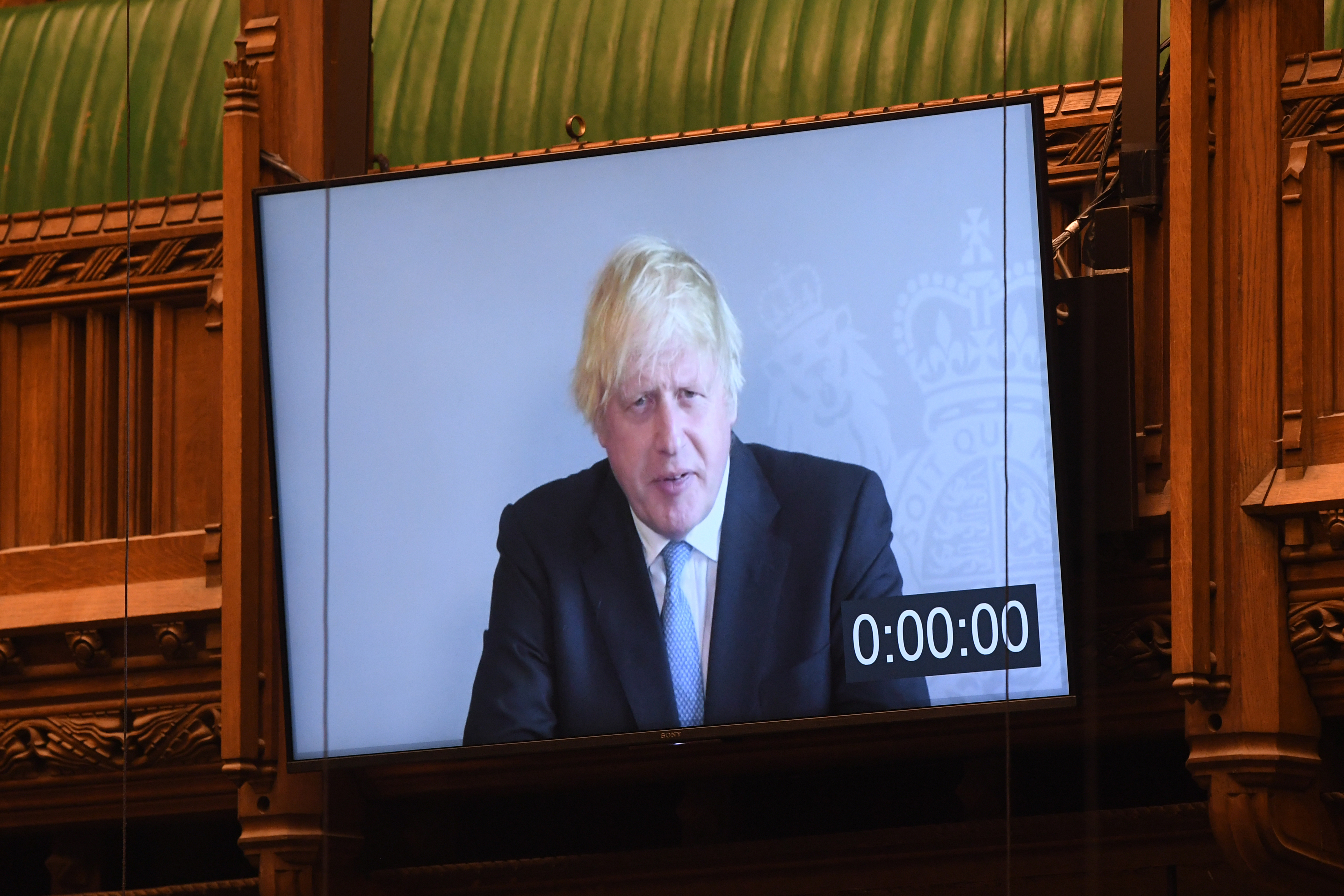
“Do you want me to have another go?” Boris Johnson’s plaintive plea in PMQs was directed at the Speaker, as a Zoom glitch cramped his usually combative style. David Cameron famously once said his Christianity was like “Magic FM in the Chilterns, it comes and goes”, and the PM’s volubility suffered similarly from his remote access to the Commons.
The erratic nature of Johnson’s contributions turned out to be uncannily apt as it matched yet another chaotic day for the government. Keir Starmer was relentless about ministerial mixed messaging on use of the NHS app. He also ridiculed No.10’s failure to define which “critical workers” (clearly the PM wasn’t one of them) would be exempt from being pinged into isolation.
Johnson tried to hit back by stressing that his own forced quarantine in Buckinghamshire just proved how important it was to comply with requests to stay at home, even if not everyone has use of a country home.
But while the PM was playing Chequers, Starmer was playing chess. His attack on Johnson’s WhatsApp messages (joking about leaving the over-80s to die from Covid) prompted the PM to let slip that “we were thinking in those ways” last year – damning admission that is sure to haunt him in any public inquiry.
Starmer also put the opportunist into Opposition, seizing on Tory backbench unease about Johnson’s U-turn over Covid “passports” by ridiculing his previous vow to eat any ID card he was forced to carry. Later, Labour announced it would not support compulsory use of double-jabbed certificates for entry to nightclubs, creating the prospect of a government defeat on any such legislation.
It was perhaps that realisation that prompted the PM to later tell the backbench 1922 Committee that basically his threat on nightclubs was all about jolting the young into getting vaccinated. If enough came forward, he wasn’t ruling out ditching the plan. Playing a game of chicken with the under-30s seems to be where his pandemic policy is right now.
What Johnson didn’t do was read the riot act to those MPs, like Commons leader Jacob Rees-Mogg, who opted not to wear face masks in PMQs. At one point I counted only a quarter of Tory MPs following the Speaker’s clear guidance, and at most just under half. With his backbenches restive over other Covid curbs, that suggested who is really calling the shots right now.
With more non-mask wearers on trains and buses this week despite government “encouragement”, the sight of senior MPs doing the same is yet another corrosive bit of message indiscipline. The bare-faced cheek of both is the public health equivalent of tailgating on the Tube, when fare dodgers ride the slipstream of those who do the right thing. The division and resentment it can breed can only get worse.
The Speaker is likely to be even more unhappy about the farcical way in which the 3% NHS pay rise was non-announced to parliament, before being announced finally in the form of a press release. Labour’s Rosena Allin-Khan, who is a part time A&E doctor, could hardly contain her anger as health minister Helen Whately said the pay rise was merely “considering” the rise.
Perhaps taking to heart the PM’s request to have “another go” at things, the department of health took just three hours to reveal the 3% was indeed happening after all. I understand the reason for the delay was not an admin error or anything to do with the fact that Sajid Javid and Rishi Sunak are themselves isolating. It feels like there was serious tension over where and when the funding might come from.
With non-NHS staff like police and teachers being told their pay was frozen (a tactic perhaps designed to make nurses think their deal was a king’s ransom in comparison), the overall impression was not one of end-of-term good news for key workers who were once clapped for their public service in the pandemic.
And it’s that U-turn, the U-turn in sentiment towards those who helped everyone else over the past year, and the suspicion that a pay rise has been dragged out of him for the NHS and is non-existent for others, that could cause the government serious trouble. The Tories are still ahead in the polls but there’s a sense that the ‘vaccine bounce’ may be coming to its natural end.
The upside of the vaccine programme is it touched nearly everyone. The downside of the ‘pingdemic’ is that it too appears to be touching nearly everyone. Calmer heads in government think the sense of disruption, confusion and chaos can’t last much longer. But as MPs head for the metaphorical beaches this summer, some Tories worry that the PM’s flip flops may linger in the public memory.
Boris Johnson’s plans to force nightclubs to make Covid ‘passports’ a condition of entry are hanging in the balance after Labour came out against the idea.
The PM’s proposal, which would from the end of September restrict entry to people who have been double-jabbed, has met with a backlash from club owners.
It is already opposed by a number of Tory MPs, who fear it would open the way for similar curbs on pubs, and Labour’s opposition now means that the government cannot be sure of getting it passed by parliament.
Even though the PM has a majority of more than 80, more than 40 Tory MPs have come out against the idea of compulsory ‘Covid passports’ at a time when most other restrictions have been lifted.
Keir Starmer prefers a rival plan to immediately mandate clubbers to get a negative Covid test before entry, believing it would offer better health protection at a time when the Delta variant of the virus is ripping through younger age groups.
Labour believes that proof double-jabbing is no guarantee that people don’t carry the virus, as the forced isolation of health secretary Sajid Javid underlined last weekend.
“We oppose the use of Covid vaccination status for everyday access to venues and services. It’s costly, open to fraud and is impractical,” a spokesperson for Starmer said.
“Being double-jabbed doesn’t prove you aren’t carrying the virus. Testing for access to venues would be more efficient, and would give people and businesses more certainty.”
Under surprise plans announced by the PM on Monday, the day when most restrictions were lifted in England, nightclubs have until the end of September to comply with a new scheme to restrict entry to the double-jabbed.
So far, some 42 Tory MPs have signed a cross-party declaration by the Big Brother Watch lobby group, which states they are against “Covid status certification to deny individuals access to general services, businesses or jobs”.
Several Conservatives are furious because ministers ruled out the idea of compulsory ‘Covid passports’ after a review by Michael Gove’s Cabinet Office.
But this week, neither the PM nor No.10 ruled out introducing mandatory passports for other crowded indoor venues such as pubs – even though Johnson said he was ”keen” to avoid the need to provide “papers for a pint”.
Labour believes that waiting until the end of September means the risk of clubs acting as ‘super spreader’ venues is too high and it wants immediate testing as a condition of entry.
The issue surfaced in prime minister’s question time, when Starmer pointed out that the PM had once promised to “eat an ID card if he ever had to produce one”.
“When it comes to creating confusion, the Prime Minister is a super spreader. Why is it okay to go to a nightclub for the next six weeks without proof of a vaccine or a test, and then from September it will only be okay to get into a nightclub if you’ve’ got a vaccine ID card?”
Johnson hit back: “Everybody can see that we have to wait until the end of September, by which time, it is only fair to the younger generation when they will all have been offered two jabs before we consider something like asking people to be double jabbed before they go into a nightclub.
“That is blindingly obvious to everybody. It is common sense, and I think most people in this country understand it. Most people in this country want to see younger people being encouraged to get vaccinations.”
Shadow domestic violence minister Jess Phillips told TimesRadio: “I just don’t think it will work. I just don’t think that businesses – like your local nightclub or local pub – would be able to police it, and I don’t think it’s fair on them.”
Downing Street confirmed that legislation would be needed to make the passports compulsory.
In a clue to government nervousness over the forthcoming vote on the plans, PoliticsHome reported that cabinet minister Simon Hart had on Wednesday pleaded with rebels to back the PM.
“As far as a rebellion is concerned, if I was in a position to talk to colleagues who are uncomfortable about these proposals [I’d say] that absolutely none of these things are ever done with any degree of enthusiasm or glee,” the Welsh Secretary said.
“It’s always done with the heaviest of hearts and on the basis of what we think is really compelling advice and evidence. I very much hope that if we get to a vote on this that we can take as many colleagues with us as possible.”
Starmer was himself forced to enter self-isolation after one of his children tested positive for coronavirus around the time he was in the Commons for Prime Minister’s Questions.
The Labour leader tested negative on Wednesday morning ahead of his appearance in parliament where he grilled Johnson over his isolation policy.