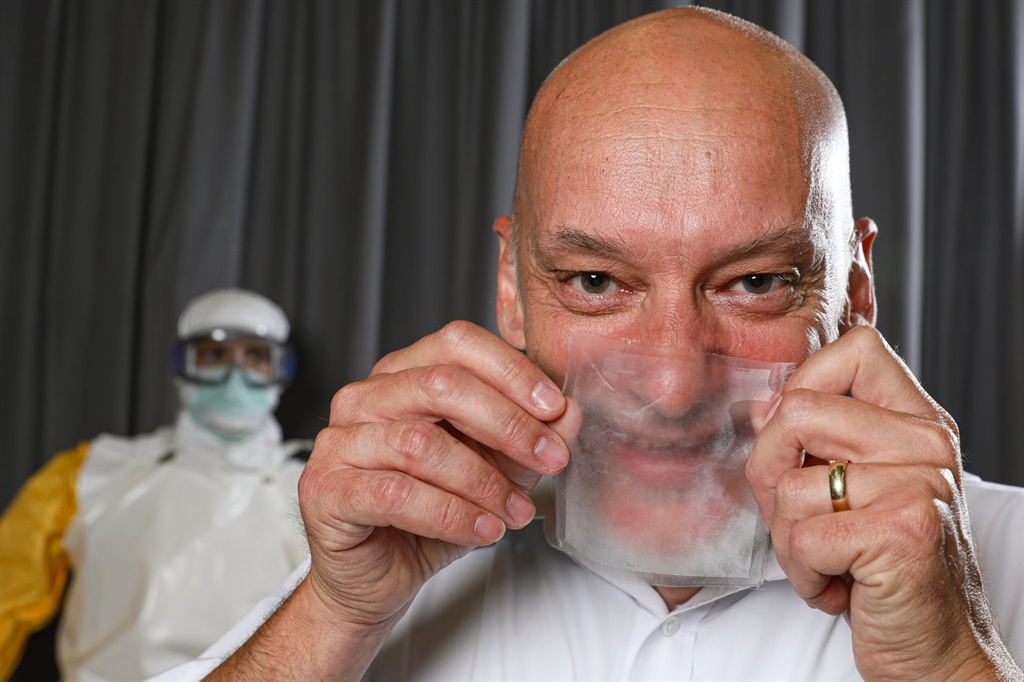
Health24.com | Swiss researchers have created a transparent, breathable surgical mask

  • A Swiss research centre developed a new material that can be make into transparent, breathable masks for healthcare professionals
  • The idea was to make it easier for health workers to communicate with their patients
  • They have already raised around R17.6 million to start the manufacturing process 

Breathable and transparent – this could be the face of future surgical masks thanks to Swiss researchers from science and technology university EPFL.

Dreamed up by the EssentialTech Centre of the university, they created a disposable surgical mask where patients can see the whole face of healthcare professionals while being treated.

Called HelloMasks, they also founded the startup HMCare to market it. There has been a boom in mask production around the world, and this surge in demand helped them to easily raise around R17.6 million to start the manufacturing process. 

READ: Masks and Covid-19: How, when and why – the latest guidelines

transparent mask

Their timing couldn’t be better. They started working on the mask two years ago – before the start of the pandemic – because they saw a need for medical practitioners to better communicate with their patients while keeping their masks on. This is especially useful for children, patients that have hearing issues, and the elderly – all who depend on visual cues for communication.

A smile from a healthcare worker also goes a long way to comfort patients. 

This was the general spirit behind the idea for the masks. Klaus Schönenberger, head of the centre, worked during the Ebola outbreak in West Africa in 2015, and saw nurses pinning photos of themselves to their chests so that patients could tell what they looked like under all the protective gear. 

He got together with Thierry Pelet, now the CEO of the start-up, and Sacha Sidjanski, a project manager at EPFL’s School of Life Sciences, who were both inspired by a storyteller at a hospital who was saddened that ill children couldn’t see her facial expression while she was entertaining them. 

READ: Running with a mask – what you should know, and how to choose the right one

[embedded content]

“Looking online, you can find prototypes of masks that are partly transparent, but they’re just normal masks with some of the fabric replaced by clear plastic,” says Pelet. These masks also fog up because the plastic isn’t breathable. 

The transparent membrane material made from polymer is biomass-based, eco-friendly, and better yet, breathable. 

[Photo of mask material]Sample of the mask’s material. (Photo: EPFL)

While designed originally for healthcare professionals – to whom it will be sold first – with the pandemic they may start marketing it to the public at large. This would be especially useful for the deaf community during the pandemic. 

They are hoping to launch in 2021

Image credit: Photo courtesy EPFL

Share Button

Coronavirus: Face coverings compulsory on public transport in England

Thousands of extra staff are deployed as passengers are told to cover their faces or risk being fined.

Share Button

Coronavirus: Blood clots targeted in treatment trial

Scientists from Imperial College London believe a hormone imbalance could be responsible.

Share Button

Processing Your Baggage

In the later years of Walt Disney’s life, he actively worked on his vision for EPCOT (Experimental Prototype Community of Tomorrow). His intention was to build a complete city of the future – a place for people to live and work in harmony. His designs included a central downtown hub with skyscrapers, Monorails and People Movers for transportation, houses for people to live in, entertainment centers, parks, waste management, and more. It was a big picture vision that he’d been working on for many years, including a deep study of urban planning.

When Walt died his EPCOT vision unfortunately died with him. No one else was willing and able to carry it forward. The real Epcot Center that was built in Orlando after Walt’s death would barely qualify as a shadow of what Walt actually wanted to build. His vision was much grander than another theme park.

What killed this dream? The answer is smoking.

Walt was a heavy smoker and had some serious health issues because of it, including lung cancer. Even as his health and energy were declining, he kept trying to work on this project, but his long-term habit of smoking got the better of him and cut his vision to shreds. He passed away in 1966 at the age of 65, not long after having a lung removed. At least he was able to say goodbye to the people he cared about.

Walt largely hid his smoking habit from the public, not allowing himself to be filmed or photographed smoking. He tried to quit of course but didn’t succeed, and in the end this nasty habit took him down.

Imagine what he could have done with an extra 10 or 20 years. The utopian city of tomorrow might actually have been built, at least the 1960s version of it. That could have created many interesting ripples.

Some forms of baggage can not only slow you down but can kill your dreams. It’s better to release this baggage while you can instead of dragging it into you future, year after year and decade after decade.

What’s your current baggage? Is there some nasty habit or inner demon that’s been burdening you? What happens if you carry it forward for the rest of your life? Even if it doesn’t damage your health, does it have the potential to crush your dreams?

We often hate to slow down and deal with our baggage, but sometimes that’s the intelligent choice. Imagine if Walt took a couple of years to put other aspects of life on pause and to do whatever it took to quit smoking when he was younger. Perhaps he could have retained two healthy lungs and spent an extra decade or more working on his biggest dreams.

With the current virus situation, there’s been a chance to slow down many aspects of life. For many people this is a good time to process and clear out old baggage, so we can release what no longer serves us.

Your baggage might be bad habit, but it could just as well be something else – a misaligned job, a misaligned relationship, a misaligned social circle, etc. What’s creating the most drag in your life when you try to advance towards your goals? What do you think would happen if you finally released it?

Processing your baggage won’t be easy, but admitting the truth that you absolutely must deal with it is a good step. Embracing and accepting the truth puts you on a path to greater freedom. Even when that’s difficult, don’t revert to denial. Just keep facing the daunting challenge.

Walt could have quit smoking. Many other people have done so. He didn’t make that enough of a priority in his life though. He didn’t do what was necessary to process that baggage.

Whatever is dragging you down is most likely a solvable problem, especially if many other people have already overcome similar burdens. It’s good to remind yourself of that often. Your problems have solutions. Your baggage doesn’t have to be permanent. Other people have processed and released similar baggage. And so can you.

Share Button

Health24.com | WATCH | What is a flexitarian?

Stringr

New diets seem to surface very often. The latest trends is the flexitarian diet, a style of eating that encourages mostly plant based foods while allowing meat products in moderation.

There has recently been an influx of plant-based meats, however, their are still some people who eat real meat. They’re now referred to as “flexitarians”.

Being flexitarian is more of a lifestyle rather than a traditional diet, as it has no clear-cut rules of recommended numbers of calories.

The new trend is also great for people who are trying to transition into eating meat-free foods, instead of going cold turkey, you can test the waters and slowly wean yourself off.

NEXT ON HEALTH24X

Share Button

Health24.com | Another benefit of volunteer work? Science says it can help you live longer

  • A study with over 12 000 participants over the age of 50 shows that mortality rates are reduced by 44% when they volunteer for more than 100 hours a year
  • It also improved mobility and increased connections with friends
  • The researchers, however, did not find volunteering to have any impact on chronic conditions

Volunteering isn’t just good for the soul – it can also increase your lifespan.

A study by the University of Michigan’s Institute for Social Research published in the American Journal of Preventative Medicine analysed data from comprehensive US research involving adults over the age of 50 to see if there’s any correlation between volunteering and physical health, health behaviours and psychosocial wellbeing.

READ: Even a little activity keeps ageing brains from shrinking

They chose 34 indicators that signify what it means to age well – how it affects things like life satisfaction, optimism, physical activity, depression and chronic conditions.

With over 12 000 participants over the span of four years, they found that those who volunteered for more than 100 hours a year – about 2 hours a week – had a 44% reduced mortality risk, a 17% reduced risk of mobility issues and 12% increased physical activity. 

‘A means to stay young’

The volunteering heroes were also less hopeless, had more of a purpose in life and felt less lonely. They were also 29% less likely not to be in regular contact with their friends. 

However, the study did not find volunteering to have any impact on chronic diseases like cancer, diabetes and arthritis, certain behaviours like drinking and smoking, and other indicators like depression and connection with family. 

ALSO SEE: Worried about ageing? Scientists discover 4 distinct ageing patterns

This contradicts earlier studies, although the researchers noted that it could be due to the study’s missing “cause of death” statistics of participants. 

Previous studies on health and volunteering also tended to be limited in sample size and skewed towards younger subjects. 

It concludes that volunteering could prevent a decline in quality in life as we get older, help the psyche and make us more resilient to stress factors. 

The art of helping in our communities is also something that physicians could potentially prescribe to older patients who are willing and able as a means to “stay young”. 

However, during the Covid-19 pandemic, those that fall in the high-risk age category need to be careful with activities outside their homes – including helping their fellow humans.

Image credit: Getty Images

Share Button

Coronavirus: Boris Johnson launches review into 2m social distancing rule

There have been concerns the hospitality sector will struggle to be viable with the rule in place.

Share Button

Coronavirus: Child psychologists highlight mental health risks of lockdown

Leading psychologists warn the education secretary that children’s mental health is at risk.

Share Button

Health24.com | Coronavirus morning update: Latest on Gauteng schools, and cybercriminals exploiting lockdown

WHAT’S HAPPENING IN SA

Cases update: 

The latest number of confirmed cases is 65 736.

According to the latest update, 1 423 deaths have been recorded in the country.

There have been 36 850 recoveries.

So far, more than 1.087 million tests have been conducted, with 27 462 new tests.

READ MORE | All the confirmed cases of coronavirus in SA

Latest news:

The Gauteng Department of Education says 330 schools in the province have applied for deviation to phase in more grades amid the coronavirus pandemic.

According to departmental spokesperson Steve Mabona, they had responded to and approved 270 of the applications while others were still processed.

Mabona said the department was expected to approve and sign the remaining applications on the day the head offices were shut after two staff members tested positive for Covid-19.

On Monday 1 June, Basic Education Minister Angie Motshekga gazetted the amended regulations on the reopening of schools amid the coronavirus pandemic.

READ MORE | 330 schools in Gauteng apply to phase in more grades, says education department

More than 50 schools have been closed in Gauteng after positive cases of Covid-19 were reported.

According to the province’s premier David Makhura and the Gauteng Coronavirus Command Council, as of Thursday 54 schools had been affected by 56 cases reported in districts across the province. This had increased from 43 schools affected by 45 Covid-19 cases on Tuesday.

During a briefing on Friday, Makhura said a number of schools still remained closed due to infrastructure issues – specifically the supply of water and the availability of ablution facilities – as well as those affected by positive Covid-19 cases.

On Thursday, 13 schools did not open after schools reopened on Monday 8 June due to infrastructure issues and vandalism, Makhura said.

READ MORE | 67 Gauteng schools closed due to Covid-19 cases, infrastructure issues

Gauteng MEC Panyaza Lesufi has tested negative for Covid-19, the Gauteng Department of Education announced on Saturday.

Lesufi tested for the virus on Tuesday and went into self-isolation after two staff members from the department’s offices in Johannesburg tested positive for Covid-19.

News24 previously reported that the department’s head office was currently being decontaminated after it was shut down on Wednesday.

Staff are expected to return to the head office on Monday once the process is complete.

READ MORE | Panyaza Lesufi tests negative for Covid-19 after scare

Stay vigilant. Hackers will keep trying to capitalise on Covid-19, warns Maher Yamout, senior security researcher at global cyber security firm Kaspersky.

When many people suddenly had to work from home when the coronavirus pandemic lockdown started, the focus of hackers shifted from email attacks to online attacks, Kaspersky research shows.

The first coronavirus case was reported in South Africa on 5 March and the country went into lockdown on 27 March.

Between February and March, Kaspersky saw a shift in South Africa. There was a drop in volume of ransomware attacks to more specifically targeted ransomware ones. Most of the time in SA, ransomware is deployed by exploiting online servers or weak passwords.

READ MORE | Cybercriminals change tack in SA, use more ransomware during lockdown

As of 13 June, there have been 14 Covid-19 related deaths in the South African Police Service (SAPS), while a total of 1 685 police officers have tested positive for the virus.

Of the 1 685 confirmed cases within the SAPS ranks, 1 034 cases have been reported in the Western Cape, according to Minister of Police Bheki Cele’s spokesperson Lirandzu Themba.

In the Eastern Cape, 186 police officers contracted the virus, 119 in Gauteng, and 53 officers in KwaZulu-Natal.

SAPS has recorded 639 recoveries, while a total of 9 909 police officers stationed around the country tested negative.

READ MORE | More than 1 600 police officers have tested positive for Covid-19, with 14 deaths – Cele

WHAT’S HAPPENING IN THE REST OF THE WORLD 

Cases update:

For the latest global data, follow this interactive map from Johns Hopkins University & Medicine.

Early on Sunday morning, positive cases worldwide were more than 7.73 million, while deaths were more than 428 000.

The United States had the most cases in the world – close to 2.07 million, as well as the most deaths – more than 115 000.

READ MORE | All the confirmed cases worldwide

Latest news:

Dozens of people tested positive for the coronavirus in Beijing as parts of the city were locked down Saturday after the emergence of a new cluster linked to a wholesale food market.

People were ordered to stay home at 11 residential estates in south Beijing’s Fengtai district and the nearby Xinfadi market was closed as authorities raced to contain the outbreak that has fuelled fears of a resurgence in local transmission.

Most of the six new domestic infections reported Saturday were linked to the meat and vegetable market, health officials said, which provides much of the capital’s food supply.

Official news agency Xinhua reported at least one of the cases was “severe”.

READ MORE | Fresh Covid-19 concerns send parts of Beijing into lockdown

LATEST RESEARCH

Many factors like age and comorbidities have been studied to help us better understand Covid-19 and people’s susceptibility to its severity – and now your blood type could be another factor that could influence your interaction with the coronavirus.

Private genetic testing company 23andME from the US have released some preliminary data from their ongoing genetic study on Covid-19, which they launched on 6 April.

It aims to find out if the ABO blood group can play a direct role in infections by serving as a receptor, or coreceptor for microorganisms, parasites, and viruses.

From the data of 750 000 participants so far – mostly customers from their existing database – they have gleaned that type O blood appears to be more protective against contracting the virus and severe symptoms than other blood types.

READ MORE | One blood type seems to be more resistant against Covid-19

HEALTH TIPS (as recommended by the NICD and WHO)

• Maintain physical distancing – stay at least one metre away from somebody who is coughing or sneezing

• Practise frequent hand-washing, especially after direct contact with ill people or their environment

• Avoid touching your eyes, nose and mouth, as your hands touch many surfaces and could potentially transfer the virus

• Practise respiratory hygiene – cover your mouth with your bent elbow or tissue when you cough or sneeze. Remember to dispose the tissue immediately after use.

Image credit: Getty Images

Share Button

Coronavirus: Racism ‘could play a part in BAME Covid deaths’

The leaked report by Public Health England says factors such as racism may contribute to increased risks.

Share Button