Eating nuts at least twice a week is associated with a 17% lower risk of death from cardiovascular disease, according to research presented today at ESC Congress 2019 together with the World Congress of Cardiology.
“Nuts are a good source of unsaturated fat and contain little saturated fat,” said study author Dr Noushin Mohammadifard of Isfahan Cardiovascular Research Institute, Iran. “They also have protein, minerals, vitamins, fibre, phytosterols, and polyphenols which benefit heart health. European and US studies have related nuts with cardiovascular protection but there is limited evidence from the Eastern Mediterranean Region.”
This study examined the association between nut consumption and the risk of cardiovascular disease and death in the Iranian population. A total of 5,432 adults aged 35 and older with no history of cardiovascular disease were randomly selected from urban and rural areas of the Isfahan, Arak and Najafabad counties. Intake of nuts including walnuts, almonds, pistachios, hazelnuts, and seeds was assessed in 2001 with a validated food frequency questionnaire.
Participants or family members were interviewed every two years until 2013 for the occurrence of cardiovascular events and death. The specific outcomes investigated were coronary heart disease, stroke, total cardiovascular disease, death from any cause, and death from cardiovascular disease.
During a median 12-year follow-up, there were 751 cardiovascular events (594 coronary heart disease and 157 stroke), 179 cardiovascular deaths, and 458 all-cause deaths.
Eating nuts two or more times per week was associated with a 17% lower risk of cardiovascular mortality compared to consuming nuts once every two weeks. The connection was robust even after adjusting for factors that could influence the relationship such as age, sex, education, smoking, and physical activity. Nut intake was inversely associated with the other outcomes but lost significance after adjustment.
ESC guidelines list 30 grams of unsalted nuts per day as one of the characteristics of a healthy diet, while noting that the energy density of nuts is high.(1)
“Raw fresh nuts are the healthiest,” added Dr Mohammadifard. “Nuts should be fresh because unsaturated fats can become oxidised in stale nuts, making them harmful. You can tell if nuts are rancid by their paint-like smell and bitter or sour taste.”
References and notes
(1)Piepoli MF, Hoes AW, Agewall S, et al. 2016 European Guidelines on cardiovascular disease prevention in clinical practice. Eur Heart J. 2016;37:2315-2381.
Low-density lipoprotein (LDL) cholesterol levels should be lowered as much as possible to prevent cardiovascular disease, especially in high and very high risk patients. That’s one of the main messages of the European Society of Cardiology (ESC) and European Atherosclerosis Society (EAS) Guidelines on dyslipidaemias published online today in European Heart Journal and on the ESC website.
Cardiovascular disease (CVD) is responsible for more than four million deaths in Europe each year. Clogged arteries, known as atherosclerotic CVD, are the main type of disease. The guidelines provide recommendations on how to modify plasma lipid levels through lifestyle and medication to reduce the risk of atherosclerotic CVD.
“There is now overwhelming evidence from experimental, epidemiological, genetic studies, and randomised clinical trials, that higher LDL cholesterol is a potent cause of heart attack and stroke,” said Professor Colin Baigent, Chairperson of the guidelines Task Force and director of the MRC Population Health Research Unit, University of Oxford, UK. “Lowering LDL cholesterol reduces risk irrespective of the baseline concentration. It means that in people at very high risk of heart attack or stroke, reducing LDL cholesterol is effective even if they have below average starting levels.”
There is no lower limit of LDL cholesterol that is known to be unsafe. The guidelines aim to ensure that the available drugs (statins, ezetimibe, PCSK9 inhibitors) are used as effectively as possible to lower levels in those most at risk. It is recommended that such patients should achieve both a target LDL cholesterol level and a minimum 50% relative reduction.
“This is to ensure that high- or very high-risk patients receive intensive LDL cholesterol lowering therapy irrespective of their baseline level,” said Professor Alberico L. Catapano, Chairperson of the guidelines Task Force and professor of pharmacology at the Department of Pharmacological and Biomolecular Sciences, University of Milan, Italy. “Patients who are already close to their target on current treatment will be offered additional treatment that provides a further minimum 50% reduction.”
“Statins are very well tolerated, and true ‘statin intolerance’ is uncommon. Most patients can take a statin regimen,” noted Professor François Mach, Chairperson of the guidelines Task Force and head of the Cardiology Department, Geneva University Hospital, Switzerland. “Statins have very few side-effects. These include an increased risk of developing diabetes, and they may rarely cause myopathy. But the benefits of statins greatly outweigh their hazards, even among those at low risk of atherosclerotic CVD.”
However, statins are not recommended in pre-menopausal women considering pregnancy or not using adequate contraception. “Although these drugs have not been shown to cause fetal malformations when unintentionally used in the first trimester of pregnancy, women needing a statin should avoid them during any period when they might conceive, as no formal study to address this question has been performed,” said Prof Catapano.
The evidence for statin therapy is more limited in patients over 75, though is still consistent with a benefit. The guidelines advise taking level of risk, baseline LDL cholesterol, health status, and the risk of drug interactions into account when deciding whether statins are appropriate in those aged 75 or over.
Revisions have been made to the risk stratification categories so that patients with atherosclerotic CVD, diabetes with target organ damage, familial hypercholesterolaemia, and severe chronic kidney disease are all categorised as very high-risk (and so will be offered intensive LDL-lowering therapy). Treatment goals for a particular risk category apply regardless of whether or not patients have had a heart attack or stroke.
Evidence since the 2016 guidelines suggests that raised Lp(a) is a cause of atherosclerotic CVD, and patients with genetically elevated Lp(a) can have similar lifetime risk of heart attack or stroke as those with familial hypercholesterolaemia. Since Lp(a) is largely genetically determined, the guidelines recommend measuring it at least once in adulthood. “Assessment should be around 40 years of age to identify people before they have a heart attack or stroke,” said Prof Baigent.
Fish oil supplements (particularly icosapent ethyl) are recommended, in combination with a statin, for patients with hypertriglyceridaemia despite statin treatment. In these patients, supplements reduce the risk of atherosclerotic CVD events, including heart attack and stroke, by about one quarter.
The guidelines advocate a lifetime approach to cardiovascular risk. This means that people of all ages and risk levels should be encouraged to adopt and sustain a healthy lifestyle. “The main requirements are healthy diet, avoidance of cigarette smoking, and regular exercise,” said Prof Mach. “There is no evidence that fish oil supplements prevent first heart attacks and strokes, so we did not recommend them for healthy people.”
WATCH: These cool T-shirts have built-in air conditioners
There’s a new, wearable air-conditioner on the block that could hit the market soon.
If you’re one to dread the hot weather, there’s potentially some good news: Sony has made a breakthrough by inventing a product called the Reon Pocket, and it can apparently get up to 13 degrees Celsius colder.
As people age, physical activity still needs to be part of the game plan for living a healthy, happy life – and experts say it’s never too late to get active and build strength.
“We try to tell people the body can still adapt, and it can still improve,” said Barbara Nicklas, a professor of gerontology and geriatric medicine at Wake Forest University School of Medicine.
‘Not everybody is the same’
Those who engage in more occupational or leisure time physical activity have a lower risk of disease and death, and the health benefits of movement can extend to all ages, Nicklas explained in an editorial in the Journal of the American Geriatrics Society.
Nicklas cautions against placing all “older adults” who are age 60 and up into one category. Rather than basing exercise and activity goals on age, they should be geared to one’s “physical functional status”.
“What can the person do?” she said. “Not everybody is the same.”
Whether you’re 65 or 85, or a runner, a tennis player or perhaps someone who has difficulty getting around, one constant remains: the importance of moving.
“Any time you can incorporate more movement throughout the day, it is good,” said Nicklas, who urges “starting where you’re at and doing what you can”.
The US Health and Human Services Department and the American Heart Association recommend at least 150 minutes per week of moderate-intensity aerobic activity or 75 minutes of vigorous activity or a combination of both, as well as muscle-strengthening activity.
Slow and steady
For those who have been living a sedentary lifestyle, walking is the best way to begin getting physically active, Nicklas said. She suggests going with a friend or enrolling in a walking programme like the one her university offers. It adds accountability, a social component and safety, to guard against falls.
Using a “walking tool”, such as a cane or walker, if it’s needed, can help you stay active, Nicklas said.
“Slow and steady – the tortoise pace – is better than the rabbit pace when you’re starting out or starting over,” she said.
Resistance or strength training – through free weights, weight machines, pushups or pullups – can help with range of motion around joints and improve muscle mass, muscle strength and bone strength. It can help in the ability to perform everyday activities, improve balance and may reduce the risk of falls.
Fred Bartlit, 87, proves the point that chronological age isn’t the determining factor when it comes to strength and feeling young.
A former US Army ranger, Bartlit always had been physically active. He also was an avid skier and golfer. As he reached his 50s, at the urging of his future wife, he intensified his workouts and began strength training at a gym.
‘The world is sedentary’
Today, the Colorado attorney and author said he is stronger than when he was in the Army at age 22. In addition to practicing law, he makes it his mission to inform older adults about battling sarcopenia, the loss of muscle with ageing.
“Our bodies, they’re crying out for physical activity,” he said. “And now the world is sedentary.”
For someone as active as Bartlit, strength training helps him ski challenging mountains trails with his 58-year-old son and 16-year-old granddaughter.
Multiple scientific studies point out that building strength is important in performing everyday activities and in avoiding or managing chronic disease.
Bartlit suggests working with a trainer at first, if possible, and trying to fit in strength training three times per week.
“You have to create habits,” said Bartlit. “It’s about living a full life. It changes the way you think, the way you feel, your confidence in doing things.”
Chronic conditions
Boosting physical activity and strength helps ageing adults do the things they want to do in daily life, and that can be motivating, Nicklas said. It may be as simple as going to the grocery store on your own or having the energy to take grandchildren to the park or to a soccer game.
Older adults are disproportionately affected by conditions such as diabetes, arthritis and heart disease, with 80% of people over 65 having at least one of those chronic conditions, according to the National Council on Aging.
But even though some health setbacks may occur with advancing age, they don’t have to completely derail an exercise plan. “This is just reality, and it’s going to happen,” Nicklas said.
“Steady improvement” should be the aim, she said. “The body is still capable of adapting.”
We’re regularly told by nutritional experts that sugar is a silent killer and is fast becoming public health’s biggest enemy. But how can something so tasty be so bad for us, and as a consumer, how can we avoid it? Nutrition researcher, Dr Andreas Pfeiffer answers all your questions.
I started learning to play guitar about three months ago, so here’s an update on how it’s going and what the experience has been like so far.
What I’ve Learned
I’ve learned a lot so far, but I also feel like I can’t really do much yet. If someone were to watch me play, I don’t think they’d be impressed by what I can presently do. I’m still learning lots of basics.
I’ve been pretty consistent with my lessons and practice. Every Saturday I have a 30-minute in-person lesson, although I’ve missed a few due to travel. This is plenty of time for me to learn something new each time and to have plenty to practice during the following week. I’ve never felt like I didn’t have enough to work on after each lesson.
For the month of June I practiced every day for at least 20 minutes, and since then I’ve been practicing 5-7 days most weeks for 20-30 minutes each time. I don’t think I’ve ever put in more than one hour of practice in a single day. Usually I practice after my workday and before dinner, typically around 6pm. Practicing guitar feels like a nice transition from the workday into the evening.
Here are some things I’ve learned in my first three months:
I know how to tune my guitar in a few different ways. My acoustic-electric guitar has a built-in tuner powered by a 9V battery, so I normally use that. I also know how to tune the guitar using an iOS tuner app. I can play along with a metronome app too.
I can play some simple tunes like “Happy Birthday,” a basic blues sequence, and small parts of a few songs (“Sunshine of Your Love,” “Brown Eyed Girl,” and “Blitzkrieg Bop”). But for the most part, I’ve been learning and practicing basics and not learning how to play a bunch of songs.
One of the first things I learned were the 6 guitar strings: low E, A, D, G, B, and high E. I learned two phrases for remembering them:
Edgar ate dynamite. Goodbye, Edgar!
Every acid dealer gets busted eventually
I can play the five chords of the CAGED system: C, A, G, E, and D. And I can play a few other chords as well. However, I can’t always play them consistently without buzzing or muting a string or too.
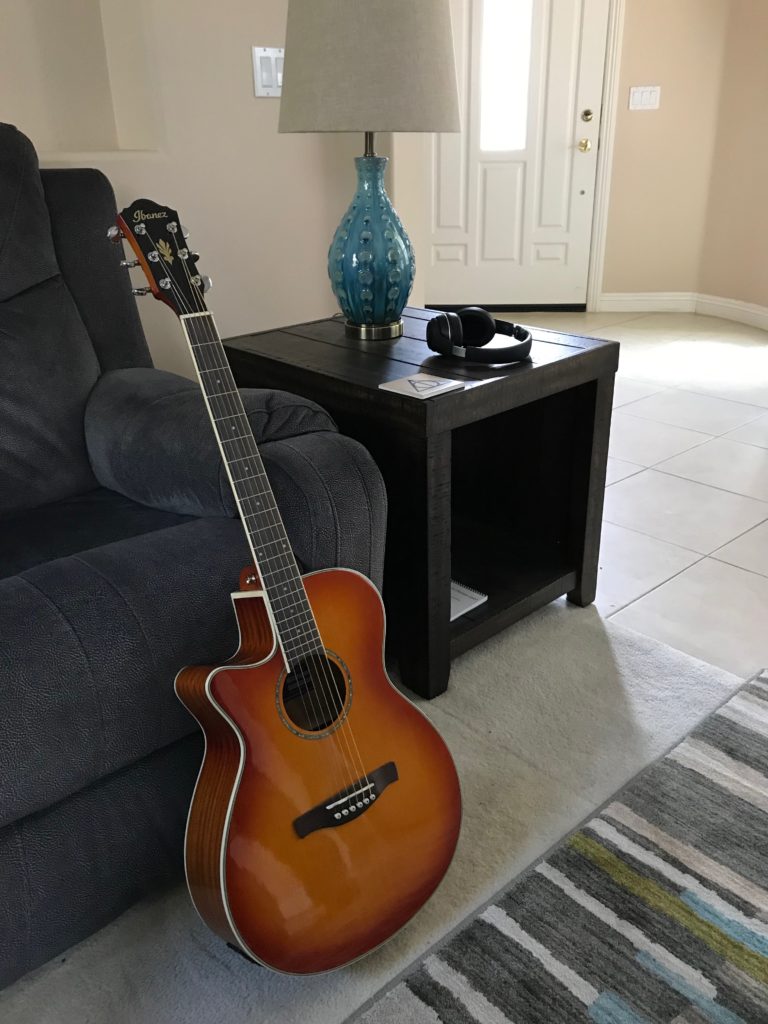
I’m using a left-handed acoustic guitar, but I had one practice session using a left-handed electric, and it was way easier to play chords on it since the strings are a much lighter gauge. I thought about switching to an electric guitar since I’m sure I could learn faster on it, but I like the acoustic I have, so even though it’s more difficult to learn on it, I’d like to stick with the acoustic for now.
I can read and follow guitar tabs, although I’m slow at this and often have to think about how the information on the tab translates to which fingers go on which frets. The more I practice a tab, the easier it gets of course. I can also read chord diagrams, but again I’m not very fast at mentally mapping them to the fingers and frets; I have to consciously think about how to read them.
I’ve learned upward and downward pick slanting, and I’ve practiced picking in and out of the strings in both directions.
I’ve practiced lots of finger permutations up and down the strings and across the frets. I’ve found this helpful for conditioning my fingers to stretch in the right ways. I’m still practicing these every week.
In the first month, I bought 24 different guitar picks (two 12-packs, one from ChromaCast and one from Dunlop). I tested all of them multiple times to get a feel for which ones I like best. I have a few favorites from each set. I like the 0.73mm and 0.60mm thickness best, although sometimes I go with 0.88mm. I begin each practice session by selecting a pick to use, which is a simple way to get started each time.
Las Vegas is very dry, frequently below 15% humidity, which is bad for wooden guitars. Multiple people at the guitar store recommended getting a guitar humidifier, which is an inexpensive way to prevent damage due to dryness. The store keeps their own acoustic guitars in a separately enclosed, humidity controlled area. If a guitar dries out too much, the neck could bow and other cracks and deformities may occur. So this seemed like a sensible piece of insurance. When I’m not using it, I always keep my guitar in its case with the humidifier, which is really just a small sponge that hangs in a plastic case between the strings. This consistently keeps the guitar at 45-50% humidity, as measured by a small humidity meter that I keep inside the case. Apparently 50-55% would be better, by I’ve been told that around 45% is typically the best we can expect in Vegas unless a significantly more expensive airtight case is used, a case that would cost a lot more than the guitar. I only need to rehydrate the humidifier sponge about twice a month, so it’s pretty low maintenance. So far my guitar is in decent shape. I didn’t know anything about this aspect of having a guitar in Vegas till after I bought one.
Speaking of the case, there were a lot of options to choose from. After doing some research, I opted for a Gator Case, which seemed like a good choice if I ever want to travel with it. The guitar fits nice and snug inside the case. The case has feet too, so I can stand it up vertically if I want. I like the look of my guitar, so I’d have preferred to leave it out in the open or on a stand when I’m not using it, but apparently that’s too risky here, and I’d rather not have it destroyed by dryness, so I always return it to its case when I’m done practicing.
When I first got the guitar, I had a really hard time playing chords on it. I tried over and over and just couldn’t play certain chords cleanly, such as the D chord. I suspected my guitar might need adjusting, so I asked a guitar tech at the store to look at it, and he was able to make some adjustments to the neck that made it a lot easier to play afterwards. The action (distance from strings to frets) on my guitar was pretty high, around 5mm in some places before I had it adjusted. Now the strings are closer to the frets, so I don’t have to press down as hard when I play. At least that early practice with the steel strings toughened up my fingers a lot.
Learning the Notes
Recently I’ve been learning the notes on the guitar, which is complicated. I figured I just had to learn the notes on one string and then I’d know every string. But no! The notes for each string are in different positions, except for the top (low E) and bottom (high E) strings, which are the same.
For example, if I want to play an A note on one of the E strings, it’s the 5th fret. To play an A note on the A string, I play the string open (no frets). On the D string, an A note is the 7th fret. On the G string, it’s the 2nd fret. And on the B string, it’s the 10th fret. So yeah… this was clearly designed by a sadist.
I started with the E strings and learned those first. Initially I practiced all combos of the E, A, D, and G notes. Then I practiced F, B, and C separately till I had those down. And then I practiced these sequences:
CDEFGABC
CEGBDFAC
CFBEADGC
CGDAEBFC
CAFDBGEC
CBAGFEDC
Then I also had to learn the sharps (♯) and flats (♭). And I know that these have multiple labels, like how C♯ is the same fret as D♭.
Eventually I would practice this sequence to cover all the notes for a given string to make sure I had them down:
C F B♭ E♭ A♭ D♭ F♯ B E A D G
And then I had to relearn all of the above for each of the other strings. That took a while.
I began by learning and practicing one string at a time. The hard part was shifting from single string practice to multi-string practice. My brain had learned the linear positions of each note based on the context of having only one string loaded into my working memory at any given time. Whenever I would switch strings, it took me a few extra seconds to load in my mental map for the new string. But with more practice, my brain is gradually mapping out the full 2D matrix with 6 rows and 12 columns instead of 6 separate 1D lists of 12 notes.
I’m not super fast at this yet, so sometimes it takes me a few seconds to figure out which fret to use, but I thought it best to work on accuracy first, and next I’ll work on getting faster.
To help me practice, I coded up a quick app on my Mac to tell me to play a random note on a random string, selecting from this format:
Play [C,F,B♭,E♭,A♭,D♭,F♯,B,E,A,D,G] on the [high E,A,D,G,B,low E] string
So this generates random notes for me to play like this:
Play F on the B string
Play D♭ on the A string
Play E on the low E string
Play G on the B string
Play G on the low E string
Play B on the B string
Play F on the low E string
Play F on the B string
Play E on the A string
Play D♭ on the G string
Play A♭ on the G string
Play F♯ on the A string
Play F♯ on the high E string
I can also set the frame rate for how quickly these appear on the screen. As I get used to one speed, I can speed it up the increase the challenge.
For a different mode of practice, I can use text-to-speech and have my laptop read these to me. I can control the rate of speech and set it slower to start, then gradually speed it up as I get faster. This feature is built into MacOS. I coded my app to save hundreds of lines of these instructions to a text file, and if I just add an instruction like [[slnc 2000]] to the end of each line, then the Mac’s speech-to-text feature will add a 2-second (2000 ms) pause. And of course I can change that number to create any length of delay I want. The slnc directive is short for silence; it’s a standard embedded command used by speech to text systems which inserts a period of silence.
See for yourself. If you’re using a Mac, select the lines below, right-click, and select Speech -> Start Speaking. You’ll notice that the voice pauses 2 seconds after each line. There’s probably a way to do this on other operating systems as well, but I’m only familiar with how to do this on a Mac.
Play F on the B string [[slnc 2000]]
Play D♭ on the A string [[slnc 2000]]
Play E on the low E string [[slnc 2000]]
Play G on the B string [[slnc 2000]]
Play F♯ on the A string [[slnc 2000]]
If you try the same for the earlier set of lines without the embedded commands, you’ll notice that there aren’t any pauses in the speech, which would make it really hard to keep up unless you’re super fast.
This might seem like a wonky way to practice, but it’s helping me get past this hurdle of learning all the notes and being able to play them faster. I could use the same idea to practice switching between different chords as well. And maybe there are other ways I could customize this little app as well. I’m sure there are much more exciting apps available elsewhere, but I liked the experience of coding this up myself for personal use. It’s links the experience of learning guitar to a well-developed skill I’ve had for decades, computer programming. I see this as a way of telling my brain: You can learn this, and you’re going to get good at this, even it it takes years.
This type of practice reminds me of when I used to practice counting cards at blackjack in my early 20s. First I focused on counting down a deck for accuracy. When I first started, it would take me about a minute, roughly a second per card. Then I practiced for speed. Eventually I could consistently count down a deck in 13-14 seconds, which was as fast as I could flip through and see all of the cards. This gave me a nice advantage in the casinos because my subconscious mind would automatically update the count as soon as I saw a card. I no longer had to keep track of the count consciously. This might sound difficult, but your brain already does this automatic computation when you see certain patterns, like 7 + 5. So it’s just a matter of doing the training, except with guitar there’s the physical aspect of moving fingers around too.
I’d love to reach the point of knowing the notes on the guitar so well that my main limitation is how fast my finger can move to the correct fret and my other hand can play the note. I want the mental computation part to be virtually instantaneous. I don’t need to consciously compute the answer to 3 x 7, so why should I need to consciously compute the correct fret for playing a B♭ on the G string? I want my finger to automatically move to the 3rd fret when I see that.
No one told me to practice the notes in this manner till I have them down flat (oh nice pun!). I just figured that learning the notes really well would be a good step forward and might be useful later on. I think this extra practice allows me to look at the guitar differently as well. Instead of just seeing a bunch of strings and frets, I can see that those strings and frets have another layer of meaning.
Learning guitar can feel a bit distant to me because so much of it is new and unfamiliar. So I keep looking for ways I can link it to something I know. I may not understand flats and sharps too well, but I understand matrices and memorization. I imagine a function whose input parameters are the string and note, and the return value is the fret number, like this
CalculateFret( GuitarString s, GuitarNote n ) -> FRETNUM
So then I’m just teaching my brain to quickly compute the correct return value for all possible input patterns. There are 72 patterns to memorize if I limit myself to the first 12 notes on each string.
I might sometimes learn or practice details that I don’t really need to learn in order to play music, but if this makes the learning experience more engaging and enjoyable for me, I think that’s a good thing. I seem to learn better when I personalize the learning process. I also feel that if I learn this the same way everyone else does, then when will I learn to be creative with it? I think the time to start being creative is while I’m still learning.
What Style to Play?
One of the strangest questions people keep asking me is: So what style of music do you want to play?
That question seems to assume that I have a known destination that already exists, like I want to learn to play jazz or blues or rock. And that isn’t true for me.
My honest answer is that I’d like to learn my own style of play. I want to play Steve-style. I don’t know what that is yet, so I’ll have to explore till I figure it out.
When I first started blogging 15 years ago, imagine if someone had asked me: So what style of blogging do you want to do? My answer would be the same: Steve-style. Today I have a pretty good grasp on what Steve-style blogging looks like, which isn’t a style I understood when I first started. So I figure I can use the same approach to explore and develop my preferred style of guitar music.
Eventually I’d love to compose and play my own songs, but I don’t know what kind of musician I’m becoming yet. How could I know where I’m going style-wise till I get there?
Eventually I’d like to be able to get an idea for a song much like I get new article ideas. Then I want to grab my guitar and just start playing around with it to experiment with how to express the song idea. Then I can refine it, practice it, and play it. If I like it then it would be nice to share it with other people too.
I also think it would be nice to connect with an audience who likes and appreciates what I can create musically, once I’m ready for that. With my current skill level, that audience would be super small right now, mostly comprised of people with serious hearing problems. But that will eventually change as I keep improving, just as it did with coding and writing and speaking.
For me the inspiration to write a new article is very much a form of social energy – I feel a desire to write an article for other people, not just for myself. With this particular blog post, I figured that many people in my usual audience won’t care to read about this topic, but I also sense that a certain subset of people who are interested in learning music as well will appreciate this level of detail and find it interesting. So I’m writing this for those who will appreciate it. I’m already thinking of music in the same way. This may sound a bit strange, but I already feel a timeless connection to the people who will eventually appreciate the music I create and share.
I don’t know what kind of music I’ll create yet, but I do think my writing experience is helping me to approach the creative process in terms of the social flow from the very beginning. Writing and music are beautiful ways for us to connect as human beings. A big part of my motivation for learning music is that I see it as this really rich mode of connection. I would love, love, love to learn how to connect with people through music, not just through code, writing, speech, videos, coaching, conversation, etc.
Process-wise I can envision myself creating songs on the guitar and then arranging more complex electronic versions of them.
For example, here’s the acoustic version of “Personal Jesus”:
[embedded content]
So imagine starting with an acoustic version like that and then eventually developing it into this:
[embedded content]
I’d love to learn how to start with a simple inspiration for a new song, develop an acoustic version on my guitar, and then if I think it has promise, gradually build it out into something richer on the computer, such as by using Logic Pro.
I’ve written a little bit of electronic music using loops in Garage Band, which you can hear on my Soundcloud page if you want. This was from a 30-day trial of music exploration from 2011. I want to develop my musical knowledge and skills a lot more first before I get back into that aspect, but at least I have some experience with creating basic compositions in software.
I had thought about only sticking with the electronic music side, but since I spend a lot of time on a computer already, I felt drawn to learn a physical instrument. I also enjoy the in-person lessons.
Additionally I’d love to explore how to play music and compose music with other people, once I feel I have enough skill to be able to contribute. I’m not sure how early it would make sense to explore that.
These are my current intentions for where I’d like to go. This may change as I learn more, but for now it seems like I have enough clarity to keep investing in this.
The Experience of Learning Guitar
Overall I’m still enjoying the process of learning guitar. It challenges me in a variety of ways. I don’t feel like I improve that much in a week most of the time, but over the span of the month I can see definite signs of progress. I’m not investing a huge amount of time in this so far, so I think I’m doing okay relative to the time I’m putting in.
There are some aspects of what I’m learning that seem confusing to me still, some minor and some major… oh another pun!
When I look at a guitar tab, the top line on the tab is for the bottom string on the guitar, which feels upside down to me. I have to keep reminding myself that the top is the high E string, but the high E is the physically lowest string when I’m holding the guitar. The low E string is at the top of the guitar.
I don’t get why some notes are just letters and others are sharps and flats. They’re all just frets on the guitar that look pretty much the same. Was this notation invented with an alphabet that only had 7 letters? Why aren’t the notes labeled A B C D E F G H I J K L? Or 1-12? What do we gain from the extra complexity? Someone commented that it’s to keep out the muggles, but I think whoever came up with this was under the influence of a confundus charm.
When I start reading other music terminology, much of it doesn’t make a whole lot of sense to me right now. I can more easily read and understand Spanish, and I don’t know Spanish that well.
I keep looking for elegance in the ways different ideas connect, and I’m not seeing it yet. I’m used to seeing elegance in computer code, and I can recognize elegant patterns in a song, but the system of music terminology and concepts feels like it was invented by Count Rugen, intentionally designed to be overly complex for torture purposes… much like iTunes.
Maybe it’s time for me to study music theory, as some have suggested. Why is it called music theory though? What’s theoretical about it? Does that mean it’s an educated guess at how music works, but we’re not really sure? Does the theory ever get updated with new breakthroughs? Or is it pretty much the same as it was a century ago?
When I learned computer programming, I often visualized coding constructs in physical terms. I pictured code execution as physical movements. Much of the terminology readily lends itself to this. For instance, a loop in coding can be thought of like a physical loop or circle. I would visualize it like running laps around a track. Branching can be thought of like the physical branches of a river or a tree. I usually prefer visual ways to represent certain ideas, which helps me understand them better, but I’m not understanding how certain musical concepts can be visualized this way. I may just need more time to figure that out.
Presently I see a lot of leaves on a tree that look like they’re all from different trees. I’m not seeing the trunk and the branches that give rise to all these different concepts, so I don’t grasp how they all relate to each other. I mostly see a big jumble of ideas that I don’t know how to traverse from one end to the other.
I’d love to reach the point where I have a solid mental map of the realm of music, at least with respect to what connects with guitar. My current mental map is bigger than it was 3 months ago, but it’s still full of holes and gaps, and my brain doesn’t know how different ideas link to each other, so it’s not entirely sure where to put them.
What to Learn Next?
If I could only achieve one type of improvement in the next three months, it would be to refine my mental map of the musical realm that links with playing guitar.
I can see the guitar as a physical instrument, and now I know how to map every fret on every string to a note. That feels like a decent step since it adds a layer of meaning to the physical instrument.
I can also map several chords to finger positions. I can map the knobs at the head of the guitar to their tuning functions. I can map a few tunes to the proper finger sequences.
But my current maps feel like I’m only connecting with small subsets of a much larger tree. I don’t understand what the whole tree looks like yet. It’s like a big blurry blob with some less blurry ornaments hanging from it.
Ultimately I don’t just want to be able to play some songs. I want to understand how to connect the dots between the inspiration to express something musically and what my options are for turning that into actual music that I can play and share. I want to build out a deep, rich, accurate understanding of the whole pipeline of music creation from start to finish. I have those kinds of well-developed mental maps for coding (which allowed me to turn ideas into video games), for writing (which allowed me to turn ideas into articles and a book), and for speaking (which allowed me to turn ideas into workshops and courses). In each case the quality of my results was largely due to the richness of my mental maps.
Good maps are partly built by experience, but they can also be enriched by learning from others’ mental maps, through reflection, through trial and error, and lots of other ways. Mapping the terrain of music is one of the most interesting aspects of this learning process, and it’s also the area where I feel like I could potentially make the most progress in the next few months.
It feels like I still have a long way to go, and that’s okay. It’s good to know that if I just keep doing what I’m doing in this area, I’ll surely know a lot more a year from now. I like that I’m in motion with stable momentum and can expect further progress.
A recent report by Kessler researchers and clinicians described the effects of binocular occlusion in a patient with spatial neglect and severe posture impairment. The article, “Impact of eliminating visual input on sitting posture and head position in a patient with spatial neglect following cerebral hemorrhage: a case report,” was epublished by Physiotherapy Theory and Practice.
The authors are Peii Chen, PhD, of Kessler Foundation, Shannon E. Motisi, DPT, Christina Cording, DPT, Irene Ward, DPT, and Neil N. Jasey, MD, of Kessler Institute for Rehabilitation.
Complications of the hemorrhagic stroke of the right basal ganglia and surrounding area included marked right gaze, severe postural asymmetry, and inadequate responses to multi-step commands. These symptoms limited the ability of the 53-year-old woman to participate in therapy, and hindered the use of conventional paper-based tools for evaluating her for spatial neglect. Under these circumstances, the diagnosis of spatial neglect was based on the Kessler Foundation Neglect Assessment Process (KF-NAP®), i.e., observation of her performance of daily life activities.
The team found evidence in the literature that indicated that some individuals performed better on tests of spatial neglect when visual stimuli were eliminated. They hypothesized that eliminating visual input would increase spatial awareness on the contralesional side, which in turn, would reduce the rightward deviations in gaze and posture. Improving posture and gaze could improve the patient’s ability to participate effectively in her rehabilitation.
To eliminate visual stimuli, the patient was blindfolded during therapy sessions, and the stroke team evaluated her behavior with and without binocular occlusion. They measured three outcome measures: head position, weight distribution, and the degree of contact between buttocks and therapy mat (buttock-mat contact). These measurements were recorded at baseline, during binocular occlusion, immediately after removal of blindfold, and three minutes after removal.
All three measures showed immediate improvement during binocular occlusion, with return to baseline at three minutes after the intervention. “We documented that while the patient was blindfolded, she sat up straighter, and her posture was more centered,” said Dr. Chen, senior research scientist in the Center for Stroke Rehabilitation Research. “It is unclear why visual stimuli was such a strong factor in this patient’s symptoms of spatial neglect,” she said.
Further research is needed to investigate the usefulness of this type of intervention in rehabilitative care. “It is important to look at ways to support upright and centered posture in our patients recovering from stroke,” she noted, “because posture and positioning are essential to participating in many therapies and in performing activities of daily life.”
Story Source:
Materials provided by Kessler Foundation. Note: Content may be edited for style and length.