Experts say China’s recent measures have created a chance to stop the virus becoming a global crisis.


Experts say China’s recent measures have created a chance to stop the virus becoming a global crisis.

Given the rapid rise of veganism we’ve been seeing lately, which by some accounts has increased by a factor of 10 or more in recent years (at least in the USA), it seems clear that this explosive growth is going to continue for a while.
It stands to reason that many people who aren’t vegan today eventually will go vegan, perhaps sometime within the next few years.
I’ve had a lot of experience seeing people transition from non-vegan to vegan, including hundreds who’ve emailed or talked to me about this before, during, and/or after their transitions.
I’ve also seen people who’ve been familiar with veganism for years but show no signs of transitioning. This got me curious to ponder more deeply about the differences.
Based on this experience, I’ll share some observations about common differences between future vegans and non-vegans. Technically both groups are non-vegan today, but I use the “future vegan” label to distinguish those who show the telltale signs of someone who’s on their way to eventually becoming vegan.
These are generalizations and predictions based on personal observation, so take them on that basis. You could also read this article to see if you recognize any of the transitional signs within yourself, and then consider whether you think those could be suggesting a personal transition coming up for you.
Moreover, while this article is just about veganism, I think you could also generalize some of these ideas even more and ponder them as advance indicators of other types of transitions, such as signs that someone may be heading for a career or relationship transition.
So here we go…
Future vegans engage with the world. They actively look around and observe. They seek information and want to learn new truths, including truths that may upset them. They’re willing to have their realities upended now and then. Veganism sparks their curiosity, so even if they feel resistant at first, they’re also compelled to learn more about it.
Non-vegans don’t engage as much with the world, preferring to stick to the familiar. They don’t read as much about unfamiliar topics. When they spot an alternative lifestyle such veganism, they don’t feel as curious to learn about it. They figure that if it’s unfamiliar, it’s probably not worth learning about.
Future vegans frequently attract other vegans and vegetarians into their lives, often without deliberately trying to do so. Sometimes it appears that vegans recognize them as kindred spirits, while other times the future vegans appear to be subconsciously taking action that will predictably inject themselves into social spheres where vegans are more abundant, as if the future vegans are courting the influence.
Non-vegans tend not to experience this attraction effect. From their perspective vegans and non-vegans tend to keep to themselves most of the time. If there’s a rise of veganism in the world, they don’t see it happening as much.
One especially common sign of a future vegan is how much they like to debate and argue with vegans. It’s part of the process of working through their objections and resistance to going through the transition for themselves. To get good at debating this topic, they also have to learn more and more about veganism, which invites them deeper into the rabbit hole and eventually plays a role in convincing them to go for it.
Non-vegans generally don’t care to debate about veganism, and they aren’t very good at it anyway due to lacking the knowledge, experience, and curiosity to fully participate. If they do engage, you’ll usually find them being emotionally dismissive, raising one or two easily countered objections and then opting out, or they’ll just quote the Bible and leave it at that. They don’t really see the point in debating when their minds are already made up. Some will object to the whole notion of a debate happening at all while they’re around.
Future vegans tend to dabble and dance with aspects of veganism or vegetarianism, often for years, before transitioning. Many will buy appliances that are much loved in the vegan community, such as a Vita-Mix. Some will apologetically say they like to eat “rabbit food” now and then, or they may feel increasingly drawn to plant foods like salads and green smoothies. They may go to vegan restaurants or a vegan event, or they’ll buy a vegan cookbook and try out some recipes. Some will catch themselves watching documentaries about factory farming. There are telltale signs of progressive investment. In fact, the non-vegans in their lives will often recognize these leanings (and often try to dissuade the future vegan) before the future vegan consciously recognizes where they’re heading.
Non-vegans tend not to experiment or lean in this direction. They don’t even want to try it or test it. It’s not something they perceive as worthwhile or interesting, not even around the edges. It’s a complete non-starter for them.
Future ethical vegans value caring and regard compassion as a quality to be developed. They generally like the idea of becoming more compassionate and see it as a worthwhile direction of character growth. This eventually leads them to question how they’re contributing to the treatment of animals, and they start thinking about how this relationship could be improved. They may also begin to care more about the planet and question how their diet and lifestyle aligns with caring.
Non-vegans tend to have more static views of caring. It’s not a quality they desire to extend and further develop beyond a certain framework. They tend to have hard edges around their boxes of caring, frequently enforced by religious views. It’s pretty rare to see signs that they have any interest in becoming more caring or compassionate towards animals, let alone towards human beings from different cultures.
Future vegans value their ability to think and choose for themselves. They prefer to make their own choices regardless of what other people may think, sometimes going with the grain of society and sometimes going against it. Making a choice to go vegan often requires a strong independent will that puts following one’s own intellect above obedience to others’ demands or expectations.
Non-vegans tend to be more conformist and obedient to the will of others. They’re more deferential to authority. Many have been conditioned against independent thought, especially with heavy religious conditioning. They fall back on rules and frames taught by others about the role of animals, such as by repeating the story that animals were created to serve humans. They regard their loyalty to the old rules and stories as being more important than independent choice.
Going vegan requires courage. This isn’t so much about bravery though. It has more to do with heart-alignment and following one’s deeper feelings, even when the road ahead isn’t clear. When someone demonstrates courage in other areas of life, such as by summoning the courage to leave a misaligned job or relationship to pursue something better, that’s a good indicator that the person may be inclined to eventually use such courage to explore veganism as well.
Non-vegans tend to be more risk averse and conservative, preferring to maintain the status quo instead of exploring the unknown to seek significant gains. Their fears, worries, and concerns speak to them more viscerally than the voice of courage.
Future vegans are interested in growth, and they understand that growth is about creating improvement, not about achieving perfection. Veganism isn’t a perfect diet or lifestyle, but it is a significant improvement for many people and certainly for animals and the environment, and this positive step forward is good enough for future vegans to regard the transition as worth pursuing. Future vegans eventually recognize that progressing to the problems of veganism is a graduation of sorts from the problems of being non-vegan.
Non-vegans tend to be more static and absolutist in their thinking. All they need is to identify one potential flaw or objection (usually a heavily debunked one) to dismiss veganism outright, even as their current lifestyle has many more flaws. They rationalize that getting enough of X, Y, and Z nutrients as a vegan would somehow be a dealbreaker problem while overlooking more severe problems linked to their lifestyle, such as high rates of cancer, heart disease, and diabetes. A key pattern is that non-vegans tend to look for reasons not to change while future vegans frequently look for reasons to change.
Future vegans value internal alignment in their thoughts, feelings, and mental models of the world. They dislike cognitive dissonance and want to resolve certain questions. They acknowledge that treating animals as products is not a satisfying solution, and they seek better answers to the questions of how to eat and live.
Non-vegans are more tolerant of cognitive dissonance. They can handle frames that are too misaligned for a future vegan to hold. Alignment is not such a big deal to non-vegans because they value other aspects of life more highly, such as obedience to authority.
Many future vegans reach the point where going vegan starts to feel inevitable. They’ve already decided that they’ll eventually do it. They’re just figuring out how to make it practical for them. For some people there’s a lot to adjust in terms of diet, lifestyle, and social life, and they want extra time to come to terms with this.
Non-vegans of course never reach this point of inevitability. They’re more likely to see it as inevitable that humans dominate animals, which also leads to other inevitable conclusions like humans dominating other humans. They’re more likely to frame diet and lifestyle as being chosen for them rather than something they get to choose.
* * *
There are other factors too, so please don’t consider this an exhaustive list, but the ones I included here are some of the main ones that pop out. It’s really the combined weight of multiple factors that matters. Many future vegans will only show a few telltale signs before they transition, but they’ll be important indicators of investment.
If you recognize some of the future vegan patterns within yourself, you might enjoy reading the very thorough article called How to Be Vegan, which I wrote in 2015. It’s not about how to transition per se. It’s about what it’s actually like to be a long-term vegan, and it’s rich in details that you aren’t likely to find elsewhere. It will inform you about lifestyle aspects you may not have even thought about yet. It’s also the longest article I’ve ever written, long enough that if you actually read the whole thing, that’s another hint and a half that you’re heading for a transition.
I’m currently in my 24th consecutive year of being vegan. Before I transitioned in January 1997, I have to admit that I also showed many (but not all) of the telltale signs that I was heading in this direction, such as buying a Vita-Mix about two years prior and testing recipes from some vegan cookbooks. I also had the inevitability sign, knowing that I was eventually going to transition many months before I finally did it. It was only a matter of when.
An inquiry recommends Ian Paterson’s 11,000 patients have their treatment reassessed.
If climate change continues unabated, the United States should prepare for an increase in deaths from injuries, a new study claims.
Looking at data on injury deaths and temperature over 38 years, researchers found a correlation between unusually high temperatures and increased rates of death from a range of causes – traffic accidents, drownings, assault and suicide.
The researchers predict that in an “anomalously warm year” – 1.5 degrees Celsius above the long-term average – the United States could see an additional 1600 deaths from injuries. Boys and men between the ages of 15 and 64 would account for most of that increase.
The fact that climate change affects human health is not news. But the focus has mainly been on links to infectious diseases and chronic conditions such as heart and lung disease, said lead researcher Robbie Parks, who conducted the research at University College London.
“The association between rising temperatures and injuries has, until now, been less explored and understood,” said Parks, who is now with Columbia University’s Earth Institute in New York City.
There are various reasons that global warming would affect injury death rates, according to the researchers. During warm weather, people tend to be out on the roads more, drink more alcohol, and be less skilled in their driving – all of which increase the odds of accidents.
Similarly, drownings become more common, while rates of assault tend to rise – possibly, research suggests, because people have more face-to-face interaction, and because heat can fuel anger and distress.
Why would young and middle-aged males be most affected? Two reasons, Parks said: They already have higher risks of various injuries, and the impact of heat on certain risks – such as drowning – is greater for men than for women.
The findings, published online in Nature Medicine, include projections for the future. But the relevance is immediate, Parks noted.
“Anomalous temperatures are occurring all the time,” he said, “with varying warm anomalies evident throughout most years – especially recently.”
A researcher not involved in the study agreed.
“All over the country, people’s health is being harmed now,” said Dr Mona Sarfaty, who heads the Program on Climate and Health at George Mason University in Fairfax, Virginia.
She is also executive director of the Medical Society Consortium on Climate and Health – a group of medical organisations that has highlighted the broad range of health effects related to global warming.
The list includes heat-related illness from more frequent and more intense heat waves; exacerbations of heart and lung disease from air pollution; increases in insect-borne infections such as Lyme disease and Zika; and illness caused by contamination of water and food supplies, due to downpours, rising sea levels and flooding.
Sarfaty said the new study now puts a spotlight on deaths from injuries, and offers “rational explanations” for why climate change could contribute to them.
For the study, Parks and colleagues examined data on injury deaths in the United States between 1980 and 2017 – over 4.1 million among males, and 1.8 million among females. They looked at whether injury deaths in a state changed during a month in which the temperature was higher than the long-term average for that state: Overall, high temperatures affected the risks of drownings and car crashes the most.
From there, the researchers predicted what would happen if, in every state, each month of the year had temperatures that surpassed the average by 1.5 degrees Celsius. The answer: An additional 1 601 Americans would die of injuries, though the study did not prove that climate change actually caused these injuries.
In reality, warming would not be uniform, Parks said. Certain parts of the country – including large cities and the Southwest – are expected to be harder-hit than others.
Still, the projections can be “very useful” in practical terms, Sarfaty said.
If local authorities know that certain injury deaths rise during heat waves, she said, they can take preventive steps. That might include a more visible presence of police on the roads, or tougher enforcement of swimming restrictions in public waters, for example.
But the wider issue of climate change is ultimately what needs to be addressed, both Sarfaty and Parks said.
And certain measures, Parks noted, could have multiple benefits: Investing in public transportation, for example, could reduce both the air pollution that contributes to global warming, as well as traffic accidents.
Image credit: iStock


There is never a certain way to tell if you will be diagnosed with cancer in the future, as there are many factors that contribute to your risk – including genetics and lifestyle choices.
While we are exposed to more stressful lifestyles and pollution than ever before, increasing our risks of some cancers, it’s our choice to make healthier lifestyle decisions, starting with what we eat.
More and more evidence points to certain eating habits increasing cancer risk. But not only is a balanced, healthy diet great to help curb our risk – nutrition is also important during the treatment stage of cancer.
A diet high in saturated fat is thought to contribute to your cancer risk.
Smoked, pickled or barbecued foods are also suspects, as are certain preservatives. Alcohol usage – more than one drink a day for women and more than two drinks a day for men (and more than one a day for all people over the age of 65) is also a risk factor.
But embarking on a healthier lifestyle and overhauling the way you eat doesn’t have to be complicated and change radically in one day.
The theme of World Cancer Day 2020, “I Am and I Will”, recognises the importance of making the choice to go for voluntary medical screenings and making healthier lifestyle decisions. So why not make a commitment to your health today?
One way to wrap your head around eating healthier in general is to view food for what it is – a source of nutrition. Instead of eating out of boredom, ask yourself how you want to feel after every meal – energised and good, or sluggish and uncomfortable? From there you can start identifying how you can make healthier swaps – shredded chicken and low-fat mayonnaise on a whole wheat wrap instead of a burger for example. Start reading up on what a healthy, balanced diet entails and what each macronutrient (fats, carbohydrates and proteins) does for your body. Our dedicated nutritional experts from Nutritional Solutions can provide further help, should you require assistance to point you in the right direction.
Now that you know that food is important for making your body function as well as it can, you need to understand the relationship between food and cancer. It’s simply not helpful to view some foods as “good” and others as “bad”, as this can easily become an obsessive mindset hindering your enjoyment of life.
Cancer occurs when the DNA inside the body mutates, giving cancer cells a chance to flourish.
Many of the foods we eat, such as fresh fruit, vegetables, healthy plant-based fats, contain anti-oxidants, anti-carcinogenics and other cancer-fighting chemicals, which can help our DNA prevent those mutations.
On the other hand, overly processed foods and foods high in saturated fat (the “bad” type of fats that you don’t find in plant oils) can lead to the risk of chronic disease such as higher blood pressure and diabetes, which also increases your risk of cancer.
This article explains the relationship between cancer and food in more detail.
Now that you know why foods rich in antioxidants, like omega-3 and -6 fatty acids and other nutrients, can help lower your cancer risk, you can start making small changes in your kitchen. Not only will it be kinder to the environment (and on your wallet) to switch to more plant-based proteins, but protein sources such as chickpeas, lentils and beans are packed with fibre and minerals.
You don’t have to change your lifestyle overnight – switch your regular helping of red meat to lean white protein such as chicken or fish. When you do want to enjoy red meat, shop for cuts with the least amount of visible fat.
When experimenting with fresh fruit and vegetables, you don’t have to load the whole fresh produce aisle into your trolley. Stick to three or four favourites that you really enjoy and buy in season – this will be more cost effective.
For many of us, food and booze go hand in hand. What’s the point of enjoying that steak without the red wine? And rightly so, but if you find yourself overindulging several times a week, you might want to do some tough questioning. Not only does regular drinking add unnecessary empty kilojoules to your daily intake, but it can affect your concentration, mood, productivity and vital body functions in several ways.
The American Heart Association defines moderation as enjoying one or two alcoholic drinks for men and one drink per day for women. This translates to one small glass (125ml) of wine, one can of beer (340 ml) or 25ml of spirits (containing 40% alcohol per volume), even though studies suggest that even moderate drinking can increase your risk for cancer.
Is it time to question your drinking habits? This article explains alcohol addiction in more detail, and provides tips on how to “lighten” your drinks.
The harsh truth is, even the healthiest people can be diagnosed with cancer. Cancer doesn’t discriminate. But a balanced diet can lessen the load.
Eating a nutritionally balanced high-quality diet may lower a cancer patient’s risk of dying by as much as 65%, according to new research on the Health24 website.
Every cancer patient’s needs differ and there is no simple way to establish what is good for you. It is often assumed that a registered dietitian simply helps when you need to lose weight. However, their role in the management of disease can also be invaluable.
Image credit: iStock


There are two types of people in the world: those who do CrossFit, and those who hear about the commitment, dedication and effort involved with this intense fitness mindset and say, “Yeah… no thanks.”
If you fall into the former camp, then you’ve probably already heard the vertical diet being talked about around your local box. But non-CrossFitters may still be in the dark about this inverted diet trend — whose nutrient profile is often described as an upside-down letter “T” — and wondering if it could help them lose weight.
“The vertical diet was created to help bodybuilders easily put on mass to meet weight-gain goals without digestive issues,” says registered dietician Amy Shapiro, founder of Real Nutrition. “The foods allowed are easy to digest and dense, yet they are clean and minimally processed.”
But before you jump on yet another diet bandwagon with a catchy name, there’s some stuff you should know about it. It’s not for everyone, first of all — and it doesn’t meet all your nutritional goals as is. Here’s the whole scoop.
Okay, back to the upside-down “T.” The vertical diet gets its name because it emphasises receiving the majority of your calories from a restricted number of nutrient-dense foods instead of eating more evenly, or horizontally, across several different food groups.
The bottom of the upside-down “T” is your foundation — meant to be filled with small quantities of foods providing necessary micronutrients — while the vertical line represents the bulk of your calories for the day (mainly red meat and white rice, but I’ll get to that later).
READ MORE: What Is Alternate-Day Fasting — And Is It A Safe Weight-Loss Method?
The diet was designed by a bodybuilder, Stan Efferding, and because of its focus on protein and carbs, it’s meant to help people build muscle mass and improve energy, stamina and endurance. According to Efferding, reducing your food intake to a limited number of easily digestible foods allows you to enhance your metabolism and improve your gut health.
When you’re following the vertical diet, you’re supposed to build a solid foundation of micronutrients by eating things like milk, eggs, fish, vitamin C-rich fruits and some vegetables, like potatoes, spinach and carrots, says Shapiro. These foods are not, however, meant to contribute to your overall calorie intake. Instead, you eat them in small amounts for their vitamins, minerals, and antioxidants.
The bulk of your calories comes from red meat and white rice. Why? Well, red meat is a nutrient-dense protein source that’s rich in iron, zinc and vitamin B12 (more so than other proteins, like chicken). Meanwhile, white rice is easily digestible, so it’s a good carb source for athletes. The vertical diet also encourages you to keep increasing your carb intake, i.e. moving up the vertical line over time.
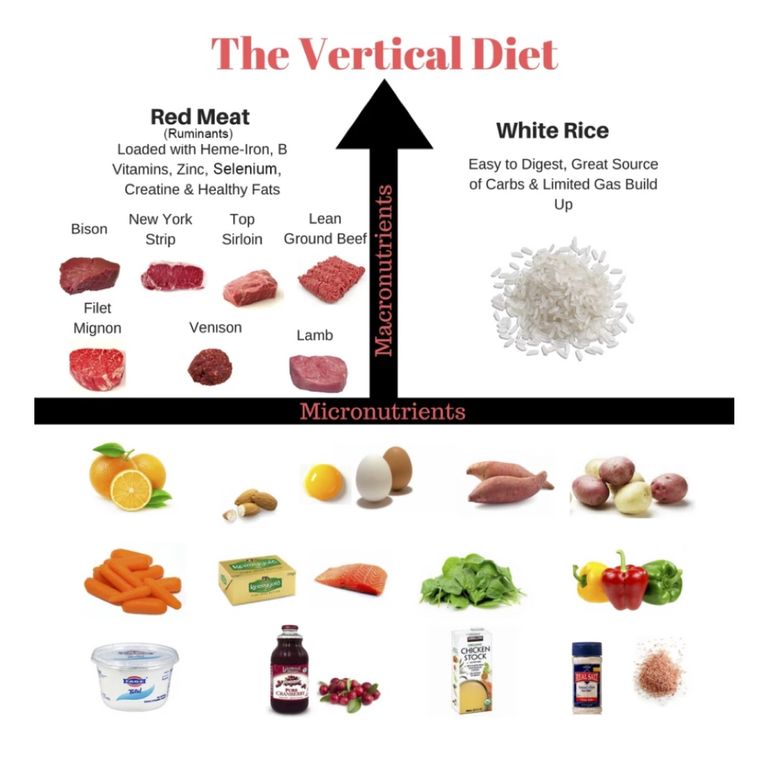
As for what’s off the vertical diet menu: chicken, fish, brown rice, wheat-based and whole-grain foods, beans and legumes, and high-raffinose (a.k.a. gassy) foods, like broccoli and cauliflower. You can’t have added or artificial sugars. There are no onions or garlic allowed, either. Basically, any food that’s not super digestible should be avoided.
The only reason people who aren’t extreme athletes or powerlifters might consider doing a diet like this is if it promises weight loss, right? (Otherwise, just… why?)
But here’s the thing: Though the vertical diet could result in weight loss for some (such as those who eat a lot of processed foods or sugars), it’s not really designed for that. Remember, the diet is supposed to help people gain muscle mass, so to lose weight — as in, fat — on the diet, you have to do some strategic tweaking.
READ MORE: Low-Carb Vs. Keto: What’s The Diff And Which Is Better?
“You could lose weight on this diet if you watch portions and eliminate excessive amounts of white rice and simple carbs,” says Shapiro.
Because the programme limits many plant-based foods needed for weight loss, she adds, you would also want to increase the amount of vegetables and reduce the quantity of fatty cuts of meat and cheese you consume. (Hello, keto’s antithesis!)
Great Q! The vertical diet claims that it will improve your gut health, and that may be true: The diet is based around foods that are mostly low in FODMAPs (a.k.a. fermentable carbs), which can contribute to bloating, gas, diarrhoea and other GI conditions like irritable bowel syndrome (IBS) and Crohn’s disease when eaten in high quantities.
A 2016 review published in Clinical and Experimental Gastroenterology showed that mostly all of the studies done on low FODMAP diets are correlated with improvement of IBS symptoms, with up to 86 percent of patients reporting fewer GI symptoms.
READ MORE: 12 Fasting Tips That’ll Help You Actually Lose Weight (And Not Go Crazy)
So, by sheer virtue of being mostly low in FODMAPs, the vertical diet may ease some of your GI distress. And, certainly, if you’re an athlete looking to put on muscle, the nutrient profile here can help you meet your goals without causing other problems.
“Usually, when you’re trying to put on muscle mass and eating large quantities, you can feel overly full, gassy and bloated,” explains Shapiro. “Vertical-diet foods are streamlined to digest easily and with minimal side effects. But because they are calorically dense, they assist with weight gain” — unless, once again, you customise the plan for your goals.
Though the foods you eat on the vertical diet are relatively clean, whole foods, there’s historically been a lot of concerns about the effects of high red meat consumption on overall health. The American Heart Association warns that eating too much red meat can have negative effects on your cholesterol levels and heart health, but some newer studies — including one done at the Harvard School of Public Health — debate whether red meat is really to blame for heart disease.
READ MORE: 5 Mindful Eating Tips That Will Change Your Relationship With Food
It’s also worth noting that the vertical diet is fairly deficient in fibre, since it emphasises white rice and cuts out whole grains, legumes and some vegetables. Shapiro says that fibre is crucial for maintaining cholesterol levels and heart health (not to mention regular bowel movements). She also notes that the diet is low in probiotics (because it cuts out most fermented foods) and high in animal protein, saturated fat and simple carbs.
So although you’re eating “cleaner,” you’re not necessarily eating more nutritiously — and you could suffer from a lack of fibre and probiotics if you’re not compensating for those losses.
Shapiro says if you’re a bodybuilder or extreme athlete looking to put on mass as your number-one goal, the vertical diet can be an effective way to get there. And even if you’re a more moderate gym rat, she says, it can still work for you — but with some important modifications.
“I would recommend including additional sprouted grains, nuts, seeds, vegetables and fruits, and limiting the intake of saturated fat from red meat and full-fat dairy,” Shapiro advises.
Although the diet mostly eliminates added sugars and processed foods (always a good thing), casual dieters just looking to lose weight might struggle to follow the high-protein, high-carb requirements of the vertical diet without accidentally gaining weight. And they might find themselves deficient in many nutrients that contribute to a broader definition of health.
At the end of the day, it’s your call, but only try an eating plan that suits you — not your kinda-obnoxious, CrossFit-obsessed next-door neighbour.
This article was originally published on www.womenshealthsa.co.za
Image credit: iStock
NEXT ON HEALTH24X

The health secretary says global cases of the new virus are “doubling every five days”.
A year-round acoustic study of marine mammals in the northern Bering Sea is providing scientists with a valuable snapshot of an Arctic world already under drastic pressure from climate change, according to WCS (Wildlife Conservation Society), Columbia University, Southall Environmental Associates, and the University of Washington.
Authors of the new study in the journal Marine Mammal Science conducted a 4-year acoustic monitoring project to determine how seasons, sea surface temperature, and sea ice influence the presence, distribution, and movements of five species of endemic Arctic marine mammals. It is the first study to conduct year-round acoustic monitoring for marine mammals off St. Lawrence Island in the Bering Sea.
“The data gathered during the study will serve as an important baseline for future monitoring of the effects of climate change, subsequent sea ice changes, and expected increases in shipping on the distribution of the region’s marine mammals,” said Emily Chou, WCS scientist and lead author of the study.
The scientists conducted the study between 2012 and 2016 with a focus on five species of Arctic marine mammal: bowhead whales (Balaena mysticetus), beluga whales (Delphinapterus leucas), walrus (Odobenus rosmarus), bearded seals (Erignathus barbatus), and ribbon seals (Histriophoca fasciata).
With the support of local indigenous hunters and fishermen, the scientists deployed archival acoustic recorders in three locations in the northern Bering Sea. “Working with local residents to deploy and retrieve equipment was an important part of our effort to keep the work as locally-based as possible,” said co-author Martin Robards.
Two of the recorders (attached to flotation devices and anchored to the seafloor with weights) were deployed off the northern shore of St. Lawrence Island, specifically near the Native villages of Savoonga and Gambell. The third recorder was placed in the Bering Strait, a 36-mile wide gap between the Russian Far East and Alaska that serves as the migratory pathway for thousands of marine mammals moving between the Bering Sea and the Arctic Ocean.
“Acoustic monitoring is the most effective means of determining the seasonal presence of these species in these challenging Arctic areas, given the unpredictable weather conditions and variable daylight and ice conditions,” said Brandon Southall, a co-author on the study. “It can also be used to measure variability in ocean noise from both natural and human sources, such as shipping, and how they may affect the behavior and well-being of marine mammals.”
The recorders logged more than 33,000 individual vocalizations from whales, walruses, and seals over the study period. Overall, the study supported previous scientific and traditional knowledge about the distribution of marine mammals in the northern Bering Sea with a finer-scale resolution than previously available. The data showed consistent seasonal distribution and movement patterns for most species, and analyses showed that time-of-year was the most statistically significant factor in the detection of marine mammal vocalization.
The study findings will help guide future monitoring efforts on the region’s cetacean and pinniped species and will inform conservation management decisions for acoustically sensitive marine mammals in the context of disappearing ice and projected increases in maritime traffic. Specifically, this type of work and continued monitoring at strategic locations in this Arctic area will eventually help identify trends caused by long-term changes in environmental conditions and human-related activities.
“There is no doubt that the Arctic is currently undergoing rapid and significant changes that are alarming,” said Dr. Howard Rosenbaum, Director of WCS’s Ocean Giants Program. “Our work on Arctic marine mammal populations in this region is essential to assess any forthcoming resulting shifts or changes resulting from warming Arctic conditions, and ultimately working partners and authorities to find solution to protect these iconic species and their habitats”
Story Source:
Materials provided by Wildlife Conservation Society. Note: Content may be edited for style and length.
Used in virtually all of the world’s languages, parentese is a speaking style that draws baby’s attention. Parents adopt its simple grammar and words, plus its exaggerated sounds, almost without thinking about it.
But if parents knew the way they speak could help baby learn, would they alter their speech?
A new study from the Institute for Learning & Brain Sciences, or I-LABS, at the University of Washington suggests they would, to baby’s benefit. Researchers examined how parent coaching about the value of parentese affected adults’ use of it with their own infants, and demonstrated that increases in the use of parentese enhanced children’s later language skills.
The study, published online Feb. 3 in the Proceedings of the National Academy of Sciences, finds that parents who participated in individual coaching sessions used parentese more often than control-group parents who were not coached, and that coaching produced more parent-child “conversational turns” and increased the child’s language skills months later.
“We’ve known for some time that the use of parentese is associated with improved language outcomes,” said Patricia Kuhl, I-LABS co-director and professor of speech and hearing sciences at the UW. “But we didn’t know why. We believe parentese makes language learning easier because of its simpler linguistic structure and exaggerated sounds. But this new work suggests a more fundamental reason.
“We now think parentese works because it’s a social hook for the baby brain — its high pitch and slower tempo are socially engaging and invite the baby to respond.”
Parentese is not what is often called “baby talk,” which is generally a mash-up of silly sounds and nonsense words. Instead, it is fully grammatical speech that involves real words, elongated vowels and exaggerated tones of voice. Spoken directly to the child, it sounds happy and engaged, and helps infants tune in socially to their parents and respond, even if only through babbling.
In a 2018 study, I-LABS researchers tracked use of parentese among adults and their 6-month-old infants, and found that babies whose parents participated in parentese coaching sessions babbled more and produced more words by age 14 months than infants whose parents were not directed in the technique.
The new study focuses on the long-term outcomes of parent coaching and how it led to changes in the parents’ language, in parent-child conversation, and eventually, in the child’s speech at 18 months.
“We had no idea that parents would respond so positively to information about how their own speech to the child affects the child’s language development. Parent coaching gave parents a measurement tool, almost like a Fitbit for parentese, and it worked,” said lead author Naja Ferjan Ramírez, a UW assistant professor of linguistics.
To assess child language output, all families in the study were given a lightweight recorder, which the child wore in a specially designed vest during four separate weekends at ages 6, 10, 14 and 18 months. The device recorded both parent and infant speech over the entirety of two consecutive days, so that researchers could measure parents’ use of parentese, parent-child conversational turns, as well as infant language production — either babbling or actual words. Parent coaching sessions occurred at 6, 10 and 14 months.
For the 48 families randomly assigned to receive coaching, the sessions provided guidance and feedback on specific communication strategies, such as using parentese, speaking directly to the child and engaging the child in back-and-forth exchanges known as conversational turns. In reviewing recordings with parents, researchers played back recordings of parents’ language behaviors and measured them against research-based targets for child language development. Parents were encouraged to include language as part of daily routines and were given language-interaction tips in the form of cards with “brain building” tips from Vroom, a program of the Bezos Family Foundation.
All parents in the study already used parentese at the beginning of the project, but their use varied greatly, the researchers said. Those in the coaching group learned more about the cognitive and social benefits of parentese, when and how to use it to promote interaction with their child, and the positive effects that parentese could have on their child’s language development.
The results show that parent coaching resulted in an increased use of parentese and infant vocalizations that continued to grow after the end of the parent coaching sessions. Between 14- and 18-months, coached families showed a drastic jump in conversational turn-taking and child vocalizations. Children of coached parents produced real words — such as “banana” or “milk” — at almost twice the frequency of children whose parents were in the control group. Parent surveys estimated that the children’s 18-month vocabulary averaged around 100 words among children of coached families, compared to 60 words among children in the control group.
“We know that language skills in infancy predict subsequent stages in language development, so enhancements in language behaviors in infancy could therefore have cascading effects on speech development over time,” said Ferjan Ramírez.
Kuhl added, “Language evolved to facilitate the social communication skills that are essential for survival of the species. In this study, we observe firsthand how parents’ language and social engagement can promote baby’s initial responsive coos, which become words, and then sentences — educating infants in the art of human communication.”
The study was funded by the Overdeck Family Foundation and UW I-LABS Ready Mind Project. Sarah Roseberry Lytle, outreach and education director at I-LABS, was a co-author.
For most social animals, even humans, the ability to distinguish friend versus foe can be a challenge that often can lead to knee-jerk aggression. But when it comes to ants getting aggressive, there’s a more sophisticated method to their madness.
In a new study, published this month in the Journal of Experimental Biology, scientists in the Department of Biological Sciences at Vanderbilt report definitive evidence of a specific mechanism within ants that is responsible for unlocking aggressive behaviors toward other ants. The research — the first to pinpoint this mechanism and its precise role in ant biology — reports a social characteristic which could help account for their evolutionary success.
“Eusocial ants are one of the biggest success stories in evolutionary biology, thanks in no small part to their advanced organizational behaviors and complex social interactions,” said Laurence Zwiebel, senior author of the paper and Cornelius Vanderbilt Chair in Biological Sciences. “For years, researchers have hypothesized that ants have specific chemical markers which play key roles in their interactions. What surprised us is that ants not only have these markers, but require these signals be very precisely decoded by specific receptors to trigger aggression.”
One of the most important aspects of ant identity is the ability to distinguish nestmates from non-nestmates that typically act as bad actors. To do this, they rely on chemical markers made up of specific odorants on their bodies, which Zwiebel refers to as a “coat of many odors,” to emit complex odor blends that act as a sort of personal identifier for other ants.
In this study, the researchers discovered that ants have to smell and correctly decode these specific compounds on intruder ants from other colonies in order to “unlock” their aggressive behavior and defend their nest. This implies that ants default to acceptance and select aggression only if they are specifically triggered.
To study this “lock and key” mechanism, Zwiebel and graduate student Stephen Ferguson, the lead author on the study, gathered Camponotus floridanus ants from nine distinct colonies collected across the Florida Keys.
Before testing, they used a specific chemical agent previously discovered by Zwiebel lab to block or over-excite ant odorant receptors. They set up mini-dueling arenas for two ants (either from the same or different colonies) to interact and, if they decide, fight. During each arena test, they filmed the ants to score the interactions based on their aggressive behaviors — the most common being lunging, biting or dragging.
While ants with normal receptors continued to recognize and fight ants from other colonies, ants with blocked or over-activated receptors displayed dramatically reduced aggressive behavior.
“Accepting friends and rejecting foes is one of the most important decisions an ant worker must make,” said Ferguson. “Our study finds that unless there is a clear and unambiguous threat, ants are more likely to be accepting than they are to be aggressive. This process may have contributed to the evolutionary success of these insects, and there may be important lessons about tempering aggression for other social beings such as humans.”
The research is supported by a grant from the National Institutes of Health and with endowment funding from Vanderbilt University.
Story Source:
Materials provided by Vanderbilt University. Original written by Spencer Turney. Note: Content may be edited for style and length.
