But the final React study found “worrying” signs that infections are still rising in those over 55.


But the final React study found “worrying” signs that infections are still rising in those over 55.
The change is part of a government drive to tackle obesity but will it make a difference to diners?

The tool being used to diagnose concussions might be overestimating the condition and wrongly identifying symptoms like fatigue and neck pain caused from intense exercise and not a brain injury, according to Rutgers researchers.
This new research raises new questions about the Sport Concussion Assessment Tool (SCAT), a questionnaire widely used along with other methods to diagnose concussions sustained during sports. Findings were presented at the American Physiological Society annual meeting April 5.
“Our findings highlight the importance of considering the effects of exercise and fatigue in assessing concussions in athletes on the field,” said the study’s first author, Stephanie Iring, a doctoral candidate in the laboratory of Jorge Serrador, an associate professor at the Rutgers School of Health Professions. “While players with a head impact may report more symptoms generally, we have to be cautious in using all symptoms on the assessment since some are common after intense exercise even when there was no head impact.”
A concussion is a traumatic brain injury usually caused by a blow to the head. Although not typically life-threatening, the effects can be serious and long-lasting. About 3.8 million sports-related concussions are reported each year in the United States.
SCAT is a tool designed for use by medical professionals to determine whether a player has suffered a concussion. The assessment includes questions about “red flag” symptoms such as neck pain, headache, muscle weakness and vision problems in addition to tests to assess memory loss and other symptoms.
In previous studies of the tool, researchers compared symptoms in athletes who experienced a blow to the head with people who have been at rest. For the new study, researchers compared SCAT scores in rugby players who had sustained a blow to the head with teammates who had just played an intense rugby match but did not have a head impact. They assessed 209 players, 80 of whom had experienced a head impact and 129 who had not.
Compared with those who did suffer a head injury, those who did have a head injury had significantly more symptoms on the SCAT assessment, reporting 26 symptoms on average. Non-injured players reported about nine symptoms. However, many players without a head injury had symptoms similar to those reported by head-injured players, including fatigue and neck pain.
“Our data shows that exertion during a match increased the number and severity of self-reported symptoms in control players even though they had not experienced a head impact,” Iring said. “This could lead to difficulty differentiating these players from those that had experienced a head impact when using on-field assessments.”
Some symptoms, including headache and “not feeling right,” were more closely associated with having a head injury. This suggests these symptoms might be a stronger indicator of concussion in players who have just finished an intense game, according to researchers. In addition to headache, other symptoms more common in those with a head injury included cognitive-sensory effects, emotional-affective symptoms and hypersensitivity. The researchers suggested further studies are needed to examine how these components can be used along with current physiological measures to better assess a concussion in athletes.
Story Source:
Materials provided by Rutgers University. Original written by Patti Verbanas. Note: Content may be edited for style and length.

Researchers from a USC-led consortium have discovered 15 “hotspots” in the genome that either speed up brain aging or slow it down — a finding that could provide new drug targets to resist Alzheimer’s disease and other degenerative brain disorders, as well as developmental delays.
The research appears online today in Nature Neuroscience.
“The big game-changer here is discovering locations on the chromosome that speed up or slow down brain aging in worldwide populations. These can quickly become new drug targets,” said Paul Thompson of USC, a lead author on the study and the co-founder and director of the ENIGMA Consortium. “Through our AI4AD (Artificial Intelligence for Alzheimer’s Disease) initiative we even have a genome-guided drug repurposing program to target these and find new and existing drugs that help us age better.”
ENIGMA is working group based at USC that is exploring a vast trove of brain data and has published some of the largest-ever neuroimaging studies of schizophrenia, major depression, bipolar disorder, epilepsy, Parkinson’s disease, and even HIV infection.
To discover the hotspots, or genomic loci, more than 200 ENIGMA-member scientists from all over the world looked for people whose brains were scanned twice with MRI. The scans provided a measure of how fast their brains were gaining or losing tissue in regions that control memory, emotion and analytical thinking.
A million markers screened
After computing brain tissue change rates in 15,000 people of all ages, researchers screened a million markers in their genomes to detect 15 genomic loci — specific, physical locations of genes or other DNA sequences on a chromosome — that were speeding up brain tissue changes.
These loci included some well-known Alzheimer’s risk genes, such as APOE, and some novel ones, Thompson said. The researchers also found overlap with genes involved with depression, schizophrenia and cognitive functioning.
“Some of these genetic variants affect the growth rates of brain substructures in childhood, while others affect the speed of brain tissue loss in older adulthood,” said co-author Neda Jahanshad, an associate professor of neurology at the Keck School of Medicine of USC. “The different parts of the brain have specific genes associated with their rates of change.”
Thompson added, “You can see that APOE — the famous Alzheimer’s gene — hits a couple of brain structures adversely — the hippocampus and amygdala — which also makes sense as they are the brain regions most vulnerable to Alzheimer’s and it seems to speed tissue loss there specifically.”
ENIGMA also has international projects studying childhood brain disorders — from Tourette syndrome and autism to epilepsy. The new list of genes that slow down or speed up brain growth in children provides new leads to pursue in these disorders as well, the researchers said.
About this study
In addition to Thompson and Jahanshad, other USC scientists involved in the study included Sophia Thomopoulos, Joanna Bright, Leila Nabulsi, Linda Ding and Alyssa Zhu, all from the USC Mark and Mary Stevens Neuroimaging and Informatics Institute. For a full list of authors, see the published study.
The study was supported with funding from the National Institutes of Health, including the National Institute on Aging (U01AG068057, R01AG058854, R01AG059874), the National Institute of Mental Health (R01MH117601), the National Institute of Biomedical Imaging and Bioengineering (P41 EB015922), and a Zenith Grant (ZEN-20-644609) from the Alzheimer’s Association.
Story Source:
Materials provided by University of Southern California. Original written by Leigh Hopper. Note: Content may be edited for style and length.

Knowledge creation — the generation of new ideas and patents — is an important driver of economic growth. Understanding how knowledge moves across industry sectors and regions can inform research and development (R&D) efforts, promote university-industry partnerships for innovation, and impact private businesses’ location decisions. A new study from the University of Illinois in collaboration with Stockholm University and Korea Labor Institute provides a thorough look at the flow of knowledge in five industrial sectors across the United States.
“Our work provides a sort of cooking recipe for patent creation, with a list of ingredients that vary by industrial sector,” says Sandy Dall’erba, professor in the Department of Agricultural and Consumer Economics (ACE) and director of the Center for Climate, Regional, Environmental and Trade Economics (CREATE) at U of I. Dall’erba is a co-author on the study.
“Some sectors depend very much on local input factors, such as the presence of a university, versus elements located further away, such as spending in R&D by another private company. In some cases, this type of collaboration takes place across companies located thousands of miles apart as virtual meetings increasingly have replaced face-to-face meetings,” Dall’erba states.
“In addition, our research measures the extent to which innovation in one sector depends on R&D in the same sector or other sectors. For instance, new patents in the drug and medical industry depend on local and distant R&D in the chemical industry.”
Traditionally, geographical proximity was considered essential for knowledge flows. Clusters such as Silicon Valley’s high-tech industry or Detroit’s automobile industry facilitate face-to-face interactions and informal networking. Economists now acknowledge innovations may be shared across greater distances, but most studies have looked at aggregate results rather than location- and industry-specific patterns.
“We wanted to see the importance of geography for the patterns of knowledge creation in specific industries. We also wanted to examine how information flows across similar or different industries. Finally, we look at spillovers from private and university research and development activities,” says lead author Orsa Kekezi, a scholar at the Swedish Institute for Social Research at Stockholm University. Kekezi began working on this research while she was a visiting scholar at Illinois.
The researchers analyzed knowledge transfers across 853 metropolitan U.S. counties in five manufacturing industries: chemical, drugs and medical, mechanical, computer and communication, and electrical and electronic.
The study uses patent applications as a proxy for knowledge creation, tracking the flow from where patents are created to where they are cited (based on data from the U.S. Patent and Trade Office). This measures the directionality of innovation and identifies the role of external factors in knowledge output.
The core elements in the analysis are intra- and inter-sectoral knowledge spillovers, as well as intra- and interregional flows, defined as local (within county), short distance (neighboring counties in 50-mile radius), and the rest of U.S. (beyond 50 miles). The researchers also looked at the presence of university and private research and development, as well as other factors, such as the number of graduate degree holders and the industrial diversity in a county.
“Overall, the local environment matters greatly for all the sectors. The industry structure in the region, the size of firms, whether there is a university — these elements all matter for innovation. All sectors benefit from the local environment,” Kekezi states.
But the specifics vary by sector and provide a complex picture of interactions. There is no one-size-fits-all approach for the development of patents, and if you look at average results, you’ll miss the intricate details and patterns across sectors and regions.
“While university research matters for all the sectors, there is large heterogeneity here as well,” says study co-author Dongwoo Kang, a research fellow at the Korea Labor Institute, South Korea. “For example, it matters more for the chemical industry and the drugs and medical industry; those sectors really benefit from basic research.
“Universities provide the core research that is needed for the chemical industry to work. Unlike perhaps the mechanical or electric industries, the chemical industry relies more on faculty scholars who are looking at basic processes,” he adds.
Interregional spillovers matter less in the chemical industry, so face-to-face contact is important. On the other hand, for the drugs and medical industry, both inter-sectoral and long-distance regional spillovers matter, so geographic proximity is not as necessary. And for the electrical and electronic industry, inter-sectoral short-distance spillovers play a significant role.
The study findings can help companies decide where to locate their establishments.
“The idea that a company values proximity to a university, or where research and development are already happening, still holds true. But we also show the network of innovation is not completely local,” Dall’erba states.
“The main takeaway from the paper is that we should not only look at local spillovers. We should look at knowledge that comes from further away, and from other industries,” Kekezi notes. “New ideas don’t come only by looking at what has been done in one’s field, but also from looking at the broader picture and how we can combine different types of knowledge to create something new.”
The development of COVID-19 vaccines serves as an example, Kang adds.
“The U.S. invested a lot of money in research and development to stimulate innovation in creating the first COVID-19 vaccines. This is typically done through a central cluster that serves as a basis for innovation. But there are also other networks making new COVID-19 vaccines. Our findings imply that not only local activities, but also research and development in other places are important for making new COVID-19 vaccines,” he explains.
The findings can also help improve the design of future local and national innovation policies.
“We need to move away from an approach whereby everything is driven by similar mechanisms and instead understand much better what really works for one industry might be quite different from what works for another industry. It’s not just about promoting industry clusters; it’s more complicated than that. When governments try to promote innovation, they need to define a strategy that works for a specific industry and a specific location,” Dall’erba says.

The UK government’s international LGBT+ conference has been cancelled amid the row over partially banning conversion therapy, multiple reports have suggested.
It comes after more than 100 organisations, including Stonewall, boycotted the landmark Safe To Be Me event, to be held in in London in June, over plans to exclude trans people from the legislation.
Advertisement
Earlier on Tuesday, the government’s LGBT business champion resigned in protest at the decision to water down the ban.
Boris Johnson last week changed the government’s policy twice within a matter of hours.
Advertisement
First, the administration said it was abandoning plans to ban the practice, with the cost of living crisis and war in Ukraine cited as reasons to “rationalise our legislative programme”.
However within hours of the announcement, it was revealed legislation would be included in the Queen’s Speech in May – but trans conversion therapy would be excluded.
Conservative MP Dehenna Davison expressed dismay at the decision to cancel the conference.
Advertisement
“We had such a huge opportunity to prove the UK (and the Conservative Party) is a defender of freedom,” she posted on Twitter.
“As a Conservative member of the LGBT+ community, it is so wrong it has come to this.”
The Times reported a senior Downing Street figure is said to have claimed that “the majority of people won’t care” that the event is not going ahead.
More than 80 LGBT+ groups and more than 20 HIV groups said they will not take part in the global, UK-hosted conference unless Johnson would revert to his promise for a trans-inclusive ban on conversion therapy.
Advertisement
Iain Anderson, the UK’s LGBT+ business champion, quit the role as he accused the government of engaging in a “woke war”.
He said ministers are trying to “drive a wedge” between the community.
Anderson added that it was “profoundly shocking” that the government had backtracked on protection for trans people during the same week that the first trans MP felt able to share his journey.
A government spokeswoman said: “We thank Iain for his contributions as LGBT business champion.
“The government has a proud record on LGBT rights and we remain committed to building upon that work with sensitivity and care.”
On Monday, the UK’s first openly trans MP has said he is “bitterly disappointed” by his own government’s decision to scrap the ban on trans conversion therapy.
Jamie Wallis, who came out last week in a heartfelt post shared on Twitter, said pressing ahead with outlawing conversion therapy – but not for trans people – would be a “broken promise”.
This is a breaking news story and will be updated. Follow HuffPost UK on Twitter, Facebook and Instagram.

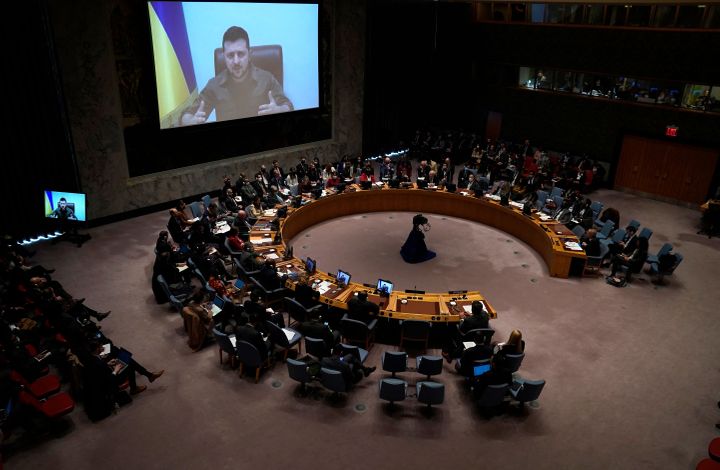
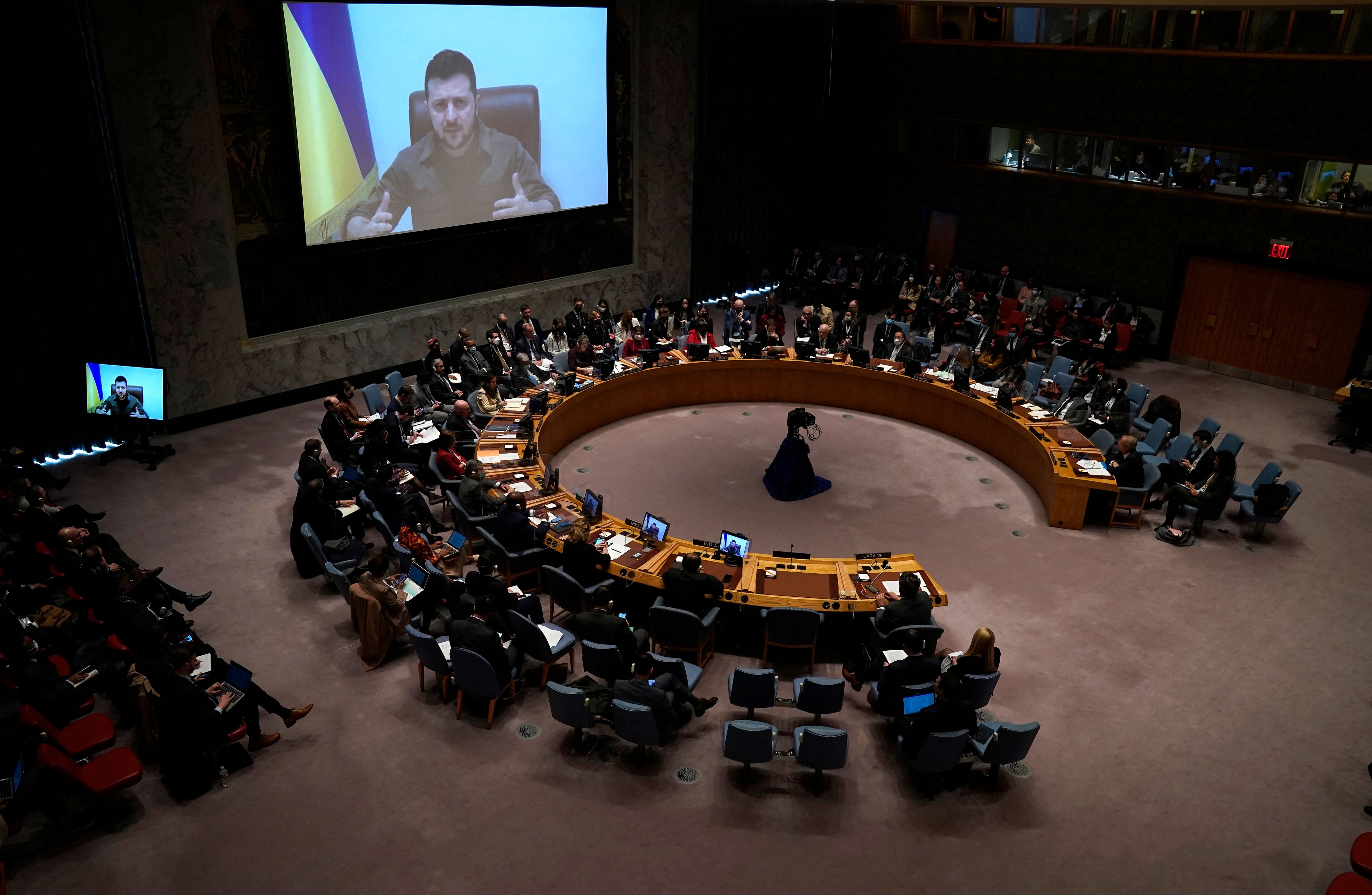
Addressing a meeting of the United Nations Security Council remotely on Tuesday, Ukrainian President Volodymyr Zelenskyy described the alleged atrocities uncovered in recent days as Russian troops moved out of areas in northern Ukraine.
“The most terrible war crimes we’ve seen since the end of World War II are being committed,” Zelenskyy told the council assembled in New York City, later arguing that “Russia wants to turn Ukraine into silent slaves.”
Advertisement
Zelenskyy proposed a tribunal for Russians who ordered or carried out war crimes similar to the Nuremberg trials in the years directly following the second world war.
Ukrainian authorities and journalists have seen evidence of widespread civilian casualties in Bucha, a suburban area northwest of Kyiv. U.S. Secretary of State Antony Blinken described the casualties as evidence of “a deliberate campaign to kill, to torture, to rape” ― not “the random act of a rogue unit.”
President Joe Biden on Monday called for Russian President Vladimir Putin to be held accountable for the violence, which he described as a war crime.
Russia has repeatedly asserted that the violence was committed after its forces left the region. Blinken, however, said Tuesday that reports of atrocities committed by the Russians are “more than credible.”
Advertisement
“I’m addressing you on behalf of the memory of the deceased,” Zelenskyy told the U.N. council. “They died suffering.”
He alleged that Russian troops searched for and killed “anyone who served our country,” including entire families, executing many people in the street. Other people were thrown in wells, Zelenskyy claimed, and some had their limbs or tongues removed. Photographs showed that some of the dead had their hands tied behind their backs.
The world has yet to see the full extent of the brutality, Zelenskyy added.
TIMOTHY A. CLARY via Getty Images
The Russians’ behavior is “no different than ISIS,” Zelenskyy said. “And here it is done by a member of the United Nations Security Council.”
Advertisement
The Ukrainian leader condemned the group, whose permanent members include the Russian Federation, for not doing more to end the conflict. He proposed three options: Remove Russia from the security council, reform the council, or dissolve it completely.
Citing what he called Ukraine’s “moral right” to propose reforms, Zelenskyy argued that Russia’s veto power makes the council worthless in fulfilling its main purpose of peacekeeping.
There is currently no process for removing a member of the security council.
“Accountability must be inevitable,” Zelenskyy said.
The Ukrainian delegation sent a video to be played following the president’s remarks, but technical issues prevented it from being shown immediately afterward.
U.S. Ambassador to the United Nations Linda Thomas-Greenfield subsequently announced that the U.S. would seek to suspend Russia from the United Nations Human Rights Council, noting that Russia has used false allegations of human rights abuses on the part of Ukraine to justify its invasion.

Boris Johnson has urged Russian people to use alternative forms of news to find out about Vladamir Putin’s alleged war crimes, arguing they would not support the invasion and crimes that are a “stain on the honour of Russia”.
In a video message directed to the Russian population, the UK prime minister said they only needed an online VPN connection to sidestep state-controlled media and gain access to independent information from around the world.
Advertisement
“Your president knows that if you could see what was happening, you would not support his war,” he said.
“He knows that these crimes betray the trust of every Russian mother who proudly waves goodbye to her son as he heads off to join the military.
Advertisement
“And he knows they are a stain on the honour of Russia itself.”
Speaking in Russian, he added: “Your president stands accused of committing war crimes. But I cannot believe he’s acting in your name.”
Advertisement
His comments follow global outrage at the massacre uncovered at Bucha, a Ukrainian town, that was targeted by the Russian forces on their way to conquer Kyiv in March.
Volodymyr Zelenskyy accused Russia of committing the “most terrible war crimes” since the Second World War as he called for trials akin to those held after the defeat of the Nazis.
The Ukrainian president accused Putin’s forces of creating “mass starvation” and shooting and raping civilians, during a graphic address to the United Nations Security Council on Tuesday.
Russian forces then began to withdraw from the region around March 30, reportedly due to a shortage of resources, meaning journalists have been able to access to beleaguered Bucha once again.
Advertisement
The Associated Press released images from the town showing bodies on the Bucha streets, with their hands tied behind their backs and wounds to the back of their heads.
According to the news agency, at least 21 bodies were found, with at least nine of them in civilian clothing.
Anatoly Fedoruk, Bucha’s mayor, said more than 300 residents in the town had been killed, while Ukrainian prosecutors allege Russian forces used the basement of one house as a torture chamber.
Satellite images showed a 45ft-long mass grave in the town too.
Russia has denied any involvement and suggested the bodies were placed their strategically by the Ukrainians.
Moscow has dismissed any accusations of war crimes too, and claims “Ukrainian radicals” are responsible for the massacre in Bucha as “not a single civilian” faced violent military action from Russian forces.
TIMOTHY A. CLARY via Getty Images
In his message, Johnson said the reports were so shocking that Putin had deliberately sought to hide the truth from his people.
Johnson said that people only needed a VPN connection to access independent information from around the world.
“When you find the truth, share it,” he said.
“Those responsible will be held to account. And history will remember who looked the other way.”
During the UK-convened meeting of the UN’s most powerful body, whose membership includes Russia, Zelenskyy called for those responsible to be “brought to justice” in a tribunal similar to the Nuremberg trials.
He warned the world is yet to see the acts committed by the Kremlin’s troops in other regions after evidence of atrocities was unearthed after their withdrawal from Bucha, near Kyiv.
Advertisement
“Today, as a result of Russia’s actions in our country, in Ukraine, the most terrible war crimes we’ve seen since the end of World War Two are being committed,” he said in the virtual address.
“Russian troops are deliberately destroying Ukrainian cities to ashes with artillery and air strikes. They are deliberately blocking cities, creating mass starvation. They deliberately shoot columns of civilians on the road trying to escape from the hostilities.
“They even deliberately blow up shelters where civilians hide from air strikes.
“The massacre in our city of Bucha is unfortunately only one of many examples of what the occupiers have been doing on our land for the past 41 days.”

China’s financial hub is now subject to indefinite restrictions after Covid cases hit a new high.
Progress in England has been static for six years – and pandemic may make outlook worse, MPs say.
