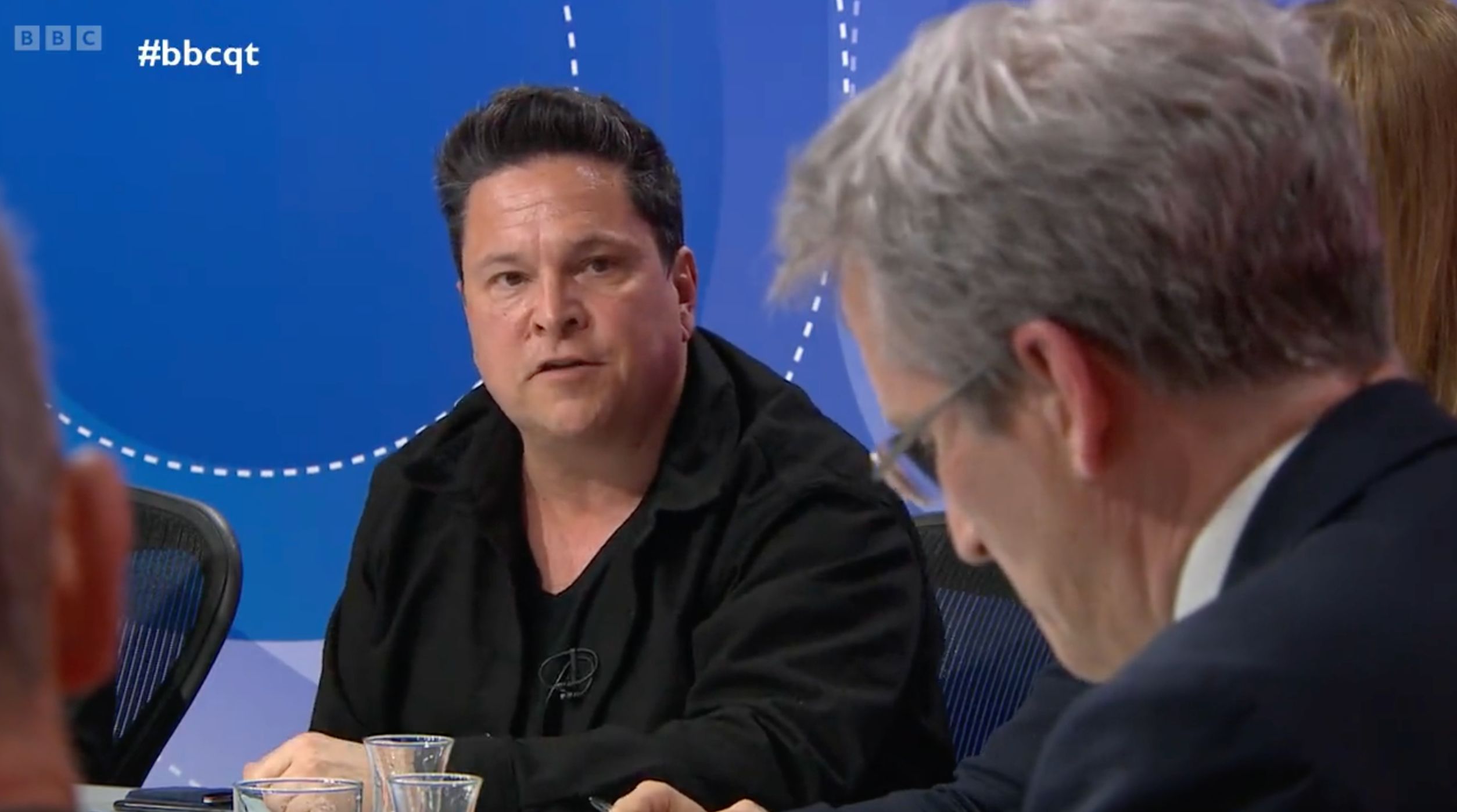
BBC Question Time: Comedian Dom Joly Blasts Government’s ‘Disgusting’ Treatment Of Ukrainian Refugees

Comedian Dom Joly has condemned the government’s “disgusting” treatment of Ukrainian refugees as he blasted the visa requirement and ministers’ fears of letting in spies.

Speaking on BBC’s Question Time, the Save the Children ambassador also criticised Conservative policies that tried to deter the “wrong sort of refugee”.

Joly took issue with the bureaucracy around the Homes for Ukraine scheme, with the government yet to say how many visas have been issued via the programme.

He also spoke out against ministers warning that women fleeing Ukraine could be Russian spies coming to Britain to launch Salisbury-style attacks.

Joly said: “Firstly, this government seems to … well, its supporters mainly, seem to have an anti-refugee, anti-immigrant feeling and so I think they feed off that, they feel that is the way to go.

“And certainly they have been incredibly confused by the fact that people seem to be incredibly sympathetic towards Ukrainian refugees and I cannot, for the life of me, see what the difference is between Ukrainian refugees and Syrians and Afghans. Well, actually, I can and I think that is one of the reasons, for instance, that there were no visa offices set up at Calais, because they did not want the wrong sort of refugee or immigrant turning up.”

He said the apparent sluggishness in issuing visas via the Homes for Ukraine scheme spoke to the “ludicrous amount of complications”.

“Why are we the only country asking people to have visas?,” he said, referring to the European Union, by contrast, granting temporary residency to Ukrainians fleeing the invasion and giving them access to employment, social welfare and housing for up to three years.

“There was this ridiculous excuse that somehow some of these people might be spies or they might be secret agents coming to do that. Well, that does not seem to affect any other country, so why are we so special?”

He finished: “I think it is disgusting the way we treat it, I really do.”

Almost a week after its launch, the government has not confirmed how many Homes for Ukraine applications have been successful. On Question Time, government minister Damian Hinds said a report detailing the figures has yet to be published, but “thousands” of Ukrainians with family links have been given visas.

He said: “Everybody recognises that there is the most enormous humanitarian emergency going on. We are a warm-hearted, kind-hearted nation, and we must do not only our share, but we want to do more than our share.”

Share Button

New Fermi arcs could provide a new path for electronics

Newly discovered Fermi arcs that can be controlled through magnetism could be the future of electronics based on electron spins. These new Fermi arcs were discovered by a team of researchers from Ames Laboratory and Iowa State University, as well as collaborators from the United States, Germany, and the United Kingdom. During their investigation of the rare-earth monopnictide NdBi (neodymium-bismuth), the research team discovered a new type of Fermi arc that appeared at low temperatures when the material became antiferromagnetic, i.e., neighboring spins point in opposite directions.

Fermi surfaces in metals are a boundary between energy states that are occupied and unoccupied by electrons. Fermi surfaces are normally closed contours forming shapes such as spheres, ovoids, etc. Electrons at the Fermi surface control many properties of materials such as electrical and thermal conductivity, optical properties, etc. In extremely rare occasions, the Fermi surface contains disconnected segments that are known as Fermi arcs and often are associated with exotic states like superconductivity.

Adam Kaminski, leader of the research team, explained that newly discovered Fermi arcs are the result of electron band splitting, which results from the magnetic order of Nd atoms that make up 50% of the sample. However, the electron splitting that the team observed in NdBi was not typical band splitting behavior.

There are two established types of band splitting, Zeeman and Rashba. In both cases the bands retain their original shape after splitting. The band splitting that the research team observed resulted in two bands of different shapes. As the temperature of the sample decreased, the separation between these bands increased and the band shapes changed, indicating a change in fermion mass.

“This splitting is very, very unusual, because not only is the separation between those bands increasing, but they also change the curvature,” Kaminski said. “This is very different from anything else that people have observed to date.”

The previously known cases of Fermi arcs in Weyl semimetals persist because they are caused by the crystal structure of the material which is difficult to control. However, the Fermi arcs that the team discovered in NdBi are induced by magnetic ordering of the Nd atoms in the sample. This order can be readily changed by applying a magnetic field, and possibly by changing the Nd ion for another rare earth ion such as Cerium, Praseodymium, or Samarium (Ce, Pr, or Sm). Since Ames Lab is a world leader in rare earth research, such changes in composition can be easily explored.

“This new type of Fermi arcs appears whenever the sample becomes antiferromagnetic. So when the sample develops magnetic order, these arcs just appear seemingly out of nowhere,” said Kaminski.

According to Kaminski, another important characteristic of these new Fermi arcs is that they have what is called spin texture. In normal metals, each electronic state is occupied by two electrons, one with a spin up, one with a spin down, so there is no net spin. The newly discovered Fermi arcs have single orientation of spin at each of their points. Since they exist only in a magnetically ordered state, the arcs can be switched on and off very quickly by applying a magnetic pulse, for example from an ultrafast laser.

“Having such a spin decoration or spin texture is important because one of the quests in electronics is to move away from the charge-based electronics. Everything that you use now is based on moving electrons in wires and that causes dissipation,” Kaminski said.

The ability to control the spin of electrons relates to a new branch of information technology called spintronics, which is based on electron spin rather than on moving charges along wires.

“Instead of moving a charge, we either flip the orientation of the spin or cause the propagation of the spin along the wire,” Kaminski explained. “These spin changes technically should not dissipate energy, so it doesn’t cost a lot of energy to store information as spin or to move information as spin.”

Kaminski emphasized the importance of this finding to the field, but he said there is still a lot of work to be done before these findings can be used in new technology.

Crystal growth and characterization were supported by Center for the Advancement of Topological Semimetals (CATS), an Energy Frontier Research Center funded by the U.S. DOE, Office of Basic Energy Sciences.

Share Button

Carbon-coated nickel enables fuel cell free of precious metals

A nitrogen doped carbon-coated nickel anode can catalyze an essential reaction in hydrogen fuel cells at a fraction of the cost of the precious metals currently used, Cornell University researchers have found.

The new discovery could accelerate the widespread use of hydrogen fuel cells, which hold great promise as efficient, clean energy sources for vehicles and other applications.

It’s one of a string of discoveries for the Héctor D. Abruña lab in their ongoing search for active, inexpensive, durable catalysts for use in alkaline fuel cells.

“This finding makes progress toward using efficient, clean hydrogen fuel cells in place of fossil fuels,” said Abruña, professor in the department of chemistry and chemical biology at Cornell University.

The results published March 21 in “A Completely Precious-Metal-Free Alkaline Fuel Cell With Enhanced Performance Using a Carbon-Coated Nickel Anode,” in the Proceedings of the National Academy of Sciences.

Expensive precious metals, such as platinum, are currently required in hydrogen fuel cells to efficiently catalyze the reactions they employ to produce electricity. Although alkaline polymer electrolyte membrane fuel cells (APEMFCs) enable the use nonprecious metal electrocatalysts, they lack the necessary performance and durability to replace precious metal-based systems.

A fuel cell produces electricity through the hydrogen oxidation reaction (HOR) and an oxygen reduction reaction (OOR). Platinum, in particular, is a model catalyst for both reactions because it catalyzes them efficiently, and is durable in the acidic environment of a PEM fuel cell, Abruña said.

But what about other materials?

Recent experiments with nonprecious-metal HOR electrocatalysts needed to overcome two major challenges, the researchers wrote: low intrinsic activity from too strong a hydrogen binding energy, and poor durability due to rapid passivation from metal oxide formation.

To overcome these challenges, the researchers designed a nickel-based electrocatalyst with a 2 nanometer shell made of nitrogen-doped carbon.

Their hydrogen fuel cell has an anode (where hydrogen is oxidized) catalyst consisting of a solid nickel core surrounded by the carbon shell. When paired with a cobalt-manganese cathode (where oxygen is reduced), the resulting completely precious-metal-free hydrogen fuel cell outputs more than 200 milliwatts per square centimeter.

The presence of nickel oxide species on the surface of the nickel electrode slows the hydrogen oxidation reaction dramatically, Abruña said. The nitrogen-doped carbon coating serves as a protection layer and enhances the HOR kinetics, making the reaction quicker and much more efficient.

In addition, the presence of the graphene coating on the nickel electrode prevents the formation of nickel oxides — resulting in electrodes with dramatically enhanced lifetimes. These electrodes are also much more tolerant to carbon monoxide, which rapidly poisons platinum.

“The use of this novel anode would dramatically lower prices enabling the application of alkaline fuel cells in a wide variety of areas,” Abruña said.

In February, Abruña and colleagues found that a cobalt nitride catalyst is nearly as efficient as platinum in catalyzing the oxygen reduction reaction.

Funding for this research was provided by the Center for Alkaline-Based Energy Solutions, an Energy Frontier Research Center funded by the U.S. Department of Energy, Office of Science, Basic Energy Sciences, and the Zhuang research group at Wuhan University, China, supported by the National Natural Science Foundation of China.

Story Source:

Materials provided by Cornell University. Original written by Kate Blackwood, courtesy of the Cornell Chronicle. Note: Content may be edited for style and length.

Share Button

Anoosheh Ashoori: Freed Iran Detainee ‘Angry’ UK Government Delayed Paying Debt To Tehran

A father freed from a prison in Iran after a five-year ordeal has said he feels “angry” the UK government took so long to secure his release.

Anoosheh Ashoori, 68, a retired civil engineer, accused Boris Johnson of “opportunism” after the prime minister ignored his request for an intervention two years ago, and is now offering a meeting.

Ashoori, a British-Iranian dual national, was arrested in August 2017 while visiting his elderly mother in Tehran.

He was detained in the notorious Evin prison for almost five years, having been accused of spying. He consistently and vigorously denied the allegations.

Ashoori was released at the same time as charity worker Nazanin Zaghari-Ratcliffe, and came after months of intensive diplomatic negotiations between London and Tehran.

The UK finally agreeing to settle a £400 million debt dating back to the 1970s appeared to break the deadlock.

British-US national, Morad Tahbaz, remains imprisoned in Iran.

<img class="img-sized__img landscape" loading="lazy" alt="Nazanin Zaghari-Ratcliffe and Anoosheh Ashoori.” width=”720″ height=”480″ src=”https://www.wellnessmaster.com/wp-content/uploads/2022/03/anoosheh-ashoori-freed-iran-detainee-angry-uk-government-delayed-paying-debt-to-tehran-2.jpg”>
Nazanin Zaghari-Ratcliffe and Anoosheh Ashoori.

Leon Neal via PA Wire/PA Images

The mother-of-one said she was let down by successive foreign secretaries before she was finally freed last week.

Speaking at a press conference in the House of Commons, Zaghari-Ratcliffe said she disagreed with her husband, Richard, who had thanked the government for finally reaching a deal over a £400 million debt owed to Iran by the UK over an order for Chieftain tanks more than 40 years ago.

The British-Iranian said there had been five different foreign secretaries over the course of her six years in jail.

She said: “How many foreign secretaries does it take for someone to come home? Five?

“What’s happened now should have happened six years ago.”

When asked on Beth Rigby Interviews on Sky News whether, after being held for nearly five years under four different foreign secretaries, he felt forgotten, Ashoori replied: “I agree with Nazanin 100%. She in fact put her finger on the right button by saying that. She should have been here years ago, if that debt was paid. That wasn’t a ransom, that was a debt that the British government owed. It should have been paid, and if it was paid perhaps none of this would have happened. So yes, I feel a bit angry.”

He added the prime minister had written to him “eager to see us”, despite Johnson previously snubbing a 2020 voicemail from Ashoori that attempted to get his case heard (his wife, Sherry, did not hear back).

Ashoori said: ”​I think that it’s a bit of opportunism involved in it, at the same time as all of this has happened under his command. So one could argue that it was the British government, the present British government, that succeeded in doing that, which is correct. At the same time you could say that why didn’t you contact us, my family, and now you are eager to do that.

“How would you expect us to absorb that? How would you expect us to think of you with this letter now? Why couldn’t this letter be sent five months ago, a year ago, two years ago? Why now?”

Ashoori said he was “not sure” whether he would see Johnson now.

In an interview with the Guardian, Ashoori questioned whether ministers would have acted earlier if they had spent just a day in Evin.

He told the newspaper: “Is it such a big job to pay this debt? Would those ministers be able to stand even one day of their life in Evin? If they could feel what it is like maybe they would have made the right decision much earlier. You cannot imagine yourself in that hell, that cesspool.”

Share Button

Distant regions of the human brain are wired together by surprisingly few connections

Understanding how the brain functions, particularly how information is processed during different activities, is difficult without knowing how many axons are in the brain and how many connect different functional regions. An approach by Burke Rosen and Eric Halgren at the University of California, San Diego, U.S. published March 24 in the open-access journal PLOS Biology, shows that despite the functional importance of connections between far-reaching regions of the brain, the actual number of these connections is low.

In the new study, researchers combined diffusion MRI data from the Human Connectome Project with histological cross-sections of the corpus callosum, the major tract that connects the left and right sides of the brain. The Human Connectome maps the strength of all connections in the brain but does not provide the actual number of axons, while the histological cross-sections allow estimates for how many axons are packed into a given volume. Combining the connection strengths with the axon densities yielded estimates for the number of axons in the cerebral cortex.

The analysis indicated that there are almost 2.5 billion long-range axons traversing the cerebral cortex. However, despite this large number, they found that the numbers connecting different functional brain regions were quite low. For example, among the estimated 130 million axons in the arcuate fasciculus tract, only about 1 to 2 million (less than 2%) directly connected Broca’s and Wernicke’s areas, a connection which is necessary for normal language ability. The model predicts that other long connections, like those from the hippocampus to the frontal cortex that are needed for memory retrieval, are actually made in multiple steps. The findings will thus improve models of cognition, especially processes that rely on connections between distal regions of the brain.

“A major unsolved problem is how the human cortex integrates information processing by its 16 billion neurons across its surface to unify awareness,” Rosen adds. “Our finding that cortical areas are sparsely connected implies that this integration is accomplished either via linkage of the dense local connections or by rare, extraordinarily privileged long-range axons.”

Story Source:

Materials provided by PLOS. Note: Content may be edited for style and length.

Share Button

Hundreds of patients dying due to A&E delays, doctors say

An estimated 240 patients are said to have died unnecessarily in Scotland this year because of A&E delays.

Share Button

Persistent cough may be tuberculosis not Covid, doctor warns

Dr Jenny Harries’ warning comes as early data shows there were 4,430 TB cases in England in 2021.

Share Button

UK Sends 6,000 More Missiles To Ukraine In Johnson Push To ‘Keep Flame Of Freedom Alive’

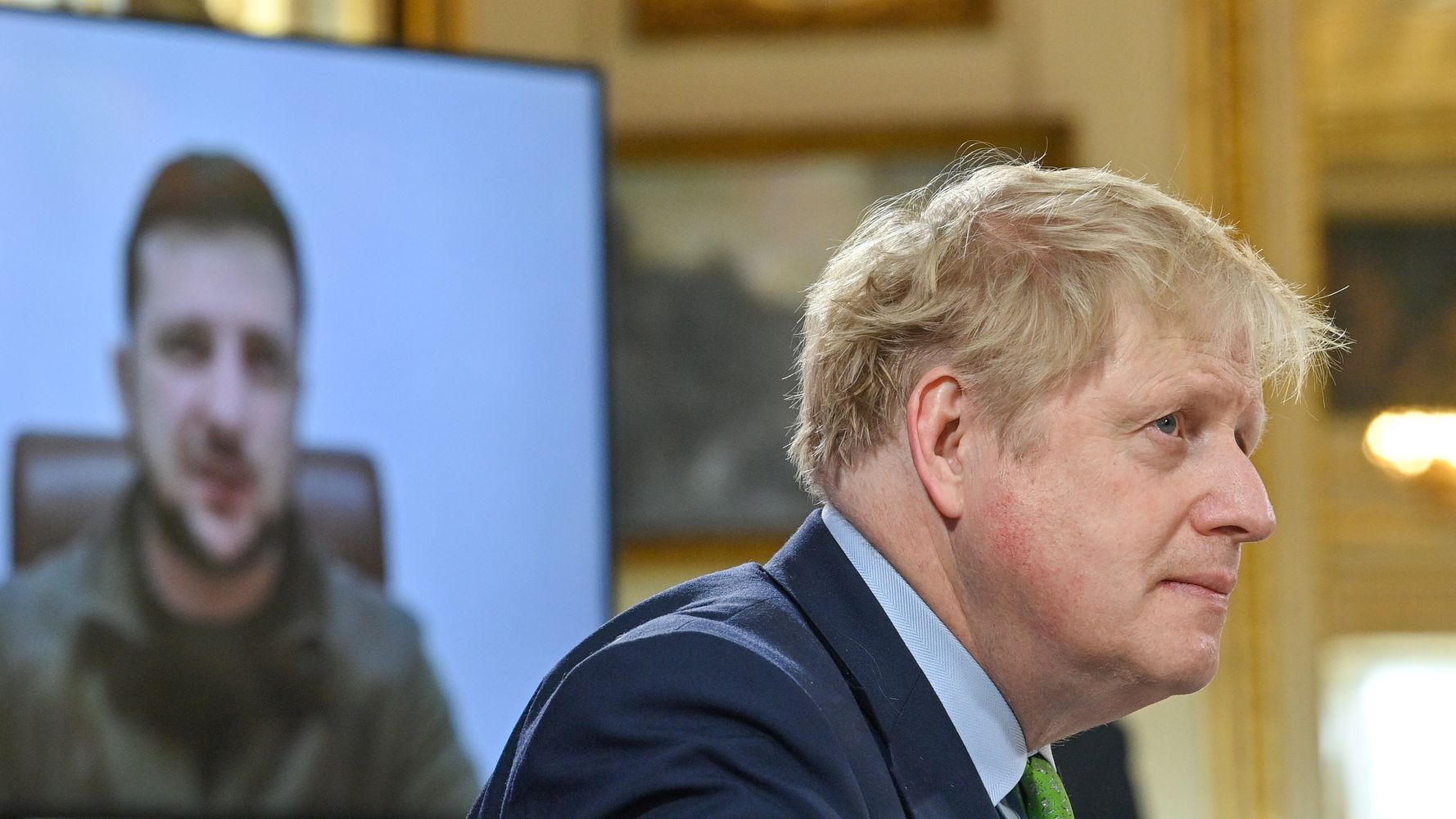
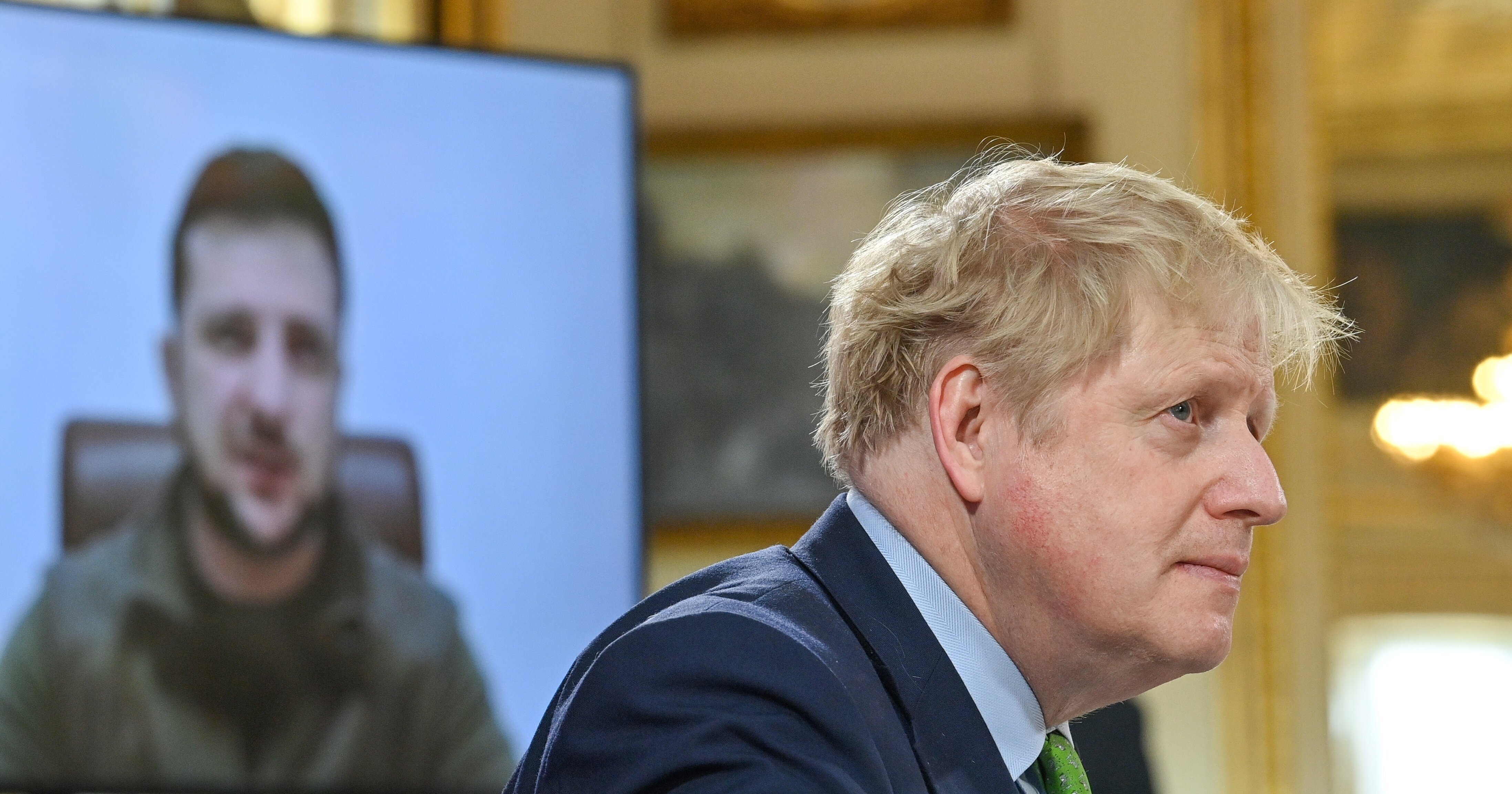
The UK is to send 6,000 more missiles to Ukraine to bolster Kyiv’s fight against Russia’s invasion as Boris Johnson urged Western allies to help “keep the flame of freedom alive”.

The British prime minister will use as summit of Nato and G7 leaders to detail a new support package for the Ukrainian military, including thousands of missiles comprising anti-tank and high-explosive weaponry.

In addition, the UK is providing £25 million from the Foreign Office’s conflict security and stabilisation fund to help pay the salaries of Ukrainian soldiers and pilots battling the Russians.

Ahead of his visit to Brussels on Thursday for talks, a month on from the Russian invasion, Johnson called on other Western leaders to step up the supply of military hardware to Kyiv as well as doubling down on sanctions against Russia.

“Vladimir Putin is already failing in Ukraine. The Ukrainian people have shown themselves to be extraordinarily brave and tenacious in defending their homeland, in the face of an unprovoked onslaught,” he said.

“But we cannot and will not stand by while Russia grinds Ukraine’s towns and cities into dust. The United Kingdom will work with our allies to step up military and economic support to Ukraine, strengthening their defences as they turn the tide in this fight.

“One month into this crisis, the international community faces a choice. We can keep the flame of freedom alive in Ukraine, or risk it being snuffed out across Europe and the world.”

Britain has already sent more than 4,000 anti-tank weapons to Ukraine, including next-generation light anti-tank weapons systems (Nlaws) and Javelin missiles.

The UK is also supplying and training Ukrainian troops in the use of Starstreak high-velocity anti-air missiles as well as providing body armour, helmets and combat boots.

In a further move, the government is to provide an additional £4.1 million to the BBC World Service to counter disinformation in Russia and Ukraine as well as new support for the International Criminal Court (ICC).

Justice secretary Dominic Raab will chair a meeting of justice and foreign ministers in The Hague to coordinate support for the ICC’s war crimes investigations.

He is expected to announce an additional £1 million in funding for the court, as well as new support from UK soldiers with expertise in intelligence gathering and Scotland Yard’s War Crimes Team.

Volodymyr Zelenskyy’s predecessor told ITV News on Tuesday: “Please, no comparison.”

“How many citizens of the United Kingdom died because of Brexit? Zero,” he said, pointing to “only today” 150 Ukrainian children were killed by the Russian military and that whole cities have been completely destroyed.

Johnson also faced a backlash on Wednesday for pulling faces in the Commons as chancellor Rishi Sunak described Ukrainians huddled in basements.

The latest UK military intelligence suggests Russia is failing to break the spirit of the Ukrainian population as its invasion continues to stall.

In an intelligence briefing on Tuesday night, the ministry of defence said attempts to use media manipulation, propaganda and install pro-Kremlin local leaders have so far been unsuccessful.

Share Button

Rishi Sunak Confronted On Live Radio By Mother Who Cannot Afford To Heat Home

A single mother-of-two has confronted Rishi Sunak about how she cannot afford to heat her home despite taking on two extra jobs and reducing her grocery bill to £15 a week.

On LBC Radio, Hezel tackled the chancellor – on the day of his spring statement – about the “intense strain” rising costs had put on her ability to provide for her children, despite “on paper” having what is considered a good salary.

She said a government grants are not “going to cut it” as she asked Sunak “what else you suggest I can be doing to help myself”.

Experts – including consumer champion Martin Lewis – have said measures in Sunak’s financial update will do not go far enough in alleviate the squeeze on households.

The caller said: “The significant increase in our energy bills has meant that we don’t have the boiler on.

“The lights are always off unless absolutely necessary and when it’s cold, we wear jumpers and coats and sometimes you can see our breaths when we breathe.

“Now, despite working a full-time job I’m having to find ways to bridge the gap. I’ve started cleaning houses and I spend every evening riding a bike delivering Uber Eats.

“I’ve managed to cut my grocery shop down to just £15 a week for an adult and two children, and I often go without myself to make sure the kids get what they need and they’re fed.”

Sunak replied that he “cannot imagine how difficult” her job was, as he has a “wife and other help”, adding that he pays tribute to her for “working your socks off to look after them”.

He pointed to the energy bill rebate and higher national insurance threshold that will give a tax cut in July, although it will only offset a tax rise due in April.

Share Button

Martin Lewis On Rishi Sunak Tackling The Cost Of Living Crisis: ‘Nowhere Near Enough’

Money Saving Expert Martin Lewis has said Rishi Sunak’s spring statement announcements to help tackle the cost of living crisis were “nowhere near enough”.

On Wednesday, the chancellor brought fuel duty down by 5p until next March, raised the national insurance contribution thresholds to remove more low-paid workers from paying it, and took a penny off the basic rate of income tax by 2024.

But the founder of moneysavingexpert.com, speaking to Sky News, made clear there was very little to help with soaring household bills.

Lewis said the national insurance change would have a limited impact on people claiming Universal Credit. and extra cash for a “starving or freezing” fund would only help those in the most extreme circumstances.

Lewis said: “The chancellor has done more than I expected him to do but still nowhere near enough.

“We are still standing on a personal finance precipice in the UK.

“The chancellor is now the only person who can pull us back from that and I don’t think what we saw today is enough to do it.”

Lewis pointed to a “very dangerous time” where typical households will see their energy bills in October go up by £1,300 compared to the same time a year earlier.

“There is nothing close in this budget to covering that amount of money,” he said.

The consumer journalist said the country was reaching the point where people were “heating the human not heating the home”. He explained: “Don’t turn your central heating on, sit in a sleeping back. This is not advice, this is the tangible situation people are putting themselves in. Whether you have to get an electric blanket to get the heat you need, then leave the house to be cold. That is a tactic I am seeing people doing. Stark, isn’t it?”

He added in a message to Sunak: “Chancellor, you are the only person who can help.”

Share Button