Making diversity, equity, inclusion integral part of physics education

While many physics instructors are beginning to incorporate lessons on diversity, equity, and inclusion (DEI) in the classroom, it can often feel like an add-on rather than an integral component of becoming a physicist.

In The Physics Teacher, by AIP Publishing, scientists from Carleton College and the University of Colorado Boulder are helping to change this narrative by presenting discussions and activities on DEI as a fundamental and essential part of physics training beyond the introductory physics level.

“Diversity, equity, and inclusion are a part of being a physicist, just as much as knowing about quantum mechanics or using an oscilloscope,” said author Martha-Elizabeth Baylor.

The team created two separate approaches for DEI curriculum at the intermediate level in 30-person and 75- to 120-person classrooms. The former replaced one question on a weekly homework assignment with a reflection essay on a topic important to physicists. The latter included activities and discussions during a two-day unit on representation.

“On the whole, students respond positively to covering this material in a physics class,” said author Jessica Hoehn. “They are eager for these conversations.”

The reflection essays in the first approach were a small component of a larger “Practicing Professionalism” framework, which explored what physicists know, do, and care about. Meanwhile, the second approach tested students on the ideas within their DEI activities and discussions, just as it would with other course content.

Baylor said students began the term by writing themselves out of the definition of a physicist. However, that changed by the end of the class.

“Many students come to see that the physics community thinks about the things that they think about, the things they care about,” said Baylor. “They find that anybody can be a physicist. They just have to care about physics, choose to do physics, and choose that as part of their identity.”

For women in these classes in particular, a large theme emerged: Their feelings about being in physics were particular to the cultural environment in the U.S.

The authors believe instructors can look at each curriculum and design their own lessons that they are comfortable enacting. The individual reflection activities in the first approach may be an easier start for instructors who want to engage with students on an individual basis, rather than lead a class discussion.

The researchers recommend looking at their resources for ideas, then gathering feedback and iteratively improving the curriculum. They hope to help other instructors frame physics as a human endeavor.

“We’re doing this, because if you enter the physics community, you need to be able to engage intelligently and respectfully in these conversations,” said Baylor.

Story Source:

Materials provided by American Institute of Physics. Note: Content may be edited for style and length.


Share Button

Changing the standard of care for stage III melanoma surgery

For years, surgery for patients with stage III melanoma — melanoma that has spread to the lymph nodes — involved removing those lymph nodes along with the primary tumor. Known as completion lymph node dissection (CLND), the surgery was meant to ensure that no cancer remained after surgery.

More recently, however, cancer surgeons have discovered that CLND has the potential to cause more problems than it solves. In most cases, patients do better on immunotherapy alone than they do when their surgery involves removal of the lymph nodes, due to potential complications from lymph node surgery.

In a paper published in February in the Annals of Surgical Oncology, University of Colorado (CU) Cancer Center members Martin McCarter, MD, Camille Stewart, MD, Karl Lewis, MD, William Robinson, MD, Ana Gleisner, MD, PhD, and Rene Gonzalez, MD — along with CU School of Medicine resident Robert Torphy, MD, PhD — reviewed their patient data to determine if immunotherapy alone resulted in better outcomes than CLND.

“In the few years prior to immunotherapy being available, some surgical trials were done asking if regional node dissection by itself improves overall survival for the patients,” says McCarter, a professor of surgical oncology at the CU School of Medicine. “And the answer came back: no, it did not improve survival. That had been the standard forever, because we didn’t have other effective therapies, but once the definitive trials were done, we learned that CLND wasn’t helping, it wasn’t improving survival. Subsequent trials demonstrated that immunotherapy can improve survival in metastatic melanoma.”

Better outcomes with immunotherapy

For the study, Torphy, working with McCarter and the other researchers, looked at data on 90 patients who underwent sentinel lymph node biopsy (a procedure to determine if a skin melanoma has spread microscopically) only for stage III melanoma but did not undergo CLND. Of those patients, 56 received immunotherapy and 34 did not. Those who received immunotherapy had better rates of distant metastasis-free survival, meaning their cancer was less likely to come back.

“As treatments for melanoma have evolved, the standard of care may be evolving as well,” McCarter says. “This study took a look at the patients who had a sentinel lymph node biopsy, so we knew the patient had a positive melanoma metastasis to their regional node. Those folks historically used to go on and get the completion lymph node dissection, but recently, people started to forego doing that lymph node dissection, which did not improve survival, and instead moved directly to immunotherapy, which did improve survival in other clinical trials. We proved that this is acceptable, that we’re not causing more harm to patients by doing it, and that those who do go on to get the immunotherapy seem to benefit from it.”

The de-escalation movement

Forgoing CLND is part of a recent movement in cancer treatment known as de-escalation (or de-implementation) — giving patients only the surgery absolutely necessary to treat their immediate disease. It’s especially important when it comes to lymph node surgery, McCarter says, as on top of the risks inherent to all surgeries, CLND has a 20% to 30% risk of permanent lymphedema, potentially harmful tissue swelling caused by an accumulation of protein-rich fluid that’s usually drained through the body’s lymphatic system.

“If you could avoid that complication and not compromise a patient’s survival, that would be beneficial,” McCarter says. “That’s what we guessed was happening outside of definitive clinical trial evidence, and that’s what we were able to show. We know that we often overtreat patients, and this fits in that paradigm of finding ways to de-escalate unnecessary therapies, which has been done in breast cancer and other cancers as well.”

Changing course

The CU researchers hope the study begins to move the needle for cancer surgeons for whom CLND is still routine, despite the earlier studies showing that the additional surgery was not improving survival.

“Previous clinical trials with the use of adjuvant immunotherapy for melanoma had required a CLND,” McCarter says. “This study used real-world data from our stage III melanoma patients who were treated with immunotherapy without having a prior CLND.

“It takes years to change people’s practice patterns. I still have conversations with community surgeons who treat melanoma, asking me, ‘Should I be doing these regional node dissections?’ even though this data has been out for five to 10 years now,” McCarter continues. “They’re afraid to give up what they used to do, and they’re afraid that they are doing a disservice to the patients or not giving them the best chance, when in reality, our understanding of cancer biology has evolved. We now have effective immunotherapy, which is overcoming some of the limitations of surgery while improving outcomes.”

Share Button

Covid in Wales: Mass testing pandemic rules to be axed

Welsh government announces plans to scrap face mask and isolation laws, and phase out testing.

Share Button

Jack Ritchie inquest: Gambling addict help ‘woefully inadequate’

Jack Ritchie was failed by “woefully inadequate” warnings about dangers of betting, a coroner says.

Share Button

Covid vaccine: How many people are vaccinated in the UK?

A look at progress made in vaccinating the country, as more than 52 million people have received at least one dose and 38 million have had a booster or third dose.

Share Button

Temperature variation could help new touchscreen technology simulate virtual shapes

High-fidelity touch has the potential to significantly expand the scope of what we expect from computing devices, making new remote sensory experiences possible. The research on these advancements, led by a pair of researchers from the J. Mike Walker ’66 Department of Mechanical Engineering at Texas A&M University, could help touchscreens simulate virtual shapes.

Dr. Cynthia Hipwell is studying friction at the finger-device level, while Dr. Jonathan Felts is researching friction in the interaction between single skin cells and the glass of the touchscreen interface. The two are bringing together their respective areas of expertise to apply friction principles at the microscopic level to finger-device interaction mechanics.

Hipwell highlighted the significance of the pursuit by comparing it to the technologies currently available for conveying immersive and accurate information through high-fidelity audio and video.

“We can view digitally recorded or remotely transmitted audio and video on a screen with great detail,” said Hipwell, Oscar S. Wyatt, Jr. ’45 Chair II professor. “We do not yet have that same capability with touch on a touchscreen. Imagine you could feel the skin of a snake that lives on another continent or the fabric of clothes you want to buy online.”

Another application of this technology, which has received high levels of interest recently, is the augmentation of immersive virtual environments, such as the proposed metaverse.

“The touch sensations that would be required to really immerse yourself into a reality that is fully digital requires huge advancements in touch perception,” said Felts, associate professor and Steve Brauer, Jr. ’02 Faculty Fellow. “What we’ve done is essentially created an entirely new way to modulate the perception of touch that hasn’t existed before.”

The team is working to show that it is possible to mimic the unique mechanical and thermal sensations associated with different surface textures and shapes. Their recent publication in the journal Science Robotics demonstrates the potential for translating these sensations on a touchscreen by using temperature variation alone, rather than expressing them through ultrasonic vibrations or electroadhesion methods.

“We were actually surprised by the magnitude of the friction increase we were able to achieve,” Hipwell said. “Its magnitude is competitive with current surface haptic devices, meaning that there is another option for friction modulation in surface-haptic device rendering.”

Another exciting development, Hipwell said, is that their research has shown that it is possible to localize the friction to the outer layer of the skin and, at least at swipe speeds, control friction without making the device feel hot.

As the research continues, Felts said many of the questions remaining involve how readily the approach can be incorporated into consumer devices and commercialized.

“Can it be scaled down? Can it respond quickly enough? Can it mimic a wide range of surfaces? Can it be affordable? We think these are fair criticisms, yet we look forward to using this phenomenon to improve our basic understanding of haptic feedback and pursuing miniaturization and commercialization avenues,” he said.

The team is continuing their work to address challenges facing the approach by further exploring the complexities of the finger-device interface and variations that occur due to environmental and skin-property differences. They also hope to look at design improvements for miniaturization and integration into touchscreens.

Story Source:

Materials provided by Texas A&M University. Original written by Steve Kuhlmann. Note: Content may be edited for style and length.

Share Button

The future of data storage is double-helical, research indicates

Imagine Bach’s “Cello Suite No. 1” played on a strand of DNA.

This scenario is not as impossible as it seems. Too small to withstand a rhythmic strum or sliding bowstring, DNA is a powerhouse for storing audio files and all kinds of other media.

“DNA is nature’s original data storage system. We can use it to store any kind of data: images, video, music — anything,” said Kasra Tabatabaei, a researcher at the Beckman Institute for Advanced Science and Technology and a coauthor on this study.

Expanding DNA’s molecular makeup and developing a precise new sequencing method enabled a multi-institutional team to transform the double helix into a robust, sustainable data storage platform.

The team’s paper appeared in Nano Letters in February 2022.

In the age of digital information, anyone brave enough to navigate the daily news feels the global archive growing heavier by the day. Increasingly, paper files are being digitized to save space and protect information from natural disasters.

From scientists to social media influencers, anyone with information to store stands to benefit from a secure, sustainable data lock box — and the double helix fits the bill.

“DNA is one of the best options, if not the best option, to store archival data especially,” said Chao Pan, a graduate student at the University of Illinois Urbana-Champaign and a coauthor on this study.

Its longevity rivaled only by durability, DNA is designed to weather Earth’s harshest conditions — sometimes for tens of thousands of years — and remain a viable data source. Scientists can sequence fossilized strands to uncover genetic histories and breathe life into long-lost landscapes.

Despite its diminutive stature, DNA is a bit like Dr. Who’s infamous police box: bigger on the inside than it appears.

“Every day, several petabytes of data are generated on the internet. Only one gram of DNA would be sufficient to store that data. That’s how dense DNA is as a storage medium,” said Tabatabaei, who is also a fifth-year Ph.D. student.

Another important aspect of DNA is its natural abundance and near-infinite renewability, a trait not shared by the most advanced data storage system on the market today: silicon microchips, which often circulate for just decades before an unceremonious burial in a heap of landfilled e-waste.

“At a time when we are facing unprecedented climate challenges, the importance of sustainable storage technologies cannot be overestimated. New, green technologies for DNA recording are emerging that will make molecular storage even more important in the future,” said Olgica Milenkovic, the Franklin W. Woeltge Professor of Electrical and Computer Engineering and a co-PI on the study.

Envisioning the future of data storage, the interdisciplinary team examined DNA’s millennia-old MO. Then, the researchers added their own 21st-century twist.

In nature, every strand of DNA contains four chemicals — adenine, guanine, cytosine, and thymine — often referred to by the initials A, G, C, and T. They arrange and rearrange themselves along the double helix into combinations that scientists can decode, or sequence, to make meaning.

The researchers expanded DNA’s already broad capacity for information storage by adding seven synthetic nucleobases to the existing four-letter lineup.

“Imagine the English alphabet. If you only had four letters to use, you could only create so many words. If you had the full alphabet, you could produce limitless word combinations. That’s the same with DNA. Instead of converting zeroes and ones to A, G, C, and T, we can convert zeroes and ones to A, G, C, T, and the seven new letters in the storage alphabet,” Tabatabaei said.

Because this team is the first to use chemically modified nucleotides for information storage in DNA, members innovated around a unique challenge: not all current technology is capable of interpreting chemically modified DNA strands. To solve this problem, they combined machine learning and artificial intelligence to develop a first-of-its-kind DNA sequence readout processing method.

Their solution can discern modified chemicals from natural ones, and differentiate each of the seven new molecules from one another.

“We tried 77 different combinations of the 11 nucleotides, and our method was able to differentiate each of them perfectly,” Pan said. “The deep learning framework as part of our method to identify different nucleotides is universal, which enables the generalizability of our approach to many other applications.”

This letter-perfect translation comes courtesy of nanopores: proteins with an opening in the middle through which a DNA strand can easily pass. Remarkably, the team found that nanopores can detect and distinguish each individual monomer unit along the DNA strand — whether the units have natural or chemical origins.

“This work provides an exciting proof-of-principle demonstration of extending macromolecular data storage to non-natural chemistries, which hold the potential to drastically increase storage density in non-traditional storage media,” said Charles Schroeder, the James Economy Professor of Materials Science and Engineering and a co-PI on this study.

DNA literally made history by storing genetic information. By the looks of this study, the future of data storage is just as double-helical.

Additional UIUC collaborators include Aleksei Aksimentiev, the Center for Biophysics and Quantitative Biology; and Alvaro Hernandez, the Roy J. Carver Biotechnology Center. Partner institutions include the University of Massachusetts at Amherst and Stanford University. For a full list of collaborators and their affiliations, please consult the published work.

Share Button

Brain stimulation shows promise as treatment for cannabis use disorder in people with schizophrenia

Repetitive transcranial magnetic stimulation (rTMS) was associated with a reduction in self-reported cannabis use by up to 60 per cent among people with schizophrenia who have cannabis use disorder (CUD), according to a CAMH-led study just published in the journal NPJ Schizophrenia.

The double-blind study is the first of its kind to investigate the effectiveness of rTMS in treating CUD in people with schizophrenia, and was supported by the U.S. National Institute on Drug Abuse (NIDA) and the CAMH Foundation.

“People with schizophrenia have very high rates of cannabis use disorder compared to the general population, and there is strong evidence that cannabis use worsens psychiatric symptoms and quality of life in these people,” said senior author CAMH clinician scientist Dr. Tony George. “Despite the known harmful effects, there is currently no approved treatment for CUD with or without schizophrenia. These results indicate rTMS may be a safe and effective way to reduce cannabis among people with schizophrenia.”

Until relatively recently, brain stimulation technologies like rTMS were used primarily for treatment-resistant depression. However, studies have now found rTMS to be effective in reducing drug use and cravings for several substance use disorders in the general population.

Study participants were given rTMS treatment at the Temerty Centre for Therapeutic Brain Intervention at CAMH five times a week for four weeks targeting the brain’s the dorsolateral prefrontal cortex (DLPFC), which is associated with the brain’s reward system and executive function.

Those who were given rTMS reported a reduction in cannabis use by up to 60 per cent after 28 days as well as reduced cravings, compared to controls receiving sham rTMS.

The authors state that one of the reasons there is currently no effective treatment for CUD in people with schizophrenia is that people with schizophrenia or other mental illnesses are usually excluded from CUD clinical trials. Dr. George says that CAMH is uniquely positioned to do this kind of research:

“In addition to our ability to conduct clinical trials with brain stimulation at the Temerty Centre, CAMH also has one of the largest schizophrenia outpatient clinics in North America as well as state-of-the-art addiction treatment programs,” said Dr. George. “All those factors make CAMH one of the few places in the world that can lead a study like this.”

“It was a difficult study to recruit for given the intensity of time commitment required by patients,” said study lead author Dr. Karolina Kozak Bidzinski. “However, the awareness patients had of the negative effects cannabis was having on their lives, the expected benefits of reducing their use and noticing the various positive outcomes that would surface throughout the duration of the trial, enabled such a high number of patients to complete the study. Hopefully this work paves the way for more research into investigating the effects of rTMS as a treatment for cannabis use disorder in people with schizophrenia.”

Story Source:

Materials provided by Centre for Addiction and Mental Health. Note: Content may be edited for style and length.

Share Button

Gavin Williamson’s Biggest Gaffes As Ex-Tory Minister Awarded A Knighthood

There was disbelief on social media as Gavin Williamson – the twice-sacked minister who oversaw an exams fiasco – was handed a knighthood by Boris Johnson.

Downing Street said on Thursday the Tory MP, who was widely criticised for his handling of schools as education secretary during the coronavirus pandemic, would be conferred the honour by the Queen.

It is understood the 45-year-old has been ennobled on the basis of his political and public service.

The former fireplace manufacturing firm managing director – who, as a Tory party enforcer, kept a pet tarantula named Cronus in a glass box on his desk – has a dubious track record in the upper echelons of politics.

His handling of disruption to schools during the height of the pandemic and the grading of GCSEs and A-levels after exams were cancelled was widely seen as disastrous.

Williamson was rewarded with the role as education secretary by Johnson despite being sacked as defence secretary by Theresa May. It is worth noting he helped run Johnson’s successful 2019 campaign to become Tory leader.

The firing from defence came following an inquiry into the leak of information from a security council meeting about Chinese telecoms firm Huawei’s involvement in the UK’s 5G mobile network. Williamson denied being the source of the leak, despite having an 11-minute conversation with a journalist that broke the story.

Away from policy errors, Williamson is perhaps best-known in British politics for his habit of making a gaffe. Here are some of his biggest:

Humiliating Marcus Rashford Mix-Up

The education secretary told the Evening Standard that he had met Rashford, a prominent campaigner for free school meals, while it was later revealed he had actually met rugby union player, Maro Itoje. Both men are Black.

Referencing his Mancunian origins and Itoje’s London upbringing, Rashford later tweeted: “Accent could have been a giveaway [emoji].”

‘Forgets’ His A-Level Results

In an interview on LBC, the education secretary said his results allowed him to go to Bradford University.

“For a lad growing up in Scarborough, Bradford was the most exotic and exciting place in the whole world,” he said.

“I remember walking up to those college doors, going into my college at sixth form, getting the envelope, opening up that envelope, seeing the grades on there and feeling absolute delight.”

But pressed on what his results were, Williamson said: “I’ve forgotten, it was so long ago.”

Williamson was only able to reveal he did not get three A*s.

‘Russia Should Go Away And Shut Up’

In the wake of the poisoning of Sergei Skripal in 2018, Williamson gave his assessment of UK-Russian relations after the Sailsbury nerve agent attack.

Blaming Russia for the incident, he said: “It is absolutely atrocious and outrageous what Russia did in Salisbury. We have responded to that.

The tenor of his warning clearly had little effect.

‘Do As I Say, Not As I Do’ Warning To Teachers

The Times’ Nicola Woolcock tweeted: “Gavin Williamson doesn’t turn up in person to Universities UK conference in Newcastle – but uses his videolink speech to warn universities to get back to in person teaching…”

Taking To The ’Gram In Parliament

Williamson was told off by parliamentary authorities after using Instagram in the House of Commons.

Then defence secretary, he posted a photo from the government frontbench of the prime minister delivering a statement on Brexit.

It was captioned: “The @theresamay making her statement to the House of Commons.”

Admittedly, it was more drab than his usual content, which has a distinct weekend warrior energy.

A Commons spokesperson said: “Where [photography] is seen or reported to be happening the individual in question will be asked to stop and reminded of the rules.”

Heckled By His Phone

In 2018, Williamson was attempting to deliver a speech on Isis in the Middle East when a voice coming from his jacket pocket interrupted proceedings.

In what the Mirror suggested was probably the first speech to parliament by an artificial intelligence assistant, Siri could be heard saying: “Hi Gavin, I found something on the web for: ‘In Syria, democratic forces supported by…’”

Williamson told MPs: “I’m not sure what caused that intervention, but I do apologise for that.

“It is very rare that you’re heckled by your own mobile phone, but on this occasion it is a new parliamentary convention, without a doubt.”

Share Button

Life Goes On: The New Normal For Ukrainians Still Living In A Warzone

Ukrainians have been subjected to an intense attack from Russia for the last week, pushing an estimated one million people to flee – but what’s life like for the millions who stayed behind?

While Russian president Vladimir Putin allegedly want to “seize the whole of Ukraine”, only the city of Kherson is actually under the control of Russian troops a week after the military invaded.

Several other cities are under intense artillery attacks and persistent shelling – a move described as a potential war crime by Boris Johnson from the Kremlin – but have so far evaded capture by the Russians.

Citizens are still having to shelter in underground stations to stay safe and Ukraine has reported more than 2,000 civilian deaths so far.

Russia has admitted 498 of its troops have died, although the Ministry of Defence thinks the real number is much higher.

And yet, millions of Ukrainians are determined to stay on and defend their country under their wartime leader and president Volodymyr Zelenksyy.

So here’s what life looks for those people who are persevering through the unimaginable conditions, as their lives have been turned upside down over the last seven days.

Civilians cross the shelled bridge in Irpin on March 2, 2022, in Irpin, Ukraine

Europa Press News via Europa Press via Getty Images

Civilians take shelter at an underground metro station in Kyiv on March 2, 2022

GENYA SAVILOV via AFP via Getty Images

Locals of Zaporizhzhia prepare and carry sand bags inside and outside of the hospital so that it is less affected by the Russian attacks, in Zaporizhzhia, Ukraine

Anadolu Agency via Anadolu Agency via Getty Images

Miraculously, utility workers have made sure internet, light, heating and hot water facilities can still operate – but only in some cities.

Food appears to still be in healthy supply in various areas of the country, despite concerns of an emerging humanitarian crisis among Western governments.

Civilians are seen in a downtown restaurant cooking food to distribute to soldiers, amid Russia's attacks.
Civilians are seen in a downtown restaurant cooking food to distribute to soldiers, amid Russia’s attacks.

Anadolu Agency via Getty Images

For those trapped without food, other Ukrainians are trying to gather supplies to help the less fortunate survive.

In the city of Mariupol, the Russian forces have reportedly cut off its water, heating, power and supply lines. The city council has compared it to the “old Leningrad”, in reference to Nazi Germany’s siege of a then-Soviet city in 1941, which left 1.5 million dead.

A Ukrainian soldier even reportedly texted the Telegraph pleading: “If anything happens don’t let us be forgotten.”

Ukraine’s strength against the Russian forces has stunned the international community too, as the ordinary people stand up against Putin’s army in both large and small ways.

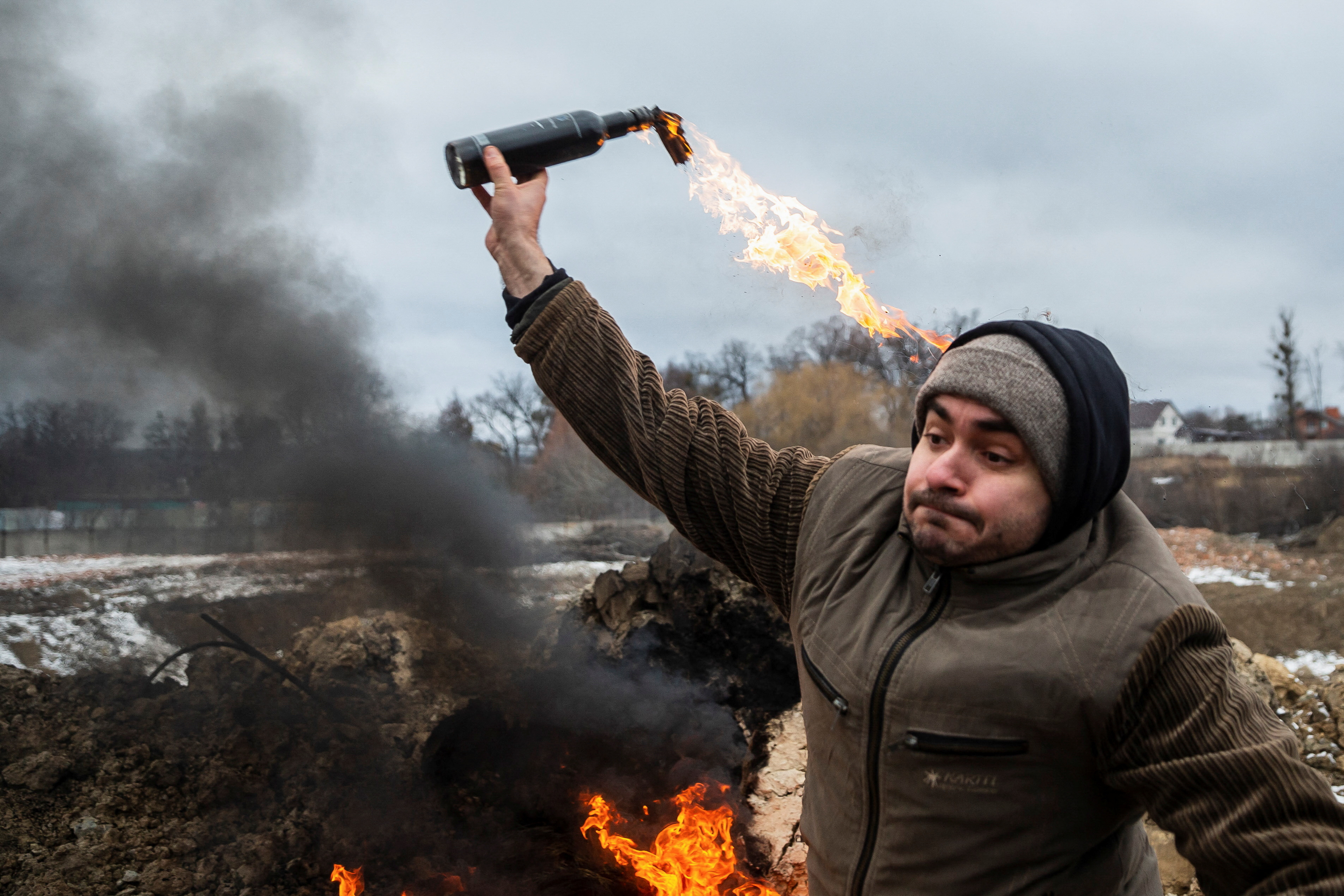
Civilians are training to fight, learning how to make molotov cocktails (homemade explosives) and, in some cases, stealing Russian equipment.

A civilian trains to throw Molotov cocktails to defend the city

VIACHESLAV RATYNSKYI via REUTERS

Civilians attend tactical and shooting exercises on the 6th day since start of large-scale Russian attacks

Anadolu Agency via Anadolu Agency via Getty Images

Civilians build iron barricades and traps to block Russia's armoured vehicles
Civilians build iron barricades and traps to block Russia’s armoured vehicles

Anadolu Agency via Anadolu Agency via Getty Images

However, as French president Emmanuel Macon has warned “the worst is yet to come” when it comes to Putin’s brutality, it remains unclear how much longer people can live under these trying conditions.

Share Button