Planting seeds: Researchers dig into how chemical gardens grow

Since the mid-1600s, chemists have been fascinated with brightly colored, coral-like structures that form by mixing metal salts in a small bottle.

Until now, researchers have been unable to model how these deceptively simple tubular structures — called chemical gardens — work and the patterns and rules that govern their formation.

In a paper published this week in the Proceedings of the National Academy of Sciences, Florida State University researchers lay out a model that explains how these structures grow upward, form different shapes and how they go from a flexible, self-healing material to a more brittle one.

“In a materials context, it’s very interesting,” said FSU Professor of Chemistry and Biochemistry Oliver Steinbock. “They don’t grow like crystals. A crystal has nice sharp corners and grows atom layer by atom layer. And when a hole occurs in a chemical garden, it’s self-healing. These are really early steps in learning how to make materials that can reconfigure and repair themselves.”

Typically, chemical gardens form when metal salt particles are put in a silicate solution. The dissolving salt reacts with the solution to create a semipermeable membrane that ejects upward in the solution, creating a biological-looking structure, similar to coral.

Scientists observed chemical gardens for the first time in 1646 and for years have been fascinated with their interesting formations. The chemistry is related to the formation of hydrothermal vents and the corrosion of steel surfaces where insoluble tubes can form.

“People realized these were peculiar things,” Steinbock said. “They have a very long history in chemistry. It became more like a demonstration experiment, but in the past 10-20 years, scientists became interested in them again.”

Inspiration for the mathematical model developed by Steinbock, along with postdoctoral researcher Bruno Batista and graduate student Amari Morris, came from experiments that steadily injected a salt solution into a larger volume of silicate solution between two horizontal plates. These showed distinct growth modes and that the material starts off as stretchy, but as it ages, the material becomes more rigid and tends to break.

The confinement between two layers allowed the researchers to simulate a number of different shape patterns, some looking like flowers, hair, spirals and worms.

In their model, the researchers described how these patterns emerge over the course of the chemical garden’s development. Salt solutions can vary a lot in chemical makeup, but their model explains the universality in formation.

For example, the patterns can consist of loose particles, folded membranes, or self-extending filaments. The model also validated observations that fresh membranes expand in response to microbreaches, demonstrating the material’s self-healing capabilities.

“The good thing we got is we got into the essence of what is needed to describe the shape and growth of chemical gardens,” Batista said.

Share Button

Ben Stokes Has The Best Response To Australian Media’s ‘Crybabies’ Taunt

England men’s cricket captain Ben Stokes has refused to rise to the Australian media’s bait in the aftermath of the controversial Ashes stumping.

The sportsmanship of the Aussie team has been questioned following the dismissal of England batsman Jonny Bairstow on Sunday’s final day of the second test at Lord’s.

With England on 193-5 and chasing a mammoth target of 371, Australia wicketkeeper Alex Carey underarmed the ball at the stumps after Bairstow left his crease at the end of an over.

While the dismissal was valid by the letter of the sport’s laws, many have questioned whether it undermined the much-cherished “spirit of the game” – as witnessed by the long and loud booing from the Lord’s crowd and Australian players being verbally abused by MCC members in the stadium’s usually staid Long Room.

England eventually lost by 43 runs to trail 2-0 in the five-test series.

The Australian media has responded to the furore by suggesting England just sucks it up.

Andrew Webster, writing in The Sydney Morning Herald, said: “The first rule of MCC Fight Club is know the rules of cricket…I would have thought membership to the most famous club in cricket meant you understood the laws of the game.”

Meanwhile, Gideon Haigh in The Australian similarly suggested that “puce-faced MCC snobs should learn their own rules”.

They went further on the front page of The West Australian, which stunted Stokes up as nappy-wearing, dummy-sucking baby and boomed: “Poms take whingeing to new level with ‘cheating’ drivel.”

“Crybabies,” the splash thundered.

But Stokes took to Twitter in an apparent attempt to defuse the situation.

“That’s definitely not me, since when did I bowl with the new ball,” he said while quote-tweeting the front page, and referencing the depiction of the shiny new cricket ball and the fact he is not an opening bowler.

Stokes had said on Sunday he was keen to move on from the incident but added he would not want to win in such a fashion at the end of an over.

“The first thing that needs to be said is, it is out,” he said.

“If I was the fielding captain I would have put a lot more pressure on the umpires to ask them what their decision was around the over and around the spirit of the game and would I want to potentially win a game with something like that happening – and it would be no.”

Australia captain Pat Cummins has defended his team over Bairstow’s dismissal, and insisted there was no “sneakiness”.

“I thought it was fair. You see Jonny (Bairstow) do it all the time, he did it on day one to David Warner, he did it in 2019 to Steve (Smith),” Cummins told reporters.

“It’s a really common thing for keepers to do if they see a batter keep leaving their crease. Cares (Carey), full credit to him, he saw the opportunity, rolled it at the stumps, Jonny left his crease. You leave the rest to the umpires.

“It was all one motion, there was no pause or sneakiness about it.”

Share Button

Million pound appeal for 20-month-old Hallie who has leukaemia

Hallie, from Coventry, needs treatment which her family say cannot be provided by the NHS.

Share Button

Smartwatches may provide early Parkinson’s diagnosis

Tracking speed of movement might provide a diagnosis up to seven years ahead of symptoms, a study suggests.

Share Button

NHS whistleblowers need more protection, expert warns

NHS whistleblowers are being victimised, risking another big hospital scandal, an expert tells the BBC.

Share Button

Family to tell first penicillin patient’s story at conference

PC Albert Alexander received the newly-discovered antibiotic after being injured in 1941.

Share Button

Swole The Vote: Why Politicians Love Doing Pushups

Robert F. Kennedy Jr., who is running for the Democratic nomination for president, wants to stand out from ordinary politicians. So this week he posted a video of himself doing shirtless pushups in a parking lot — you know, as potential presidents do!

The 69-year-old son of Robert F. Kennedy and nephew of former President John F. Kennedy showed off his physique in a clip that has been viewed over 15 million times. “Get yourself in shape for a Kennedy Presidency!” he tweeted.

His workout in nothing but jeans at a Gold’s Gym in Venice Beach, California ― a mecca for muscleheads ― drew tons of favorable news coverage and served as an implicit contrast to 80-year-old Joe Biden, the oldest president in U.S. history.

It’s debatable whether American voters are longing for a set of rippling pecs in the Oval Office. But the prominent vaccine skeptic isn’t the first politician to flex their muscles as a way to boost their image or project strength to voters. For many politicians, displays of physical prowess can be a way to fend off questions about their age, set themselves apart in a crowded field, or even just make themselves seem more relatable or charismatic ― though it doesn’t necessarily work.

Does anyone remember the historic candidacy of John Delaney?

The former Democratic congressman from Maryland ran for president in 2020 and tried to distinguish himself from the crowded primary field in part by sharing videos of himself doing pushups and deadlifts in tight T-shirts. Delaney was jacked as hell. But it did nothing for his campaign. He ended his run just days before the Iowa caucuses.

The desire to be seen as a musclehead over an egghead isn’t limited to the younger congressional set. The longest-serving Republican senator in U.S. history, 89-year-old Chuck Grassley, has often played up his exercise habits in campaign ads.

In 2021, the Iowa Republican and then-44-year-old Sen. Tom Cotton (R-Ark.) did a 22-pushup demonstration ― though some might say they were half-pushups ― to raise awareness about suicide among military servicemembers. And in 2017, an 83-year-old Grassley challenged a much-younger reporter to a pushup contest and matched his number with 25.

But being buff doesn’t bring invincibility. After winning an eighth Senate term last year, Grassley broke his hip doing what he called “a stupid maneuver in my kitchen” that briefly put him in a wheelchair. The sprightly senator is back to taking stairs at the Capitol, but recently said he’s not yet running again.

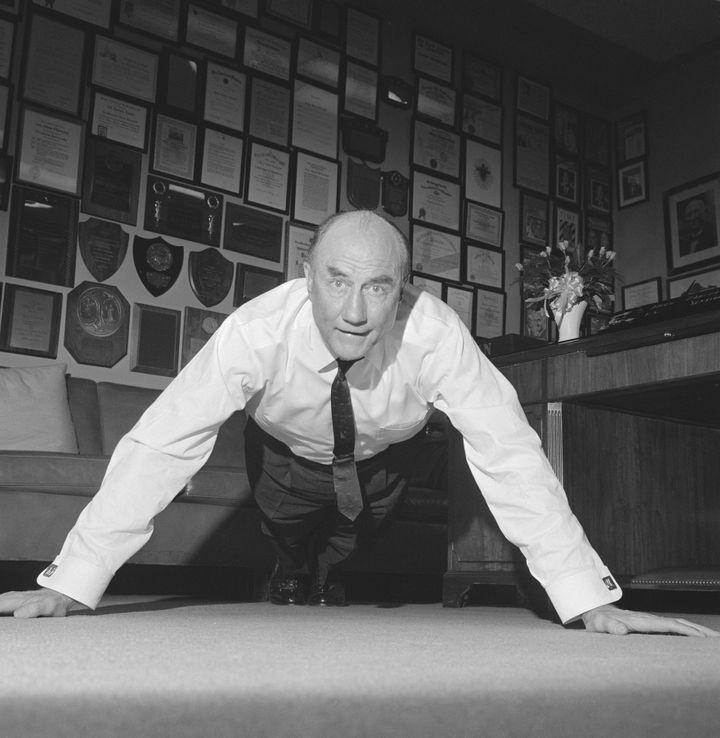
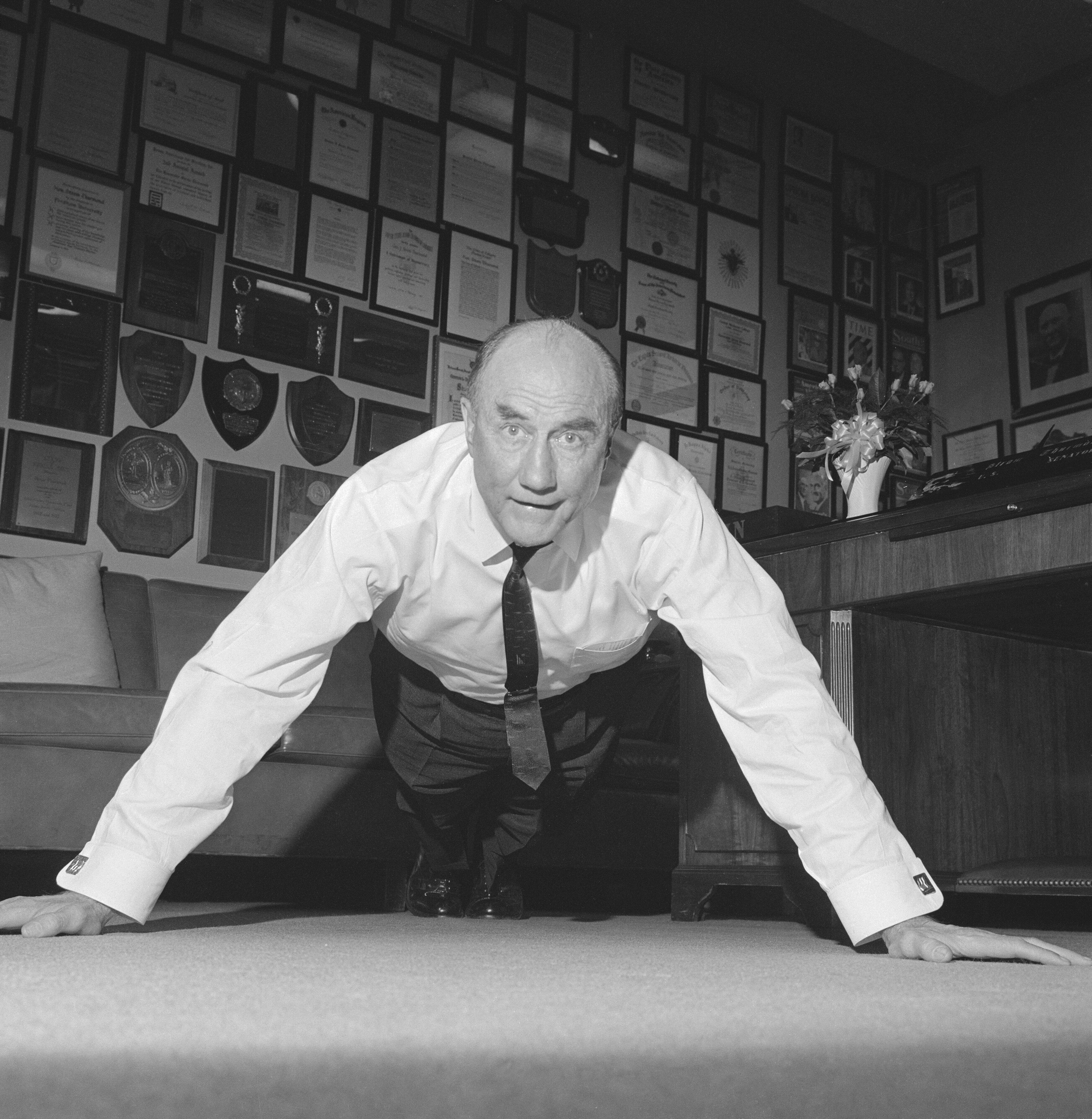
This is not a new phenomenon. The late Sen. Strom Thurmond (R-S.C.), marked his 65th birthday by doing 101 pushups, then another for the photographers.

Bettmann via Getty Images

The president of the United States is another fan of proposing feats of strength when challenged over his age ― though he doesn’t follow through. In 2019, during a tense exchange with an Iowa voter who told the then-77-year-old he was too old for the presidency, Biden threw down the gauntlet.

“You want to check my shape, let’s do pushups together. Let’s run. Let’s do whatever you want to do,” Biden told the man, who was 83 himself and apparently did not take up the offer from the now-president, who has a stiffened gait and has tripped and fallen in public.

The same year, Biden jokingly said he would challenge Donald Trump to a pushup match. He even suggested wrestling a HuffPost reporter in response to a question about voters’ concerns over his health. “What the hell ‘concerns,’ man? You wanna wrestle?” (For the record: We’re still waiting, Mr. President).

Other politicians simply love to share videos of themselves working out, particularly new members of Congress.

In February, Rep. Jamaal Bowman (D-N.Y.) posted a video of himself bench-pressing 405 pounds, which is a lot. He told HuffPost at the time that his eventual goal was to do the same weight for two repetitions. (It’s called the House of Reps, after all.)

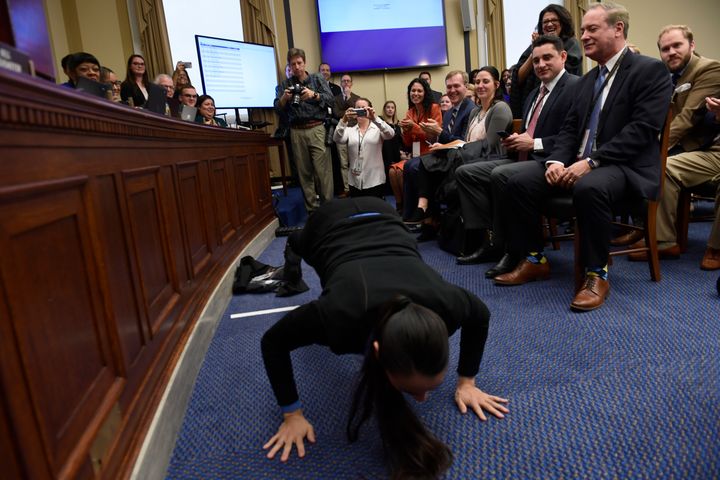
Rep. Sharice Davids (D-Kan.), then a member-elect, did pushups on Capitol Hill in 2018.

Susan Walsh/Associated Press

It’s not just dudes, either. In 2019, Rep. Alexandria Ocasio-Cortez (D-N.Y.) posted a video of herself doing pushups alongside a fellow member as a way to blow off steam between hearings. In February, conspiracy theorist Rep. Marjorie Taylor Greene (R-Ga.) showed off some butterfly pull-ups, which look incredibly weird to anyone unfamiliar with CrossFit.

And never forget the, dare we say, iconic 2012 Time Magazine photo shoot of then-Republican vice presidential candidate Paul Ryan demonstrating some bicep curls in a backward hat with a moody blue backdrop, possibly some of the most awkward “gym bro” images of all time.

Of course, there are other ways to show your fixation on masculinity. Sen. Josh Hawley (R-Mo.) this year published a book titled “Manhood,” calling on American men “to stand up and embrace their God-given responsibility as husbands, fathers, and citizens.” The Missouri Republican argues masculinity isn’t so “inherently problematic” as liberals make it out to be. (The book doesn’t say how many pushups Hawley can do.)

As if to provide a counterpoint, Sen. Markwayne Mullin (R-Okla.) this week challenged a combative committee witness to an actual cage match. The witness, a union president who called Mullin a “greedy CEO” and a “clown,” did not accept the challenge within Mullin’s three-day time period, so the two will have to continue fighting with words. It’s probably an improvement on the historical way of settling disputes in the upper chamber: duels with pistols.

Of course, after pride comes the fall — particularly on Twitter. Even though he looks buff, Kennedy betrayed weakness in the face of Twitter users who wondered why he seemed to struggle to do only eight-and-a-half pushups in his video.

“I can do more than 10 pushups,” he assured them. “That was my last set.”

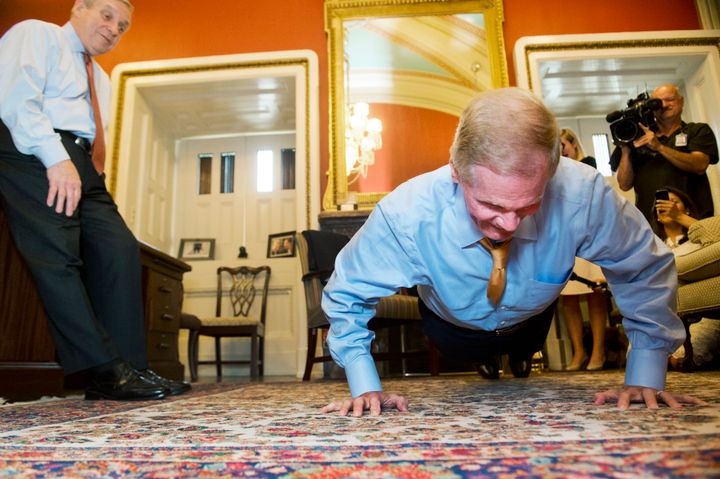
Then-Sen. Bill Nelson (D-Fla.) did 46 pushups in 2014 as part of a bet payoff over hockey.

Tom Williams/CQ Roll Call via Getty Images

Share Button

Sophy Ridge Leaves Steve Barclay Squirming Over Tories’ NHS Spending Plans

Steve Barclay was left squirming by Sophy Ridge as he failed to explain how the Tories will pay for a major NHS spending boost.

The Sky News presenter repeatedly asked the health secretary where the £2.4 billion to recruit thousands more doctors and nurses will come from.

Rishi Sunak unveiled the long-awaited NHS workforce plan on Friday.

Asked by Ridge how the government would find the money, Barclay would only say it would be “through the Treasury” but refused to give any specifics.

Ridge responded: “What does that mean though? Is that more money for your department or are you going to have to find it from existing NHS budgets or is it borrowing? Where is it coming from?”

In a rambling answer, Barclay said: “This is additional money, it will be announced in the usual way through fiscal events.”

Ridge hit back: “I haven’t heard any new tax rises or spending cuts so I’m assuming it sounds like it must be extra borrowing.

″A hundred per cent of GDP – that the current level of debt. Interest rates rising, so the cost of servicing debt is going up – is that really responsible?

“If Labour announced a policy of £2.4 billion without saying where that money was coming from you would be after them like a rocket.”

Barclay said the policy would also improve the retention of NHS staff, thereby saving money on hiring agency workers.

Share Button

NHS England chief Amanda Pritchard says strike disruption will get worse

Amanda Pritchard told the BBC that July’s strikes could be the worst yet for patients.

Share Button

NHS England head urges football clubs to consider gambling ad impact

Clubs should think carefully before accepting sponsorship from gambling firms, says NHS England head.

Share Button