Pandemic’s urgency drove new collaborative approaches worldwide

In a paper in the journal Nature, Los Alamos National Laboratory scientists Bette Korber, Hyejin Yoon, Will Fischer and James Theiler, among nearly 130 authors from institutions around the world, describe their groundbreaking collaborative work, “Defining the risk of SARS-CoV-2 variants on immune protection.”

Korber, Fischer, Yoon and Theiler are members of a rarified team that the National Institute of Allergy and Infectious Diseases assembled in January 2021, drawing on experts from around the world who specialize in relevant research fields such as viruses, the immune system, vaccines, epidemiology, structural biology, bioinformatics, virus genetics, and evolution. The team is called SAVE, for SARS-CoV-2 Assessment of Viral Evolution.

As noted in the Nature paper, the authors state, “This effort was designed to provide a real-time risk assessment of SARS-CoV-2 variants potentially impacting transmission, virulence, and resistance to convalescent and vaccine-induced immunity. The SAVE program serves as a critical data-generating component of the United States Government SARS-CoV-2 Interagency Group to assess implications of SARS-CoV-2 variants on diagnostics, vaccines and therapeutics and for communicating public health risk.”

Broad model for rapid response

SAVE focuses on mutations in SARS-CoV-2 and emerging virus variants. But its members say the global collaborative concept “is a broad model for rapidly responding to evolving pathogens with pandemic potential.”

“Over the past two decades, we have witnessed the emergence/re-emergence of several RNA viruses, including West Nile virus, H1N1 influenza virus, chikungunya virus, Zika virus, SARS-CoV-1, MERS-CoV and Ebola virus, that have threatened global public health,” the paper’s summary states. “Developing collaborative programs between academic, industry and commercial partners is essential to respond to rapidly evolving viruses,” said Marciela DeGrace of NIAID, the paper’s lead author.

SAVE members represent 58 different research sites located in the United States and around the world. Members participate within three sub-groups:

  • Early Detection and Analysis
  • In Vitro — what they can learn using flasks, beakers and tubes
  • In Vivo — what they can learn in animal models that mimic human disease

Early detection methods

Korber’s team was part of the Early Detection and Analysis team, where such high-impact work as the initial identification of mutations in the virus made waves in the scientific community before its capacity for mutation had been clearly understood and accepted.

The Nature paper notes, “The process is collaborative and iterative, with seven teams using independent models and methodologies to prioritize mutations and lineages as well as rank importance for downstream testing. While the focus is on human infections, the Early Detection group also monitors variants circulating in animal populations, such as mink and deer, since they represent a potential reservoir source.”

On a weekly basis, the SAVE Early Detection and Analysis team reviews downloads of SARS-CoV-2 genomes from the international initiative for sequence sharing, GISAID. They search for variant and co-variant signatures in the genomes, then divide the work into two approaches:

  • one based on convergent evolution as the main signal for selection and functional impact of mutations (done byCambridge and Walter Reed Army Institute of Research teams)
  • the other anchored on prevalence and growth patterns of mutations and defined lineages (the role ofLos Alamos, Icahn School of Medicine at Mount Sinai, J. Craig Venter Institute/Bacterial Viral Bioinformatic Resource Center, UC-Riverside and Broad Institute teams)

Highlights of Los Alamos impact

At Los Alamos, the Korber team identifies emergent mutational patterns within the SARS-CoV-2 spike protein to track newly emerging and expanding variants and determine transitions in global and regional sampling frequencies over time, which is the specialty area in which Los Alamos has made a huge impact.

They pay particular attention to mutations in parts of the spike protein known to be highly targeted by antibodies, or that might impact infectivity. They also systematically define the most commonly circulating form of each emerging variant of interest or concern against the backdrop of the continuously evolving virus.

“Identifying the emerging variants, and obtaining accurate sequences for those variants, required continued wrangling of burgeoning data,” said Theiler. “There are now close to 10 million SARS-CoV-2 sequences in GISAID. These sequences, however, are non-uniformly sampled, are often partial and some contain errors, and of course it is the newest variants that give the sequencers the most trouble.”

“The tools we developed, along with our colleagues on the LANL COVID-19 Viral Genome Analysis Pipeline (cov.lanl.gov), provided the infrastructure that enabled us to follow this pandemic though its various waves,” he added.

Korber noted that “by working with the SAVE Early Detection team, we were able to be part of a synergistic collaborative effort, where our results in terms of early detection could be cross-checked with those of others.”

She added, “The real beauty of being part of the larger SAVE project was the knowledge that our analysis pipeline could provide foundational support for the many experimental teams in SAVE, and that we could help the scientific community get the best version of newly emergent variants into their laboratories as quickly and accurately as possible. In this way the science needed to understand the immunological and virological characteristics of new variants was rapidly obtained, in time to help inform public health decisions.”


Share Button

Are ‘person’ or ‘people’ gender-neutral concepts? New study finds male tilt in analysis of billions of words

The concept of a “person” or “people” is, despite its definition, not gender-neutral when it comes to how we use these terms. In fact, we tend to prioritize men when referring to people in general, shows a new study by a team of psychology and linguistics researchers.

The findings, which are reported in the journal Science Advances, are based on an analysis of more than 630 billion words drawn from internet web pages, using artificial intelligence tools to measure what words mean based on how they are used by millions of individuals.

“Many forms of bias, such as the tendency to associate ‘science’ with men more than women, have been studied in the past, but there has been much less work on how we view a ‘person,’ ” says April Bailey, a postdoctoral researcher in New York University’s Department of Psychology and the lead author of the paper.

“Our findings show that even when using gender-neutral terms, we prioritize men over women,” adds co-author Adina Williams, a research scientist at Meta AI and a graduate of NYU’s doctoral program in linguistics.

Bias at such a foundational level — our word choices — is potentially consequential, the researchers note.

“Conceptions of ‘people’ form the basis of many societal decisions and policymaking,” observes Andrei Cimpian, a professor in New York University’s Department of Psychology and the senior author of the paper. “Because men and women are each about half of the species, prioritizing men in our collective idea of a ‘person’ creates inequity for women in decisions based on this idea.”

The research team examined words’ meanings by considering how they are used by individuals. Specifically, the team studied how we use words expressing the concept of “person” and its gender-specific counterparts, “woman” and “man.”

To test whether we’re likely to think of men more often than we are of women when writing about “people,” the team used artificial intelligence algorithms that learn the meaning of words based on how they are used, drawing from a language repository collected by the non-profit Common Crawl in May 2017. This repository included more than 630 billion mostly English-language words appearing on nearly three billion web pages.

The researchers considered how word meaning is related to word context and use. For example, if you hear, “Each morning, Joe boiled water in the balak for tea,” you might guess that “balak” means something similar to “kettle,” even though “balak” is unfamiliar, because the words alongside “balak” (“tea,” “boiled,” and “water”) also frequently co-occur with “kettle.”

In the Science Advances paper, the researchers investigated, in three studies, the meaning of “person” and related words (e.g., “people”) by taking into account adjacent words — the linguistic context.

In the first study, they compared the similarity in meaning (inferred via linguistic context) between words for people (e.g., “individual”) and words for men (e.g., “he” and “male”) to the similarity in meaning between words for people and words for women (e.g., “she” and “female”).

They found that words for people were used more similarly, and were thus more similar in their meaning, to words for men than to words for women — and by a statistically significant margin. Put another way, the collective concept “people” overlapped more with the concept “men” than with the concept “women” in the studied words.

In the second study, instead of focusing on words for people, the team examined words denoting features central to this concept — specifically, words for traits that commonly describe what people are like. They compared hundreds of trait words identified in past research as common descriptors of people (e.g., “extroverted,” “analytical,” and “superstitious”) to the same lists of words for women and for men from the paper’s initial study.

They found that the meaning of these descriptor words in the second study were, overall, more similar to the meaning of words for men than to the meaning of words for women, with a statistically significant difference between the two. That is, common words that describe what people are like (e.g., “extroverted”) are also used more similarly to words for men than to words for women.

In a third study, the researchers studied the use of verbs — a reasonable area for exploration given the initial findings. Specifically, if the collective concept “people” overlaps more with the concept “men” than with the concept “women,” then words that describe what people do and what is done to them (e.g., “love,” “annoy”) may also be more likely to be similar in their contextual meaning to words denoting men than to words denoting women.

In this study, they compared the meaning similarities between more than 250 verbs that describe actions that people take (e.g., “facilitate,” “smile,” and “threaten”) and words for men vs. words for women.

As with the second study, which focused on common words that describe what people are like, words that describe what people do (e.g., “run”) were also used more similarly to words for men than to words for women — a difference that was again statistically significant.

Share Button

Conversion therapy: Ban to go ahead but not cover trans people

The government U-turns on plans to drop a ban on conversion therapy for gay and bisexual people.

Share Button

Experts Tearing Their Hair Out Over Cost Of Living: ‘Country Needs More Help!’

Two household names known for their money-saving tips have revealed their frustration at Downing Street for its latest hike in energy bills, which will push people into poverty.

From April 1, the government has lifted the cap on energy bills which will increase the average household’s annual payments by £700. It’s set to hit 18 million households and is the largest increase since the regulating price cap was introduced.

The number of households in England in fuel poverty is subsequently set to double to five million people.

This is just one of several measures which have pushed the UK into a cost of living crisis where people will have to choose between eating and heating. Council tax, water bills and car tax costs are all rising this Friday too.

It’s now at the point where every the money-saving specialists, personal finance expert Martin Lewis and anti-poverty campaigner Jack Monroe, are at a loss.

People ‘already at the brink’

Monroe, known for calling out supermarkets over rising prices and sharing their affordable recipes, appeared deeply unsettled when they told ITV’s Lorraine that “people are at the brink” already on Friday.

They said: “It all boils down to the fact that people don’t have the basic income to meet their most basic and fundamental needs.”

The campaigner added that “it’s a crisis that has been building for the last decade”, and financial aid – rather than government platitudes – is needed.

Monroe sighed when asked what advice to give to people struggling and said: “It’s getting increasingly difficult to give tips and advice because people are at the brink.”

‘Lack of compassion’ from people in charge

The anti-poverty activist also shared why this crisis is particularly frustrating, explaining: “We’re one of the richest economies in the world, people shouldn’t have to be scrabbling around for these war-time tips in order to live a decent standard of living.”

Monroe later tweeted: “If I seemed a bit strung out on Lorraine this morning it’s because I am.”

They explained that across the last decade of campaigning against UK poverty, they “have never known the scale of sheer desperation and terror that is bombarding my inboxes daily from people worried they can’t survive this crisis”.

They added: “That’s not an exaggeration; people with disabilities, people on Universal Credit, people on low wages and zero hour contracts and underemployed in insecure part time jobs, people living alone, elderly people, all literally petrified about their immediate futures.”

This means it becomes “quite stressful” when trying to give people tips because “most people are doing everything they can think of”, they tweeted, including “the most absurdly unthinkable things”.

They pointed out that the main solution is just “urgent financial assistance from those that we elected to represent us”.

They added that they’re “almost out of hope”, explaining: “I’m beyond irritated at the lack of compassion and accountability shown by those who made this happen and have the power to stop it, but are choosing not to.”

Monroe pointed towards the elected MPs and called for action – and to “get the Tories out” – over the poverty crisis.

“Enough has to be enough,” they added.

‘Never experienced anything like this before’

Martin Lewis, founder of MoneySavingExpert.com, expressed his concerns about the cost of living crisis on Thursday and explained how it had negatively affected him.

Speaking to BBC Radio 5 Live, he said: “I think the anxiety and level of sick[ness] I feel in my stomach…no-one could have my mail bag and not feel sick at the moment.

“I think the only time I can remember is the week of the pandemic before furlough was announced. When we had no certainty and there was no help… that level of panic.

“And I feel that, for the lowest-earners in society, we’re back to that. The difference is I’m not sure where the help is coming from.

“We’ve certainly never experienced anything like this before.”

Not ‘party-political’ issue but a ‘humanitarian’ one

Lewis also explained that he tries to stay apolitical, but added: “I have to be blunt, the country needs more help.

“We are a first world, rich nation, and I am on [BBC] bloody radio station talking about how people are going to survive as to whether they choose to freeze or to starve, and I don’t feel that is right.”

The expert then took aim at those making the decisions, hitting out at chancellor Rishi Sunak’s controversial spring statement.

This included promises to raise the threshold for paying National Insurance, cut the basic rate of income tax (in 2024), cut fuel duty, up household support fund and drop VAT on green home improvements.

Lewis has already criticised this mini-budget for providing “nowhere near enough” support amid the cost-of-living crisis.

On Thursday, Lewis reiterated this message: “I have said this until I’m blue in the face – the spring statement, not enough help was given.

“And we need to protect our poorest, and we also need help for people with lower-to-middle incomes who are going to see their lifestyles curtailed very substantially by this.

“This is not a party political point. This is a humanitarian point.”

He said many people have tightened their belts to the point where it could not be tightened any more – and therefore political intervention was the only solution.

“I’m sorry the frustration is coming out, but I just wish the senior members of cabinet to have my mail bag,” the consumer journalist concluded.

Sunak’s self-defence

Sunak was forced to defend himself after he announced his mini-budget earlier this week. He has been criticised for not matching benefits to the 8% surge of inflation expected this spring, and for failing to help the worst-off.

But the chancellor disagreed with the claim that “government can or should” compensate everybody, especially when global factors – such as the rise in wholesale gas prices – are involved.

He also told MPs on Monday he wanted to keep borrowing down “at a time when we are worried about the macroeconomic outlook, particularly with regard to interest rates and inflation”.

“My job is to make the right long-term decisions and my view is that an excessive amount of borrowing now is not the responsible thing to do,” the cabinet minister said.

Share Button

Zelenskyy Removes 2 Ukrainian Generals After Accusing Them Of Being ‘Traitors’

Ukrainian President Volodymyr Zelenskyy announced Thursday he is sacking two Ukrainian military generals for allegedly being “traitors.”

“Those servicemen among senior officers who have not decided where their homeland is, who violate the military oath of allegiance to the Ukrainian people as regards the protection of our state, its freedom and independence, will inevitably be deprived of senior military ranks,” Zelenskyy said during his nighttime address to the nation posted on Telegram, according to the English translation included in the video.

Zelenskyy named the two individuals as Naumov Andriy Olehovych, ex-chief of the Main Department of International Security of the Security Service of Ukraine, and Kryvoruchko Serhiy Oleksandrovych, former head of the Office of the Security Service of Ukraine in the Kherson region.

The Ukrainian president did not spell out what actions prompted the generals’ dismissal, but pledged to root out any more “antiheroes” in the future.

“Now I do not have time to deal with all the traitors,” he said. “But gradually they will all be punished.”

Over recent months, Zelenskyy has taken steps to tighten his control in Ukraine and steer the country away from Russia. In early February, before the war, he decided to shut down three TV channels owned by Viktor Medvedchuk, an ally to Russian President Vladimir Putin, claiming they aired “propaganda.” Following the invasion, he declared martial law, which he recently extended until late April, and eliminated 11 political parties with ties to the Kremlin.

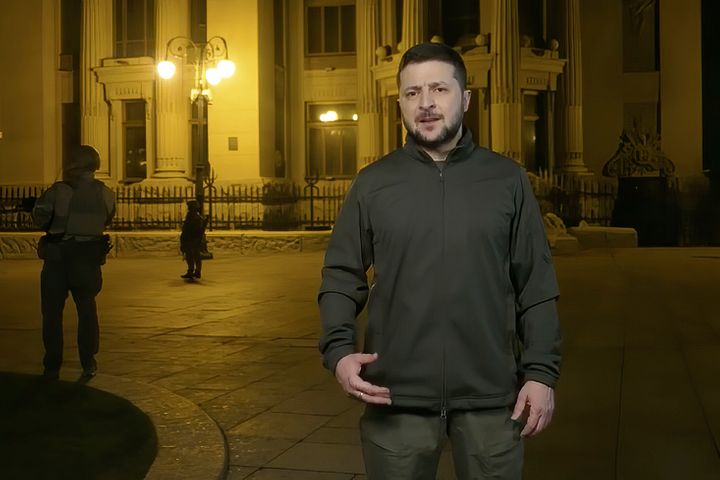
Ukrainian President Volodymyr Zelenskyy speaks from Kyiv, Ukraine, on March 31.

Ukrainian Presidential Press Office via Associated Press

Ukraine and the West have been warning that Russia is regrouping its forces despite promising to scale back to “increase trust” in peace talks, which are set to resume Friday.

Russia’s defense minister told military officials Tuesday the country was now turning its attention to the “main goal — the liberation of Donbas,” according to The Associated Press .

“What we don’t believe is that [Putin’s] planning to send them home,” John Kirby, Pentagon’s press secretary told MSNBC on Thursday. “What we think he’s going to do is refit these troops, resupply them and put them back into Ukraine for offensive operations somewhere else.”

Young Russian men of draft age are also worried that Putin will send them to fight on the front lines in Ukraine as annual spring conscription is set to start Friday, despite officials ruling that out.

Jeremy Fleming, the head of British intelligence agency GCHQ, echoed U.S. intelligence warnings Thursday that Putin is “misinformed” on Russia’s military failings in Ukraine, adding that at one point the Russians accidentally shot down one of their own aircraft.

“Even though we believe Putin’s advisers are afraid to tell him the truth, what’s going on and the extent of these misjudgements must be crystal clear to the regime,” Fleming said.

Share Button

Covid: Record 4.9 million people have the virus in UK

The latest data from the ONS suggests some 4.9 million people in the UK are infected with the virus.

Share Button

Gap-free human genome sequence completed for first time

The scientific achievement, which has taken decades, offers insights into people’s genetic building blocks.

Share Button

Immensa: Why were Covid test errors at Wolverhampton lab not stopped sooner?

Immensa Labs, in Wolverhampton, is estimated to have sent out 43,000 false negative test results.

Share Button

Covid: Nurses’ boss wants life assurance scheme extended for NHS staff

The scheme gave financial support to families of health and social care workers who died in the pandemic.

Share Button

Artificial pancreas to revolutionise diabetes care in England

It can eliminate the need for finger prick tests and prevent life-threatening attacks, say experts.

Share Button