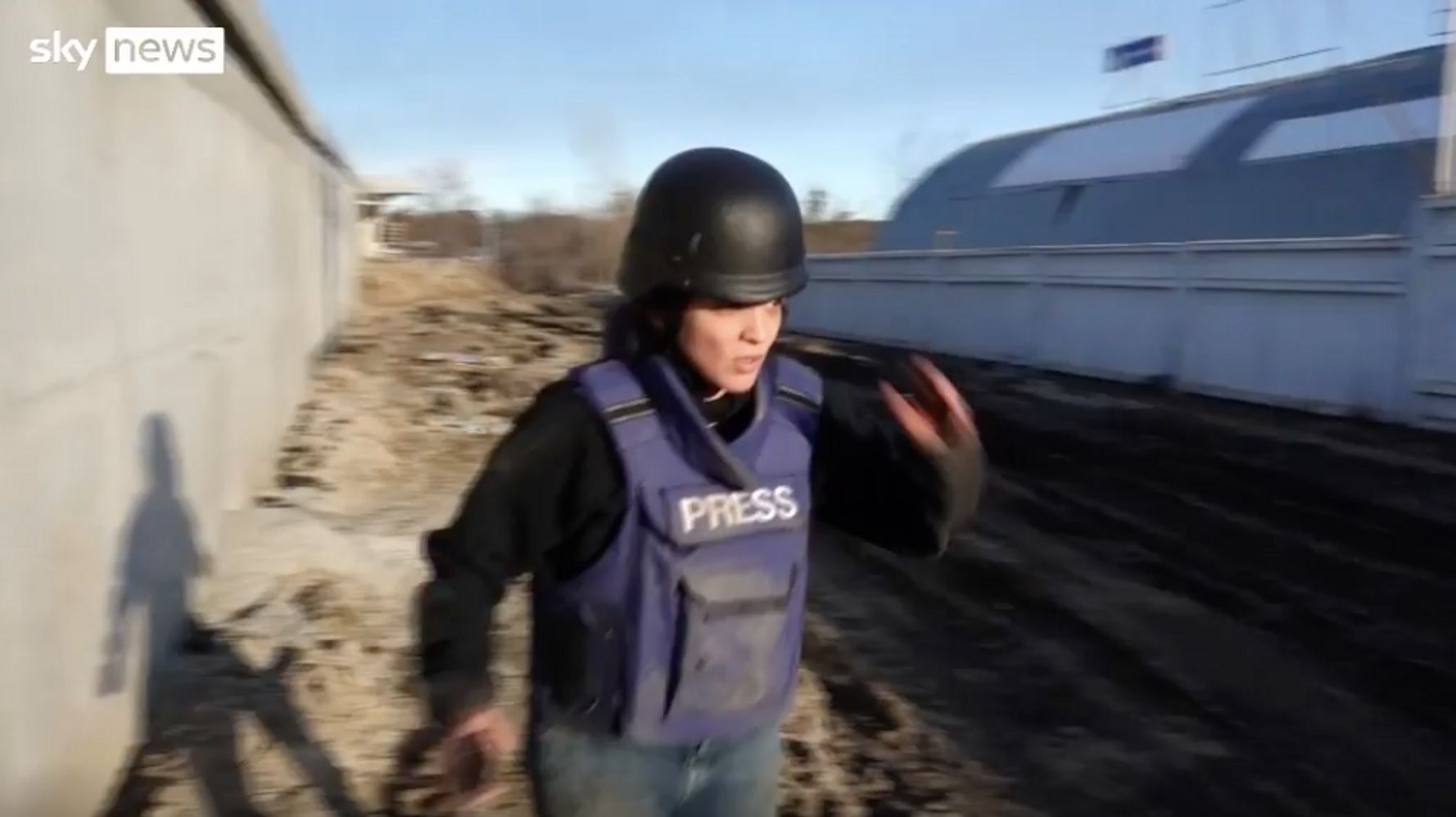
Harrowing footage shows the moment Sky News journalists came under fire from Russian forces in Ukraine earlier this week.
Veteran Sky News foreign correspondent Stuart Ramsay and his team of four others were attacked Monday while driving in a vehicle near the capital of Kyiv. Video shows the moment the team’s car was fired upon.
The attackers were Russian saboteurs targeting fleeing civilians, Ramsay reported.
“It’s a professional ambush,” Ramsay says in narration over the video. “The bullets just don’t miss.”
As the car takes fire, the journalists make a run for it down an embankment.
Camera operator Richie Mockler, who continued to film even as bullets pierced the vehicle he was in, took two rounds to his body armor. All five journalists were able to make their escape and are back in the U.K.
“We were lucky,” Ramsay says in the video. “Thousands of Ukrainians are not. And every day, this war gets worse here.”
Sainsbury’s is renaming chicken Kievs to match the Ukrainian spelling of their capital city Kyiv in the wake of the Russian invasion.
The supermarket chain said it would start rolling out new packaging in the coming weeks using chicken Kyiv, rather than the Russian spelling Kiev. Ukrainians pronounce their capital “kee-yiv”. The Russian version is “kee-yev”.
Advertisement
The retailer also said it has removed all products that are “100 per cent sourced from Russia” from its shelves.
“We stand united with the people of Ukraine. We have reviewed our product range and have decided to remove from sale all products that are 100 per cent sourced from Russia,” a statement said.
Advertisement
“This means that from today we will no longer sell two products – Russian Standard vodka and Karpayskiye black sunflower seeds.”
What is the history?
Advertisement
Kiev, based on transliteration from the Russian cyrillic Киев, has long been the accepted international spelling, a hangover from Ukraine being swallowed up by Tsarist Russia and the Soviet Union.
But since independence in 1991, Ukrainians have been anxious to shed the connection with the USSR and the Russification of their country. Kyiv was officially adopted in 1995.
The spelling and pronunciation took on even greater political significance four years ago after Russia’s annexation of the Crimea. It prompted the Ukrainian Ministry of Foreign Affairs to launch the “KyivNotKiev” campaign.
Since international media started to pay closer attention to the country as Russian president Vladimir Putin prepared the ground for an invasion, Ukrainians have implored foreign journalists to report the name accurately.
Advertisement
But not everyone is saying “chicken Kyiv”
Sainsbury’s is the first UK supermarket to make the switch, and it remains to be seen if other retailers will follow.
In the media, the respected Associated Press news organisation, which produces a hallowed spelling and grammar “stylebook” that is followed by newsrooms across the world, has said “chicken Kiev” will remain its preference.
It tweeted in January: “The spelling Kyiv is AP style for the capital of Ukraine, in line with the Ukrainian government’s preferred transliteration to English and increasing usage. The style for the food dish remains chicken Kiev.”
The spelling Kyiv is AP style for the capital of Ukraine, in line with the Ukrainian government’s preferred transliteration to English and increasing usage. The style for the food dish remains chicken Kiev.
AP changed “style” for the spelling of the city in 2019. AP’s vice president for standards, John Daniszewski, wrote at the time:
“We are making a significant change in our style for the Ukrainian capital city Kiev. It will henceforth be written in text, captions and datelines as Kyiv.
“The change is in line with the Ukrainian government’s preferred name and transliteration. The spelling Kyiv also has been gaining usage over the last decade among governments, international bodies and media organizations.
“The former spelling, Kiev, will still be seen in AP stories in certain contexts, such as the popular culinary dish, chicken Kiev, and in historical contexts, such as Kievan Rus, the name of the early East Slavic culture and state.
“Although the AP prefers traditional English spellings for many cities, including Rome, Moscow and Warsaw (not Roma, Moskva and Warszawa), we regard the Ukrainian spelling of Kyiv as an important adaptation because it is linked to Ukraine’s present status. To many Ukrainians, the former spelling Kiev appears outdated because it is associated with a time when Ukraine was part of the Russian and Soviet states, rather than an independent country.”
Ukrainians have been subjected to an intense attack from Russia for the last week, pushing an estimated one million people to flee – but what’s life like for the millions who stayed behind?
While Russian president Vladimir Putin allegedly want to “seize the whole of Ukraine”, only the city of Kherson is actually under the control of Russian troops a week after the military invaded.
Advertisement
Several other cities are under intense artillery attacks and persistent shelling – a move described as a potential war crime by Boris Johnson from the Kremlin – but have so far evaded capture by the Russians.
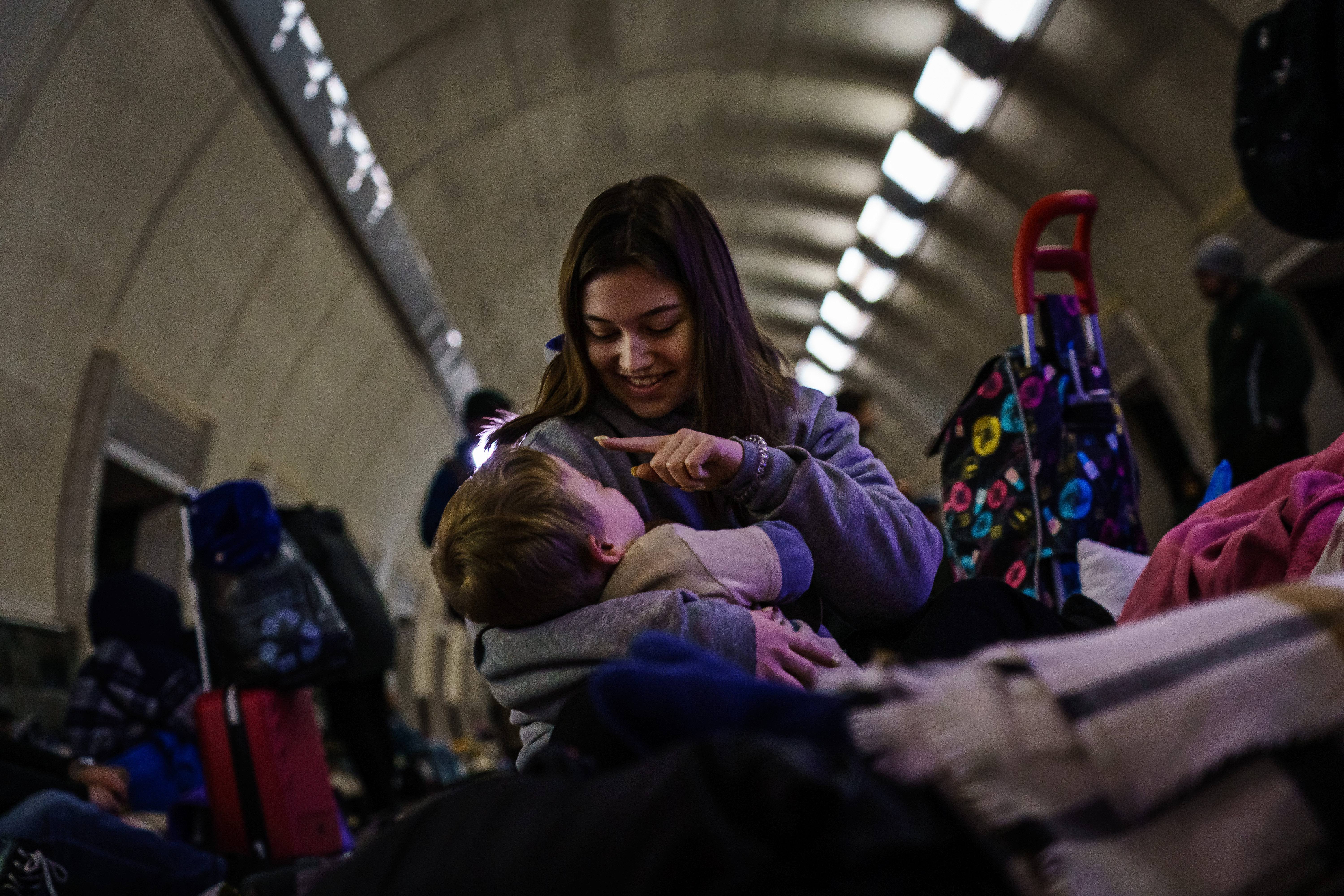
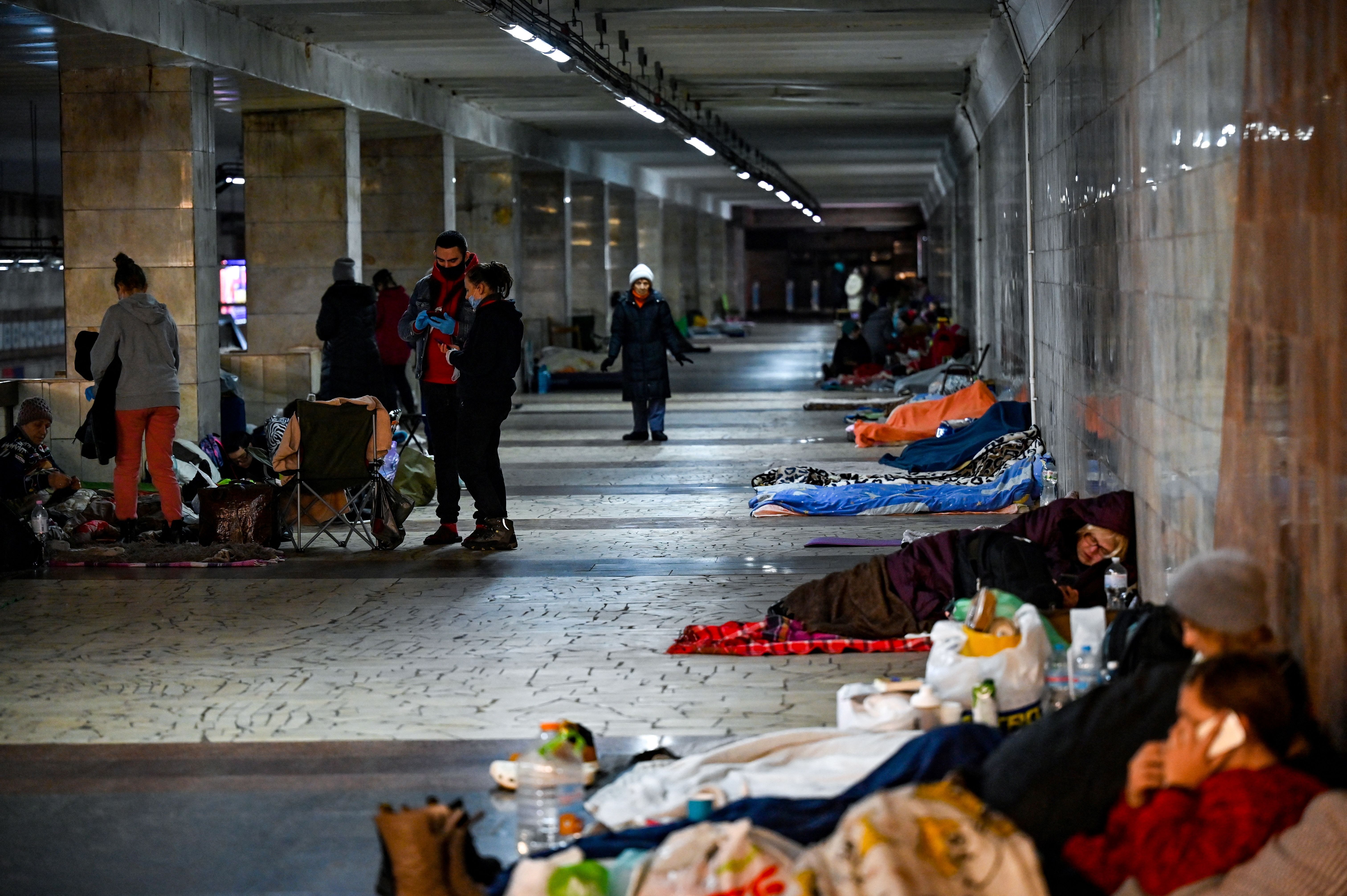
Citizens are still having to shelter in underground stations to stay safe and Ukraine has reported more than 2,000 civilian deaths so far.
And yet, millions of Ukrainians are determined to stay on and defend their country under their wartime leader and president Volodymyr Zelenksyy.
Advertisement
So here’s what life looks for those people who are persevering through the unimaginable conditions, as their lives have been turned upside down over the last seven days.
Life continues amidst Putin’s evil. Here’s a mother with her newborn in a hospital basement in Kyiv. From @lynseyaddario, who is doing incredible work chronicling this tragedy and the fortitude of the Ukrainian people. pic.twitter.com/wH9Bb2b8XP
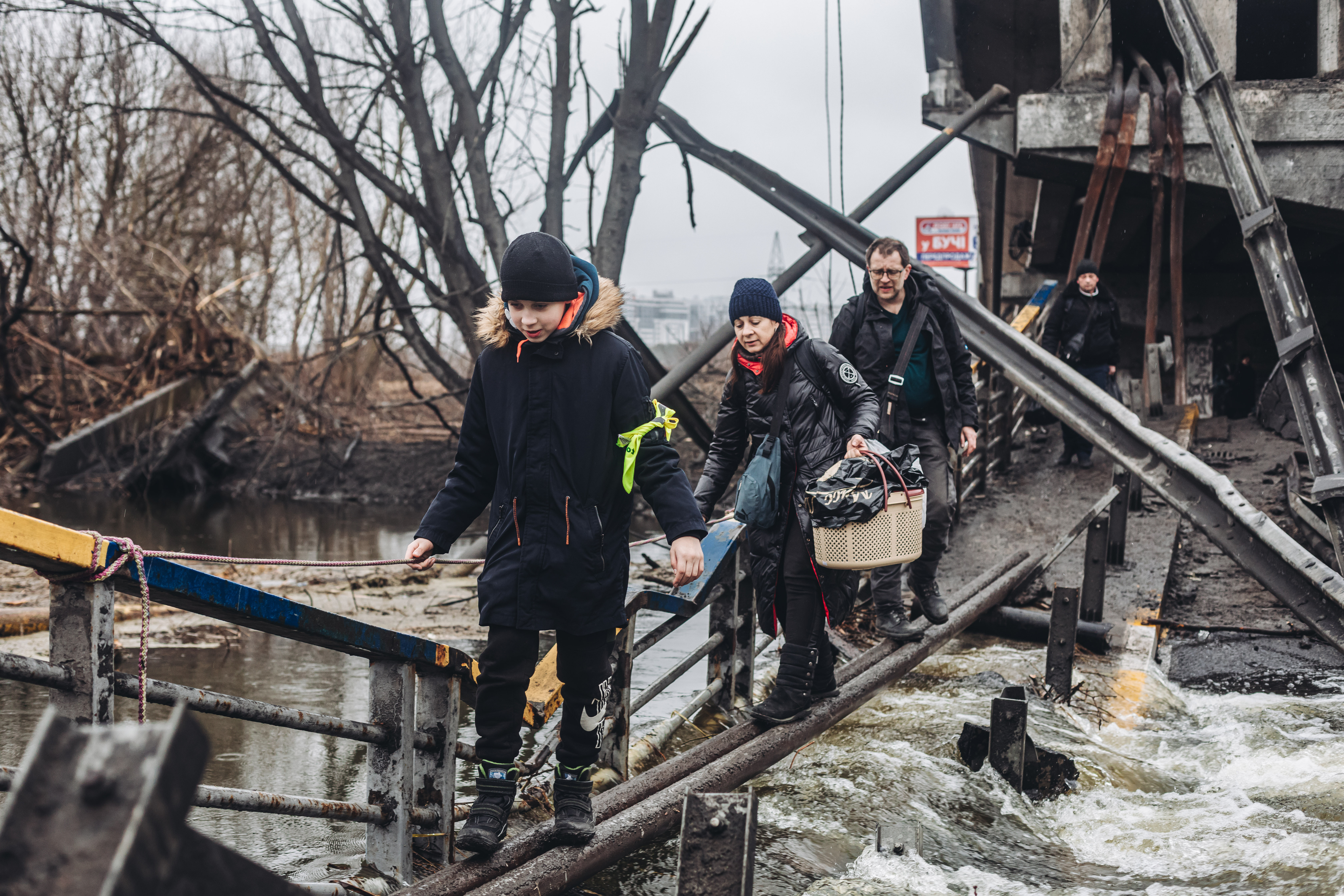
Civilians cross the shelled bridge in Irpin on March 2, 2022, in Irpin, Ukraine
Europa Press News via Europa Press via Getty Images
Civilians take shelter at an underground metro station in Kyiv on March 2, 2022
GENYA SAVILOV via AFP via Getty Images
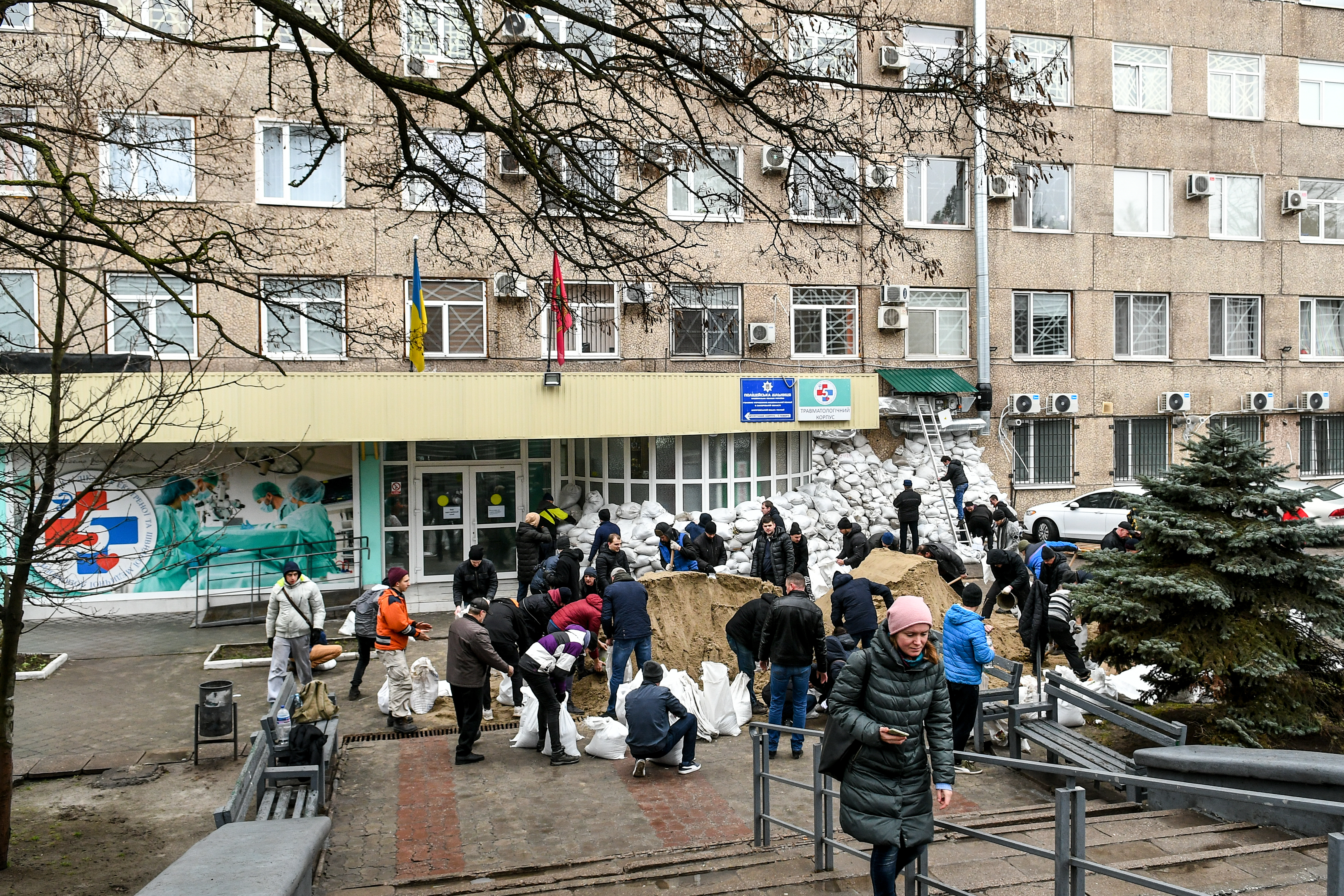
Locals of Zaporizhzhia prepare and carry sand bags inside and outside of the hospital so that it is less affected by the Russian attacks, in Zaporizhzhia, Ukraine
Anadolu Agency via Anadolu Agency via Getty Images
Miraculously, utility workers have made sure internet, light, heating and hot water facilities can still operate – but only in some cities.
While I am waiting for our website to recover from a cyberattack, want to praise Ukraine’s utility workers and internet providers. We still have internet, light, heating and hot water. The garbage truck, taking out the trash this morning, scared the hell out of us.
Food appears to still be in healthy supply in various areas of the country, despite concerns of an emerging humanitarian crisis among Western governments.
we also have bread. KyivKhlib factory has been baking some 50 tons a day! People are living inside the factory!
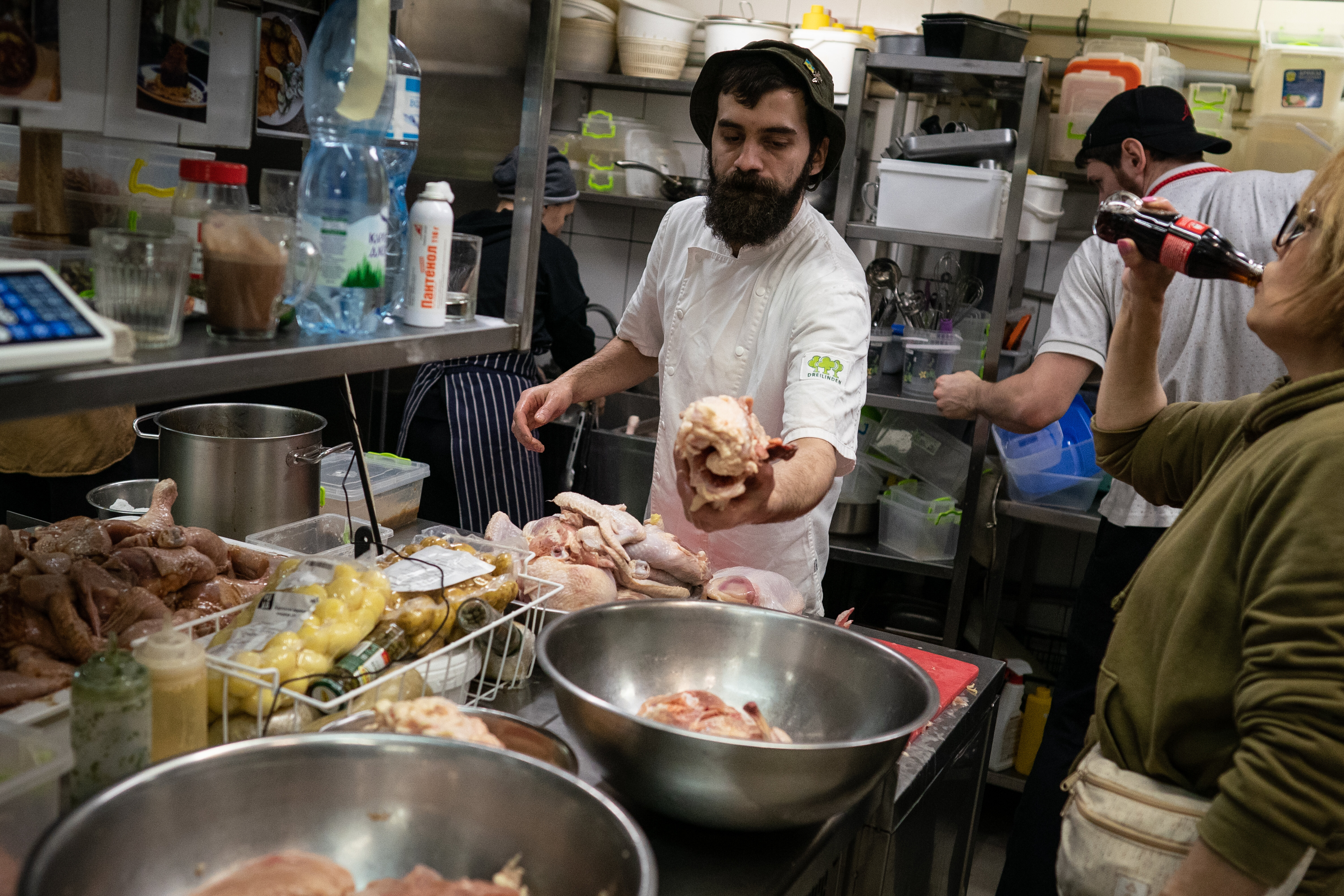
Civilians are seen in a downtown restaurant cooking food to distribute to soldiers, amid Russia’s attacks.
Anadolu Agency via Getty Images
Good news from the streets of Kyiv, many of the shops have fresh fruit and veg on the shelves, there has been a restock! After a few tough days, there are currently no long queues for food here in the city centre.
For those trapped without food, other Ukrainians are trying to gather supplies to help the less fortunate survive.
Advertisement
In the city of Mariupol, the Russian forces have reportedly cut off its water, heating, power and supply lines. The city council has compared it to the “old Leningrad”, in reference to Nazi Germany’s siege of a then-Soviet city in 1941, which left 1.5 million dead.
A Ukrainian soldier even reportedly texted the Telegraph pleading: “If anything happens don’t let us be forgotten.”
Ukrainian volunteers in Poltava region collect supplies — food, water, medicine, clothes — for civilians trapped in nearby Kharkiv. pic.twitter.com/pNLavlJ7D2
Ukraine’s strength against the Russian forces has stunned the international community too, as the ordinary people stand up against Putin’s army in both large and small ways.
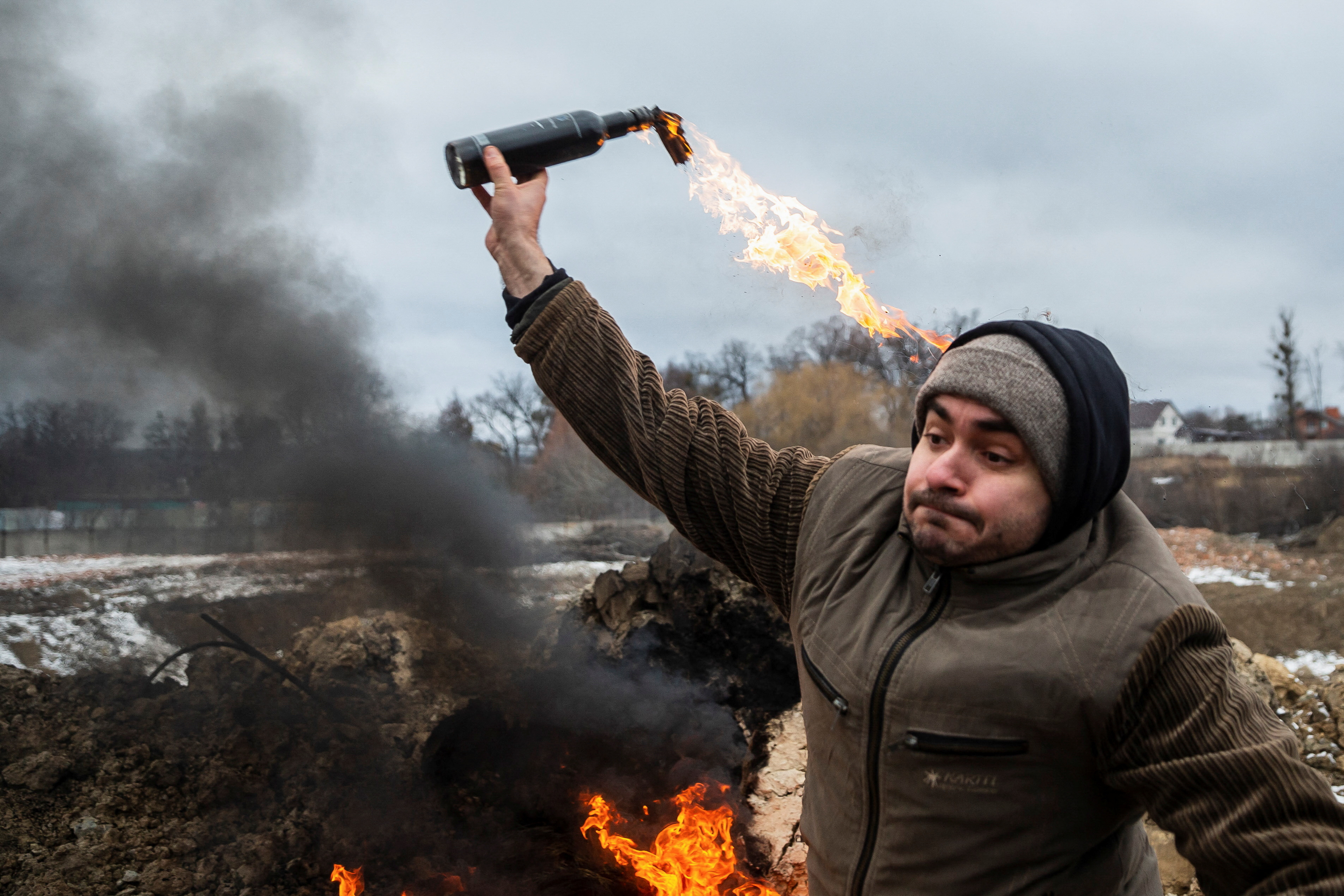
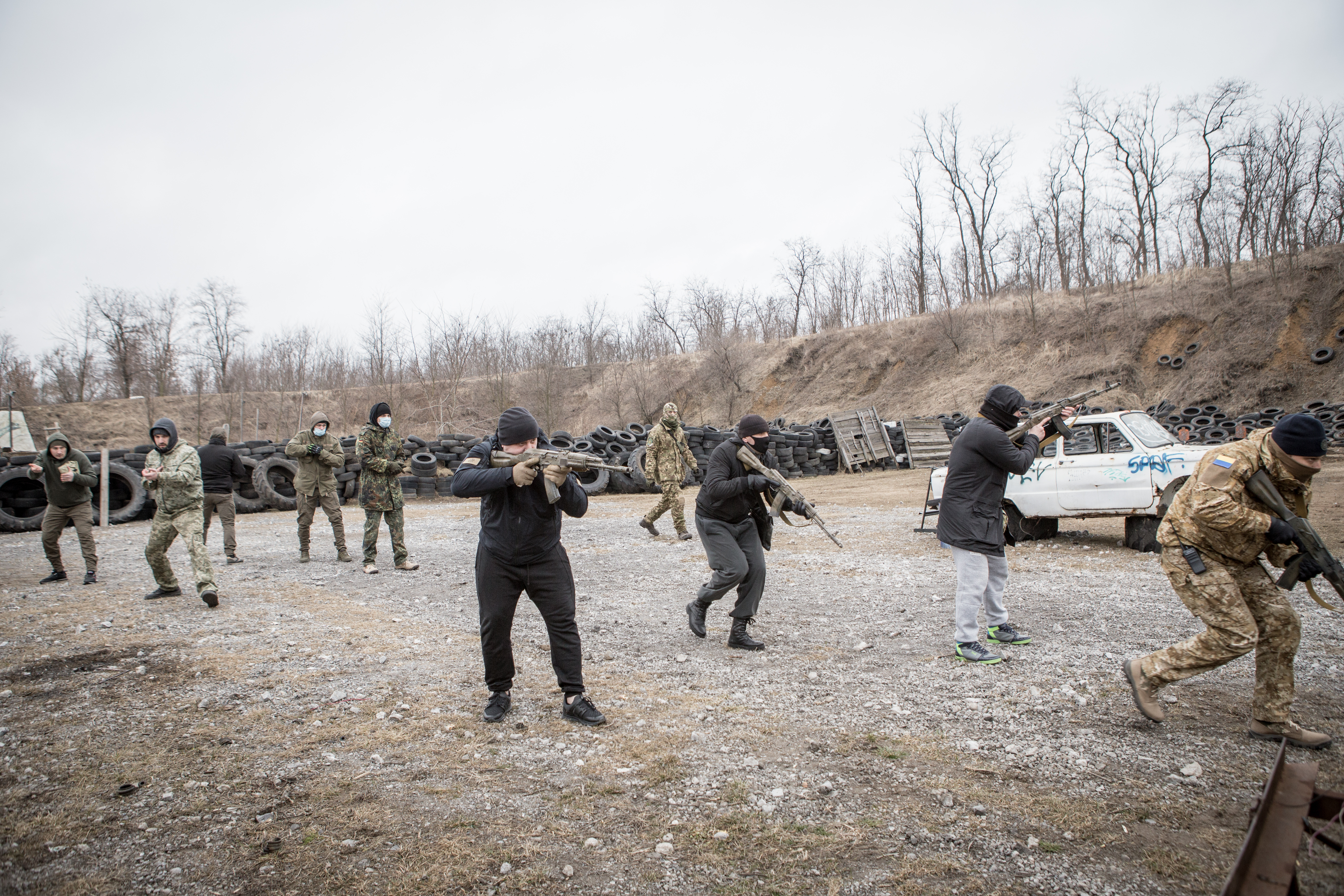
Civilians are training to fight, learning how to make molotov cocktails (homemade explosives) and, in some cases, stealing Russian equipment.
A civilian trains to throw Molotov cocktails to defend the city
VIACHESLAV RATYNSKYI via REUTERS
Civilians attend tactical and shooting exercises on the 6th day since start of large-scale Russian attacks
Anadolu Agency via Anadolu Agency via Getty Images
These images are amazing. A sort of 21st century equivalent of David and Goliath – Ukrainian farmers in their tractors , driving off with high-tech Russian weaponry https://t.co/2fimORpC0x
Civilians build iron barricades and traps to block Russia’s armoured vehicles
Anadolu Agency via Anadolu Agency via Getty Images
However, as French president Emmanuel Macon has warned “the worst is yet to come” when it comes to Putin’s brutality, it remains unclear how much longer people can live under these trying conditions.
The UK will personally sanction Russian president Vladimir Putin, Boris Johnson has told a virtual meeting of Nato leaders.
Putin and his foreign minister Sergei Lavrov are being targeted over their “revanchist mission” to overturn the post-Cold War order, the prime minister said.
Advertisement
He told alliance leaders on Friday that the UK would echo measures announced by the EU to target the Russian leader.
Referring to Putin’s wish to recover territory which previously fell under the USSR, he said Russia was “engaging in a revanchist mission to overturn post-Cold War order”.
Advertisement
Johnson told allies “the UK would introduce sanctions against president Putin and foreign minister Sergei Lavrov imminently, on top of the sanctions package the UK announced yesterday”, according to a No 10 spokesman.
“He warned the group that the Russian president’s ambitions might not stop there and that this was a Euro-Atlantic crisis with global consequences,” he said.
Advertisement
Johnson also used the meeting to urge “immediate action” over the banning of Russia from the Swift payment system to “inflict maximum pain” on the Kremlin.
One western official said it was “likely” that Russia failed to achieve its main objectives on day one of its invasion of Ukraine.
The official added: “And my fear with those objectives, that timescale not being met, is if that continues to be a theme where they are delayed and then my concern is that that Russia uses indiscriminate use of indirect fire, particularly artillery systems, thermobaric weapons – which we know Russia has both in its armoury and has used in previous conflicts.
Advertisement
“At the moment we’re not seeing the use of those particular weapons. But my fear would be that if they don’t meet the timescales and objectives that they would be indiscriminate in the use of violence and they don’t adhere to the same principles of necessity and proportionality and rule of law that Western forces do.
“This might be the last time you see me alive,” Ukrainian President Volodymyr Zelenskyy reportedly told EU leaders on a conference call on Thursday night.
Zelenskyy is currently hiding in Ukraine’s capital city of Kyiv as more than 100,000 Russian troops continue to attack the country on Putin’s orders.
“We were supposed to talk on the phone this morning, but he was no longer available,” Italian prime minister Mario Draghi told his parliament on Friday morning of Zelenskyy.
Buckingham Palace has released another update regarding Queen Elizabeth’s health.
The palace said on Wednesday that the queen, who tested positive for Covid-19 on Sunday, held her weekly telephone audience with prime minister Boris Johnson.
Advertisement
The news of the queen’s call followed the US blog Hollywood Unlocked’s false “exclusive” claim that the Queen died on Tuesday, which quickly circulated on social media. The false claim, made on the site’s Instagram page, has yet to be taken down by the blog.
The queen’s positive Covid-19 test came just days after her son, Prince Charles, and Camilla, Duchess of Cornwall, also tested positive. The statement from the palace over the weekend said the queen was “experiencing mild cold like symptoms but expects to continue light duties at Windsor over the coming week”.
Advertisement
The queen cancelled virtual engagements on Tuesday, as the palace said she was “still experiencing mild cold-like symptoms”, but would still “continue with light duties”.
The latest news about the queen’s health comes after questions were raised in October, when the sovereign cancelled a planned engagement to Northern Ireland the day of the trip.
Advertisement
Buckingham Palace said at the time that the queen had “reluctantly accepted medical advice to rest for the next few days”.
The queen held a virtual appointment the following week, though she cancelled an in-person appearance at the United Nations climate change conference, COP20.
In late October, the palace released another statement on Queen Elizabeth’s health, saying that she was intent in making an in-person appearance at the National Service of Remembrance on November 14.
Advertisement
The queen was unable to attend the service, though, missing it due to a sprained back.
Charles talked about his mother’s health just a few days later, telling press during a trip to Jordan that the sovereign was doing “all right”.
“Once you get to 95, it’s not quite as easy as it used to be,” the Prince of Wales told Sky News royal correspondent Rhiannon Mills in November. “It’s bad enough at 73.”
Boris Johnson “fears for the security of Europe” as tensions mount over a potential Russian invasion of Ukraine and British people were urged to leave the country.
The UK prime minister voiced his concern during a call with Western leaders – including US president Joe Biden – as the Foreign Office updated its advice on Friday evening to urge UK nationals to “leave now while commercial means are still available”.
Advertisement
At the same time, Biden’s national security adviser Jake Sullivan said there is the “credible prospect” of an invasion of some sort taking place before the end of the Winter Olympics on February 20.
He said the Russians are in a position to “mount a major military operation in Ukraine any day now”, which could include a “rapid assault on the city of Kyiv” or on other parts of the country.
Advertisement
The warning was echoed by UK defence secretary Ben Wallace, who said warned an invasion could come “at any time”.
Tensions have heightened in the last 24 hours as Russian president Vladimir Putin has now amassed an estimated 130,000 troops on the border with Ukraine.
Advertisement
<img class="img-sized__img landscape" loading="lazy" alt="US national security advisor Jake Sullivan speaks during the daily White House press briefing.” width=”720″ height=”480″ src=”https://www.wellnessmaster.com/wp-content/uploads/2022/02/boris-johnson-fears-for-the-security-of-europe-as-tensions-grow-over-potential-russian-invasion-of-ukraine-2.jpg”>
US national security advisor Jake Sullivan speaks during the daily White House press briefing.
Anna Moneymaker via Getty Images
The Foreign Office followed the US in advising against all travel to Ukraine, with a spokesman saying: “The safety and security of British nationals is our top priority, which is why we have updated our travel advice.
“We urge British nationals in Ukraine to leave now via commercial means while they remain available.”
After Johnson and world leaders held the virtual call, a No 10 spokesperson said: “The prime minister told the group that he feared for the security of Europe in the current circumstances.
“He impressed the need for Nato allies to make it absolutely clear that there will be a heavy package of economic sanctions ready to go, should Russia make the devastating and destructive decision to invade Ukraine.
Advertisement
“The prime minister added that president Putin had to understand that there would be severe penalties that would be extremely damaging to Russia’s economy, and that Allies needed to continue with efforts to reinforce and support the Eastern frontiers of Nato.
“He urged the leaders to work together to deliver economic and defensive support to Ukraine.
“The leaders agreed that if president Putin deescalated, there was another way forward, and they pledged to redouble diplomatic efforts in the coming days.”
Speaking from the White House, Sullivan said Russia could choose “in very short order to commence a major military action against Ukraine” but stressed the US does not know whether Putin has made a final decision.
Moscow denies it is planning an invasion and called the Western military actions provocations meant to bait Russia into war.
But diplomatic efforts to resolve the crisis have yet to yield results.
The two countries share a border, and between 1919 and 1991 Ukraine was part of the Soviet Union. Ukraine declared independence from the Soviet Union in the early-1990s but maintained close economic and cultural links with Russia.
Russia has been trying to reunite with its neighbour even since, with Putin calling the break-up of the Soviet bloc the “greatest geopolitical tragedy of the 20th century”.
It’s not entirely clear why Putin is acting now. There’s speculation he may be moving because the US looks weak following the messy evacuation from Afghanistan.
Metropolitan Police commissioner Dame Cressida Dick has been forced out as head of the force after a series of controversies.
The under-fire police chief said earlier in the day she had “absolutely no intention of going”, but later admitted the mayor of London Sadiq Khan “no longer has sufficient confidence in my leadership to continue”.
Advertisement
In a statement, she made clear her resignation followed a meeting with the mayor which “left me no choice but to step aside”.
Dick’s leadership has been dogged by a series of scandals, including the murder of Sarah Everard by serving officer Wayne Couzens and racist, misogynist and homophobic messages exchanged by officers shared by officers at Charing Cross police station.
Advertisement
In a statement, Khan, said: “Last week, I made clear to the Metropolitan Police commissioner the scale of the change I believe is urgently required to rebuild the trust and confidence of Londoners in the Met and to root out the racism, sexism, homophobia, bullying, discrimination and misogyny that still exists.
“I am not satisfied with the commissioner’s response.
Advertisement
“On being informed of this, Dame Cressida Dick has said she will be standing aside. It’s clear that the only way to start to deliver the scale of the change required is to have new leadership right at the top of the Metropolitan Police.
“I would like to thank Dame Cressida Dick for her 40 years of dedicated public service, with the vast majority spent at the Met where she was the first woman to become Commissioner. In particular, I commend her for the recent work in helping us to bring down violent crime in London – although of course there is more to do.
“I want to put on the record again that there are thousands of incredibly brave and decent police officers at the Met who go above and beyond every day to help keep us safe, and we owe them a huge debt of gratitude.
“I will now work closely with the home secretary on the appointment of a new commissioner so that we can move quickly to restore trust in the capital’s police service while keeping London safe.”
Advertisement
In a statement, Dick said: “It is with huge sadness that following contact with the Mayor of London today, it is clear that the Mayor no longer has sufficient confidence in my leadership to continue.
“He has left me no choice but to step aside as commissioner of the Metropolitan Police Service.”
Hours earlier, when asked by the BBC if she should step down she said: “I have absolutely no intention of going and I believe that I am and have been, actually for the last five years, leading a real transformation in the Met.”
This is a breaking news story and will be updated. Follow HuffPost UK on Twitter, Facebook and Instagram.
The UK has recorded 534 daily Covid-19 deaths, the highest figure since February last year.
It comes as statisticians suggested Covid-19 infections have stopped falling, and a week after Plan B restrictions were abandoned and ministers said the Omicron-fuelled surge was “in retreat”.
Advertisement
The government said on Wednesday a further 534 people have died within 28 days of testing positive for Covid-19, bringing the total to 157,409.
These figures now include deaths in England following possible reinfections of Covid-19, which is why there has been a jump in the cumulative total of deaths and why the daily total is higher than recently.
Advertisement
But the daily figure is the highest since February 23, 2021, when the daily count was 548. The new data will raise questions over the rolling back of measures to curb the spread of Covid-19.
On Monday, culture secretary Nadine Dorries, when doing a media round defending Boris Johnson, said: “We have won the war on Covid in this country. That’s what people see and that’s what people know.”
Advertisement
There were 88,085 cases of Covid-19 reported in the UK on Wednesday.
Earlier in the day the Office for National Statistics (ONS) said Covid-19 infections have plateaued or showed an increase.
In England around one in 20 people in private households are estimated to have had the virus in the week to January 29, or 2.6 million people – unchanged from the week to January 22.
In Wales around one in 20 people had Covid-19 last week, up from one in 30.
Advertisement
Northern Ireland has also seen a week-on-week increase, from one in 20 people to one in 15.
In Scotland, the ONS describes the trend as “uncertain” with around one in 30 people estimated to have had Covid-19 last week, unchanged from the previous week.
Giuffre is seeking an undisclosed amount of damages.
The royal has repeatedly denied all of Giuffre’s allegations. His legal team tried to get the case thrown out based on a previous agreement between Giuffre and Epstein, but the judge dismissed the motion.
Advertisement
Here’s a breakdown of everything Andrew said in his new document.
Andrew’s denials
The royal has denied all the allegations against him, starting from before Giuffre’s decision to serve legal papers in August 2021.
Maxwell, the ex-girlfriend of billionaire Jeffrey Epstein, was recently convicted of sex trafficking. Epstein killed himself behind bars a month after he was arrested for sex trafficking back in 2019, before his trial.
He was already a convicted sex offender.
Maxwell’s conviction then sparked speculation that she might reveal the names of other people involved with Epstein.
Andrew also “admits that he met Epstein in or around 1999” but denies he participated in any abuse with the disgraced financier.
The royal’s legal team said he “lacks sufficient information to admit or deny” her allegations about Epstein using “his vast connections” to create “a web of transcontinental sex trafficking”.
His counsel added that he lacked “sufficient information to admit or deny” Giuffre’s claim that Maxwell was “the highest-ranking recruiter in Epstein’s sex-trafficking enterprise”.
His lawyers also listed “consent” as one of his defences, although it’s unclear what he means by that.
Andrew also claimed Giuffre waited too long after the alleged abuse to bring a complaint.
Advertisement
A “doctrine of unclean hands” is listed too, claiming that Giuffre had acted unethically related to the accusations, forfeiting her right to benefit in any way from the situation.
“Assuming, without admitting, that Giuffre has suffered any injury or damage alleged in the complaint, Giuffre’s claims are barred by the doctrine of consent,” the document states.
Andrew ‘demands a trial’
His lawyers also added: “Prince Andrew hereby demands a trial by jury on all causes of action asserted in the complaint.”
How has Giuffre responded?
David Boies, Giuffre’s representative, said Prince Andrew’s response “continues his approach of denying any knowledge or information concerning the claims against him, and purporting to blame the victim of the abuse for somehow bringing it on herself”.
He added that his client was looking forward “to confronting Prince Andrew with his denials and attempts to blame Ms Giuffre for her own abuse at his deposition and at trial”.
Lisa Bloom, who represents several of Maxwell and Epstein’s accusers, dubbed Andrew’s demand for a trial a “PR move” considering Giuffre has already requested a jury trial, as is her constitutional right.
She said Andrew’s request was therefore “meaningless”.
The Palace added that Andrew was defending his case “as a private citizen”.
Andrew released this legal document just 10 days before the start of the platinum jubilee – meaning the ongoing saga could easily overshadow his mother’s celebration of 70 years on the throne.
A county cricket chief has been accused of generalising in “outdated” stereotypes by suggesting Black players prefer football and rugby and the Asian community prioritise education in the latest racism storm to engulf the sport.
The chairman of Middlesex, Mike O’Farrell, was forced to apologise after a backlash to his comments made to parliament about the cricket’s lack of diversity.
Advertisement
Azeem Rafiq, the cricketer whose revelations lifted the lid on institutional racism in the sport, said he was staggered by O’Farrell’s views on the reasons why individuals from the Afro-Caribbean and South Asian communities drifted away from the sport, as he suggested counties did not get enough credit for the work they do.
O’Farrell told the digital, culture, media and sport select committee that 57 per cent of players at Middlesex at under-17 level were from culturally diverse backgrounds but that it became “more difficult” to keep that level of representation at older age-groups.
Advertisement
He said: “The football and rugby world becomes much more attractive to the Afro-Caribbean community, and in terms of the South Asian community…we’re finding that they do not want to commit necessarily the same time that is necessary to go to the next step because they prefer – not always saying they do it – they prefer to go into other educational fields where cricket becomes secondary.”
Honestly these outdated views in the game are exactly why we are in this position. Unfortunately the decision makers hold onto these myths. ‘The Black community only like football, and asian community only interested in education’ Seriously the game deserves better. https://t.co/6Nzoad0kYq
— Ebony-Jewel Rainford-Brent MBE (@ejrainfordbrent) January 25, 2022
Oh no. Middlesex chairman has just done the “black people don’t like cricket, they like football” thing in front of DCMS. Unchallenged. Followed it up with “asian people are too interested in academia”. Literally saying this right now live in front of the entire world
Ebony Rainford-Brent, a director at Surrey, tweeted: “These outdated views in the game are exactly why we are in this position.
Advertisement
“Unfortunately the decision-makers hold onto these myths. ‘The Black community only like football, and Asian community only interested in education’. Seriously, the game deserves better.”
Rafiq, who gave harrowing evidence to the same committee in November about the racial abuse he suffered at Yorkshire, said there is “a demographic of county chairs that don’t see the problem” of discrimination within cricket.
He said: “This narrative that we’ve been hearing for a long time that Asian people want to go and study is because we’ve not been made to feel welcome in our workspaces. I think it was incredibly disrespectful, but I think it just shows the wider problem.”
This has just confirmed what a endemic problem the game has
I actually can’t believe what I am listening to#GiveMeStrength
Rafiq also took issue with Hampshire chair Rod Bransgrove’s claim that his county was “overachieving in some areas” on equality, diversity and inclusion.
“It just shows what a long way we’ve got to go,” Rafiq told Sky Sports News.
“These people have come to a select committee and said they think that they’re overachieving, that the counties don’t get enough credit. (I’m) pretty angry.
“I think it shows that maybe the problem lies with the counties a lot more than the ECB (England and Wales Cricket Board). You’ve got a demographic of county chairs that don’t see the problem.
“I found it quite staggering to hear that one of the chairs felt that they were actually overachieving in this space.
“The way (new Yorkshire chair) Lord Patel spoke came from someone who not only has suffered, but gets it, and there’s a massive willingness to confront the issue.
“Whereas what I heard from the other (county chairs) was ‘we’re great, look at us, we do so many things in the community’. And this was exactly the same language that Yorkshire used in their defence with me.”
O’Farrell issued a statement apologising for his remarks, and added: “I was aiming to make the point that as a game, cricket has failed a generation of young cricketers, in systematically failing to provide them with the same opportunities that other sports and sectors so successfully provide.
“Cricket has to take responsibility for these failings and must learn that until we make the game an attractive proposition for youngsters of all backgrounds to continue through the pathway into the professional game, much like other sports and sectors are doing, the game won’t make the progress it needs to.”
He said in a later interview with Sky Sports News that he was not planning to resign, but that he would step down if the Middlesex board or the club’s members wanted him to.