Liz Truss Versus The Trade Unions: The Next Front In The Culture Wars?

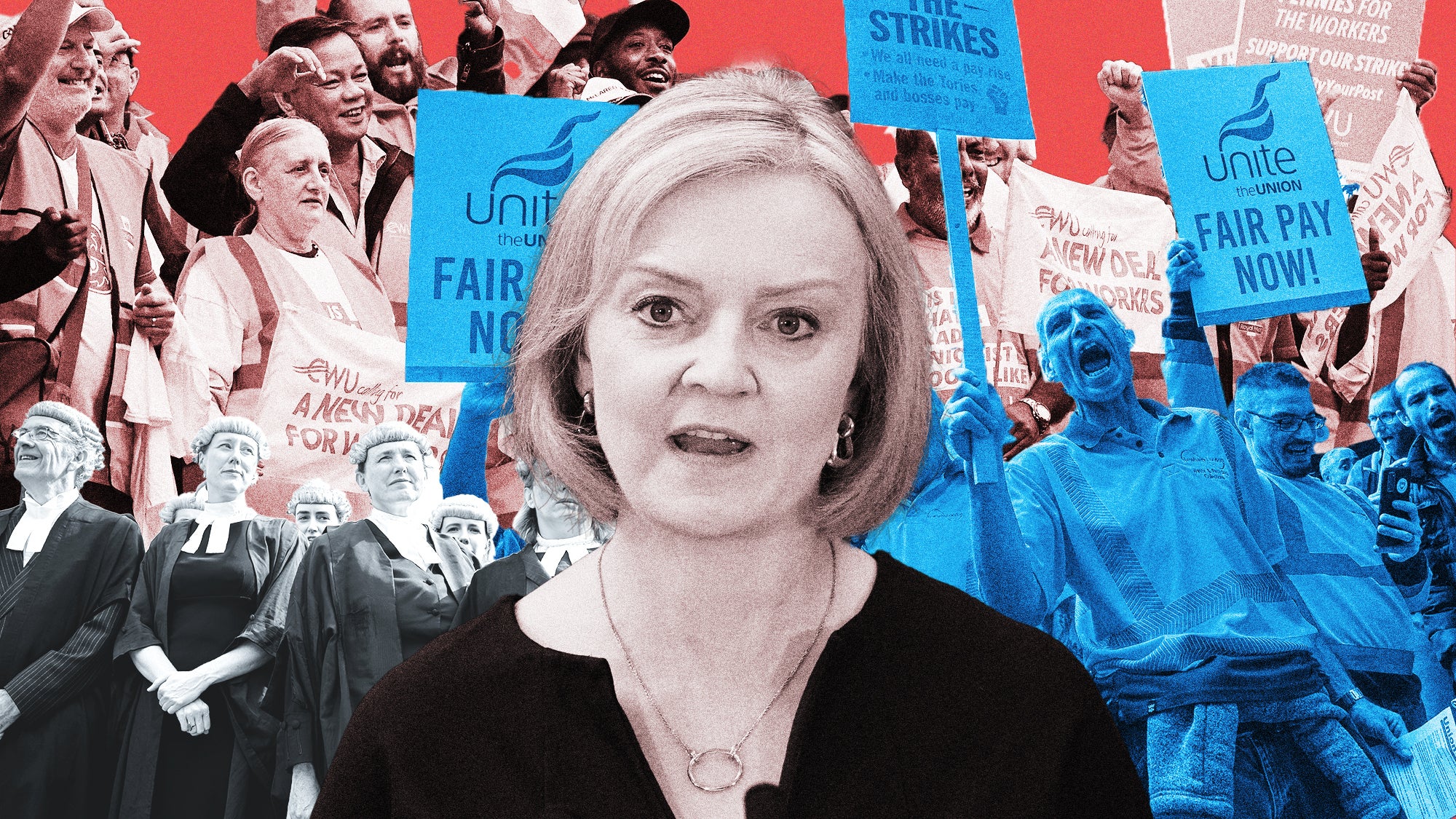
Much has been made of Liz Truss’s attempts to emulate her icon, Margaret Thatcher, in her quest to become Tory leader and prime minister.

While she has sought to distance herself from the comparison, there is one thing she does share with her late predecessor: she has taken over as prime minister at a time when Britain’s economy is crumbling and its workforce is more mutinous than ever.

Angered by an inflation rate of 9.9 per cent that is outstripping stagnant wages, trade unions are organising en masse for industrial action that threatens to take Britain back to the turmoil of the 1970s.

One by one, they are rejecting the government’s single-digit pay offers and organising strike ballots. Collectively, they have said “enough is enough”.

Their resistance sets the scene for a new front in the divisive culture wars in which unions fear Truss will attempt to “crush the enemy within” by bringing in a series of measures that will hamper their ability to take industrial action.

Kwasi Kwarteng, Truss’s new chancellor, confirmed this week the government will bring forward legislation making it harder to go on strike.

“What we have is a government that seems to be struggling to come up with answers to the cost of living crisis,” says Tim Sharp, senior policy officer for employment rights at the Trades Union Congress (TUC).

“It appears that some in government would like to distract from that with a culture war against the unions.

“We had a leadership contest in which the candidates had to appeal to some of their more ideological members and that’s why we’ve seen the pledges in terms of anti-union action.”

Which unions are striking?

The RMT and Aslef rail unions, the Communication Workers Union (CWU) representing Royal Mail workers and barristers under the Criminal Bar Association (CBA) have all been on strike over pay and working conditions in recent weeks.

Dockhands represented by Unite have also been striking at the port of Felixstowe and are set to do so again in September, in the shadow of the Labour Party conference in Liverpool.

The National Education Union (NEU), the largest education union in the UK that represents teachers, lecturers and support staff, will open its online preliminary ballot for strike on September 24, before a formal ballot takes place in November.
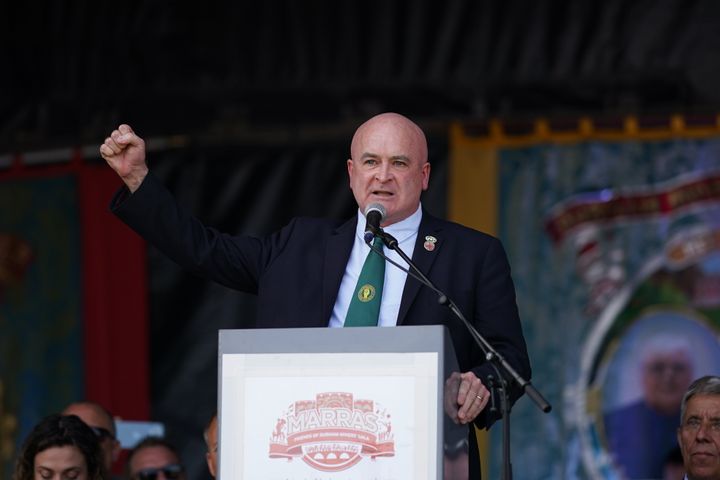
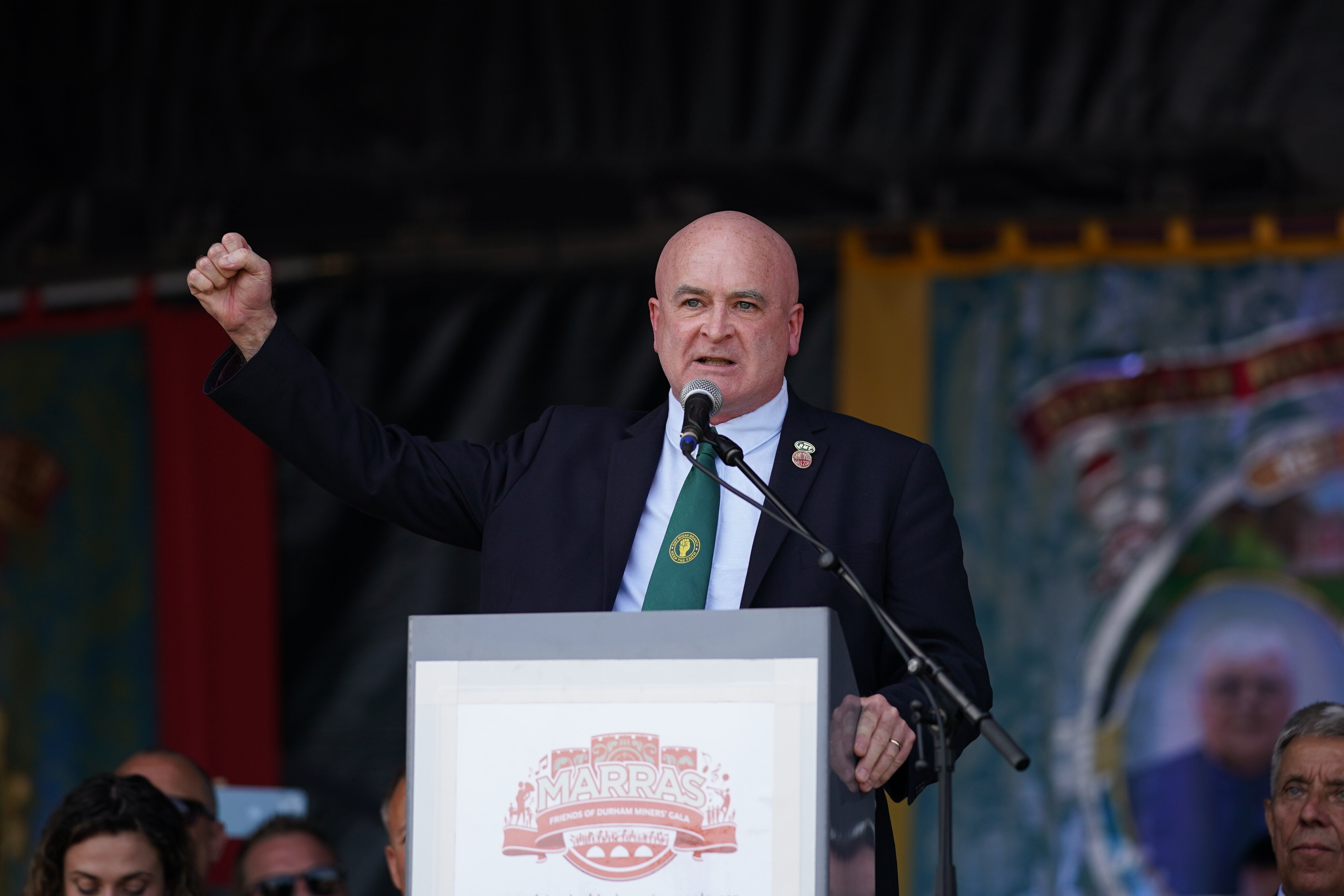
RMT general secretary Mick Lynch has said Britain could be brought to a standstill by a wave of strikes hitting “every sector of the economy”.

Ian Forsyth via Getty Images

The Royal College of Nursing (RCN), whose members include half a million nurses, midwives, nursing support workers and students, opened a postal ballot for strike action on September 15 that will close on October 13.

If enough members vote for industrial action, it will be the first time in the union’s history that its members in England and Wales go on strike.

The British Medical Association (BMA) has also said it will ballot junior doctor members in England for industrial action if the government fails to restore pay to 2008/09 levels by the end of this month.

The public needs to be prepared for the havoc such strikes could wreak on their daily lives.

“Every school in the country is going to be shut bringing total chaos,” one union source says. “Tens of thousands of hospital appointments are going to be cancelled.

“This is the price you pay for a Tory government that has slashed public services.”

The tools in Truss’s arsenal

If Truss is looking at how she might limit trade union rights, David Cameron’s Trade Union Act of 2016 might provide some inspiration.

Billed at the time as some of the most “regressive” anti-union legislation in the world, the law brought in measures such as higher thresholds for success in industrial ballots.

It also increased the notice period unions must give to employers ahead of any strike action from one week to two weeks.

In an ordinary union, there must be a 50 per cent turnout for an industrial ballot in order for their results to be legally valid. A simple majority has to vote in favour of strike action for it to go ahead.

But for workers who deliver “important” public services, not only does the 50 per cent turnout have to be met, the support of 40 per cent of all eligible members must also be attained for the strike action to be legal.

Unions fear that Truss could use a new law to bring in thresholds that are so high that they could make strikes nigh on impossible.

They anticipate that she could also widen the definition of what counts as a public service to include bus drivers and tube drivers, for example, to apply the 40 per cent threshold.

“If she goes in this direction there will be new laws — that’s a fact,” says one union source.

“She’s got a parliamentary majority. You’re not going to stop her legislating.

“If the Tories use an act of parliament to redefine what defines a public service, at a stroke they would cover huge sections of private industry.

“They can make it even more difficult for unions to get through the thresholds. These laws are already the most stringent of anywhere in Europe.”

A new law to guarantee a minimum level of service on “vital national infrastructure” was a key pledge to come out of the leadership campaign, as was a tax on the strike benefit members receive when they don’t go into work.

Truss also suggested brining in a cooling-off period so that unions can no longer strike as many times as they like in the six-month period after a ballot.

Tim Sharp says the effect of Truss’s plans could be that they make union disputes harder to resolve.

“The industrial action we’ve had has been grassroots driven,” he tells HuffPost UK.

“They risk making industrial disputes harder to resolve. You often see a day of strikes here and there, but if a union is being limited in how often it can take industrial action, then what you could see is longer periods of strike action.”

Another union insider agrees: “If Truss thinks she’s going to shut down the unions she’s got another thing coming.

“She will just create so much anger it increases turnout in the many union ballots currently going on.”

Workers of the world unite

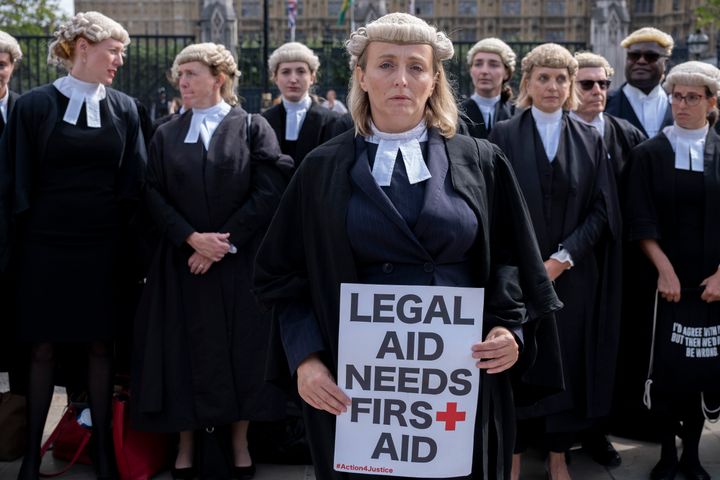
Criminal barristers are on strike over pay for legal aid work.

Mike Kemp via Getty Images

In the unions, Truss has found herself an opponent that will not go down without a fight.

Sharon Graham, the boss of the Unite union, tells HuffPost UK there will be a “prolonged and fierce resistance to Truss attacking workers’ rights”.

“If Liz Truss thinks we have just been sitting waiting for her anti-trade union laws, she’s wrong,” she says.

“We’re ready. If she puts up the thresholds for legal strike action we’ll employ more organisers to get the vote out. If she taxes strike pay, we’ll take more money from the strike fund to hold the real value of strike pay.

“And if she tries to gag trade unions we’ll find ways to speak out more and more.”

And in a swipe at Truss’s own result in the Tory leadership contest Graham says: “Right now if workers plan strike action 50 per of those who can vote in the strike ballot must vote for the strike to be legal.

“It’s a bit rich for Liz Truss to be upping the figures in new laws. In her election for leader she only got 47 per cent of Tory members who were entitled to vote.

“If the Tory Party was bound by the same restraints as the unions Truss would not have made the grade for leader. You could not make it up.”

RMT general secretary Mick Lynch said workers could be forced to take “unlawful industrial action” if the government makes it impossible for legal strikes to take place.

He told Sky News: “We’re fast getting to a situation where we’re going to have laws that are as oppressive as those that exist in Russia and China and back in Poland before Solidarnosc came along and took unlawful industrial action to break free of the oppression of the old Soviet bloc an the communist regime.”

The TUC is already preparing its campaign to appeal to the public when the battle begins.

National rallies will take place in Westminster and there will be a tour of town halls, a national day of action and a lobby of parliament.

The message members have been told to stick to is that Truss plans’ “threaten the right to strike” and are an attempt to distract the public from the burgeoning cost of living crisis.

And crucially, there is the edict to “stay calm: they want us to blow our tops, don’t give them the satisfaction”.

Failing that, the government could find itself in court.

In a sign of the resistance to come, 11 trade unions launched legal action against the government on Tuesday over government plans to replace striking workers with agency staff.

They claim the government has broken the Employment Agencies Act 1973 by failing to consult them on the changes and is violating “fundamental trade union rights” protected by Article 11 of the European Convention on Human Rights.

No pain, no gain

For Truss, a protracted battle with the unions could help her forge her reputation with voters, for whom she remains largely unknown.

According to pollster James Johnson, the co- founder of JL Partners, Truss could win plaudits from the public from sticking to what she thinks is right.

“I don’t think it’s a politically calculated move, I think it comes from a genuine frustration within government,” he says.

“What pays off for Liz Truss is that if they are pursuing what they think is right, even if it doesn’t go down well, that may have a long term effect in popularity in showing that there is a steeliness and sense of inner conviction — and that is what the public do crave.”

By taking such a firm line, she also sets a contrast in voters’ minds between herself and Labour leader Keir Starmer, whom the public still perceive as weak on strikes.

“There are negative views about Starmer because of his position on strike — at first he seemed to back people going out, then he didn’t,” Johnson explains.

“It reinforces that view that he doesn’t stand for anything, and that is fine if the other leading party is seen like that — but if we get that contrast developing between Truss and Starmer, then he could be in trouble.”

The jury is out on whether Truss can recapture the status of a conviction politician — or whether the turmoil that ensues is so great that it would cancel any benefit that came from taking a stand.
Share Button

Treasury Minister Dunked On For Premature Celebration Of Rising Pound

The chief secretary to the Treasury has faced online ridicule after celebrating the rise in the pound – just before it repeatedly dropped to a 37-year low.

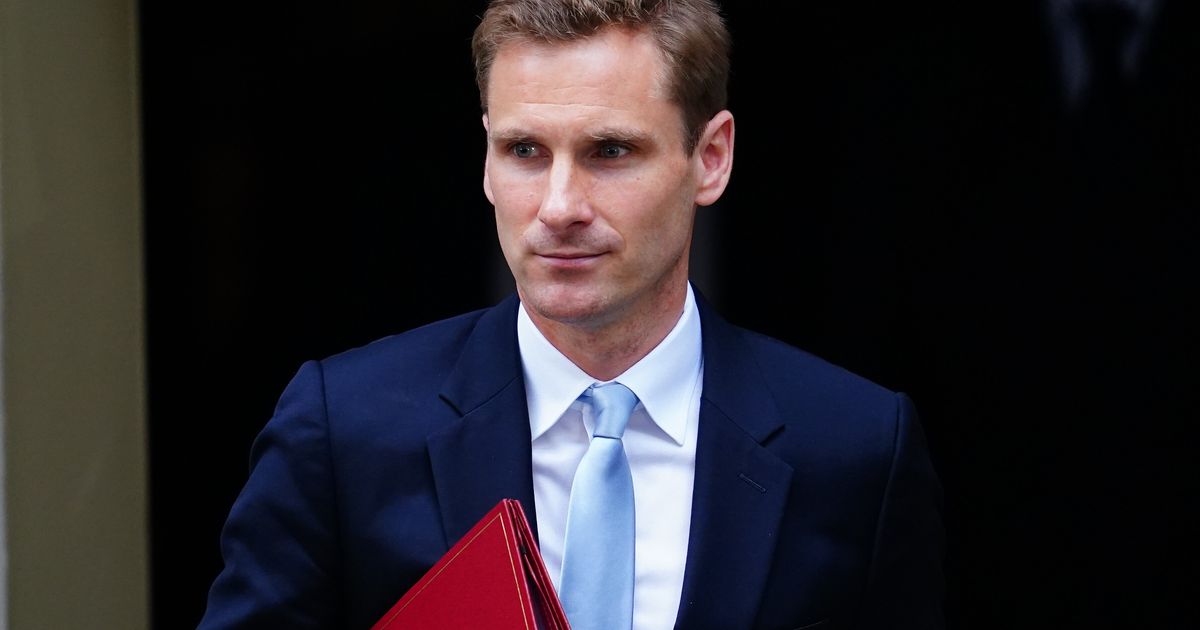
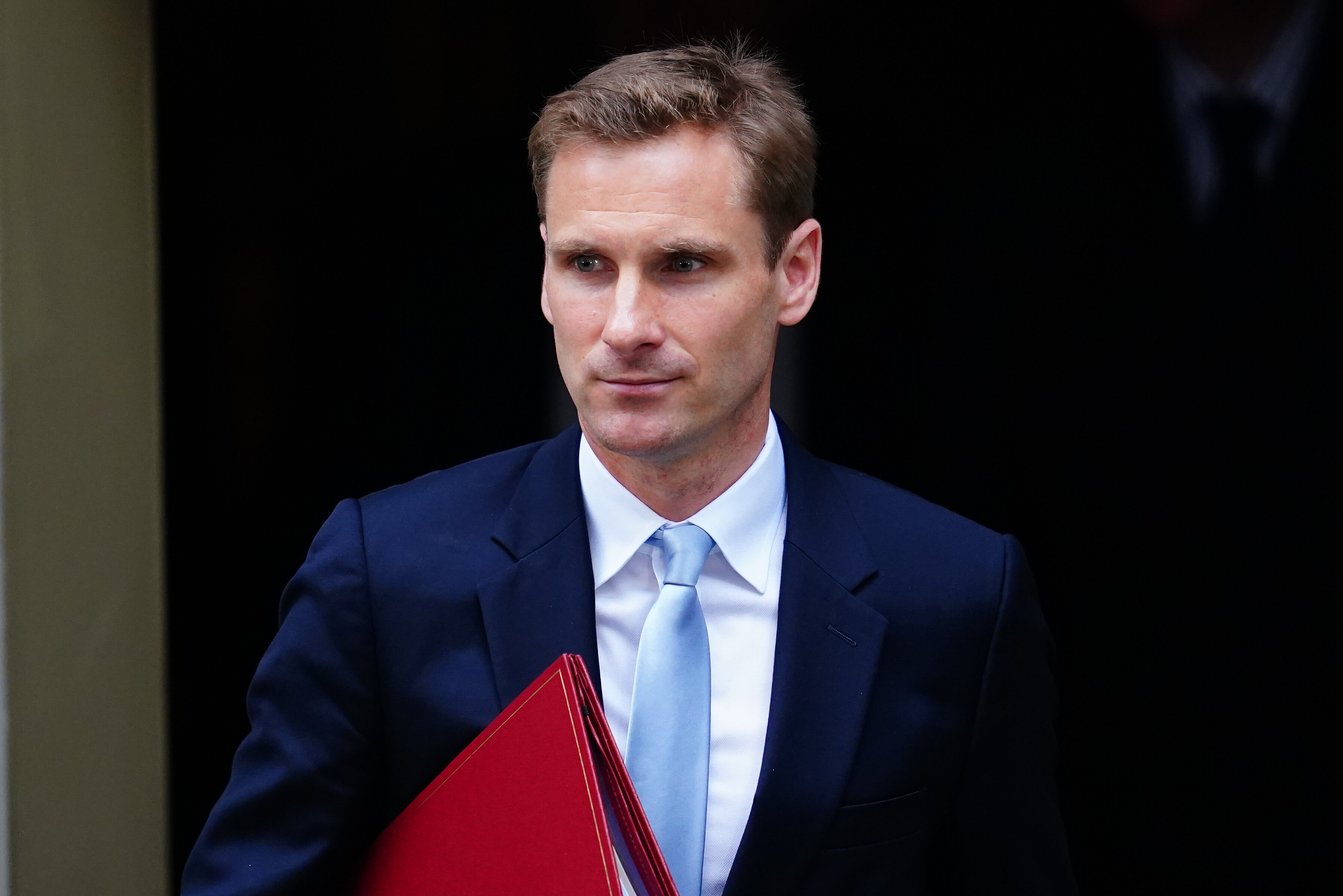
Chris Philp, second in command to chancellor Kwasi Kwarteng, seemed thrilled as sterling rose against the US dollar briefly as his boss unveiled his mini-budget.

He tweeted: “Great to see sterling strengthening on the back of the new UK Growth Plan.”

But once the markets digested what amounted to tax cuts costing up to £45 billion annually, the currency went in reverse.

At its lowest point on Friday afternoon £1 could buy just 1.0896 US dollars – the worst exchange rate for Britons since 1985.

It was a drop of over 3%, and means the pound has lost more than 7% of its value against the dollar in just a month.

Twitter was in unforgiving mood.

Appearing on the BBC later, Philp said the markets will see that the government has a “credible and responsible” economic plan

He told BBC Radio 4’s PM programme: “I think when the chancellor sets out his medium-term fiscal plan, which includes getting debt to GDP falling, then I think markets and others will see that we have a credible and responsible plan.”.

He also insisted the government has a “plan” to drive up GDP by 1% on current forecasts every year.

“I have every confidence that the objective we set out, the extra 1%, will be delivered. We’re not hoping, we’ve got a plan to do it.”

Philp rejected the idea that the government has abandoned the cautious approach to the public finances taken by previous Tory administrations.

Using more than £70 billion of increased borrowing, Kwarteng on Friday set out a package which included abolishing the top rate of income tax for the highest earners.

He cut stamp duty for homebuyers, and brought forward a cut to the basic rate of income tax, to 19p in the pound, a year early, to April, as part of tax cuts costing up to £45 billion annually.

Kwarteng told the Commons tax cuts are “central to solving the riddle of growth” as he confirmed plans to axe the cap on bankers’ bonuses while adding restrictions to the welfare system.

Share Button

‘Send Putin To The Trenches’: Russia’s Military Call-Up Sparks Protests

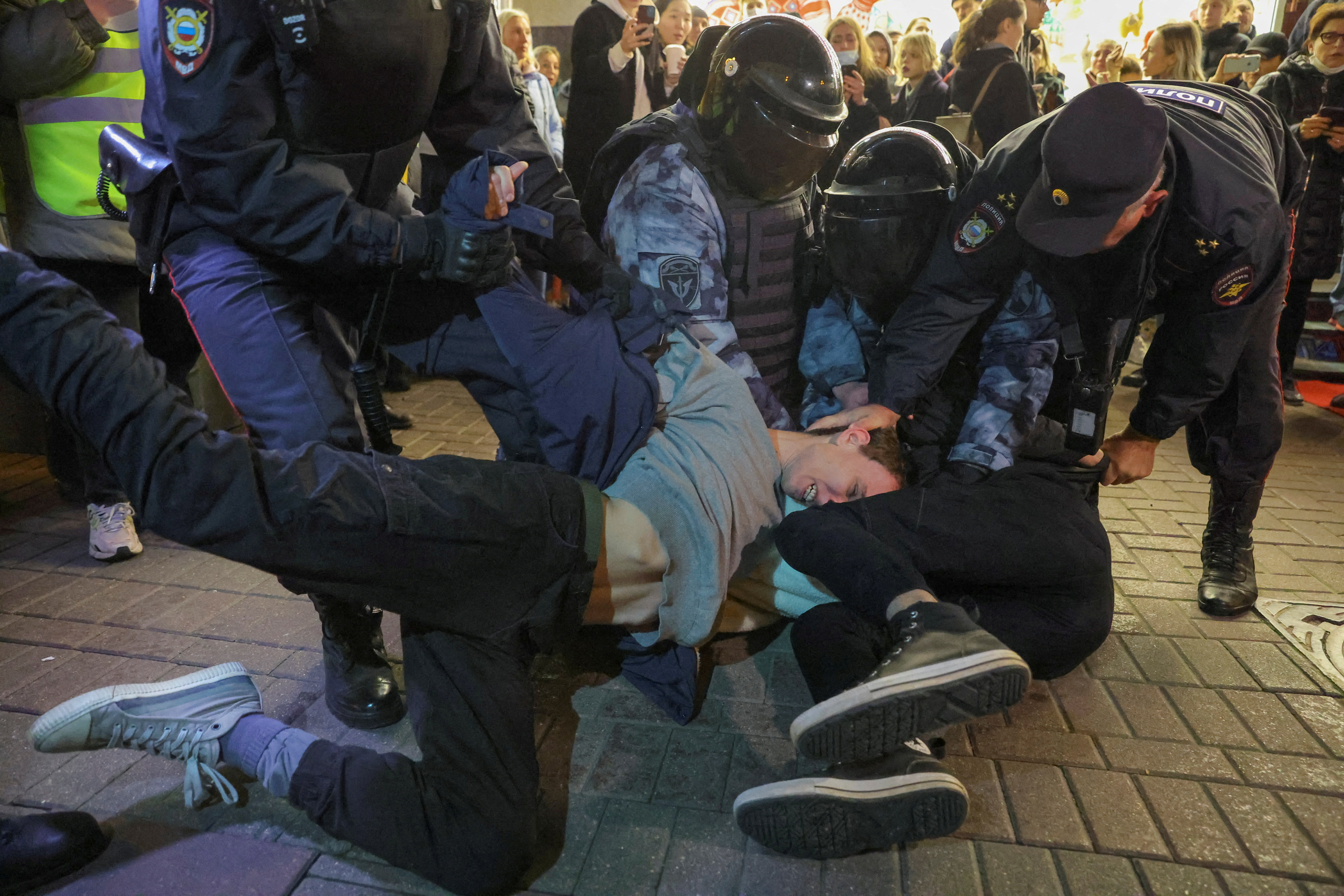
Protesters in Moscow have chanted “send Putin to the trenches” amid widespread disapproval of Russia’s biggest conscription drive since World War Two.

Within hours of president Vladimir Putin ordering a partial mobilisation of reservists on Wednesday, rare protests were reported across the country that led to almost 1,200 arrests.

Shortly after Putin’s address, Russian media reported a spike in demand for plane tickets abroad as some draft-age men headed for the border.

In the capital Moscow, hundreds of people gathered on the central Stary Arbat street amid heavy police presence. Protesters could be seen chanting “No war”, “Send Putin to the trenches” and “Let our children live” in videos published to social media.

Putin’s risky order follows humiliating setbacks for his troops nearly seven months after they invaded Ukraine.

The first such call-up in decades heightened tensions with Ukraine’s Western backers, who derided it as an act of weakness and desperation.

Liz Truss accused Putin of “sabre rattling” as the UK prime minister addressed the United Nations General Assembly, aded that the Russian president is desperately trying to justify a “catastrophic failure” in Ukraine.

The total number of reservists to be called up could be as high as 300,000, officials said.

Despite Russia’s harsh laws against criticising the military and the war, protesters outraged by the mobilisation overcame their fear of arrest to stage protests in cities across the country.

Nearly 1,200 Russians were arrested in anti-war demonstrations in cities including Moscow and St Petersburg, according to the independent Russian human rights group OVD-Info.

As protest calls circulated online, the Moscow prosecutor’s office warned that organising or participating in such actions could lead to up to 15 years in prison.

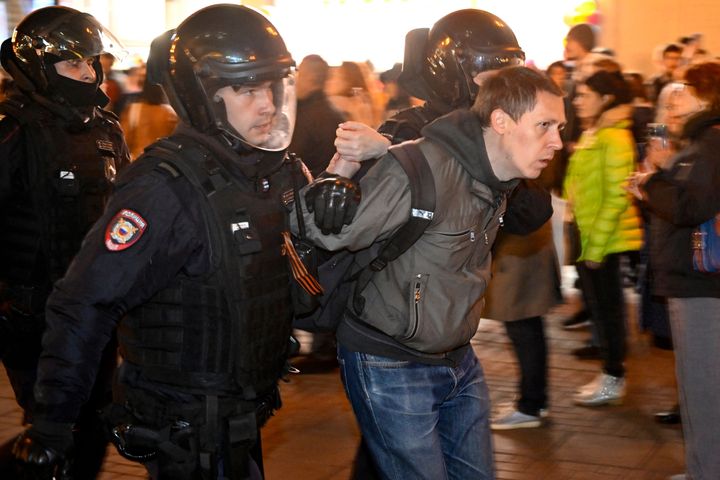
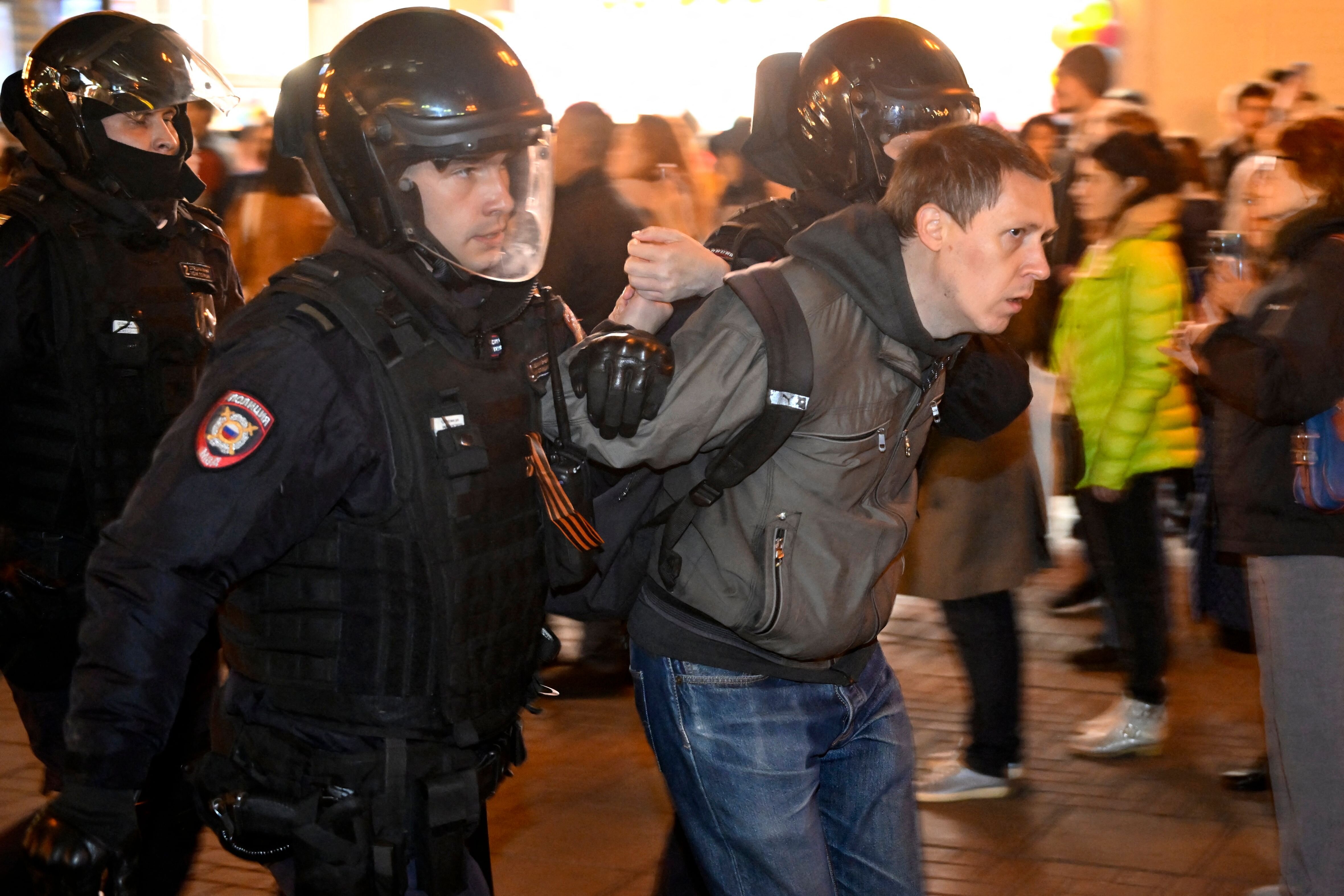
Police officers detain a man in Moscow on September 21, 2022, following calls to protest against partial mobilisation announced by President Vladimir Putin. - President Vladimir Putin called up Russian military reservists on September 21, saying his promise to use all military means in Ukraine was "no bluff," and hinting that Moscow was prepared to use nuclear weapons. His mobilisation call comes as Moscow-held regions of Ukraine prepare to hold annexation referendums this week, dramatically upping the stakes in the seven-month conflict by allowing Moscow to accuse Ukraine of attacking Russian territory. (Photo by Alexander NEMENOV / AFP) (Photo by ALEXANDER NEMENOV/AFP via Getty Images)
Police officers detain a man in Moscow on September 21, 2022, following calls to protest against partial mobilisation announced by President Vladimir Putin. – President Vladimir Putin called up Russian military reservists on September 21, saying his promise to use all military means in Ukraine was “no bluff,” and hinting that Moscow was prepared to use nuclear weapons. His mobilisation call comes as Moscow-held regions of Ukraine prepare to hold annexation referendums this week, dramatically upping the stakes in the seven-month conflict by allowing Moscow to accuse Ukraine of attacking Russian territory. (Photo by Alexander NEMENOV / AFP) (Photo by ALEXANDER NEMENOV/AFP via Getty Images)

ALEXANDER NEMENOV via Getty Images

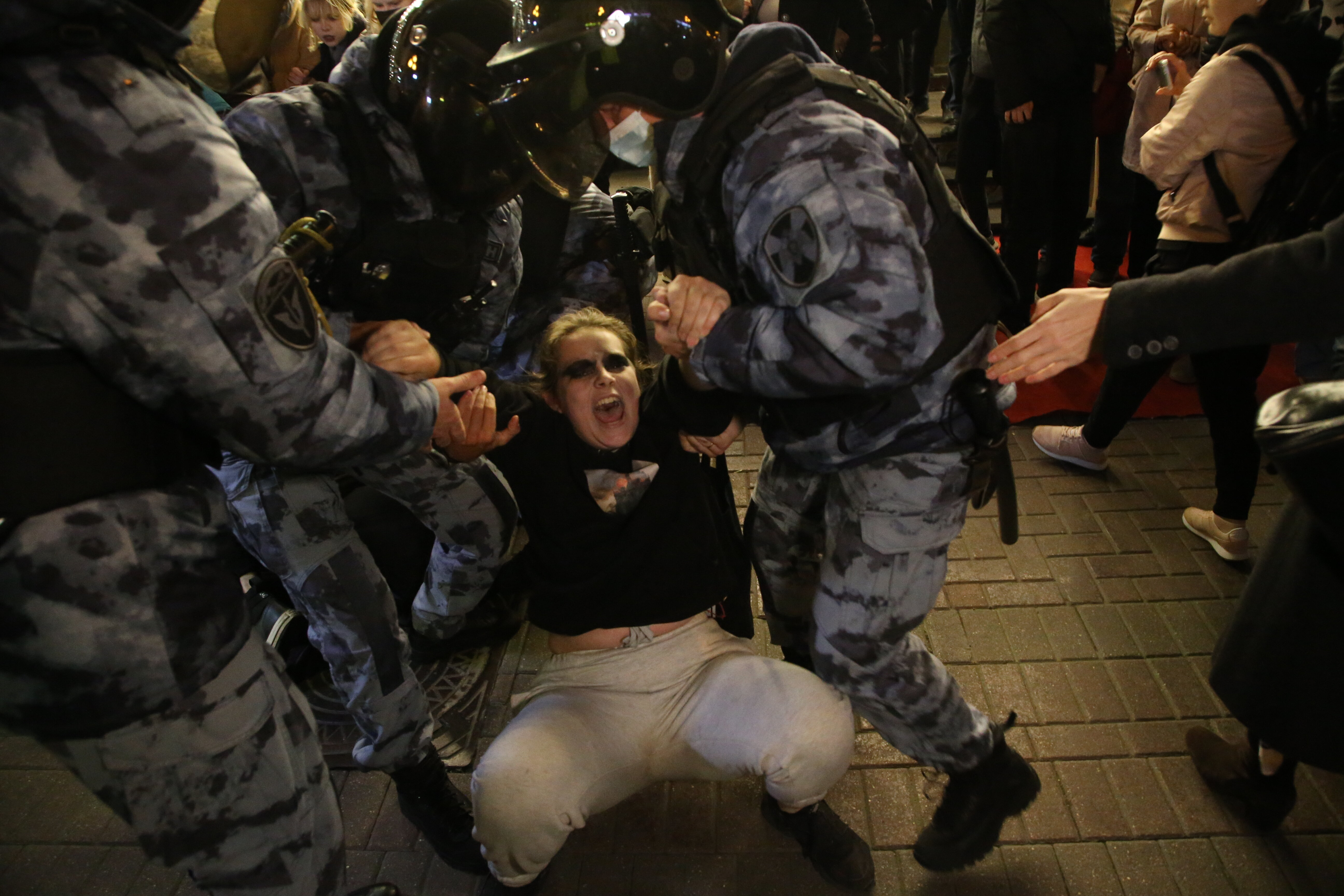
<img class="img-sized__img landscape" loading="lazy" alt="Russian police officers detain a protester during a protest rally at Arbat street in Moscow, Russia.” width=”720″ height=”480″ src=”https://www.wellnessmaster.com/wp-content/uploads/2022/09/send-putin-to-the-trenches-russias-military-call-up-sparks-protests-4.jpg”>
Russian police officers detain a protester during a protest rally at Arbat street in Moscow, Russia.

Contributor via Getty Images

The Associated Press news agency witnessed at least a dozen arrests in the first 15 minutes of a nighttime protest in the capital.

“I’m not afraid of anything. The most valuable thing that they can take from us is the life of our children. I won’t give them life of my child,” said one Muscovite, who declined to give her name.

Asked whether protesting would help, she said: “It won’t help, but it’s my civic duty to express my stance. No to war!”

In Yekaterinburg, Russia’s fourth-largest city, police hauled onto buses some of the 40 protesters who were detained at an anti-war rally. One woman in a wheelchair shouted, referring to the Russian president: “Goddamn bald-headed ‘nut job’. He’s going to drop a bomb on us, and we’re all still protecting him. I’ve said enough.”

Share Button

A Cabinet Minster Thinks The Tories Haven’t Had A ‘Clear Run’ Since Coming To Power

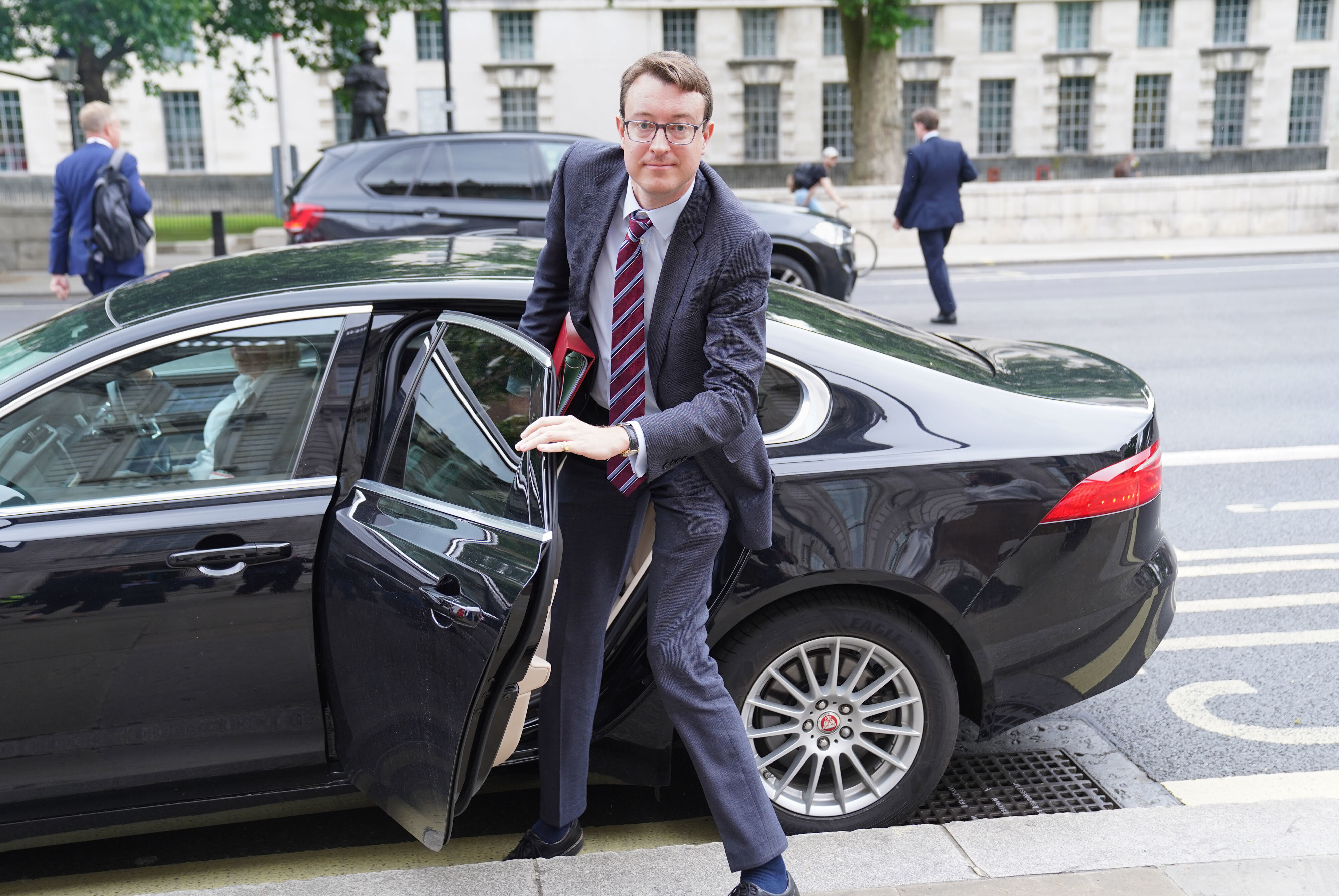
A cabinet minister and close Liz Truss ally has argued that the Conservatives have not had a “clear run” in power over the last decade.

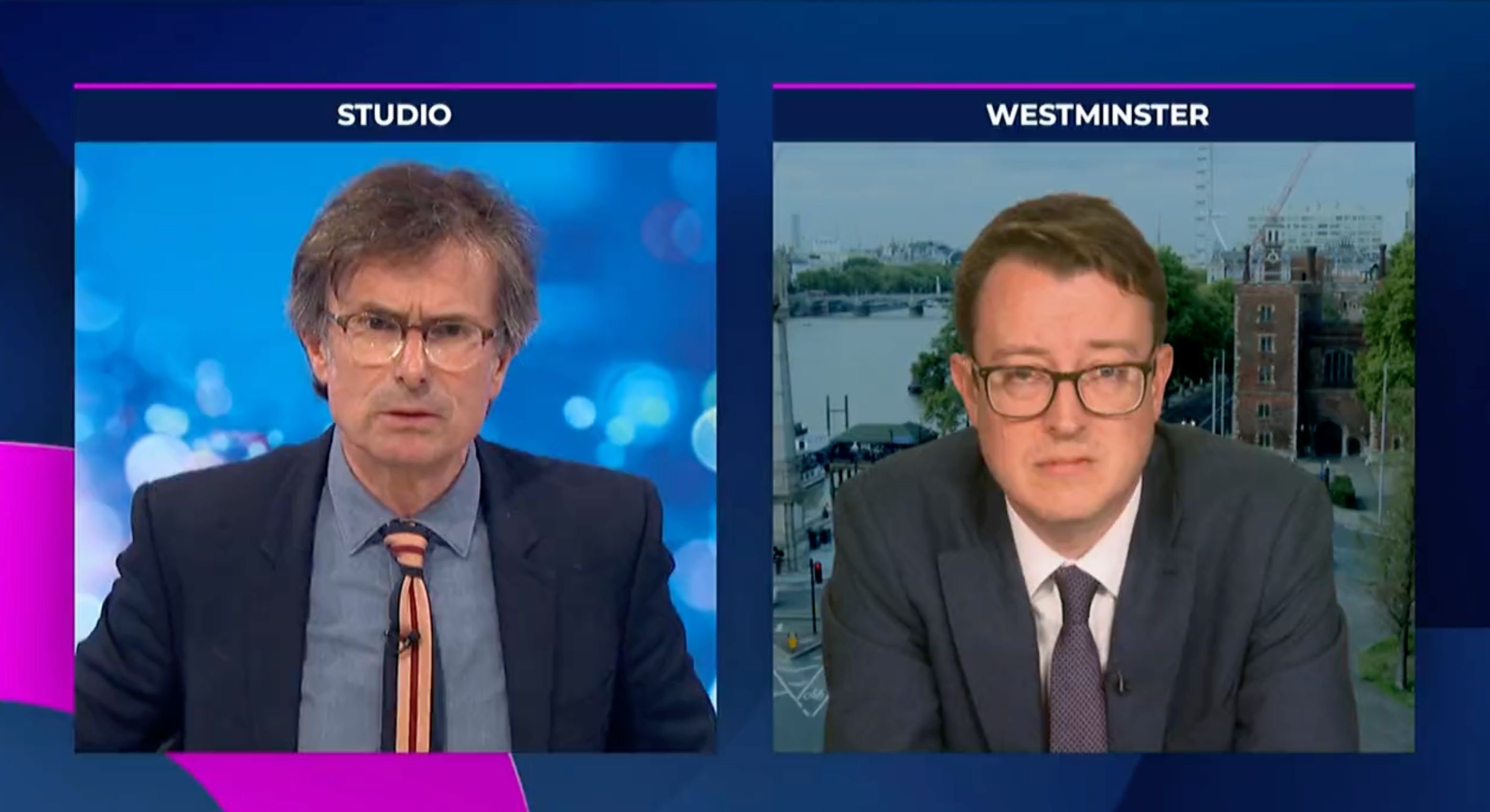
Appearing on ITV’s Peston programme, levelling up secretary Simon Clarke, a former top Treasury minister, said that no Conservative government “has had a clear run at events over the entire course of the last decade, it has been one crisis after another”.

Critics pointed to the fall-out from the Brexit referendum – which saw off two Tory prime ministers – as at least one self-inflicted crisis, and how tackling big events is the nature of governance.

Other disruption since the Tories came to power in 2010 includes the Cameron-Osborne austerity programme, the Covid-19 pandemic and Russia’s invasion of Ukraine.

His comment appeared to be a justification for moving to an “unashamedly pro-growth policy” under the Truss premiership.

Clarke added: “What Liz is saying is that we need to accept that we may not get back to normal, that if you like, that the world is in an extraordinary state of affairs at the moment and that being so, that we just need to press on and govern, frankly, as we want to be remembered – as a government that makes things better for people.

“And clearly as secretary of state for levelling up, my focus is on life chances, and on spreading opportunity. I’m delighted that we’re moving to an unashamedly pro-growth policy.”

Clarke also admitted the government’s economic policy is not “risk-free” as he said that the Tories wanted to go back to the growth rates seen before the financial crash in 2008, when Labour was in power.

At the the mini-budget on Friday, chancellor Kwasi Kwarteng is expected to put into practice many of the tax-cutting promises made by Truss during the Tory leadership campaign.

As well as reversing the hike in national insurance contributions and scrapping a planned increase in corporation tax, which Truss has promised, it has been reported he will cut stamp duty in a further attempt to drive growth.

On plans to lift the cap on bankers’ bonuses while millions feel the squeeze of the cost-of-living crisis, Clarke also said this would help level up “because there would be more revenue for the exchequer”.

Share Button

Despite Disagreements, Biden Tells Truss The UK Is ‘Our Closest Ally In The World’

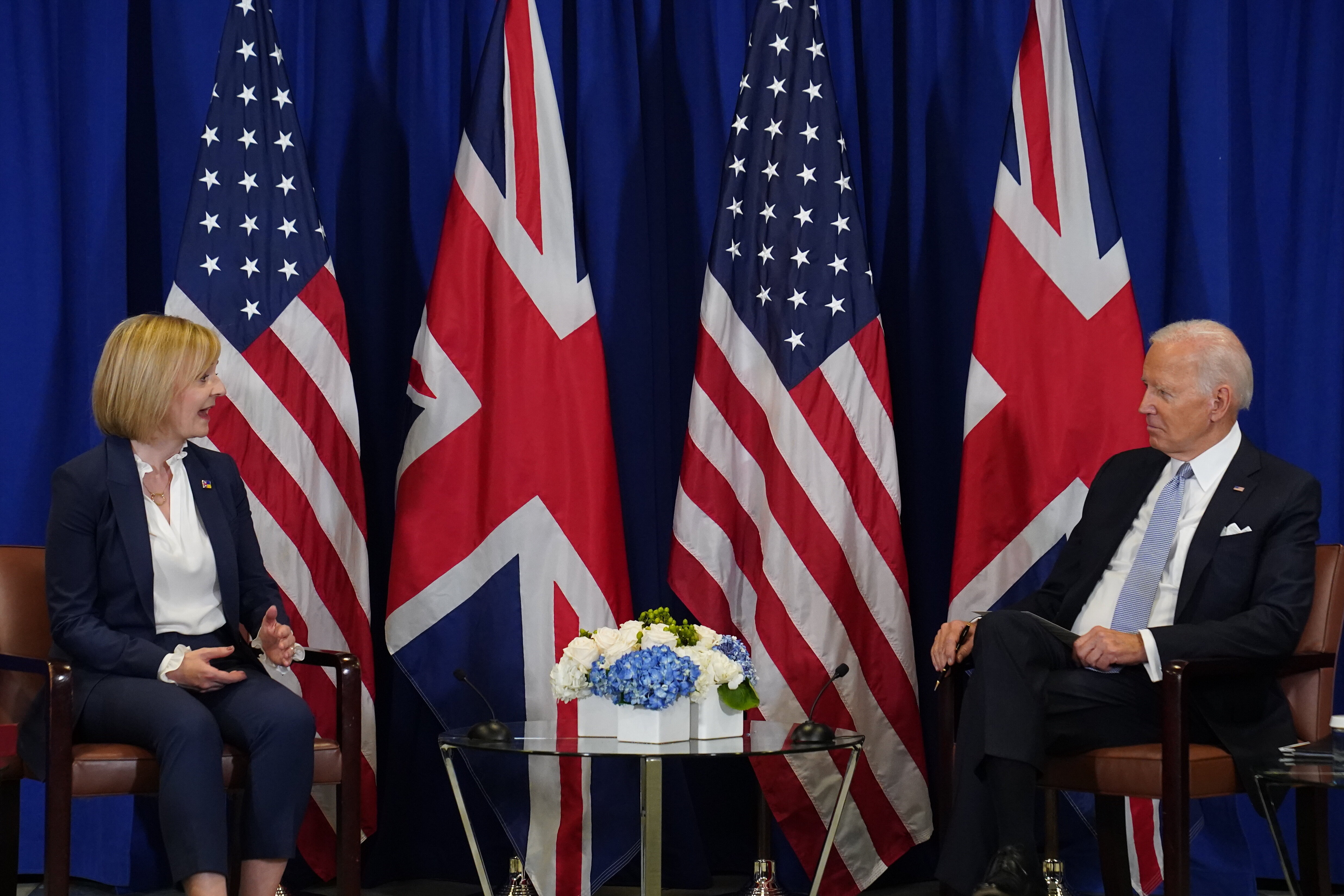
US president Joe Biden has told Liz Truss the UK is “our closest ally in the world”, despite sharp disagreements between the leaders of the two countries.

Ahead of a one-to-one meeting at the United Nations General Assembly in New York, Biden and the new UK prime ministers spoke to reporters before sitting down to talks centring on the Russian invasion of Ukraine and the energy crisis it has provoked.

Though Biden’s words were reassuring, the president told Truss he is “looking forward to hearing what’s on your mind” about the row over the Northern Ireland Protocol, which prevents a hard border on the island of Ireland, underlining tensions over post-Brexit arrangements.

The prime minister sought to reassure the US president by telling him how she would be explaining how the Good Friday Agreement that brought peace to the island would be upheld.

Biden and Truss were meeting after the president sent a tweet just as the PM was discussing her economic policy, which said he was “sick and tired of trickle-down economics”.

“It has never worked,” he said.

The comments underlined the differences between the two leaders’ stances after Truss made clear her economic agenda had the trickle-down theory – tax cuts for the wealthy and corporations will benefit everyone – at its heart.

The prime minister’s official spokesman said it was “ludicrous” to suggest Biden was criticising UK policy, arguing each country is facing different economic challenges.

The prime minister is pushing ahead with the controversial Northern Ireland Protocol Bill which the EU and other critics say will breach international law by suspending elements of the agreement.

There have also been suggestions she could unilaterally trigger Article 16 of the protocol, to override parts of the agreement brokered as part of the Brexit divorce deal.

In opening marks at the top of their meeting, the US president told Truss: “We are both committed to protecting the Good Friday Agreement of Northern Ireland.

“And I’m looking forward to hearing what’s on your mind.”

He congratulated her on becoming prime minister, adding: “I look forward to working closely with you. You’re our closest ally in the world and there’s a lot we can continue to do together.”

Truss told the president the UK and the US are “steadfast allies” as she thanked him for his support following the death of the Queen.

“Of course I’m looking forward to discussing the Belfast Good Friday Agreement and how we make sure that’s upheld into the future,” she added.

Biden said their “full agenda” for the meeting includes Ukraine’s defence against Vladimir Putin’s invasion, China and preventing Iran from obtaining nuclear weapons.

“We also want to talk about energy, which understandably is of significant consequence to all of Europe and the United Kingdom in particular,” he added.

US national security adviser Jake Sullivan made it clear Biden would discuss the protocol “in some detail” with Truss.

Sullivan told reporters the president “will encourage the UK and the European Union to work out an effective outcome that ensures there is no threat to the fundamental principles of the Good Friday Agreement”.

Share Button

New York Files Civil Suit Against Donald Trump And Three Of His Children

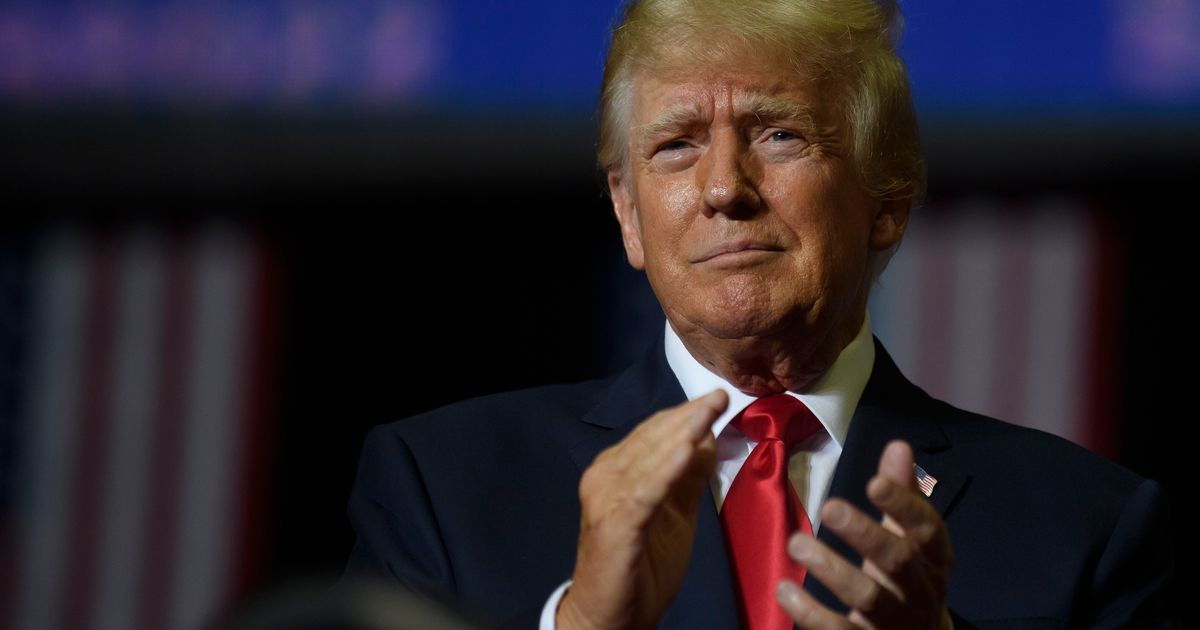
New York attorney general Letitia James announced Wednesday that she has filed a civil lawsuit against former president Donald Trump and his three eldest children over his long-running alleged tax-dodging scheme.

James hopes to convince a court to take steps to bar Trump, Donald Trump Jr, Ivanka Trump and Eric Trump from conducting business in the state of New York, along with making them pay a financial penalty and limiting access to loans.

“Donald Trump falsely inflated his net worth by billions of dollars to unjustly enrich himself and to cheat the system, thereby cheating all of us,” James said at a press conference outlining Trump’s alleged misconduct.

Prosecutors in New York have been looking into Trump’s real estate business practices for several years following reports that he routinely undervalued and overvalued assets to avoid paying his fair share of taxes. James said that “a comprehensive three-year investigation” involved millions of documents and interviews with 65 witnesses.

Her office is also making criminal referrals to federal prosecutors and the IRS, believing the Trumps to have violated federal law.

By shifting the valuation of his assets, Trump was allegedly able to convince banks to lend money to the Trump Organization on more favourable terms, to secure more favorable insurance arrangements and to pay lower taxes.

“White collar financial crime is not a victimless crime. When the well-connected break the law to take in more money than they are entitled to, it reduces resources to working people, to regular people, to small businesses and to all taxpayers,” she said.

James gave several examples: One asset in New York had been listed as being worth over 60 times what an appraiser had valued it. Mar-a-Lago, Trump’s South Florida golf resort, was estimated to be worth $75 million, but James said it had been “valued as high as $739 million” on documents her office reviewed.

“All told, we uncovered more than 200 examples of false and misleading asset valuations that were used on his statements,” James said, calling the pattern an “astounding” one.

She added: “It was a scheme that by its very nature became more profitable over time.”

The hefty lawsuit is around 280 pages long and contains details on 23 assets that were misvalued at various times.

Trump and his eldest children had all been deposed as part of James’ investigation, although Trump invoked his Fifth Amendment right to avoid self-incrimination more than 400 times.

The Trump camp was reportedly anticipating civil legal action, according to Bloomberg.

Share Button

6 Major News Stories That May Have Slipped Under Your Radar During National Mourning

The Queen’s death marked the end of an era for many in the UK, but that didn’t mean life stopped for the world.

While a few stories – such as the death of Chris Kaba, the ongoing cost of living crisis, and Liz Truss’ new cabinet – did get a look-in, the state funeral meant others slipped off the agenda.

So, as the country comes out of this period of national mourning, here’s a list of essential news stories you might have missed altogether over the last 11 days.

1. Community tensions soar in Leicester

Leicester is famous for its multicultural population, but a spate of clashes in recent weeks has shaken the city to its core.

Violence first broke out after the India vs Pakistan cricket match a month ago, on Sunday, August 28, and more scuffles followed in the next few weeks.

But, locals claim that the tensions began rising long before the match, with members of both the local Hindu and Muslim communities allegedly squaring up against one another, although the exact cause is still unclear.

The tensions seemed to come to a head on the night of September 17, when around 200 people – mainly masked or hooded men – gathered for an unauthorised protests in the east of the city.

All local officers available were called to the scene, and a stand-off followed, with police having to separate rival groups as they threw bottles at one another.

Police officers were even diverted from the Queen’s funeral in London to provide back up to the force in Leicestershire. They made 47 arrests in total and 16 officers were injured in the violence on Saturday night alone.

Claudia Webb, independent MP for Leicester East, said tensions had been simmering for “months”, and has previously claimed that some social media accounts were “preying on this unease” by “spreading misinformation”.

In a Twitter post, she wrote: “There are reports of incitement to hate being targeted at those of Muslim and Hindu faith, which is being shared on social media to cause fear.

“Places like Facebook and via WhatsApp designed to ‘entrap’ members of the local community to attend a protest, sparked by hate.”

She claimed such posts were “designed to provoke additional clashes and to cause disharmony and distrust”.

Mayor of Leicester Sir Peter Soulsby has said these recent events have left him “baffled”, while Labour MP for Leicester South, Jonathan Ashworth, said the troubles were a “dark episode” where he and residents “rightly pride ourselves on celebrating our diversity”.

Extremists, territorial rivalries and the influence of people from outside the city have all been blamed for supposedly inciting violence.

Webb also warned on Tuesday that the violence could spread beyond Leicester without central government intervention.

The Hindu and Muslim communities in Leicester released a joint statement two days after the violence at the weekend, saying: “We are from one family. We settled here in this city together, we fought the racists together, we build it up together. The recent violence is not who we are as a city.”

The Indian government has also released a statement, strongly condemning the violence.

“We have strongly taken up this matter with the UK authorities and have sought immediate action against those involved in these attacks.”

2. Mahsa Amini’s death

Protests have broken out across Iran’s capital Tehran, following the death of Mahsa Amini, a 22-year-old woman, last Friday.

She had been in a coma for three days after “morality” police held her for supposedly breaking hijab rules. She was detained outside a Tehran metro station, as part of the police’s clampdown on clothing.

Witnesses said officers beat her inside a police van which later took her to a detention centre, although police brigadier-general Hossein Rahimi dismissed such claims as “cowardly accusations”.

Police also claimed that Amini had suffered from “sudden heart failure” while at the detention centre where she was to be “educated” with other women.

The authorities later released footage showing a woman they claim is Amini talking to a female official, who had tried to reach for her clothing. Amini then holds her head with her hands and falls to the floor.

The police, who described her death as “unfortunate”, said that Amini had “previous physical problems”, but her father denied such a claim, and claimed the CCTV footage is edited.

In protest to Amini’s death and the strict regime of Iran, women have since been seen removing their headscarves and cutting their hair while shouting “death to the dictator”, in what is believed to be a reference to the country’s supreme leader, Ayatollah Ali Khamenei.

Demonstrations in Tehran and western Iran over the weekend reportedly led to the death of two people during a clash with riot police.

Protests in Saqez, a western part of Iran, led security forces to allegedly open fire on a crowd as they tried to move towards the local governor’s office.

Further demonstrators took place in Kurdistan’s capita, Sanandaj. Amini was an ethnic Kurd from Saqez.

3. Hurricane Fiona

A devastating storm, Hurricane Fiona, has swept across parts of the Caribbean in recent weeks – and it doesn’t look like it’s going to slow down any time soon.

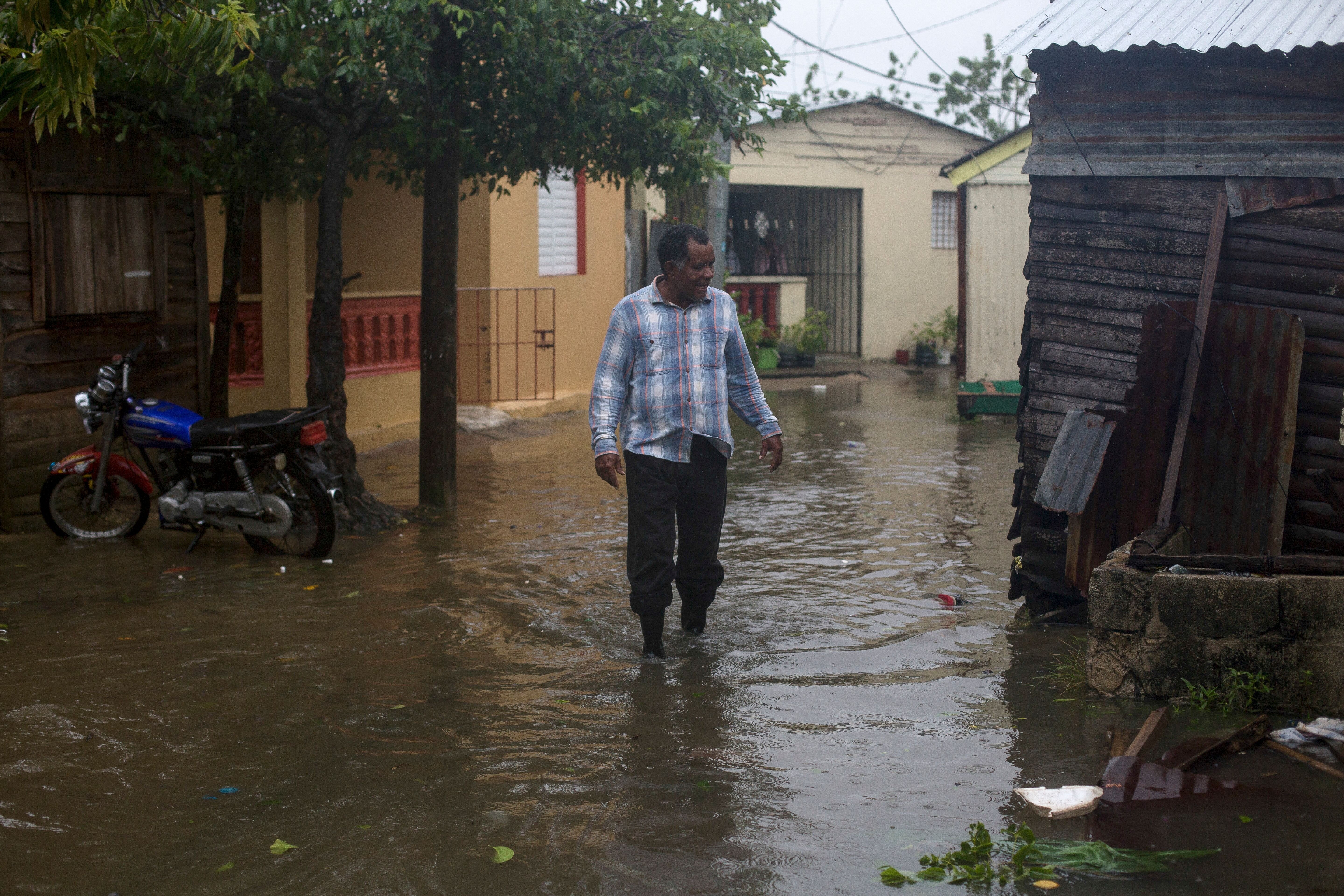
Residents on the Turks and Caicos Islands were urged to seek shelter on Tuesday, after Fiona had already wrecked havoc in Puerto Rico and the Dominican Republic. The hurricane is expected to reach the southern Bahamas too, and the eastern Bahamas by Wednesday.

In Puerto Rico, the storm killed at least three people and caused significant flooding with more than 75cm of rain falling.

It also caused a total blackout which isn’t expected to be fixed any time soon, especially as the territory is still struggling with its power grid after the brutal category 5 storm, Hurricane Maria, which knocked out 80% of power lines in 2017.

The weather in the US territory was still chaotic on Monday, with frequent lightning and rain. Torrential rain and wind then hit the Dominican Republic too, and it now seems to be building up in power.

The category 2 storm is expected to become a category 3 with winds beyond 111mph, which will make it the first “major hurricane” of the 2022 season, according to the National Hurricane Centre. By the time it reaches the eastern Bahamas, it could be category 4.

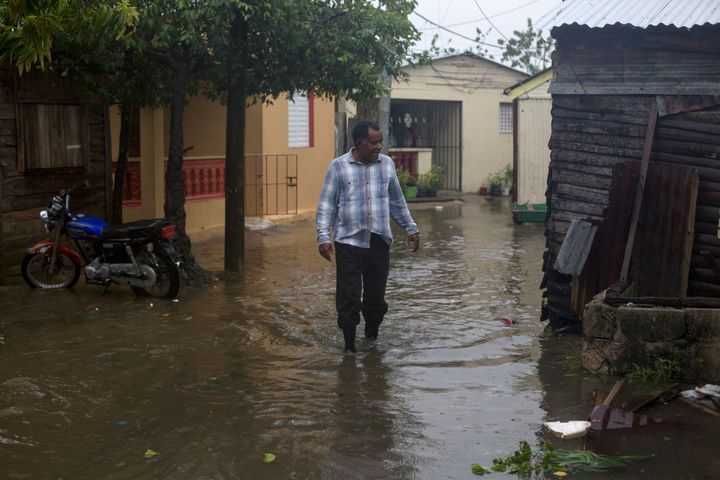
A man wades through a flooded street in Nagua, Dominican Republic, on September 19

ERIKA SANTELICES via Getty Images

4. Typhoon Nanmadol

At least two people were killed as record winds and rain hit the west of Japan on Monday.

Prime minister Fumio Kishida even delayed his flight to New York for the UN General Assembly so that he could look at the damage of the 14th typhoon Japan has faced this season.

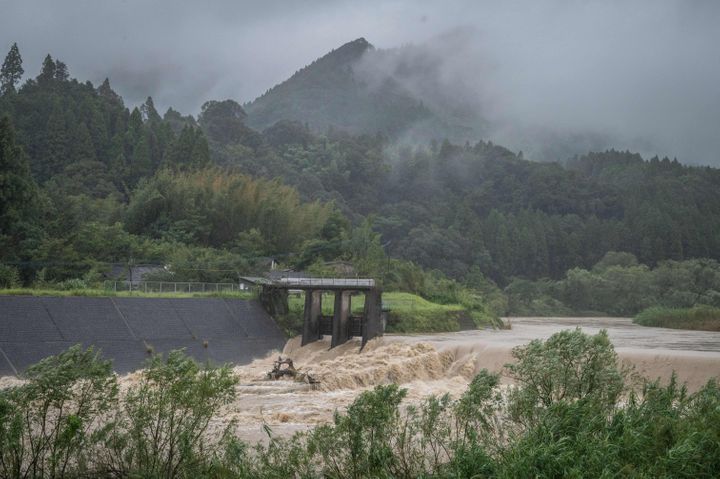
There was major landfall near Kagoshima city on Sunday, before it hit the islands of Kyusha and Honshu, while rivers overflowed and roofs were ripped off by the strong wind.

“We need to remain highly vigilant for heavy rains, gales, high waves and storm surges,” a Japanese Meteorological Agency official said, according to Reuters news agency. At least 115 people have been reported injured and around 340,000 households lost power.

Water flowing along the Sendai River in the wake of Typhoon Nanmadol in Ebino, September 19

YUICHI YAMAZAKI via Getty Images

5. Putin moves submarines away from Crimea – but nuclear fears continue

Russian president Vladimir Putin has allegedly moved the country’s submarines away from the annexed peninsula Crimea.

As Crimea was seized by Russia in 2014 (and seen by some as the start of Russia’s war against Ukraine), it was thought to be secured under Moscow’s rule.

But, as the UK’s defence ministry tweeted on Tuesday, Russia’s Black Sea Fleet “has almost certainly relocated” its submarines from Crimea to southern Russia.

The officials explained: “This is highly likely due to the recent change in the local security threat level in the face of increased Ukrainian long-range strike capability. In the last two months, the fleet headquarters and its main naval aviation airfield have been attacked.

“Guaranteeing the Black Sea Fleet’s Crimea basing was likely one of Russian president Vladimir Putin’s motivations for annexing the peninsula in 2014. Base security has now been directly undermined by Russia’s continued aggression against Ukraine.”

It comes after Ukraine’s highly successful counteroffensive which has reclaimed large swathes of land from Russia in the north-east.

“The occupiers are clearly in a panic,” Ukrainian president Volodymyr Zelenskyy claimed on Monday.

Russia has also sparked fears of a nuclear war once again, after a missile exploded less than 900 feet from reactors of the South Ukraine Nuclear Power Plant, the second largest nuclear plant in the country.

This is separate to the worries around the Zaporizhzhia power plant, which sits on the frontline of the fight between Ukraine and Russia.

The South Ukraine plant is far from the frontline, but the attack demonstrates the extent of Russia’s reach (if it did indeed come from Moscow).

Still, there was no damage to safety equipment, and the exact source of the explosion could not be independently confirmed.

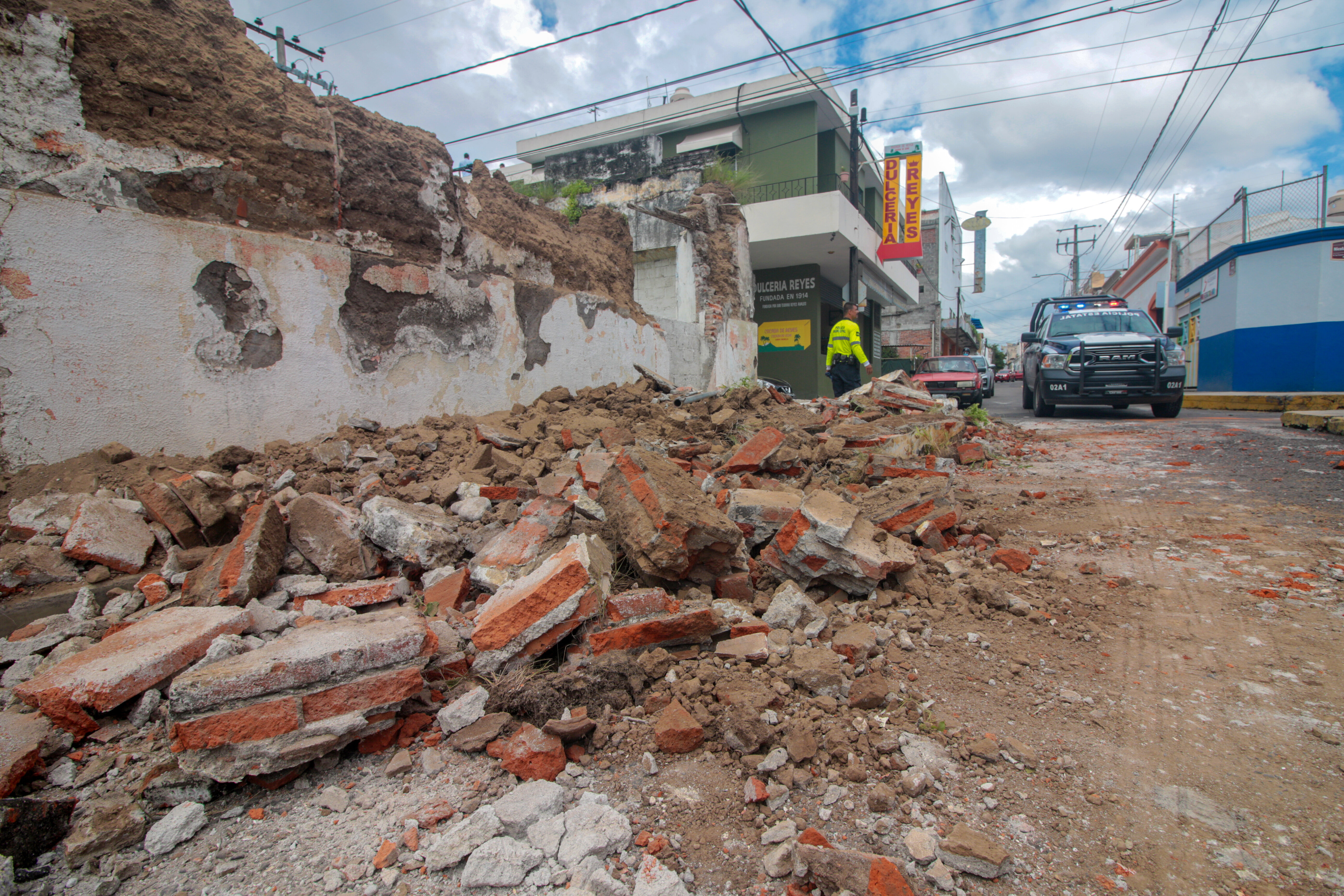
6. Mexico earthquakes

On the anniversary of two other significant earthquakes, dating back to 1985 and 2017, Mexico was hit by yet another earthquake which killed at least two people.

The National Autonomous University of Mexico said there is no scientific explanation for why all three quakes would happen on the same day.

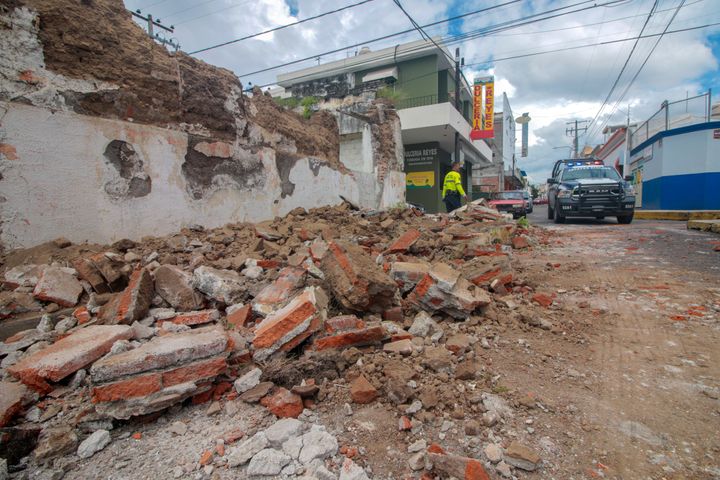
A 7.6 magnitude hit western Mexico on Monday, knocking out power and leaving people in Mexico City desperately seeking safety.

Hospitals were damaged, and other buildings collapsed onto the people within.

The US Pacific Tsunami Warning Centre also issued a warning for coastal areas, saying waves reaching up to three metres above the tide level were possible.

The September 19, 1985 earthquake killed thousands, and more than 350 died in September 19, 2017.

 A view of damaged buildings aftermath of 7.6 magnitude earthquake in Colima, Mexico, on September 19.
A view of damaged buildings aftermath of 7.6 magnitude earthquake in Colima, Mexico, on September 19.

Anadolu Agency via Getty Images

Share Button

Nadine Dorries Stuns Twitter By Deleting Her Account

Nadine Dorries has stunned Twitter by appearing to delete her account.

The former culture secretary sparked numerous rows with controversial posts attacking her political opponents.

But visitors to her Twitter feed were today greeted with the message: “This account doesn’t exist.”

Nadine Dorries appears to have deleted her account.

The surprise move comes just two weeks after the Mid Bedfordshire MP – a staunch ally of Boris Johnson – quit the cabinet.

New prime minister Liz Truss had offered her the chance to retain her digital, culture, media and sport brief, but she decided to leave the government amid speculation she could be made a peer in Johnson’s resignation honours list.

Dorries had earned a large Twitter following thanks her pugnacious approach to defending her political views.

In July, she sparked a full-scale Tory civil war over her attacks on Truss’s leadership rival, Rishi Sunak.

Attacking the multi-millionaire former chancellor’s expensive wardrobe, Dorries tweeted: “Liz Truss will be travelling the country wearing her earrings which cost circa £4.50 from Claire’s Accessories.

“Meanwhile…Rishi visits Teeside in Prada shoes worth £450 and sported £3,500 bespoke suit as he prepared for crunch leadership vote.”

It forced her Tory colleague Angela Richardson MP to respond: “FFS Nadine! Muted.”

The same month, she retweeted an image which showed Sunak as Brutus stabbing Boris Johnson as Brutus in the back in the back.

Dorries’s decision to delete her account drew astonishment from Twitter users.

Although others believe it may be linked to her impending elevation to the House of Lords.

Share Button

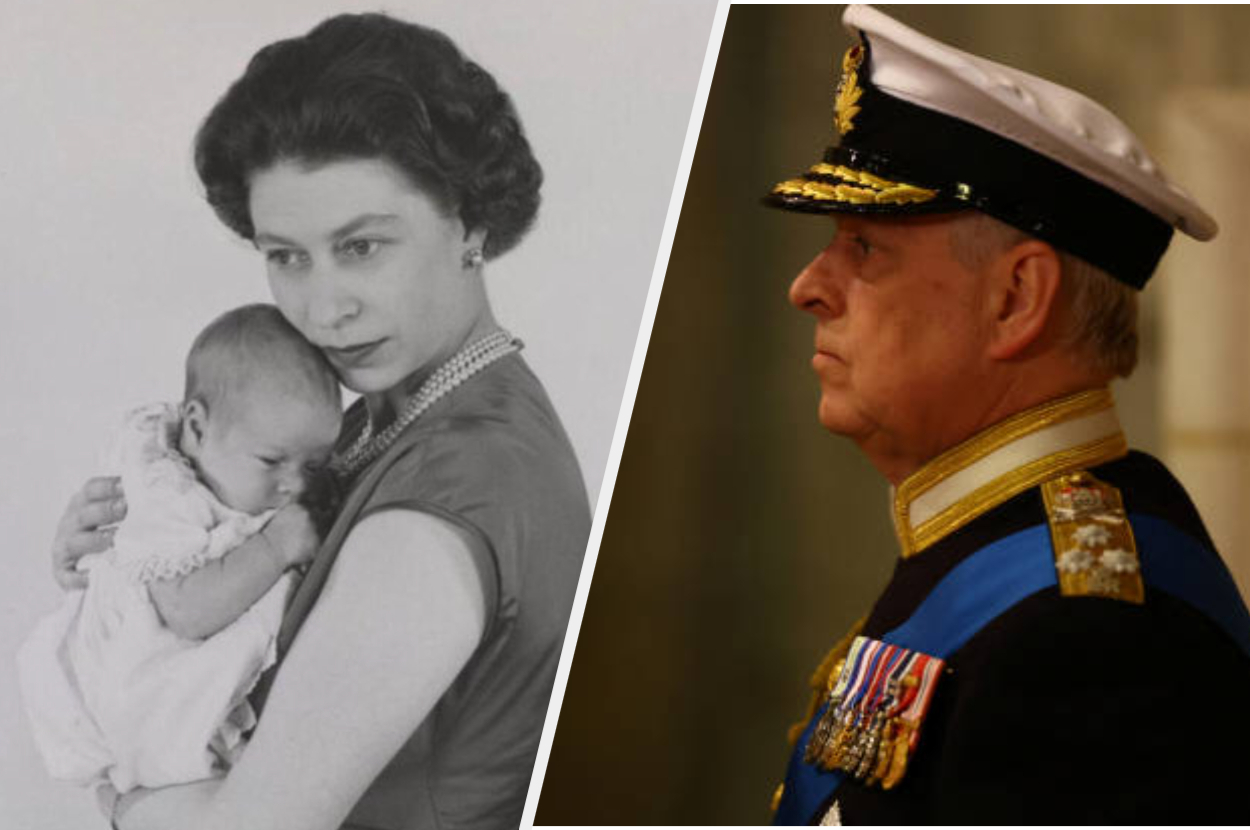
Prince Andrew Pays Tribute To Queen’s ‘Compassion’ And ‘Love For A Son’

Prince Andrew has paid tribute to the Queen, saying he will “treasure forever” her “love, compassion and care”.

The Duke of York, who stepped down from public life in 2019 over his friendship with paedophile billionaire Jeffrey Epstein, said he would miss the Queen’s “insights, advice and humour”.

He described his late mother as “Mummy, Mother, Your Majesty, three in one” and said it had been an “honour and privilege” to serve her.

In his tribute, Andrew said: “Mummy, your love for a son, your compassion, your care, your confidence I will treasure forever.

“I have found your knowledge and wisdom infinite, with no boundary or containment.

“I will miss your insights, advice and humour.

“As our book of experiences closes, another opens, and I will forever hold you close to my heart with my deepest love and gratitude, and I will tread gladly into the next with you as my guide.

“God Save The King.”

Prince Andrew’s appearance during the 10 days of national mourning has caused unease for some due to the nature of his decision to step back from public life.

Earlier this year, the Duke of York paid millions to settle a civil sexual assault case against Virginia Giuffre, who accused the prince of sexually assaulting her when she was 17 after she was trafficked by Epstein.

Prince Andrew denied the claims and said he had never met Guiffre.

Ahead of the legal settlement, the Queen stripped her son of all of his honorary military roles, including Colonel of the Grenadier Guards. He also gave up his HRH style.

Due to the fact that he is no longer a working royal, the Duke of York is no longer permitted to wear uniform during the ceremonial events marking the Queen.

Earlier in the week, he wore a morning suit while marching behind his mother’s coffin.

However, he received a special exception allowing him to wear military uniform for the Queen’s vigil on Friday.

On Monday a man was arrested and charged with breach of the peace for “shouting abuse” at Prince Andrew during the procession carrying the Queen’s coffin down the Royal Mile in Edinburgh.

Videos on social media showed a man shouting at the duke as he walked behind the hearse on Monday, before being dragged to the ground by two bystanders.

The man was subsequently arrested and was released by police on an undertaking to appear at court at a later date.

Share Button

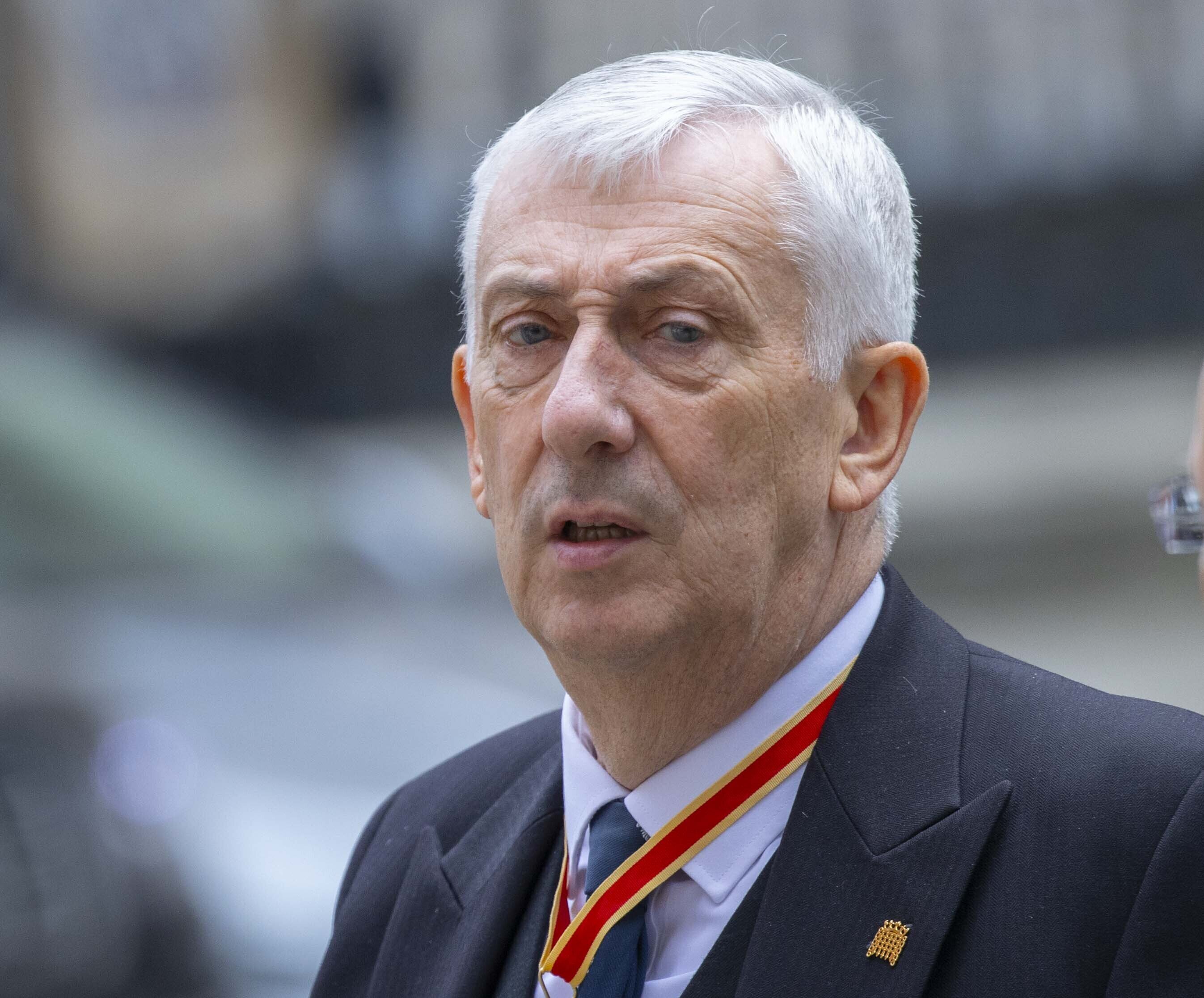
Lindsay Hoyle Says Queen’s Funeral Is ‘The Most Important Event The World Will Ever See’

Commons Speaker Sir Lindsay Hoyle has said a political row with China should not “overshadow” the Queen’s state funeral, which he described as the “most important event the world will ever see”.

Hoyle made the comment after he denied he had been “leant on” to allow Chinese officials to attend the Queen’s lying-in-state at Westminster Hall.

Politico reported earlier in the week that the group from Beijing had been refused permission by the Commons authorities to attend the lying-in-state after Hoyle intervened.

There have been tensions between Westminster and China ever since the country imposed sanctions on MPs who have spoken out against the alleged human rights abuses against the Uyghur people in Xinjiang.

Initially it was understood that a Chinese delegation would be able to attend the funeral but that they would not be permitted access to the lying-in-state.

However, there has been confusion after a parliamentary spokesman said on Saturday that foreign representatives “invited to attend the state funeral in Westminster Abbey are also invited to attend the lying in state”.

It led to Iain Duncan Smith, one of the MPs sanctioned by China, claiming in the Telegraph that the “establishment” had “leant” on Hoyle to force him to admit a Chinese delegation into Westminster Hall.

“It’s clear and obvious that the establishment leant on the Speakers to give way,” he told the newspaper.

“The people that win at the end of the day, are the Chinese Communist party which is a brutal, dictatorial and anti-human rights organisation and all we’ve done is given them another victory.

“It looks like appeasement is back, alive and well in the British establishment.”

But today Hoyle denied that he had been “leant” on and said the Chinese ambassador and accredited officials remain barred from the House of Commons.

Hoyle told BBC’s Sunday With Laura Kuenssberg: “Nobody has been leaning on me at all. Far from it.

“My view remains the same, that we would not welcome a reception in parliament. And that’s when I stopped the ambassador and accredited Chinese from coming into the House of Commons.

“So let’s be clear, to hold a reception in the House of Commons when MPs and a peer has been sanctioned is not acceptable. My view remains the same and nothing has changed.

“The sanction against those accredited officials remains in place and will remain so.”

Trying to take the heat out the row, Hoyle said: “We should not allow anything to overshadow the most important event the world will ever see — and that’s the funeral of her Majesty”.

He added: “The passing of her Majesty has brought people together, so we shouldn’t be distracted by others, and I think that’s the problem that we’re seeing.

“People always want a different story and a different angle. What I want to do is keep focused — this is about the royal family, this is about their grief, this is about the people of this country coming together to pay their respects.”

Earlier in the week, a group of MPs and peers sanctioned by China expressed serious concerns about the Chinese government being invited to the Queen’s funeral.

In a letter to Hoyle and Lord Speaker, Lord McFall, Tim Loughton and Iain Duncan Smith said it was “extraordinary” that Chinese representatives had received an invitation.

The letter read: “Given that the United Kingdom parliament has voted to recognise the genocide committed by the Chinese government against the Uyghur people it is extraordinary that the architects of that genocide should be treated in any more favourable way than those countries who have been barred.”

Last September, Hoyle and Lord McFall blocked the Chinese ambassador to the UK, Zheng Zeguang, from visiting parliament.

At the time Hoyle argued that it would not be “appropriate” for the ambassador to meet at the Commons while seven British parliamentarians remain sanctioned.

It is understood the Chinese ambassador is still not welcome in parliament.

Chinese president Xi Jinping is not scheduled to attend the Westminster Abbey service on Monday and will instead send his deputy, Wang Qishan, instead.

Invitations to the Queen’s state funeral have also not been sent to Russia, Belarus or Myanmar, while Iran will only be represented at an ambassadorial level, it is understood.

Share Button